Video Object Retrieval from Unstructured Big
Data Using Hidden Markov Model
N.Preetha, A.Kalaiselvi,
PG Student, Department of Computer Science & Engineering, IFET College of Engineering, Villupuram, Tamilnadu,
India
Assistant Professor, Department of Computer Science & Engineering, IFET College of Engineering, Villupuram,
Tamilnadu, India
ABSTRACT: Big data is the collection of both structured and unstructured data that is so large and fast moving. Unstructured data is heterogeneous and variable in nature and comes in many formats including text, document, image, video, and so on. Videos especially surveillance videos forms the highest source of unstructured big data. The videos are stored in various compression formats and extracting images from these videos is a complex task. Foreground extraction is performed to extract images from videos only in HEVC compression format. In the proposed model, objects can be extracted efficiently from videos having different formats by using Hidden Markov Model (HMM). Hidden Markov Model is probabilistic method and provides accurate results during object retrieval from videos.
KEYWORDS: HMM, Unstructured big data, CTU, Surveillance video.
I. INTRODUCTION
Big data is a broad term for data sets so large or complex that traditional data processing applications are
inadequate. Massive amount of data comes from sensors that are used to gather climate information, posts to social
media sites, digital pictures and videos, purchase transaction records, and cell phone GPS signals etc. [1]. This huge amount of the data is known as “Big data”.
Big data describe an enormous volume of both structured and unstructured data that is so huge that it's complicated to process using traditional database and software techniques. Big data includes several challenges. The challenges include analysis, capture, data duration, search, sharing, storage, transfer, visualization, and information privacy.
Big data refer to huge data sets characterized by larger volumes (by orders of magnitude) and greater variety
and complexity, [2] generated at a higher velocity. These three key characteristics are described as the three Vs of big data.
The volume describes the massive scale and growth of unstructured data outpaces traditional storage and analytical solutions.
Big data are collected from new sources that haven’t been mined for insight in the past. Traditional data management processes can’t cope with the heterogeneity and variable nature of big data, [2] which comes in formats as different as email, social media, video, images, blogs, and sensor data—as well as “shadow data” such as access journals and Web search histories.
Data is generated in real time with demands for usable information to be served up as needed describes the velocity in big data. Unstructured data from video demand much more attention in the current Big Data market.Digital devices that generate millions of pixels in a flash are in the pockets of billions of people worldwide.[3] Online video archiving systems such as YouTube, where users upload 100 hours of video every minute.
cameras for caring for kids or seniors, and those embedded in laptops and on the front and back sides of mobile phones. All of these cameras are capturing huge amounts of video and feeding it into cyberspace daily.
Surveillance-video big data introduce many technological challenges, including compression, storage, transmission, analysis, and recognition.[5] Among these, the two most critical challenges are how to efficiently transmit and store the huge amount of data, and how to intelligently analyze and understand the visual information inside. The videos are stored in various compression formats and extracting objects from these videos is a complex task. So, it requires an effective and standard technique for object retrieval.
II. RELATED WORK
We review related work in this section some of these are referred to in more detail depending on the context.
A. Real-time Analysis of Surveillance ‘Big’ Data
Surveillance video is the biggest source of unstructured Big Data, the emergence of high-efficiency video coding (HEVC) standard is poised to have a huge role in lowering the costs associated with transmission and storage.[6] An efficient approach to foreground extraction/ segmentation is done using novel spatio-temporal decorrelated block features extracted directly from the HEVC compressed video.
The method exploits coded bitstream semantics to unlock object motion/activity patterns. A widespread commercial deployment of HEVC is clearly imminent, the proposed method brings a tremendous potential to connect the computational power of integrated capturing and encoding devices.
Foreground objects are extracted using novel CTU features of the HEVC compressed video. [6]This method exploits the fact that compressed HEVC video is essentially a source of highly de-correlated data having two features that sufficiently describe each CTU block. They have qualitatively and quantitatively evaluated against several other state-of-the-art methods.
In the fast developing environment, videos can be stored in various compression formats but HEVC format alone is considered for extraction. To overcome this problem in future work we plan to use a common approach for image extraction from videos having multiple formats.
B. Real-time Unstructured Big Data Analysis Framework
The volume of data is incredibly growing so, a novel framework for real-time unstructured big data analysis, such as a movie, sound, text and image data have been designed. [7] The real-time data mining method which collects data as a transaction and find frequent events or patterns of many transactions can be applied to the real-time big data analysis.
A novel framework method has been used for the real-time analysis of unstructured big data such as video, image, sounds and text. [7] This framework analyzes the big data using CEP engine and uses CQL to modify the analysis conditions in real-time without re-executions of the system. In addition, it provides functions to manage several distributed analysis systems using the method of CQL management easily.
Though it appeared to be efficient, problem arises in usage of CEP engine. CEP engines don’t handle adapter management or subscription handling mechanisms. CQL cannot support join and sub query. Large result evaluation consumes more time.
Future work will aim to overcome this problem by using an effective object retrieval technique for unstructured big data.
C. C-means Clustering Algorithm
An image change detections is a process to determine how two different images of the same scene taken at different time. [8] The change detection is highly applicable for no of applications like remote sensing, medical diagnosis and video surveillance.
fusion techniques and C-means clustering algorithm. [8] The image fusion technique is applicable to determine image differences by using complementary information images. The C-means clustering algorithm is used for classifying changed and unchanged regions in between the two images.
This algorithm can be used for efficient extraction of images, but the problem with this algorithm is that the apriori specification of clusters must be provided and it can provide better result with lower number of termination criteria but the number of iteration increases. The problem with C-means clustering algorithm can be prevailed over by the usage of Hidden Markov Model in future work.
D. Hidden Markov Model
Author presented a brief description about Hidden Markov model, its working and applications. Moreover, it provides the advantage of using this technique in our project. [9] HMM is defined as a doubly stochastic process with an underlying stochastic process that is not observable (it is hidden), but can only be observed through another set of stochastic processes that produce the sequence of observed symbols. HMM consist of a finite number of states, clock time and observation symbol is made according to a probability distribution.
E. Background Subtraction in Urban Traffic Video
Identifying moving objects from a video sequence is a critical task.[10] A common approach is to perform background subtraction, which identifies moving objects from the portion of a video frame that differs significantly from a background model.
There are many challenges in developing a good background subtraction algorithm. First, it must be robust against changes in illumination. Second, it should avoid detecting non stationary background objects such as swinging leaves, rain, snow and shadow cast by moving objects. Finally, its internal background model should react quickly to changes in background.
Various background subtraction algorithms are compared for detecting moving vehicles and pedestrians in urban traffic video sequences. [10] Five Specific algorithms are tested on urban traffic video sequences which include frame differencing, adaptive median filtering, median filtering, mixture of Gaussians, and Kalman filtering. The algorithms discussed are inefficient against environment noise and sudden change of illumination. So, we try to implement Hidden Markov model for effective object retrieval.
III. PROPOSED SYSTEM
The proposed system aims to retrieve video objects from unstructured big data. Unstructured data is heterogeneous and variable in nature and comes in many formats. Objects are extracted from videos having HEVC compression formats. The videos are stored in various compression formats and extracting objects from these videos is not a simple task. The objects are retrieved efficiently and accurately from videos of different format using Hidden Markov Model.
a) Hidden Markov Model
HMM is defined as a doubly stochastic process with an underlying stochastic process that is not observable (it is hidden), but can only be observed through another set of stochastic processes that produce the sequence of observed symbols.
N
j
i
a
S
q
S
q
P
S
q
S
q
S
q
P
ij i t j t k t i t j t
,
1
|
,...
,
|
1 2 1State transition coefficients have the property
N j ija
11
The above stochastic process could be called an observable Markov model since the output of a process is the set of states at each instant of time, where each state corresponds to a physical event.
b) Elements of Hidden Markov Model
The number of states of the model (N), the number of distinct observation symbols per state (M) and the state transition probability distribution A={aij}
)
|
(
t j t 1 iij
P
q
S
q
S
a
The observation symbol probability distribution in state j;
)
|
(
)
(
k t jj
k
P
V
at
t
q
S
b
The initial state distribution
)
(
1 ii
P
q
S
The most general representation of the PDF is a finite mixture of normal distributions with different means and variances for each state.
N
j
U
O
C
O
b
jm jmM m jm j
1
)
,
,
(
)
(
1
Where Cjm is mixture coefficient for the m’th mixture in state j and is Guassian with mean jm and covariance matrix Ujm for the m’th mixture component in state j.
IV. SYSTEM ARCHITECTURE
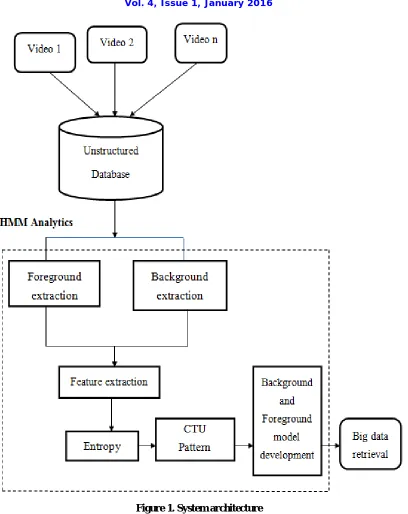
The overall architecture which describes the object retrieval from videos having different formats is shown in figure1. Unstructured database is the collection of videos having different formats. The query is to extract some objects from any of these videos. To retrieve the required object, Hidden Markov Model (HMM) operation is performed.
Foreground extraction and Background extraction are interrelated. The required objects are extracted from the video frames and its values are analysed with the help of feature extraction. The uncertainties like color differentiation, redundancies among the pixels are measured by entropy.
The extracted values are analysed finally by Coding Tree Unit (CTU). CTU maintains the details of each color component. Based on the values of coding tree unit efficient background and foreground model is developed.
Figure 1. System architecture
V. SYSTEM DESIGN
A. Pre-processing
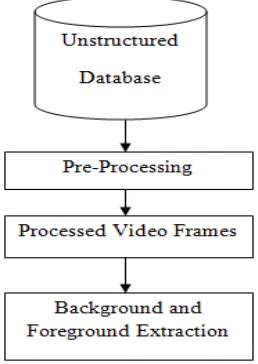
Unstructured data from a database cannot be processed directly. The performance can be improved by removing noise and insignificant features. So, pre-processing is required. The pre-processing of unstructured data is shown in Figure 2.
Figure 2. Pre-processing
Unstructured data are pre-processed and the variations are extracted and classified by the classifier.Videos having different formats are sent to the pre-processor for video frame analysis. The unstructured video frames are classified based on their formats by the classifier and they are sent for further process.
B. Foreground and Background Extraction
Foreground extraction is an image processing technique where an image's foreground is extracted for further processing. An image's region of interest are objects (humans, cars, etc.) in its foreground. Foreground extraction is performed by analyzing the processed video frames. The process of Foreground extraction is shown in Figure 3.
Background extraction is performed in case when location is required. The process is shown in Figure 4.The required object can be retrieved from videos only by performing both background and foreground extraction.
Foreground and background extraction are interrelated. During the analysis process both foreground and background are analyzed. A required object cannot be extracted without performing background analysis.
C. Generation of CTU Pattern
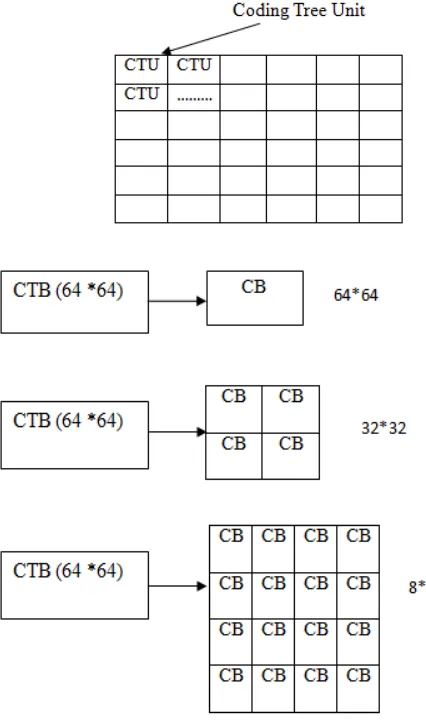
The image is divided into coding tree unit to analyze the values. It maintains the details of each color component. The width and height of CTU are signalled in a sequence parameter set, meaning that all the CTUs in a video sequence have the same size.
CTU – Coding Tree Unit is therefore a logical unit. It usually consists of three blocks, namely luma (Y) and two chroma samples (Cb and Cr), and associated syntax elements. Each block is called CTB (Coding Tree Block).Its analysis is shown in Figure 4.
The Pixel components are processed as follows:
Figure 4. Analysis of Coding Tree Block
D. Background And Foreground Model Development
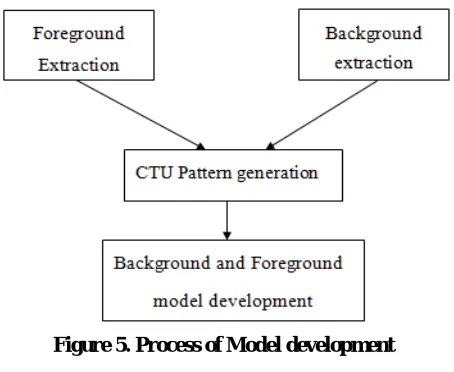
Coding Tree Unit foreground and background model are developed. Once the model is developed required object is extracted and provided to the user. Figure 6 describes the process of foreground and background model development.
Figure 5. Process of Model development
VI. CONCLUSION AND FUTURE WORK
The amount of data that is being created and stored on a global level is almost unimaginable and it just keeps growing. The amount of structured, semi structured and unstructured data increases day by day. In a big data environment unstructured data occupies a greater percentage than structured one. The major part of unstructured big data consists of videos. It faces lots of challenges from analysis to processing. Retrieving the objects from videos having different formats is a complex task. The complexity in object retrieval can be reduced effectively by using Hidden Markov Model. This model is based on probability and provides accurate results during extraction. It also increases the efficiency during object extraction from videos. The implementation details and performance metrics of Hidden Markov Model for object retrieval from videos having different formats will be discussed in future.
REFERENCES
[1] Abu Bakar Munir, Siti Hajar Mohd Yasin and Firdaus Muhammad-Sukki, “Big Data: Big Challenges to Privacy and Data Protection”, International Journal of Social, Behavioral, Educational, Economic and Management Engineering Vol.9, No: 1, pp.1-4, 2015.
[2] David Turner, Michael Schroeck and Rebecca Shockley, “Analytics: The real-world use of big data”, IBM global business services, pp.3-18, October 2012
[3] Chunsheng Fang, “Large-Scale Video Analytics on Hadoop”, August 12, 2013. [Blog entry]. Pivotal’s Blog. Available http://blog.pivotal.io/data-science-pivotal/features/large-scale-video-analytics-on-hadoop [Accessed 20 October 2015].
[4] Jeff Bertolucci (2013, 28.January), “Video Surveillance Feeds Big Data”, Information week [online]. Available: http://www.informationweek.com/big-data/big-data-analytics/video-surveillance-feeds-big-data. [Accessed 19 October 2015].
[5] James Manyika, Michael Chui, Brad Brown, Jacques Bughin, Richard Dobbs, Charles Roxburgh, Angela Hung Byers,“Big data: The next frontier for innovation, competition, and productivity” McKinsey Global Institute, pp.20-68, May 2011.
[6] Bhaskar Dey and Malay K. Kundu, “Efficient foreground extraction from HEVC Compressed video for application to real-time Analysis of surveillance ‘big’ data” , IEEE Transactions on Image Processing, Vol. 24, No. 11, pp.3576-3584, November 2015.
[7] Jaein Kim, Nacwoo Kim, Joonho Park, Kwangik Seo, Hunyoung Park, “Real-time Unstructured Big Data Analysis Framework”, International Conference on ICT Convergence, pp.519-522, October 2013.
[8] T.A.Pawar, “Change Detection Approach for Images Using Image Fusion and C-means Clustering Algorithm”, International Journal of Advance Research in Computer Science and Management Studie, Volume 2, Issue 10, October 2014.
[9] L.R.Rabiner, B.H.Juang, “An Introduction to Hidden Markov Models”, IEEE ASSP Magazine , pp.2-8, January 1986.