context of Mathematical Problem Solving: A multi-case study. (Under the direction of Allison W. McCulloch).
The ability to succeed in Science, Technology, Engineering, and Mathematics (STEM) careers is contingent on a student’s ability to engage in mathematical problem solving. As a result, there has been increased focus on students’ ability to think critically by providing them more with problem solving experiences in the classroom. Much research has been conducted on mathematical problem solving, beginning with Polya’s (1945) seminal work. Subsequent work has extensively studied factors that influence students’ success in problem solving. However, there is a need to accumulate this research so that it can be successfully connected to practice. One way to accomplish this is to develop an overarching problem solving theory. Schoenfeld (2011) developed such a theory and attributes an individual’s goals (personal aims to achieve), resources (knowledge available), and orientations (beliefs, values) as influential factors in the decisions made during any goal-oriented activity. This theory was tested and a model created for mathematics teaching but not formally for students’ mathematical problem solving. This study fills this gap by testing and validating Schoenfeld’s theory for problem solving as a way to document and assess students’ problem solving process.
The six students that participated in this study were incoming and returning freshmen at an HBCU participating in a summer bridge program. This multi-case study investigated the problem solving process of these students. A conceptual framework was created based on Schoenfeld’s (2008) problem solving theory, along with Carlson and Bloom’s (2005)
test this theory, empirical evidence was collected to: (1) provide detailed, rich descriptions about how and why students make decisions during problem solving and (2) validate the scope of the proposed problem-solving theory. Data collection included the use of individual task-based interviews followed by video-stimulated response interviews. The transcripts were transcribed and analyzed and coded for these factors. Cross-case finding for each factor was reported.
Empirical evidence validated the proposed problem solving theory. That is, students’ goals, knowledge, and affect were factors that influenced the choices students made.
Although external contextual factors did impact students’ motivation, it was not prevalent for all students. Furthermore, the data indicate that affect is the driving force that moves the student through the problem-solving phases. If students do not believe that it takes exploration and patience to solve problems, if negative emotions are felt, their ability to access knowledge needed to connect mathematical ideas were hindered. However, if they hold favorable beliefs about mathematics and problem solving, then a negative emotion will be used as motivation to continue the problem-solving process. These findings confirm that affect is the factor that may be the most influential predictor for students’ decision to
by
Nadia Monrose Mills
A dissertation submitted to the Graduate Faculty of North Carolina State University
in partial fulfillment of the requirements for the degree of
Doctor of Philosophy
Mathematics Education
Raleigh, North Carolina
2015
APPROVED BY:
_______________________________ ______________________________
Allison W. McCulloch Karen Allen Keene
Committee Chair
________________________________ ________________________________
DEDICATION
BIOGRAPHY
Nadia Monrose Mills was born on May 19, 1979, in St. Croix, Virgin Islands. She is the daughter of Gilbert and Elizabeth Monrose, immigrants from St. Lucia. In 1997, Nadia graduated from Ivanna Eudora Kean High School in St. Thomas, Virgin Islands, and attended the University of the Virgin Islands for her undergraduate studies. She earned a B.S. in Mathematics and graduated cum laude in May 2001. Nadia then immediately enrolled in graduate school at the University of Maryland, College Park, where she earned a Master’s of Education in Curriculum and Instruction with a concentration in Mathematics Education. While completing her Master’s degree, which was earned in May 2006, Nadia taught mathematics at both public high schools in St. Thomas, Charlotte Amalie High School and the Ivanna Eudora Kean High School.
After teaching high school mathematics for six year, Nadia applied to the doctoral program for Mathematics Education at North Carolina State University. As a graduate student, Nadia worked as a research assistant on Diagnostic E-Learning Trajectories Approach (DELTA) Project, Learning Trajectories Based Instruction (LTBI) Project, and Accomplished Elementary Teachers of Mathematics and Science (ATOMS) Project. She also served as a teaching assistant for two undergraduate courses, Calculus for the Elementary School Teacher and Introduction to 21st Century Teaching.
ACKNOWLEDGMENTS
Thanks to the chair of my dissertation committee, Dr. Allison W. McCulloch. She has motivated, encouraged, and provided her expertise, which made this all possible. Her expert feedback and understanding through all the personal obstacles during my year of writing made this dissertation possible.
Thanks to the other members of my dissertation committee, Dr. Karen Keene, Dr. Lee V. Stiff, and Dr. Alina Duca for your time and support during this process. Special thanks to Dr. Lee V. Stiff for his expertise, being a second opinion and a sounding board during the shaping of my research question, and providing support for my job talk.
Thanks to the board of directors of the Jones, Holloway and Bryan Foundation, especially Dr. Judith Grybowski, for believing in me and offering their financial support for the five years it took to complete this degree. Thanks also to the Virgin Islands Cultural and Academic Endowment (VICAE) through the Office of the Provost at the University of the Virgin Islands for their financial support in helping me make my dream a reality.
Thanks also to my wonderful classmates for your support inside and outside the classroom. A special thanks goes out to Ayanna Perry for the support she has given me even from afar.
Thanks to the students who participated in my study. Thank you for sharing your experiences and time with me. I am truly grateful for your honesty and your participation in my study.
encouragements. To the parents and coaches that became our friends on our sons’ soccer teams.
I thank my mom, dad, siblings, relatives, and close friends that offered prayers and well wishes even when they did not understand the details of my struggles as a graduate student.
A special thank you goes to Aunty Olive, who left her home to stay with me and has been a mother, sister, child care taker, and helped in anyway that I needed her. I can never repay what you have done. This degree is as much yours as it is mine. Without you, this would be impossible.
TABLE OF CONTENTS
LIST OF TABLES ... x
LIST OF FIGURES ... xi
Chapter One ... 1
Purpose of the Study and Research Question ... 3
Definition of General Terms ... 4
Problem ... 4
Mathematical problem solving ... 4
Significance of the Study ... 5
Overview of Methodological Approach ... 5
Organization of the Dissertation ... 6
Chapter Two ... 7
Problem Solving Process ... 7
Decision-making During Problem Solving ... 10
Knowledge of knowing ... 12
Monitoring and self-regulation ... 13
Goals and Problem Solving ... 14
Knowledge of Content and Strategies ... 17
Affect and Problem Solving ... 20
Local affect ... 21
Global affect ... 22
Contextual Factors and Problem Solving ... 24
Conceptual Framework ... 26
Goals ... 28
Knowledge ... 28
Affect ... 29
External contextual factors ... 30
Chapter Summary ... 31
Chapter Three ... 33
Study Design ... 34
Participants and Study Context ... 36
Student selection... 37
Mathematical knowledge test ... 38
Mathematical beliefs survey ... 39
Last mathematics course ... 42
Brief Case Descriptions ... 45
Leann. ... 45
Kirsten ... 46
Dani ... 46
Nathan ... 46
Phil ... 47
Data Collection Methods ... 47
Task-based interviews ... 48
Problem-solving items ... 50
Video-stimulated recall interviews ... 57
Data Analysis Methods ... 61
Ongoing Analysis ... 61
Retrospective Analysis ... 64
Coding Scheme ... 65
Themes ... 74
Reliability and Validity ... 78
Reliability ... 79
Validity ... 79
Internal Validity ... 79
External Validity ... 80
Bias Disclosure ... 81
Background of the Researcher ... 81
Role of the Researcher ... 82
Ethical Issues ... 83
Limitations ... 83
Chapter Summary ... 84
Chapter Four ... 86
Goals ... 88
Orienting phase ... 89
Planning phase ... 93
Executing phase ... 95
Checking phase ... 97
Knowledge ... 100
Knowledge of Traditional Problem Solving Strategies ... 101
Guess and check ... 101
Look for a pattern ... 103
Make a drawing ... 104
Multiple strategies and other strategies ... 107
Knowledge of recently encountered content ... 110
Knowledge of mathematical relationships ... 114
Knowledge of similar problems ... 122
Affect ... 124
Local affect ... 125
Anxiety ... 125
Confusion ... 126
Frustration ... 128
Pleasure ... 130
Summary ... 131
Global affect ... 132
Schooling Influence ... 132
Beliefs about own learning ... 133
Mathematics involves relating ideas ... 134
Problem solving requires exploration and patience ... 135
Beliefs about calculator use ... 137
Summary ... 139
External contextual factors ... 139
Physical limitations ... 140
Saving face ... 141
Chapter Summary ... 143
Chapter Five ... 145
Answering the Research Questions ... 146
Overarching research question ... 163
Narrative ... 163
Implications ... 165
Implications for mathematics educators ... 165
Implications for mathematics teachers K-16 ... 166
Limitations ... 167
Future Research ... 168
Conclusion ... 171
APPENDICES ... 194
Appendix A: Informed Consent ... 195
Appendix B: Mathematical Knowledge Test ... 197
Appendix C: Revised Survey ... 205
Appendix D: Original Video- Stimulated Recall Interview Protocol ... 208
Appendix E: Piloted Problems ... 209
Appendix F: Revised Video- Stimulated Recall Interview Protocol ... 211
LIST OF TABLES
Table 1: Problem Solving Process ... 10
Table 2: Mathematical knowledge test results ... 39
Table 3: Part I: Beliefs about mathematics and mathematical problem solving ... 40
Table 4: Score distribution for attitudes and beliefs about mathematics and problem solving ... 42
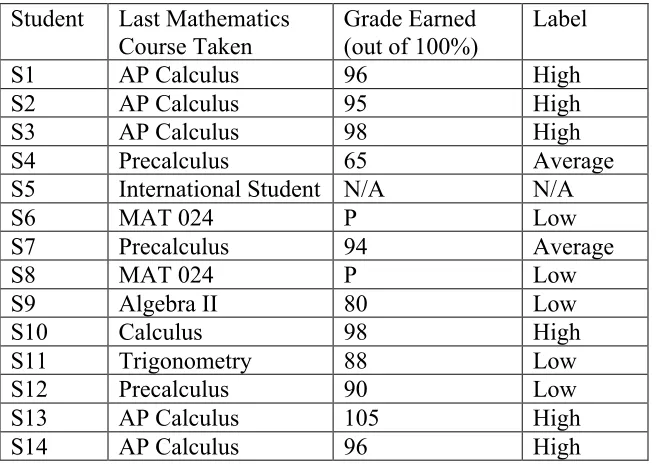
Table 5: Last mathematics course and grade earned ... 43
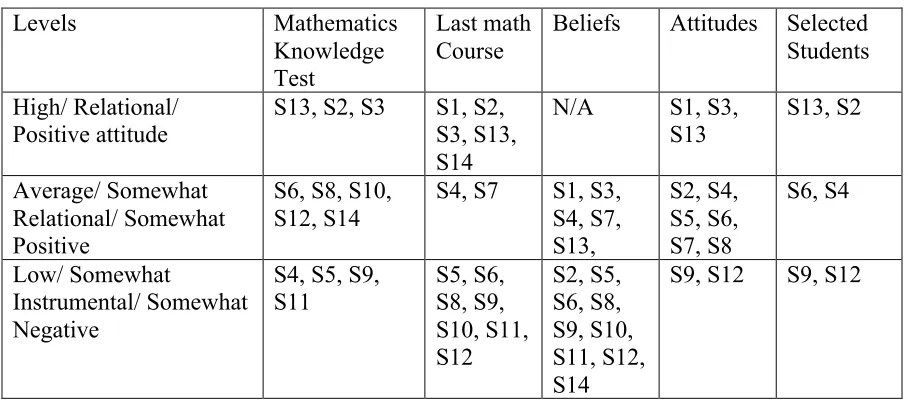
Table 6: Summary table ... 44
Table 7: Student pseudonyms and performance level ... 45
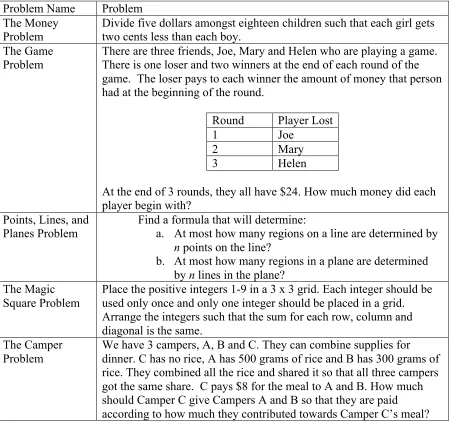
Table 8: Problems ... 54
Table 9: Nathan’s additional problems ... 56
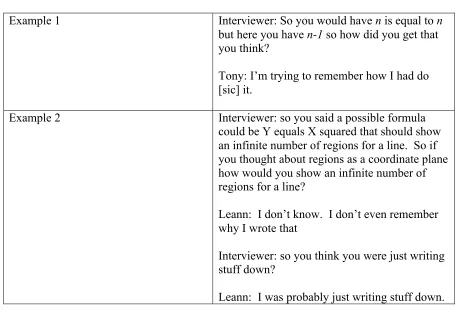
Table 10: Examples of memory decay ... 60
Table 11: Sample questions from video-SR interview protocol ... 63
Table 12: Sample transcription along with non-verbal expressions ... 65
Table 13: Example passages ... 67
Table 14: Influential factors, descriptions, and examples ... 71
Table 15: Sample summary table ... 74
Table 16: Themes for goals ... 76
Table 17: Themes for local affect ... 77
Table 18: Student performance on problems ... 88
Table G 1: Summary Table ... 213
Table H 1: Themes for goals ... 216
Table H 2: Themes for content knowledge ... 217
Table H 3: Themes for local affect ... 217
Table H 4: Themes for global affect ... 218
LIST OF FIGURES
Figure 1:The association between goals, plans and resources (Slade, 1994, p. 71) ... 16
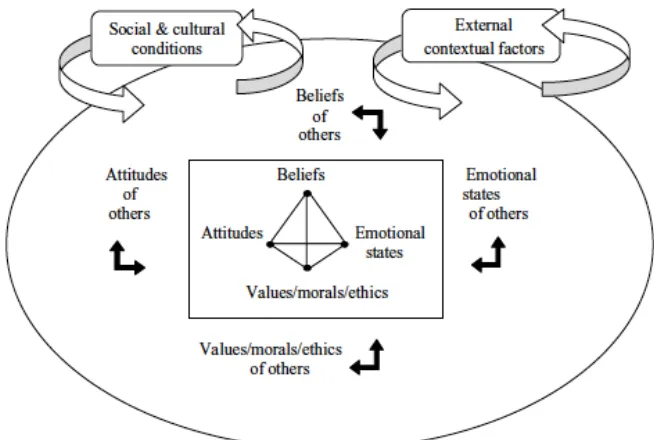
Figure 2: DeBellis and Goldin’s (2006) framework for their representational perspective on affect. ... 25
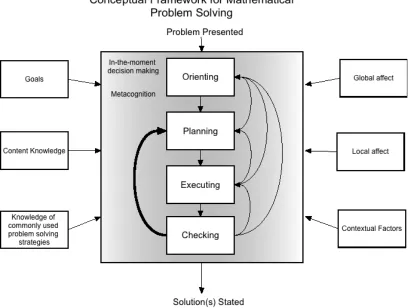
Figure 3: Conceptual framework of proposed study. ... 28
Figure 4: Revised conceptual framework. ... 87
Figure 5: Examples of Leann’s annotations ... 90
Figure 6. Example of Tony’s graph used in orienting phase. ... 91
Figure 7: Leann’s multiplication table ... 94
Figure 8: Nathan’s written work for the Money Problem ... 96
Figure 9: Dani’s written work for the Camper Problem. ... 97
Figure 10: Leann’s looking for a pattern to solve the Magic Square Problem ... 104
Figure 11: Phil’s table for the Game Problem ... 105
Figure 12: Tony’s drawing of functions to solve the Points, Lines, and Planes Problem .... 105
Figure 13: Kirsten’s triangles ... 106
Figure 14:Tony’s written work for the Points, Lines, Planes Problem ... 107
Figure 15: Kirsten’s table for the Money Problem ... 108
Figure 16:Tony’s solution to part a of Points, Lines, and Planes Problem written in functional notation ... 111
Figure 17:Tony’s written work during the video-SR interview for the Points, Lines, and Planes Problem. ... 112
Figure 18: Leann’s solution to the Points, Lines, and Planes Problem ... 112
Figure 19: Dani’s written work for the Camper Problem. ... 117
Figure 20: Dani’s diagram for solving the Points, Lines, and Planes Problem. ... 118
Figure 21: Tony’s list of triples that sum to 15 and their frequency ... 121
Figure 22: Leann’s hand computation ... 138
Figure I 1: Tony’s written work ... 219
Figure I 2: Leann’s written work ... 226
Figure I 3: Kirsten’s written work ... 232
Figure I 4: Dani’s written work ... 244
Figure I 5: Nathan’s written work ... 256
Chapter One
Mathematical problem solving matters. It is a substantial element of the reasoning expected in Science, Technology, Engineering, and Mathematics (STEM) college level courses. Success in STEM related degrees translates to more opportunities in today’s workforce (Pender, Marcotte, Sto Domingo, & Maton, 2010). Success in any STEM career requires proficiency in mathematics and in particular mathematical problem solving.
Therefore, there is an urgency to integrate problem solving into the mathematics curriculum at the K-12 level (English & Sriraman, 2010).
The National Council of Teachers of Mathematics’ (NCTM) (2000), Principles and Standards for School Mathematics supports making problem solving an integral part of mathematics instruction because it enables students to “acquire ways of thinking, habits of persistence and curiosity, and confidence in unfamiliar situations that will serve them well outside the mathematics classroom” (p. 52). Problem solving can be used as a way for
students to learn new mathematics and develop critical thinking skills which may support the development of life skills, such as persistence, curiosity, and confidence in unfamiliar
“model with mathematics” (2010, pp. 6-8). These two influential documents suggest that problem solving is still relevant in curricula and should continue to be studied.
Prominent researchers in the field have suggested that the development of a problem-solving theory should be given top priority (i.e. Lester, 1994; English & Sriraman, 2010, Schoenfeld, 2010). They state that the purpose for theory development is not to produce a “ ‘grand theory’ of problem solving” (p. 269). Rather, creating a theory will force researchers to collaborate and accumulate problem-solving knowledge into one depository (English & Sriraman, 2010). The hope is that the creation of a theory will allow researchers to “more reliably observe, document, and assess important mathematical developments in our students” (English & Sriraman, 2010, p. 269). Therefore, one way to advance problem-solving research is to create a theory.
Purpose of the Study and Research Question
The goal of this study is to contribute to the creation of a proposed problem-solving theory. Therefore, empirical evidence was collected to: (1) provide detailed, rich descriptions about how and why students make decisions during problem solving and (2) validate the proposed problem-solving theory. This required an in-depth qualitative investigation into the factors (i.e., goals, knowledge, affect, and external contextual factors) that contribute to the choices students make during problem solving. These descriptions provided detailed insight supplying the means to test the accuracy, range, and scope of the theory regarding students’ problem-solving processes (Schoenfeld A. H., 2008). Therefore, the following research question was proposed:
a. How do students’ goals inform their choices during the mathematical problem-solving process?
b. How does students’ knowledge inform their choices during the mathematical problem-solving process?
c. How does students’ affect inform their choices during the mathematical problem-solving process?
d. How do external contextual factors inform students’ choices during the mathematical problem-solving process?
Definition of General Terms
In this section, I define terms that may be ambiguous in mathematics research literature to provide clarity in this study.
Problem. In this study, Schoenfeld’s (1992) definition of a problem was used. He states:
[a] problem is only a problem (as mathematicians use the word) if you don’t know how to go about solving it. A problem that has no ‘surprises’ in store, and can be solved comfortably by routine or familiar procedures (no matter how difficult!) is an exercise (Schoenfeld A. H., 1992, p. 41).
sorting out, integrating, modifying, revising, or refining clusters of mathematical concepts from various topics within and beyond mathematics” (Lesh & Zawojewski, 2007, p. 782).
Significance of the Study
This theory on problem solving is necessary because there is a gap in the literature that needs to be filled. I used empirical data to study individual students’ problem-solving process and created rich descriptions of how their goals, knowledge, affect, and external contextual factors influence their choices. Schoenfeld (1983) supports the notion that there is great value in studying an individual’s problem solving process in isolation. He stated “if you just keep your eyes open and take a close look at what people do when they try to solve problems, you’re almost guaranteed to see something of interest” (p. 38 as cited in (Schoenfeld A. H., 2010). Therefore, the empirical data gathered from students’ problem-solving process would provide sufficient data to create these rich descriptions and validate this theory.
Overview of Methodological Approach
To conduct a study on students’ problem solving processes, in-depth qualitative analysis must be employed. In this section, I give a brief summary of the methodological approach for this study. A more thorough treatment of this subject is found in Chapter 3. To investigate the research question, a multi-case study was employed. There were six
(video-SR) interviews. Interviews were audio and video recorded, transcribed, and coded.
Triangulation is necessary to increase the rigor, validity and reliability of results (Creswell, 2013), therefore, student artifacts and researcher journal were collected to provide additional evidence of students’ problem solving process.
Organization of the Dissertation
Chapter Two
In this chapter, I present a review of the literature as it pertains to problem solving. I begin with a review of the problem-solving process. I then review the literature pertaining to the factors that have been researched and proven to affect problem-solving success. These factors include the problem-solving proess, students’ goals, mathematical content knowledge, knowledge of problem-solving strategies, global and local affect, context of situation, and in-the-moment decision fueled by students’ metacognition skills (i.e. monitoring and self-regulation). I conclude by presenting the conceptual framework that was used to drive my study.
Problem Solving Process
Subsequent research found that the problem-solving process is more complex and cyclic in nature. That is, an individual may take nonlinear paths through the problem-solving process and may not even employ each phase (Garofalo & Lester, 1985). For example, one landmark framework, created by Schoenfeld (1985), identified five phases or episodes of the problem solving process. They are reading, analysis, exploration, planning/implementation, and verification. In the reading phase, students read the question and work at understanding it. During the analysis phase “an attempt is made to fully understand a problem to select an appropriate perspective and reformulate the problem in those terms, and to introduce for consideration whatever principles or mechanisms might be appropriate” (Schoenfeld A. H., 1985, p. 298). The next less structured phase is exploration where student may conduct a broad search for relevant information that can be use to solve the problem. During the planning/implementation phase, students may show evidence of creating an explicit plan and work towards achieving it. In the last phase, verification, students check their answer to ensure that it makes sense given the context of the problem. This framework dissected Polya’s understanding the problem into reading and analysis. The planning/implementation phase overlaps Polya’s planning your solution and carrying out your plan and both end with checking or verification of the solution.
Garofalo and Lester (1985) created a cognitive-metacognitive framework that
(Garofalo & Lester, 1985; Schoenfeld A. H., 1983; Artz & Armour-Thomas, 1992).
Although Garofalo and Lester’s (1985) framework does not provide a comprehensive list of all possible cognitive and metacognitive behaviors that can occur, it does identify areas where students’ cognitive actions may be influenced by their metacognitive decision-making. These metacognitive behaviors are organized based on the problem solving phases:
orientation, organization, execution, and verification. For example, in the organization phase students plan their behavior and choice of actions. The metacognitive behavior that may occur is the “identification of goals and sub goals, global planning, and local planning to implement global plans” (Garofalo & Lester, 1985, p. 171) , which is similar to Polya’s four-phase framework.
Artzt and Armour-Thomas (1992) created a framework to study problem solving in a small group setting. This framework is a modification of Schoenfeld’s framework. This modification occurred based on the following claims: (1) Schoenfeld’s framework was limited due to the exclusion of identifying metacognitive behaviors, and (2) in Schoenfeld’s framework students were studied in a small group setting versus independently. Artzt and Armour-Thomas’ (1992) framework adds an understanding phase and separates the
Most recently, Carlson and Bloom (2005) presented a version of the problem solving process similar to Polya’s (1945) and Garofalo and Lester’s (1985) frameworks. They claim their four phases include all phases added by previous researchers. These phases, described in Table 1, are orienting (includes reading and understanding), planning (which includes exploration, analysis), executing (which includes implementation) and checking (which includes verification) (Carlson & Bloom, 2005). The evolution of these frameworks provides evidence that problem-solving research is progressing and that problem solving consists of both cognitive and metacognitive abilities.
Table 1: Problem Solving Process Phase Description
Orienting Includes reading and analyzing (Schoenfeld A. H., 1983) and refers to the preliminary actions students take to understand the problem.
Planning Includes exploration and analysis. This is the phase where explore problem solving strategies, knowledge base that they have and make a plan to solve the problem.
Executing Includes implementation and is the phase where students carry out their plan from the previous phase.
Checking Includes verification and is the phase where students determine the reasonableness of their solution.
Decision-making During Problem Solving
follows a familiar course of action each time (Schoenfeld A. H., 2010). For example, if a student knows how to use the division algorithm, observing them solve multiple problems will be monotonic. However, when the process is non-routine, such as in problem solving, the decision-making is more problematic and may be unpredictable. In this study, non-routine making under time constraint, sometimes called in-the-moment decision-making, was studied to learn what contributes to students’ decision-making in a time-constrained environment when posed with a problem-solving task.
Research has shown that students’ metacognitive skills are important for making productive decisions during the problem-solving process (Lester, Garofaol, & Kroll, 1989; Schoenfeld A. H., 1983). During problem solving a student’s metacognition might influence decisions regarding which problem solving strategy to implement. Furthermore, with
effective metacognitive skills the amount of time a student dedicates to a strategy is also managed (Schoenfeld A. H., 1983). Metacognitive behaviors include “predicting, checking, monitoring, reality testing, and coordination and control of deliberate attempts to solve problems “ (Schoenfeld A. H., 1983, p. 335). Carlson and Bloom (2005) describe
available knowledge during mathematical problem solving. Therefore, the terms
metacognition, monitoring, and control overlap, are codependent, and have held similar meanings in the literature (Carlson & Bloom, 2005). Wilson and Clarke (2004) refer to metacognition as “the awareness individuals have of their own thinking: their evaluation of that thinking, and their regulation of that thinking” (p. 26). Their definition of metacognition consists of three distinct components: metacognition awareness, evaluation, and regulation. Combining the definitions, metacognition is being aware of one’s knowledge and thought processes and exhibiting control of them during the problem solving process. Therefore metacognition has two main components: (1) having knowledge of one’s own knowing and thought processes (awareness), and (2) having control (i.e. monitoring and self-regulation (evaluation and regulation)) of one’s decisions during problem solving.
how to implement it was the least reported metacognitive function and the most reported was evaluation (i.e. monitoring).
Research by Cai (1994) on college-aged students also supports this conclusion. He found that students who took more advanced mathematics courses displayed more
metacognitive behaviors than students with less exposure to higher-level mathematics courses. That is, students with more mathematics experience were aware of what they knew and recognized how they could use that knowledge in a sequential order to get to the solution (Cai, 1994).
Monitoring and self-regulation. Someone that makes productive in-the-moment decisions during problem solving monitors and regulates actions based on how well the problem-solving session is going (Kilpatrick, 1985). Goos, Galbraith, and Renshaw (2000), refer to monitoring when all is going well as routine monitoring. However, they state what is more interesting is the monitoring that occurs when students encounter specific difficulties caused by non-routine tasks. These difficulties trigger metacognitive actions called red flags. Situations which trigger red flags are: (1) lack of progress, (2) error detection, and (3)
The decisions students make that are not necessarily influenced by red flags may be made to meet a conscious or unconscious goal whether productive or counterproductive (Schoenfeld A. H., 2010; Goos, Galbraith, & Renshaw, 2000). According to Goos, Galbraith and
Renshaw (2000), monitoring during problem solving is when students assess (a) knowledge, (b) understanding of the problem, (c) appropriateness of strategy, (c) progress towards a goal, (d) execution of the strategy and (e) the result for accuracy and sense. These monitoring actions are differentiated from self-regulation actions such as identify new information, reinterpret the problem, change strategy, and correct calculation errors (Goos, Galbraith, & Renshaw, 2000). According to Schoenfeld (1992) monitoring and acting in response to the results of progress are the core components of self-regulation. In a similar vein to
Schoenfeld, the terms monitoring and self-regulation will be used together to represent both related actions.
Decision-making has been modeled using two different perspectives. The first and older perspective is prescriptive in nature and models decision-making as a mathematical function that is based on maximizing an expected value based on the probabilities (Slade, 1994; Schoenfeld A. H., 2010). Most recently, decision-making has been modeled as a process that is based primarily on an individual’s goals. Goals drive the decision process and in the next section, I address its role in problem solving.
Goals and Problem Solving
aligned to the intended outcome (Brown, 1987; Slade, 1994). What is a goal? The goal concept is very broad and ranges in abstractness (Carver & Scheier, 1998; Slade, 1994). Carver and Scheier (1998) state that goals are hierarchical, where more abstract goals are ranked more highly and smaller-grained more concrete goals are called sub goals. For example, when given a mathematical problem-solving task, the overarching goal is to solve the problem. Then as students attack the problem, sub goals are made (e.g., read the problem, create a graph, solve for x). As problem solvers seek to achieve these sub goals, they activate their metacognitive skills to attain a solution. After a solution is reached, it is then checked to determine its validity.
According to Sweller (1988), novice and expert problem solvers differ by the goals and sub goals they set. For example, he found that novice problem solvers use the means-end strategy which means that they work backwards through the problem and as a result have to find sub goals and solve those first because a direct relationship between the goal and the givens were not identified. However, expert problem solvers have the knowledge and schema required to be able to apply a working-forward method allowing for a more straightforward process because of their ability to identify the goals and sub goals. The problems used in this study were more algebraic in nature and are more efficiently solved using the working-forward method.
the use of resources (e.g. knowledge), which may also lead to the creation of more plans and goals. In the context of mathematical problem solving, the goal that students set enables them to create a plan of action to solve the problem. This plan will require that students use
mathematical knowledge to execute the plan. The resources students choose may provide an opportunity to either create a new plan or a new goal. The student will then move among goals, plans and resources during the problems solving process.
Figure 1: The association between goals, plans and resources (Slade, 1994, p. 71)
In his study of college-aged students, Cai (1994) noted that while problem solving, students who were successful created sub-goals that directly related to the main goal of the problem. Unsuccessful students however, stated goals and created sub-goals that had weaker connections. To achieve goals, the problem solver must activate their knowledge and self-regulating skills to attain a viable solution (Zimmerman, 2000).
regulate failures and monitor by comparing information about the current behavior of the problem-solving process to the goals that were set (Sheeran & Webb, 2012).
Knowledge of Content and Strategies
It is evident that students’ ability to solve any problem is contingent on their knowledge base (Schoenfeld A. H., 1985). Schoenfeld (2011) defines an individual’s knowledge as “the information that he or she has potentially available to bring to bear in order to solve problems, achieve goals, or perform other such tasks” (p. 25). In the context of problem solving, this knowledge will consist of mathematical facts, procedural knowledge (i.e., how to do things, use algorithms), conceptual knowledge (i.e., how and why things work), and problem-solving strategies (Schoenfeld A. H., 2010; Jonassen D. , 2000). These different types of knowledge are all connected and work together during problem solving.
According to Jonassen (2000), domain knowledge is a strong predictor of problem-solving ability. Domain knowledge includes mathematical facts and procedural knowledge. Jonassen claims that to improve problem solving, domain knowledge is not enough; it must be integrated with the “knowledge of how concepts within a domain are interrelated” (p. 69). He refers to this integrated knowledge as structural knowledge or cognitive structure and observed that the stronger it is integrated with domain knowledge, the better the students’ problem solving ability. This structural knowledge can also be considered conceptual knowledge.
students do not benefit from learning domain-specific skills only but need guided instruction and training that focuses on the metacognitive skills required to successfully complete the task (Mayer, 2000; English & Sriraman, 2010; Lester, 1994; Schoenfeld A. H., 1985).
Early research in mathematical problem solving focused on problem-solving
strategies students need to know to be successful problem solvers. In Polya’s (1945) seminal work, How to Solve It , problem-solving strategies of successful problem solvers were investigated and summarized. They include strategies such as (a) making a diagram, (b) making a table, (c) working backwards, and (d) rereading the question (Polya, 1945). Polya suggested that if students are taught these strategies and heuristics, they will be successful at problem solving. However, subsequent research found that teaching students stategies and heuristics alone did not make significant improvements in their problem solving abilities (Lesh & Zawojewski, 2007; Schoenfeld A. H., 1992; Gick, 1986). One explanation is that Polya’s problem solving strategies are too broad, too numerous, and more complex than anticipated (Schoenfeld A. H., 1992; English & Sriraman, 2010).
Although having knowledge of problem-solving strategies are not solely sufficient to significantly improve a student’s problem solving ability, research on the characteristics of expert and novice problem solvers show that expert problem solvers have a large repetoire of problem solving strategies (Lester, 1994). That is, they have the knowledge base necessary to solve the problem successfully. It is very difficult to teach students problem-solving
(Schoenfeld A. H., 1985). To complicate things further, knowing these strategies is not enough, students must also know when to employ which strategy to ensure the right one is chosen. Schoenfeld (1985) also noted that knowing problem solving strategies does not imply that one knows how to solve problems, deep content knowledge is also required.
Expert problem solvers also possess a large schema for problem solving. Gick (1986) defines schema as “a cluster of knowledge related to a problem type” (p. 102). This cluster of knowledge includes the goals that are typical to the problem, the constraints, and solution procedures. However, novice problem solvers do not have a large schema, therefore, they will need to search more for a solution. The necessity to search requires the usage of problem-solving strategies and may include breaking the problem down into smaller
problems or subgoals (Gick, 1986). Research has shown that individuals who are conscious about the use of problem-solving strategies are more successful at problem solving (Gick, 1986). Experts do not rely solely on mean-ends analysis as their general search strategy to solve non-routine problems but use a sophisticated repertoire of information-gathering search strategies (p. 116). Problem-solving strategies may be schema driven (i.e., envoked by a schema), mostly in routine problem solving, or search based when there is no schema, mostly in non-routine problem solving (Gick, 1986).
Affect and Problem Solving
Previously, research on the influential factors (i.e. problem solving process, metacognition, goals and knowledge) on decision-making during mathematical problem solving has been reviewed. This body of research has provided evidence that decision-making during problem solving is not influenced by any one factor. In this section, I will review literature on the role of affect in decision-making during problem solving.
McLeod (1989) found that problem solvers who were aware of their emotional reactions to problem solving were more successful. The realization that cognitive processes along with non-cognitive processes contribute to problem-solving success motivated a new area of research on affect and problem solving.
What is affect? Affect is a general term that includes beliefs, attitudes, and emotional states (DeBellis & Goldin, 2006). Therefore, to understand affect a working definition of emotions, attitudes, and beliefs is warranted. “Emotions describe rapidly-changing states of feeling experienced consciously or occurring preconsciously or unconsciously during
by DeBellis and Goldin (2006) that categorizes affect into local affect and global affect to organize my review of the literature.
Local affect. In problem solving, affect can be categorized into local affect and global affect (DeBellis & Goldin, 2006). Local affect is short-termed and changes frequently (i.e., unstable) during the problem solving process. Local affect is based on emotions, which is described as a short-term feeling. Local affect is more easily observed since emotions such as happiness, frustration, and confusion, are often captured by a person’s facial expressions or body language. DeBellis and Goldin (2006) suggested a representational and structural concept of affect. To view affect as representational is to suggest that the emotions “carry meaning for the individual” (DeBellis & Goldin, 2006, p. 133) and those emotions dictate the interaction between content knowledge and metacognition impacting the problem solving process. Viewing affect as representational also suggests that there are physical cues that allow affect to be communicated during interactions between oneself and others (DeBellis & Goldin, 2006). For example, “intonation, eye movements, facial expressions, ‘body
problem solving was not going as expected. This negative emotion either caused student to give up or persevere in looking for other stratgies to solve the problem. This provides evidence that emotions are an integral component in problem-solving success.
Global affect. Global affect is longer-termed, influenced by local affect, and impressionable (DeBellis & Goldin, 2006). That is, global affect is made up primarily of attitudes and beliefs. Research by Carlson (1999) found that students with favorable beliefs about mathematics and problem solving were more successful. The beliefs students have about mathematics cause them to become frustrated or excited depending on if they believe mathematical problem solving should take some time and not all solutions come quickly.
The Indiana Mathematics Beliefs Scale was developed to measure the beliefs of high school and college-level students on problem solving. It focused on five beliefs about problem solving that impact students’ motivation to solve problems (Kloosterman & Stage, 1992). These beliefs are (a) I can solve time-consuming mathematics problems, (b) There are word problems that cannot be solved with simple step-by-step procedures, (c) Understanding concepts are important in mathematics, (d) Word problems are important in mathematics, (e) Effort can increase mathematical ability (Kloosterman & Stage, 1992). In contrast,
Schoenfeld (1992) compiled a list of beliefs that negatively impact students’ motivation to solve problems. They include (a) Mathematics problems have one and only one right answer, (b) Ordinary students are not expected to understand mathematics, (c) Students who
Local affect and global affect can be described as empowering or disempowering (DeBellis & Goldin, 2006). Empowering affect allows students to persevere in problem solving, try new strategies, and spend more time understanding the problem. For example, a student that experiences curiosity and bewilderment when posed with a problem may be motivated to understand the problem and employ strategies to help him/her do so. Gaining insight into the problem and making progress will turn bewilderment into pleasure. In contrast, the same feeling can be disempowering and hinder performance by creating a cognitive block so that information cannot be retrieved and applied in a productive manner (DeBellis & Goldin, 2006). For example, a student may begin solving a problem with curiosity and bewilderment but may choose one set strategy that may not work. This then creates frustration, anxiety, and despair in the student, which may cause the student to stop exploring alternate strategies and leave the problem unsolved.
emotions can cause students to either give up or continue to persevere depending on their beliefs about mathematics and problem solving (Kloosterman & Stage, 1992). Students must experience mathematics as sense making to create attitudes and beliefs about mathematics that will empower them to engage in problem solving productively.
Contextual Factors and Problem Solving
It is important to note that there are external factors, which I will refer to as contextual factors, which impact students’ decision-making during problem solving. According to Jonassen (2000), these external factors are cultural, social, and organizational (Jonassen D. , 2011). DeBellis and Goldin (2006), characterize external factors that influence the affective domain as the beliefs, attitudes, emotions, and values of others (i.e. peers, school authority), which in turn are influenced by social and cultural conditions and external contextual factors (see Figure 2). According to Lave and Wagner (1991), the social context and culture shared by students, school, and society determines the type of knowledge and practices that students construct. External factors include the physical surroundings, time constraints, working individually versus in a group, and the ability to use technological tools (DeBellis & Goldin, 2006; Jonassen D. , 2000).
The design of a study may also be an external factor that affects students’
& Seaman, 1995). Onwuegbuzie and Seaman (1995) conducted a study on students’ performance on statistics assessments that were timed and untimed. They found that all students’ performance improved on the untimed test. Therefore, to comprehensively study student decision-making during the problem solving process, it is imperative that contextual factors are included. That is, external factors will have an influence on students’ decision making during the problem solving process.
Figure 2: DeBellis and Goldin’s (2006) framework for their representational perspective on affect.
The literature reviewed so far discusses the factors that influence decision-making and success in mathematical problem solving. In the following section, these heavily
Conceptual Framework
Schoenfeld (2011), proposed a theory of goal-oriented decision-making, which attributes an individual’s goals (personal aims to achieve), resources (knowledge available), and orientations (beliefs, values) as being the influential factors to the decisions made during any goal-oriented activity. Schoenfeld (2011) proposed this theory for any goal-oriented activity such as cooking, car repair, mathematical problem solving, or teaching. Before Schoenfeld summarized this theory into general terms, he tested the theory on science and mathematics teaching. In this work, Schoenfeld (2008) developed a theory of teaching-in-context and provided a model and theoretical account of how and why teachers decide on which moves to make during active teaching. In teaching, this theory claims that teachers’ knowledge, goals, and beliefs are factors that influence how and why they make decisions in the classroom (Schoenfeld A. H., 2008).
Research has shown that students’ goals, knowledge, affect, and decision-making ability fueled by metacognition (monitoring and self-regulation) are important factors that determine problem-solving success. Schoenfeld supports the application of this theory explicitly to mathematical problem solving when he states: “I found that the following were major determinants of problem-solving success or failure: the knowledge base, heuristic strategies, metacognition (specifically, monitoring and self-regulation), beliefs, and
To frame this study, I drew on Schoenfeld’s work (1985, 2008 & 2011), the
mathematical problem solving process, and factors discussed in the review of the literature that have been shown to influence problems solving success.
My conceptual framework (see Figure 3) begins with the student entering the problem solving process after being presented with a problem. I used the Multidimensional Problem-Solving Framework proposed by Carlson and Bloom (2005) to describe the problem solving process. A description of this framework is found in Chapter Two in Table 1. This
framework recognizes that the problem solving is cyclic and that expert problem solvers cycle through the planning, executing, and checking phases represented by the bold arrow on the left side of the conceptual framework diagram. Since students do not solve problems like experts do, my framework includes all possible paths they may take. The arrows on the right side of the diagram represent these paths.
As students begin problem solving, they are constantly making decisions. The
Figure 3: Conceptual framework of proposed study.
Goals. In Schoenfeld’s theory, he suggests that goals and goal-oriented behavior are almost omnipresent. He defines a goal as “something that an individual wants to achieve, even if simply in the service of other goals” (p. 20). These goals may be conscious or unconscious and are created by the problem solver to engage in the process. In my framework, goals were defined and used in alignment with Schoenfeld’s goal-oriented decision-making theory.
problems, achieve goals, or perform other such tasks” (p. 25). In this definition, he also includes conceptions with misconceptions and notes that to determine the correctness of solutions the focus will be on the student’s correct mathematical thinking. He also recognizes that students use different types of knowledge, content knowledge, and knowledge of
problem-solving strategies, when problem solving (Schoenfeld A. H., 2010). In the context of mathematical problem solving, this knowledge will consist of mathematical facts,
procedural knowledge (how to do things, using algorithms), conceptual knowledge (how and why things work), and problem solving strategies and heuristics (Schoenfeld A. H., 2010). These different types of mathematical knowledge are all connected and work together during problem solving.
In my conceptual framework, mathematical facts, procedural knowledge and
conceptual knowledge were referred to as content knowledge. Knowledge of problem solving strategies was separated into its own factor. To understand and explain students’ choices as a result of their knowledge, misconceptions were also taken into consideration (Schoenfeld, 2010).
constantly changing affect (i.e., emotions) and global affect more stable affect (i.e., attitudes and beliefs).
External contextual factors. There are other factors that are not included in Schoenfeld’s theory that research has shown may also have an affect on students’ problem-solving success. They include social, cultural and physical factors. Provisions to capture these contexts and others unique to this study were made. Restating this theory to reflect my conceptual framework, a students’ in-the-moment decision-making can be attributed to their goals, knowledge, affect, and external contextual factors. My conceptual framework implies that when students encounter a non-routine problem-solving task, their in-the-moment decisions are goal-oriented and managed by their ability to monitor and self-regulate
achieving these goals. Hence monitoring and self-regulation will not be treated as an external factor. The in-the-moment decisions, which are aligned with their goals, will be influenced by their content knowledge, knowledge of problem solving strategies, global affect, local affect, and external contextual factors.
To validate any theory, it is necessary to provide empirical evidence and rich
descriptions of the data gathered with which a model can be created. The empirical evidence serves to validate the theory and the model tests the scope and range of the theory
detailed description of the lesson and models of each teaching episode. These models represented what teachers did and why they did them during teaching. He found that a productive teaching routine that can be applied to all teachers and could also be used as a means to help other teachers learn this routine. This study collected empirical evidence that informed detailed descriptions of each student’s problem solving process. However only the cross-case findings is reported. These findings allowed for the research questions to be answered along with the validation of the theory.
Chapter Summary
In this chapter the literature related to the problem solving process and factors that influence decision-making was reviewed. In particular, the research on students’ goals, knowledge, affect, and metacognition (monitoring and self-regulation) was reviewed. In summary, problem solving is complex and its success is codependent on students’ cognitive and metacognitive abilities. That is, knowledge alone does not guarantee problem-solving success; success also depends on the productive interplay among knowledge, the awareness of that knowledge and how and when to use it along with the beliefs and emotions that occur during the process.
Hence the need for a problem solving theory that can provide a mechanism for modeling students’ in-the-moment decision making during problem solving. Schoenfeld (2011), proposed such a theory that has been used to create models of teaching. The goal of this study is to validate this goal-oriented decision-making theory with empirical data and rich descriptions of students’ mathematical problem solving process.
Chapter Three
This study seeks to contribute to the creation of a theory for problem solving. This problem-solving theory, proposed by Schoenfeld (2011), states that an individual’s goals, knowledge, affect and his/her decision-making mechanisms are influential factors in the decisions made during problem solving. The creation of a problem-solving theory is important because it will add to existing mathematical problem-solving research by providing a lens through which one can understand how and why students make decisions during the problem-solving process. For this proposed theory to be widely accepted, it must be tested to determine its range and scope. Therefore, this study has two goals, (1) to provide detailed, rich descriptions about how and why students make decisions during problem solving and (2) to validate the proposed problem-solving theory. According to Eisenhardt (1989), a case study is one methodology that can be used to provide detailed, rich
descriptions and to test or generate theory. Therefore, to accomplish these goals, empirical evidence captured by qualitative methods about an individual’s goals, knowledge, affect, and external contextual factors during problem solving is needed. Based on the aforementioned goals, the following research question is investigated.
1. In what ways do students’ goals, knowledge, affect, and external contextual factors inform their choices during the mathematical problem solving process?
b. How does students’ knowledge inform their choices during the mathematical problem solving process?
c. How does students’ affect inform their choices during the mathematical problem solving process?
d. How do external contextual factors inform students’ choices during the mathematical problem solving process?
In the next few paragraphs, I discuss the features of multi-case study methodology employed to carefully study this phenomenon. This is followed by a description of the study design, case selection methods, data collection methods, and analysis methods. Lastly, validity and reliability issues are addressed.
Study Design
themes” (Creswell, 2013, p. 97). These multiple sources of information are required to ensure a detailed and in-depth analysis (Eisenhardt, 1989; Creswell, 2013; Stake, 1995; Yin, 2009). Therefore in this study task-based interviews, video-stimulated recall (video-SR) interviews, student artifacts, and the researcher’s journal were used as data sources. According to
Creswell (2013), these multiple sources of data are needed to give a robust description of each case.
This study is focused on process because I am interested in how students go about solving problems rather than whether they successfully complete the task. And lastly, this study is concerned with participant perspectives. In this study, the participant perspective is represented by students’ affect (i.e., emotions, beliefs, and attitudes) during their problem solving experience. This study does not occur in its ideal naturalistic setting. Ways in which I compensated for this will be discussed later in this section. Also, since a goal of this research is to validate theory it is not absolutely inductive. However, as indicated by my conceptual framework, I allowed for some induction to occur with the inclusion of the external
contextual factors component requiring me to look beyond the theory’s factors in my analysis.
In Creswell’s (2013) definition of a case study, the researcher “explores a real-life, contemporary bounded system (a case) or multiple bounded systems (cases) over time, through detailed, in-depth data collection” (Creswell, 2013, p. 97). In this multi-case study, students represent the real-life contemporary bounded systems. The students were
Clarke, Cotner, and Lee (2006), a range of cases is necessary to allow for generalization across cases. The within-case analysis was used to support the across-case analysis in providing detailed descriptions of students’ problem solving process. These descriptions were then used to validate the theory. The number of cases in multiple case studies is typically between four and five (Creswell, 2013); however, in this study, six cases were identified to provide a more in-depth description and analysis of students with varying backgrounds. In the upcoming sections, I provide a detailed description of the case selection methods and context for this study.
Participants and Study Context
The participants in this study were a subset of students enrolled in a summer bridge program at a Historically Black University (HBCU) in the Caribbean. This HBCU has been hosting this program for the past several years at no cost to the participants. The program is based on the belief that improving mathematics competency, particularly in calculus
concepts, is a major component for success in STEM majors (UVI, 2013). In addition to a course in mathematics, courses in computer science, scientific writing and reading, and seminars focused on the transition to college life were offered. Each day, the students were required to attend either a bridge to pre-calculus or a bridge to calculus course immediately followed by the seminar courses. They would then have scientific writing and reading in the evenings and their computer science course on Friday mornings only. The rest of the
who stayed with them in the dormitories and helped them with their homework and other assignments. This residential program ran for six weeks, June 23, 2014 to August 1, 2014.
The students enrolled in the summer bridge program were incoming or current freshmen interested in pursuing a STEM degree, with special considerations given to students who planned to attend the HBCU. The 19 total students, 16-19 years of age, were asked to participate in this study during the application phase. The consent form (see Appendix A) was included in the documentation that the program mailed to accepted applicants. There were 14 students who agreed to participate in the study. Out of the 14 students who volunteered, 6 were purposefully selected to represent variability in the
influential factors (i.e., goals, knowledge, affect, and external contextual factors) of problem solving. In the next section, I discuss the methods used to purposefully select the students.
Student selection. Students were purposefully selected to represent a range of content knowledge, beliefs about mathematics, and problem solving, and also to represent polar types (Eisenhardt, 1989; Creswell, 2013). The data that supported this purposeful sampling were the results of a mathematical knowledge test and a survey on mathematics and problem solving beliefs. The result of any summative test alone is not always the best
Mathematical knowledge test. Prior to instruction, participants took a test (see Appendix B) on their mathematics knowledge using the instrument mandated by the
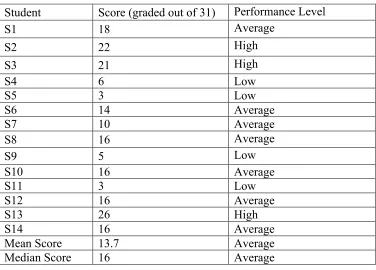
program. This test focused on pre-calculus skills and included topics such as: solving linear and quadratic equations, simplifying expressions, properties of exponents and logarithms, graphing linear equations, properties of functions and trigonometry. The test was scored out of 31 points with scores ranging from 3 points to 26 points, with a mean score of 13.7 points and median score of 16 points. Students were then assigned a performance level. High performing students scored between 20-31 points, average performing students 10-19 points, and low performing students 9 points and below. Table 2 shows the results of the
Table 2: Mathematical knowledge test results
Student Score (graded out of 31) Performance Level
S1 18 Average
S2 22 High
S3 21 High
S4 6 Low
S5 3 Low
S6 14 Average
S7 10 Average
S8 16 Average
S9 5 Low
S10 16 Average
S11 3 Low
S12 16 Average
S13 26 High
S14 16 Average
Mean Score 13.7 Average
Median Score 16 Average
understanding of mathematics has a reasoning orientation towards mathematics and views mathematics as sense making. In contrast, one who holds an instrumental understanding possesses a rule following orientation towards mathematics (Quillen, 2004).
Past studies that have utilized this instrument (Quillen, 2004; Cifarelli, Goodson-Epsy, & Chae, 2010) used a numbered scale on a continuum from 1 to 5, with 1 being a strong instructional view and 5 being a strong relational view. This numbered continuum is used in conjunction with a 5-point Likert scale. Students respond to a statement regarding their beliefs about mathematics and problem solving, using Strongly Disagree (SD), Disagree (D), Undecided (U), Agree (A), and Strongly Agree (SA). An answer of Undecided receives no points. The choice that represents a relational view of mathematics and problem solving received a higher point value. To increase the survey’s validity, the most favorable response on a question that will receive the maximum value of 5 points could be either SD or SA. Table 3 shows two questions from Part I of the survey. In the first question, the most
favorable response is SD, whereas in the second question, the most favorable response is SA.
Table 3: Part I: Beliefs about mathematics and mathematical problem solving
1. Getting the right answer is the most important part of mathematics.
SD D U A SA
2. I usually try to understand the reasoning behind all of the rules I use in
mathematics.
I adopted the coding scheme as presented in Cifarelli, Goodson-Epsy and Chae (2010). To find the overall survey score, they found the average value and classified the scores as follows: an overall survey score of 1.0-2.0 is instrumental, 2.1-3.0 is somewhat instrumental, 3.1-4.0 is somewhat relational and 4.1-5.0 as relational.
Part II of the Mathematical Beliefs Survey measured attitude towards mathematics and mathematical problem solving. Similar to Part I, the most favorable response on a question will receive the maximum value of five points but could be either SD or SA, to increase the survey’s validity. A more positive attitude corresponds to a higher point value. The coding scheme as presented in Cifarelli, Goodson-Epsy and Chae (2010) was also used for Part II. The scale is as follows: 1.0-2.0 as a negative attitude, 2.1-3.0 as a somewhat negative attitude, 3.1-4.0 as somewhat positive attitude, and a 4.1-5.0 as a positive attitude.
All participants in the summer bridge program took the survey but only the
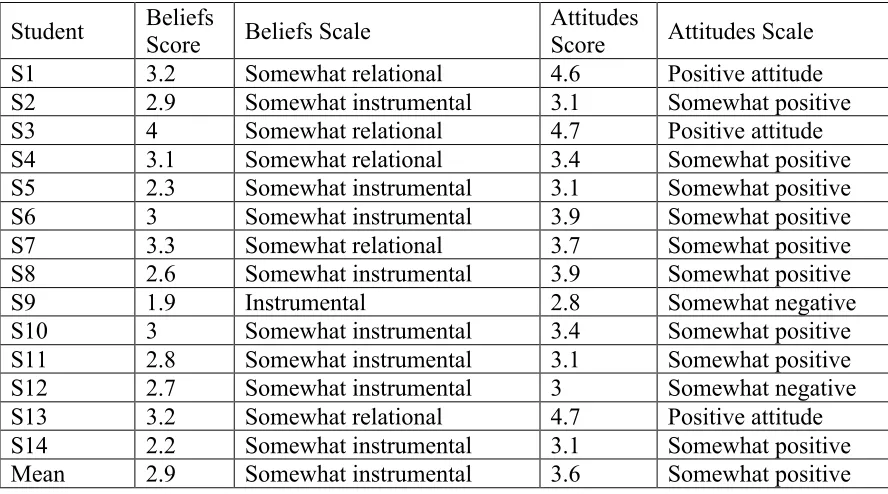
participants who gave consent were analyzed. The survey scores were calculated by hand and then entered into Microsoft Excel to calculate descriptive statistics. The mean score for Part I, beliefs about mathematics and mathematical problem solving was 2.9. That is, as an aggregate, the students held a somewhat instrumental view of mathematics. There was one student who held an instrumental view of mathematics, eight that held a somewhat
For Part II, attitudes towards mathematics and problem solving, the mean score was 3.6. That is, as an aggregate, the students held a somewhat positive attitude towards
mathematics and mathematical problem solving. Three students received a 4.1-5.0, a positive attitude, nine students scored a 3.1-4.0, a somewhat positive attitude, two students scored 2.1-3.0, a somewhat negative attitude, or 1.0-2.0, a negative attitude. The distribution of these scores is also in Table 4.
Table 4: Score distribution for attitudes and beliefs about mathematics and problem solving
Student Beliefs Score Beliefs Scale Attitudes Score Attitudes Scale
S1 3.2 Somewhat relational 4.6 Positive attitude
S2 2.9 Somewhat instrumental 3.1 Somewhat positive
S3 4 Somewhat relational 4.7 Positive attitude
S4 3.1 Somewhat relational 3.4 Somewhat positive
S5 2.3 Somewhat instrumental 3.1 Somewhat positive
S6 3 Somewhat instrumental 3.9 Somewhat positive
S7 3.3 Somewhat relational 3.7 Somewhat positive
S8 2.6 Somewhat instrumental 3.9 Somewhat positive
S9 1.9 Instrumental 2.8 Somewhat negative
S10 3 Somewhat instrumental 3.4 Somewhat positive
S11 2.8 Somewhat instrumental 3.1 Somewhat positive
S12 2.7 Somewhat instrumental 3 Somewhat negative
S13 3.2 Somewhat relational 4.7 Positive attitude S14 2.2 Somewhat instrumental 3.1 Somewhat positive Mean 2.9 Somewhat instrumental 3.6 Somewhat positive
Last mathematics course. I also considered the last mathematics course taken and grade
Precalculus (e.g. Trigonometry and Advanced Algebra) was labeled low. Table 5 shows this information.
Table 5: Last mathematics course and grade earned Student Last Mathematics
Course Taken
Grade Earned (out of 100%)
Label
S1 AP Calculus 96 High
S2 AP Calculus 95 High
S3 AP Calculus 98 High
S4 Precalculus 65 Average
S5 International Student N/A N/A
S6 MAT 024 P Low
S7 Precalculus 94 Average
S8 MAT 024 P Low
S9 Algebra II 80 Low
S10 Calculus 98 High
S11 Trigonometry 88 Low
S12 Precalculus 90 Low
S13 AP Calculus 105 High
S14 AP Calculus 96 High
Table 6: Summary table
Levels Mathematics
Knowledge Test
Last math Course
Beliefs Attitudes Selected Students High/ Relational/
Positive attitude
S13, S2, S3 S1, S2, S3, S13, S14
N/A S1, S3, S13
S13, S2
Average/ Somewhat Relational/ Somewhat Positive
S6, S8, S10, S12, S14
S4, S7 S1, S3, S4, S7, S13, S2, S4, S5, S6, S7, S8 S6, S4 Low/ Somewhat Instrumental/ Somewhat Negative
S4, S5, S9, S11 S5, S6, S8, S9, S10, S11, S12 S2, S5, S6, S8, S9, S10, S11, S12, S14
S9, S12 S9, S12
To ensure that a range of students was represented, two students represented by each level were selected. The following students were chosen, S2 and S13 who fell mostly in the high/relational/positive attitude categories, S4 and S6 who fell mostly in the
Table 7: Student pseudonyms and performance level
Student Number Pseudonym Performance Level
S13 Tony High
S2 Leann High
S4 Kirsten Average
S6 Dani Average
S9 Nathan Low
S12 Phil Low
Brief Case Descriptions
Tony. At the time of the study, Tony was a seventeen-year-old male freshman
entering college. He attended public high school and was enrolled in AP Calculus AB during his senior year. Although his major was undeclared, he was interested in pursuing a career in engineering. Tony was selected to represent a high performing student because of his strong mathematics background and his favorable orientation towards mathematics and problem solving.
Kirsten. At the time of the study, Kirsten was an eighteen-year-old female freshman entering college. She attended a parochial private high school and was enrolled in pre-calculus during her senior year. She declared biology as her intended major and plans to pursue a career in veterinary medicine. Kirsten was selected to represent an average performing student because although she scored low and average on the components pertaining to her mathematical knowledge, she scored average on her beliefs and attitudes towards mathematics and problem solving.
Dani. At the time of the study, Dani was an eighteen-year-old female and a returning freshman at this HBCU. Although her last mathematics course taken at a parochial private high school was calculus, she was placed into a non-credit developmental mathematics course at the university. She declared physics as her intended major and plans to pursue a career as an astrophysicist. Dani was selected to represent an average performing student because of the variability in her mathematical knowledge components (average) and beliefs (low) and attitudes (average) towards mathematics and problem solving.
Phil. At the time of the study, Phil was an eighteen-year-old male freshman entering college. He attended a parochial private high school and was enrolled in pre-calculus during his senior year. He declared computer engineering technology as his intended major and plans to pursue a career as an engineer. Phil was selected to represent a low performing student because of his low performance on all components except the mathematics knowledge test, on which he earned an average score.
After purposefully selecting students based on their mathematical knowledge and beliefs about mathematics and problem solving, empirical data was collected to provide a basis for the detailed descriptions. In the next section, I share the data sources.
Data Collection Methods
To provide detailed descriptions of students’ problem solving based on their decision-making, it is necessary to observe them while engaged in problem solving and to interpret what was done (Goldin, 2000). Task-based interviews are used in mathematics education research to study mathematical behavior and require interaction among the student,