ISSN(Online): 2320-9801
ISSN (Print): 2320-9798
International Journal of Innovative Research in Computer
and Communication Engineering
(An ISO 3297: 2007 Certified Organization)
Vol. 3, Issue 7, July 2015
The Calibration and Voting Process of
Preferential Electronic Voting Machine using
Microcontroller
Shaikh Adiba, Dr. Ramesh R. Manza
Research Student, Dept. of C.S. & I.T., Dr. Babasaheb Ambedkar Marathwada University, Aurangabad (MS), India. Assistant Professor, Dept. of C.S. & I.T., Dr. Babasaheb Ambedkar Marathwada University, Aurangabad (MS), India.
ABSTRACT: With the elevation in technology there is a great demand of automation of voting systems in different areas of application. The paper ballots are used for Preferential voting as it is a very knotty and composite process as a whole. This paper deals with the tuning and vote recording method of Preferential Electronic Voting machine. The machine has been devised in such a way that it is competent, compelling, convenient and foolproof for voter as well as election conducting agency.
KEYWORDS: calibration, PEVM, CU, BU, voting, preferences, election, microcontroller.
I. INTRODUCTION
The notion of preferential election is distinct from assembly election. Preferential voting was used for the Legislative Assembly (Lower House) of the Victorian parliament in UK. According to this system, voters number candidates on the ballot paper in a rank order of choice. On each ballot paper, voters choose the candidate they most want to elect and write 1 in the box next to their name. They write 2 next to their second choice, 3 to their third choice and so on. The system is such that it enables to choose a candidate that can build an absolute majority of support in the electorate rather than the simple majority of first past the post voting [3]. The complete process of preferential voting makes use of paper ballot and still counting of votes is done manually in many countries. There are many clauses in counting method that makes the task very complex. This paper deals with the tuning and vote recording method of Preferential Electronic Voting machine.
II. APPROACH
The architecture of PEVM is based on preferential voting governing the rules of voting process stated in statutes of Marathwada Act 1974. The machine is constructed using ATMEGA32 from AVR series microcontroller which is a powerful 8-bit microcontroller with RISC (Reduced Instruction Set Computing, high performance and low power consumption. The details of which can be read from the datasheet. An interesting feature is that it has 32k bytes of In-System-Self Programmable (ISSP) flash memory- endurance- 10,000 write/erase cycle and it operates on 4.5v to 5.5v. Data retention is up to 20 years at 850 C and up to 100 years at 250 C. There are two hardware units and a software unit. The PEVM is going to be used in typical preferential voting system. A suitable flowchart is developed showing the process of tuning the machine before election. The program is written embedded C language that has been tested using AVR Studio compiler to make the code error free. And for loading the microcontroller chip with the executable program, the HEX file is generated and burned to the microcontroller chip with the help of AVR-burner.
III.CALIBRATION OF PEVM
ISSN(Online): 2320-9801
ISSN (Print): 2320-9798
International Journal of Innovative Research in Computer
and Communication Engineering
(An ISO 3297: 2007 Certified Organization)
Vol. 3, Issue 7, July 2015
the control unit. If anything went wrong then one has to simply press the „Reset‟ switch on the control unit and restart the software. After data has been correctly loaded into control unit, it is required to load same information into ballot unit. This can be done by connecting control and ballot unit together.
Fig.1
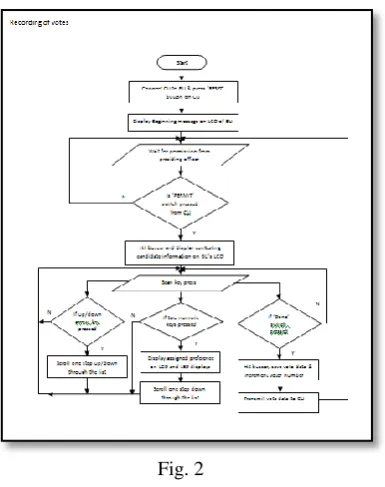
IV.VOTE RECORDING PROCESS
ISSN(Online): 2320-9801
ISSN (Print): 2320-9798
International Journal of Innovative Research in Computer
and Communication Engineering
(An ISO 3297: 2007 Certified Organization)
Vol. 3, Issue 7, July 2015
Fig. 2
V. SNAPS OF WORKING MODEL
1. Calibrating Control Unit:
Before beginning the actual voting session, the Preferential Electronic Voting Machine (PEVM) needs to be initialized with the data such as the names of the contesting candidates, number of contesting candidates, number of candidates to be elected. The calibration is done from the control software in the computer system. The control unit is connected to the computer system having the control software through serial port as can be seen in figure 3.
Fig. 3
ISSN(Online): 2320-9801
ISSN (Print): 2320-9798
International Journal of Innovative Research in Computer
and Communication Engineering
(An ISO 3297: 2007 Certified Organization)
Vol. 3, Issue 7, July 2015
Fig. 4 Fig. 5
2. Loading Names into Ballot Unit through Control Unit:
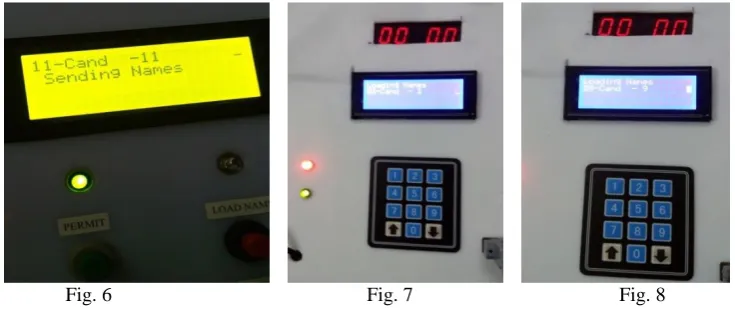
When the voting data has been loaded into control unit, it is required to load the same information into ballot unit (BU) too. For this, BU is connected to the CU RS-232 connector and „RESET‟ button is pressed. Here, green LED glows indicating BU and CU connected successfully. To send the voting data to BU, one needs to press „Load Names‟ button on CU. This is shown in figure 6. The simultaneous action can be seen on BU in figure 7 and 8.
Fig. 6 Fig. 7 Fig. 8
3. Vote Casting:
Ballot unit contains the following components
1. LCD display for displaying contesting candidates name, serial number and the preference number given by the voter.
2. LED display that displays the serial number of the candidates and its allotted preference number.
3. A numeric key panel for giving the preference number to the candidates. If the voter wants to give number 1 then he has to press key „0‟ and key‟1‟. That is „01‟and so on.
4. A switch named „DONE‟ to confirm the vote.
When the „PERMIT‟ button is pressed on CU a buzzer hits and allows the BU to display the names of the candidates and is ready to accept the vote from voter. Figure 9 and 10 shows CU and BU ready state respectively.
ISSN(Online): 2320-9801
ISSN (Print): 2320-9798
International Journal of Innovative Research in Computer
and Communication Engineering
(An ISO 3297: 2007 Certified Organization)
Vol. 3, Issue 7, July 2015
Fig. 9 Fig. 10
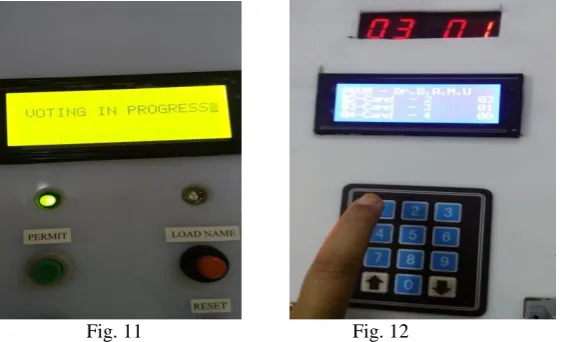
Figure 11 shows the state of CU after pressing „PERMIT‟ switch. Figure 12 shows the state of voting process on BU. If the voter has assigned preference number to a candidate the list automatically scrolls above and cursor blinks on next line, indicating the voter to vote for this candidate now. The voter can scroll on its own by pressing down arrow or up arrow keys on key panel and the preferences can be changed.
Fig. 11 Fig. 12
ISSN(Online): 2320-9801
ISSN (Print): 2320-9798
International Journal of Innovative Research in Computer
and Communication Engineering
(An ISO 3297: 2007 Certified Organization)
Vol. 3, Issue 7, July 2015
VI.CONCLUSION AND FUTURE WORK
The snaps of the model show the correct working of the preferential electronic voting machine. The proposed research has invented a new voting machine in India that can provide an easy way of voting in preferential type of voting system. The machine is less expensive and simple to operate. To ensure the acceptance of voting result, one has to apply an appropriate counting method to interpret the votes cast and produce a voting results that reflects the true opinion of the voters. The LCD display used can be replaced by some graphical display unit in future. Although, the machine is constructed for University elections, but it can be used for other preferential voting systems.
REFERENCES
1. Statute under the Marathwada University Act, 1974.
2. Shaikh Adiba, Ramesh R Manza, “Architecture of Electronic Voting Machine for Preferential Voting used in University Election”. In
International Journal of Engineering Research & Technology, Vol1, Issue 5, July 2012.
3. Shaikh Adiba, Ramesh R Manza, “Design of Preferential Electronic Voting Machine using AVR series Microcontroller”. In International
Journal of Emerging Trends & Technology in Computer Science (IJETTCS), Vol 4, Issue 3, May-June 2015.
4. Barry Wright “Objective Measures of Preferential Ballot Voting Systems” (April 20, 2009) Duke University, Durham, North Carolina.
5. Sarah P. Everett, Kristen K. Greene, Michael D. Byrne, Dan S. Wallach, Kyle Derr, Daniel Sandler, Ted Torous, “Electronic Voting Machines
versus Traditional Methods: Improved Preference, Similar Performance” Proc. Measuring, Business, and Voting, (April 2008) Florence, Italy.
6. Jurij Toplak “Preferential Voting: Definition and Classification”. University of Maribor.
7. Sung-Hyuk Cha and Yoo Jung An “Taxonomy and Nomenclature of Preferential Voting Methods”. Proceedings World Congress on
Engineering & Computer Science, (Oct. 2012), San Francisco, USA.