ISSN(Online): 2320-9801
ISSN (Print): 2320-9798
I
nternational
J
ournal of
I
nnovative
R
esearch in
C
omputer
and
C
ommunication
E
ngineering
(An ISO 3297: 2007 Certified Organization)
Vol. 3, Issue 6, June 2015
DKIM Enabled Two Factor Authenticated
Secure Mail Client
Saritha P, Nitty Sarah Alex
M.Tech Student[Software Engineering], New Horizon College of Engineering, Bangalore, India
Sr. Asst Prof , Department of Information Science, New Horizon College of Engineering, Bangalore, India
ABSTRACT
:
Email has been emerged as the commonly used network application which made it necessary to be secured. An email client is a computer program by which user’s access their mail. The proposed mail client provides two factor authentication login rather than the normal username and password login by generating a security code. It also includes a feature called Domain Keys Identified Mail (DKIM) which appends digital signature to each of the mail being sent by the particular organization.KEYWORDS
:
DKIM, Pretty Good Policy, Privacy Enhanced Mail, Secure Multipurpose Mail Extension, Two factor AuthenticationI. INTRODUCTION
The most prevalent form of login has used an ID and password which is classified as one factor authentication. There have been various methods through which the attackers could hack the password. This could be very problematic especially in large organizations. In this way any of the important mail send from an organization can be hacked and could be modified. Another major issue which is found in the current email systems is the email spoofing wherein the emails appear to be from a legitimate sender but in real would have been send by a attacker. It could be a link or message viewing of which could result in system attacked by viruses or hacking the entire personal account of the users. This paper mainly concentrates on making an email secure for a user or for an organization. It uses a two factor authentication mechanism rather than the normal single username and password in order to overcome the problems of using single username and password like the hacking of passwords. It also tries to avoid the common problems of spamming by digitally signing the mail using any of the values in its header fields and it particularly focuses on the security of organizations by using their domain names.
II. RELATED WORKS
ISSN(Online): 2320-9801
ISSN (Print): 2320-9798
I
nternational
J
ournal of
I
nnovative
R
esearch in
C
omputer
and
C
ommunication
E
ngineering
(An ISO 3297: 2007 Certified Organization)
Vol. 3, Issue 6, June 2015
entire address books worth of viruses and personal information. Another disadvantage is the email spoofing [2]wherein the emails send from hacker appears to be from a legitimate sender and other is the phishing attack[3] where the messages are altered in between by the man in middle. It could be a link or message viewing of which could result in system attacked by viruses or hacking the entire personal account of the users. Also there are many advertisements like mail which arrives at the inbox of the current mails systems viewing of which could again result in getting attacked by a Trojan. There has been various email secure methods like Privacy Enhanced Mail(PEM)[4] which had two main protection features which were the signed messages and the encrypted messages, Pretty Good Policy(PGP) [5] where users could independently certify keys as belonging to other users and Secure Multipurpose Mail Extension(S/MIME) [6] which is a standard for public key encryption and signing of MIME data.
III. PROPOSED ARCHITECTURE
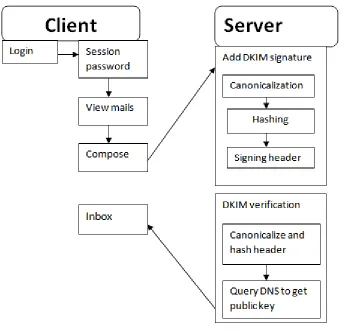
The Fig.1 shows the overall architecture of the proposed system. It clearly shows how the login to the mail folders is done and how the digital signatures are appended to the mail composed by the user.
Fig 1 Proposed system architecture
ISSN(Online): 2320-9801
ISSN (Print): 2320-9798
I
nternational
J
ournal of
I
nnovative
R
esearch in
C
omputer
and
C
ommunication
E
ngineering
(An ISO 3297: 2007 Certified Organization)
Vol. 3, Issue 6, June 2015
the user is logging in from within the organization or is from a reliable IP, if found reliable then he will be directed to his mail’s inbox folder wherein he could view his mails. If the user is found to log in from outside then he will be directed to page where he has to enter the session password which is created by the server and send to the particular user’s mobile.
User composes a mail and transfers it into the sender’s Mail Transfer Agent which appends the signature by canonicalising and hashing the message body. Whenever a mail arrives the receiving Mail Transfer Agent would initially check if it is a DKIM signed mail or not. If it is found to be digitally signed then it checks the signature by creating a text DNS query to the senders domain. If found to be valid then it checks for the reputation of the sent domain and if this is invalid then the mail received from the particular domain would be either sent to spam or would be discarded depending on the organization policy.
IV. IMPLEMENTATION
Implementation of this project deals with issues of quality, performance and delivering the end product. The entire project is coded in java. The different modules included are:
Login
Initially the registered users are provided with a usual login screen containing the username and password. Users then enters their valid username and password after which they would be directed to a page wherein they have to enter the session password. This session password is created by using hashing algorithms by combining parameters as the username, pin timestamp and IMSI number. All these parameters are concatenated, xored and converted to eight digit hexadecimal number which is send to var/spool/sms/outgoing directory. If their entered password is same as the password generated by the server only then the user would be directed to their email inbox wherein they could view their mails.
DKIM signing
This module is concerned with appending the digital signatures to the emails being send by the mail client of an organisation. The process of Domain keys identified mail signing is mainly useful in large organisations. If an organisation uses DKIM then all of the mails sent out by their mail client is said to be digitally signed. DKIM performs email sender identification by associating a domain name and owner to the content of the email message, allowing the organization to confirm the content of the message. This is then passed to the sending Mail transfer agent which creates a digital signature by selecting the header fields to be hashed and create a digital signature using RSA algorithm using a private key. The public key which is used to verify the digital signature will be made available in the form of a text record in sending domain name server. It also hashes the body of the message using SHA 256 algorithm in order to maintain the integrity of the message.
DKIM verification
ISSN(Online): 2320-9801
ISSN (Print): 2320-9798
I
nternational
J
ournal of
I
nnovative
R
esearch in
C
omputer
and
C
ommunication
E
ngineering
(An ISO 3297: 2007 Certified Organization)
Vol. 3, Issue 6, June 2015
V. RESULTS
The following snapshots shows the output obtained after the execution of different modules
Fig 2 Figure showing page to enter session pin
ISSN(Online): 2320-9801
ISSN (Print): 2320-9798
I
nternational
J
ournal of
I
nnovative
R
esearch in
C
omputer
and
C
ommunication
E
ngineering
(An ISO 3297: 2007 Certified Organization)
Vol. 3, Issue 6, June 2015
The above screen shows the file in which the session password would be stored . Whenever the user provides the correct login details he would be directed to a page where he has to enter the session password. The user would get this password each time he logs in which would be send to the shown file and then would be sent as an sms to the user.
Fig 4 Digitally signed mails
The figure shows the outgoing mails from the organisation. As we adopt the technology of DKIM all the mails send from the domain would be digitally signed by using SHA 256 and RSA encrypting. Thus there would be a verification done based on the key provided in domain of all the received mails only afte which the mails would be directed to the user’s mailbox.
VI. CONCLUSION
This paper discusses about the development of a secure mail client which provides a two factor authentication based on session pin generation and also reduces phishing and email spoofing by the use of Domain Keys Identified Mail. This is provided by using hash algorithms. Thus it is more secure than the existing mail clients which has only a single username and password authentication. As a future enhancement extra security feature other than using PGP or S/mime can be provided by creating a proxy server which could be placed in between the email client and the email server. In this the email client either generates self signed certificates or requests it from the Certifying Authority. Server also generates a self signed certificates or requests from Certifying Authority. A connection will be initiated only if the certificates could match each other thereby ensuring security.
REFERENCES
1. Xing Hu, “Development Of Textual Email Clients in java”,University of Bath,2005
2. http://cds.unibe.ch/teaching/cn%20applets/IP_Spoofing/IP%20Spoofing.pdf
3. http://web.mit.edu/~bdaya/www/Network%20Security.pdf
4. S.Kent,RFC 1422,”Privacy enhancement for electronic mail: Part II :Certificate based key management”,Obsoletes RFC1114, February 1993
5. Simson L. Garfinkel Erik Nordlander, David Margrave, effrey I. Schiller, “How to Make Secure Email Easier To Use”