Energy Efficient Mobile Sink Path Selection
Using a Cluster Based Approach in WSNs
L.Brindha
1U.Muthaiah
2II Year M.E., Dept. of CSE, Sri Shanmugha College of Engg and Technology, Tiruchengode, Tamil Nadu, India1
Head of Dept, Dept. of CSE, Sri Shanmugha College of Engg and Technology, Tiruchengode, Tamil Nadu, India2
ABSTRACT: Data collection and Aggregation is most important task in the wireless sensor network energy saving can be achieved in wireless sensor networks by using mobile Sink (MS) capable of carrying data in unconstrained path. In large –density applications, the sensor node should be transmit the collected data to mobile sink within time constraint. In the existing system, to form a hybrid moving pattern in which a mobile-sink node only visits rendezvous points (RPs), as opposed to all nodes for data collection. Due to Processing overhead of Rendezvous point is not appropriate for large and delay sensitive applications. To overcome this problem, the proposed method is a Clustering Based Weighted Rendezvous Planning (CBWRP) algorithm for sensor networks. The sensor nodes are ordered into clusters. Inside a cluster, nodes transfer data to cluster head (CH) through routing protocol. Cluster Head is elected for each cluster based on the High energy first (HEF) clustering algorithm. This algorithm is used for selecting cluster head with high ranking of residual energy of each sensor node. This algorithm is used for minimizes the energy depletion throughout sensor network. CH has a responsibility for collecting data from each sensor node and transmits data to nearest Rendezvous point. The travelling path of Mobile Sink (MS) to visit all Rendezvous point which can be considered as a NP Hard problem. This problem taken as delay-aware energy efficient path (DEETP) and solved as Weighted Rendezvous Planning (WRP) algorithm.WRP preferentially designates sensor nodes with the highest weight as a RP with distance of RP should be less than of maximum allowed tour length. WRP algorithm calculating weight for each sensor node which can be computed by hop distance and number of packets forwarded.
KEYWORDS: High energy first algorithm; Wireless Sensor Networks; total transmission energy; maximum number of hops; network lifetime
I. INTRODUCTION
Wireless Sensor Networks
A wireless sensor network is a collection of nodes organized into a cooperative network. Every node has its own processing capability, may contain multiple types of memory (program, data and flash memories), have a RF transceiver (usually with a single omni-directional antenna), have a power source (e.g., batteries and solar cells), that mainly accommodates numerous sensors and actuators .Such systems can revolutionize the way to live and work.
Currently, wireless sensor networks are beginning to be deployed at an accelerated pace. This can be considered as the Internet becoming a physical network. This new skill is stimulating with unrestrained prospective for numerous application areas. Most current deployed sensor networks involve relatively small amount of sensors, wired to a central processing unit in which every signal processing is performed.
II. LITERATURE REVIEW
A. Rendezvous Planning in Wireless Sensor Networks with Mobile Elements
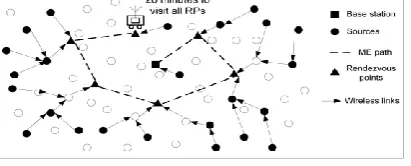
G. Xing at el (2008) formulates the minimum-energy rendezvous planning (MERP) problem which aims to find a set of RPs that can be visited by MEs within a required delay while the network energy consumed in transmitting data from sources to RPs is minimized
• They develop two rendezvous planning algorithms: RP-CP and RP-UG. RP-CP catches the optimal RPs when MEs move along the data routing tree. RP-UG is a utility-based acquisitive heuristic that can find RPs with good ratios of network energy saving to ME travel distance
• They design the Rendezvous-based Data Collection (RDC) protocol that facilitates reliable data transfers at RPs by efficiently coordinating MEs’ movement and data transmission/caching in the network
• The simulations based on realistic settings ofMica2 motes show that our approach significantly outperforms several other schemes in high-bandwidth data collection under temporal constraints
Fig 1 ME-based data collection
B. Efficient Data Collection in Wireless Sensor Networks with Path-Constrained Mobile Sinks
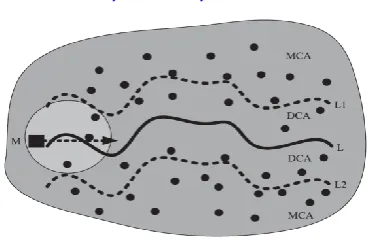
The sink mobility along a constrained path can improve the energy efficiency in wireless sensor networks. Due to the path constraint, a mobile sink with constant speed has limited communication time to collect data from the sensor nodes deployed arbitrarily. This poses significant challenges in jointly improving the amount of data collected and reducing the energy consumption. S. Gao at el (2011)proposed a novel data collection scheme, termed the Maximum Amount Shortest Path (MASP), that increases network throughput as well as conserves energy by optimizing the assignment of sensor nodes.
Path-Constrained Sink Mobility
Predictable sink mobility is exploited to improve energy efficiency of sensor networks. A mobile sink is fitted on a public transport vehicle which moves along a fixed path at times. However, all sensor nodes can only transfer data to the single mobile sink in one-hop mode. Actually, single-hop communication between all sensor nodes and the mobile sink may be infeasible due to the limits of existing road infrastructure and communication control. An architecture of wireless sensor networks with mobile sinks is proposed for a traffic investigation application. However, it is also assumed that all sensor nodes in MSSN are located within the direct communication range of the mobile sink.
Path-Controllable Sink Mobility
Fig 2 An example of path-constrained mobile WSNs
C. Maximizing the Lifetime of Wireless Sensor Networks with Mobile SinkiIn Delay-Tolerant Applications
This paper proposes a framework to maximize the lifetime of the wireless sensor networks (WSNs) by using a mobile sink when the underlying applications tolerate delayed information delivery to the sink. Inside a prescribed delay tolerance level, each node does not need to throw the data immediately as it becomes available. Instead, the node can store the data for the time being and transmit it when the mobile sink is at the most favorable location for achieving the longest WSN lifetime. To find the best solution within the projected framework, optimization problems that maximize the lifetime of the WSN subject to the delay bound constraints, node energy constraints, and flow conservation constraints.
Y. Yun at el (2010) conducted extensive computational experiments on the optimization problems and find that the lifetime can be increased significantly as compared to not only the stationary sink model but also more traditional mobile sink models and also shown that the delay tolerance level does not affect the maximum lifetime of the WSN.
III. EXISTING SYSTEM
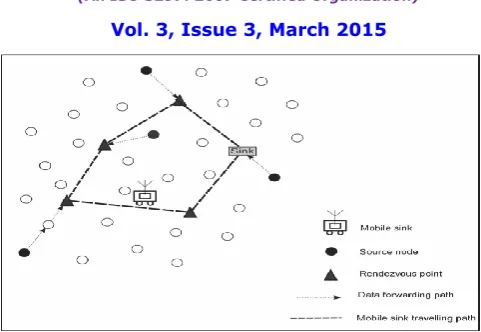
Several studies have demonstrated the benefits of using a mobile sink to reduce the energy consumption of nodes and to prevent the formation of energy holes in wireless sensor networks (WSNs). However, these benefits are dependent on the path taken by the mobile sink, mainly in delay-sensitive applications, as all sensed data must be composed within a given time constraint. An approach projected to address this challenge is to form a hybrid moving pattern in which a mobile-sink node only visits rendezvous points (RPs), as opposed to all nodes. Sensor nodes that are not RPs forward their sensed data via multi hopping to the nearest RP. The essential problem then becomes computing a tour that visits all these RPs within a given delay bound. Determining the optimal tour, however, is an NP-hard problem. To deal with this problem, a methodology called weighted rendezvous planning (WRP) is proposed, whereby every sensor node is assigned a weight corresponding to its hop distance from the tour and the number of data packets that it forwards to the closest RP.
In WSNs with a mobile sink, one fundamental problem is to determine how the mobile sink goes about collecting sensed data. One approach is to visit each sensor node to receive sensed data directly. This is essentially the well-known traveling salesman problem (TSP), where the goal is to find the shortest tour that visits all sensor nodes. To this end, researchers have proposed the use of rendezvous points (RPs) to bound the tour length. This means a subset of sensor nodes are designated as RPs, and non-RP nodes simply forward their data to RPs.
Fig 3 Hybrid movement pattern for a mobile sink node
Disadvantages
• Rendezvous points can collects the data from nodes directly instead of Cluster Head
• Mobile Sink’s range or heavy involvement of network periphery nodes in data retrieval, processing, buffering, and delivering tasks
• These nodes run the risk of rapid energy exhaustion resulting in loss of network connectivity and decreased network lifetime
• The specification of the appropriate number and locations of rendezvous Points (RPs) is crucia.
• The number of Rendezvous Points should be equivalent (neither small nor very large)to the deployment density of single nodes
IV. PROPOSED SYSTEM
In large –density applications, the sensor node should be transmits the sensed data to mobile sink within time constraint. The proposed system the cluster head transmits to Rendezvous point rather than all sensor nodes. Due to Processing overhead of Rendezvous point is not appropriate for large and delay sensitive applications. To overcome this problem, the proposed method is a Clustering Based Weighted Rendezvous Planning (CBWRP) algorithm for sensor networks. The sensor nodes are organized into clusters. Within a cluster, nodes transmit data to cluster head (CH) through routing protocol. In the clustering process, Cluster Head is elected for each cluster .CH have a responsibilities for collecting data from each sensor node and transmits data to nearest Rendezvous point.
High energy first (HEF) clustering algorithm is used for selecting cluster head with high ranking of residual energy of each sensor node. This algorithm is used for minimizes the energy depletion throughout sensor network field. The travelling Path of the Mobile Sink to visit all Rendezvous point which can be considered as a NP Hard problem. This problem taken as delay-aware energy efficient path (DEETP) and solved as Weighted Rendezvous Planning (WRP) algorithm.WRP algorithm calculating weight for each sensor node which can be computed by hop distance and number of packets forwarded.
HEF Clustering
Advantages
• HEF algorithm used for evaluate the efficient CH selection for achieving energy efficient wireless sensor network
• This method proved that the network lifetime can be efficiently prolonged and minimizes energy consumption • An algorithm can work very well to prolong the network lifetime for a period of time, a possible failure can be
catastrophic, resulting in the failure of a mission, or the loss of human life
V. MODULE DESCRIPTION
The proposed system consists of four modules and each module is dependent. Each module process an input taken from output of the previous partition. The flow of process can be executed and some modules have iterative process. The modules are,
Node Creation And Configuration
Clustering
Rendezvous Points Selection
Mobile-Sink Tour
A. Node Creation and Configuration
Start to proceed with the initialization script for NS-2 objects for configuring the parameters. The needed number of nodes is generated by using the node command in NS2. The nodes are disseminating in a wireless environment. The random motion is set as false. So, the nodes are not moving in a random direction. Each node is considered as an autonomous node. The nodes are configured as to process in WSN environment. The node configuration is done by using node-config command. For configuration, to specify the Channel used by the node, Radio propagation model, Link layer type, Physical layer type, Type of interface queue and the protocol used to route the packets dynamically. To specify parameters for the simulation are declared, to describe the desired topology and protocol stack.
B. Clustering
Sensor nodes grouped into clusters and each cluster have a leader called Cluster Head (CH).CH nodes aggregate the data and transmit them to the base station (BS) either directly or other CH nodes. High Energy First (HEF) algorithm used for evaluates the efficient CH selection for achieving energy efficient wireless sensor network. This method proved that the network lifetime can be efficiently prolonged and minimizes energy consumption.
HEF is a centralized cluster selection algorithm and core idea of this clustering algorithm is to choose the highest-ranking residue energy of sensor as a cluster head. Energy for each sensor node can be computed by Energy Consumption model which have transmitted power, receive power and sense power.
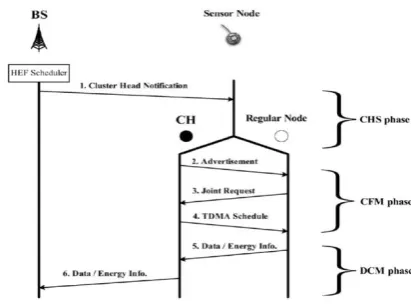
HEF algorithm consists of one or more rounds for CH selection to minimizing energy depletion. HEF selects cluster heads according to the energy remaining for each sensor node, and then the “setup” message (indicating cluster members, and the cluster head ID for each participated group) is sent to the cluster head of each cluster.Each round comprises the following three phases:
Cluster Head Selection(CHS) Phase
Cluster Formation(CFM) Phase
Data Communication(DCM) Phase
Conditions of HEF Algorithm
Each node works as a clustered node or a regular sensor node in a round.
Ec >=Er
where Ec -energy consumption for cluster rate.
Er- refers energy consumption for regular node
Fig 4 Phases of HEF algorithm
Steps of HEF Algorithm
• The cluster head of each group broadcasts the “setup” message inviting the neighbor sensor nodes to join its group
• After receiving the “setup” message at this round, the regular sensors send the “join” message to its corresponding cluster head to commit to associate with the group
• Each cluster head acknowledges the commitment, and sends TDMA schedule to its cluster members
• All sensors perform its sensing and processing and communication tasks cooperatively at this clock cycle (round)
• Each sensor sends its energy information to its cluster head at the end of this clock cycle
• Upon collecting cluster members’ information at a given period, the cluster head sends the summative report to the base station
C. Rendezvous Points Selection
WRP preferentially designates sensor nodes with the highest weight as a RP. The weight of a sensor node is calculated by multiplying the number of packets that it forwards by its hop distance to the closest RP on the tour. Thus, the weight of sensor node i is calculated as,
Wi = NFD (i) × H (i, M) eq (1)
where H(i,M) = {hi,mj|¥mk € M,hi,mj≤ hi,mk} eq (2)
hi,j is the hop distance between nodes i and j
NFD (i) = C (i, Tmj) +1 eq (3)
C (i, Tmj) is a function that returns the number of children that node i has in the data forwarding tree rooted at its
corresponding RP mj.
Based on eq (1), sensor nodes that are one hop away from an RP and have one data packet buffered get the minimum weight. Hence, sensor nodes that is farther away from the selected RPs or has more than one packet in their buffer have a higher priority of being recruited as an RP. The energy consumption is proportional to the hop count between source and destination nodes, and the number of forwarded data packets. Hence, visiting the highest weighted node will reduce the number of multihop transmissions and thereby minimizes the energy consumption.
In addition, as dense areas give rise to congestion points due to the higher number of nodes, energy holes are more likely to occur in these areas. Hence, a mobile sink that preferentially visits these areas will prevent energy holes from forming in a WSN. WRP Algorithm takes as input G (V, E), and it outputs a set of RPs. WRP first adds the fixed sink node as the first RP. Then, it adds the highest weighted sensor node. After that, WRP calls TSP to calculate the cost of the tour. If the tour length is less than the required length maximum length of traveled path, the selected node as an RP. Otherwise, it is removed from the tour.
After a sensor node is added as an RP, WRP removes that RPs from the tour that no longer receives any data packets from sensor nodes. This is because adding a sensor node to the tour may reduce the number of data packets directed to this RPs. Consequently, this step affords WRP more opportunities to add other nodes into the tour. Note that the variable “removed” is used to guarantee that an RP will be deleted from the tour only once. If a removed RP is added to the tour for the second time, because its corresponding variable “removed” is true, it will not be removed from the tour again. In this way, all sensor nodes will be added to the tour when the required tour length for a mobile sink is bigger than the time to visit all sensor nodes.
D. Mobile-Sink Tour
There are two types of sinks which one can be act as mobile element and other one act as Base Station. Travelling Salesman problem (TSP) used to find a shortest path for visiting all Rendezvous points by a Mobile-Sink node.A mobile sink that preferentially visits areas of RP will prevent energy holes from forming in a WSN. In clustering purpose only all the sensor nodes send its data’s to cluster head and cluster head sends the data’s to appropriate rendezvous point and mobile sink node travel along the network and collect the data’s from rendezvous point. This process to effectively save the energy of network.
During simulation time the events are traced by using the trace files. The performance of the network is evaluated by executing the trace files. The events are recorded into trace files while executing record procedure. In this procedure, the events trace like packet received, Packets lost, Last packet received time etc. These trace values are write into the trace files. It produce Performance analysis graph for average energy consumption between WRP and CBWRP.
VI. CONCLUSION AND FUTURE WORK
An WRP, which is a novel algorithm for controlling the movement of a mobile sink in a WSN. WRP selects the set of RPs such that the energy expenditure of sensor nodes is minimized and uniform to prevent the formation of energy holes while ensuring sensed data are collected on time. The proposed method is a Clustering Based Weighted Rendezvous Planning (CBWRP) algorithm for sensor networks. The sensor nodes are organized into clusters. Within a cluster, nodes transmit data to cluster head (CH) through routing protocol.HEF clustering algorithm is to choose the highest-ranking residue energy of sensor as a cluster head. This algorithm is used for minimizing energy depletion and maximizing the network lifetime. A mobile sink that preferentially visits areas of RP will prevent energy holes from forming in a WSN.
The time complexity of our algorithm is dependent on how many times WRP calls the TSP solver to calculate a tour that visits all RPs. The highest weighted node will reduce the number of multihop transmissions and thereby minimizes the energy consumption. This method makes that the network lifetime can be efficiently prolonged and minimizes energy consumption. This system minimizes the number of multi hop transmissions in the data collection by the Mobile Sink (MS). It produce Performance analysis graph for average energy consumption between WRP and CBWRP.
REFERENCES
[2] S. Gao, H. Zhang, and S. Das, “Efficient data collection in wireless sensor networks with path-constrained mobile sinks,” IEEE Transactions Mobile Computing, vol. 10, no. 4, pp. 592–608, Apr. 2011.
[3] W. Liang, J. Luo, and X. Xu, “Prolonging network lifetime via a controlled mobile sink in wireless sensor networks,” in Proc. IEEE Global Telecommunications Conf., Miami, FL, USA, pp. 1–6, Dec. 2010.
[4] K. Almi’ani, A. Viglas, and L. Libman, “Energy-efficient data gathering with tour length-constrained mobile elements in wireless sensor networks,” in Proc. 35th IEEE Conf. LCN, Denver, CO, USA, pp. 582–589, Oct. 2010.
[5] Y. Yun and Y. Xia, “Maximizing the lifetime of wireless sensor networks with mobile sink in delay-tolerant applications,” IEEE Trans. Mobile Computing, vol. 9, no. 9, pp. 1308–1318, Sep. 2010.
[6] G. Xing, T. Wang, Z. Xie, and W. Jia, “Rendezvous planning in wireless sensor networks with mobile elements,” IEEE Trans. Mobile Computing, vol. 7, no. 12, pp. 1430–1443, Dec. 2008.
[7] S. Basagni, A. Carosi, E. Melachrinoudis, C. Petrioli, and Z. M. Wang, “Controlled sink mobility for prolonging wireless sensor networks lifetime,” Wireless Networks, vol. 14, no. 6, pp. 831–858, Dec. 2008.
[8] G. Xing, T. Wang, W. Jia, and M. Li, “Rendezvous design algorithms for wireless sensor networks with a mobile base station,” in Proc. 9th ACM Int. Symp. Mobile ad hoc Network Computing., Hong Kong, China, pp. 231–240, May 2008.
BIOGRAPHY
Brindha L is a PG Student in the Computer Science and Engineering Department, Sri Shanmugha College of Engg. and Technology, Tiruchengode, Tamil Nadu, India. She received Bachelor of Engineering in Computer Science and Engineering (BE) degree in 2009 from Sengunthar Engineering College, Tiruchengode, Tamil Nadu, India. Her research interests includes Computer Networks (wireless Networks).