Volume 2010, Article ID 324780,9pages doi:10.1155/2010/324780
Research Article
Primal Decomposition-Based Method for Weighted Sum-Rate
Maximization in Downlink OFDMA Systems
Chathuranga Weeraddana, Marian Codreanu, Wei Li, and Matti Latva-Aho
Centre for Wireless Communications, University of Oulu, P.O. Box 4500, 90014 Oulu, Finland
Correspondence should be addressed to Chathuranga Weeraddana,[email protected]
Received 19 September 2009; Revised 29 December 2009; Accepted 8 March 2010
Academic Editor: Ping Wang
Copyright © 2010 Chathuranga Weeraddana et al. This is an open access article distributed under the Creative Commons Attribution License, which permits unrestricted use, distribution, and reproduction in any medium, provided the original work is properly cited.
We consider the weighted sum-rate maximization problem in downlink Orthogonal Frequency Division Multiple Access (OFDMA) systems. Motivated by the increasing popularity of OFDMA in future wireless technologies, a low complexity suboptimal resource allocation algorithm is obtained for joint optimization of multiuser subcarrier assignment and power allocation. The algorithm is based on an approximated primal decomposition-based method, which is inspired from exact primal decomposition techniques. The original nonconvex optimization problem is divided into two subproblems which can be solved independently. Numerical results are provided to compare the performance of the proposed algorithm to Lagrange relaxation based suboptimal methods as well as to optimal exhaustive search-based method. Despite its reduced computational complexity, the proposed algorithm provides close-to-optimal performance.
1. Introduction
Orthogonal Frequency Division Multiple Access (OFDMA) plays a major role in the physical layer specifications of future wireless technologies (e.g., 3G-LTE, WIMAX, IMT-A) [1–4]. In OFDMA systems, the transmit power and subcarriers are dynamically assigned to the users, based on their channel state information (CSI) to optimize a certain performance criteria [5–22]. In general, this process requires solving combinatorial optimization problems. Thus, the existing convex optimization techniques cannot be directly applied, and the complexity of the problem increases exponentially with the number of subcarriers.
Two main radio resource allocation (RRA) problems have been addressed in the literature. The first ones, consist of maximizing an increasing function of the user rates [5–13] subject to different power constraints, whilst the second ones consist of minimizing the transmit power subject to constraints on the minimum user rates [13–17]. A suboptimal greedy method for maximizing the smallest rate among the users has been proposed in [5]. A branch-and-bound based algorithm for sum-rate maximization has been proposed in [6]. However, in practice the branch-and-bound
Subcarriers
1 2 3 4 M
Time User 1
User 2
UserK
Subcarriers allocated for user 1 Subcarriers allocated for user 2 Subcarriers allocated for userK
Figure1: Downlink OFDMA system withKusers andMsubcarriers.
nonconvexity of the optimization problem the optimality of the algorithm is not guaranteed.
In this paper, we propose an alternative method based on the primal decomposition technique [24, 25]. Using numerical simulations, its performance is compared to Lagrangian relaxation based algorithm [13] as well as to the optimal exhaustive search algorithm. Numerical results show that the proposed algorithm converges very fast. Although, the optimality of the final value cannot be guaranteed due to the nonconvexity of the problem, the simulations show that rate-region achieved by the proposed algorithm exactly matches with the one obtained using optimal exhaustive search algorithm.
The rest of the paper is organized as follows. InSection 2
we present the system model and problem formulation. The proposed algorithm is presented in Section 3 and convergence properties are discussed inSection 4.Section 5
compares the complexity of the proposed algorithm to Lagrangian relaxation-based algorithm in [13] as well as to the optimal exhaustive search based method. The numerical simulation results are presented in Sections 6, and 7 con-cludes our paper.
Notations. |x|denotes the absolute value of complex num-berx.xTrepresents the transpose of vectorxande
idenotes
theith standard unit vector.CN(c,σ2) stands for circularly
symmetric complex Gaussian distribution with mean c, variance σ2/2 per dimension. For any real number r, [r]+
denotes max{0,r}.
2. System Model and Problem Formulation
Consider a single antenna (Note that, under OFDMA assumption, extension to the multiple antennas case is straightforward [26].) OFDMA downlink transmission with
K users andMsubcarriers as shown inFigure 1. The signal received by userkin subcarriermcan be expressed as
rkm=hkmxkmpkm+wkm, k=1,. . .,K, m∈Sk, (1)
where k is the user index, m is the subcarrier index, Sk
denotes the set of subcarriers allocated to userk,xkm is the
transmitted signal,pkmis the power allocated,hkmis channel
frequency response, andwkmis the received noise. We assume
thathkmis time-invariant and its value is available at the base
station. The noise samples are assumed to be independent and identically distributed aswkm∼CN(0,σkm2 ). We denote
by ckm = |hkm|2/σkm2 the channel signal-to-noise ratio
(SNR) of kth user in subcarrier m and by βk the weight
associated with the rate of user k. The weighted sum-rate maximization problem subject to a sum-power constraintPT
can be formulated as [13]
maximize
K
k=1
m∈Sk
βklog2
1 +pkmckm
subject to
K
k=1
m∈Sk
pkm=PT
Sk∩Sl= ∅, ∀k /=l
pkm≥0, k=1,. . .,K, m=1,. . .,M,
(2)
where variables arepkmandSk.
It is also useful to introduce a virtual system where each subcarrier can be used by all users in the same time. This results in a general OFDMA downlink channel where the signal received by userkin subcarriermis given by
rkm=hkmxkm
pkm+hkm K
i /=k xim
pim+wkm (3)
decoding at receivers, the weighted sum-rate maximization problem for the virtual system can be formulated as
maximize
where the optimization variables are pkm. The constraints
associated with orthogonal subcarrier allocations in problem (2) have been dropped out and the interference among users allocated to the same subcarrier is reflected in the objective.
Here we can make several observations. First, any solution of problem (4) is such that the second constraint in problem (2) is automatically satisfied, for reasons that will be explained in the beginning ofSection 3.2. In other words, any solution of problem (4) is feasible for problem (2). Moreover, at any of these solutions the objective function of problem (4) will be exactly the same as the objective function of problem (2). Based on these observations it can be concluded that any solution of the auxiliary problem (4) is a solution for the original problem (2) as well.
The original problem (2) is combinatorial and it requires exponential complexity to find a global optimum. Although problem (4) is still nonconvex it is noncombinatorial. Thus, in the following, we focus on solving problem (4) instead of solving the original problem (2). A similar approach has been used in [7] to solve the (nonweighted) sum-rate maximization problem, that is, for the particular caseβk =
1,k=1,. . .,K. However, the methods proposed there do not apply to the general case of arbitrary weights, for reasons that will become clear inSection 3.3. Due to the nonconvexity of problem (4) finding the global optimum is intractable. Thus, an approximative method inspired from the primal decomposition technique is presented inSection 3.
3. Approximated Primal
Decomposition- (APD-) Based Algorithm
3.1. Primal Decomposition. To reveal the complicating con-straints [24], we introduceMnew variablespm=K
where the optimization variables arepkmandpm. Note that pmrepresents the total power on subcarrierm. Treating pm
as complicating variables, problem (5) can be decomposed [24, 25] into a master problem and M subproblems, one subproblem for each subcarrierm = 1,. . .,M. For a given subcarrierm, the subproblem is given by
maximize
can be expressed as
maximize
3.2. Algorithm Derivation. Let us denote byP the feasible set of problem (6). Note that subproblem (6) is not a convex optimization problem (Since we maximizea convex function.). However, its objective function is convex with respect to (w.r.t.) optimization variables p1m,. . .,pKm, its
feasible set is a nonempty convex polyhedral set (i.e., a simplex [27]) and its objective is bounded above on P. Thus, by following the approach of [7, Section III], from [28, Corollary 32.3.4] (If a convex function f is bounded above on a convex setX⊆dom f, then the maximum of f relative toXis attained at one of the finitely many extreme points ofX.) it follows that the solutions of subproblems (6) must be achieved at one of the vertices of the polyhedral setP. Consequently, the solutions of theM subproblems can be expressed as
p1m,. . .,pKm
=pmeTjm, m=1,. . .,M, (8)
where jm represents the index of the user allocated tomth
subcarrier, that is,
We note that the index jm depends on pm according to (9)
and the function fm(pm) is the pointwise maximum of a
set of concave functions. Therefore fm(pm) is not a concave
function w.r.t. pm [27] in general. Thus, standard convex
optimization tools (e.g., subgradient-based methods) cannot be directly applied to solve master problem (7).
We propose an iterative method, where at each iteration
iwe first solve theMsubproblems (6) to obtain an user-to-carrier allocationjm(i)for a given subcarrier power allocation p(mi),m=1,. . .,M. Then, the objective of the master problem is approximated by the following lower bound
M
whereP denotes the feasible set of the master problem (7). The lower bound is concave w.r.t.p1,. . .,pMand the solution of the approximated master problem can be found by multilevel waterfilling algorithm [9]. The resulting solution is used as subcarrier power allocation for the next iteration. The proposed algorithm can be summarized as follows.
Algorithm 1. Approximated primal decomposition (APD) for OFDMA weighted sum-rate maximization.
(1) initialization:i=1,pm(i)=PT/M.
(2) solve theMsubproblems (6) forpm=p(mi)and return
jm(i),m=1,. . .,Mcomputed according to (9).
(3) solve the following approximation of master problem (7) (4) check a stopping criteria; if it is satisfied EXIT,
otherwise leti=i+ 1 and go to step (2).
The solution of problem (13) solved at step (3) is given by the following multilevel waterfilling expression [9]:
pm=
whereLis chosen such that the power constraint is satisfied with equality, that is,
L=PT+
3.3. Particularization to the Sum-Rate Maximization. The problem of the sum-rate maximization (i.e.,βk = 1 for all k =1,. . .,K) in downlink OFDMA systems is solved in [7, Section III]. The solution method is exactly equivalent to only one iteration of the APD algorithm. Unlike the general weighted sum-rate maximization, in which user weightsβk’s
are different, in the sum-rate maximization (i.e., βk = 1
the function f
m(pm) is not concave w.r.t. pmwhen the user
weightsβk’s are different). As a result, the inequality given in
(12) holds with equality and solving problem (7) gives the optimal subcarrier power allocation [7, Section III].
4. Convergence Behavior and Exit Criterion
In this section, we start by investigating the monotonicity of the proposed algorithm. Then we provide a specific exit criterion which certifies that algorithm converged to a fixed power and subcarrier allocation followed by a simple graphical illustration.
4.1. Monotonic Behavior. The following theorem states the monotonic behavior of the proposed algorithm.
Theorem 1. For any iterationi≥1,
that is, the proposed APD method is an ascent algorithm.
Proof. From (10) and (11), it follows that the solution of (6) in iterationiis given by,
fm
Now we can write the following chain of relations,
M
where the first inequality follows from (13), the second one follows trivially from the maximization over the users, and the last equality follows from (11) and (10), respectively.
increasing in the objective between two successive iterations is below a certain predefined threshold. However, for the proposed algorithm we are able to find an exit criterion which certifies that algorithm converged to a fixed power and subcarrier allocation and further improvement is not possible. This is described by the following theorem.
Theorem 2. If at iterationn+ 1, (n≥1) we havejm(n)=jm(n+1), m=1,. . .,Mthen the following holds:
(1) jm(i)=jm(n), for alli≥n,m=1,. . .,M,
(2) p(mi)=p(mn+1), for alli≥n+ 1,m=1,. . .,M,
(3)Mm=1 fm(p(mi))−
M
m=1 fm(pm(n+1))=0, for alli≥n+1.
That is, the algorithm converges to a fixed power and subcarrier allocation.
Proof. Since ckm’s are continuous random variables, the
probability to have multiple solutions for (9) is zero. Thus, in the following we assume that jm given by (9) is unique
(Equation (9) has multiple solutions if and only ifckm =clm
for somel /=k. Whenpm=0 we assignjmany arbitrarily user
index.).
Note that the objective function of (13) is strictly concave. Thus it has a unique solution [27]. Therefore, for all m, jm(n) = jm(n+1) implies that p(mn+1) = p(mn+2). Since
(9) has a unique solution as well,p(mn+1) = p(mn+2) further
implies that jm(n+1)= jm(n+2). Since we have shown thatjm(n)= jm(n+1) implies that jm(n+1)=jm(n+2), item (1) follows directly by
induction. Furthermore, item (2) follows from item (1) by the uniqueness of the solution of problem (13). Finally, item (3) follows trivially from item (2).
Thus the exit criterion checks if the subcarrier allocation between two successive iterations remains unchanged. Such point is a local optimum (possible global) in the sense that the objective cannot be increased by changing the power allocation or subcarrier allocation only.
As a specific example, consider the simple OFDMA system with two subcarriers (i.e., m = 1, 2). By performing the variable transformations p1 = (1 −
t)PT andp2 =tPT,t∈[0, 1], we can express the variation
of2m=1fm(pm) onP as,
h(t)=max
k βklog2(1 + (1−t)PTck1)
+ max
k βklog2(1 +tPTck2),
(19)
which is plotted inFigure 2. According toFigure 2(a)global optimal is achieved at the iteration (i+ 3). Achieving global optimality is not always possible because, quasiconcavity [27] ofh(t) cannot be guaranteed with random channel SNR,
ckm. Consequently the APD algorithm can converge to a local
optimal solution as shown inFigure 2(b).
5. Complexity Analysis
In this section, we analyze and compare the computational complexity of the proposed APD algorithm to Lagrangian
h(t)
0 t(i) t(i+1) t(i+2) t=t(i+3)=t(i+4). . . 1 t j(mi)
jm(i+1)
jm=jm(i+2)=jm(i+3)=jm(i+3)=jm(i+4). . .
(a) Convergence to the global optimal solution
h(t)
0 t(i) t(i+1) t(i+2)=t(i+3) t 1 t j(mi)
j(mi+1)
jm(i+2)=j(mi+3). . .
j m
(b) Convergence to a local optimal solution
Figure2: Convergence of APD algorithm.
relaxation-based algorithm [13] as well as to the opti-mal exhaustive search algorithm. With K users and M
subcarriers, altogether we haveKM user-subcarrier
combi-nations. Therefore finding optimal subcarrier and power assignment requires KM searches. Combined with
multi-level waterfilling at each instance of subcarrier assignment,
O(MKM) operations are required to find the solution.
The algorithm proposed in [13] for the weighted sum-rate maximization problem requiresO(MK) operations to obtain a suboptimal solution. The proposed APD algorithm described in Section 3requires O(MK) operations in step (2) andO(Mlog2M) operations (This is the number of operations required in ordering.) in step (3). In practice, it is reasonable to assume thatK log2M (The assumption is reasonable since the number of users simultaneously serviced by the system can be very large. For example, in a Wi-Max systemM can be up to 2048 [29]. However, the value of log2M will not become very large (in a WiMax system log2M =11 at most).). Therefore the complexity of the APD algorithm can be approximated byO(MK).
6. Numerical Results
The performance of the proposed APD algorithm is com-pared to the dual decomposition-based algorithm proposed in [13], denoted as WSRmax, as well as to the optimal algo-rithm based on exhaustive search. The WSRMax algoalgo-rithm uses a bisection search method to update the dual variableλ
[λmin,λmax], we exploit the fact that the subgradient of the
dual function can be analytically computed. Since the dual function is convex, the sign of its subgradients changes as we pass through the minimum point of the dual function [13, equation (11)]. Therefore, we use a grid search (with step size 1) to identify the interval in which the subgradient of dual function changes its sign, and it is used as initial bisection search interval. Thus, the interval [λmin,λmax] is guaranteed
to contain the optimal value of the the dual function and the width of the initial interval is one, that is, (λmax−λmin) =
1. The proposed APD algorithm is initialized by allocating equal power to all subcarriers.
In what follows, we compare the convergence behavior of the APD and the WSRMax algorithms. For a fair comparison, we define the following metric:
ΔCweighted sum=E
the average normalized weighted sum-rate deviation, where
Coptis the optimal weighted sum-rate value obtained using
optimal exhaustive search,Csubopt is the estimated objective
value from either the APD algorithm or the WSRMax algorithm, and expectation E{·} is taken w.r.t. channel realization. An OFDMA system with M = 8 subcarriers and a uniform power delay profile with 4 channel taps is considered. We assumeσ2
km = σ2,k = 1,. . .,K,m =
1,. . .,Mand define SNR per subcarrier asPT/(M·σ2).
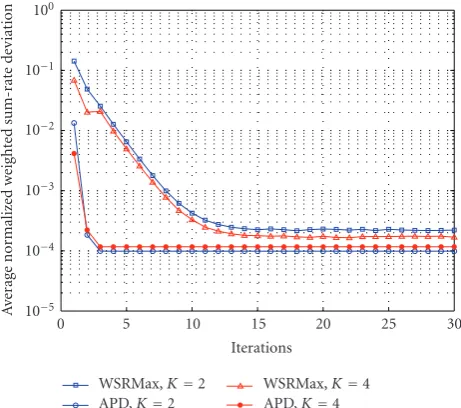
Figure 3shows the convergence behavior of the consid-ered algorithms with SNR= 10 dB for K = 2 and K =
4 users. The weights of the users are [1, 2] for K = 2 and [1, 2, 1, 2] for K = 4. The floor of the curves is due to the suboptimality of the algorithms. The results show that the APD algorithm converges faster than the WSRMax algorithm and provides smaller average normalized weighted sum-rate deviations. Specifically, for both cases,K =2 and
K = 4, the APD algorithm requires only 3 iterations on average to achieve an average normalized weighted sum-rate deviation of 10−4 whilst the WSRMax algorithm requires
around 15 iterations to reach the same accuracy level. It is intuitively obvious that the number of iterations required by the APD algorithm is sensitive to the nature of the surface of the objective functionMm=1 f
m(pm) of problem (7), for
example, see Figure 2. In general, it is a hard to quantify the number of iterations before convergence (or any bounds on the number of iterations) due to the nonconvexity of problem (5). However, the numerical results suggest that the APD algorithm often converges very fast in practice. It should be emphasized that the number of iterations required in the initialization of the WSRmax algorithm (i.e., the number of iterations required to find the initial bisection search interval) is not considered when drawing the curves. In particular, for the initialization process, the WSRMax algorithm requires a several number of steps (each step has complexity of O(MK)) and the proposed APD algorithm requires none. Moreover, it is hard to find good initialization methods for the WSRMax algorithm (i.e., initialization for bisection search method) compromising
0 5 10 15 20 25 30
Figure3: Average normalized weighted sum-rate deviation versus
iterations forK =2 and 4 users,M =8 subcarriers, and SNR= 10 dB.
between the number of steps required in the initialization and the width of the initial searching interval (λmax − λmin). Consequently, additional precautions are required and
therefore, in practical implementations the APD algorithm is more favorable compared to the WSRMax algorithm.
In the sequel, we compare the behavior of the APD and the WSRMax algorithms using the following metric:
Pε=ProbCopt−Csubopt> ε
, (21)
the probability of missing the global optimal, where ε is a small number which quantifies the maximum admissible deviation betweenCoptandCsubopt. It is considered that the
global optimum is missed ifCsuboptis more thanεaway from
Copt.
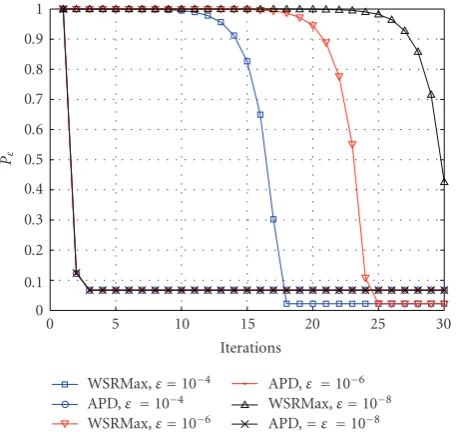
Figure 4 uses the same simulation setup as that in
Figure 3and depicts the variation of probability of missing the global optimal, Pε with the number of iterations. The
floor of probabilityPε is again due to the suboptimality of
both algorithms. The influence ofεonPεis totally
indistin-guishable in case of the APD algorithm. This behavior shows that the proposed algorithm APD can arrive very close-to-optimal solutions within a very small number of iterations and then it remains there. The results further show that thePε
evaluated using the WSRMax algorithm is highly dependent onε. That is, the smaller the deviations in theCsubopt from
the optimalCopt, the larger the number of iterations required
by the WSRMax algorithm to reach the expected target value
Pε. Therefore, independent from theε, the APD algorithm
allows to find a suboptimal solution within a small number of iterations at the expense of a slight increase inPε. These
observations are very useful in practice since they carry sig-nificant information in the system design point of view. For example, consider a design requirementP10−4 ≤ 0.3. Here,
0 5 10 15 20 25 30
Figure4: Probability of missing global optimum versus iterations
forK=2 users,M=8 subcarriers, and SNR=10 dB.
more the design requirement asP10−6≤0.3, then the number
of iterations required by the WSRmax increases to 24. In con-trast, the APD algorithm always requires just one iteration.
Figure 5 shows the rate region (The standard way to characterize the boundary points in the 2-user rate region is by solving problem (4) forβ1=αandβ2=1−α, whereα∈
[0, 1] [30].) computed by using all considered algorithms. The same simulation setup as in [13] was used whereM=8,
K = 2,PT = 16 and the channel SNR vectors for users 1
and 2 are 10[12, 22,. . .,M2]T and 10[M2, (M−1)2
,. . ., 12]T,
respectively. Although the computational complexity of the proposed algorithm is much smaller compared to that of optimal exhaustive search-based method,Figure 5indicates that the rate region obtained by the APD algorithm almost coincides with the optimal rate region. This behavior is expected since the average normalized weighted sum-rate deviation, (20) is in the order of 10−4as shown inFigure 3.
In the following we compare the behavior of the APD and the WSRmax algorithm for large number of subcarriers and users. Since, for large number of users and subcarriers the complexity of evaluatingCopt is prohibitively high, the
metrics defined in (20) and (21) are not used. The behavior of the APD algorithm is compared with that of the WSRmax algorithm.
In Figure 6, the evolution of the expected weighted sum-rate provided by the APD algorithm is compared to the resulting expected weighted sum-rate from the WSRmax algorithm, where the expectation is taken w.r.t. channel realization. An OFDMA system withM=256 subcarriers, a uniform power delay profile with 128 channel taps, andK=
8, 16, 32, 64 users is considered. The weights of the users are taken from the sequence{1, 2, 1, 2,. . ., 1, 2}, (e.g., whenK=
8, weights are [1, 2, 1, 2, 1, 2, 1, 2]). The SNR is assumed to be 10 dB. The results show that even for a large number of
car-0 0 10 15 20 25 30 35
User 1’s achieveable data rate 0
Figure5: Data rate region with 2 users and 8 subcarriers.
0 5 10 15
Figure6: Evolution of expected weighted sum-rate,K=8,16,32,64
users,M=256 subcarriers, and SNR=10 dB.
riers, the APD algorithm converges very fast as compared to the WSRMax algorithm independent of the number of users.
7. Conclusions
suboptimal, but still very close-to-optimal solution with very high probability (i.e., more than 90% of the time). Unlike the recently proposed WSRMax algorithm [13], the APD algorithm requires no additional precautions in the initialization, and convergence to a suboptimal solution is possible within a very small number of iterations. Although the proposed primal decomposition-based solution method does not rely on zero duality gap for proving the optimality in the case of large number of subcarriers, our computational experience with larger number of subcarriers suggests that the proposed APD algorithm is capable of finding the same solution as the WSRmax algorithm (which is asymptotically optimal when the number of carriers grows to∞) even with very few iterations.
Acknowledgment
This research was supported by the Finnish Funding Agency for Technology and Innovation (Tekes), Academy of Finland, Nokia, Nokia Siemens Networks, Elektrobit, Graduate School in Electronics, Telecommunications and Automation (GETA) Foundations, Nokia Foundation, and Tauno T¨onning Foundation.
References
[1] S. Sesia, I. Toufic, and M. Baker,LTE—The UMTS Long Term Evolution, John Wiley & Son, Oxford, UK, 2009.
[2] S. H. Ali, K.-D. Lee, and V. C. M. Leung, “Dynamic resource allocation in OFDMA wireless metropolitan area networks [Radio Resource Management and Protocol Engineering for IEEE 802.16],”IEEE Wireless Communications, vol. 14, no. 1, pp. 6–13, 2007.
[3] T. Kwon, H. Lee, S. Choi, et al., “Design and implementation of a simulator based on a cross-layer protocol between MAC and PHY layers in a WiBro compatible,”IEEE Communications Magazine, vol. 43, no. 12, pp. 136–146, 2005.
[4] C. Y. Huang, H.-H. Juan, M.-S. Lin, and C.-J. Chang, “Radio resource management of heterogeneous services in mobile WiMAX systems,”IEEE Wireless Communications, vol. 14, no. 1, pp. 20–26, 2007.
[5] W. Rhee and M. Cioffi, “Increase in capacity of multiuser OFDM system using dynamic subchannel allocation,” in
Proceedings of the IEEE Vehicle Technology Conference, vol. 2, pp. 1085–1089, Tokyo, Japan, May 2000.
[6] Z. Mao and X. Wang, “Branch-and-bound approach to OFDMA radio resource allocation,” inProceedings of the IEEE Vehicle Technology Conference, pp. 1–5, Montreal, Canada, September 2006.
[7] G. Li and H. Liu, “On the optimality of the OFDMA network,”
IEEE Communications Letters, vol. 9, no. 5, pp. 438–440, 2005. [8] J. Jang and K. B. Lee, “Transmit power adaptation for multiuser OFDM systems,”IEEE Journal on Selected Areas in Communications, vol. 21, no. 2, pp. 171–178, 2003.
[9] L. M. C. Hoo, B. Halder, J. Tellado, and J. M. Cioffi, “Multiuser transmit optimization for multicarrier broadcast channels: asymptotic FDMA capacity region and algorithms,” IEEE Transactions on Communications, vol. 52, no. 6, pp. 922–930, 2004.
[10] W. Yu and J. M. Cioffi, “FDMA capacity of Gaussian multiple-access channels with ISI,”IEEE Transactions on Communica-tions, vol. 50, no. 1, pp. 102–111, 2002.
[11] C. S. Bae and D.-H. Cho, “Fairness-aware adaptive resource allocation scheme in multihop OFDMA systems,”IEEE Com-munications Letters, vol. 11, no. 2, pp. 134–136, 2007. [12] Z. Shen, J. G. Andrews, and B. L. Evans, “Adaptive resource
allocation in multiuser OFDM systems with proportional rate constraints,”IEEE Transactions on Wireless Communications, vol. 4, no. 6, pp. 2726–2736, 2005.
[13] K. Seong, M. Mohseni, and J. M. Cioffi, “Optimal resource allocation for OFDMA downlink systems,” inProceedings of the IEEE International Symposium on Information Theory, pp. 1394–1398, Seattle, Wash, USA, July 2006.
[14] C. Y. Wong, R. S. Cheng, K. B. Letaief, and R. D. Murch, “Multiuser OFDM with adaptive subcarrier, bit, and power allocation,”IEEE Journal on Selected Areas in Communications, vol. 17, no. 10, pp. 1747–1758, 1999.
[15] G. Zhang, “Subcarrier and bit allocation for real-time services in multiuser OFDM systems,” in Proceedings of the IEEE International Conference on Communications, vol. 5, pp. 2985– 2989, Paris, France, June 2004.
[16] D. Kivanc, G. Li, and H. Liu, “Computationally efficient bandwidth allocation and power control for OFDMA,”IEEE Transactions on Wireless Communications, vol. 2, no. 6, pp. 1150–1158, 2003.
[17] W. W. L. Ho and Y.-C. Liang, “Optimal resource allocation for multiuser MIMO-OFDM systems with user rate constraints,”
IEEE Transactions on Vehicular Technology, vol. 58, no. 3, pp. 1190–1203, 2009.
[18] C. Y. Wong, R. S. Cheng, K. B. Letaief, and R. D. Murch, “Multiuser OFDM with adaptive subcarrier, bit, and power allocation,”IEEE Journal on Selected Areas in Communications, vol. 17, no. 10, pp. 1747–1758, 1999.
[19] M. Ergen, S. Coleri, and P. Varaiya, “QoS aware adaptive resource allocation techniques for fair schesuling in OFDMA based broadband wireless access systems,”IEEE Transactions on Broadcasting, vol. 49, no. 4, pp. 362–370, 2003.
[20] G. Li and H. Liu, “Downlink radio resource allocation for multi-cell OFDMA system,” IEEE Transactions on Wireless Communications, vol. 5, no. 12, pp. 3451–3459, 2006. [21] G. Li and H. Liu, “Resource allocation for OFDMA relay
networks with fairness constraints,”IEEE Journal on Selected Areas in Communications, vol. 24, no. 11, pp. 2061–2068, 2006. [22] I. Kim, I.-S. Park, and Y. H. Lee, “Use of linear program-ming for dynamic subcarrier and bit allocation in multiuser OFDM,”IEEE Transactions on Vehicular Technology, vol. 55, no. 4, pp. 1195–1207, 2006.
[23] D. P. Bertsekas,Network Optimization Continuous and Discrete Models, Athens Scientific, Belmont, Mass, USA, 1999. [24] S. Boyd, “Primal and dual decomposition. Course
reader for convex optimization II, Stanford,” 2007,
http://www.stanford.edu/class/ee364b/.
[25] D. P. Palomar and M. Chiang, “Alternative distributed algo-rithms for network utility maximization: framework and applications,”IEEE Transactions on Automatic Control, vol. 52, no. 12, pp. 2254–2269, 2007.
[26] D. Tse and P. Viswanath,Fundamentals of Wireless Communi-cation, Cambridge University Press, Cambridge, UK, 2005. [27] S. Boyd and L. Vandenberghe, Convex Optimization,
[28] R. T. Rockafellar,Convex Analysis, Princeton University Press, Prinston, NJ, USA, 1970.
[29] L. Nuaymi,WiMax Technology for Broadband Wireless Access, John Wiley & Sons publication, Oxford, UK, 2007.