University of Warwick institutional repository: http://go.warwick.ac.uk/wrap
This paper is made available online in accordance with publisher policies. Please scroll down to view the document itself. Please refer to the repository record for this item and our policy information available from the repository home page for further information.
To see the final version of this paper please visit the publisher’s website. Access to the published version may require a subscription.
Author(s): Michael J. Mol, Pieter Pauwels, Paul Matthyssens and Lieven Quintens
Article Title: A technological contingency perspective on the depth and scope of international outsourcing
Year of publication: 2004 Link to published article:
http://dx.doi.org/10.1016/j.intman.2004.02.005
A TECHNOLOGICAL CONTINGENCY PERSPECTIVE ON
THE DEPTH AND SCOPE OF INTERNATIONAL OUTSOURCING
Michael J. Mol1
Nijmegen University, Nijmegen School of Management, The Netherlands
Pieter Pauwels
Maastricht University, Faculty of Economics and Business Administration, The Netherlands
Paul Matthyssens
Limburg University Center, Faculty of Applied Economic Sciences, Belgium and Erasmus University Rotterdam, Rotterdam School of Management, The Netherlands
Lieven Quintens
Limburg University Center, Faculty of Applied Economic Sciences, Belgium
A TECHNOLOGICAL CONTINGENCY PERSPECTIVE ON
THE DEPTH AND SCOPE OF INTERNATIONAL OUTSOURCING
ABSTRACT
In this study we present and test a technological contingency perspective on two dimensions
of international outsourcing: depth and scope. The depth of international outsourcing refers to
the ratio of foreign to total outsourcing. The scope of international outsourcing captures the
degree of psychic dispersion between the country of operations and the countries a firm is
outsourcing from. Using multiple regression analysis on a sample of 189 firms in the
Netherlands, the effect of five technological contingency factors is measured: product
innovation, technological and volume uncertainty, asset specificity, and the integration of the
outsourcing function. A most interesting finding is that technological uncertainty and the
degree of product innovation turn out to be both positively associated with a high scope/low
depth type of international outsourcing and negatively associated with a low scope/high depth
type of international outsourcing. The findings create a platform for a two-dimensional
typology, which provides an explanatory logic for the expansion and development path of
international outsourcing.
KEY WORDS
INTRODUCTION
International outsourcing has been identified as one of the major trends both in purchasing
management (Trent and Monczka, 1998; Carter et al., 2000) and international business
(Kotabe, 1998). Through the expansion of their supply base across geographical borders firms
open up a wider potential supply range that enables them to select world-class suppliers and
effectively minimize the cost of supplies (Bryce and Useem, 1998). Notwithstanding its
potential strategic and financial impact, international outsourcing remains a somewhat
neglected phenomenon in the empirical purchasing and supply chain literature (Petersen,
Frayer and Scannell, 2000) and has often been considered an off-center topic in the
international business literature (Murray, Kotabe and Wildt, 1995; Buckley, 2002). For
instance, no more than ten articles could be retrieved from the Journal of International
Business Studies archive (1970 – 2002) that specifically dealt with international (out)sourcing
or organizational purchasing across borders. If available, empirical insight dates back to the
late 1980s and early 1990s and is mostly exclusively focused on the international outsourcing
behavior of US based firms. Research on outsourcing internationalization by European firms
has been confined to case based explorations of the structure and functions of particular
outsourcing networks (e.g., Dubois, 1998; Ford, 1998). As a consequence, hardly any
empirical evidence on international outsourcing strategies in Europe is available. As a
consequence of the relatively poor coverage and theoretical isolation of international
outsourcing, some fundamental questions on this phenomenon remain unanswered.
A prime question is whether international outsourcing is to be considered a re-active
manifestation of a cost-minimizing strategic approach or rather a pro-active value-maximizing
Bailey, Masson and Raeside, 2002). For the present study we also include the latter
perspective, which points at the critical role of international outsourcing in the strategic and
technological prowess of firms (Kotabe, 1998; Petersen et al., 2000). Dunning (1993) has
suggested that international outsourcing may be used most frequently for either very low tech
or very high tech products but not much in the intermediate range. To the best of our
knowledge, this suggested U-curve is still to be investigated empirically.
The present paper focuses on the effect of technological contingencies on international
outsourcing. More specifically, we investigate the impact of product innovation, volume and
technological uncertainty, asset specificity, and the integration of the outsourcing function on
the degree of international outsourcing. A highly related but more dynamic issue is how these
technological parameters influence the international expansion of outsourcing. Although the
outsourcing internationalization process has been covered in earlier studies (e.g., Monczka
and Trent, 1992; Monczka, Trent and Handfield, 2002), many times the proposed expansion
models have been embedded in an establishment chain or „stages‟ perspective (Cavusgil,
1980; Reid, 1984). As a consequence, development models of international outsourcing may
lack explanatory and predictive power over the factors that stimulate or obstruct inter-stage
movement along the outsourcing internationalization path (Leonidou and Katsikeas, 1996).
Therefore, a second aim of this paper is to investigate how the aforementioned technological
parameters impact upon – i.e., stimulate, obstruct or steer – the expansion path of
international outsourcing.
The remainder of this paper is structured as follows. First, we present a two-dimensional
conceptualization of the degree of international outsourcing, the main dependent construct.
outsourcing. Perspectives on the relationships between international outsourcing and product
innovation, volume and technological uncertainty, asset specificity, and the integration of the
outsourcing function are converted into hypotheses. We then develop the measures and
discuss the method of the empirical study. A presentation and discussion of the analytical
results in the next two sections brings us to a typology of international outsourcing. This
typology allows us to formulate preliminary propositions on the expansion and development
path of international outsourcing. We finish the paper with a discussion of its limitations and
an agenda for future research on international outsourcing.
DEPTH AND SCOPE OF INTERNATIONAL OUTSOURCING
The focus of this study is the location dimension of outsourcing, more in particular the degree
of outsourcing outside a country of operations. We capture the degree of international
outsourcing through two dimensions: „depth‟ and „scope‟. At the firm level, depth is an
indicator of the economic penetration of international outsourcing and has often been
operationalized as a ratio of outsourcing abroad to total outsourcing (Birou and Fawcett,
1993; Kotabe and Omura, 1989; Mol, van Tulder and Beije, 2002; Servais and Møller Jensen,
2001; Swamidass and Kotabe, 1993). Intuitively, this single economic criterion seems to
capture the degree of international sourcing at large. However, since many years scholars
have pled for a multidimensional conceptualization of internationalization (e.g., Welch and
Luostarinen, 1988; Sullivan 1994; 1996). Indeed, the depth dimension of international
outsourcing focuses on the economic outcome of outsourcing solely, forgoing its dynamic and
structural character. Therefore, we propose „scope‟ as a second dimension of international
Following Sullivan (1994) and in analogy with the market expansion and diversification
literature (e.g., Ayal and Zif, 1979; Olusoga, 1993), the scope dimension captures the degree
of diversification of international outsourcing and is operationally defined as a measure of
psychic dispersion. The rationale for this scope dimension builds upon the notion of psychic
distance, a central construct in the organizational behavior theory of internationalization
(Johanson and Vahlne, 1977; Hallén and Wiedersheim-Paul, 1989). The psychic distance
between countries is the degree to which a firm in a focal country is uncertain of the
characteristics of foreign (sourcing) markets. Elaborating the notion of bounded rationality
(March and Simon, 1958), the main assumption is that firms are less likely to take up
outsourcing relations with suppliers from countries that are perceived to be dissimilar (i.e.,
show high psychic distance, see Stöttinger and Schlegelmilch, 1998). A higher psychic
distance indicates a higher perceived cost/benefit ratio of a particular venture or, at least,
increases ambiguity over expected costs and benefits of the outsourcing process to that
particular region. Although is it presumed that psychic distance decreases when experience
grows (Gripsrud, 1990), the psychic distance at the outset of a new outsourcing venture
indicates the maximal level of dissimilarity a firm has to deal with in terms of risk reduction
and difficulty of knowledge internalization. The scope of outsourcing internationalization
matters greatly for the managerial complexity of the international outsourcing process as high
scope implies higher learning costs on how to manage intercultural relations with multiple
and far away suppliers (Andersen and Buvik, 2001). Furthermore, it is operationally much
more complex to manage a supplier network that encompasses such a wide range of countries.
In sum, a two-dimensional conceptualization of the degree of international outsourcing is
proposed. The depth of international outsourcing captures the economic penetration of foreign
outsourcing refers to the risk, ambiguity and complexity of learning during the outsourcing
internationalization process. This way, our conceptualization captures the inherently dynamic
character of international outsourcing.
A TECHNOLOGICAL CONTINGENCY PERSPECTIVE
A limitation of some earlier studies on international outsourcing is that they did not take into
account environmental factors that may impact upon the strategic role of international
outsourcing in the framework of a firm‟s corporate strategy. More recent studies have
illustrated that situational variables do have a significant moderating effect on the
appropriateness of particular outsourcing strategies (e.g., Murray et al., 1995; Murray, 2001).
The basic assumption of a contingency approach as presented hereafter is that the
appropriateness of a certain degree of international outsourcing depends on relevant
moderating context factors (Lawrence and Lorsch, 1967; Prescott, 1986). Various
contingency variables may have a potential impact on the outsourcing strategy in general and
on the degree of international outsourcing in particular. From a theoretical and empirical
perspective, though, technological contingencies seem to outperform other potential variables
in their impact on international outsourcing. The ongoing stream of research on strategic
technology partnering illustrates and underpins the strategic role of outsourcing strategies in
the context of technology-dominated industries and competition (e.g., Hagedoorn and Narula,
1996; Steensma and Corley, 2000; Steensma and Fairbank, 1999). Murray et al. (1995),
among others have illustrated empirically the significant impact of moderating factors such as
Elaborating on the aforementioned stream of research, this study‟s technological contingency
perspective relies upon four factors: product innovation, asset specificity, volume uncertainty
and technological uncertainty. The degree of product innovation is an internal technological
parameter that captures the flow of ongoing innovative activity within the firm. Asset
specificity complements the first parameter and captures a firm‟s stock of internalized
technology and specialized assets in terms of specialized labor, manufacturing equipment and
production location. From an external perspective, volume and technology uncertainty
represent the volatility of an industry, which is inherently related to the level of innovative
behavior at the level of suppliers (Eisenhardt, 1989). Together these four factors are used to
capture the technological situation in which international outsourcing is developing. In
addition to these technological parameters, the integration of the outsourcing function in the
supply chain of the firm is focused upon. The rationale for including this variable is that a
high degree of integration is a prerequisite for the strategic role of the outsourcing function in
a firm that builds and competes on the basis of its (internalized) technological capabilities
(Narasimhan and Carter, 1990; Kotabe, 1992). In the remainder of this section, the
relationship between each of these contingency factors and the degree of international
outsourcing is developed and translated into specific hypotheses.
Product innovation
Kotabe and Murray (1996) and Kotabe, Murray and Javalgi (1998) suggest that the degree of
product innovation has no significant impact on a firm‟s make-or-buy decisions.
Nevertheless, we concur with Murray et al. (1995) that the degree of product innovation does
have a relevant impact on the degree of international outsourcing. Under conditions of high
product innovation activity, firms internalize more new technological knowledge than when
highly innovative firms intensify their global searching activity to obtain and combine
knowledge from various specialized sources around the world (Doz, Santos and Williamson,
2000). Therefore, it is expected that during periods of increased product innovation a firm
seeks innovative solutions outside the current portfolio of suppliers. To obtain this new
knowledge, the firm is willing to invest in new supplier relations and to incur economic and
emotional costs to overcome the increased psychic distance it faces. As a consequence, we
expect that a growing scope of international outsourcing is intertwined with increasing
product innovation.
However, it is expected that this widening scope will be driven by the technological core of
the product innovation process. To compensate for the risks, complexity and (opportunity)
costs of increased product innovation a firm is expected to reduce its risk-seeking behavior for
non-focal inputs, which are expected to remain the bulk of its inputs. Ceteris paribus, we
expect that increased product innovation activity reduces the depth of international
outsourcing since the larger quantities of international outsourcing are related to the
aforementioned cost minimization argument. An innovative firm will source the bulk of its
non-strategic inputs from suppliers as close as possible to the country of operations. In sum,
we forward the following hypotheses:
Hypothesis 1a: Product innovation is negatively associated with a firm’s depth of
foreign outsourcing.
Hypothesis 1b: Product innovation is positively associated with a firm’s scope of
Asset specificity
The more (technology-) specific a firm‟s production facilities are, the more they embed the
firm‟s technological competitive advantages. Yet, high asset specificity provides limited
freedom with respect to labor, equipment and location choices. Various authors have
investigated the importance of asset specificity in international outsourcing contexts
(Andersen and Buvik, 2001). Murray et al. (1995) and Kotabe and Murray (1996) found a
positive relation between the degree of asset specificity and the extent of the internal
outsourcing of components in multinational firms. Given their strategic importance, firms
want to optimize the efficiency and the effectiveness of these assets. Due to their
technology-specific character, firms may need to rely on very specialized suppliers to ensure an optimal
yield of these assets (Andersen and Buvik, 2001). Since the redeployment value of these
assets is limited (sunk costs), firms may want to incur relatively high outsourcing costs and
risks to assure optimal input. As a consequence, we hypothesize that, ceteris paribus, asset
specificity has a positive impact on the scope of international outsourcing. Although this
scope incurs costs in terms of increased psychic distance, firms do not compensate for these
cost by reducing the depth of their international sourcing, as in the case of product innovation.
A suboptimal depth would reduce the yield of the assets. Assuming the benefit of having a
proper supplier to be larger than the cost of the increasing depth, we hypothesize a positive
impact of asset specificity on the depth of international sourcing. In general, high asset
specificity will force firms to look for highly specialized supply sources, wherever in the
world, particularly if the size and scope of the local supply base is limited.
Hypothesis 2a: Asset specificity is positively associated with a firm’s depth of
Hypothesis 2b: Asset specificity is positively associated with a firm’s scope of
foreign outsourcing.
External factors: Volume and Technological Uncertainty
Intuitively, one would expect that increased uncertainty over (technological) evolutions in the
market impacts on the international sourcing strategy of a firm. Yet, empirical validation and
theoretical explanation of this relationship remains a fallow field (Deavers, 1997). Following
Walker and Weber (1984), we focus on technological uncertainty and volume uncertainty.
Volume uncertainty refers to the fluctuations and uncertain estimates of input volumes, while
technological uncertainty denotes general changes in specifications and frequent technological
improvements and changes.
Increasing complexity and decreasing reliability of supply chains are expected to affect both
the scope and depth of outsourcing internationalization (Levy, 1995). To compensate for
increasing input volume uncertainty, firms are expected to prefer close-to-home suppliers as
well as to reduce their portfolio of suppliers, respectively to increase control and negotiation
power. When volume uncertainty is high, firms will tend to simplify and condense their
supply chains as much as possible by choosing more local suppliers and by limiting the
number of countries they source from. Therefore, we state:
Hypothesis 3a: Volume uncertainty is negatively associated with a firm’s depth of
foreign outsourcing.
Hypothesis 3b: Volume uncertainty is negatively associated with a firm’s scope of
When technological uncertainty is considered high, firms are expected to react in two
ways. On the one hand, a firm wants to reduce this uncertainty by seeking best-in-class
suppliers all over the world. To a certain extent, the desire to decrease technological
uncertainty in cooperation with a world-class supplier from a remote country
overcompensates the psychic distance to that particular country. On the other hand,
increased complexity, ambiguity and perceived risk resulting from the cooperation with
world-class suppliers is offset by reducing risk-seeking outsourcing behavior in
non-strategic outsourcing. A firm will cluster these non-non-strategic inputs – yet in most cases
the bulk of inputs – as close as possible to the site of operations, concentrated in a more
controllable number of suppliers. Hence, we put forward the following hypotheses:
Hypothesis 4a: Technological uncertainty is negatively associated with a firm’s
depth of foreign outsourcing.
Hypothesis 4b: Technological uncertainty is positively associated with a firm’s
scope of foreign outsourcing.
Integration of outsourcing function
Kotabe (1992) stressed that global outsourcing operates at the interfaces of the marketing,
R&D, and production functions. In his point of view, these functions operate best when there
is sufficient coordination between them. Global outsourcing, even when it cuts production
costs, should not be applied if it undermines the long-term technological capabilities of the
firm. This implies that close cooperation inside the firm will be needed to facilitate foreign
outsourcing. Yet, the integration of the purchasing department with other departments in the
company is a seldom-used variable. In their conceptual paper, Narasimhan and Carter (1990)
international outsourcing. They suggest that when the purchasing department is
well-integrated with other parts of the firm and both formal and informal inter-departmental
communication exists, more information is passed through and knowledge creation is
enhanced. Moreover, when values on internationalization are shared within a company, more
support is given towards international activities. This increasing support implies that refusals
for international pilot sourcing projects will be less frequent, hereby increasing the scope of
foreign outsourcing more rapidly. Besides the scope, the depth will also be positively
influenced. More integration leads to better specifications of inputs, facilitating explicit
ordering with foreign suppliers, lowering the costs of communication and thus increasing the
total amount of inputs sourced abroad. Therefore:
Hypothesis 5a: The extent of integration of the purchasing department with other
departments is positively associated with a firm’s depth of foreign outsourcing.
Hypothesis 5b: The extent of integration of the purchasing department with other
departments is positively associated with a firm’s scope of foreign outsourcing.
METHOD AND MEASURES
A mail survey on international outsourcing strategy was sent to 787 managers of
medium-sized and large manufacturing firms in the Netherlands in late 2000 and early 2001. The
Netherlands makes a good case for a study on international outsourcing because it is a small
and open economy with substantial foreign investments in various manufacturing industries
as well as various well-established local firms with substantial international experience. Thus
international outsourcing can be expected to be relatively prominent in the Netherlands. The
The survey was pre-tested through several interviews. Two rounds of mail surveys were sent
out following the regular procedures (Dillman, 1978). After those two rounds close to 2,000
telephone calls were executed to get in touch with respondents. There were several reasons for
these calls. First, they helped increase the number of responses by encouraging potential
respondents. Second, sometimes it was the case the person in question no longer worked for
the firm but some other knowledgeable person was traced by telephone, usually the targeted
person‟s successor. Third, for those firms that had not completed a survey we could establish
the reasons for not doing so. Thus it was possible to analyze in some detail the reasons for
non-response among a great majority of the remaining firms in the sample. A group of 19
(survey was never delivered) and 67 (survey inappropriate for firm) and 30 (survey
inappropriate for individual), or 116 firms can be dropped from the sample when calculating
the effective response rate. A total valid response of 204 firms was obtained. If at least 80 %
of the survey was completed, a response was seen as valid. This implies the effective response
rate for the survey is 204/671*100 %, or 30.4%, which is reasonably high. For this particular
analysis 189 firms had valid responses for all variables employed and responded early enough
to be processed. Next, additional background information was obtained from Statistics
Netherlands (CBS), through which we established there was no non-response bias since
respondents and non-respondents were not significantly different in terms of turnover, number
of employees, extent of outsourcing, and profitability.
To measure the depth of international outsourcing (DEPTH), firms were asked to indicate the
ratio of international sourced inputs to total inputs, with respect to their most important
product. The question was: “Out of 100 % of all the volume your firm sources externally,
Norway / Sweden, Germany /Austria / Switzerland, France /Italy /Spain / Portugal, UK /
Ireland, Greece, Central and Eastern Europe, US / Canada / Australia, Japan, rest of Asia, and
rest of world”.
The scope of international outsourcing (SCOPE) was operationalized by assigning the value 1
if a firm outsources from a certain block (0 if it does not) and then multiplying this by the
psychic distance to that block. The psychic distance to a block is 0 for the Netherlands, 1 for
Scandinavia, 2 for the Belgian, Germanic, UK and Ireland, other Anglosaxon, and Latin
blocks, 3 for CEE, Japan, the rest of Asia, and the rest of the world. Consequently, the scope
of international outsourcing is calculated as: scope = D1 + D2 + ... + Dn, with n the number of
countries the firm outsources from and D is the psychic distance between the focal country
and a foreign country in which external suppliers are located.
Through summing the values for all blocks we obtain a score on SCOPE. For instance, a firm
that only outsources from the Netherlands has a SCOPE of 1 * 0 = 0, while a firm that
outsources from the Netherlands, Scandinavia and Japan is assigned a value of 1 * 0 + 1 * 1 +
1 * 3 = 4. This measure not only reflects how many countries a firm is outsourcing to but also
how remote (in psychic terms) these countries are to that firm.
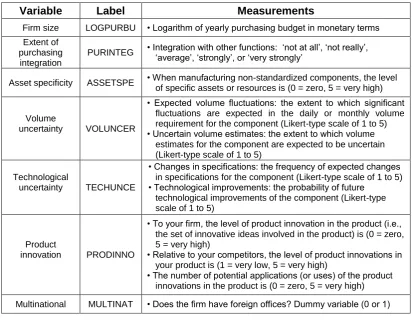
The applied measures for the remaining variables are summarized in Table 1.
---
Insert Table 1 about here
The degree of product innovation was used as an independent variable, using the measures of
Murray et al. (1995). Here a Cronbach of .80 was obtained using two out of three proposed
items, since those two measures generated the highest reliability. To measure volume and
technological uncertainty the scales proposed by Walker and Weber (1984) were used
(respectively = 0.59; = 0.56). Unfortunately, both ‟s are reasonably low, a potential
cause for concern. Asset specificity was measured using the criterion proposed by Murray et
al. (1995).
At this point, we added two more variables to increase the internal validity of the study: firm
size and degree of multinationality. Although they are not in the core of our study, both
variables are generally accepted by the literature to have a positive impact on the degree of
international outsourcing. Firm size was measured by the logged annual outsourcing budget.
Larger firms will have size and knowledge advantages, which enable them to outsource more
substantial volumes from abroad. This is in line with the basic assumption of scholars who
study the inward-outward internationalization nexus (Welch and Luostarinen, 1993). This
nexus indicates the intra-organizational knowledge and information transfer from the
purchasing to the marketing department and vice versa. Mol et al. (2002), focusing on the
types of firms and industries that engage in international outsourcing, found a positive
influence of size on the depth of foreign outsourcing. When managing the scope of
outsourcing it will also be beneficial to be a large firm, since large firms can cover more
supply markets in their search function.
Multinationality was measured using a dichotomous dummy. Being part of a multinational
company by definition implies that the company is also operating abroad. It can be assumed
depth and the scope of the company‟s foreign outsourcing. It is noteworthy that being a
multinational not necessarily implies that the firm is foreign owned. Mol et al. (2002) found
that multinationality is indeed positively related to depth of foreign outsourcing. We expect to
replicate this finding for depth and for scope of foreign outsourcing.
ANALYSIS
Multiple regression (OLS) and correlation analysis were applied to assess the proposed
hypotheses. The regression model of the depth of international outsourcing is presented in
Table 2. The model statistics, R² and F-value are considered quite solid. Except for
technological uncertainty and product innovation, all other contingency parameters turn out to
be significant contributors to the model ( = 5%).
---
Insert Table 2 about here
---
Table 3 summarizes the regression model for the scope of international outsourcing. In
contrast to the depth-model, technological uncertainty and product innovation significantly
contribute to the regression model of the scope of international outsourcing ( = 5%).
---
Insert Table 3 about here
---
Table 4 summarizes the results of the correlation analysis, including the correlations between
of international outsourcing: low depth/low scope (cell 1), high depth/low scope (cell 2), low
depth/high scope (cell 3) and high depth/high scope (cell 4). Most striking are the results on
volume uncertainty, firm size and multinationality when comparing cell 1 and cell 4, and on
technological uncertainty and product innovation when comparing cell 2 and cell 3. Next we
discuss these results in more detail.
---
Insert Table 4 about here
---
DISCUSSION
The findings on product innovation partially support our hypotheses. Hypothesis 1a, stating
that the level of product innovation has a negative impact on a firm‟s depth of foreign
outsourcing, is not supported by the data. To the contrary, hypothesis 1b, suggesting that
increased product innovation increases the scope of international outsourcing, is clearly
supported. We could not empirically confirm Dunning‟s (1993) alternative thesis of a
U-shaped relation between technology level and depth of international outsourcing. Innovative
tech firms do not outsource less abroad. They outsource differently. Apparently, in the context
of increasing product innovation firms do not offset the costs related to an increasing scope of
international outsourcing by reducing or increasing the depth of their international
outsourcing activities. Consequentially, three options are open: (1) firms compensate for
increased scope within the new and remote outsourcing ventures themselves, for instance
through contractual arrangements, (2) firms offset these increased costs in other activities not
increased risks – as they are inherently related to the innovative behavior of the firm, all in all
a firm‟s deliberate strategic choice.
The depth as well as the scope regression indicates a positive and significant relation between
asset specificity and international outsourcing. This supports hypotheses 2a and 2b. It appears
that companies with high asset specificity outsource a substantial part of their goods and
services from a variety of distant countries. A further rationale for this finding can be found in
the economic evaluation of the sourcing costs compared to the alternative deployment
possibilities of the financial means embedded in these specific assets. Asset specific inputs are
typically crucial to achieving competitive advantage, which contributes to the finding that
firms go through the trouble of outsourcing internationally. Due to the limited size of the
Netherlands, where the surveyed firms are located, more suppliers of asset specific goods will
by default be located outside the country.
Volume uncertainty is negatively related to both the scope and the depth of foreign
outsourcing. This confirms hypotheses 3a and 3b. Indeed, when future volumes are uncertain
and supply chain stability becomes low, international outsourcing becomes more costly and
difficult (Levy, 1995). Obviously this not only implies that outsourcing large volumes
internationally is considered a dangerous strategy under the condition of volume uncertainty,
but also that a concentrated (low scope) outsourcing strategy is preferred in an effort to
increase the input volumes per supplier and, as such, aims to increase bargaining power.
Concerning the effect of technological uncertainty, the data partially support our hypotheses.
No support was found for hypothesis 3a that proposes a negative relation between
hypothesis 3b: technological uncertainty is positively related to the scope of international
outsourcing. In line with the findings on product innovation, technological uncertainty
broadens the scope of international outsourcing without reducing its depth. To compensate for
the costs of an increasing scope, the three aforementioned compensatory options are open.
Two conclusions can be drawn. First, the parallel findings on product innovation (internal
parameter) and technological uncertainty (external parameter) hit the core of the relationship
between technological volatility as a holistic contingency variable and the internationalization
process of outsourcing. Technological volatility increases the scope of international
outsourcing without reducing its depth. Second, the opposite effects of volume uncertainty
and technological uncertainty on the scope of international outsourcing clarify why earlier
studies did not find any significant result for an overall measure of environmental uncertainty.
The data illustrate that increasing integration between purchasing and other departments of a
company has a positive effect on the degree and scope of international outsourcing,
supporting hypotheses 5a and 5b as well as earlier findings in the literature (e.g., Kotabe,
1992). On top of the technological contingency variables, the analyses provide interesting
findings on the effect of multinationality and firm size. Both variables turn out to be
positively related to the scope and depth of international outsourcing. The degree of
international sourcing is positively related to outbound multinationality. This significant
impact can be attributed to many factors. In their evolution from an ethnocentric to geocentric
orientation, companies aim for a collaborative approach between headquarters and
subsidiaries, thereby developing global standards, objectives and reward systems (Perlmutter,
1995). Moreover, truly MNCs train and develop their (purchasing) staff everywhere, thereby
then sense potential purchasing markets. Such companies also optimize their organization
structure, which results, for instance, in a global matrix (Bartlett & Ghoshal, 1995).
With respect to firm size, larger companies may benefit from economies of scale. Therefore,
they are better able to concentrate and coordinate their buying efforts of similar goods
throughout the different plants (Faes, Matthyssens and Vandenbempt, 2000). The larger firm,
and especially the multinational firm can also exploit economies of scope and learn from
internal and external networks. Larger firms have more negotiation power, which
compensates for increased costs of internationalization. As they also tend to have more
personnel, specialization will occur more frequently. This makes the search for world-best
sources more likely, thereby increasing both the scope and depth of international outsourcing.
These findings support the basic assumption of scholars investigating the direct and indirect
relationships between outward (product markets) and inward (factor markets)
internationalization (e.g., Korhonen, 1999; Karlsen et al., 2003; Mol et al., 2002).
A TYPOLOGY OF INTERNATIONAL OUTSOURCING
On top of the effect of the contingency variables on the depth and scope separately, Table 4
summarizes their effects on the combination of scope and depth. This exercise allows us to
develop a two-dimensional classification of the degree of international outsourcing in the
context of technological and other contingency variables (Figure 1). Sample splits on the basis
of the average score on scope and depth allowed us to assign all observations to one of these
four cells.
Insert figure 1 around here
---
Cell 1 consists of 72 companies characterized by a low depth and a low scope of international
outsourcing. This group of non-multinational firms is characterized by their small size,
relatively limited asset specificity and relatively high degree of volume uncertainty.
Typically, cell 1 harbors firms that are just starting to outsource on a more international scale
and/or firms that are incapable of outsourcing abroad or are not forced to do so by market
parameters. Firms in cell 1 are labelled infant to reflect their limited focus on international
outsourcing.
Cell 2 contains 41 companies, all characterized by a high depth and low scope in international
outsourcing. As both technological uncertainty and product innovation correlates negatively
with this type, it is expected that these firms do not operate in a technologically volatile
environment. Most probably, for these firms international outsourcing is a tactical instrument
to minimize costs of supplies. Moreover, a low scope and depth enhance bargaining power
vis-à-vis a condensed cluster of nearby suppliers. In sum, these firms are not relying on the
international arena for technological reasons but for efficiency reasons. The evolution of these
firms towards a wider scope of outsourced activities is bounded by their cost minimizing
strategies. Consequentially, we label this type of firms bounded players.
The 32 companies with low depth but high scope are incorporated in cell 3. The
characteristics are opposite to those of „bounded players‟ (cell 2). A positive correlation with
both product innovation and technological uncertainty indicates that these firms operate in a
internationalization is innovation related and typically counters the costs that are associated
with sourcing small quantities from numerous and remote countries. We call this type of
company opportunity taker.
Cell 4 consists of 54 companies with a high score for both depth and scope of foreign
outsourcing. This type comprises the larger multinational firms, which are typically
confronted with volume uncertainty. We label these firms mature globalists as it is assumed
that they represent the most advanced category of international outsourcing companies, driven
in their internationalization process by both cost and innovation drivers.
TOWARDS A DYNAMIC PERSPECTIVE ON INTERNATIONAL EXPANSION OF
OUTSOURCING
On the basis of Table 4 and Figure 1 a dynamic perspective on the international expansion of
outsourcing can be developed. It may be expected that infants depart from their cell when
technological volatility increases (towards Type 3) or financial criteria become stricter
(towards Type 2). Eventually, Type 1, 2 and 3 may grow into experienced and mature
outsourcing globalists (Type 4) when they have matured in their original position through
experiential learning. As such, the typology presented in Figure 1 can be considered as a
dynamic perspective on possible expansion paths of international outsourcing.
Given the contingency factors related to each of these types, the typology may even have
predictive power over the international expansion path of outsourcing firms. More in
particular, it is expected that less innovative firms that operate in a technological non-volatile
whereas more innovative firms operating in a technological volatile environment will
experience a concave, diversified expansion path (Type 1 3 4) (In analogy to Ayal and
Zif, 1979). In fact, the former seek to exploit international opportunities to mainly reach lower
costs. They build a supply network of low cost outsourcing partners and because scale
economies count, the number of international sources is supposed to be rather limited. The
latter category focuses on reaching competitive advantages through the tapping of innovative
sourcing opportunities. If successful, they will use a wide variety of innovative suppliers with
whom they reach close cooperation. Furthermore, it is expected that a concentrated expansion
path (via Type 2) will less likely lead to maturity (Type 4).
Given the „complexity costs‟ of coordinating a wide scope of suppliers, an increasing scope of
international outsourcing conflicts with the fundamental cost driver of Type 2 (bounded
player) firms. The diversification path is alleged to lead to faster internationalization.
Uncertainty and volatility of technology implies a frequent change in specifications whereby
finding market opportunities, in terms of new materials, new suppliers and better quality
becomes essential, boosting the search for world-best suppliers. Whereas the evolution from
Type 2 to Type 4 is hindered by cost implications, the progression from Type 3 towards Type
4 does not have this barrier. Outsourcing more when dealing with technological uncertain and
innovative products, suggests a tendency towards some degree of standardization and
maturity of the produced goods, whereby larger quantities are needed.
This dynamic perspective is not normative in the sense that (1) not all companies follow these
patterns, and (2) cell 4 is not a natural and optimal endpoint for global sourcing in all cases.
Contingency factors beyond the aforementioned technological perspective may constrain the
modes. While the explanatory logic of described dynamism is most plausible, it needs
empirical support and corroboration.
LIMITATIONS, CONCLUSIONS AND SUGGESTIONS FOR FUTURE RESEARCH
We acknowledge that the current paper has a number of shortcomings. Depth and scope are
currently measured by means of one criterion each. This could be expanded, for instance by
incorporating the number of foreign suppliers to determine scope. Similarly, some of the
independent measures were found to be not fully reliable and might need improvement.
Moreover, there may be additional factors to discern when explaining foreign outsourcing,
which could further enhance the explanatory value of the model. One might, for example, take
into account the history of the firm as one important predictor of its current international
outsourcing pattern. Merged firms produce patterns that can strongly deviate from their
independent peers. Of course there are also inherent limitations attached to single country
research designs. It may well be that these findings are specific for the case of the
Netherlands, although no such indications were found beyond the fact that size and scope of
the local supply base are limited. Replication elsewhere would be useful. Furthermore, a more
extensive investigation of the characteristics of the various types deserves more attention in
the future. Another interesting and important avenue for future research, unfortunately beyond
the scope of the current paper, is how scope and depth of international outsourcing influence
the performance of firms and how this relation itself may be modified by other variables. For
instance, it may well be the case that high tech firms not only use a high scope of international
outsourcing but are also better off doing so. For now, however, foreign outsourcing has been
In sum, international outsourcing was characterized by two dimensions: depth and scope. A
technological contingency perspective on these two dimensions produced a reasonably sound,
yet discriminating perspective. The scope of international outsourcing turned out to be
positively related to technological uncertainty and product innovation, whereas these
variables did not load significantly on depth of international outsourcing. In addition, asset
specificity is positively related to scope and depth while volume uncertainty has a negative
impact. From a more dynamic perspective, these findings are promising since they can predict
the international expansion of outsourcing. However, this has not been corroborated
empirically. It was proposed that a more technologically intense environment induces a more
diversified internationalization path whereas a less technologically intense environment
induces a more concentrated path. Managers ought to be aware that product factors are key
determinants of sourcing strategy and that expansion paths can go through either the
innovative trajectory or the cost minimizing approach.
Given the increasing strategic and economic importance of outsourcing in supply chains of
globally operating firms, it would be wise to increase academic efforts on global outsourcing.
It is of utmost importance to avoid empirical and conceptual simplification of the core object.
To assure the former, international outsourcing should be studied in relationship to relevant
contextual parameters. The latter is guaranteed when outsourcing studies apply theories
REFERENCES
Andersen, O., Buvik, A., 2001. Inter-firm co-ordination: International versus domestic
buyer-seller relationships. Omega 29(2), 207-219.
Ayal, I., Zif, J., 1979. Market expansion in multinational marketing. Journal of Marketing 43
(Spring), 84-94.
Bailey, W., Masson, R., Raeside, R., 2002. Outsourcing in Edinburgh and the Lothians.
European Journal of Purchasing and Supply Management 8, 83-95.
Bartlett, C.A., Ghoshal, S., 1995. Transnational Management. Text, Cases, and Readings in
Cross-Border Management. Irwin, Boston.
Birou, L.M., Fawcett, S.E., 1993. International purchasing benefits, requirements and
challenges. The Journal of Purchasing and Materials Management 29(2), 28-37.
Bryce, D.J., Useem, M., 1998. The impact of corporate outsourcing on company value.
European Management Journal 16(6), 635-643.
Buckley, P.J., 2002. Is the international business research agenda running out of steam?
Journal of International Business Studies 33(2), 365-373.
Carter, P.L, Carter, J.R., Monczka, R.M., Slaight, T.H., Swan, A.J., 2000. The future of
purchasing and supply: a ten-year forecast. The Journal of Supply Chain Management
36(1), 14-26.
Cavusgil, S.T., 1980. On the internationalization process of firms. European Research 8(6),
273-281.
Deavers, K.L., 1997. Outsourcing: A corporate competitiveness strategy, not a search for low
wages. Journal of Labor Research 18(4), 503-519.
Dillman, D.A., 1978. Mail and Telephone Surveys: The Total Design Method. Wiley, New
Doz, Y., Santos, J., Williamson, P., 2000. From Global to Metanational: How Companies
Win in the Knowledge Economy. Boston: Harvard Business School Press.
Dubois, A., 1998. Organising Industrial Activities across Firm Boundaries. Routledge,
London.
Dunning, J. H., 1993. Multinational Enterprises and the Global Economy. Addison-Wesley,
Wokingham.
Eisenhardt, K.M., 1989. Making fast strategic decisions in high-velocity environments.
Academy of Management Journal 14(4), 532-550.
Eisenhardt, K.M., Tabrizi, B.N., 1995. Accelerating adaptive processes: product innovation in
the global computer industry. Administrative Science Quarterly 40(March), 84-110.
Faes, W., Matthyssens, P., Vandenbempt, K. 2000. The pursuit of global purchasing synergy.
Industrial Marketing Management 29(6), 539-553.
Ford, D., 1998. Managing Business Relationships. Wiley, Chichester.
Grisprud, G., 1990. The determinants of export decisions and attitudes to a distant market:
Norwegian fishery exports to Japan. Journal of International Business Studies 21(3),
469-486.
Hagedoorn, J., Narula, R., 1996. Choosing organizational modes of strategic technology
partnering: International and sectoral differences. Journal of International Business
Studies 27, 265-284.
Hallén, L., Wiedersheim-Paul, F., 1989. The evolution of psychic distance in international
business relationships. In I. Haag and F. Wiedersheim-Paul (Eds.). Between Market and
Hierarchy. University of Uppsala, Sweden, 15-27.
Johanson, J., Vahlne, J.-E., 1977. The internationalization process of the firm – a model of
knowledge development and increasing foreign commitment. Journal of International
Karlsen, T., Silseth, P.R., Benito, G.R.G., Welch, L.S., 2003. Knowledge, internationalization
of the firm, and inward-outward connections. Industrial Marketing Management, 32(5),
385-396.
Korhonen, H., 1999. Inward-Outward Internationalization of Small and Medium Enterprises.
Acta Universitas Oeconomicae Helsingiensis A-147, Helsinki.
Kotabe, M., 1992. Global outsourcing Strategy: R&D, Manufacturing, and Marketing
Interfaces. Quorum Books, New York.
Kotabe, M., 1998. Efficiency vs. effectiveness orientation of global outsourcing strategy: A
comparison of U.S. and Japanese multinational companies. Academy of Management
Executive 12(4), 107-119.
Kotabe, M., Murray, J.Y., 1996. Determinants of intra-firm outsourcing and market
performance. International Business Review 5(2), 121-135.
Kotabe, M., Murray, J.Y., Javalgi, R.G., 1998. Global outsourcing of services and market
performance: An empirical investigation. Journal of International Marketing 6(4), 10-31.
Kotabe, M., Omura, G.S., 1989. Outsourcing strategies of European and Japanese
multinationals: A comparison. Journal of International Business Studies 20(1), 113-130.
Lawrence, P.R., Lorsch J.W., 1967. Organisation and Environment. Homewood, Ill.: Irwin.
Leonidou, L.C., Katsikeas, C.S., 1996. The export development process: An integrative
review of empirical models. Journal of International Business Studies 27(3), 517-551.
Levy, D.L., 1995. International outsourcing and supply chain stability. Journal of
International Business Studies 26(2), 343-360.
March, J.G., Simon, H.A., 1958. Organizations. John Wiley, New York.
Mol, M.J., van Tulder, R.J.M., Beije, P.R., 2002. Global outsourcing: Fad or fact? Rotterdam:
Monczka, R.M., Trent, R.J., 1992. Worldwide outsourcing: Assessment and execution.
International Journal of Purchasing and Materials Management 28(4), 9-18.
Monczka, R.M., Trent, R.J., Handfield, R.B., 2002. Purchasing and Supply Chain
Management, South-Western, Cincinnati.
Murray, J.Y., Kotabe, M., Wildt, A.R., 1995. Strategic and financial implications of global
outsourcing strategy: A contingency analysis. Journal of International Business Studies
26(1), 181-202.
Murray, J.Y., 2001. Strategic alliance-based global sourcing strategy for competitive
advantage: A conceptual framework and research propositions. Journal of International
Marketing 9(4), 30-58.
Narasimhan, R., Carter, J.R., 1990. Organisation, communication and co-ordination of
international outsourcing. International Marketing Review 7(2), 6-20.
Olusoga, S.A., 1993. Market concentration versus market diversification and
internationalization: implications for MNE performance. International Marketing Review
10(2), 40-59.
Perlmutter, H.V., 1995. The tortuous evolution of the multinational corporation. In C.A.
Bartlett, S. Ghoshal, Transnational Management: Text, Cases, and Readings n
Cross-Border Management, 92-101. Irwin, Boston.
Petersen, K.J., Frayer, D.J., Scannell, T.V., 2000. An empirical investigation of global
outsourcing strategy effectiveness. The Journal of Supply Chain Management 36(2),
29-38.
Prescott, J.E., 1986. Environments as moderators of the relationship between strategy and
performance. Academy of Management Journal 29, 329-346.
Reid, S.D., 1984. Market Expansion and Firm Internationalization. In: E. Kaynak (Ed.)
Servais, P., Møller Jensen, J., 2001. The internationalization of industrial purchasing: the
example of small Danish manufacturers. In C.N. Axinn, P. Matthyssens (Eds.),
Reassessing the internationalization of the firm, Advances in international marketing 11,
227-254. JAI, Elsevier Science Ltd., Amsterdam.
Steensma, H.K., Fairbank, J.F., 1999. Internalizing external technology: A model of
governance mode choice and an empirical assessment. The Journal of High Technology
Management Research 10(1),1-35.
Steensma, H.K., Corley, K.G., 2000. On the performance of technology-sourcing
partnerships: The interaction between partner interdependence and technology attributes.
Academy of Management Journal 43(6), 1045-1067
Stöttinger, B., Schegelmilch, B.B., 1998. Explaining export development through psychic
distance: enlightening or elusive ? International Marketing Review 15(5), 357-372.
Sullivan, D., 1994. Measuring the degree of internationalization of a firm. Journal of
International Business Studies 25(2), 325-342.
Sullivan, D., 1996. Measuring the degree of internationalization of a firm: a reply. Journal of
International Business Studies 27, 179-192.
Swamidass, P.M., Kotabe, M., 1993. Component outsourcing strategies of multinationals: An
empirical study of European and Japanese multinationals. Journal of International
Business Studies 24(1), 81-99.
Trent, R.J., Monczka, R.M., 1998. Purchasing and supply management: Trends and changes
throughout the 1990s. International Journal of Purchasing and Materials Management
34(4),2-11.
Walker, G., Weber, D., 1984. A transaction cost approach to make-buy decisions.
Welch, L.S., Luostarinen, R.K., 1988. Internationalization: Evolution of a concept. Journal of
General Management 14(2), 34-55.
Welch, L.S., Luostarinen, R.K., 1993. Inward-outward connections in internationalization.
Variable Label Measurements
Firm size LOGPURBU • Logarithm of yearly purchasing budget in monetary terms Extent of
purchasing integration
PURINTEG • Integration with other functions: ‘not at all’, ‘not really’, ‘average’, ‘strongly’, or ‘very strongly’
Asset specificity ASSETSPE • When manufacturing non-standardized components, the level of specific assets or resources is (0 = zero, 5 = very high)
Volume
uncertainty VOLUNCER
• Expected volume fluctuations: the extent to which significant fluctuations are expected in the daily or monthly volume requirement for the component (Likert-type scale of 1 to 5) • Uncertain volume estimates: the extent to which volume
estimates for the component are expected to be uncertain (Likert-type scale of 1 to 5)
Technological
uncertainty TECHUNCE
• Changes in specifications: the frequency of expected changes in specifications for the component (Likert-type scale of 1 to 5) • Technological improvements: the probability of future
technological improvements of the component (Likert-type scale of 1 to 5)
Product
innovation PRODINNO
• To your firm, the level of product innovation in the product (i.e., the set of innovative ideas involved in the product) is (0 = zero, 5 = very high)
• Relative to your competitors, the level of product innovations in your product is (1 = very low, 5 = very high)
• The number of potential applications (or uses) of the product innovations in the product is (0 = zero, 5 = very high)
[image:34.595.64.479.80.401.2]Multinational MULTINAT • Does the firm have foreign offices? Dummy variable (0 or 1)
Table 1: Overview of variables and measures
Standardized Beta t Sig.
(Constant) -1.73 0.09
Logged firm size 0.22 3.33 0.00
Extent of purchasing integration 0.12 1.94 0.05
Asset specificity 0.14 2.10 0.04
Volume uncertainty -0.25 -3.70 0.00
Technological uncertainty 0.03 0.38 0.71
Product innovation -0.02 -0.35 0.73
[image:34.595.74.392.440.559.2]Multinational 0.24 3.55 0.00
Table 2: Regression model for depth of international outsourcing (N = 189).
Standardized Beta t Sig.
(Constant) -3.61 0.00
Logged firm size 0.26 3.81 0.00
Extent of purchasing integration 0.13 2.04 0.04
Asset specificity 0.15 2.27 0.02
Volume uncertainty -0.15 -2.25 0.03
Technological uncertainty 0.20 2.74 0.01
Product innovation 0.16 2.30 0.02
Multinational 0.18 2.75 0.01
Table 3: Regression model for scope of international outsourcing (N = 189).
R²: 0.277 Adj. R²: 0.249 F-value: 9.902
[image:34.595.74.390.593.717.2]SCOPE DEPTH CELL1 CELL2 CELL3 CELL4 LOGPURBU PURINTEG ASSETSPE VOLUNCER TECHUNCE PRODINNO MULTINAT
SCOPE 1.000
. 199
DEPTH .371 1.000
.000 .
199 199
CELL1 -.605 -.704 1.000
.000 .000 .
199 199 200
CELL2 -.292 .476 -.381 1.000
.000 .000 .000 .
199 199 200 200
CELL3 .399 -.262 -.327 -.222 1.000
.000 .000 .000 .002 .
199 199 200 200 200
CELL4 .590 .545 -.456 -.309 -.265 1.000
.000 .000 .000 .000 .000 .
199 199 200 200 200 200
LOGPURBU .353 .326 -.272 -.012 -.008 .322 1.000
.000 .000 .000 .870 .913 .000 .
198 198 199 199 199 199 199
PURINTEG .132 .061 -.114 -.054 .076 .101 .013 1.000
.063 .389 .108 .449 .283 .156 .855 .
199 199 200 200 200 200 199 200
ASSETSPE .179 .166 -.161 -.019 .065 .131 .083 -.043 1.000
.012 .020 .024 .791 .367 .067 .247 .545 .
195 195 196 196 196 196 195 196 196
VOLUNCER -.151 -.334 .194 -.098 .115 -.225 -.170 .076 -.089 1.000
.035 .000 .006 .169 .108 .001 .017 .289 .217 .
197 197 198 198 198 198 197 198 195 198
TECHUNCE .200 -.080 -.101 -.185 .272 .057 .067 .065 -.012 .313 1.000
.005 .264 .157 .009 .000 .421 .353 .365 .871 .000 .
197 197 198 198 198 198 197 198 195 198 198
PRODINNO .229 -.022 -.020 -.194 .156 .077 .037 .029 .154 .081 .331 1.000
.001 .764 .779 .007 .030 .290 .615 .690 .033 .261 .000 .
192 192 193 193 193 193 192 193 191 192 192 193
MULTINAT .227 .355 -.240 .150 -.066 .169 .258 -.086 .071 -.169 -.139 -.069 1.000
.001 .000 .001 .033 .354 .017 .000 .223 .326 .017 .051 .340 .
199 199 200 200 200 200 199 200 196 198 198 193 200
Figure 1: A typology of international outsourcing with underlying dimensions.
high
SCOPE
DEPTH
high
low
Type 1:
Infant
firm size (-)
asset specificity (-) volume uncertainty(+) multinational (-)
Type 3:
Opportunity
taker
technological uncertainty (+) product innovation (+)
Type 2:
Bounded
player
technologicaluncertainty (-) product innovation(-)
Type 4:
Mature
globalists
firmsize (+)
volume uncertainty (-) multinational (+)