http://wrap.warwick.ac.uk
Original citation:
Rajpoot, N.M. (2002) Texture Classification Using Discriminant Wavelet Packet
Subbands. In: IEEE 45th Midwest Symposium on Circuits and Systems (MWSCAS
2002), 4-7 August, 2002 pp. 300-303.
Permanent WRAP url:
http://wrap.warwick.ac.uk/8981
Copyright and reuse:
The Warwick Research Archive Portal (WRAP) makes this work by researchers of the
University of Warwick available open access under the following conditions. Copyright ©
and all moral rights to the version of the paper presented here belong to the individual
author(s) and/or other copyright owners. To the extent reasonable and practicable the
material made available in WRAP has been checked for eligibility before being made
available.
Copies of full items can be used for personal research or study, educational, or not-for
profit purposes without prior permission or charge. Provided that the authors, title and
full bibliographic details are credited, a hyperlink and/or URL is given for the original
metadata page and the content is not changed in any way.
Publisher’s statement:
“© 2002 IEEE. Personal use of this material is permitted. Permission from IEEE must be
obtained for all other uses, in any current or future media, including reprinting
/republishing this material for advertising or promotional purposes, creating new
collective works, for resale or redistribution to servers or lists, or reuse of any
copyrighted component of this work in other works.”
A note on versions:
The version presented here may differ from the published version or, version of record, if
you wish to cite this item you are advised to consult the publisher’s version. Please see
the ‘permanent WRAP url’ above for details on accessing the published version and note
that access may require a subscription.
TEXTURE CLASSIFICATION USING DISCRIMINANT WAVELET PACKET SUBBANDS
Nasir Rajpoot
Department of Computer Science
University of Warwick
Coventry, CV4 7AL
United Kingdom
email:
[email protected]ABSTRACT
This paper addresses the issue of selecting features from a given wavelet packet subband decomposition that are most useful for texture classification in an image. A functional measure based on Kullback-Leibler distance is proposed as a way to select most discriminant subbands. Experimental results show a superior performance in terms of classifica-tion error rates.
1. INTRODUCTION
Texture is an important regional characteristic that can be employed in order to analyse an image. There does not ex-ist a widely accepted definition of texture. However, for the sake of simplicity, texture may be considered as a spatial area consisting of an arrangement (regular or otherwise) of primitives resembling eachother [1]. The classification of image data into different classes of texture is a challenging problem in image analysis [2]. Texture classification meth-ods have been classified into five major categories based on the types of features they associate with a texture: statis-tical, structural, geometrical, model-based, and signal pro-cessing [3]. Of the signal propro-cessing methods, perhaps the most common approach is to decompose the input image into frequency subbands [4], from which, it is hoped, the features associated with textures present in the image can be extracted. Discrete wavelet transform provides a tractable way of decomposing an image into a number of frequency subbands at different scales, a feature that has been associ-ated with human visual system [5]. A conventional dyadic wavelet transform [6], however, has a shortcoming in that it does not benefit from possibly useful features that can be obtained by further decomposing the high frequency sub-bands. Adaptive wavelet decomposition [7], also known as wavelet packet decomposition, was developed to over-come this limitation by providing better frequency localiza-tion. For the purpose of classification of image data into
more than one texture classes, however, the selection of best wavelet packet decomposition has to be done in such a way that the feature images provide maximum discrimi-nation [8]. The idea is similar to choosing a wavelet packet basis that can be most efficiently encoded by certain quan-tization scheme [9].
The task of a texture segmentation system is to assign class labels to each of the image pixels, and to do so effi-ciently and accurately. A general pattern recognition para-digm achieves this task in two stages: feature extraction and classification. In case of wavelet packet texture analysis, the extraction of features from image subbands plays a crucial role as it provides the useful information in the form of fea-ture vectors. In this paper, following issues are addressed in the context of a two-class texture classification problem:
(1) Can a few features associated with wavelet packet
sub-bands be sufficient for reasonably accurate classification?
(2) Given a wavelet packet subband decomposition
consist-ing ofnsubbands, how can we selectk(wherek < n) most discriminant subbands to associate the best features with? It is shown that texture classification with reasonably small error rate is possible using only a few subbands. A discrim-inant measure based on Kullback-Leibler distance between the normalized energy of wavelet packet coefficients of two classes in a subband is proposed in order to selectk most discriminant subbands.
2. WAVELET TEXTURE ANALYSIS
2.1. Introduction
The principle behind wavelets is that shifts and dilations of a prototype functionψ(t)are chosen as basis functions, de-composing the signal into its components belonging to dif-ferent frequencies while providing good localization in time (space) at the same time. The discrete wavelet transform can be computed with the help of filter banks that decompose the signal (image) into low and high frequency subbands. The low frequency subband is further decomposed in order to go down the transform one more level. Wavelet based texture classification methods use the wavelet subbands to extract textural features – for a review of these methods, please refer to [2, 4]. Each subband can be passed through a nonlinearity followed by a smoothing function to compute a feature image.
2.2. Wavelet Packet Decomposition
A more general form of the wavelet basis, known as the
wavelet packet basis [7] adaptively segments the frequency
axis as opposed to the adaptive segmentation of time axis in case of local cosine basis (or cosine packet basis). The fre-quency intervals of varying bandwidths are adaptively se-lected to extract specific frequency contents present in the given signal. This frequency segmentation is useful, for ex-ample, to analyze a local phenomenon occurring in the sig-nal and belonging to a specific frequency band. The discrete wavelet packet transform of a1-d discrete signalx = xi,
i= 0,1, . . . , N−1can be computed as follows. The wave-let packet coefficients are defined as
w0
0(l) = xl l= 0, . . . , N−1
w2jp(l) = X
k
gk−2lwnj−1(k) l= 0, . . . , N2−j−1
w2jp+1(l) = X
k
hk−2lwnj−1(k) l= 0, . . . , N2−j−1
(1) wherej = 1,2, . . . , J; J = log2N, wjp(l) is the trans-form coefficient corresponding to the wavelet packet func-tion which has relative support size2j, frequencyp2jand is located atl2j. In other words,j,pandlcan be regarded as
the scale, frequency and position indices of the correspond-ing wavelet packet function respectively. The coefficients
{hn}and{gn}correspond to the lowpass and highpass
fil-ters respectively for a two-channel filter bank and the trans-form is invertible if appropriate dual filters{h˜n},{g˜n}are
used on the synthesis side. When comparing to the wave-let decomposition, it can be regarded as a decomposition which lifts the limit of only decomposing the lowpass fil-tered signal so that all the highpass subbands can be further decomposed as well. This results in a combinatorial explo-sion of possible bases which to select a suitable basis from.
Since this library of available bases provides an overcom-plete representation, a fast optimization algorithm such as [10] is required to select a combination of bases from this library which is well suited to the signal under considera-tion.
2.3. Wavelet Packet Texture Analysis
In the case of general wavelet packet decomposition, a basis needs to be selected which has the maximum discriminat-ing power among all possible bases in the library of wavelet packets. Apart from that, texture classification using wave-let packet subbands may proceed in the same way a sys-tem based on wavelet subbands, as in Section 2.1, works. The issue of selection of features from subband decompo-sition demands more scrutiny now due to a large number of possible bases that can be used to represent the image. To start with, it has to be made sure that the basis chosen to represent the image is a suitable one and indeed an op-timal one for the purpose of texture classification. Chang and Kuo [11] suggested usingl1-norm as a cost function for tree prunning in a top-down manner. A subband is further decomposed only if itsl1-norm is larger than a factor of the maximum norm value at the same resolution. This approach leads to an adaptive tree-structured wavelet decomposition, a term the authors of [11] used for wavelet packet decompo-sition. Acharyya and Kundu [12] employ an energy based cost function and a top-down search without any decimation to compute the basis wavelet packet basis for texture seg-mentation. Laine and Fan [13] used energies of subbands from the full wavelet packet tree as a signature for images belonging to certain texture class.
3. TOWARDS DISCRIMINANT SUBBANDS
3.1. Motivation
trans-form coefficients for different texture regions are given pri-ority over those which do not react very strongly to one tex-ture or other.
There are nCk = µ
n k

possible combinations ofk
subbands from a total ofn subbands. It is not practical to employ a brute force approach which finds out the best combination by trying out each of them. This is motiva-tion enough for finding out an efficient way of determin-ing which of these combinations of subbands is optimal in terms of best discriminating different textures. Reduction in dimensionality of the problem may result in not only more accurate but also faster classification.
3.2. Discriminant Measure
Consider a wavelet packet subband nodeλp,qd , where dis the depth andp, q represent the location at depthdof the wavelet packet tree. We use the convention that in case of an image, a subbandλp,qd is decomposed into four subbands λd2p,+12q,λd2p+1+1,2q,λ2dp,+12q+1,λ2dp+1+1,2q+1andλ00,0denotes the root node (original image). Letfp,qd and gp,qd denote the normalized energy distributions of wavelet packet coeffi-cients corresponding to the subband nodenp,qd associated with classes1and2respectively given by
fdp,q(x, y) =
¡
wp,qd (x, y)Tc(1)¢2
kc(1)k2 (2)
and
gp,qd (x, y) =
¡
wp,qd (x, y)Tc(2)¢2
kc(2)k2 (3)
wherewdp,q(x, y)T denotes the basis vector corresponding
to position(x, y)in the subbandnp,qd andc(1)andc(2) de-note texture images corresponding to classes1and2 respec-tively. A discriminant measureDp,qd (f,g)should be able to measure how differentlyf andgare distributed thus relat-ing it directly to the discrimination power of subbandnp,qd . Such a measure can then be used to determine which of the
nC
kcombinations of subbands to use in order to reduce the
classification error rate. The Kullback-Leibler distance, also known as the relative entropy, betweenf andgis given by
Ip,qd (f,g) =X
x X
y
f(x, y) logf(x, y)
g(x, y). (4)
A symmetric version of this distance measure, also known as theJ-divergence, given by
Dp,qd (f,g) =Ip,qd (f,g) +Ip,qd (g,f) (5)
is proposed to measure the discrimination power of a sub-band.
Image Decomposition Features Error Rate
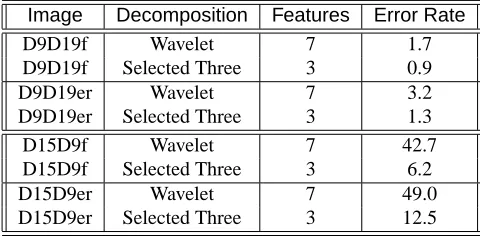
D9D19f Wavelet 7 1.7 D9D19f Selected Three 3 0.9 D9D19er Wavelet 7 3.2 D9D19er Selected Three 3 1.3
D15D9f Wavelet 7 42.7 D15D9f Selected Three 3 6.2 D15D9er Wavelet 7 49.0 D15D9er Selected Three 3 12.5
Table 1: Classification trials for test images
4. EXPERIMENTAL RESULTS
Orthonormal eight-tap filters of Daubechies [14] having four vanishing moments were used for all our experiments. While some researchers have reported that the choice of filters does not have a noticeable effect on the classification error rate [11, 15], others have disagreed [16]. The image was de-composed into a two-level full wavelet packet (full-WP) decomposition resulting in sixteen subbands. The discrimi-nant measure of (5) was used to select four best discrimidiscrimi-nant subbands. A feature image was formed for each of the sub-bands by synthesising the subband and applying Gaussian smoothing on the synthesised image. Feature vectors made up of pixel values in all of the feature images were then used to classify an image pixel using an unsupervisedk-means classifier. Results presented in Table 2 show a compara-ble performance by features based on the best discriminant subbands. The error rate is improved by using only four features instead of all sixteen.
Image Decomposition Features Error Rate
[image:4.612.308.548.73.191.2]D9D19f Full-WP 16 1.9 D9D19f Best Four 4 1.5 D9D19er Full-WP 16 3.6 D9D19er Best Four 4 2.1 D15D9f Full-WP 16 42.8 D15D9f Best Four 4 10.4 D15D9er Full-WP 16 48.5 D15D9er Best Four 4 16.0
Table 2: Classification results for test images
5. CONCLUSIONS
50 100 150 200 250 50
100
150
200
250
(a) D9D19f 50 100 150 200 250
50
100
150
200
250
(b) D9D19er
50 100 150 200 250 50
100
150
200
250
(c) D15D9f 50 100 150 200 250
50
100
150
200
250
[image:5.612.49.283.69.334.2](d) D15D9er
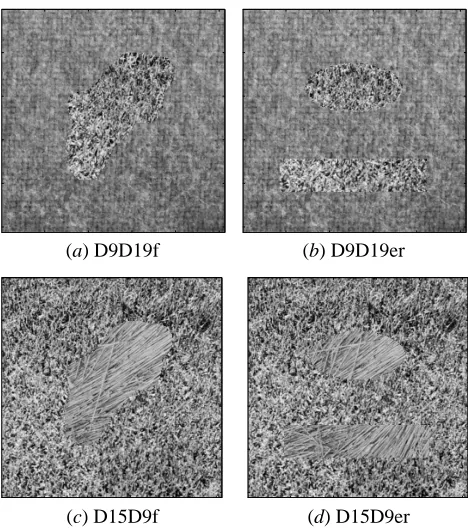
Figure 1: Test Images
the context of a two-class problem. Experimental results show that better performance can be achieved by selecting the most discriminant subbands. Natural extensions to this solution are the use of a classifier more sophisticated than ak-means classifier and the extension of discriminant mea-sure to cater for more than two classes. The crucial issue of selection of an optimal wavelet packet basis for texture classification remains to be investigated.
6. REFERENCES
[1] C.-T. Li and R.G. Wilson. Unsupervised texture segmentation using multiresolution Markov random fields. to appear in IEEE Trans. on PAMI, November 2002.
[2] S. Livens, P. Scheunders, G. Van de Wouwer, and D. Van Dyck. Wavelets for texture analysis. In Proc.
IEE Conf. on Image Proc. and Its Applications, July
1997.
[3] M. Tuceryan and A.K. Jain. Texture analysis. In C.H. Chen, L.F. Pau, and P.S.P. Wang, editors, Handbook
Pattern Recognition and Computer Vision, pages 359–
372. World Scientific, 1993.
[4] T. Randen and J.H. Husoy. Filtering for texture classi-fication: A comparative study. IEEE Trans. on PAMI, 21(4), April 1999.
[5] S. Mallat. A Wavelet Tour of Signal Processing. Aca-demic Press, 1998.
[6] S. Mallat. A theory for multiresolution signal decom-position. IEEE Transactions on Pattern Analysis and
Machine Intelligence, 11:674–693, 1989.
[7] R.R. Coifman and Y. Meyer. Othornormal wave packet bases. preprint, Deptt. of Maths., Yale Uni.,
USA, 1990.
[8] N. Saito and R.R. Coifman. Local discriminant bases. In A.F. Laine and M.A. Unser, editors, Mathematical
Imaging: Wavelet Applications in Signal and Image Processing II, volume 2303, 1994.
[9] N.M. Rajpoot, R.G. Wilson, F.G. Meyer, and R.R. Coifman. A new basis selection paradigm for wave-let packet image coding. In Proc. IEEE Intl. Conf. on
Image Proc., Oct. 2001.
[10] R.R. Coifman and M.V. Wickerhauser. Entropy-based algorithms for best basis selection. IEEE Trans. on
Info. Th., 38(2):713–718, Mar. 1992.
[11] T. Chang and C.C.J. Kuo. Texture analysis and classi-fication with tree-structured wavelet transform. IEEE
Trans. on Image Processing, 2, 4:429–441, 1993.
[12] M. Acharyya and M.K. Kundu. Adaptive basis selec-tion for multi texture segmentaselec-tion bym-band wave-let packet frames. In Proc. IEEE Intl. Conf. on Image
Proc., Oct. 2001.
[13] A. Laine and J. Fan. Texture classification by wavelet packet signatures. IEEE Trans. on PAMI,
15)(11):1186–1190, 1993.
[14] I. Daubechies. Orthonormal bases of compactly sup-ported wavelets. Communications on Pure and
Ap-plied Mathematics, 41:909–996, 1988.
[15] N. Fatemi-Ghomi, P.L. Palmer, and M. Petrou. Perfor-mance evaluation of texture segmentation algorithms based on wavelets. In Proc. Workshop on Perf. Char.
of Vision Algorithms, April 1996.