T
HE
E
FFECTS OF
P
OSITIVE AND
N
EGATIVE
D
ETERRENT AND
P
REVENTIVE
A
NTI
-P
IRACY
M
ESSAGES ON
M
OVIE
P
IRACY
A
TTITUDES
AND
I
NTENTIONS
An Examination of Moderating Factors
Robin Martina Segers
S1492276
8th of September 2015
First Supervisor
Dr. J. J. van Hoof
Second Supervisor
Drs. M. H. Tempelman
UNIVERSITY OF TWENTE
FACULTY OF BEHAVIORAL, MANAGEMENT AND SOCIAL SCIENCES
COMMUNICATION STUDIES
Abstract
Previous studies on digital piracy mainly focused on the downloading behavior of consumers.
The objective of this research is to examine the different persuasive effectiveness of
communication strategies on the consumers responses to decrease digital movie piracy
behavior among Dutch consumers. The design of this experiment is based on a 2 (message
controls: deterrent and preventive) x 2 (message frames: positive or negative) multiple
factorial design and examines the impact of moderators (personal factors) on the effects
between anti-piracy messages and the attitude toward movie piracy and the intention to
engage in movie piracy (consumer responses). The moderators that are included are
ego-involvement, perceived risk, moral values, subjective norm, perceived behavioral control,
current behavior, credibility towards the message. The method of investigation used in this
study is based on an online questionnaire with an experiment. 338 Dutch respondents received
different scenario’s with preventive and deterrent messages, within a positive and negative
frame. Results show that the experimental manipulations have no significant different effect
on the consumer responses after covarying out the personal factors. For the level of
ego-involvement, perceived risk, subjective norms, and perceived behavioral control were found
significant different consumer responses. Conclusion, the positive or negative frames and
deterrent or preventive message controls have no influence on the attitude toward movie
piracy and the intention to download from an illegal source differently. The level of
ego-involvement (low), perceived risk (high), subjective norms (high), and perceived behavioral
control (low) have a more negative effect on the consumer responses when consumers
received the anti-piracy messages. Moral values, the current behavior, and the credibility of
the advertisement do not have an impact on this effect. Further research to examine the
decrease of the consumer responses after receiving anti-piracy messages is proposed.
Keywords: movie piracy, deterrent controls, preventive controls, positive and negative
primes, Theory of Planned Behavior, ego-involvement, perceived risk, moral values,
subjective norm, perceived behavioral control, current behavior, credibility towards the
Introduction
In the Netherlands the amount of digital downloading from illegal sources is a serious
problem (Ast, 2012). Since it is possible to download, the online platform became very
popular among digital pirates for the sharing of music, software, movies and television series.
For this reason the entertainment industry has a hard time to compensate the missed incomes,
because people are downloading from illegal file-sharing websites for free (Duivestein, 2014).
In the Netherlands, there were 61 million movies downloaded from platforms like Pirate Bay
and Torrent sites, which costs the movie industry 78,4 million Euros each year (Remmers,
2014). Therefore, the private copying levy was introduced to compensate the missed incomes
of the authors (Kraan, 2014). In a response, Leenheer and Poort (2014) conducted a research
to examine if the private copying levy had an effect on the attitude and behavior of Dutch
consumers with regard to the downloading of movies from an illegal source. Results showed
that the movie downloading from an illegal source still increased (Leenheer & Poort, 2014) in
relation to their research in 2012, which was conducted before the home copy levy was
introduced (Poort & Leenheer, Filesharing 2@12: Downloaden in Nederland, 2012).
There are some solutions to reduce digital piracy and convince consumers to not
engage in this unethical and illegal behavior. For example, the Software Alliance combats the
use of illegal software worldwide by visiting and controlling companies unannounced (BSA,
2014). On the other hand, the music industry has a solution to gather money and decrease
digital movie piracy with Spotify, this is a software where consumers pay per month to listen
to almost all the music (Cox & Collins, 2014). In similar fashion, the movie industry has
Netflix. Dispite, according to Cox and Collins (2014), there is lower impact upon paid legal
consumption for movies than for music, so the downloading and streaming of movies from an
illegal source is still increasing.
Because the home copy levy was not successful, the Dutch government was forced by
the European Union to enter an immediate download prohibition in April 2014 (Engelfriet,
2014). Also, the access of subscribers to The Pirate Bay was blocked in 2012. Poort,
Leenheer, van der Ham and Dumitru (2014) examined this approach towards online copyright
enforcement. They found no impact on the illegal downloading behavior of the Dutch
population (Poort, Leenheer, Ham, & Dumitru, 2014).
Another option to convince consumers not to engage in digital piracy is the use of
anti-piracy messages. Jeong and Khouja (2013) found, in an analysis of the effectiveness of
to cause an attitude change by raising consumers’ awareness about the negative social impact
of piracy (Jeong & Khouja, 2013). In addition, a consumer can be afraid what people will
think about him or her when he or she is guilty of movie piracy (Al-Rafee & Rouibah, 2009).
D’Astous, Colbert and Monpetit (2005) conducted a research to examine the relative
effectiveness of various communication strategies of recording companies in the U.S. to
convince consumers not to engage in digital piracy of music. Concluding that companies
should focus on the negative consequences consumers take risk when download music from
illegal sources, such as fines and imprisonment (d'Astous, Colbert, & Monpetit, 2005).
According to Cox and Collins (2014), an ethical strategy will have impact on movie piracy
behavior. The belief that piracy harms the movie industry has a high limiting effect on digital
piracy behavior. This is more effective for movie piracy than for music piracy (Cox &
Collins, 2014).
The decision of what communication strategy is best to use to decrease the movie
piracy behavior depends on the effectiveness on the consumer responses (e.g. attitude toward
movie piracy and the intention to download from an illegal source). In this regard, a key
question should be considered: do different communication strategies have different consumer
responses? The objective of this research is to examine the differences in impacts of positive
and negative anti-piracy campaigns with deterrent and preventive controls on the attitude
towards movie downloading and intention to download movies from an illegal source to
recommend companies in the movie business which communication strategy is best to use to
dissuade consumers from illegal movie downloads. The interactive causation is examined by
several moderating factors. Message framing can influence the decision making process
through a variety of contexts (Shamaskin, Mikels, & Reed, 2010). The Theory of Planned
Behavior of Ajzen (1991) is used to explain the behavioral intentions to download movies
from an illegal source. The findings of this research are highly relevant to marketers of
movies or other products that could be digitalized, i.e. software and music.
Background and Literature Review
Literature suggests that deterrent and preventive controls are effective to combat the crime of
digital piracy (Gopal & Sanders, 1997; Gopal, Sanders, Bhattacharjee, Agrawal, & Wagner,
2004; Jeong & Khouja, 2013). The use of deterrent controls is a back-end strategy that makes
use of sanctions to control crime. Deterrent controlled campaigns are educational, legal, and
copyright laws and try to enforce them. This strategy will teach the consumers about the law
(Gopal, et al., 2004). Typical deterrent controls include policy statements and guidelines in
the messages (Gopal & Sanders, 1997).
Preventive controls is a frond-end strategy that persuades consumers to make use of
other possibilities. In an example, value-added strategies can make it more attractive to
purchase movies (Jeong & Khouja, 2013). Preventive controls refer to the benefits of legal
behavior of consumers. This strategy includes messages that make it more attractive to
purchase or the strategy appeals to consumers to make ethical decisions (Gopal, Sanders, et
al., 2004).
Consumer responses
According to Taylor et al. (2009), it appears to be important that a psychological model of
intentions and behaviors must be taken into account in a research with an entertainment
context (Taylor, C.Ishida, & Wallace, 2009).The Theory of Planned Behavior (TPB) can be a
good predictor to find out if a particular behavior can be influenced (Ajzen, 1991). In the past,
several researchers used the TPB to explain undesirable behavior. Also, this theory is used to
explain the behavior of digital piracy (Cronan & Al-Rafee, 2008; d'Astous, et al, 2005).
According to the TPB, most people behave in a way that they intended to do, so the intention
is a good predictor of the actual behavior of a person. The intentions contain the motivations
that influence the behavior (Ajzen, 1991).
Following the TPB, attitude towards a subject, subjective norm and perceived
behavioral control have an impact on the intention to behave in a particular way (Ajzen,
1991). The attitude towards a subject is easily persuaded (Beck & Ajzen, 1991). The
definition of the attitude towards movie piracy is the favorable evaluation of the movie
downloading behavior and it reflects tendencies or predispositions to respond in a predictable
way (Ajzen, 1991; Gass & Seiter, 2014).
Deterrent and preventive controls
According to Gopal and Sanders (1997), preventives and deterrents are strategies to counter
digital piracy and are often used in anti-piracy campaigns. Deterrent controls attempt to
hinder individuals to engage in digital piracy with threats, whereas preventive controls
attempt to distract the consumers from their goal to download from illegal sources (Gopal &
Sanders, 1997). D’Astous, et al. (2005), found that, within the music industry, a
difficult. This strategy appeals to ethical decisions of consumers and decreases peoples
downloading behavior and is therefore a preventive strategy (d'Astous, et al, 2005).
On the other hand, according to Sinha and Mandal (2008), there is little evidence that
digital piracy can be reduced by preventive control measurements (Sinha & Mandel, 2008). In
addition, according to LaRose, Lai, Lange, Love and Wu (2006), potential punishments,
which are deterrent controls, have a negative influence on downloading intentions (LaRose,
Lai, Lange, Love, & Wu, 2006). To find out if deterrent controls have a greater impact than
preventive controls, the following hypothesis is proposed:
H1: Messages with deterrent controls will have a greater negative effect on the consumer
responses than messages with preventive controls.
Positive and negative messages
In a public service campaign positive framed messages focus on the positive consequences
and negative framed messages focus on the negative consequences of the compliance to the
advertisement (Block & Keller, 1995). According to Chang (2008), positive framed messages
provoke a higher positive and lower negative effect in consumer responses, in contrast to
negative framed messages (Chang, 2008). Referring to Kahneman and Tversky (1979),
consumers who are under risky conditions, when it comes to money, will be more influenced
by negative framed messages. On the other hand, when positive framed messages are used,
consumers tend to be risk averse (Kahneman & Tversky, 1979). To find out if negative
framed messages have a greater effect with regard to movie piracy, the following hypothesis
is made:
H2: Negative framed messages will have a greater negative effect on the consumers
responses than positive framed messages.
Interaction effect
Sinha and Mandel (2008) used positive and negative incentives in their research about the
factors that control consumers’ intentions to engage in digital piracy. The positive incentives
are more preventive and focused on legal downloading. The negative incentives are more
deterrent and focused on the perceived risk of piracy. According to them, the negative
incentives can increase piracy intentions and on the other hand, positive incentives reduce the
tendency to download illegal (Sinha & Mandel, 2008). There is a lack of research about this
deterrent and preventive messages depends on the level of the impact of the positive and
negative messages. Consequently, the following hypothesis arises:
H3: There is an interaction effect between receiving a deterrent or preventive controlled
message and receiving a positive or negative framed message such that (a) the
persuasive advantage of preventive messages produce a more negative effect on the
consumer responses with a positive frame and (b) deterrent messages produce a more
negative effect on the consumer responses with a negative frame.
Moderators
The intention to engage in unethical behaviors is influenced by the characteristics of the
situation and the characteristics of individuals (Jones & Kavanagh, 1996). Therefore, the
influence of the anti-piracy massages on the consumer responses can be moderated by
personal factors.
Beck and Ajzen (1991) used the TPB to explain shoplifting and lying. The intention to
engage in this behavior was predicted by the difficulty of the behavior (Perceived behavioral
control) and the perceived social pressure (subjective norms) (Beck & Ajzen, 1991). Other
researchers found that the risk of getting caught was also predicting the intention to engage in
a particular behavior (Pratt & McLaughlin, 1989). According to Cronan and Al-Rafee (2007),
the past behavior and moral values are factors that influence the downloading intentions. In
the following sections the moderators ego-involvement, perceived risk, moral values,
subjective norms, PBC, current behavior, and credibility of the advertisement are tested, to
examine if other factors have an influence on the impact of positive and negative deterrent or
preventive communication strategies on the consumer responses. The height of a moderator
influences the effect of the communication strategy and the consumers responses (Dooley,
2009).
Ego-involvement. To know which communication strategy will have the greatest
impact, it is important to know how consumers are involved with digital movie piracy. The
social judgment theory can help to understand how to approach a persuasive effort by
knowing a person’s attitude towards movie piracy. Consumers always make judgments about the persuasive messages based on their anchors. This anchor is based on a person’s attitude
(Dainton & Zelley, 2011). Thus, when is examined how the attitude towards movie piracy of
group, the latitude of acceptance, which includes all a person’s ideas of acceptable. Second, the latitude of rejection contains all a person’s unacceptable ideas. And last, the latitude of
non-commitment, which include people who have no opinion (Dainton & Zelley, 2011).
With a high ego-involved person, he or she believes the topic is important (Dainton &
Zelley, 2011). So, it is likely that a person which is high ego-involved with downloading from
an illegal source, will not easily be persuaded to do otherwise, because of the latitude of
rejection. According to Maheswaran and Meyers-Levy (1990), low involved consumers will
be more persuaded by negative than positive framed messages. On the other hand, positive
framed messages persuades high involved consumers more than negative framed messages
(Maheswaran & Meyers-Levy, 1990). Also, Kim (2013) advised campaign organizers to
make use of negatively framed messages when consumers are high ego-involved, because
high involved consumers are less willing to rethink their behaviors (Kim, 2013).The
following hypotheses are proposed:
H4: Consumers with a low ego-involvement will have a more negative effect on the
consumer responses when confronted to anti-piracy messages than consumers with a
high ego-involvement.
Perceived risk. In this research, risk has possible negative consequences, which can
have an effect on the impact of the anti-piracy campaigns. The risk of being caught or the risk
of getting an underlying penalty are the most important factors that affects the decision
making process to copy a movie or not (Fetscheerin, 2005). In the research of Phau and Ng
(2010), results show that the chance of getting caught may have a stronger influence on the
attitude toward software piracy than the perceived severity of punishment (Phau & Ng, 2010).
According to Adermon and Liang (2014), the risk of being caught has had an effect on piracy
and music sales. Sweden implemented the copyright protection and the perceived risk
increased suddenly among Swedish people. Internet traffic decreased by 16% and the music
sales increased by 36%. Adermon and Liang concluded that to have a successful copyright
protection law, law enforcement through convictions are necessary (Adermon & Liang,
2014). Furthermore, Akbulut (2014) found that prosecution risk is one of the predicting
variables of the attitude and intention regarding digital piracy. In this research the perceived
risk is defined as the possible risks of illegal downloading. Therefore, the following
H5: Consumers with a high perceived risk will have a more negative effect on the
consumer responses when confronted the different anti-piracy messages than
consumers with a low perceived risk.
Moral values. Because downloading of illegal sources is an ethical decision making
process, the moral values of consumers are important to examine the effect of anti-piracy
campaigns. According to Phau and Ng (2010) and Wu and Yang (2011), software piracy is
not perceived as an ethical issue. The results show that the lower a consumers moral values
are the attitude toward software piracy will become more positive (Phau & Ng, 2010). Wu
and Yang (2011) concluded that China students are willing to copy from the internet even if
they know that it is an unethical behavior. Moral recognition does not influence the intention
to pirate from the internet for China students, therefore, Taiwan students see internet piracy as
unethical (Wu & Yang, 2011). On the other hand, in Turkey ethical behavior can be enforced
through law cautions with regard to piracy (Akbulut, 2014). The hypothesis will be as
follows:
H6: Anti-piracy campaigns will have a more negative effect on the consumer responses
when consumers have high moral values than consumers holding low moral values.
Subjective norms. The subjective norms have an influence on the intention to engage
in a particular way. It refers to the perceived social pressure not to perform in movie piracy
behavior. It is possible that a social network of a person will influence the intention to commit
movie piracy in a negative way (Ajzen, 1991). According to Teah and Phau (2009) it is likely
that a consumer will have a positive attitude towards movie piracy if it is socially supported to
download. Also Cronan and Al-Rafee (2008), found that subjective norms influences the
intention to download. In other words:
H7: Consumers with high subjective norms show more negative consumer responses when
confronted to the anti-piracy messages than consumers with low subjective norms.
Perceived behavioral control. Another factor is perceived behavioral control, which
contains self-efficacy and controllability. Self-efficacy is a persons’ belief that the behavior
can actually be performed and controllability is the perception that the actual behavior is easy
or difficult to perform (Ajzen, 1991). According to Ajzen (1991), actual behavioral control
In the research of Cronan and Al-Rafee (2008) is found that good skills and recourses
to pirate also lead to a positive intention to engage movie piracy (Cronan & Al-Rafee, 2008).
The internet offers several free applications to pirate movies which can make it easy to engage
in movie piracy (Teah & Phau, 2009). So the following hypothesis will arise:
H8: Consumers with a low perceived behavioral control show more negative consumer
responses than consumers with a high perceived behavioral control when confronted
with anti-piracy campaigns.
Current behavior. Ingram and Hinduja (2008) examined the techniques of
neutralization for understanding online music piracy. In their research, 90% of the
respondents believed that music piracy was a proper behavior (Ingram & Hinduja, 2008).
Several researchers found that if consumers are used to engage in digital piracy, these people
are more likely to repeat this unethical behavior (Cronan & Al-Rafee, 2008; Taylor et al.,
2009; Akbulut, 2014). When consumers download below the average of 5 films each year,
fear appeals will have a greater impact on the behavior than heavy downloading consumers
(LaRose, et al., 2006). According to Cronan and Al-Rafee (2008), people who downloaded in
the past will have higher intentions to pirate in the future. Their research suggests that only
within a stable situation, the past behavior is a good predictor of later behavior. A change in
the conditions may have an effect on the intention to behave in the same way in the future
(Cronan & Al-Rafee, 2008). The following hypothesis arises:
H9: Consumers with a low current behavior show more negative consumer responses when
confronted with anti-piracy campaigns than consumers with a high current behavior.
Credibility of the advertisement. The believability of a message or source is also
important. The credibility of the source may influence the persuasiveness of messages in
different situations (Clark, Evans, & Wegener, 2011). According to Muthaly, Ha, Yeo and
Kim (2009), a low advertisement credibility has a negative effect on the behavioral intentions,
therefore, people are more willing to discuss the matter with other people if their credibility is
low (Muthaly, Ha, Yeo, & Kim, 2009). The following hypothesis can be made:
H10: Consumers with a high credibility of the advertisement show more negative consumer
responses when confronted with anti-piracy campaigns than consumers with a low
Conceptual framework. In this research the effects of positive and negative deterrent
and preventive messages are examined on consumers’ attitude towards movie piracy and
intentions to download movies from illegal sources. The positive and negative deterrent and
preventive messages are the independent variables. The dependent variables are the consumer
responses: attitude towards movie piracy and the intention to engage in movie piracy. The
moderators consists several variables: ego-involvement, perceived risk, moral values,
subjective norm, perceived behavioral control, current behavior and credibility of the
advertisement.One of the levels (high or low) of the moderators is expected to have a more
negative effect on the consumer responses than the other level, so a the impacts of the
messages increase.
Do the anti-piracy messages significantly affect the consumer responses differently
after adjusting for the personal factors? To explain the theorized relationships of the
dependent, independent variables and the moderating factors, the model in Figure 1 is
[image:11.595.67.525.393.656.2]suggested to illustrate the hypotheses from the sections 2.1 till 2.5.7.
Method
The method of investigation used in this study is based on an online questionnaire with an
experiment. The reason for this approach is to get quick responds and make use of frequently
used scales. The design of this experiment is based on a 2 (message controls: deterrent and
preventive) x 2 (message frames: positive or negative) multiple factorial design and examines
the impact of moderators (personal factors) on the effects between anti-piracy messages and
the attitude toward movie piracy and the intention to engage in movie piracy (consumer
responses).
Procedure
The procedure of the experiment consisted out of two studies. The first study was a pre-test to
make sure that the research is valid, so the questionnaire was tested within a small respondent
group. The stimulus material was made up to eight different scenario’s. Two communication
strategies are used for the anti-piracy campaigns. There were 30 respondents gathered, who
randomly received two out of eight messages. The respondents were asked how they
interpreted the messages and to rank several images from 1 to 3, with the most dissuasive
image on the first place. The image with the highest scores is used in the manipulations (see
figure 2). Then, the Chronbach’s Alpha was performed to see if the constructs are reliable. If
necessary, some questions were deleted to increase the validity.
In the second study, the final questionnaire is spread among the target group.
Respondents filled out a questionnaire that is distributed with an online survey through
Facebook, e-mail, and LinkedIn. The subjects were randomly assigned to one of eight
conditions. The survey thus provides a means of studying the consumer responses which
[image:12.595.72.353.564.739.2]encounter when responding to anti-piracy messages.
Manipulations
There are two messages created for both dependent and preventive controls, in order to
increase the likelihood that the messages indeed be perceived as deterrent or preventive. The
deterrent messages are based on punishment and education about movie piracy and the
preventive messages are based on ethical decisions and other options to download or stream
movies in a legal way. The four messages will also be positive and negative framed (see
Table 1 for an English version of the first four messages and Appendix A for the second four
messages and a Dutch version). The messages are verified by means of the preliminary
survey. The messages were shown in a pop up screen as if the consumer really intended to
download a movie (Figure 2, Page 12).
Consumers was asked if they think the messages where interpreted more deterrent or
preventive. The respondents could choose ‘more educative or punishable’ or ‘focused on
ethical decisions or on other options to download or stream movies’ (with a scale 1 to 5). An
independent-samples t-test was conducted to compare the interpretation of the deterrent and
preventive controlled messages by examining if the mean scores where significantly different
from 3 (1 is more deterrent and 5 is more preventive). If the mean score is closer to 1, the
message is interpreted as deterrent, and if the mean score is closer to 5, the message is
[image:13.595.76.529.491.730.2]interpreted as preventive. The mean score of the interpretation of the deterrent controlled
Tabel 1
Manipulation messages in English
Deterrent Preventive
Positive
We have detected that you attempt to download or stream a copyrighted movie from an illegal source. Many people do not know that it is no longer allowed in the Netherlands since April 2014. New methods are used to identify piracy. Piracy may be punished with a fine of €500,-. However, the chances of you being caught is
very small.
We have detected that an attempt is made to download or stream a copyrighted movie from an illegal source. It is better for the producers that you pay per
download. There exist legal possibilities (e.g. iTunes or Netflix) to download or stream movies. By downloading or streaming from legitimate sources the movie industry receives money. By buying filmmakers retain their jobs.
Negative
We have detected that you attempt to download or stream a copyrighted movie from an illegal source. Many people do not know that it has been prohibited in the Netherlands since April 2014. New methods are used to identify piracy. Piracy is punishable with a fine of €500,-. The chance that you will be caught is also very large.
We have detected that an attempt is made to download or stream a copyrighted movie from an illegal source.
messages (M=2.52, SD=1.18) was statistically significant lower than 3, conditions; t(175) =
-5.45, p < .001. The preventive controlled messages (M=3.67, SD=1.22) were significant
higher than 3, t(170) = 7.20, p < .001.
To test if the messages where interpreted as if there was a positive or negative prime,
respondents could give an indication with a scale of 1 (= negative) to 5 (= positive). An
independent-samples t-test shows a significant difference between the mean score of positive
(M=2.82, SD=1.07) and negative (M=2.52, SD=1.04) interpreted messages, conditions; t(345)
= 2.60, p = .01 (two-tailed). The negative messages are significant lower than 3, conditions;
t(168) = -5.94, p < .001. So, these messages are interpreted as negative. However, the positive
messages are also significant lower from 3, conditions; t(177) = -2.24, p = .024 (two-tailed).
Therefore, the positive messages are interpreted as more positive than the negative messages,
however not as positive.
Measures
The dependent variables and the moderators are tested with 55 items from most existing
scales. After the pre-test some questions were deleted and recoded. The dependent variables
are measured with 5-point Likert-scales (with 1= strongly disagree and 5= strongly agree) and
bi-polar scales. Some examples of the 11 items to measure the attitude toward movie piracy
are ‘I love downloading and streaming of movies from an illegal source’ and ‘the
downloading and streaming of movies is desirable’. The intention to download movies was measured with 8 items, ‘I have the intention to download or stream movies from an illegal source in the future’ and ‘It is likely that I will download and stream movies from an illegal source’.
Ego-Involvement was measured with 9 items, for example ‘for me, downloading and
streaming movies from an illegal source is: important-unimportant, irrelevant-relevant’
(bi-polar). And some 5-point Likert-scales ‘I download or stream very few’, ‘I think downloading
movies is very important for me’.
The perceived risk was measured with 5 items ‘I think that downloading and streaming from an illegal source brings a lot of risks’ and ‘I think the risks of downloading and streaming of movies from an illegal source are important’.
The moral values were measured with 4 items, ‘I should feel guilty if I download or
stream from an illegal source’ and ‘Downloading or streaming from an illegal source is a
crime’. And, subjective norms was measured with 3 items, for example ‘most people who are
Perceived behavioral control was measured with 5 items, for example ‘if I wanted to, I could easily download or stream movies’, ‘I belief that I am capable to download or stream movies’.
The credibility of the advertisement was measured after the experiment with 6 bi-polar
items, for example ‘I think the advertisement is: good-bad, reliable-unreliable’.
The current behavior was measured with the item ‘how many films did you download or stream last 6 months’. Using 5-point rating scales, respondents indicated how their current
behavior is, from 0, 1-4, 5-10, 11-25, 26+ movies in the past 6 months. Tabel 2 gives an
overview of the reliability statistics.
At the end of the survey some demographics were asked. In Appendix B the
questionnaire is presented. Based on a median split, respondents were scored as low (=1) or
[image:15.595.70.466.364.518.2]high (=2) on the moderating factors. The collected data was checked for the basic descriptive
Tabel 2
Reliability statistics
Constructs Chronbach's Alpha Number of items Deleted items
Attitude towards movie piracy .91 11 2
Intention to engage in movie piracy .95 8 2
Ego-involvement .93 9 1
Perceived Risk .84 5 -
Moral Values .88 4 2
Subjective Norms .86 3 2
Perceived behavioral control .84 5 -
Current behavior - 1 -
Credibility of the advertisement .86 6 -
Table 3
Descriptive Statistics of the Moderating factors
Moderating Factors Mean SD N
Ego-Involvement a) 3.27 .96 369 Perceived Risk a) 2.60 .78 369
Moral Values a) 2.49 .93 356 Subjective Norms a) 2.01 .83 356
Perceived Behavioral Control a) 4.37 .72 388 Current Behavior b) 3.03 1.38 388
Credibility of the Advertisement c) 2.84 .86 347 a) 5-point likert scale (1 = strongly disagree / 5 = strongly agree)
b) 5-point self-reported (0, 1-4, 5-10, 11-25 or 26 + downloads in 6 months)
[image:15.595.70.383.574.699.2]statistics with the analytics software, SPSS. Table 3 shows the means, standard deviations
and number of cases of the moderating factors. Overall, the consumers thought it is easy to
download or stream from an illegal source (M= 4.37, SD= .72) and they score the lowest on
subjective norms (M= 2.01, SD= .83).
Participants
Wang and McClung (2010) focused their research on college students because they are
technical sufficient, they have no high income and have heavy consumption of entertainment,
which makes them likely to engage in digital piracy (Wang & McClung, 2010). The focus of
this research is on Dutch men and women in the age category of 18 years and older. The
respondents were recruited via Social Media. In total, 525 respondents participated in this
experiment. After the opening screen, 4% (n=21) of the respondents did not start the
questionnaire. There were 69 respondents excluded from this research, because they never
downloaded legal or illegal before and 97 respondents stopped during the questionnaire. The
duration of the questionnaire was between 10 and 15 minutes. The dropout rate of 22% was
little lower that the 24% that is normal with a questionnaire with a duration of 15 minutes
(MacElroy, 2000). At the end, there are 338 completed questionnaires that are useful for this
research.
The mean age of the participants is 25.91 (n=338), with a minimum of 17 and a
maximum of 66. More women (n=186) than men (n=152) participated this research. The
province of Overijssel is best represented with 176 respondents.
Analysis
The factorial multivariate analyses of covariance (MANCOVA) is used to test if there is a
statistical significant difference between the independent variables (dependent and preventive
controls and positive and negative frames), after statistically controlling for the effects of the
covariates (personal factors). With this method, the dependent variables (attitude toward
movie piracy and intention to download from an illegal source) are analyzed together. Before
the MANCOVA can be used, the assumptions of parametric statistics were tested.
Results
In this section the results of the 2 x 2 multiple factorial between subjects experiment are
discussed in order of the dependent variables: attitude toward movie piracy and intention to
deterrent and preventive controls are described, then the interaction effects, where after the
moderating effects of the personal factors. The hypotheses are tested in the last paragraph.
Message effects on the consumer responses
The independent variables are divided in: deterrent and preventive controlled messages, and
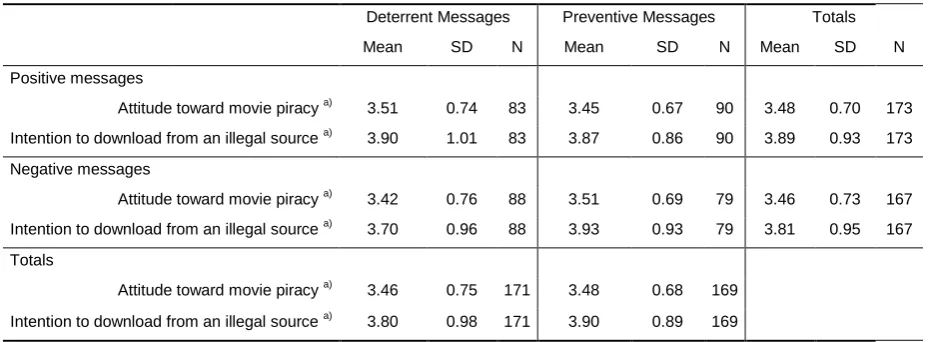
positive and negative primed messages. Table 4 shows the means, standard deviations, and
number of cases of the consumer responses separated for the different messages.
To test if the consumer responses had the desired effect after receiving the anti-piracy
messages, the MANCOVA was executed. The MANCOVA indicates that the means of the
deterrent or preventive message controls is not significant different for one of the dependent
variables, condition; F = .966, partialη2 = .006, p = .382. For example, there is no statistical
evidence that there is a difference in de means of the attitude towards movie piracy for the
deterrent (M= 3.46, SD= 0.75) and the preventive (M= 3.48, SD= 0.68) controlled messages.
Also, the MANCOVA found no evidence that the means of the consumer responses for
receiving a positive primed message differ from the means of the consumer responses for the
negative primed messages, condition; F = .593, partialη2 = .004, p = .553. In an example, the
mean attitude towards movie piracy of the positive primed messages (M= 3.48, SD= 0.70)
does not differ from the mean of the negative primed messages (M= 3.46, SD= 0.73). The
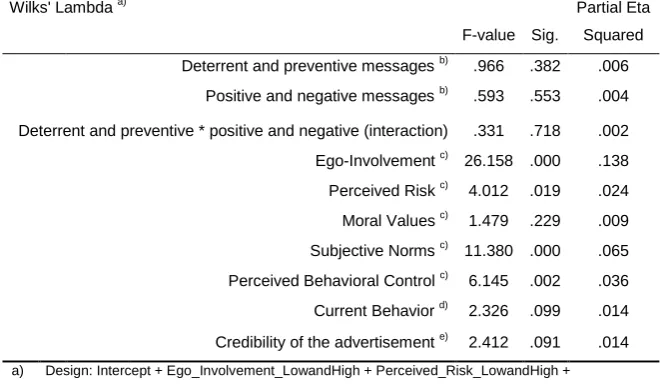
[image:17.595.66.532.498.669.2]Multivariate Tests table (Table 5, Page 18) shows the results of the MANCOVA.
Tabel 4
Descriptive statistics of the consumer responses per manipulation Deterrent Messages Preventive Messages Totals
Mean SD N Mean SD N Mean SD N
Positive messages
Attitude toward movie piracy a) 3.51 0.74 83 3.45 0.67 90 3.48 0.70 173
Intention to download from an illegal source a) 3.90 1.01 83 3.87 0.86 90 3.89 0.93 173 Negative messages
Attitude toward movie piracy a) 3.42 0.76 88 3.51 0.69 79 3.46 0.73 167 Intention to download from an illegal source a) 3.70 0.96 88 3.93 0.93 79 3.81 0.95 167 Totals
Attitude toward movie piracy a) 3.46 0.75 171 3.48 0.68 169 Intention to download from an illegal source a) 3.80 0.98 171 3.90 0.89 169
Tabel 5
Multivatiate tests
Wilks' Lambda a)
F-value Sig.
Partial Eta
Squared
Deterrent and preventive messages b) .966 .382 .006
Positive and negative messages b) .593 .553 .004 Deterrent and preventive * positive and negative (interaction) .331 .718 .002
Ego-Involvement c) 26.158 .000 .138
Perceived Risk c) 4.012 .019 .024
Moral Values c) 1.479 .229 .009
Subjective Norms c) 11.380 .000 .065
Perceived Behavioral Control c) 6.145 .002 .036
Current Behavior d) 2.326 .099 .014 Credibility of the advertisement e) 2.412 .091 .014 a) Design: Intercept + Ego_Involvement_LowandHigh + Perceived_Risk_LowandHigh +
Moral_Values_LowandHigh + Subjective_Norms_LowandHigh + Perceived_Behavioral_Control_LowandHigh + Current_Behavior_LowandHigh + Credibility_of_the_Advertisement_LowandHigh +
Message_Deterrent_or_Preventive + Positive_and_negative_Messages + Message_Deterrent_or_Preventive * Positive_and_negative_Messages
b) Manipulation
c) 5-point likert scale (1=strongly disagree / 5=strongly agree)
d) 5-point self-reported (0, 1-4, 5-10, 11-25 or 26 + downloads in 6 months) e) 5-point bi-polar scale (bad/good, unreliable/reliable, weak/strong)
Interaction effect
The third hypothesis (H3) was to test if there is an interaction effect between receiving a
deterrent or preventive controlled message and receiving a positive or negative framed
message. The MANCOVA found that there is no interaction effect, conditions; F (1)= .331,
partialη2 = .002, p= .718 (see Table 5 for the multivariate tests). There is no statistical
evidence that the impact of the deterrent and preventive messages on the consumer responses
depend on the positive and negative frames.So, the differences shown in the plots (figure 3
and 4 on Page 19) are not significant. In an example, the preventive controlled messages with
a positive frame (M= 3.45, SD= 0.67 ) have no greater negative effect on the attitude towards
movie piracy compared to a negative frame (M= 3.51, SD= 0.69 ) and the deterrent controlled
messages with a negative frame (M= 3.42, SD= 0.76 ) have no greater negative effect
Figure 3: Mean Attitude Towards Movie Piracy per Figure 4: Mean Intention to Engage in Movie Piracy
per Received Message per Received Message
Covariates
To find out what the moderating role of the personal factors is on the impact of the anti-piracy
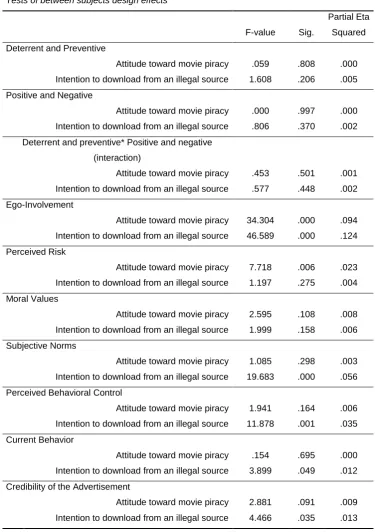
messages, we take a better look at the results of the tests of between subjects design effects of
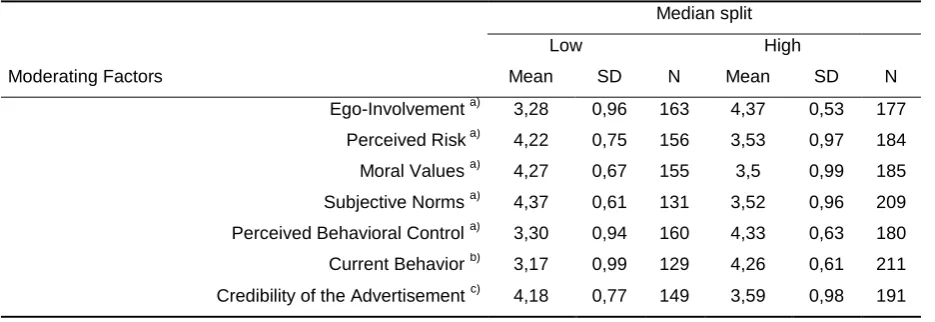
the MANCOVA (Table 6, Page 20). The mean of the consumer responses per level of the
moderating factors are shown in Table 7 and Table 8 on page 21.
The MANCOVA indicated that at least one of the consumer responses differ in mean
with regard to the level of ego-involvement, conditions; F(3)= 26.158, partialη2 = .002,
p<.001. The table with the Test of between subjects design effects (Table 6) shows which of
the dependent variables is significant. There was a significant difference of the low
ego-involvement (M= 3.08, SD= 0.67) and the high ego-involvement (M= 3.83, SD= 0.55) on the
attitude toward movie piracy (F(1)= 34.304, partialη2 = .094, p < .001). This means, that
consumers with a low ego-involvement are more persuaded by the anti-piracy messages than
consumers with a high ego-involvement. Also, there was a significant difference in the mean
intention to download from an illegal source per level of ego-involvement (F(1)= 46.589,
partial η2 = .124, p< .001).
The second factor that has a significant different mean for at least one of the consumer
responses is the perceived risk, conditions; F(3)= 4.012, p= .019. There was a significant
difference of the low perceived risk (M= 3.75, SD= 0.66) and the high perceived risk (M=
3.23, SD= 0.67) on the attitude towards movie piracy (F(1)= 7.718, partialη2 = .023, p=.006).
Which means, that there is found that consumers with a high perceived risk have a lower
attitude towards movie piracy than consumers with a low perceived risk. On the other hand,
3,36 3,38 3,4 3,42 3,44 3,46 3,48 3,5 3,52 Deterrent controlled message Preventive controlled message Mean Attitude Towards Movie Piracy
Positive frame Negative frame
3,55 3,6 3,65 3,7 3,75 3,8 3,85 3,9 3,95 Deterrent controlled message Preventive controlled message Mean Intention to Engage in Movie Piracy
[image:19.595.318.539.70.259.2]there was no significant difference in the mean intention to download from an illegal source
[image:20.595.65.441.148.681.2]per level of perceived risk, conditions; F(1)= 1.197, partial η2 = .004, p = .275).
Tabel 6
Tests of between subjects design effects
F-value Sig.
Partial Eta Squared Deterrent and Preventive
Attitude toward movie piracy .059 .808 .000 Intention to download from an illegal source 1.608 .206 .005 Positive and Negative
Attitude toward movie piracy .000 .997 .000 Intention to download from an illegal source .806 .370 .002 Deterrent and preventive* Positive and negative
(interaction)
Attitude toward movie piracy .453 .501 .001 Intention to download from an illegal source .577 .448 .002 Ego-Involvement
Attitude toward movie piracy 34.304 .000 .094 Intention to download from an illegal source 46.589 .000 .124 Perceived Risk
Attitude toward movie piracy 7.718 .006 .023 Intention to download from an illegal source 1.197 .275 .004 Moral Values
Attitude toward movie piracy 2.595 .108 .008 Intention to download from an illegal source 1.999 .158 .006 Subjective Norms
Attitude toward movie piracy 1.085 .298 .003 Intention to download from an illegal source 19.683 .000 .056 Perceived Behavioral Control
Attitude toward movie piracy 1.941 .164 .006 Intention to download from an illegal source 11.878 .001 .035 Current Behavior
Attitude toward movie piracy .154 .695 .000 Intention to download from an illegal source 3.899 .049 .012 Credibility of the Advertisement
Attitude toward movie piracy 2.881 .091 .009 Intention to download from an illegal source 4.466 .035 .013
c) 5-point likert scale (1=strongly disagree / 5=strongly agree)
Tabel 7
Descriptive statistics of the attitude toward movie piracy per level of the moderators
Median split
Low High Moderating Factors Mean SD N Mean SD N
Ego-Involvement a) 3,08 0,67 163 3,83 0,55 177 Perceived Risk a) 3,75 0,66 156 3,23 0,67 184 Moral Values a) 3,8 0,63 155 3,2 0,67 185 Subjective Norms a) 3,77 0,62 131 3,29 0,71 209 Perceived Behavioral Control a) 3,14 0,67 160 3,77 0,61 180 Current Behavior b) 3,07 0,74 129 3,72 0,57 211 Credibility of the Advertisement c) 3,7 0,68 149 3,29 0,69 191
a) 5-point likert scale (1 = strongly disagree / 5 = strongly agree)
b) 5-point self-reported (0, 1-4, 5-10, 11-25 or 26 + downloads in 6 months) c) 5-point bi-polar scale (bad/good, unreliable/reliable, weak/strong)
Tabel 8
Descriptive statistics of the intention to engage in movie piracy per level of the moderators
Median split
Low High Moderating Factors Mean SD N Mean SD N
Ego-Involvement a) 3,28 0,96 163 4,37 0,53 177 Perceived Risk a) 4,22 0,75 156 3,53 0,97 184 Moral Values a) 4,27 0,67 155 3,5 0,99 185 Subjective Norms a) 4,37 0,61 131 3,52 0,96 209 Perceived Behavioral Control a) 3,30 0,94 160 4,33 0,63 180 Current Behavior b) 3,17 0,99 129 4,26 0,61 211 Credibility of the Advertisement c) 4,18 0,77 149 3,59 0,98 191
a) 5-point likert scale (1 = strongly disagree / 5 = strongly agree)
b) 5-point self-reported (0, 1-4, 5-10, 11-25 or 26 + downloads in 6 months) c) 5-point bi-polar scale (bad/good, unreliable/reliable, weak/strong)
The MANCOVA found no evidence that the moral values, conditions; F (1)= 1.479,
partial η2 = .009, p= .229, current behavior, conditions; F (1)= 2.326, partial η2 = .014,
p=.099, and the credibility of the advertisement, conditions; F (1)= 2.412, partialη2 = .014,
p=.091, were different in the low and high levels. This means, that the level of moral values,
current behavior and credibility of the advertisement have no influence on the impact of the
positive and negative deterrent and preventive controlled messages on the consumer
[image:21.595.67.535.374.535.2]The third factor that has a significant different mean of at least one of the consumer
responses is subjective norms, conditions; F(3)= 11.380, p< .001. Only the means of the
intention to download from an illegal source were significant different (F(1)= 19.683, partial
η2
= .056, p< .001). So, consumers with low subjective norms (M= 4.37, SD= 0.61) have
higher intentions to download movies illegal then consumers with high subjective norms
(M=3.52, SD= 0.96) after receiving the anti-piracy messages.
The fourth factor perceived behavioral control is significantly different for only the
intention to download from an illegal source (F(1)= 11.878, partial η2 = 0.035, p< .001). A
low PBC (M= 3.30, SD= 0.94) leads to lower intention to download movies illegal than a high
PBC (M= 4.33, SD= 0.63) after receiving the anti-piracy messages.
Hypotheses
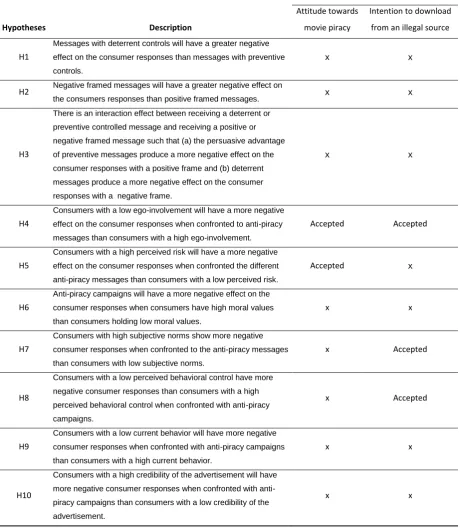
In Table 9 on page 23 there is an overview of the rejected and accepted hypotheses.
Hypotheses 1, 2, and 3 are rejected, since there is no statistical evidence that there is a main
effect or interaction effect of the different messages on the consumer responses. Also,
hypotheses 6, 9 and 10 are rejected, because there is no statistical evidence that the level of
the moral values, current behavior and the credibility of the advertisement have an impact on
the effect of the anti-piracy messages on the consumer responses.
A low ego-involvement has a more negative influence on both consumer responses, so
hypothesis 4 is not rejected. A high perceived risk leads only to lower attitude toward movie
piracy. Hypothesis 5 will be rejected for the intention to download from an illegal source.
At last, a high score on subjective norms and a low PBC will lead to lower intentions
to engage in movie piracy. Therefore, hypotheses 7 and 8 are rejected for the attitude towards
Table 9
Overview hypotheses
Hypotheses Description
Consumer Responses
Attitude towards
movie piracy
Intention to download
from an illegal source
H1
Messages with deterrent controls will have a greater negative
effect on the consumer responses than messages with preventive
controls.
x x
H2 Negative framed messages will have a greater negative effect on
the consumers responses than positive framed messages. x x
H3
There is an interaction effect between receiving a deterrent or
preventive controlled message and receiving a positive or
negative framed message such that (a) the persuasive advantage
of preventive messages produce a more negative effect on the
consumer responses with a positive frame and (b) deterrent
messages produce a more negative effect on the consumer
responses with a negative frame.
x x
H4
Consumers with a low ego-involvement will have a more negative
effect on the consumer responses when confronted to anti-piracy
messages than consumers with a high ego-involvement.
Accepted Accepted
H5
Consumers with a high perceived risk will have a more negative
effect on the consumer responses when confronted the different
anti-piracy messages than consumers with a low perceived risk.
Accepted x
H6
Anti-piracy campaigns will have a more negative effect on the
consumer responses when consumers have high moral values
than consumers holding low moral values.
x x
H7
Consumers with high subjective norms show more negative
consumer responses when confronted to the anti-piracy messages
than consumers with low subjective norms.
x Accepted
H8
Consumers with a low perceived behavioral control have more
negative consumer responses than consumers with a high
perceived behavioral control when confronted with anti-piracy
campaigns.
x Accepted
H9
Consumers with a low current behavior will have more negative
consumer responses when confronted with anti-piracy campaigns
than consumers with a high current behavior.
x x
H10
Consumers with a high credibility of the advertisement will have
more negative consumer responses when confronted with
anti-piracy campaigns than consumers with a low credibility of the
advertisement.
x x
Discussion
This study examined the differences of the communication strategies, deterrent or preventive
consumer responses were included. The results of this research provide some supporting and
antithetical information compared with previous studies.
The effects of the messages
According to D’Astous, et al. (2005), anti-piracy arguments do not have the effect that some
would expect. This research supports that suggestion, there is found no evidence that the
effects of the four messages on the consumer responses where different. According to Brown
(2013), previous anti-piracy approaches focused on the punitive measures, which failed to
have an impact on piracy behaviors. From this research is found that the deterrent and
preventive messages both had the same effect on the consumer responses with regard to
movie piracy. It is possible that the missing difference of impact between the anti-piracy
messages on the consumer responses is depending on the ineffectiveness in changing
consumers habits or on attitudinal motives and social influences (d'Astous, et al., 2005). Holt
and Copes (2010) depicted that the denial of injury is the most common factor that is
employed by pirates to justify their behaviors. Consumers who pirate reconciled their
behaviorsby ignoring or downsizing the harm that piracy had on the entertainment industry
(Holt & Copes, 2010).This may decrease the effects of the messages that are focused on
ethical decisions.
According to Block and Keller (1995), message framing is less important in higher
efficacy conditions, because a consumer needs less processing within more certain behaviors
(Block & Keller, 1995). This could explain why there is no significant difference in consumer
responses between the messages with positive and negative frames.
The attitudes toward the act (hedonic and utilitarian), the desire and motivations to
engage in digital piracy are important in marketing persuasion (Taylor, et al, 2009).This
research found no interaction effect of the positive and negative messages frames and the
deterrent and preventive controls on the consumer responses toward movie piracy. An
explanation for this absence may be that the consumer responses are influenced by other
factors, such as: mood or affect (Baek, Shen, & Reid, 2013). Al-Raffee and Rouibah (2009)
conducted a research to point the differences in digital piracy between Arabic and Middle
Eastern countries. According to them, the religion has an impact on the effects of anti-piracy
messages on intention to pirate (Al-Rafee & Rouibah, 2009). In addition, Brown (2013)
concludes that the best anti-piracy strategy would be to focus on alternatives to piracy and
Collins, 2014).So, the movie branch may copy the strategy of Spotify to persuade consumers
not to engage in movie piracy.
Moderating factors
Cronan and Al-Rafee (2008) found influencing factors of the intention to pirate digital
material. The attitude, perceived behavioral control (PBC), moral obligation and past behavior
were found to be significant components. This research found that the level of
ego-involvement, perceived risk, subjective norms and PBC have an impact on the effects of the
communication strategies on one or both of the consumer responses.
Consumers with a low ego-involvement have a lower score on the consumer responses
after receiving the anti-movie piracy messages than consumers with a high ego-involvement.
Consumers with a high ego-involvement believe movie piracy is important for them, and can
be less persuaded not to engage in this behavior (Dainton & Zelley, 2011). This research does
not confirm the research of Maheswaran and Meyers-Levy (1990) and Kim (2013), where
low involved consumers were more persuaded by negative than positive framed messages,
because no different effect on the consumer responses for the message frame was found.
Without fearing the risk of being caught, people will do whatever they want. The
threat of sanctions is needed to enforce people to comply with the law (Ariel, 2012).
Consumers with a high perceived risk have a lower attitude towards movie piracy than
consumers with a low perceived risk after receiving positive and negative deterrent or
preventive messages. On the other hand, this research found no significant difference in the
mean intention to download from an illegal source per level of perceived risk. Prohibitions
and prosecutions in anti-piracy campaigns can trigger piracy, as forbidden behavior is more
attractive and fascinating to consumers (Akbulut, 2014). This may be a reason why there is no
significant effect for the deterrent and preventive controlled messages for the perceived risk
on the intention to download illegal.
Phau and Ng (2010) show that low moral values lead to a more positive attitude
toward software piracy (Phau & Ng, 2010). This research found no effect of the anti-piracy
messages on the consumer responses for the level of moral values. So piracy may not be
perceived as an ethical issue (Wu & Yang, 2011).
According to Teah and Phau (2009) and Cronan and Al-Rafee (2008) a consumer will
have a more positive attitude towards movie piracy and higher intentions to engage in movie
illegal than with high subjective norms. So, when the social environment disapproves movie
piracy, consumers will show a more negative response. It may that there is no difference in
the consumer responses for the level of subjective norms on the attitude towards movie piracy
after receiving the messages, because according to Ajzen (1991) the attitude towards a
behavior has an influence on the intention to behave in that particular way, but the attitude
may not be influenced by the subjective norms.
Akbulut (2014) found a relation between facilitating conditions and optimism bias,
which predicted the habits of consumers. This suggests that the easier the downloading or
streaming of movie is, the greater is the chance that this behavior becomes habitual. On the
other hand, Nendedkar and Midha (2012) could not retain a relation between the facilitating
conditions and the attitude toward piracy. This research found that the level of perceived
behavioral control (PBC) had an influence on the impact of the anti-piracy messages on the
intention to engage in movie piracy, therefore no differences for the attitude towards movie
piracy was denoted. A low PBC will lead to lower intentions to download from an illegal
source after receiving anti-piracy messages. The addition of regret as a predicting variable
along with multidimensional conceptualizations of the attitude toward the act and PBC
combined provides a more holistic examination of psychological process leading to digital
piracy (Taylor, et al, 2009).
The results that a low advertisement credibility has a negative effect on the behavioral
intentions of Muthaly, Ha, Yeo and Kim (2009), are not supported by this research. There is
no evidence that the level of credibility of the advertisement has an influence on the impact of
the anti-piracy messages.
Limitations
There are some limitations to generalize this study for the Netherlands, whereas the
respondents were mostly students. Therefore, the results cannot be expected to represent
wider populations.
There is a possibility that other content for the messages, which could have been
studied, would provide different results. Although, results show that the deterrent controlled
messages are interpreted by the respondents as deterrent and the preventive controlled
messages are interpreted as preventive. The results indicated that the negative messages where
interpreted as more negative than the positive messages. Furthermore, the positive messages
are also interpreted as negative.
Bay’ (see Appendix A) and the results may not extent to other advertising media for
anti-movie piracy, such as television ads or e-mail. It is also possible that respondents did not
imagined that de messages where real, because the message was within a questionnaire.
Which can make it difficult to believe this could happen when one is downloading or
streaming from an illegal source at home. The message was presented in ‘The Pirate Bay’, so
not in a situation where consumers stream movies illegal.
Another explanation for the missing differences between the effects of the anti-piracy
messages can be that anti-piracy messages often are distributed through different canals, such
as television or radio. Also, the respondents may have al lack of paid attention to the
anti-piracy messages in this survey method (d'Astous, et al., 2005).
Brown (2013) concluded in his research about morality and digital piracy, that it is
important to avoid the word piracy in the surveys. This can provide non-disclosure about the
behaviors of the respondents (Brown, 2013). In this research it is mentioned that the questions
were only about the downloading and streaming from illegal sources. This may have had an
impact on the openness of the respondents.
According to Nan (2013), the timing of the source identification is important. In this
research, the source of the message was not mentioned in the different scenario’s. The effect
of the perceived source credibility on advertising persuasiveness is stronger when the source
was revealed before the message (Nan, 2013). According to LaRose, et al. (2006), the source
of the message is important. The fear of sanctions is greater when it comes from for example
one’s university than when it comes from industry lawsuits. The magazine credibility has a
positive impact on the credibility of the advertisement (Bae, Wright, & Taylor, 2001). A real
test for the pop up may be more believable and shocking, but this is very expensive. And, the
privacy law may retain the government to test the messages for real.
Practical implications
The positive and negative, deterrent or preventive messages have no different effect on the
consumer responses, so the focus of the messages does not matter within anti-piracy
campaigns. When anti-piracy campaigns are manipulated, companies have to take into
account that the level of ego-involvement, perceived risk, subjective norms, and perceived
behavioral control have an impact on the effects of the communication strategies on the
consumer responses.
use different communication strategies at the same time to dissuade consumers from
downloading movies from illegal sources. Companies should not only use messages, therefore
a nationwide marketing plan has to be made. The focus on other paid options (Spotify), and
the transmission through several media (print, television and radio) should make consumers
more aware of the illegal behavior. It is important to examine what campaigns are best
involved with regard to anti-piracy campaigns. Media, the government, or educational
institutions can have different effects.
In addition to decrease piracy, like the German government, the Dutch government
needs to trace consumers who download from illegal sources and give them fines, because
German consumers are afraid to get fines when downloading from an illegal source. Another
option could be a home copy levy on the internet. In this case, people pay extra for the use of
the internet, so if consumers download from illegal sources, the missed incomes can be
compensated by this levy.
Also, parents could educate their children about illegal downloading, just like they do
to prevent their children to use alcohol or bully classmates. Parents can work with schools to
achieve a change in the behavior for the new generations. The police should provide briefings
on these schools to explain the illegal activities of downloading. This provides more
knowledge about the anti-piracy law. Therefore, these possibilities to decrease the
downloading behavior should be examined by further research first.
Future research
If Browns statement, that anti-piracy campaigns have failed the decreasing of the piracy
engagement within the music piracy (Brown, 2013), also can be said for movie piracy, this
must be examined with future research. Because this research cannot conclude anything about
the decrease in the intention to engage in movie piracy. To find out if a decrease can be
accomplished by anti-piracy messages, the intentions to engage in movie piracy should be
examined with an experiment and a control group without an experiment. This way the
intentions of the control group can be compared with the experimental group.
The research of Bea, Wright and Taylor (2001) indicates that the source of the
message contributes to the credibility of the advertisement. In this research the credibility of
the source of the message is not examined, so in further research this should be taken into
account and is needed to test if the power of universities is greater than that of the government
when it comes to sending anti-piracy messages.
negative frame have a greater impact on low educated consumers and ads with a positive
frame have a greater impact on high educated consumers (Smith, 1996). This research did not
focus on the education level of the respondents. Therefore, the findings of Smith (1996) could
suggest that there is a difference in the positive and negative framed messages when the level
of education is included. The positive and negative messages in this research is only focused
on the language.
Consumers may not know about the risks of movie piracy, which leads to no change in
the behavior of consumers after receiving the anti-piracy messages. There are several
dimensions of risk, for example: social risk, time loss risk, and opportunity cost risk (Kassim
& Ramayah, 2015). Kassim and Ramayah (2015), found negative relationships of the risk
dimensions and the attitude towards the use of Internet banking. In future research, these risk
dimensions may give a better examination of the effects of the perceived risk on the consumer
responses and the received messages. Following the issue-risk-judgment model, perceived
risk is categorized as social, financial, performance and prosecution risks (Tan, 2002).
Furtherresearch should take into account the desire and motivations to engage in
movie piracy, this could explain why consumers will not be persuaded not to engage in movie
piracy (Taylor, C.Ishida, & Wallace, 2009).
Conclusion
The goal of this research was to test the ego-involvement, perceived risk, moral values,
subjective norm, perceived behavioral control (PBC), current behavior, credibility towards the
message as moderating factors in the effect of the anti-piracy messages on the consumer
responses. The consumer responses were not significantly different among the four messages.
The means of the consumer responses do not differ significantly for the received deterrent
controlled or preventive controlled message. Additionally, the means of the consumer
responses do not differ significantly for the positive or negative message. Which means that
from this research, the message controls and frames did not influence the attitude toward
movie piracy and the intention to download from an illegal source differently.
The level of ego-involvement, perceived risk, subjective norms, PBC have an impact
on the effects of the communication strategies on the consumer responses. Consumers with a
low level of ego-involvement show a lower attitude towards movie piracy and lower
intentions to engage in movie piracy. A high perceived risk leads to a lower attitude towards