University of Warwick institutional repository: http://go.warwick.ac.uk/wrap
A Thesis Submitted for the Degree of PhD at the University of Warwick
http://go.warwick.ac.uk/wrap/36253
This thesis is made available online and is protected by original copyright. Please scroll down to view the document itself.
Title
Expert nursing knowledge as an evolutionary process
Name
Jane E. Conway
RGN, NDN, DN London, Cert Ed. RNT, BSc. (Hons.)
In submission for the degree of Doctor of Philosophy.
University of Warwick
Continuing Education Department
'We will now discuss in a little more detail the struggle for existence'.
Contents Title page
Quotation by Darwin (1)
Contents (ii)
Tables (vi)
Acknowledgements (vii)
Declaration (viii)
Summary (ix)
Abbreviations (x)
Glossary (xi')
Chapter 1 Background - early influences on the study 1 Chapter 2 Expert nursing knowledge - defining the field 7
- Types of knowledge 10
- Nursing literature 18
- Reflection and nursing knowledge 26
- Intuition and nursing knowledge 34
- Teachers' practical knowledge 38
- Competences and accreditation 46
- Conclusion 51
Chapter 3 The research process and related issues 54
- Theoretical framework 57
- Research tools 59
- Questionnaires 59
- Diaries 62
- Learning style inventory 62
- Expert nurses-workshops 62
- Critical incident technique 64
- Participant observation 64
- Sampling 67
- Situation of the study 69
- Stage I Authority A 70
- Stage 2 Authority B 77
- Analysis of the data 84
- The generation of theory 94
Chapter 4 Reliability and validity 95
- Credibility 97
- Personal validity 98
- Validity and Supervision 99
- Face validity 100
- Verification with source 101
- Replicability and fittingness 102
- Auditability 104
- Confirmability 105
Chapter 5 Expert nursing knowledge - findings 108
- Quantitative findings 109
- Qualitative findings 125
- World view 125
- Categories of expert knowledge 127
- Pluralism of nursing expertise 132
- Technologists 133
- Autonomy and Authority 136
- Diagnosing 145
- Technologists summary 158
- Traditionalists 159
- Traditionalists summary 182
- Specialists 183
- Criteria for inclusion in specialist group 184
- Specialists summary 204
- Humanistic Existentialist Group 205
- Humanistic Existentialists summary 238
- Summary of the four types of expertise 239
Chapter 6 Re-visiting the literature 240
- Limitations of models in the field 248
- Nursing philosophies 249
Chapter 7 Discussion and Implications 253
- The nature of expert nursing knowledge 254
- Philosophical influences 256
- Models and goals 257
- Reflective ability 259
- Education - necessary but not sufficient 261
- Resources 269
- Relationships and authority 271
- Doctor-nurse relationships 275
- Implications for further research 287
References 288
Appendices
(i) Questionnaire requesting respondents to name an expert 303
(ii) Modified questionnaire. 309
(iv) Specialist nurse questionnaire 313 (v) Questionnaire to identify if experts felt their practice reflected the Higher Award characteristics and Benner's (1984)
competencies. 315
(vi) Questionnaire to obtain information about the expert. 320
(vii) Learning style inventory. 326
(viii) Workshop Format. 327
(ix) Description of workshops. 336
(x) Critical Incident instructions. 339
(xi) List of knowledge devised by group A. 342
(xii) Sections omitted from workshop - group B. 348
(xiii) Rating scale panel of experts 351
List of tables
1. Carper's Patterns of knowing (Carper 1978) 19 2. Classification of knowledge related to practice 45 (nursing and teaching)
3. The two educations as curricular models (Jarvis 1986) 243
Acknowledgements
I wish to thank Mike Vaughan of Wolverhampton University, Lovemore Nyatanga of the University of Derby and Mike Mcmanus of Sheffield Hallam University, for sharing their experiences of accreditation with me. Thanks are also due to Margaret Bamford ex-Regional Nurse West Midland Health Authority for asking me to complete a working paper on accreditation and to Margaret Crotty ex-Principal of the United Midland College of Nursing and Midwifery (UMC) for support in carrying out the study.
Thanks to the managers and expert nurses of both Health Authorities. The experts gave freely of their time and energy and and this was truly appreciated. Thanks are also due to the panel of experts, Marilyn Williams, Lyn Francis and Lyn Swindlehurst. Marilyn deserved a special mention for acting as a sounding board for my half-baked ideas and for supporting me through the 'darker days'. Ian Williams, Geff Stockle and Gill Williamson have also been helpful. At a personal level thanks are due to my partner David, for his encouragement and support.
Declaration
Author's Statement : This thesis, Expert nursing knowledge as an evolutionary process is the original work of the
undersigned, Jane E. Conway in all respects.
Signature: Date:
Summary
The introduction of the Framework and Higher Award (ENB 1991b) provides the opportunity for nurses to claim credits for the knowledge they use in practice. The assumption is, that this is accreditable (ENB 1991). This study aims to identify if this is the case by examining the practical knowledge of 35 expert nurses. Expert nurses were chosen as they are the most likely of all nurses to be using knowledge in their practice which is accreditable at diploma and degree levels.
The study was carried out in two Health Authorities, using both quantitative and qualitative methods. The later formed the main contribution to the study. Ethnographic and phenomenological approaches were used to guide the workshops, interviews, observation visits and critical incident collection. Modified grounded theory was used for data analysis. As a result of the inductive nature of the study, emphasis changed from identifying knowledge for accreditation purposes, to exploring the types of knowledge and expertise that emerged from the data.
Findings challenge much that had been written about nursing knowledge. A number of issues arise. Questions are raised about the definitive way that expertise is presented in the literature. Also, the assumption that the importation of subject matter knowledge will produce practitioners who provide expert care is challenged. Whilst education is seen as important, it is not sufficient. Other factors in the nurses'
'world view' require consideration. The experts exhibited four different 'world views'. These in turn had an evolutionary effect on knowledge development and knowledge use. Four distinct types of expertise were found to have developed.
Abbreviations
A and E - accident and emergency
APL - accreditation of prior learning
APEL - accreditation of prior experiential learning
AV - atrio ventricular compartments of the heart
-BPM - beats per minute
BP - blood Pressure
CAPD - continuous ambulatory peritoneal dialysis (a filtration process used for patients with renal failure).
CATS - credit accumulation and transfer
CBE - competence based education
CCU - coronary care unit
CNAA - Council for National Academic Awards
CVA - cerebral vascular accident or stroke
DOH - Department of Health.
DIC - disseminated intravascular coagulation (clotting throughout the body)
DVT - a clot in a vein in the leg
ECG - electrocardiogram : a recording of the electrical activity of the heart.
ENB - English National Board
ENB 923 - Developments in Nursing Care short course
ENB 998 - Teaching and Assessing short course.
EUSOL - Edinburgh University solution of lime
GI - gastro intestinal (stomach and intestines)
HSDU - hospital sterile disposal unit
ISC - intermittent self catheterization
IV- intra venous
IVC - inferior vena cava. A large vein which empties into the the right side of the heart.
MRSA - methicillin resistant staph aureus.
MSU - mid-stream specimen of urine
OPD - out patient department.
P2K - Project 2,000
PREPP - Post Registration Education and Practice Project
PREP - Post Registration Education and Practice.
QRS Complex - recording of the electrical activity of the heart
RCN - Royal College of Nursing
RSCN - Registered Sick Children's Nurse
RGN - Registered General Nurse
Glossary
Acidosis - a condition in which the acidity of body fluids and tissues is abnormally high.
Adrenalin - an important hormone secreted by the medulla of the adrenal gland. It has widespread effects on the circulation.
Aneurysm - a local dilation of an artery.
Arterial line - a fine flexible tube inserted into an artery
Arrest - a cardiac arrest
Atrium - a chamber of the heart.
Auscultation - the process of listening, usually with a stethoscope, to sounds produced by movement of gas or liquid within the body, as an aid to diagnosis.
Barium enema - a radiographic examination of the lower intestine.
Brachial pulse - pulse point over the brachial artery on the inner surface of the arm at the elbow.
Bradycardia - slow heart rate.
Bypass graft - an operation in which a segment of a coronary artery narrowed by atheroma is bypassed by an autolgous section of healthy saphenous vein.
Calcium - a drug that is used to correct chemical inbalances in the heart during a cardiac arrest.
Cannula - hollow tube designed for insertion into a body cavity.
Cardiac arrest - the cessation of effective pumping action of the heart.
Coned - herniation of the brain stem through the foramen magnum caused by acute cranio-spinal pressure dissociation
Coronary thrombosis - the formation of a blood clot in a coronary artery, which obstructs the flow of blood to the heart
Crepitation - a soft fine crackling sound heard in the lungs through the stethoscope.
Cross infection - the transfer of infection from one patient to another in hospital
Defib - defibrillation
Defibrillation - administration of a controlled electric shock to restore normal heart rhythm in cases of cardiac arrest due to ventricular fibrillation.
Dexamethasone - a cortico-steroid drug
Diastole - the period between two contractions of the heart, when the muscle of the heart relaxes and allows the chambers to fill with blood.
Dopamine - a neurotransmitter drug
Duodenal ulcer - an ulcer in the duodenum, caused by the action of acid and pepsin, on the duodenal lining of a susceptible individual.
Embolism - obstruction of a blood vessel by a travelling clot.
Endocarditis - inflammation of the lining of the heart and the heart valves.
Endoscopy - use of a flexible tube to examine the inside of the body - inserted through a body orifice.
Endoscopist - Doctor trained to use an endoscope .
Extended role certificate - a certificate issued by an employing authority to signify that the holder has permission to undertake specific named tasks normally the province of doctors.
Fibrillation - a rapid and chaotic beating of the many muscle fibres of the heart, which is consequently unable to maintain effective synchronous contraction.
Fundi of the eye - part of the interior of the eye which is situated opposite the pupil.
Gastrostomy tube - a tube inserted through an opening into the stomach
Haemofiltration - a technique for removing waste materials from the blood using the principle of dialysis.
Heparin - an anti-coagulant
Hickman line - a catheter used for total parentral nutrition administration
Hypertension - high blood pressure
Homan's sign - pain elicited in the calf when the foot is dorsiflexed. Indicative of a clot in a vein.
Hypoglycaemic attack - low blood sugar - usually due to diabetic patients having too high a dose of Insulin.
Infarct - a small localised area of dead tissue produced as a result of an inadequate blood supply
Inferior vena cava - a large vein which empties directly into the heart.
Insulin - a hormone that controls the level of sugar in the blood
Intubated - when a tube is passed into the trachea to facilitate breathing.
Lasix - a diuretic drug.
Metastasis - the distant spread of disease especially in cancer
Metformin - a drug that reduces blood sugar levels
Myocardial infarction - death of a segment of heart muscle, which follows interruption of its blood supply.
Naso-gastric tube - a tube passed down the nose into the stomach.
Oral agents - drugs to control diabetes
Organ harvesting - the removal of organs from a donor for the purpose of subsequent transplantation.
Oximeter - an instrument for measuring the proportion of oxyhaemoglobin in the blood.
Pacemaker - a devise used to produce and maintain a normal heart rate in patients who have heart block.
Post cardiotomy psychosis - a mental state that can occur after a cardiac operation in which the patient becomes very confused and disorientated.
Primary Nursing - where a nurse is responsible for the total planning and administration of a patient's care from admission to discharge.
Project 2,000 - a new educationally based programme for nurses.
Prothrombin time - clotting time of the blood.
Pulmonary Oedema - fluid in the lungs
Pump failure - heart failure
Rota-virus - a type of virus
Saturations - the level of carbon dioxide and oxygen in the blood.
Sharps - any objects with a sharp or pointed end, for example blades, needles and syringes.
Sub-acute bacterial endocarditis - a form of endocarditis usually caused by streptococcus or staphylococcus.
Sub-arachnoid haemorrhage - a bleed into the sub-arachnoid space of the coverings of the brain.
Syringe pump - a pump used for transmitting a measured dose of a substance, usually a drug to a patient.
Tachycardia - fast heart rate
Tamponade - abnormal pressure on a part of the body; for example, as caused by the presence of excessive fluid between the pericardium and the heart.
Thoracotomy - a surgical opening of the chest cavity to inspect or operate on the heart, lungs, or other structures within.
Tricuspid valve - the heart valve between the right atrium and the right ventricle.
Urodynamics - measuring pressure within the bladder
V F - ventricular fibrillation
Ventricular fibrillation - fibrillation that causes the heart to stop beating.
SHO - senior house officer : a senior doctor
SVC - superior vena cava - a large vein which empties into the right side of the heart.
TPN - total parentral nutrition
TURP - trans-urethral resection of prostate. An operation to remove the prostate gland
Type II AV Block - a type of heart block.
U & E - urea and electrolytes
UKCC - United Kingdom Central Council
Chapter 1
Early influences on the study
Nursing has undergone major change during the last ten years as a result of two main influences. First, reorganisation of the National Health Service (NHS) (Griffiths 1984) in line with market forces, has been influential. Secondly, the drive for professionalisation and academic recognition within nursing itself (UKCC 1986, ENB 1991b, UKCC 1994) has promoted substantial change. The introduction of Project 2000 (P2K)
(UKCC 1986) was a major attempt to move nursing from a training based profession to an educationally based one. However, it has produced an anomaly in that newly qualified nurses emerge as diplomates, but senior nursing staff, often very experienced, who were trained before this time largely have not achieved this academic level.
In September 1991 The English National Board (ENB) released its Framework and Higher Award for Continuing Professional Education for Nurses, Midwives and Health Visitors. The implementation document identifies the centrality of CATS and APEL to the Framework and Higher Award.
Colleges of Nursing ... will take account of relevant prior learning achievements of practitioners ... [which] avoids repetitious learning and contributes to value for money in education ... Colleges of Nursing ... will include recognition for assessment of prior experiential learning (APEL) (ENB 1991b:27).
The Post-Registration Education and Practice Project (PREPP) (UKCC 1989, 1994), is another major initiative in continuing education which acknowledges the importance of credit accumulation and transfer. Both the Framework and Higher Award (1991) and the PREPP recommendations (UKCC 1989, 1994) indicate that where appropriate, academic recognition should be given for knowledge used in professional practice. These factors form the backdrop to this study.
At a personal level many of my initial concerns were practical.I wanted the research process to be as valuable as possible. Previous experience with research had proved to be of limited value. On completion, little or nothing changed. This seemed a poor use of resources and contrary to the notion of academic work feeding into and linking with the world of work (ENB 1991b). In an attempt to avoid this and in order to have maximum work involvement and support, I decided to use a modified action research approach thereby providing the opportunity for the world of work and the study to flow from one to the other. I also believe that it is important that practice forms the basis for theories which guide nursing actions, and is recognised as a legitimate source of nursing knowledge. In the past a theory-practice gap had developed as the primacy of examining nursing practice was not recognised.
It was also important to me that the research area should be of professional and intellectual interest. The work of Benner
(1984) had impressed me considerably and I was eager to use the interpretive approach that she had used, which illuminated the reality of the practice setting so clearly.
classified, the problems that arise in relation to this have not been addressed.
For example, accreditation of previous learning (APL) is a relatively straightforward process, but this is not the case with claims for knowledge gained in the practice situation itself (APEL). Many experienced nurses are in the position of having participated in the development of curricula, also of acting as teachers and mentors to diplomate nurses. Some of these nurses are trailblazers taking practice beyond the realms of basic training, yet, if they have not attended academic courses, they are likely to encounter difficulties in trying to make accreditation claims. This is because traditionally nursing courses were accredited for the written component of the course at the appropriate level, certificate, diploma, or degree, but the practical aspect of the course was only recognised at certificate level. One notable exception to this is a nursing degree course at the John Radcliffe Hospital Oxford where practice is assessed through the use of a reflective learning contract (Burns 1992).
It is also important to examine the factors that influence the development of practical nursing knowledge.
Chapter 2
The use of knowledge in expert practice : a definition of the field.
Practical nursing has only in the last fifteen years been seen as a fit topic for investigation (Benner and Wrubel 1982, Benner 1984, Benner and Tanner 1987, Corcoran and Moreland 1988, Brykczynski 1989, Farrell and Bramadat 1990, Butterworth 1993). This says much about the way practical nursing knowledge has been valued. As nursing has striven for professionalisation its theoretical knowledge base has informed this process. Consequently, recognition and importance was attached to theoretical knowledge and practical knowledge was seen as its instrumental application.
Several factors challenge such perceptions. The persistence of a theory-practice gap, when students find that what they are taught in college does not reflect the reality of the practice setting, has been influential. Also, Benner's (1984) placing of practice, central to knowledge use and development, has resulted in a reappraisal of the way knowledge is viewed in nursing.
These require nursing to articulate the value of its practice and by implication the knowledge inherent in that practice in a way previously unheard of. Finally the requirement of nursing's professional bodies (ENB 1991b) for colleges of nursing to establish a means for examining and accrediting the knowledge found in practice, begs questions requiring investigation. The most fundamental is : 'is there knowledge in expert practice that is accreditable V.
To explore this question, relevant literature was consulted. This revealed that whilst nursing has in the past been recalcitrant about examining its practical knowledge base, there is a growing body of literature relevant to considerations of knowledge use and practice (Carper 1978, Benner and Wrubel 1982, Benner 1984, Tanner 1987, Corcoran and Moreland 1988, Hardy 1988, Brykczynski 1989, Urden 1989, Farrell and Bramadat 1990, Davis et al 1990, Nehring 1990, Fitzpatrick et al 1992, Davies 1993, Shay and Stallings 1993, Butterworth 1993).
Calderhead 1987, 1989, Lampert and Clark 1990, Swanson et al 1990).
Educational commentators, particularly, appear to have examined the practice of teaching (Elbaz 1981,1983, Eraut 1985, Shulman 1986, Sockett 1987) in a similar fashion to that undertaken by nursing. Indeed the literature on teachers' examination of knowledge in practice provides a rich resource from which insights and experience can be drawn and applied directly to attempts to discover the knowledge in nursing practice (Eraut 1985, 1983, Nolan and Huber 1989, Shulman 1985,and Sockett 1987). Literature on experiential learning (Burnard 1989, Nyatanga 1989, Spence Laschinger 1990) also provides a useful resource of information. The literature related to these areas is now examined in more detail.
Types of Knowledge
Associated with the general question 'is there knowledge in expert practice that is accreditable ?' are two further questions. These are central to deliberations about practical knowledge : First, what is meant by knowledge ? Second, why is
Indeed, thinking about knowledge varies from one philosophical perspective to another (Plato, Aristotle, Heidegger 1962, Merleau-Ponty 1964, Dewey 1933, 1958, 1966, 1971, Polanyi 1958,1967, Gadamer 1970, Schon 1983, 1987). The Platonic perspective for example, as portrayed in the teachings of Socrates, presents value as attached to 'the power of the principles of good and beauty', importance is attached to making these significant in students' own lives (Greene
1986:482). This is characterised by an interpretation of knowledge as transcendent, linked to notions of idealism and the emergence of man's own true nature (Greene 1986:482). For Plato, true knowledge occurs when ideas are remembered and brought into consciousness (Urden 1989). Knowledge gained through experience is considered to be of little value.
...'conceptual knowledge' surpasses sense perception and reveals the essence of things. Knowledge obtained through experience-sense-perception is not genuine knowledge (Frost 1962)
(Urden 1989:18).
The importance of gaining 'conceptual' knowledge is therefore paramount, with experience playing no part in this process. An alternative perspective is presented by Aristotle who emphasises the importance of the intellect, linking it to the quality of a person's life. The best life according to Aristotle 'is the life of the intellect, since the intellect is
The rational life is peculiar to man, and therefore fulfilment and happiness are to be found in perfecting it as far as possible (Hanfling 1987:203).
Of particular relevance to this study is Aristotle's notion of praxis. His assertion that the practical arts such as politics and education were not rigorous sciences can also be applied to nursing. Praxis emphasises the importance of values and morals in relation to action, that is, the action is informed by these.
Practical deliberation has its roots in the disposition of the actor to act truly, rightly, wisely and prudently - the disposition called
'phronesis' by Aristotle. It expresses itself in praxis - informed action (Carr and Kemmis 1986:93).
This linkage of knowledge and values is significant in relation to practical nursing knowledge. Nursing commentators are starting to emphasise the importance of praxis, particularly in relation to providing reflective care, based on a critical thinking process. Since Aristotle, it has been possible to 'distinguish three broad forms of reason on the basis of the way they relate thought and action: they are technical, practical and theoretical reason'(Kemmis 1985:141).
Technical or instrumental reason concerns choosing between available means to achieve a known end. Its ideal type is the 'making' action of the craftsperson ... Practical reason, by contrast, takes place ...[when] the actor must decide how to act rightly and appropriately in a given situation ... Theoretical or speculative reason (theoria) is simply the pursuit of truth through contemplation (Kemmis 1985:142).
Technical knowledge for example was highly valued under nursing's apprenticeship model. Conversely today practical reason through the process of reflection is being increasingly emphasised.
Whilst educational commentators cite both Plato and Aristotle as having influenced thinking about knowledge in a major way
(Shulman 1986) I found in later philosophical works, for example Heidegger (1962), and Schon (1987), that notions of transcendence are refuted and detached rationality is presented as a flawed perception of professional practical knowledge. Indeed contemporary philosophical theorists (Dewey 1933, 1958, 1966, 1971, Heidegger 1962, Merleau-Ponty 1964, Polanyi 1966, Gadamer 1970, Schon 1983, 1987) reject early descriptions of knowledge and devise unique ways of perceiving it.
Whilst acknowledging its Platonic and Aristotelian roots, practical knowledge appears to be a conception of the last
Philosophers and educational commentators describe practical knowledge in many ways, and this presents difficulties, also there is little consistency in the language used. For example practical knowledge has one meaning when used by Burnard (1987), but another when used by Carr and Kemmis (1986). Some descriptions acknowledge a moral and ethical dimension to practical knowledge such as is found in praxis, whilst others do not recognise this dimension, content to present a classification system only.
Benner (1984:2) cites both Kuhn (1970) and Polanyi (1958) as having observed that 'knowing that' and 'knowing how' are different kinds of knowledge. This early distinction of knowledge is attributed to Gilbert Ryle cited by Berliner (1986:6) who specified that indeed 'knowing how is a different kind of knowing than knowing that'.
'Intelligent' cannot be defined in terms of 'intellectual' or 'knowing how' in terms of 'knowing that'; 'thinking what I am doing ' does not connote 'both thinking what to do and doing it'. When I do something intelligently ... I am doing one thing and not two. My performance has a special procedure or manner, not special antecedents (Ryle 1949:32 cited by Schon 1983:51).
Ryle's position is clarified by Hyland (1992) in relation to knowledge and competence.
This distinction of knowledge is complex for although Ryle is describing two types of knowledge he emphasises that it is the intelligence informing the activity that is significant and not the mere behaviour itself. An example which illustrates this thinking is evident in Goodman's (1984) consideration of reflective practice which is discussed later in this chapter. For Goodman it is not reflection per se, that is significant, rather it is the nature of that reflective activity.
There is increasing evidence of the influence of philosophers such as Ryle, Dewey, Heidegger, Heron and Schon in the work of nursing theorists. Burnard (1987) for example uses the work of Heron (1981), to present an epistemological theory of knowledge. He presents three domains of knowledge propositional, practical, and experiential. Each of the domains although presented as distinct is inter-related. Propositional knowledge or 'textbook' knowledge is similar to cognitive psychology's declarative knowledge, and Ryle's concept of
'knowing that'.
Practical knowledge
is knowledge that is developed through the acquisition of skills, often, though not necessarily, of a psychomotor type. Thus, giving an injection, or driving a car, demonstrates practical knowledge (Burnard 1987:190).
Experiential knowledge is knowledge gained through 'direct personal experience'. It is 'the subjective and affective nature of that encounter that contributes to this kind of knowledge' (Burnard
1987:190).
Whilst Burnard's(1987)
theory is informative it raises many queries. Its originality is evident in the experiential aspect of the theory; propositional knowledge and practical knowledge correlating to'knowing how' and 'knowing that'. However, his distinction between practical and experiential knowledge is not entirely convincing. Whilst he classes experiential activity as being concerned with relationships and learning from experience, he reduces practical knowledge to mere skills acquisition. This implies a separation that does not in reality exist. Practising a skill is synonymous with gaining experience, and developing a relationship, therefore the distinction is somewhat arbitrary.
Heidegger has also had a major influence on thinking about knowledge and approaches to examining nursing knowledge. Benner (1984) explicitly acknowledges that the definition she uses for experience is grounded in Heideggerian philosophy and her research methodology for examining expert practice is rooted firmly in the hermeneutic interpretive approach.
Hermeneutics is an ancient discipline which was originally concerned with the interpretation of ancient religious texts; it was primarily a method for discovering the correct interpretation from several differing versions of the same text. Modern hermeneutics has been developed by Heidegger (1962) and Gadamer (1975,1976) (Reason and Rowan 1981:132).
Heidegger's concern is associated with a reaction against calculative thought, with a call for 'meditative thinking' not as a substitute for calculative thought but rather as 'a way of regaining a certain rootedness in nature and a more reflective awareness of cognitive agency' (Greene 1986:491). It is Heidegger's contention that this kind of thinking when combined with a 'renewed consciousness' might prevent the technological domination of thinking. Like the critical viewpoint in sociology, the aim is to demystify through the process of phenomenology. Hermeneutic phenomenology legitimises qualitative approaches to investigating practical knowledge that previously were not recognised in nursing (Benner 1984:8, Boud et al 1985:11).
traditional approaches to knowledge and enquiry into that knowledge and are forming the focus for considerable discussion within nursing today (Ornery 1983, Benner 1985, Holden 1991, Clarke and Wheeler 1992, Hiraski 1992, Baker et al 1992, Tichen and McIntyre 1993, Harvey 1993, Greenwood 1994, Jasper 1994).
Significant conclusions can be drawn from this analysis of the philosophical literature related to practical knowledge. It is evident that traditional empirical approaches to examining knowledge have their roots in the work of Aristotle where detached theoretical reasoning was valued and rational thought was presented in a hierarchical manner, thus devaluing or not recognising knowledge in practice. Under the influence of philosophers such as Dewey (1933, 1958, 1966), Heidegger (1962) and Schon (1983, 1987) a reconceptualisation of knowledge in practice has taken place.
Nursing literature
As there is still little research into nursing knowledge the classification provided by Carper (1978) remains influential today. Some theorists suggest that Carper misunderstood the differences between practical and theoretical knowledge (Benner
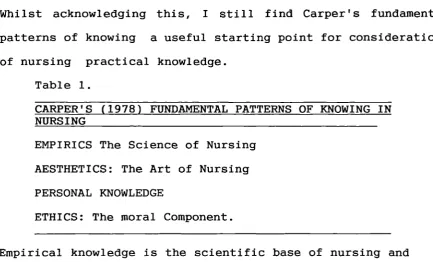
Whilst acknowledging this, I still find Carper's fundamental patterns of knowing a useful starting point for considerations of nursing practical knowledge.
Table 1.
CARPER'S (1978) FUNDAMENTAL PATTERNS OF KNOWING IN NURSING
EMPIRICS The Science of Nursing AESTHETICS: The Art of Nursing PERSONAL KNOWLEDGE
ETHICS: The moral Component.
Empirical knowledge is the scientific base of nursing and is presented as being very much in a state of development:
There is a critical need for knowledge about the empirical world, ... that is systematically organised into general laws and theories for the purpose of describing, explaining and predicting phenomena of special concern to the discipline of nursing (Carper 1978:14).
Aesthetics is described as being concerned with the Art of Nursing. Wiedenbach cited by Carper (1978:16-17) suggests that the art of nursing is
... made visible through actions taken to provide whatever the patient requires to restore or extend his ability to cope with the demands of his situation .
It is presumably expected that empathy will be acquired in a tacit form through a process of symbiosis.
The personal knowledge component, is 'the most problematic, the most difficult to master and teach' (Carper 1978:18). This component represents the knowledge evident in the nurse patient relationship. It is concerned with interpersonal processes and involves interactions, relationships and transactions. The phrase 'therapeutic use of self', which has become increasingly prominent in the literature, implies that the way in which nurses view themselves and the patient / client is of primary concern in any therapeutic relationship.The fourth and final pattern of knowing concerns the ethical dimension of nursing practice.
The ethical pattern of knowing in nursing requires an understanding of different philosophical positions regarding what is good, what ought to be desired, what is right; of different ethical frameworks devised for dealing with the complexities of moral judgements; and of various orientations to the notion of obligation
(Carper 1978:21).
Carper's patterns of knowing provide a useful framework for identifying different types of knowledge in nursing practice.
(Benner 1984). Her work focussed on nurses' discretionary judgement used in clinical situations. She addresses the risky, situation-specific decisions that are usually covered up, but that nurses face in their practice every day.The central premise of her work is that
... expertise develops when the clinician tests and refines propositions, hypotheses, and principle-based expectations in actual practice situations (Benner 1984:3).
She identifies six types of practical knowledge
Nursing competence involves more than knowledge and skill: also included within this domain are the processes of critical, creative and reflective thinking , decision making and problem-solving.
Indeed it may be argued that these processes represent the main components of nursing practice
... (Fitzpatrick et al 1992:1214).
These considerations do not sit easily with behaviourist approaches to professional competence and indicate that cognisance needs to be given to factors such as reflective ability when investigating expert practical nursing knowledge.
Early studies of nursing knowledge in America were essentially technical, using concept attainment and information processing theory (Tanner 1987). However, as the complexity of nursing knowledge was recognised these approaches have given way to more qualitative inductive approaches. An eclectic approach used by Shay and Stallings (1993) describes the attributes of expert nurses in relation to a number of indices used as part of a retention programme at the Wake Area Health Education Centre (AHEC) North Carolina.
Participants indicated that important characteristics of the nurse included striving for perfection and excellence, being anxious to help others, being loyal to friends, and to the organisation, having a feeling that there is a job to do, and staying with a job until it is finished.The valued personal characteristics were sincerity, radiance, warmth, trust, and consideration (Shay and Stallings 1993:68) .
1986, Goodman 1987, Beech 1991). In a recent British study by Butterworth et al (1993) 2,006 nominated expert respondents completed a delphi survey of optimum practice. A number of recommendations emerged and included the need for management support, and staff development on an on-going multi-disciplinary basis. Other recommendations were linked to resource issues, for example the requirement that centres of clinical practice be linked to data-bases and libraries. In many ways this study reinforces what nurses have long known: that support and continuing educational updating are essential requirements of expert practice.
However, this study has a major flaw in that the findings are based on what expert nurses said they did, rather than what they actually did in practice.These cannot be assumed to be one and the same thing and this considerably weakens the value of the study. The distinction is important, and is supported by Schon (1987:255) who clearly differentiates between 'espoused theories' and 'theories-in-use'. Meerabeau (1992) in an examination of tacit knowledge expresses similar concerns:
... wherever possible, research into practice should involve observation of that practice (Meerabeau 1992:110).
Australia (Davies 1993) and China (Davis et al 1990). They emphasise the importance of role models in transmitted knowledge about the artistic rather than the scientific aspects of nursing. These findings support Schon's (1987) contention that artistry is at the heart of professional practice. Values associated with practice are discovered and classified as 'good' and 'bad'. Students
... articulate[d] those attributes of nurses which lead to holistic care and those which lead to rigid, fragmented and impersonal care. They were able to recognise creativity and flexibility in practitioners and to relate these attributes to the ability to provide individualised, context-specific care (Davies 1993:635)
Studies of professional socialisation (Davis and Olesen 1989 cited by Davis et al 1990) also suggest the importance of qualities such as caring, responsibility and diligence in the 'good nurse'. Whilst positive role models may well assist the development of expertise particularly in relation to personal qualities and artistry, the negative effect that bad examples have on knowledge use and development does not appear to have been addressed in the literature.
A recurring theme is the linking of values to knowledge development (Davis et al 1990, Davies 1993). This is clearly illustrated by Raya (1990) through the emphasis she puts on developing the whole being in terms of nurse education.
Whilst such values appear rather lofty when contrasted with the practicalities of everyday practice for nurses, Raya emphasises the importance of the ethical component of curricula, citing this as essential to the preparation of nurse graduates. Such sentiments are addressed in the new Project 2000 (P2K) curriculum (UKCC 1986). It will be interesting to see if future studies substantiate the benefits of this holistic approach to education in terms of improved care provision.
Reflection and nursing knowledge
Reflection is strongly linked to knowledge use in practice. It is defined in many ways, and there is ambiguity in the way the term is used. Reflection is presented as a significant process by other professions, most notably teaching (Calderhead 1989, Turner-Muecke et.al . 1986, Zeichner and Liston 1987,Munby and Russell 1989, Nolan and Huber 1989, Osterman and Kottkamp 1993) and social work (Eisikovits and Guttman 1982).
Conversely reflection-on-action occurs after the event and is similar to the more traditional and accepted interpretations (Dewey 1933, Boud et al 1985) of the concept of reflection. Schon's model of reflection-in-action and reflection-on-action provides new insights and further dimensions to the traditional acceptance of reflection. By linking reflection to artistry and the development of professional practice, Schon takes reflection firmly into the professional arena in a novel and original way.He presents a fundamental reorganisation of the ways in which we think about professional practice and the relationship of theory to practice (Munby and Russell 1989).
Boud et al's (1985) definition however, differs from Schon's, suggesting that reflection is something so familiar that it tends to be overlooked and assumed to be occurring effectively. These differentiations are problematical since it is impossible merely by the use of the term reflection to know exactly in what sense the term is being used.
Clearly illuminating the central issues, Munby and Russell (1989) present a cogent review of Schon's work on reflection. They highlight the need to separate Schon's reflection-in-action from other forms of reflection and suggest that the promise of Schon's work lies in his view that
Commentators who present reflection as something familiar, do not address the dynamic nature of reflection as presented by Schon. Boud et al's original work has been revisited but links to the artistry of professional practice are still not apparent although a type of reflection-in-action is described. During a recent workshop (May 1994) David Boud presented reflection-in-action as dynamic in so much as the individual is actively involved in the process of reflection. This differs from the dynamism presented by Schon in reflection-in-action with its links to professional practice which has been such a stimulus for debate and exploration. Numerous authors have drawn on Schon's work (Zeichner and Liston 1987, Nolan and Huber 1989, Powell 1989, Dewing 1990, Brook and Champion 1992, Newell 1992, Jarvis 1992, Cameron and Mitchell 1993, Atkins and Murphy 1993, James 1993) and present it as a model for professional practice.
Attempts have been made to understand how reflection develops and to find appropriate methods to measure this process (Goodman 1984, Powell 1989, Jarvis 1992), whilst others have provided comprehensive reports on the topic (Brook and Champion
1992). The work of the Frankfurt School of Social Research, and of Habermas in particular is cited as having
inspired a critical science concept of reflection as self-determination. Reflection is viewed as a process of becoming aware of one's context, of the influence of societal and ideological constraints on previously taken-for-granted practices
Three areas identified by Habermas are 'knowledge constitutive' in that they determine categories which are interpreted as knowledge .
They also determine the mode of discovering knowledge and for establishing whether knowledge claims are warranted. Three distinct but interrelated learning domains are suggested ... the technical, the practical and the emancipatory
(Mezirow 1981:3-4).
Of particular importance is Habermas's emancipatory level of learning interest. This is concerned with self-knowledge and self-reflection.
... one must become critically conscious of how an ideology reflects and distorts moral, social and political reality and what material and psychological factors influence and sustain the false consciousness which it represents -especially reified powers of domination (Mezirow 1981:6).
The challenging of assumptions within ideologies has been presented by Freire (1970) as conscientization. This is the process
... by which the Hegelian and Marxist concept of false consciousness becomes transcended in traditional societies through education (Mezirow 1981:8).
another. Mezirow cites Habermas who has clearly recognised this fact.
We are never in a position to know with absolute certainty that critical enlightenment has been effective, that it has liberated us from the ideological frozen constraints of the past, and initiated genuine self-reflection ... any claim of enlightened understanding may itself be a deeper and subtler form of self-deception ... (Habermas 3:218-219 cited by Mezirow 1981:8)
Such ideas may have positive benefits for an emerging profession such as nursing, which has based much of its practice on ritual and routine in the past (Bevis 1982), and is only now attempting to look with critical insight on its practice (Leino-Kilpi 1990, Darbyshire et al 1990, 1991, McCaugherty 1991a, 1991b, 1992a, 1992b). Habermas's theory has
significant implications, identifying as it does the importance of perspective transformation in the development of both learning and education. It has been highly influential in shaping critical thinking in education. Mezirow for example based his theory of adult critical thinking on it and in turn Brookfield (1987) acknowledges that Mezirow, a colleague of his at Columbia University, has contributed to the development of his book on adult critical thinking. The use of the term critical thinking appears synonymous with Habermas's presentation of reflection.
He suggests reflective levels , based on Van Manen's (1977) work, in an effort to guide and deepen the reflective processes of trainee teachers. Whilst specifically examining the role of reflection in teacher education, he provides insights which have direct application for nursing. Goodman's theory of reflection focuses on levels of reflection, the process of reflection and reflective attitudes (Goodman 1984). Level one is concerned with the techniques needed to reach a given objective. At this level of reflection students are concerned with 'what works'. At level two student focus on the relationship between theory and practice. The third level incorporates reflections on both ethical and political concerns, and principles such as justice, equality and emancipation are used as criteria in deliberations (Goodman 1984). This framework provides an excellent means for reflecting on practice, incorporating as it does practical, theoretical, moral and political considerations. Such an approach appears particularly suited to the profession of nursing which proclaims advocacy as a central tenet (UKCC 1992).
Calderhead also provides useful insights into the types of reflection teachers use for understanding classroom practice. These insights are also likely to be highly applicable to nursing practice.
... Reflection focussed on the immediate concerns of accomplishing the task ahead of them
(Calderhead 1987:276).
This supports Goodman's findings and challenges the assumption that practitioners can and do reflect in depth. It is evident that practical concerns of day to day practice form the main focus for practitioners' reflections, and curriculum builders need to be cognisant of this.
Another reflective theoretical framework is presented by Powell (1989). Drawing on critical theory she uses Mezirow's seven levels of reflectivity for analysing data she had collected. The levels of reflectivity are hierarchically arranged. The first four relate to consciousness and the last three to critical consciousness. These levels have some areas of commonality with Goodman's (1984) levels of reflection based on Van Manen's (1977) work. Both of these theoretical frameworks emphasise description and awareness of feelings. They also both address judgmental reflectivity, although the emphasis and interpretation is different. How effective Powell's framework can be is far from clear, as it is surely necessary to ensure that a process of emancipation and conscientization has occurred in the individual reflecting. Powell does not address this issue, rather presenting these levels as a mechanistic formulae for developing reflection.
In addition developing reflective practitioners is seen as a management responsibility. Campbell, a management consultant, suggests that an essential requirement is
an organisation in which being protective and making changes is not only possible, but expected ... reflective practitioners require reflective management (Campbell 1991:34-35).
This is supported by the findings of Butterworth et al (1993) in their study of optimum practice.The importance of reflection as the key element in learning from experience was explored by Boyd and Fales (1983). Their analysis of reflective learning shares some aspects with Habermas's critical theory in that it involves a 'shift from one perceptual perspective to another' (Boyd and Fales 1983:101).
both nurse and patient emancipation. This has considerable implications for the type of knowledge used in practice.
Intuition and nursing knowledge
The importance of intuition in terms of nursing knowledge has been recognised only recently (Gerrity 1987, Rew and Barrow 1987, Correnti 1992). Gerrity (1987) highlights the importance of intuition and draws on Jungian theory to support its use and development. Intuition is also presented as an aspect of the pattern of personal knowledge (Agan 1987) whilst Correnti
(1992) promotes strategies to facilitate its use.
There are dissensions vis-a-vis an intuitive model for nursing (Farrington 1993, English 1993). These commentators are keen to redefine intuition in terms of the feature-detection model of cognitive psychology (English 1993) or in terms of Heuristics
Gerrity notes that as nursing has aspired towards professional status its concern has been to establish a scientific base to practice:
As nursing becomes a science, the text-book ideal of scientific knowledge becomes the dominant mode of knowledge in nursing. This mode is largely analytical,verbal, and linear. The intuitive mode has been deemphasised and devalued (Gerrity 1987:69).
In the past decade such mechanistic approaches has been superseded by an approach to clinical decision-making that acknowledges the importance of a synthesis of intuition and skilled theoretically based nursing (Gatley 1992). Benner and Tanner (1987) use Dreyfus's aspects of intuitive judgement as the first attempt in nursing to devise a model of expertise.
Exploration of intuition is linked to a desire for a wider, less 'mechanistic', indeed less 'scientific' agenda in nursing (Schraeder and Fischer 1987, Rew and Barrow 1987, Gerrity 1987).Scientific approaches are viewed as essentially masculine by some commentators (Schraeder and Fischer 1987). They criticize the narrowness of the biomedical model and suggest that
The antithesis of the biomedical approach is the caring, warm, and intuitive dimensions of clinical practice. This has been described as the yin, or female paradigm (Randolph 1981 cited by Schraeder and Fischer 1987:47).
Agan argues that
Most nurses are women, so nursing is unique in that it is a women's science while all the others are viewed primarily as men's sciences (Agan
1987:64).
This uniqueness is presented as enabling nursing to transcend the male world view of scientific method and to question the myths that have perpetuated an erroneous view of knowledge about the world (Rew 1989 citing Chinn 1985). Schraeder and Fischer in their study of a neonatal unit, like Benner (1984) found that
... intuitive thinking was found in the most experienced, technically proficient nurses
(Schraeder and Fischer 1987:48)
Links between intuition and holistic approaches to care are demonstrated by many (Schraeder and Fischer 1987, Rew 1989, Agan 1987). They take intuitive approaches to care into the realms of spirituality, (Rew 1989, Agan 1987) psychic phenomena, (Agan 1987) and expanded consciousness (Barnum 1989). Agan provides an informative exploration of the concept of intuitive knowing which conveys perceptual awareness into the realms of psychic experience.
of legitimised approaches to professional knowledge such as Schon's (1987) reflection-in-action and Benner and Tanner's (1987) clinical judgements. It seems that words like psychic are still beyond the pale in the British literature, threatening as they do the scientific basis of nursing and professionalisation that has so long been striven for. Perhaps nursing in Britain is as yet too insecure in terms of its shaky scientific basis and emerging professionalisation to tolerate ambiguity in terms of its knowledge use.This is rather ironic considering the efforts being made to produce flexible reflective practitioners (UKCC 1986).
is as integral to nursing knowledge as is the science of nursing. This has only being recognised as nursing commentators, primarily in America, develop the confidence to challenge the technical rationalist model so eagerly adopted by nursing in its flight towards professionalisation. To what extent intuition is used as a base for practice is not known, but there are indications that it might occur more frequently than has been recognised.
Teachers' practical knowledge
Practical knowledge and the development of expertise have been examined in several occupational groups. These include management (Isenberg 1984, Klemp and McClelland 1986) racetrack handicappers (Ceci and Liker 1986) and milkmen (Scriber 1986). Literature related to teachers' practical knowledge and expertise is particularly informative, providing useful insights which are directly applicable to nursing (Elbaz 1981, Eraut 1985, Clandinin 1985, Sternberg 1985, Huberman 1985, Shulman 1986, Shuell 1986, Berliner 1986, Sockett 1987, Lampert and Clark 1990, Floden and Klinzing 1990, Hyland 1993).
Questions have been raised about the appropriateness of narrow and mechanistic approaches to developing teachers' knowledge and expertise (Hyland 1993). These queries also apply to the development of nursing knowledge. Such approaches
The assumption that expertise can be somehow imported into practice through an educational process does not acknowledge the importance of context in terms of knowledge use.
... teaching [like nursing] is a complex act requiring the moment by moment adjustments of plans to fit continually changing and uncertain conditions (Lampert and Clark 1990:21).
Recognition of the importance of context and uncertainty echoes the Dreyfus model of skills-acquisition drawn on by Benner (1984). Emphasis on context is also supported by others
A range of empirical studies ... have demonstrated that the knowledge ... involved in being an acknowledged expert are all context specific... (Hyland 1992:24).
Such emphasis reinforces an educational as opposed to a training approach to both teacher and nursing professional knowledge development. Questions need asking then, about the appropriateness of competency approaches for professional development. I return to this below. The way knowledge used in teaching is classified is confusing, as numerous categorisations are presented. Lampert and Clark for example offer three types, contextual, interactive, and speculative. They also suggest that it is necessary to
... raise questions about where expert teachers get that knowledge, and how and where they get it might be related to their capacity to use it
(Lampert and Clark 1990:21).
teachers use knowledge. Once again much wider issues than subject knowledge are considered. These further substantiate earlier indications that a multiplicity of factors require consideration when examining practical knowledge. Others also raise questions about teachers' practical knowledge:
Where do teachers' explanations come from ? How do teachers decide what to teach, how to represent it, how to question students about it and how to deal with problems of misunderstanding ? (Shulman 1986:8)
Shulman (1986:10) presents three forms of teachers' knowledge : propositional knowledge, case knowledge and strategic knowledge. There are no apparent links with Lampert and Clark's (1990:21) classification of contextual, interactive and speculative teachers' knowledge. It is not surprising that educationalists debating the same area should present different perspectives.This seems to reflect a lack of clarity in the literature in terms of what can justifiably be called 'teaching knowledge'; and of what forms that knowledge takes. Further refining his description, Shulman differentiates between three types of propositional knowledge:
... there are fundamentally three types of propositional knowledge in teaching corresponding to three major sources of knowledge about teaching: disciplined empirical or philosophical inquiry, practical experience, and moral or ethical reasoning. I will refer to these three types of propositions as principles, maxims and norms (Shulman 1986:11).
ethical or moral component of knowledge in nursing. Whilst Shulman (1986) acknowledges both the moral and the empirical aspects of knowledge he does not explicitly identify the importance of the art of teaching or of the influence of personal knowledge in teaching. It is likely however that his use of pedagogical parables corresponds to development of the artistry of teaching practice.
What distinguishes mere craft from profession is the indeterminacy of rules when applied to particular cases. The professional holds knowledge, not only of how - the capacity of skilled performance, but of what and why ... and
[is] capable of explaining why something is done (Shulman 1986:13).
This differentiation of professional expertise is significant, specifying as it does the difference between mere skilled performance and informed practice. It underpins the importance of a sound educational base in making informed decisions about practice in indeterminate situations. Recognition of the complexity of teachers' knowledge is also evident in Eraut's (1985) work on knowledge creation and use in professional contexts. He distinguishes between different types of professional knowledge and concludes that
... knowledge is likely to be labelled and packaged according to traditional assumptions about where and how it will be acquired (Eraut 1985:119).
practitioners, Eraut's critique of traditional approaches to professional education reconceptualises the issues related to developing professional knowledge. He broadens the debate to factors other than the curriculum, and calls for wider considerations regarding continuing education.
Continuing education needs to be viewed in the broad sense of all kinds of further learning beyond initial qualification, not in the narrow sense of attending courses. Thus it includes informal learning and on-the-job learning (Eraut 1985:131).
In addition he presents the need for a broader conception of what constitutes professional knowledge. Essentially he is calling for an opening up of professional knowledge, and emphasises the importance of making the practical situation central to knowledge development. In similar vein Elbaz (1981) also expresses dissatisfaction with traditional perceptions about teachers' knowledge.
The prevailing view of the teacher as a passive transmitter of knowledge does not accord with my own experience, in teaching and in work with teachers, of what the teaching act requires (Elbaz 1981:43).
Elbaz identifies the complexity of practice and challenges the view that teachers do not have a body of knowledge:
The view of teachers as lacking in knowledge is, I believe, mistaken and misleading ...
(Elbaz 1981:45)
practical knowledge, namely situational, theoretical, personal, social and experiential. Like Shulman (1990) he further proposes three terms, which are rules of practice, practical principle, and image, and he suggests that these
'embody the teacher's purposes in varying ways '.
Socket (1987) emphasises the importance of both context and moral knowledge. Clandinin (1985) provides an interesting and informative presentation of the importance of images in terms of teachers' personal, practical knowledge. This work emphasises the influence of the personal in terms of practical knowledge, an area that has as yet received scant attention in the nursing literature .
These differing views suggest that examination of teachers' practical knowledge in still in its infancy. There is evidence of considerable speculation in this area, with numerous interpretations being presented. Fundamental issues are raised, which can be described as a questioning of assumptions to do with knowledge use and development.
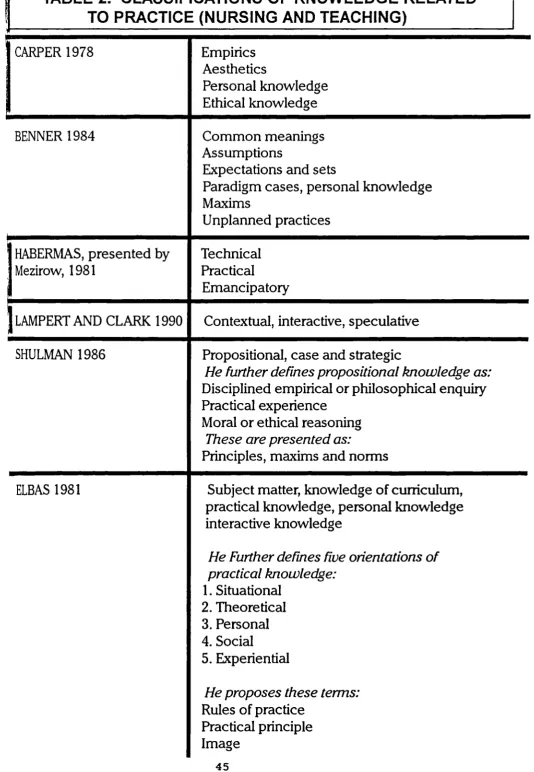
1986:10, Lampert and Clark 1990:21). This is particularly evident in the use of cases in the teaching literature (Eraut 1985) and critical incidents in the nursing literature (Benner 1984). Other links exist such as those presented by Shulman (1986) who acknowledges both the moral and the empirical aspects of knowledge. These link with two of Carper's (1978:14) patterns of knowing. Table 2 (overleaf) provides a classification of knowledge related to practice in both nursing and teaching.
TABLE 2. CLASSIFICATIONS OF KNOWLEDGE RELATED
TO PRACTICE (NURSING AND TEACHING)
CARPER 1978
Empirics
Aesthetics
Personal knowledge
Ethical knowledge
BENNER 1984
Common meanings
Assumptions
Expectations and sets
Paradigm cases, personal knowledge
Maxims
Unplanned practices
HABERMAS, presented by
Mezirow, 1981
Technical
Practical
Emancipatory
LAMPERT AND CLARK 1990
Contextual, interactive, speculative
SHULMAN 1986
Propositional, case and strategic
He further defines propositional knowledge as:
Disciplined empirical or philosophical enquiry
Practical experience
Moral or ethical reasoning
These are presented as:
Principles, maxims and norms
ELBAS 1981
Subject matter, knowledge of curriculum,
practical knowledge, personal knowledge
interactive knowledge
He Further defines five orientations of
practical knowledge:
1. Situational
2. Theoretical
3. Personal
4. Social
5. Experiential
He proposes these terms:
Competences, accreditation and practical nursing knowledge
Accreditation of prior experiential learning (APEL) and of prior learning (APL) are relatively new concepts in nursing, with only a few notable commentators in the last five years. McManus (1990) produced an advisory document for the ENB (1990) whilst Nyatanga and Fox's study (1991a) provides guidance about good APEL practices.
They have written on APEL separately (Nyatanga 1989) and with others (Fox et al 1992). Others are now contributing to this growing body of literature (Rowbotham 1991, Glen and Hight 1992, Crook and Maran 1993, Day 1991, Barnes 1992, MacAlister 1993, Howard 1993). Much of the literature is essentially descriptive and pragmatic in nature (Simosko 1985, 1991), mainly originating from the Further Education Unit (Mortimore
1984, FEU 1987), Council for National Academic Awards (CNAA) and Learning from Experience Trust. Much of it is the work of Evans (1984, 1987, 1988).The need for a rigorous approach to APEL assessment is highlighted by Barnes (1992). Rowbotham sees accreditation processes as both rigorous and developmental.
However, such approaches to professional development are challenged on several accounts. Concerns are expressed about the notion of a competence approach to assessment. These are presented in relation to nursing practice (Cernik and Evans 1992) and more generally in terms of professional practice (Hyland 1993). Such views echo earlier concerns with behavioural approaches to education (Pinar 1986).
The Unit for the Development of Adult Education (UDACE) undertook a project to investigate ways of describing clearly what the outcomes of higher education are. Outcomes are used rather than the term competences, because of concerns expressed by the academic community.
There are two major concerns in the academic world about ... competence.The first is a fear of vocationalism that important dimensions of higher education which relates to the development of the person, to the acquisition and transmission of cultural and social values, may be lost in the pursuit of short term work-related value systems.The second is a fear of reductionism that the analytical techniques which break learning down into small pieces inevitably lead to the neglect of those qualities which we understand as a subject, profession or a discipline (UDACE document 1991:6)
Emphasis on objectives and rule-governed behaviour is perceived as producing a social type, who becomes developmentally arrested with a consequent numbing to
In similar vein Hyland is critical of educational reforms which aim to link teacher education with competence based education (CBE).
Extreme caution needs to be exercised here, however, for the experiments with CBE in the post-school sector have been less than inspiring and, as Betts (1992) observed in a recent critique of the proposed reforms in teacher education, there is 'a genuine fear that the current fashion for defining competence as the application of skills and underpinning knowledge is leading to a narrowing of the professional role, if not actually deskilling it' (Betts, 1992 p8.)(Hyland
1993:130)
He raises further concerns and reservations in relation to competence-based education and the more qualitative and reflective nature of the teacher's role.
Programmes based on the functional analysis of work roles are likely to produce teachers who are 'competent' yet ill-equipped for further professional development, uncritical of educational change and largely ignorant of the wider cultural, social and political context in which the role of teachers needs to be located.
Such teachers will be neither experts nor reflective practitioners ... and will be
'professionals' in name only (Hyland 1993:130).
These reservations need careful consideration as they are likely to be directly applicable to nursing also. There is scant evidence however, that the consequences of competence approaches to nursing education have been reflected on to this degree, although some concerns are raised.
To overestimate the power of competency-based testing will cause an undesirable reductionism in nursing. That is, the definition of practice will be reduced to the capabilities of the measuring tools. Practice in any helping profession is more complex than current test methodology can evaluate
Other concerns are expressed in a more tentative style, focussing on the practicalities rather than the deeper professional issues in relation to political, ethical and emancipatory considerations.
The attempt to measure competency is fraught with difficulties. Nurse educationalists have found it useful to make use of product objectives ... but such approaches tend to stifle initiative and imply that terminal objectives are satisfactory (Cernik and Evans 1992:37).
Voices questioning competency approaches are in the minority (Benner 1982, Cernik and Evans 1992). Many commentators adopt a more positive stance (Rowbotham 1991, Nyatanga and Fox 1991a, 1991b, Fox et al 1992). In particular both the Framework and Higher Award document (ENB 1991b) and PREPP (UKCC 1989) recommendations extol the virtues of accreditation approaches as a means of claiming credits for knowledge gained through nursing practice. There is scant evidence of concerns related to this approach.It is as if, in its rush to take on board the latest initiative, nursing has neglected to consider the total implications. As the nursing workforce is largely trained at certificate level at the moment, it may be that educational opportunism is holding sway, in the belief that accreditation issues can go hand in glove with developing reflective practitioners.
identifying knowledge from practice. Although these have not been presented in relation to accreditation, they may also be useful for this purpose. A useful starting point for identifying knowledge found in practice is through the use of Flanagan's (1954) critical incident technique. Critical incident approach is used in the ENB Professional Portfolio (1991a) and several nursing commentators have identified this technique as a useful tool for developing knowledge from practice (Benner 1984, Smith and Russell 1991).
Numerous techniques can be used and include paradigm case analysis (Farrell and Bramadat 1990) and 'thinking aloud' (Corcoran et al 1988). Another means of assessing clinical competence presented by Ross et.al . (1988) is the use of the objective structured clinical examination (OSCE). This was used to measure the psychomotor learning outcomes of a programme to assist students to conduct a nursing neurological examination. It was found that 'the OSCE appears to be a promising method for the evaluation of clinical skills performance'(Ross et.a1.1988:55). The OSCE might be a useful tool for post-registration also, and enable the articulation of the knowledge found in practice.