University of Warwick institutional repository: http://go.warwick.ac.uk/wrap
This paper is made available online in accordance with
publisher policies. Please scroll down to view the document
itself. Please refer to the repository record for this item and our
policy information available from the repository home page for
further information.
To see the final version of this paper please visit the publisher’s website
.
Access to the published version may require a subscription.
Author(s): John Curtice and David Firth
Article Title: Exit polling in a cold climate: the BBC–ITV experience in
Britain in 2005
Year of publication: 2008
Link to published article:
Exit polling in a cold climate:
The BBC/ITV experience in Britain in 2005
John Curtice
Department of Government
University of Strathclyde
David Firth
∗Department of Statistics
University of Warwick
July 16, 2007
Abstract
Conducting an exit poll to forecast the outcome of a national election in terms of both votes
and seats is particularly difficult in Britain. No official information is available on how individual
polling stations voted in the past; use of single member plurality means that there is no
con-sistent relationship between votes and seats; electors can choose to vote by post; and most of
those who vote in person do so late in the day. In addition, around one in every six intended
exit-poll respondents refuses to participate. Methods developed to overcome these problems, and
their use in the successful 2005 BBC/ITV exit poll, are described and evaluated. The
methodol-ogy included: a panel design to allow the estimation of electoral change at local level; coherent
multiple regression modelling of multi-party electoral change to capture systematic patterns of
variation; probabilistic prediction of constituency winners in order to account for uncertainty in
projected constituency-level vote shares; collection of information about the voting intentions
of postal voters before polling day; and access to interviewer guesses on the voting behaviour
of refusals. The coverage and accuracy of the exit poll data are critically examined, the impact
of key aspects of the statistical modelling of the data is assessed, and some general lessons are
drawn for the design and analysis of electoral exit polls.
Key words: general election, exit poll, forecasting, postal voting, probability calibration, Steed
swing, swingometer, ternary diagram
1
Introduction
Electoral exit polls are typically conducted in order to enable a broadcasting organisation to
publish, as soon as the polls close, an estimate of the share of the vote won by each party. In
the case of a legislative election an attempt is also usually made to indicate how many seats
each party is expected to win. These estimates provide a basis for informed on-air discussion
∗Address for correspondence: Department of Statistics, University of Warwick, Coventry CV4 7AL, UK; email
during the period between the close of polling stations and the declaration of the first results;
the numbers of viewers and listeners during that period are often among the highest achieved
by current affairs broadcasts.
Conducting and analysing an exit poll successfully is a formidable methodological challenge
at the best of times. As it has to be conducted in a sample of polling stations, the design of any
such poll is inevitably heavily clustered, with highly adverse consequences for sampling error.
Those who are approached to ascertain how they voted may well refuse to disclose what they
have done in what after all is a secret ballot. Meanwhile the results of the interviews that are
conducted have to be collated and analysed in little more than a few hours against an immovable
deadline. The potential for error is considerable.
The problems facing those carrying out exit polls in the United Kingdom, however, are
par-ticularly formidable:
(i) In contrast to most other countries, election results are not counted and declared by polling
station/district. This makes it impossible to use knowledge of the election results at a
previous election in order to stratify the selection of polling districts and so help ensure
that they are representative of the country as a whole.
(ii) Elections to the principal legislature, the House of Commons, are conducted using the
single member plurality electoral system under which there is not necessarily a regular
relationship between votes and seats.
(iii) Voters can if they wish opt to vote by post rather than attending a polling station, thereby
automatically eluding the exit pollster.
(iv) As elections take place on a working day (Thursday) rather than, as is the case in many
countries, a non-working day (such as a Sunday), the majority of electors vote in the early
evening, thereby leaving very little time indeed to collate and analyse the bulk of the data
before the polls close.
Despite these difficulties, at 10 p.m. on 5 May 2005 the two principal broadcasting organisations
in the UK, the BBC and ITV, broadcast a forecast total of 356 seats for Labour — a House of
Commons majority of 66 seats — based on the analysis of a jointly commissioned exit poll (see
Table 1). When eventually the result of a delayed election in South Staffordshire was declared in
the early hours of June 21, this proved to be exactly the arithmetic of the new parliament. Never
before in the history of exit polling in Britain has the overall majority been predicted with such
accuracy (see, e.g., Payne, 2003, p. 214). Such anexact forecast of the headline majority could
not of course have been made without a fair measure of luck, since many House of Commons
seats are very closely contested. Indeed, the poll-based forecast for the number of seats won
by the two main opposition parties was slightly less accurate, and the national vote shares for
the Liberal Democrat and Labour parties were respectively slightly underestimated and slightly
Table 1: 2005 BBC/ITV exit poll forecast and final election outcome compared
Lab
Con
LD
Oth
Exit poll
votes (GB) (%)
37
33
22
8
seats (UK)
356
209
53
28
Outcome
votes (GB) (%)
36.2
33.2
22.6
7.9
seats (UK)
356
198
62
30
as could reasonably be expected given the difficulties mentioned above. This paper reports on
and critically evaluates the methodology that lay behind these forecasts. In so doing it aims to
identify what general lessons might be drawn for the conduct of exit polls given this apparent
success in a particularly harsh electoral climate.
The paper falls into three main sections. In Section 2 we outline in more detail the problems
facing exit pollsters in the United Kingdom and how the methodology of the 2005 BBC/ITV exit
poll attempted to overcome those problems. In Section 3 we evaluate the accuracy of the exit
poll data in estimating party performance in terms of votes won. In Section 4 we examine how
the analysis and modelling of those data contributed to the accuracy of the forecast in terms of
seats won. Finally in our concluding remarks we consider the lessons to be drawn from the 2005
experience.
2
Overcoming the Obstacles
2.1
Selecting Polling Locations
As we have noted, votes are never counted and published at the level of individual polling
sta-tions in Britain. We thus do not have accurate information on the political complexion of any
particular polling district, information that could be used to ensure that a selection of polling
districts is politically representative. At the same time the geography of polling districts does
not match that of the enumeration districts for which information is available from the census.
This means that the census cannot easily be used to stratify polling districts according to those
social characteristics known to be correlated with voting behaviour. At best one can engage in a
multi-stage process of stratification. First of all one can select a stratified sample of
parliamen-tary constituencies for which both past general election results and census data are available.
Then, within each selected constituency, one or more local authority wards can be selected
af-ter stratifying by past local election results and, again, census data. But thereafaf-ter within the
selected wards polling districts have either to be selected at random, or an attempt made, for
these wards, to construct a best fit of census enumeration districts with polling districts, and
this then used to guide the selection of a ‘typical’ polling district within each selected ward.
Meanwhile, neither census data nor local election results are always a reliable guide to the
po-litical complexion of an area in a general election, and local authority ward boundaries do not
How might one overcome this apparently insoluble problem? We begin by observing that the
changein each party’s share of the vote between any adjacent pair of elections varies far less
than does each party’s actual share of the vote. For example, the constituency-level standard
deviation of the percentage of the vote won by the three main parties in Britain in 2005 was
Labour 15.1, Conservative 14.0, and Liberal Democrat, 10.4. In contrast, the equivalent statistic
for the change in their share of the vote since 2001 was only Labour 4.0, Conservative 3.0 and
Liberal Democrat 4.4 (Curticeet al., 2005). As a result, the probability that any randomly selected
set of polling stations accurately reflects the change in each party’s share of the vote across
Britain as a whole is much higher than is the probability that any such set accurately reflects
each party’s share of the vote. Even a set of polling stations that is not representative in terms
of each party’s share of the vote may well be representative when it comes to thechangein their
share of the vote.
But of course we can only calculate the change in each party’s share of the vote in a polling
district if we have information on how well the parties performed in that district at the last
election — precisely the information that is not available from the official results in Britain.
However, if an organisation has conducted an exit poll at the previous election, it does have some
— albeit potentially imprecise — information on how well the parties performed at each polling
station covered by that poll. If therefore it returns to those same stations at the subsequent
election, it can use an exit poll to estimate the change in each party’s share of the vote. It is this
approach that was adopted by the 2005 exit poll. Its principal purpose was to estimate the local
change in each party’s share of the vote. Thereafter estimates of each party’s share of the vote
and the number of seats it would win were derived by applying the estimated changes to the
actual outcome at the 2001 election in each constituency.
This was not the first time that such an approach had been adopted. ITV’s exit polls had long
been conducted as far as possible in the same polling districts as at the previous election. The
BBC’s history of exit polls is a shorter one, but in 2001 it too adopted a strategy of revisiting the
same polling districts as it had done in 1997. Thus when the two organisations decided in 2004
to lay down their rivalry and commission a joint exit poll, largely on the grounds of cost, it was
relatively easy for them to agree that the 2005 poll should be based on those polling districts
that had been covered by one or other of them in 2001.
There had, however, been some differences between the approach used by ITV in 2001 in
selecting polling districts and that used by the BBC. While it had been disproportionately
con-ducted in marginal constituencies, and in particular those marginal between Labour and the
Conservatives, the 2001 BBC poll, conducted at 90 polling stations, had covered all kinds of
con-stituencies. In contrast the parallel ITV poll, conducted in 100 locations, hadonlyvisited polling
stations in constituencies that had previously been marginal. Either they were constituencies
that had been marginal between Labour and the Conservatives (all of which were constituencies
that were closely contested by the Liberal Democrats and the Conservatives (a mixture of seats
held relatively narrowly by either party). In excluding any other kind of marginal, this approach
reflected the fact that these had hitherto been the two main political ‘battlegrounds’ at British
general elections. The two organisations adopted their different approaches because their polls
were designed to achieve somewhat different objectives. ITV’s poll was only intended to produce
a seat projection, not forecast shares of the vote, and thus it could focus exclusively on the two
types of constituency where seats were most likely to change hands. In contrast, not only was
the BBC’s poll intended to produce a forecast vote share, but it was also used, alongside the
results from those seats that declared first, in order to produce an updated forecast; see, for
example, Brownet al.(1999). As most of the constituencies that declare early are safe (Labour)
constituencies (e.g., Payne, 2003, p.202) it is only possible to make an early check on the likely
accuracy of an exit poll if it contains at least some polling stations located in safe constituencies.
Any possibility that this divergence would cause difficulty in securing agreement between
the two organisations about which approach, and thus which polling districts, should comprise
the locations at which interviewing was conducted (which it had been agreed should total 120)
in the 2005 poll was, however, removed by a further complication. Polling district boundaries,
which are determined by local returning officers, are far from being permanent. If, for example,
an area’s electorate grows substantially, this may make it administratively desirable that it be
subdivided into two. Meanwhile the introduction of new local authority ward boundaries may
split an existing polling district into two or more wards and so require an adjustment of polling
district boundaries. Much of England and Wales, including all of London and all of the English
metropolitan districts, had had their local authority ward boundaries redrawn since the 2001
general election, making it particularly likely that their polling district boundaries had been
redrawn since then too. It was anticipated that, for this reason alone, a significant proportion of
the 190 polling locations covered by the two organisations in 2001 (some of which were in any
event located in the same parliamentary constituency) could not be revisited because the 2001
polling district no longer existed. In particular, there might well be fewer polling stations than
desirable in London, a city where there was both a large number of marginal seats and where the
change in each party’s share of the vote had departed notably from the national pattern at past
elections (see, for example, Curtice and Steed, 1997). Even in those locations where the polling
district boundary had not changed, if a large increase or decrease in electorate had occurred
since 2001 there was a danger that the partisan colour of the area might have changed as a
result of population change, an eventuality that would make any exit-poll data for such an area
much less informative than it might otherwise have been about the national pattern of change.
In addition, if the location of a polling station had changed, even though the boundaries of the
polling district were the same, the physical layout of the new location might present insuperable
logistical difficulties for interviewers. In combination these considerations suggested that it was
and that it might even be necessary in London in particular to visit some new polling locations.
This proved to be the case. After making extensive checks during the early months of 2005 on
whether the boundaries of each of the 190 polling districts covered by ITV and the BBC in 2001
had changed, on whether the location of their polling station had changed, and after determining
how much their electorate had changed between 2001 and 2005, just 116 of the 190 sampling
points visited in 2001 could reasonably be revisited. Even then that figure was only reached after
both adopting rather looser criteria in London in respect of the degree of change in the size of
the electorate between 2001 and 2005 that would be tolerated, and after accepting too that in
some instances the poll should be conducted in more than one polling location within the same
parliamentary constituency. As this sample of 116 districts was still light on polling locations
in London, it was augmented by the addition of four polling districts in the capital that had not
been covered in 2001. These were districts where, after inspection and manipulation of the 2002
local election results and 2001 census data, it appeared likely that their political complexion was
similar to that of the parliamentary constituency in which they were located, thereby making it
possible to estimate the change in the share of the vote in that location by comparing the 2005
exit poll data with the result for the whole constituency in 2001.1
These 120 polling locations were far from being representative of the country as a whole.
They inevitably over-represented marginal constituencies. For example, no less than 47% were
located in constituencies where in 2001 Labour won with a lead of less than 20% over the
Con-servatives, whereas such constituencies comprised only 20% of all constituencies. This can be
seen in Figure 1. This ternary diagram contrasts the political colour of the constituencies in
which the 120 exit poll locations were situated with that of all the 628 constituencies in Great
Britain. In the diagram a seat in which Labour secured all of the vote would be located in the
corner marked ‘Labour’, and the further a constituency is located away from that corner, the
lower Labour’s share of the vote. Seats that fall in the sector of the triangle that is nearest to
the Labour corner are those where Labour came first, though the closer they are to the lines that
demarcate the Labour sector the more marginal they are. The same logic applies to the
repre-sentation of the share won by the Conservatives and Labour; for further details see, for example,
Upton, (1976, 1994) or Miller (1977). As can be seen, the locations covered by the exit poll were
disproportionately situated in constituencies that fell within Labour’s sector of the triangle but
were relatively close to the Conservative one. Overall, the share of the 2001 vote won by each
party in our exit-polled constituencies was Labour 40%, Conservative 36% and Liberal Democrat
20%, compared with the national (GB) outcome of Labour 42%, Conservative 33% and Liberal
Democrat 19%. Evidently, the ability of the exit poll to provide the basis for an accurate estimate
of the outcome rested on the premise that a sample that was unrepresentative in terms of the
national share of the vote could still, after being analysed for possible differences of behaviour
● ● ● ● ● ● ● ● ● ● ● ● ● ● ● ● ● ● ● ● ● ● ● ● ● ● ● ● ● ● ● ● ● ● ● ● ● ● ● ● ● ● ● ● ● ● ● ● ● ● ● ● ● ● ● ● ● ● ● ● ● ● ● ● ● ● ● ● ● ● ● ● ● ● ● ● ● ● ● ● ● ● ● ● ● ● ● ● ● ● ● ● ● ● ● ● ● ● ● ● ● ●● ● ● ● ● ● ● ● ● ● ● ● ● ● ● ● ● ● ● ● ● ● ● ● ● ● ● ● ● ● ● ● ● ● ● ● ● ● ● ● ● ● ● ●● ● ● ● ● ● ● ● ● ● ● ● ●● ● ● ● ● ● ● ● ● ● ● ● ● ● ● ● ● ● ● ● ● ● ● ● ● ● ● ● ● ● ● ● ● ● ● ● ● ● ● ● ● ● ● ● ● ● ● ● ● ● ● ● ● ● ● ● ● ● ● ● ● ● ● ● ● ● ● ● ● ● ● ● ● ● ● ● ● ● ● ● ● ● ● ● ● ● ● ● ● ● ● ● ● ● ● ● ● ● ● ● ● ● ● ● ● ● ● ● ● ● ● ● ● ● ● ● ● ● ● ● ● ● ● ● ● ● ● ● ● ● ● ● ● ● ● ● ●● ● ● ● ● ● ● ● ● ● ● ● ● ● ● ● ● ● ● ● ● ● ● ● ● ● ● ● ● ● ● ● ● ● ● ● ● ● ● ● ● ● ● ● ● ● ● ● ● ● ● ● ● ● ● ● ● ● ● ● ● ● ● ● ● ● ● ● ● ● ● ● ● ● ● ● ● ● ● ● ● ● ● ● ● ● ● ● ● ● ● ● ● ● ● ● ● ● ● ● ● ● ● ● ● ● ● ● ● ● ● ● ● ● ●●● ● ● ● ● ● ● ● ● ● ● ● ● ● ● ● ● ● ● ● ● ● ● ● ● ● ● ● ● ● ● ● ● ● ● ● ● ● ● ● ● ● ● ● ● ● ● ●● ● ● ● ● ● ● ● ● ● ● ● ● ● ● ● ● ● ● ● ● ● ● ● ● ● ● ● ● ● ● ● ● ● ● ● ● ● ● ● ● ● ● ● ● ● ● ● ● ● ● ● ● ●● ● ● ● ● ● ● ● ● ● ● ● ● ● ● ● ● ● ● ● ● ● ● ● ● ● ● ● ● ● ●● ● ● ● ● ● ● ● ● ● ● ● ● ● ● ● ● ● ● ● ● ● ● ● ● ● ● ● ● ● ●● ● ● ● ● ● ● ● ● ● ● ● ● ● ● ● ● ● ● ● ● ● ● ● ● ● ● ● ● ● ● ● ● ● ● ● ● ● ● ● ● ● ● ● ● ● ● ● ● ● ● ● ● ● ● ● ● ● ● ● ● ● ● ● ● ● ● ● ● ● ● ● ● ● ● ● ● ● ● ● ● ● ● ● ● ● ● ● ● ● ● ● ● ● ● ● ● ● ● ● ● ● ● ● ● ● ● ● ● ● ● ● ● ● ● ● ● ● ● ● ● ● ● ● ● ● ● ● ● ● ● ● ● ● ● ● ● ● ● ● ● ● ● ● ● ● ● ● ● ● ● ● ● ● ● ● ● ● ● ● ● ● ● ● ● ●
LD
Lab
Con
2.2
Postal voting
The problem of selecting polling locations for an exit poll in Britain is long standing, but in 2005
a new problem presented a potentially more fundamental challenge. Exit polls can of course
only acquire information from those who actually attend a polling station to vote. If a significant
proportion do not vote in person but rather vote, say, by post, then it may no longer be the case
that those who vote in person are representative of all those who vote at that station. Equally,
and more importantly for our purposes, if there has been a significant increase since the last
election in the proportion of people who vote by post there is a danger that any estimate of
the changes in party shares of the vote derived by comparing the results of two exit polls may
be biased. If those who newly opt to vote by post have different political preferences from
those who continue to vote in person, this will have an artefactual impact on the change in the
vote share recorded amongst those who vote in person. Between 2001 and 2005 there was just
such an increase in the proportion voting by post. Although postal voting on demand had first
been introduced just prior to the 2001 election, relatively few voters availed themselves of this
new facility at that election; just 4% of the electorate were registered to vote by post (Electoral
Commission, 2002).2 That figure had, however, already begun to approach 10% by the time of
the 2004 local and European elections (Electoral Commission, 2004), and it appeared from data
on postal votes collected for 594 constituencies as part of the 2005 exit-poll exercise that nearly
12% were so registered at the 2005 election.3 Even if we were happy to assume, as we were,
that the change in each party’s share of the vote amongst those who voted by post in both 2001
and 2005 matched the change in the share amongst those who voted in person both times, we
evidently had to allow for the possibility that the estimates we derived from comparing data
from the 2001 and 2005 exit polls would be biased by a change in the kind of person who voted
in person.
One possible approach to this problem would have been to identify and interview, just before
polling day, a sample of those living within each sampled polling district who were registered
to vote by post and to ascertain both for whom they voted in 2001 and how (that is in person
or by post) and for whom they voted in 2005. Such an approach was, however, clearly both
costly and unlikely to yield reliable data. Instead a much simpler approach was adopted, an
approach made possible by the fact that in a number of the pre-election polls it conducted in
2001 the polling company, MORI, had identified those voters who said they had registered to
vote by post or intended to do so. If similar information were collected on polls conducted
during the 2005 campaign it would be possible to establish whether those who were continuing
to vote in person appeared to have changed their political composition relative to that found
amongst postal voters. If they had, then together with information on the change in the number
of postal voters at each polling station covered by the exit poll sample it would be possible
to make an appropriate adjustment to the exit poll estimates. In the event the data that were
the political composition of those voting by post becoming a little less distinctively Conservative
than it had been previously.4This meant that our exit poll ran the risk of slightly overestimating
any swing to the Conservatives since 2001 (albeit only by a fraction of one percentage point5).
2.3
Refusals
Past experience suggests that in Britain as many as one in six of those who are approached
to participate in an exit poll may refuse to complete the mock ballot paper that has been the
principal mechanism by which information on how people vote has been collected in previous
exit polls. If voters of one political persuasion are more likely to refuse to participate than
those of another, that proportion is sufficiently large to bias the vote-share estimates derived
from an exit poll appreciably — though of course if the degree of such differential refusal is
approximately constant across elections it need not bias estimates of thechangein each party’s
share of the vote based on comparing the data from one exit poll with those of another. The
approach adopted to this problem in exit polls conducted for the BBC and ITV prior to 2005 had
been somewhat different. In 2001 MORI’s interviewers, working for ITV, were required to replace
those who refused with the next person who left the polling station of the same age and gender
as the person who had refused. NOP for the BBC in contrast made no attempt to replace refusers
but instead asked interviewers to guess how they thought all those whom they had approached
had voted. These data provided a means by which the voting behaviour of those who had refused
could be estimated.6 In 2005 the NOP procedure was adopted, though both the 2001 and the
2005 exit polls could be analysed on the day with the data on refusers and replacements either
included or excluded.
2.4
Modelling votes and seats
Although numerous attempts have been made to suggest that there is a regular and predictable
relationship under single member plurality between votes and seats across the country as a
whole (e.g., Kendall and Stuart, 1950; Butler, 1951; Tufte, 1973; Laakso, 1979; Taagepera and
Shugart, 1989), in truth that relationship depends on the geographical dispersion of party
sup-port (Gudgin and Taylor, 1979). Thus for example a party with a relatively small share of the
vote across the country as a whole will win more seats if its vote is geographically concentrated
than if it is evenly spread. In contrast a larger party will win more seats if its support is more
evenly spread, such that it wins plenty of seats by small margins and relatively few by large ones.
This of course is not necessarily a problem if the geography of party support is the same from
one election to the next. Indeed this is the assumption that is made by the most widely used
method to forecast the likely consequences of any outcome in votes, that is a model of uniform
change under which each party’s support is assumed to rise or fall in every constituency in line
British elections has demonstrated that non-uniform movements of party support can change
the electoral geography of a party’s support in a manner that significantly affects the
relation-ship between seats and votes (Curtice and Steed, 1982; Curtice and Steed, 1986; Curtice, 1992;
Curtice and Steed, 1997; Johnstonet al., 2001; Blau, 2004; Curticeet al., 2005; Curtice, 2006).
Any attempt to derive an estimate of the outcome of a British election in terms of seats
needs therefore not simply to be able to estimate accurately the level of party support across the
country as a whole, but also its geographical distribution — or more precisely in our case, given
our focus on the change in party support, how that distribution might have changed since the
last election. We thus needed to develop from the exit poll data a parsimonious statistical model
describing the systematic variation in the change in party support found in the poll, which could
then be used to predict the change in each party’s support in each constituency in Great Britain.7
Such an approach would also enable us to ensure that our estimate of each party’s share of
the vote was not biased by the unrepresentative nature of our sample of polling locations. In
order to maximise our ability to capture whatever systematic variation in party support existed,
we collated a wide variety of constituency-level background data, including previous election
results, demographic data from the 2001 census, and socio-economic data made available to
use by the marketing agency, Experian, which could be used as predictor variables in regression
models of change.
First, however, it is necessary to define what changes in vote share are to be modelled — i.e,
the response variables to be used in regression models — given that in Britain there are more
than two parties capable of winning significant numbers of seats. It is not possible simply to
cre-ate separcre-ate regression models for the change in each party’s vote share of the vote because the
resulting estimates would not necessarily sum to 100%. A coherent resolution of this difficulty
was achieved by using four ‘nested’ change variables, namely the changes in
• Oth
• 100×Nat/(100−Oth)
• 100×LD/(100−Oth−Nat)=100×LD/(LD+Lab+Con)
• 100×Lab/(Lab+Con)
— the change in the last of these being the equivalent of ‘Steed’ or ‘two-party’ swing (Steed, 1965).
Here ‘Nat’ means the percentage vote share for the Scottish National Party (SNP) in Scotland and
Plaid Cymru (PC) in Wales, and ‘Oth’ denotes the aggregated votes for all other candidates. A
hierarchy of this kind allows four separate regression equations to be constructed without fear
of violating the sum-to-100 constraint.
This hierarchy is of course arbitrary, and was chosen largely because the outcome of the
resulting models could easily be explained, not least to BBC and ITV journalists. For the same
reason, and also for reasons of numerical stability, these four response variables were used in
such transformation — and accordingly care was taken to avoid the use of predictor functions
implying vote shares outside (0, 100%). To help us meet these constraints we routinely
trans-formed continuous-valued predictor variables; prior to their inclusion as candidate predictors in
our regression models of change, such variables were typically either dichotomized, for example
at their median, or else coded into three ordered categories (‘low’, ‘medium’, ‘high’). Clearly such
transformation degrades the available information, but this was a price we were happy to pay
in order to be free to experiment with different sets of candidate predictors, under severe time
pressure, without the danger of producing some unreasonable or even nonsensical constituency
vote-shares by extrapolation of the predictor function beyond the range of the limited available
data.
Multiple linear regression models were selected and fitted fitted separately for each of the
four defined change variables. Estimation was by weighted least squares, with automated
down-weighting of gross outliers using Tukey’s bisquare function (e.g., Mosteller and Tukey, 1977,
Ch.10). The estimated four-dimensional change vector for each constituency, as predicted by
our regression models, was then applied to the shares of the vote won by each of (Con, Lab, LD,
Nat, Oth) in 2001.8 This provided us with a predicted share of the vote for each major party
in each 2005 constituency. Predicted national shares were then obtained by straightforward
ag-gregation of these estimates, based on an assumption of no change in the pattern of turnout
between 2001 and 2005.9
It might be anticipated that predicting the total number of seats to be won by each party
would be equally straightforward: we could simply allocate each seat to the party with the largest
predicted vote share and then sum across all constituencies. However, to do so would have been
to neglect both the substantial uncertainty present in our predicted constituency vote shares,
and the fact that even if our model captured adequately the systematic variation in change in
party support (which it was by no means guaranteed to do), there would still be additional
ran-dom variation. So instead, we used the predicted vote shares as the basis for a probabilistic
prediction for each seat, an approach that has been central to the BBC’s approach to election
night forecasting since 1970 (Brown and Payne, 1975, 1984; Brownet al., 1999). For example, the
predicted percentage vote shares in the Ribble South constituency, on the basis of our models
estimated from the exit poll, were: Con 37.8, Lab 41.8, LD 19.1, Oth 1.3. Rather than identifying
Labour as the winning party in Ribble South on the basis of those predicted shares, we computed
a corresponding set of probabilities as to who would win that seat: Con 0.27, Lab 0.73, LD 0.00,
Oth 0.00. Thus, although our model predicted that Labour would have slightly more votes than
the Conservatives in Ribble South, the uncertainty was such that we still gave the Conservatives
a 27% chance of winning the seat.10 The expected House of Commons seat totals were then
ob-tained simply by summing each party’s probabilities over all constituencies, and then rounding
the result to whole numbers for presentation. It should be noted that the aim was purely one
informative predictionintervalfor the House of Commons seats totals, that was not our brief.
The probability calculation itself rests on an assessment of uncertainty about the predicted
vote shares derived from our exit-poll regression models. A thorough statistical-modelling
ap-proach to this would demand a fully Bayesian analysis, with proper quantification of model
uncertainty, of uncertainty about sources of bias, etc., as well as sampling variation. Partly due
to lack of time, and partly for reasons of transparency — we wished to avoid such complications
as multiple models and simulation-based inference — a much simpler, entirelyad hocapproach
was adopted. The probability for partyj to win in constituencyiwas calculated from the
pre-dicted percentage vote sharessij asrij/Pjrij, where
rij=exp
" −
max
j{sij} −sij
σ
λ#
, (1)
andσ , λare adjustable ‘tuning’ constants. The value ofλin this formula is chosen to reflect the
anticipated shape of the distribution of errors in the estimated shares{sij}: roughly speaking,
the value λ= 1 corresponds to a ‘heavy-tailed’ error distribution with exponential tails, while
larger values of λ correspond to lighter-tailed distribution shapes in which gross errors are,
relatively speaking, less frequent. The constantσ is a scale parameter, controlling the amount
of dispersion in the implicit error distribution: a small value ofσ indicates that the likely errors
in predicted vote shares are small, and produces probabilities that are correspondingly close to 1
for the party with the highest predicted share in a seat and close to 0 for the other parties; larger
values ofσrepresent greater uncertainty in the predicted vote shares, and yield correspondingly
more moderate probabilities. The use of (1) does not — as far as we know, for any choice ofλand
σ — produce probabilities that are consistent with any particular multivariate distribution for
the{sij}. This means, in particular, that the constantsλandσ do not have simple interpretations
in terms of familiar distributional properties; for example, the ‘best’ value of σ to use in (1)
cannot be determined by estimating — or by eliciting belief about — the joint dispersion of
likely errors in the{sij}.
On 5 May 2005 the tuning-constant values actually used when applying formula (1) were
λ=1.5 andσ=4. Their impact when included in formula (1) is exemplified by the Ribble South
probabilities quoted above. These values were chosen on the basis of some experimentation with
the 2001 exit-poll data and actual election results, where it was found that the choicesλ=1.5
and σ =3 would have produced well-calibrated probabilities based on the regression models
that were actually used for the 2001 poll at the BBC. The slightly larger value of 4 for σ was
used for the 2005 election since it was thought likely that there would be more unexplained
variation in change than there had been in the 2001 general election.11 For an assessment of
2.5
Getting the Data
Not only did the BBC and ITV combine their forces in commissioning an exit poll, but in
re-sponding to the invitation to tender so also did the two organisations who had conducted the
fieldwork for the two broadcasters in 2001. NOP (who had conducted all of the BBC’s exit polls
since 1992) and MORI (who conducted ITV’s 2001 poll) presented a joint bid for the 2005 poll,
and divided the fieldwork between them. At each polling station, the proportion of voters who
were approached to complete the mock ballot paper was in inverse proportion to the number
of electors registered to vote (other than by post) at that station. This meant that the poll was
designed to produce roughly equal numbers of ‘interviews’ per polling station, with a target of
an achieved sample of 225 interviews at each station — or a total of 27,000 interviews across all
120 stations, a large proportion of which, as indicated earlier12, would take place relatively late
in the day, leaving little time for modelling and analysis.
Meeting the challenge of processing this amount of data in a short period of time has,
how-ever, been facilitated by developments in information technology. Although the original poll
data were simply phoned through to NOP’s telephone call centre, thereafter they could be made
available to the analysis team using a secure network connection. This was used to deliver data
speedily on a regular basis throughout the day, with a particular emphasis on the evening ‘rush
hour’. The poll data were made available at two levels — the individual respondent and, more
importantly, aggregated to the level of each individual polling station. The latter data could
then be linked to the wide range of contextual information that had been compiled about the
parliamentary constituency in which each station was located, and it is this combined file of
information that was the key resource used in the modelling of the data.
The first few data deliveries on polling day were used mainly to check data quality and identify
problems to be resolved by the two polling organisations. However, from about 4 p.m., graphical
exploratory methods, automated forward search and tabulation were used in order to suggest,
on the basis of the data collected so far, candidate statistical models for the emerging pattern of
electoral change, and to identify possible outliers in the data (which were either downweighted
or removed). Thus our ability to assimilate and model a large amount of data in a short period of
time depended heavily on the ability provided by relatively recent developments in information
technology to write interactive programs both to visualise data and to test and retest in rapid
succession a series of statistical models together with associated diagnostics.13
After about 7 p.m., formal statistical models were fitted to each new data drop, and a wide
array of standard diagnostic tools were used to criticise these models, to identify un-modelled
patterns of change, etc. By this stage we were simply working with a fairly small number — two
or three — of candidate regression models for each of the two most important change variables,
namely the Liberal Democrat performance and the swing from Conservative to Labour. The
different candidate models used different predictors, and had different interpretations: they
have been to proceed by using model averaging, in essence constructing a (possibly weighted)
average of the predictions made by the various candidate models under consideration. Such
an approach has strong statistical appeal in terms of likely predictive accuracy, but would have
made life difficult for the journalists and presenters tasked with explaining the exit poll ‘story’
to the public. Ultimately the 10 p.m. forecast was made on the basis of one selected model for
each of the two main change variables; the models chosen gave a predicted Labour majority in
the middle of the range indicated by our various candidates, and provided a basis for briefing
journalists and presenters on the patterns of systematic variation found in the exit poll.
3
How good was the exit poll?
3.1
Introduction
Having described how our methodology attempted to meet the various challenges that faced the
2005 exit poll, we now turn to an evaluation of the results. This will fall into two parts. In the
present Section we assess the quality of the data provided by the exit poll itself, considering not
only the accuracy of the data in the polling stations that were covered, but also the adequacy
of the coverage of polling stations. Thereafter, in Section 4, we examine how well our statistical
modelling approach actually worked, and assess its contribution to the accuracy of the forecast.
3.2
Estimated versus actual change
One simple test of the ability of the exit poll to estimate the change in vote share in the stations
it covered is that the change as measured by the exit poll at any polling station should be a good
estimate of the change in the constituency where the polling station is located. Figure 2 plots,
for the 120 polling stations covered, the change in the share of the vote for each of the three
main parties as estimated by the exit-poll (leaving aside the information available on refusers)
against the actual change in the share of the vote in the constituency in which each station was
located. The line drawn on each graph indicates where perfect estimates would lie. All three
plots show fairly widely scattered estimates, though the change in the Liberal Democrat vote has
the smallest error variance. For the Conservatives and Labour the correlation between the polling
station estimate of change and the the actual constituency change is just 0.43 (in both cases),
while for the Liberal Democrats it is 0.61. Similarly, the mean absolute deviation of estimated
from actual change was 4.2% in the case of the Conservatives, 4.6% for Labour, but only 3.6% for
the Liberal Democrats.
In each panel of Figure 2 it would appear that the errors are distributed more or less evenly
on both sides of the line of perfect estimates, though there is some apparent evidence that the
exit-poll data tended to overestimate Labour and underestimate Liberal Democrat performance.
● ● ● ● ● ● ● ● ● ● ● ● ● ● ● ● ● ● ● ● ● ● ● ● ● ● ● ● ● ● ● ● ● ● ●● ● ● ● ● ● ● ● ● ● ● ● ● ●● ● ● ● ● ● ● ● ● ● ● ● ● ● ● ● ● ● ● ● ● ● ● ● ● ● ● ● ● ● ● ● ● ● ● ● ● ● ● ● ● ● ● ● ● ● ● ● ● ● ● ● ● ● ● ● ● ● ● ● ● ● ● ● ● ● ● ● ● ● ●
−20 −10 0 10 20
−20 −10 0 10 20 Conservative actual exit poll ● ● ●● ● ● ● ● ● ● ● ● ● ● ● ● ● ● ● ● ● ●● ● ● ● ● ● ● ● ● ● ● ● ● ● ● ● ● ● ● ● ● ● ● ● ● ●● ● ● ● ● ● ● ● ● ● ● ● ● ● ● ● ● ● ● ● ● ● ● ● ● ● ● ● ● ● ● ● ● ● ● ● ● ● ● ● ● ● ● ● ● ● ● ● ● ● ● ● ● ● ● ● ● ● ● ● ● ● ● ● ● ● ● ● ● ● ● ●
−20 −10 0 10
−20 −10 0 10 Labour actual exit poll ● ● ● ● ● ● ● ● ● ● ● ● ● ● ● ● ● ● ● ● ● ● ● ● ● ● ● ● ● ● ● ● ● ● ● ● ● ● ● ● ● ● ● ● ● ● ● ● ● ● ● ● ● ● ● ● ● ● ● ● ● ● ● ● ● ● ● ● ● ● ● ● ● ● ● ● ● ● ● ● ● ● ● ● ● ● ● ● ● ● ● ● ● ● ● ● ● ● ● ● ● ● ● ● ●● ● ● ● ● ● ● ● ● ● ● ● ● ● ●
−20 −10 0 10 20
[image:16.595.106.488.78.197.2]−20 −10 0 10 20 Liberal Democrat actual exit poll
Figure 2: Exit-poll estimates of change in vote share 2001–2005 for the three main parties, versus
actual change in the constituency polled.
Table 2: Accuracy of exit poll data: mean change 2001–2005 in vote share for the three main
parties, in percentage points
Con
Lab
LD
Poll (‘raw’ data)
+
0
.
9
−
4
.
6
+
2
.
4
Poll (with guesses)
+
1
.
3
−
5
.
2
+
2
.
6
Results (sampled seats)
+
0
.
8
−
5
.
3
+
3
.
2
Results (all seats)
+
0
.
2
−
5
.
9
+
4
.
0
constituencies of our 120 polling places, the (negative) mean change in the Labour vote share
was underestimated by 0.7 points and the mean increase in the Liberal Democrat vote share
was under-estimated by 0.8, while the mean change for the Conservatives in the exit poll was
almost identical to that in the actual results. An indication of the strength of this apparent
evidence of bias in the poll data can be obtained from a set of simple two-sided t-tests: for
both the Conservatives and Labour, such a test finds the evidence to be very far from significant
at conventional levels, though as a result of the smaller error variance for the change in the
Liberal Democrat vote the computedp-value (0.048) in that case is just significant at the 5% level.
A slightly more general, two-parameter regression test does not find any significant evidence
against the hypothesis that the intercept is zero and the slope is unity, for any of the three
parties. On this basis, any apparent evidence of bias in the exit poll should be regarded as
inconclusive: the small biases that are suggested by Table 2 could quite easily have arisen by
chance.
Also shown in Table 2, in the second row, is the mean estimated change that results from
incorporating into the exit-poll data the information on interviewer guesses that was obtained in
order to impute the responses of refusers. As can be seen, this brings the Labour share of the
vote more or less in line with the actual outcome in the sampled constituencies and reduces the
apparent Liberal Democrat error. However, it also makes the Conservative figure less accurate.14
With the guesses included, none of the mean deviations is significantly different from zero (the
Liberal Democrat mean error in particular becomes−0.6, withp-value 0.22), and it is still the
case that none of the regression lines differs significantly from a unit slope through the origin.
are Con 4.7%, Lab 4.6%, and LD 4.1%. It was because of this final characteristic that, in the event,
the decision was taken during polling day not to incorporate the information on the estimated
behaviour of refusers in the final modelling of the poll.
3.3
Coverage
Even if the exit poll was reasonably accurate in its estimate of what happened in the
constituen-cies that it did cover, its ability to act as an effective means of assessing the tally of votes and
seats across the country as a whole could still be compromised if it did not adequately cover all
the various kinds of constituencies where the change in party performance deviated appreciably
from that across the country as a whole. We noted earlier that the sample of polling districts
focused primarily on those seats that were marginal between Labour and the Conservatives, and
between the Conservatives and the Liberal Democrats. It thus contained few seats where the
Liberal Democrats were challenging Labour. There were in truth few of these in the country as
a whole: in 2001 there were only 9 seats in which the Liberal Democrats were second to Labour
but no more than 20 points behind, and only 52 where they were second at all. As can be seen
from Figure 1 above, in the event there were only three such seats in our sample, including just
one where the Liberal Democrats were less than 20% behind. But as can be seen in Figure 3,
which shows how every constituency moved across a ternary diagram between 2001 and 2005,
in practice there were some large movements from Labour to the Liberal Democrats in many
seats where the Liberal Democrats started as second to Labour. Indeed the Liberal Democrat
vote rose on average by 7.8 points in seats where they started as second to Labour, nearly twice
the national average of 4.0 points, while Labour’s own vote fell by 7.1 points, compared with the
national average of 5.9 points, a pattern that helped the Liberal Democrats to capture no fewer
than eleven seats from Labour.15 With data on more Labour/Liberal Democrat seats, we would
almost certainly have improved our model for change in the Liberal Democrat share in
particu-lar, and thus would have been more likely to predict successfully that several apparently ‘safe’
Labour seats would fall to the Liberal Democrats. Meanwhile, as we can see if we compare the
third and fourth rows of Table 2, more data from such constituencies would also have helped
bring the poll’s estimate of Labour and Liberal Democrat performance across the country as a
whole into line with the actual results. As it was, in the three seats covered by the poll where the
Liberal Democrats were standing second to Labour, neither the Labour nor the Liberal Democrat
performance proved to be particularly exceptional.16
The problem was of course not one that could readily have been avoided, since the polling
locations were inherited from the separate 2001 exit polls. However, even if the 2005 locations
were to be used again in a similar exercise at the next election, then — boundary changes apart17
— the problem would be rather less severe since the void has now been occupied to some extent
by the movement of several constituencies in 2005 from ‘safe’ Labour territory to the Liberal
● ● ● ● ● ● ● ● ● ● ● ● ● ● ● ● ● ● ● ● ● ● ● ● ● ● ● ● ● ● ● ● ● ● ● ● ● ● ● ● ● ● ● ● ● ● ● ● ● ● ● ● ● ● ● ● ● ● ● ● ● ● ● ● ● ● ● ● ● ● ● ● ● ● ● ● ● ● ● ● ● ● ● ● ● ● ● ● ● ● ● ● ● ● ● ● ● ● ● ● ● ●● ● ● ● ● ● ● ● ● ● ● ● ● ● ● ● ● ● ● ● ● ● ● ● ● ● ● ● ● ● ● ● ● ● ● ● ● ● ● ● ● ● ● ● ● ● ● ● ● ● ● ● ● ● ● ● ● ● ● ● ● ● ● ● ● ● ● ● ● ● ● ● ● ● ● ● ● ● ● ● ● ● ● ● ● ● ● ● ● ● ● ● ● ● ● ● ● ● ● ● ● ● ● ● ● ● ● ● ● ● ● ● ● ● ● ● ● ● ● ● ● ● ● ● ● ● ● ● ● ● ● ● ● ● ● ● ● ● ● ● ● ● ● ● ● ● ● ● ● ● ● ● ● ● ● ● ● ● ● ● ● ● ● ● ● ● ● ● ● ● ● ● ● ● ● ● ● ● ● ● ● ● ● ● ● ● ● ● ● ● ● ● ● ● ● ● ● ● ● ● ● ● ● ● ● ● ● ● ● ● ● ● ● ● ● ● ● ● ● ● ● ● ● ● ● ● ● ● ● ● ● ● ● ● ● ● ● ● ● ● ● ● ● ● ● ● ● ● ● ● ● ● ● ● ● ● ● ● ● ● ● ● ● ● ● ● ● ● ● ● ● ● ● ● ● ● ● ● ● ● ● ● ● ● ● ● ● ● ● ● ● ● ● ● ● ● ● ● ● ● ● ● ● ● ● ● ● ● ●●● ● ● ● ● ● ● ● ● ● ● ● ● ● ● ● ● ● ● ● ● ● ● ● ● ● ● ● ● ● ● ● ● ● ● ● ● ● ● ● ● ● ● ● ● ● ● ●● ● ● ● ● ● ● ● ● ● ● ● ● ● ● ● ● ● ● ● ● ● ● ● ● ● ● ● ● ● ● ● ● ● ● ● ● ● ● ● ● ● ● ● ● ● ● ● ● ● ● ● ● ● ●● ● ● ● ● ● ● ● ● ● ● ● ● ● ● ● ● ● ● ● ● ● ● ● ● ● ● ● ● ● ● ● ● ● ● ● ● ● ● ● ● ● ● ● ● ● ● ● ● ● ● ● ● ● ● ● ● ● ● ● ● ● ● ● ● ● ● ● ● ● ● ● ● ● ● ● ● ● ● ● ● ● ● ● ● ● ● ● ● ● ● ● ● ● ● ● ● ● ● ● ● ● ● ● ● ● ● ● ● ● ● ● ● ● ● ● ● ● ● ● ● ● ● ● ● ● ● ● ● ● ● ● ● ● ● ● ● ● ● ● ● ● ● ● ● ● ● ● ● ● ● ● ● ● ● ● ● ● ● ● ● ● ● ● ● ● ● ● ● ● ● ● ● ● ● ● ● ● ● ● ● ● ● ● ● ● ● ● ● ● ● ● ● ● ● ● ● ● ● ● ● ● ● ● ● ● ● ● ● ● ● ● ● ●● ● ● ● ● ●● ● ● ● ● ● ● ● ● ● ● ● ● ● ● ● ● ● ● ● ● ● ● ● ● ● ● ● ● ● ● ● ● ● ● ●●● ● ● ● ● ● ● ● ● ● ● ● ● ● ● ● ● ● ● ● ● ● ● ● ● ● ● ● ● ● ●● ● ● ● ● ● ● ● ● ● ● ● ● ● ● ● ● ● ● ● ● ● ● ● ● ● ● ● ● ● ● ● ● ● ● ● ● ● ● ● ● ● ● ● ● ● ● ● ● ● ● ● ● ● ● ● ● ● ● ● ● ● ● ● ● ● ● ● ● ● ● ● ● ● ● ● ● ● ● ● ● ● ● ● ● ● ● ● ● ● ● ● ● ● ● ● ● ● ● ● ● ● ● ● ● ● ● ● ● ● ● ● ● ● ● ● ● ● ● ● ● ● ● ● ● ● ● ● ● ● ● ● ● ● ● ● ● ● ● ● ● ● ● ● ● ● ● ● ● ● ● ● ● ● ● ● ● ● ● ● ● ● ● ● ● ● ● ● ● ● ● ● ● ● ● ● ● ● ● ● ● ● ● ● ● ● ● ● ● ● ● ● ● ● ● ● ● ● ● ● ● ● ● ● ● ● ● ● ● ● ● ● ● ● ● ● ● ● ● ● ● ● ● ● ● ● ● ● ● ● ● ● ● ● ● ● ● ● ● ● ● ● ● ● ● ● ● ● ● ● ● ● ● ● ● ● ● ● ● ● ● ● ● ● ● ● ● ● ● ● ● ● ● ● ● ● ● ● ● ● ● ● ● ● ● ● ● ● ● ● ● ●● ● ● ● ● ● ● ● ● ● ● ● ● ● ● ● ● ● ● ● ● ● ● ● ● ● ● ● ● ● ● ● ● ● ● ● ● ● ● ● ● ● ● ● ● ● ● ● ● ● ● ● ● ● ● ● ● ● ● ● ●● ● ● ● ● ● ● ● ● ● ● ● ● ● ● ● ● ● ● ● ● ● ● ● ● ● ● ● ● ● ● ● ● ● ● ● ● ● ● ● ● ● ● ● ● ● ● ● ● ● ● ● ● ● ● ● ● ● ● ● ● ● ● ● ● ● ● ● ● ● ● ● ● ● ● ● ● ● ● ● ● ● ● ● ● ● ● ● ● ●
LD
Lab
Con
Table 3: Estimated and actual vote shares for the constituencies of the four new polling places in
London. The exit-poll estimates exclude interviewer guesses for refusers.
Exit-poll estimates (%)
Constituency result (%)
Constituency
Con
Lab
LD
Con
Lab
LD
Camberwell and Peckham
5.2
62.8
23.0
9.8
65.3
18.8
Dulwich and West Norwood
13.8
47.9
25.1
21.9
45.4
24.4
Enfield North
29.4
47.7
7.5
39.6
44.3
11.4
Old Bexley and Sidcup
45.4
30.9
12.1
49.8
27.5
14.7
3.4
The four new London locations
We noted earlier that one particular difficulty facing the poll was a relative paucity of sampling
points in London, and that as a result in the capital four new polling districts thought to be
representative of the constituency as a whole were included in the sample. Table 3 assesses how
effectively this was achieved by showing the shares of the total vote, as estimated by the exit
poll in the selected polling district, and actual outcome in the constituency in which they were
located.
Table 3 suggests that there was some success in achieving that aim, except that the
Con-servative vote was appreciably under-estimated in all four cases. It might be thought that this
discrepancy could be due to refusal bias, and that estimates derived from interviewers’ guesses
of refusers’ votes would help remove it. However, the estimated Conservative shares with this
information included are, at 4.9%, 13.8%, 29.2% and 44.7%, scarcely different from the data seen
in the first column of Table 3. In the event, the estimates from these four locations had little
impact on the forecast derived from the exit poll, since they were given reduced weight in our
regression analyses to reflect the lack of 2001 ‘baseline’ exit-poll data. Their presence in the
panel of polling places should, however, be beneficial if a similar exit poll takes place at the next
general election.
4
From exit poll to seats forecast
4.1
Models for exit-poll change
We now turn to an assessment of how the exit poll data were modelled. We described earlier that
our initial step was to develop a model of change in four measures of party support. However, the
exit poll itself contained almost no information about the variation in Other, SNP or PC voting, so
in practice most of the modelling effort was focused on the other two change variables, namely
the change in the Liberal Democrat share of the three-party (LD, Con., Lab.) vote, and the change
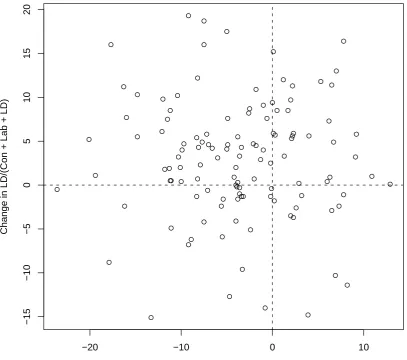
in the Labour share of the two-party (Con., Lab.) vote. Figures 4 and 5 display graphically these
two estimates of change produced by the exit poll in each selected polling district. In Figure 4
we simply show the estimated change in the Liberal Democrats’ share of the vote for the three
features:
(i) in general, a fall in Labour’s vote share of the two-party vote (median change−3.0)
(ii) in general, an increase in Liberal Democrat share of the three-party vote (median+3.5), and
(iii) a very wide scatter of points (especially in the case of the Liberal Democrat change variable),
rather wider than would be expected if there were simply sampling variation around a
pattern of uniform change.
The third feature certainly suggests that there was a need to try to identify and model the
existence of systematic variation in the exit poll data in order to improve the accuracy of the
forecast. Meanwhile, Figure 5, which presents the exit poll estimates of change in a ternary
diagram, suggests that the pattern of change since 2001 did differ according to the strength of
the parties in a constituency in 2001. For example, the poll suggested that the Liberal Democrats
were gaining votes in ‘safe’ Labour seats (where Labour were performing particularly badly) but
were doing less well in seats they were contesting with the Conservatives.
The estimated coefficients for the two models actually used for the 10 p.m. forecast were
as shown in Table 4.18 The model for Con.-Lab. swing was in fact relatively simple, with just
two predictor variables. First it suggested that Labour was losing ground rather less sharply
relative to the Conservatives in seats where turnout had been relatively low in 2001. Seats with
low turnouts are typically Labour strongholds in large cities, while those with higher turnouts
tend to be Conservative-held seats in rural areas (Curtice and Steed, 2001). In short, it would
appear that the poll anticipated that the two-party swing away from Labour was least in some
of its strongholds. At the same time, however, the model also suggested that after taking this
relationship into account Labour did in fact perform rather better in seats that were particularly
rural.19.
In contrast, the final model for change in Liberal Democrat support, which as we have seen
was more variable, was more complex and contained some fairly large estimated effects. In
particular the party was expected to do less well in seats the party was defending and in those
where it was challenging the Conservatives — though this latter pattern was expected to be less
strong in more marginal seats (defined as those where the Liberal Democrats were less than 10
percentage points behind the Conservatives). At the same time there was a substantial predicted
bonus for the Liberal Democrats in Scotland.
But how well did these models capture the variation that actually happened across the country
as a whole? (For a comprehensive analysis of the variation in the change in party support between
2001 and 2005, see Curtice et al., 2005). Given that we have already noted that Labour often
performed relatively badly in some of its strongest seats, the fact that our model suggested that
the swing away from Labour was lower in such seats might appear erroneous. However reference
back to Figure 3 indicates that in many of these seats there was also a movement away from the
Conservatives. Moreover, this fall constituted a relatively large proportion of the existing small
●
● ●
● ●
●
● ●
● ●
●● ●
●
● ●
● ●
● ●
●
● ●
●
●
●
● ●
● ●
● ●
●
●
●
●
●
● ●
●
● ●
●
●
●
● ●
●
●
● ●
●
●
● ●
● ●
●
● ●
● ●
●
●
● ● ●
●
●
● ●
● ●
●
● ●
●
● ●
●
●
●
● ●
●
●
● ●
●
● ●
● ●
●
● ●
●
● ● ●
● ●
●
● ●
● ●
●
●
● ●
●
●
● ●
● ● ●
● ●
−20
−10
0
10
−15
−10
−5
0
5
10
15
20
Change in Lab/(Con + Lab)
[image:21.595.85.493.139.499.2]Change in LD/(Con + Lab + LD)
Figure 4: Estimated change 2001–2005 in shares of the three-party vote, expressed in percentage
points, at the exit-poll locations. Data as at 9.25 p.m. on 5 May 2005.
Table 4: Estimated coefficients in the two regression models that were selected as the basis for
prediction.
Change in Lab/(Con + Lab)
Change in LD/(LD + Con + Lab)
predictor
estimate
predictor
estimate
Intercept
−
4
.
3
Intercept
3.9
‘Turnout 2001’
−
1
.
8
Scotland
13.7
‘Country dwellers’
2
.
5
‘Con first; LD second’
−
9
.
5
‘LD first’
−
6
.
6
[image:21.595.140.452.657.743.2]●
● ●
● ●
● ●
● ●
●
●
● ●
●
● ●
● ●
● ●
● ●
●
● ●
● ●
● ●
●
● ●
●
● ●
●
● ●
● ●
●
●
● ●
● ●
●
● ●
● ●
●
● ●
● ● ●
●
● ●
●
● ● ●
● ● ●
●
●
● ●
● ●
●
● ●
● ●
●
●
● ●
● ●
●
● ● ●
● ●
●
●
● ● ●
●
● ●
● ● ●
● ●
● ●
●
● ●
● ● ●
● ●
● ●
●
● ●
● ●
LD
Lab
[image:22.595.101.494.185.570.2]Con
such seats to below the national average. Overall the two-party swing in seats that Labour was
defending was just−2.4 compared with−3.0 across the country as a whole. On the other hand,
Labour’s vote did hold up relatively well in those seats where the Liberal Democrats were fending
off a Conservative challenger (two-party swing−0.7); such seats typically are particularly rural.
Thus the two variables in the model appear to have helped identify some key variation in the
pattern of two-party swing.
However, the model did fail to incorporate one important pattern that also occurred. This
was that the Conservatives performed relatively well in much of the south-eastern corner of
England. The mean two-party swing in London together with the South East government region
was −4.8%, almost two points higher than the mean for the country as a whole. Moreover,
thanks to the relatively high proportion of marginal seats in this part of the country, this above
average performance brought the Conservatives an important dividend in terms of seats (Curtice,
2005b). Yet in the exit poll the average swing in polling districts in London and the South East
was indistinguishable from that found in the poll as a whole.
The Liberal Democrat model also identified some important features of that party’s
perfor-mance. As we already have had reason to note, the party performed better in seats where it
was in competition with Labour than it did in those where it was attempting to challenge the
Conservatives. Indeed on average the party made little or no progress in seats where it shared
first or second place with the Conservatives, and it actually suffered a net loss of two seats to
them. The Liberal Democrats also advanced more strongly in Scotland. However, in each case the
size of our estimated coefficient was too strong. For example, rather than the Liberal Democrat
party performing around seven percentage points worse than average in seats that were
Conser-vative/Liberal Democrat marginals, it did so by only just over three points. Equally it advanced
more strongly in Scotland than it did in England, but only by some three points, not fourteen!20
Meanwhile here too there are some apparent gaps in the model. Two of the most striking
fea-tures of the Liberal Democrat performance were that the party’s share rose particularly strongly
in seats with relatively large numbers of Muslims and also in those with a relatively high
propor-tion of students. In the case of the former this may well have been because the exit poll only
covered two polling districts in constituencies where, according to the 2001 census, more than
10% of the population was Muslim. The Liberal Democrat share of the three party vote was
in-deed estimated to have risen by well above the national average in these locations (by 18 points
in one instance and 12 in another), but the evidence of just two sampling points was insufficient
to justify the inclusion of a Muslim variable in the model. Given that there are only 39
constituen-cies in total where more than 10% of the population is Muslim, having sufficient sampling points
in relevant constituencies to detect such a pattern is always going to be difficult. In the case
of constituencies with large student populations the poll was somewhat more representative: it
contained 15 districts in constituencies where more than 10% of the population were students