RESEARCH ARTICLE
Multiple sensory modalities used by squid in successful predator
evasion throughout ontogeny
Carly A. York1,*, Ian K. Bartol1and Paul S. Krueger2
ABSTRACT
Squid rely on multiple sensory systems for predator detection. In this study we examine the role of two sensory systems, the lateral line analogue and vision, in successful predator evasion throughout ontogeny. Squid Doryteuthis pealeii and Lolliguncula brevis were recorded using high-speed videography in the presence of natural predators under light and dark conditions with their lateral line analogue intact or ablated via a pharmacological technique. Paralarval squid showed reduced escape responses when ablated; however, no differences were found between light and dark conditions in non-ablated paralarvae, as was previously shown in juveniles and adults, indicating that the lateral line analogue is integral for predator detection early in life. However, vision does play a role in survival because ablated squid in dark conditions had lower levels of survival than all other treatments. Throughout ontogeny, squid oriented themselves anteriorly towards the oncoming predator, maximizing sensory input to the lateral line analogue system and providing better positioning for tail-first escape jetting, the preferred escape mode. Ablated juveniles and adults had lower response times, escape velocities and peak acceleration than non-ablated individuals, indicating that the lateral line analogue enables squid to respond quicker and with more powerful jets to a predator and maximize escape success. Our findings reveal that the lateral line analogue plays a role in predator detection and successful escape response at the earliest life stages, and continues to contribute to successful evasion by aiding visual cues in juvenile and adult squid.
KEY WORDS: Lateral line analogue, Squid, Ontogeny, Predator–prey
INTRODUCTION
Hydrodynamic stimuli provide important information for aquatic animals and consequently, most taxa have developed a sensory system for the detection of water movements and pressure fluctuations (Bleckmann, 1994; Coombs et al., 1989). Over the past two decades, many studies have revealed the functional significance of the fish lateral line (Bleckmann, 1994; Bleckmann and Zelick, 2009; Coombs et al., 1989; Engelmann et al., 2000; Montgomery et al., 1995). Aquatic animals create flows and pressure fields when they swim and detecting these hydrodynamic conditions can provide important information about animal
movement behaviors. Fishes can use this hydrodynamic
information to detect and avoid predators (Bleckmann, 1994; Bleckmann and Zelick, 2009; Montgomery et al., 2001). The role of
the lateral line in fish predator–prey interactions has been
investigated using lateral line ablation techniques, whereby the escape response rapidly diminishes with ablation, but returns with hair cell regeneration (Feitl et al., 2010; McHenry et al., 2009;
Stewart et al., 2013). In fish, theC-start escape response is initiated
when neuromasts comprising the lateral line are stimulated by pressure gradients generated by an oncoming predator (McHenry
et al., 2009; Wainwright et al., 2007). Larval zebrafish (Danio rerio)
react swiftly (within 30 ms) to the flow field produced by an
attacking predator via aC-start escape response that quickly moves
the fish out of the predator’s path (Hale, 1999; McHenry et al.,
2009).
While the vertebrate lateral line systems have been well studied, hydrodynamic receptor systems are also commonly used among invertebrates for predator evasion. In fact, the ability to detect fluid motion is found throughout many aquatic invertebrate groups from protozoans to lower chordates (Coombs et al., 1989). For example, copepods are capable of sensing flow using setae along the first antenna, which can alert them to an oncoming predator (Fields and Yen, 2002; Heuch et al., 2007; Viitasalo et al., 1998; Visser, 2001; Yen et al., 1992). The setae extend into the surrounding fluid environment, allowing copepods to detect predator flows within a
three-dimensional volume surrounding the copepod body
(Browman et al., 2011; Doall et al., 2002). Invertebrate tunicates also have specialized sensory receptor cells along their tentacles that sense hydrodynamic cues from predators (Burighel et al., 2003).
Like fishes and the invertebrates described above, cephalopods have flow-sensing structures. Squid and cuttlefish have epidermal hairs along their head and arms that are similar to the lateral line system of fishes (Bleckmann et al., 1991; Budelmann, 1995, 1996; Budelmann and Bleckmann, 1988; Sundermann, 1983). However, compared with the fish system, the cephalopod lateral line analogue is not as well studied. It comprises epidermal hair cells that are polarized and have multiple kinocilia with a single axon extending from each hair cell (Budelmann and Bleckmann, 1988). The polarization of the hairs occurs anteriorly, posteriorly and laterally in both the left and right directions. This allows cephalopods to
detect water movements as low as 18.8 µm s−1, which is comparable
in sensitivity to that of fish lateral lines (Bleckmann et al., 1991).
Cuttlefish (Sepia officinalis) behaviorally respond to stimulation of
their lateral line analogue in the range of frequencies from 10 to 600 Hz (Komak et al., 2005). In addition, York and Bartol (2014) demonstrated that ablation of the lateral line analogue leads to
reduced survivability of juvenile and adult squid (Lolliguncula
brevis) when interacting with a predator.
One important advantage of squid in predator evasion is their reliance on multiple sensory systems for detection of predators (Budelmann, 1996). In addition to the lateral line analogue system, cephalopods have a highly capable visual system, with prominent eyes and dominant optic lobes useful for predator detection and initiation of escape responses (Budelmann, 1995, 1996; Young,
Received 23 March 2016; Accepted 28 June 2016
1
Department of Biological Sciences, Old Dominion University, Norfolk, VA 23529, USA.2Department of Mechanical Engineering, Southern Methodist University, Dallas, TX 75275, USA.
*Author for correspondence ([email protected])
C.A.Y., 0000-0002-0062-4185
Journal
of
Experimental
1962). Resembling the vertebrate eye, the cephalopod eye incorporates a large posterior chamber, lens, iris, retina, choroid, sclera and argenta (Budelmann, 1995). Additionally, their visual
acuity is approximately 5–10 min of arc (Muntz and Johnson, 1978)
and recordings from the optic lobe have revealed that the fusion
frequency–the number of flashes of light perceived per second–is
between 20 and 60 Hz and is dependent on the light intensity (Bullock and Budelmann, 1991). Both of these values are comparable to measurements of the vertebrate eye (Budelmann, 1995). Used together, visual processing and flow sensing represent a powerful integrated mechanism for predator detection in cephalopods.
Many organisms live in distinct environments during different stages of their development, requiring their sensory systems to change throughout ontogeny. Although cephalopods do not undergo a complete metamorphosis and do not have a distinct larval stage like true larvae, squid hatchlings do differ ecologically
from older ontogenetic phases and thus are called ‘paralarvae’
(Robin et al., 2014; Shea and Vecchione, 2010; Young and Harman, 1988). Unlike juveniles and adults, which are adept at long-distance movement (Robin et al., 2014), paralarvae are planktonic and cover only short distances by active swimming, often moving in diel vertical migrations (Boyle and Boletzky, 1996; Robin et al., 2014). Moreover, paralarvae do indeed differ morphologically from older life stages, having: (1) a rounded mantle compared with adults that have longer, more streamlined bodies; (2) relatively shorter arms
than adults; (3) a proportionally larger funnel; and (4)
underdeveloped fins that do not seem to contribute significantly to swimming propulsion (Boletzky, 1974; Okutani, 1987; Packard, 1969). Important physiological changes also occur throughout ontogeny, with paralarvae having greater proportions of surface mitochondria-rich (SMR) mantle fibers (Preuss et al., 1997), shorter thick myofilament lengths (Thompson and Kier, 2006; Thompson et al., 2010), and less coordination of giant and non-giant motor systems (Preuss and Gilly, 2000) relative to adults. The brain volume of squids also increases exponentially, with different brain regions developing at different stages throughout ontogeny (Kobayashi et al., 2013).
Squids undergo morphological and physiological changes and occupy different ecological niches throughout ontogeny (Boyle and Boletzky, 1996) and therefore may perceive predators differently at various life stages, as is the case with certain fishes and
invertebrates. Because herring (Clupea harengus) larvae lack
canal neuromasts during early ontogenetic stages, they have reduced responsiveness to predator attacks, but increase their wake-sensing capabilities with size as the lateral line canal system develops (Blaxter and Fuiman, 1990). Squids do not appear to have a canal neuromast system (Budelmann and Bleckmann, 1988), but they still may exhibit important differences in hair cell sensitivity with ontogeny given differences in ecology, morphology and physiology with life stage. Additionally, the visual capabilities of
alewife (Alosa pseudoharengus), yellow perch (Perca flavescens)
and bloaters (Coregonus hoyi) have been shown to improve
throughout ontogeny, and these changes may lead to increases in predator avoidance as a result of the increased ability to detect potential predators (Miller et al., 1993). Crustaceans also undergo considerable reorganization of their visual systems throughout ontogeny; while larvae have eyes that are structurally suited for orientation and vertical migration, adults are capable of more elaborate visual tasks such as navigation, prey recognition and capture, mate selection and communication (Cronin and Jinks, 2001). Given the variation of sensory capabilities seen in other taxa,
it is likely that differences in ecology, morphology and physiology of squid throughout ontogeny translate to differences in their abilities to perceive an oncoming predator. No information is currently available on the role of vision and the lateral line analogue in predator evasion throughout multiple life history stages of squid. While it has been shown that the lateral line analogue plays a role in successful predator detection in juvenile and adult squid (York
and Bartol, 2014), the kinematics of predator–prey interactions have
not been examined for squid under different light conditions after ablation of the lateral line analogue. Additionally, the relative roles of the lateral line analogue and vision throughout ontogeny have not been explored in any cephalopod. Therefore, in this study, we address two primary questions: (1) are epidermal hairs and vision both important for successful predator evasion in squid throughout ontogeny, and (2) do orientation angles, swimming velocities, accelerations and response times change throughout ontogeny when visual cues and the lateral line analogue are modified?
MATERIALS AND METHODS Animal collection and maintenance
The methods used for animal collection and maintenance are similar to those used in York and Bartol (2016) and are briefly repeated here for convenience. This project was conducted in accordance
with Old Dominion University’s Institutional Animal Care and Use
Committee (Protocol #12-016). Paralarval Doryteuthis pealeii
Lesueur 1821 [dorsal mantle length (DML)=1.8 mm] and juvenile
and adultLolliguncula brevisBlainville 1823 (DML=3–7 cm) were
used for this research. Despite their abundance in the Chesapeake Bay, coastal Atlantic and Gulf of Mexico as juveniles and adults,
L. brevis egg mops are extremely difficult to locate and obtain.
Therefore,D. pealeiiwas selected to study early ontogenetic stages.
D. pealeii is a reasonable substitute for L. brevis because both
species have similar body size, fin size and shape, and ecological niches as paralarvae (Bartol et al., 2008).
D. pealeiiparalarvae were purchased from the Marine Biological
Laboratory, Woods Hole, MA and maintained in buckets with drilled 5 cm diameter holes covered by mesh (for water circulation)
suspended in a larger 450 gallon (≈1704 liter) recirculating seawater
system at a salinity of 30–32‰and at temperatures of 19–24°C until
hatching. SquidL. brevisused in this project were captured by otter
trawl in Wachapreague, VA, USA. Trawls were conducted in August, September and October as the catch probabilities are highest in these months (Bartol et al., 2002). After capture, squid were transferred to a 114 liter, circular holding tank (Angler Livewells, Aquatic Eco-Systems, Apopka, FL, USA) fitted with a portable battery-powered aerator (Model B-3, Marine Metal Products, Clearwater, FL, USA) for transport to the lab. Squid were then placed in 1704 liter seawater systems configured with several forms of filtration (e.g. BioBalls, protein skimmers, ozone filtration, etc.), where they were maintained until the experiments were performed. Seawater was maintained at temperatures and
salinities equivalent to those of the capture sites (19–22°C; 30–
35‰). A moderate current flow was maintained to promote active
swimming and squid were fed a diet of livePalaemonetes pugioand
Fundulus heteroclitosas suggested by Hanlon et al. (Hanlon, 1990;
Hanlon et al., 1983). Squid were allowed to acclimate for at least 2 h prior to experimental trials. Only those animals that appeared healthy and exhibited normal behaviors were used. In total, 80 paralarval squid and 40 juvenile/adult squid were selected for this study. Some survival and escape response data for the 40 juvenile/ adult squid were presented previously in York and Bartol (2014)
(see Fig. 2); however, we examine the data more comprehensively
Journal
of
Experimental
in this study, including a detailed kinematic analysis of escape behaviors.
Two summer flounder (Paralichthys dentatus) [13 cm and 16 cm
body length (BL)] and two mummichogs (Fundulus heteroclitus)
(1.3 cm and 1.5 cm BL) were purchased from the Marine Biological Laboratory, Woods Hole, MA, and maintained in a recirculating
seawater system at salinities of 30–32‰. The flounder and
mummichogs were fed live squid (L. brevis and D. pealeii,
respectively) for 1 week prior to experimental trials so that they could become proficient in squid capture before data collection. Although we are using different fish species for the paralarvae and juvenile/adult trials, the species chosen reflect predators that the squid often encounter in each ontogenetic phase in the waters of the mid-Atlantic region (Boyle and Rodhouse, 2008), with the goal of documenting behaviors that reflect natural conditions.
Predator–prey experiments
Predator–prey interaction experiments were used to evaluate the use
of vision and the lateral line analogue in predator evasion. Lateral
line ablation was accomplished with a 500 µmol l−1 neomycin
sulfate solution, which is commonly used in ablation studies in fish (Harris et al., 2003) and has been validated as an effective technique in squid (York and Bartol, 2014). One hour prior to trial acclimation, squid were placed in a container that either held the neomycin solution for ablation groups or untreated seawater for the non-ablation groups. Four different conditions were tested: (1) light non-ablated, where the trials were held in bright light conditions with squid having intact hair cells; (2) light ablated, where the trials were held in bright light conditions with squid having ablated hair cells; (3) dark non-ablated, where the trials were held in dark conditions with squid having intact hair cells; and (4) dark ablated, where the trials were held in dark conditions with squid having ablated hair cells.
Paralarvae trials were conducted in a 10×10×10 cm clear acrylic tank. One DALSA Falcon video camera (DALSA Corp., Waterloo,
ON, Canada; 1400×1024 pixel resolution, 100 frames s−1) outfitted
with a 25 mm lens (FOV=2.7×3.7 cm) was positioned above the arena for a dorsal view, and another DALSA Falcon outfitted with a 25 mm lens was positioned beside the tank for a lateral view. A 500 W halogen light (465 lx) provided illumination for the light experimental trials. An IR56 infrared light (C&M Vision Technologies, Houston, TX, USA; wavelength=850 nm) was used to illuminate the working section during the dark trials. The
photoreceptors of many species of squid, including L. brevis,
contain only one visual pigment peaking in spectral sensitivity
around 480–500 nm (Budelmann, 1996; McCormick and Cohen,
2012), which falls well below the wavelength frequency of the infrared lighting. Video frames from the cameras were stored in real time on hard disk using a CLSAS capture card (IO Industries, London, ON, Canada) and Streams 5 software (IO Industries). For
each experiment, 5–10 paralarvae were placed in the arena with two
small mummichogs. Food was withheld from the mummichogs 24 h prior to the start of all trials. Multiple predators were used to increase the frequency of predation events. At the beginning of each trial, the squid were placed in the arena for a 30 min acclimation period. After the acclimation period, the fish were added and the experiments commenced. Each trial lasted 10 min, after which the fish were removed and surviving paralarvae were returned to their holding tank.
The experimental set-up for the adult/juvenile trials is described in York and Bartol (2014) and is briefly summarized here. Trials took place in a round tank (1.2 m diameter, 76 cm deep) with a
crushed coral substrate. The arena was lined with curtains to avoid disturbing acclimating animals. A UNIQ UP-685 CL high-speed color camera (Uniq Vision; 659×494 pixel resolution, 110
frames s−1) outfitted with a 5 mm lens (FOV=1.3 m×1.7 m) was
suspended from scaffolding over the tank. Video frames from the cameras were stored in real time on hard disk using a CL160 capture card (IO Industries) and Video Savant 4.0 software (IO Industries). Four 500 W halogen lights (450 lx) provided illumination for the light experimental trials. Infrared lighting (IR56 infrared light, C&M Vision Technologies Inc., Houston, TX, USA, wavelength frequency=850 nm) was used for dark treatments; however, the infrared lighting did not provide sufficient lighting for detailed kinematic measurements (see below).
For each juvenile and adult experiment, a 40 cm diameter cylinder made of 5 mm plastic mesh was lowered into the experimental tank containing two summer flounder and a single squid was placed inside the cylinder for a 30 min acclimation period. The trials commenced when the cylinder partition was raised above the tank and the flounder and squid were allowed to interact. Each trial ran for 10 min; after this time any surviving squid were removed. Multiple predators again were used to increase the odds of a predation event, and as was the case for paralarval trials, food was withheld from the predators 24 h prior to the start of all trials. Ten separate squid were tested in each of the four treatment conditions. Each group contained squid of similar sizes (light non-ablated: mean=4.2±0.3 cm DML; light ablated: mean=3.9±0.3 cm DML; dark non-ablated: mean=3.9 ±0.4 cm DML; dark ablated: mean=3.9±0.3 cm DML). Although differences in experimental methods between ontogenetic stages could potentially affect the behaviors observed in this study, these differences (e.g. tank size, squid number, lens magnification) were necessary to measure the variables of interest given the large size differences of the squid from paralarval to adult stages.
Frame-by-frame position tracking of the squid body features was accomplished using image-tracking software (Hedrick, 2008). Infrared lighting used during the dark trials for juveniles and adults did not provide sufficient lighting to capture detailed kinematic measurements and were therefore excluded from kinematic analysis. In juveniles and adults, eight points were tracked: (1) mouth of fish; (2) middle of the fish body; (3) tail of squid; (4) eye of squid; (5) antero-dorsal tip of the squid mantle; (6) tip of squid arms; (7) leading edge of ink; and (8) trailing edge of ink. In paralarvae, four points were tracked in both dorsal and lateral views: (1) mouth of fish; (2) middle of the fish body; (3) posterior tip of the squid mantle; and (4) eye of squid. The tracked points were used to determine: (1) distance between the predator and prey at the initiation of escape response; (2) the minimum distance between predator and prey; (3) the velocity of the squid at the beginning of the interaction; (4) the maximum and mean velocity of the predator and prey during the encounter; (5) the time the prey reached maximum velocity after initial predator recognition; (6) the maximum acceleration of the predator and prey; (7) time when maximum acceleration was reached; and (8) distance between predator and prey at point of maximum acceleration. These variables
were calculated for all predator–prey encounters, including those
where the squid did not perform an escape response. These parameters were calculated using customized MATLAB routines developed in-house. The routine performed a low-pass filter of the data using a cut-off frequency between 10 and 20 Hz and a second-order Butterworth filter applied using the filtfilt function in MATLAB (which applies the filter twice to remove phase distortion), giving an effective order of 4 to the filter
operation.
Journal
of
Experimental
The angular orientation of squid to approaching predator (θ) and
the angular orientation of the squid escape trajectory (φ) were
measured at the initiation of the predator’s attack and over several
frames of the escape response, respectively (Fig. 1A). The angular
orientation of squid to approaching predator (θ) was the angle
between the squid’s longitudinal axis and the line connecting the tip
of the predator rostrum to the squid’s center of mass. The angular
orientation of the squid escape trajectory (φ) was the angle between
the line connecting the tip of the predator rostrum to the prey’s
center of mass and the path of the escape over multiple frames.
Predator–squid distance (d) was measured from the predator’s
rostrum to the closest component of the squid. Interactions were
divided into four groups of angular orientations for bothθandφ: (1)
<45 deg, (2) 46–90 deg, (3) 91–135 deg, (4) 136–180 deg. These
groupings were useful in determining whether the predator approached the squid from an anterior, lateral or posterior direction, as well as for determining the direction of the squid escape trajectory (Fig. 1B).
Statistical analysis
Statistical analysis was performed in SPSS v.18. The proportion of escape responses and interactions survived for each squid was calculated to show success relative to the number of capture
attempts. All data were tested for normality using Shapiro–Wilk
tests. Data from several groups varied from normality (P≤0.02), and
therefore all data were arcsine transformed prior to parametric analysis. A regression was performed on the total number of interactions survived and the mantle length of the juvenile and adult squid in each condition to determine the relationship between size
and survivability, and no significance was found (all P≥0.10).
Additionally, kinematic measurements were compared between juveniles and adults with no significant differences found (all
P≥0.05), and thus all juvenile and adult squid were pooled into one
ontogenetic group for further analysis. Paralarvae, which had consistent dorsal mantle lengths of 1.8 mm, were considered a second ontogenetic group.
As there were often multiple predator–prey encounters per trial,
kinematic parameters were compared between multiple encounters
to assess differences as the trial progressed, but no significant differences were found in any of the kinematic parameters tested (all
P>0.05). Therefore, measurements from multiple encounters were
averaged per individual for further comparison between treatment groups. Analysis of variance was used to compare survival and escape between treatment groups through ontogeny. Multivariate analysis of variance (MANOVA) was used to compare kinematic variables in squid among treatment and ontogenetic groups.
Significance was tested at P<0.05 and data are all means±s.d.
unless otherwise noted.
RESULTS
Paralarval and juvenile/adult escape and survival
Overall success in predator–prey interactions significantly differed
between treatment groups within paralarvae (F6,150=3.2,P=0.005,
Wilks’ λ=0.79, η2=0.11). Significant differences were found
between the mean proportion of paralarvae that initiated an escape
response within each treatment group (F3,77=5.08, P=0.003;
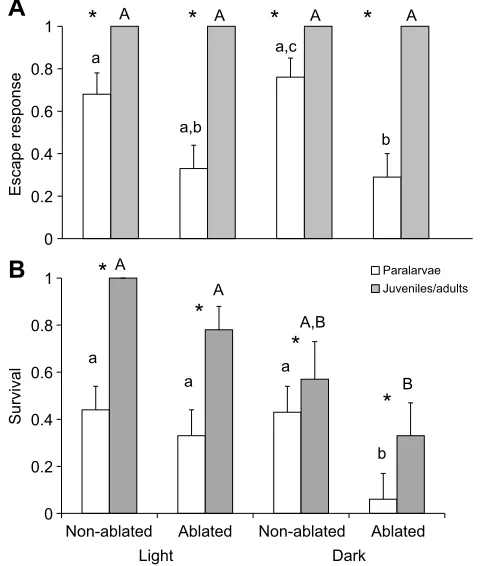
Fig. 2A). Tukey post hoctests revealed that both the light
non-ablated group (mean proportion for escape=0.68±0.47) and the dark non-ablated group (mean proportion escape=0.76±0.44) had a higher proportion of escape responses than the dark ablated group (mean proportion escape=0.29±0.46). Additionally, the light ablated group (mean proportion escape=0.33±0.48) had a
B
A
180 deg0 deg Posterior
Anterior Lateral
θ φ
135 deg
45 deg 90 deg 4
3
[image:4.612.321.561.61.344.2]1 2
Fig. 1. Angular orientation of squid during interactions with predator.
(A) The angular orientation of squid to approaching predator (θ) is the angle between the squid’s longitudinal axis (solid black line extending from squid) and the line connecting the tip of the predator rostrum to the squid’s center of mass (dashed gray line). The angular orientation of the squid escape jet (φ) is the angle between the line connecting the tip of the predator rostrum to the prey’s center of mass and the path of the escape over multiple frames (dashed arrow extending from squid). (B) Diagram of squid orientations with interactions divided into four groups of angular orientations for bothφandθ: (1) <45 deg, (2) 46–90 deg, (3) 91–135 deg, (4) 136–180 deg.
0 0.2 0.4 0.6 0.8 1
Escape response
Paralarvae Juveniles/adults
a
a,b
a,c
b
0 0.2 0.4 0.6 0.8 1
Non-ablated Ablated Non-ablated Ablated
Light Dark
Survival
*
a
a a
b A
A
A,B
B A A
A A
*
*
*
*
*
*
*
[image:4.612.53.297.492.637.2]B
A
Fig. 2. Escape responses and survival for paralarval and juvenile/adult squid for non-ablated and ablated squid during light and dark conditions.
Mean proportion of (A) escape responses and (B) surviving individuals for non-ablated and non-ablated paralarval (n=80) and juvenile/adult squid (n=40) during light and dark conditions. Lower case letters indicate significant differences between paralarvae treatment conditions and upper case letters indicate differences between juvenile/adult treatment groups. Bars with the same letters are not significantly different (Tukeypost hoccomparison tests). *P<0.05 between paralarvae and juvenile/adults in each treatment group. Non-transformed means and s.e.m. are presented. Juvenile/adult data shown in this figure are from York and Bartol (2014).
Journal
of
Experimental
significantly lower proportion of escape responses than the dark
non-ablated condition (mean proportion escape=0.76±0.44).
Although not statistically significant atα=0.05, light ablated squid
exhibited a trend in lower proportion of escape responses
(0.33±0.48) compared with the light non-ablated group (P=0.08).
The number of paralarvae that survived interactions with the predator also significantly differed according to treatment group
(F3,77=2.8, P=0.04; Fig. 2B), with greater levels of survival
detected for both light treatment groups and the dark non-ablated group relative to the dark ablated group (mean proportion survival=0.06±0.25).
When paralarval escape and survival data are compared with juvenile and adult escape and survival data reported in York and Bartol (2014), significant differences were found between the two groups in the proportion of squid that performed escape responses and the proportion of squid that survived in each treatment group. Juveniles and adults were more likely to initiate an escape response
than paralarvae in all four treatment groups (allP<0.05; Fig. 2A).
Juveniles and adults also had significantly greater levels of survival
than paralarvae in all treatments (allP<0.05; Fig. 2B).
Paralarvae kinematics
The mean velocity, maximum velocity and maximum acceleration of the predator did not significantly vary among the four treatment
groups (MANOVA:F9,151=1.3,P=0.25, Wilks’λ=0.84,η2=0.06),
indicating that the fish behaved similarly throughout the paralarvae trials irrespective of treatment level. No differences in the response kinematics of paralarvae were found among the four treatment
conditions (MANOVA: F15,166=0.97, P=0.48, Wilks’ λ=0.79,
η2=0.07). Indeed, neither the mean nor maximum velocity of the
paralarval squid differed among treatment groups (mean velocity:
F3,64=0.89, P=0.45; maximum velocity: F3,64=0.60, P=0.62)
(Fig. 3A,B). Additionally, no differences were found in the
maximum acceleration of the paralarval squid (F3,64=2.5,P=0.07)
(Fig. 3C) or time to reach maximum velocity (F3,64=0.89,P=0.45)
(Fig. 3D). Furthermore, the distance between the predator and prey at the initiation of the escape response, minimum distance between predator and prey, and the velocity of the squid at the beginning of the interaction were not found to be significantly different among
treatment groups (all P>0.05). No significant correlation was
detected between the mean velocity of the approaching predator and the escape response of the squid within all treatment groups (all
P>0.05).
Throughout all of the treatment groups, the angular orientation
of squid to approaching predator (θ) was 0–90 deg. Within this
narrow angular range, there were some significant differences inθ
among the treatment groups (F3,62=3.3, P=0.03; Fig. 4A,C). In
particular, squid in the light ablated group oriented themselves at lower angles (mean=26±17 deg) than the dark non-ablated group
(mean=56±24 deg;P=0.01). The mean angle of the squid’s escape
trajectory (φ) did not differ by treatment group (F3,62=0.12,P=0.94;
Fig. 4B,D), with all mean angles falling between 90 and 180 deg. Inking behavior was not observed among the paralarval squid.
Juvenile and adult kinematics
As mentioned earlier, interactions in the dark conditions involving juveniles and adults were not recorded with high resolution due to insufficient lighting and were therefore excluded from kinematic analysis. The mean velocity, maximum velocity and maximum acceleration of the predator did not differ significantly between light
ablated and light non-ablated treatments (F3,16=1.06, P=0.39,
Wilks’ λ=0.83, η2=0.17), indicating that the fish behaved
similarly throughout the trials. Conversely, significant differences in squid kinematics were found throughout the treatment groups
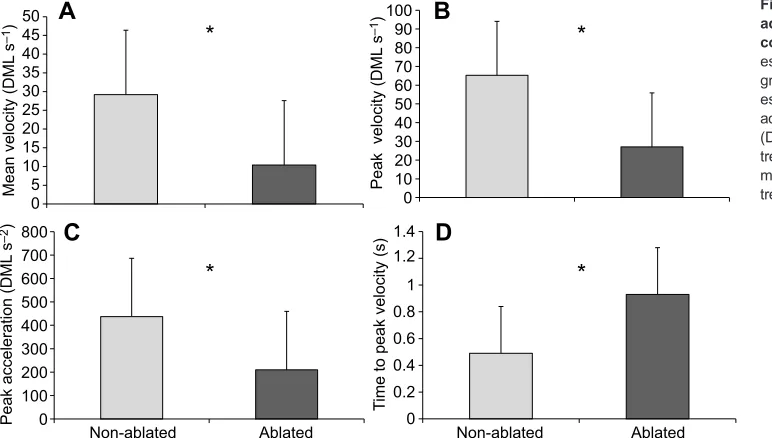
(F8,11=4.1,P=0.005, Wilks’λ=0.25,η2=0.75). The mean velocity
of the squid’s escape response was significantly higher in
non-ablated than ablated light conditions (F1,19=9.0,P=0.01,
non-ablated=29±17 DML s−1, ablated=10±9.7 DML s−1) (Fig. 5A).
0 2 4 6 8 10 12 14
Peak velocity (DML
s
–1
)
0 1 2 3 4 5 6 7 8 9 10
Mean velocity (DML
s
–1
)
0 50 100 150 200 250 300 350
Peak acceleration (DML
s
–2
)
0 0.05 0.1 0.15 0.2 0.25 0.3 0.35
T
ime to peak velocity (s)
A
B
C
D
Non-ablated Ablated Non-ablated Ablated
Light Dark
Non-ablated Ablated Non-ablated Ablated
[image:5.612.111.505.456.704.2]Light Dark
Fig. 3. Kinematics of the paralarval squid escape responses.(A) The mean velocity of the paralarval escape response. (B) The peak velocity of the escape response. (C) The peak acceleration of the escape response. (D) The time to peak velocity in each treatment group. Non-transformed means and s.e.m. of
n=16–26 paralarvae for each treatment group are presented. No differences were found among the groups, as indicated by the bars.
Journal
of
Experimental
Additionally, significant differences were found between the maximum velocity of the squid in the light non-ablated and
ablated groups (F1,19=5.8, P=0.002) with the non-ablated group
having significantly higher peak velocities (65±29 DML s−1) than
the ablated group (27±19 DML s−1) (Fig. 5B). The time for squid to
reach maximum velocity also differed between treatment groups
(F1,19=10.4,P=0.005), with the ablated group taking significantly
longer to respond than the non-ablated group (non-ablated=0.49 ±0.35 s; ablated=0.93±0.26 s; Fig. 5D). The maximum acceleration
reached by the squid also differed according to treatment group
(F1,19=5.8,P=0.03), with the ablated group only reaching half of the
acceleration of the non-ablated group (non-ablated: 440±250
DML s−2; ablated: 210±160 DML s−2) (Fig. 5C).
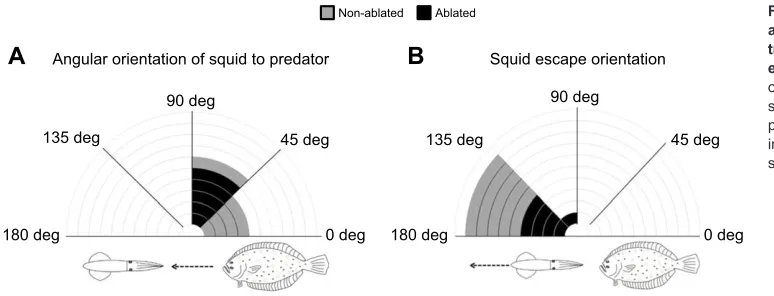
The squid in both treatment groups actively oriented between 0 deg and 90 deg during all predator interactions. However, the ablated group had a significantly higher mean angle towards the
predator than the non-ablated group (F1,19=2.9, P=0.01;
non-ablated=39±12 deg; ablated=69±31 deg; Fig. 6). The mean angle of
Ablated Non-ablated
Light
Dark
Angular orientation of squid to predator Squid escape orientation
A
B
C
D
180 deg 0 deg
135 deg 45 deg
90 deg
180 deg 0 deg
135 deg 45 deg
90 deg
180 deg 0 deg
135 deg 45 deg
90 deg
180 deg 0 deg
135 deg 45 deg
[image:6.612.92.516.62.334.2]90 deg
Fig. 4. Angular orientation of squid (θ) and paralarval squid escape trajectories (φ) during predator encounters.(A,C) Angular orientation of the squid to the predator. (B,D) Paralarval escape trajectories (φ) during predator encounters. A and B, light conditions; C and D, dark conditions. Each sectional increment in the diagrams represents two squid (n=80).
0 5 10 15 20 25 30 35 40 45 50
0 10 20 30 40 50 60 70 80 90 100
0 100 200 300 400 500 600 700 800
Non-ablated Ablated 0
0.2 0.4 0.6 0.8 1 1.2 1.4
*
*
*
*
A
B
C
D
Non-ablated Ablated
Peak velocity (DML
s
–1
)
Mean velocity (DML
s
–1
)
Peak acceleration (DML
s
–2
)
T
ime to peak velocity (s)
Fig. 5. Kinematics of the juvenile and adult escape responses in light conditions.(A) The mean velocity of the escape response in each treatment group. (B) The peak velocity of the escape response. (C) The peak acceleration of the escape response. (D) The time to peak velocity in each treatment group. Non-transformed means+s.e.m. ofn=10 squid for each treatment group are presented.
Journal
of
Experimental
[image:6.612.51.437.513.732.2]escape trajectories (φ) did not differ between non-ablated and
ablated groups (F1,19=0.93, P=0.37; non-ablated=150±5.4 deg;
ablated=140±12 deg; Fig. 6). Interestingly, the ablated group demonstrated a lower proportion of inking events than the
non-ablated group (F1,19=2.2, P=0.04; non-ablated=0.52±0.35
proportion ink events; ablated=0.22±0.22 proportion ink events). When inking was performed, both ablated and non-ablated groups
inked at similar distances from the predator (t7=0.19,P=0.90;
non-ablated: 2.7±1.1 DML; non-ablated: 2.4±3.0 DML). Other kinematic parameters (distance between the predator and prey at the initiation of escape response, minimum distance between predator and prey, the velocity of the squid at the beginning of the interaction) were not
significantly different between treatment groups (all P>0.05).
Additionally, no significant correlation was detected between the mean velocity of the approaching predator and the escape response
of the squid within either treatment group (allP>0.05).
DISCUSSION
The findings of this study demonstrate for the first time that both vision and the lateral line analogue provide sensory information for initiation of an escape response and successful predator evasion in squid throughout ontogeny. Cephalopod vision has been viewed as the dominant sensory modality used in predator detection because of the well-developed complex nature of cephalopod eyes (Budelmann, 1995, 1996). Cephalopods have a wide visual field that can extend over 360 deg in the horizontal plane, allowing them to detect predators within an extensive sensory sphere (Cronin, 2005; Messenger, 1968). Despite the highly advanced visual system, there are many situations where visual cues are reduced and/or unreliable, such as in turbid waters, at night, in complex environments where visual indicators are overwhelming, or in cases where predators are well camouflaged (Budelmann, 1995, 1996). Under these conditions, cephalopods can benefit from other sensory systems, such as the lateral line analogue, which is sufficiently sensitive to detect a 1-m-long fish swimming at a distance of about 30 m away, even when vision is disabled (Budelmann, 1995).
The use of the lateral line analogue was evident in paralarval squid where significantly different escape responses were observed among the four treatment groups. In both the light and dark conditions, the non-ablated groups showed a higher proportion of escape responses than the dark ablated group and a clear trend towards a higher proportion of escape responses than the light ablated group, indicating that the lateral line analogue plays a role in initiation of an escape response. Interestingly, there was no difference in the initiation of an escape response of the paralarvae in the light non-ablated and dark non-ablated conditions, as would
be expected given the importance of the visual system in cephalopods. This unexpected finding may derive from reduced visual capabilities at early ontogenetic stages, although this topic has not been examined to date.
The lack of survival differences across the light ablated, light non-ablated and dark non-non-ablated treatments in paralarvae is likely to be due to differences in swimming speed between the prey (squid) and
predator (fish). The mean velocity of the predator (0.23 m s−1) was
higher than that of the paralarvae (0.17 m s−1), making successful
escape difficult, even when the lateral line analogue and visual systems were accessible. Interestingly, when both visual and lateral line sensing were removed (i.e. the dark ablated treatment), survival was lowest, indicating that use of these two sensory modalities in concert is important for successful predator evasion in paralarvae. These results are consistent with previous studies on zebrafish, where larvae with intact lateral line systems are able to avoid many more attacks than larvae with ablated lateral line systems (Stewart et al., 2013). As previously determined by York and Bartol (2014), light non-ablated adult/juvenile squid survive more overall interactions than all other treatment groups. We found that they survived a higher proportion of interactions (1.00±0.00) than dark ablated squid (0.33±0.44), while exhibiting a trend in higher proportion of interactions survived than dark non-ablated squid (0.57±0.50). These results demonstrate that vision is an important modality for predator avoidance in addition to the lateral line analogue. The higher mean proportion of interactions survived in light ablated adults (0.78±0.34) than dark ablated adults (0.33 ±0.44) provides further support for this conclusion.
Significant differences were found in the proportion of escape responses and survival between the paralarvae and older squid throughout the treatment conditions. Overall, juveniles and adults performed more escape responses than paralarvae, which led to a significantly higher rate of survival for juveniles and adults in all treatment conditions. This result may reflect different anti-predator strategies of squid throughout ontogeny, whereby paralarvae use different approaches to compensate for an underdeveloped nervous
system and life in a more viscous flow regime (Reparalarvae=1–102;
Rejuveniles/adults=103–106) (Chen et al., 1996; Bartol et al., 2009a,b).
In 32% of the predator–prey interactions, paralarvae did not change
their behavior as a predator was approaching, other than orienting arms-first towards the predator. The juveniles and adults, however, always responded to an approaching predator with an escape response, regardless of ablation treatment. Unlike juveniles and adults, paralarvae often rely on a repertoire of stereotyped behaviors, such as circling and spiraling, in combination with a clear body pattern, to avoid predation rather than employing a directed escape response (York and Bartol, 2016). This reliance on random,
A
B
Ablated Non-ablated
Angular orientation of squid to predator Squid escape orientation
180 deg 0 deg
135 deg 45 deg
90 deg
180 deg 0 deg
135 deg 45 deg
[image:7.612.47.434.56.204.2]90 deg
Fig. 6. Angular orientation of squid (θ) and juvenile and adult squid escape trajectories (φ) during predator encounters in light conditions.Angular orientation of squid (A) and juvenile/adult squid escape trajectories (B) during predator encounters. Each sectional increment in the diagrams represents two squid (n=20).
Journal
of
Experimental
constant motion may be the paralarvae’s best defense given presumed sensory limitations during early ontogeny and under-developed motor control. Nonetheless, reduction in the frequency of escape jetting probably produced the observed differences in escape responses and survival.
In juveniles and adults, the kinematics of the escape responses under light conditions (detailed kinematic analysis was not performed in dark conditions because of camera resolution issues) significantly differed based on ablation conditions. The mean
velocity of the juvenile and adult’s escape response was
significantly higher for non-ablated versus ablated squid, with the
ablated group having mean velocities of 10±9.7 DML s−1, while the
non-ablated group had mean velocities of 29±17 DML s−1. The
peak velocity of the ablated group (27±19 DML s−1) was also
significantly lower than the peak velocity of the non-ablated group
(65±29 DML s−1). Additionally, the time for the squid to reach
maximum velocity was almost twice as long in the ablated versus
non-ablated group, and the ablated group only reached
approximately half of the peak acceleration of the non-ablated group. Collectively, these results strongly suggest that juveniles and adults use their lateral line analogue to sense the hydrodynamic
signatures of oncoming prey, similar to zebrafish (Danio rerio),
which detect the bow wave generated by an approaching predator using their lateral line system (Stewart et al., 2014). When flow-sensing hairs are disabled through ablation, the squid reacts more slowly and with a lower velocity escape response than observed in those with intact sensory hairs, thereby leading to reduced survivability. These results make sense given the sensitivity of the lateral line analogue to flow perturbations (Bleckmann et al., 1991) and its importance as an early warning system for predators.
Another potential reason for reduced survivability of ablated juvenile and adult squid is their lower frequency of inking events than non-ablated squid. Juvenile and adult squid in the non-ablated
group inked in 52% of predator–prey interactions, whereas ablated
squid inked in only 22% of interactions. Previous studies have indicated that an inking event is one of the most important anti-predator behaviors for successful anti-predator evasion with a >50%
increase in survival occurring in squidDoryteuthis pealeiiwhen
inking is used during attacks by fish versus when it is not (Staudinger et al., 2011). While ink can clearly cause visual confusion during predator encounters, chemicals in the ink are also thought to limit olfactory or taste receptors in predators, causing them to alter their path toward their squid targets (Caldwell, 2005; Hanlon and Messenger, 1996). Thus, reduced inking in ablated squid likely played some role in reduced levels of survival. Interestingly, unlike the juveniles and adults, the paralarval squid did not exhibit inking behavior throughout the trials, which may have contributed to lower survival levels in paralarvae. The reason for this is unclear as paralarval squid can produce ink (York and Bartol, 2016). However, perhaps the lack of inking in paralarvae is a reflection of more restrictive use of this defense given the high amount of energy that is needed to produce ink (Wood et al., 2008) along with the need to allot high levels of energy toward growth (Russo et al., 2003).
While the paralarvae did show differences in the proportion of escape jets employed across treatment groups, there were no differences in their mean or peak velocity, time before reaching peak velocity or acceleration of their escape jet across the treatment groups. The lack of observed kinematic differences may derive from an underdeveloped motor system at this ontogenetic stage. The squid mantle undergoes muscular changes throughout ontogeny, where the superficial mitochondria-rich (SMR) fibers are used for jetting in paralarvae, but central mitochondria-poor (CMP) fibers
increase in number and produce the power for an escape jet in juveniles and adults (Preuss et al., 1997). To produce an escape jet, the squid nervous system comprises a giant axon that generates a powerful all-or-none contraction of the circular muscle fibers of the mantle (Young, 1938), as well as parallel non-giant motor axons that can generate equally strong contractions, but require repetitive firing (Gilly et al., 1996; Prosser and Young, 1937). During escape responses, juvenile and adult squid show two recruitment patterns for the giant axons where either (1) a stereotyped escape response is driven by a single giant axon spike, or (2) a more complex escape jet is produced by a synchronized recruitment of non-giant and giant axons (Otis and Gilly, 1990). Paralarvae squid hatch with functional giant and non-giant motor systems (Marthy, 1987; Martin, 1965; Preuss et al., 1997); however, concerted recruitment of the two systems does not become fully established until several weeks post-hatching (Preuss and Gilly, 2000). The paralarvae examined in this
study were 24–48 h post-hatching. Therefore, it is likely the
paralarval escape responses were stereotyped and driven by the single giant axon, whereas more complex and variable escape responses were demonstrated in the juveniles and adults through recruitment of non-giant axon activity. This is supported by observations that paralarvae responded with a similar jet response, regardless of predator approach, whereas juveniles and adults showed greater variation in the escape response (e.g. variation in velocity, time to peak velocity and acceleration), particularly in the ablated groups. Additionally, the basal lobe system of the brain, which is associated with the control of movements in cephalopods, increases exponentially throughout ontogeny (Kobayashi et al., 2013), which may also relate to control over the escape response in
predator–prey interactions.
Throughout all of the predator–prey interactions, the squid
actively oriented themselves at angles of 0–90 deg relative to the
oncoming predator. While it is conceivable that this positioning is driven by a preference of the fish to attack the anterior portion of the prey, the squid in this study consistently kept their arms towards the predator once the threat was detected (typically at the beginning of the experimental trial). Thus, the observed orientation angles most likely reflect a behavioral preference by the squid. This position is advantageous because the squid can readily perform a tail-first escape jet, the preferred form of escape, where high swimming speeds and maximal funnel aperture throughput for jet ejection are achieved (Bartol et al., 2001, 2009a,b). The anterior orientation is also beneficial for hydrodynamic sensing given the anterior position of the lateral line analogue along the arms and head of the animal. By positioning themselves anteriorly, the squid are able to detect hydrodynamic cues produced by the oncoming predator with the greatest population of hair cells. This is important because other studies on fish lateral line systems have revealed greatest escape success when fish prey are orientated with maximum hair cell exposure to the oncoming predator (Stewart et al., 2014). For example, zebrafish larvae escape oncoming predators most effectively when they are positioned laterally to the predator because this orientation exposes the maximum area of the fish lateral line (Coombs et al., 1989; Stewart et al., 2014). Furthermore, previous studies have shown fish that move quicker than an
approaching predator should execute a fast start (i.e. C-start) at
90 deg from the predator’s path to create the maximum amount of
distance from the predator (Weihs and Webb, 1984). Squid do not
produce body-derivedC-starts for escape; they use a tail-first escape
jet. In the juveniles and adults, the ablated group positioned themselves at a higher (more lateral) angle to the predator than the
non-ablated group, which indicates that without lateral line
Journal
of
Experimental
analogue sensory input, they are less capable of sensing the predator, particularly its bow wave, and positioning themselves optimally for their escape response. The paralarvae in the light, ablated group, however, had lower angles than the dark non-ablated group. This result suggests that vision is also important for positioning. Although the light ablated squid oriented themselves optimally for escape, they exhibited significantly less escape responses than squid in the dark non-ablated group, indicating that input from the lateral line analogue is crucial for successful escape at the paralarval stage, even when the animal is advantageously orientated for escape.
The escape response of squid is driven primarily by a rapid powerful jet, which propels the animal away from the predator. The flexible funnel can direct the jet at any angle within a hemisphere below the body (Ward and Wainwright, 1972) and the funnel can even alter the jet trajectory during an escape jet (Otis and Gilly, 1990). Based on geometric models, escaping with a trajectory of 180 deg corresponds to maximizing the distance from a predator approaching at a speed lower than that of the prey (Domenici, 2002; Domenici et al., 2011). Non-ablated juvenile and adult squid in this
experiment performed escape jets at mean peak speeds of 2.6 m s−1
(63 DML s−1), whereas the predator only approached peak velocities
of 0.87 m s−1(6.6 BL s−1). Given this speed discrepancy, juvenile
and adult escape trajectories close to 180 deg provide good spatial
separation from the approaching predator. While squidL. brevisare
highly maneuverable (Jastrebsky et al., 2016), they maintained largely straight escape paths when responding to a predator. In juveniles and adults, 90% of all the squid examined performed an escape trajectory between 136 and 180 deg. Paralarvae, however, had more variable escape trajectories, with 42% of escapes falling between 90 and 135 deg and only 58% between 136 and 180 deg. Unlike the juveniles and adults, the paralarvae did not achieve higher peak velocities than the predator, with the squid reaching only mean
velocities of 0.17 m s−1 (9.2 DML s−1) while the fish predator
reached 0.23 m s−1(1.5 BL s−1). Given the inability of paralarvae to
outswim the predator along a similar rectilinear path, it certainly seems reasonable that paralarvae would select other escape angles than 180 deg and even employ random, more unpredictable escape paths. It is also possible that paralarvae lack the jet control to perform consistent escape trajectories at this ontogenetic stage because of an underdeveloped nervous system. Regardless, employing multiple swimming paths decreases the probability that predators will lock onto repeated escape behaviors and improves survivability (Domenici et al., 2011). Interestingly, survival of paralarvae with
escape trajectories of 90–135 deg did not differ from those with
trajectories of 136–180 deg across those treatment groups with
survivorship exceeding 0%. These results support the conclusion that unpredictable escape trajectories are advantageous during the paralarval life-history stage.
Throughout ontogeny, squid are prey targets for many marine predators, including fish, marine mammals, sea birds, and even other cephalopods, making predator detection an extremely important aspect of survival to reproductive age (Clarke, 1996; Piatkowski et al., 2001). Additionally, squid undergo substantial morphological, ecological and physiological transitions as they develop from planktonic paralarvae to larger, more neurologically advanced adults. This is the first study to examine the use of multiple sensory modalities in predator detection throughout squid ontogeny. Our findings indicate that the lateral line analogue plays a role in predator detection and initiation of escape responses at the earliest life stages and continues to contribute to successful evasion by aiding visual cues in juvenile and adult squid. These results
provide novel insight into the sensory modalities used by squid to evade predators from the earliest life stages to maturity.
Acknowledgements
We thank the crew of VIMS ESL, Rachel Jastrebsky and Tripp York for trawling assistance and Joseph Thompson, Sara Maxwell and Lisa Horth for comments on earlier drafts of this manuscript. This research was undertaken and presented as part of the PhD dissertation of C.A.Y.
Competing interests
The authors declare no competing or financial interests.
Author contributions
C.A.Y., I.K.B. and P.S.K. collaborated on the experimental approach, data analysis and preparation of this manuscript. C.A.Y. performed the experiments and collected the data.
Funding
This work was supported by the National Science Foundation [IOS 1115110 to I.K.B. and P.S.K.] and the Society for Integrative and Comparative Biology Grant-in-Aid of Research [to C.A.Y.].
References
Bartol, I. K., Mann, R. and Patterson, M. R.(2001). Aerobic respiratory costs of swimming in the negatively buoyant brief squidLolliguncula brevis.J. Exp. Biol.
204, 3639-3653.
Bartol, I. K., Mann, R. and Vecchione, M.(2002). Distribution of the euryhaline squidLolliguncula brevisin Chesapeake Bay: effects of selected abiotic factors.
Mar. Ecol. Prog. Ser.226, 235-247.
Bartol, I. K., Krueger, P. S., Thompson, J. T. and Stewart, W. J.(2008). Swimming dynamics and propulsive efficiency of squids throughout ontogeny.Integr. Comp. Biol.48, 720-733.
Bartol, I. K., Krueger, P. S., Stewart, W. J. and Thompson, J. T.(2009a). Pulsed jet dynamics of squid hatchlings at intermediate Reynolds numbers.J. Exp. Biol.
212, 1506-1518.
Bartol, I. K., Krueger, P. S., Stewart, W. J. and Thompson, J. T.(2009b). Hydrodynamics of pulsed jetting in juvenile and adult brief squidLolliguncula brevis: evidence of multiple jet “modes” and their implications for propulsive efficiency.J. Exp. Biol.212, 1889-1903.
Blaxter, J. H. S. and Fuiman, L. A.(1990). The role of the sensory systems of herring larvae in evading predatory fishes.J. Mar. Biol. Assoc. UK70, 413-427.
Bleckmann, H. (1994). Reception of hydrodynamic stimuli in aquatic and semiaquatic animals. InProgress in Zoology, p. 115. New York: Fischer.
Bleckmann, H. and Zelick, R.(2009). Lateral line system of fish.Integr. Zool.4, 13-25.
Bleckmann, H., Budelmann, B. U. and Bullock, T. H.(1991). Peripheral and central nervous responses evoked by small water movements in a cephalopod.
J. Comp. Physiol. A168, 247-257.
Boletzky, S.(1974). The‘larvae’of Cephalopoda: a review.Thalassia Jugoslavica
10, 45-76.
Boyle, P. R. and Boletzky, S. V.(1996). Cephalopod populations: definition and dynamics.Philos. Trans. R. Soc. B Biol. Sci.351, 985-1002.
Boyle, P. and Rodhouse, P.(2008).Cephalopods: Ecology and Fisheries. Ames, IA: Blackwell Science.
Browman, H. I., Yen, J., Fields, D. M., St-Pierre, J.-F. and Skiftesvik, A. B.(2011). Fine-scale observations of the predatory behaviour of the carnivorous copepod Paraeuchaeta norvegica and the escape responses of their ichthyoplankton prey, Atlantic cod (Gadus morhua).Mar. Biol.158, 2653-2660.
Budelmann, B. U. (1995). Cephalopod sense organs, nerves and the brain: adaptations for high performance and life style.Mar. Freshw. Behav. Physiol.25, 13-33.
Budelmann, B. U. (1996). Active marine predators: the sensory world of cephalopods.Mar. Freshw. Behav. Physiol.27, 59-75.
Budelmann, B. U. and Bleckmann, H. (1988). A lateral line analogue in cephalopods: water waves generate microphonic potentials in the epidermal head lines ofSepiaandLolliguncula.J. Comp. Physiol. A164, 1-5.
Bullock, T. H. and Budelmann, B. U.(1991). Sensory evoked potentials in unanesthetized unrestrained cuttlefish: a new preparation for brain physiology in cephalopods.J. Comp. Physiol. A168, 141-150.
Burighel, P., Lane, N. J., Fabio, G., Stefano, T., Zaniolo, G., Candia Carnevali, M. D. and Manni, L.(2003). Novel, secondary sensory cell organ in ascidians: in search of the ancestor of the vertebrate lateral line.J. Comp. Neurol. 461, 236-249.
Caldwell, R. L.(2005). An observation of inking behavior protecting adultOctopus bockifrom predation by green turtle (Chelonia mydas) hatchlings.Pac. Sci.59,
69-72.
Journal
of
Experimental
Chen, D. S., Dykhuizen, G. V., Hodge, J. and Gilly, W. F.(1996). Ontogeny of copepod predation in juvenile squid (Loligo opalescens).Biol. Bull.190, 69-81.
Clarke, M. R.(1996). The role of cephalopods in the world’s oceans: general conclusion and the future.Philos. Trans. R. Soc. B Biol. Sci.351, 1105-1112.
Coombs, S., Görner, P. and Münz, H.eds. (1989).The Mechanosensory Lateral Line. New York, NY: Springer.
Cronin, T. W.(2005). A visual ecology of predator-prey interactions. InEcology of Predator-Prey Interactions(ed. P. Barbosa and I. Castelllanos), pp. 105-138. Oxford: Oxford University Press.
Cronin, T. W. and Jinks, R. N.(2001). Ontogeny of vision in marine crustaceans.
Am. Zool.41, 1098-1107.
Doall, M., Strickler, J., Fields, D. and Yen, J.(2002). Mapping the free-swimming attack volume of a planktonic copepod,Euchaeta rimana.Mar. Biol.140, 871-879.
Domenici, P.(2002). The visually mediated escape response in fish: predicting prey responsiveness and the locomotor behaviour of predators and prey.Mar. Freshw. Behav. Physiol.35, 87-110.
Domenici, P., Blagburn, J. M. and Bacon, J. P.(2011). Animal escapology I: theoretical issues and emerging trends in escape trajectories.J. Exp. Biol.214, 2463-2473.
Engelmann, J., Hanke, W., Mogdans, J. and Bleckmann, H. (2000). Hydrodynamic stimuli and the fish lateral line.Nature408, 51-52.
Feitl, K. E., Ngo, V. and McHenry, M. J.(2010). Are fish less responsive to a flow stimulus when swimming?J. Exp. Biol.213, 3131-3137.
Fields, D. M. and Yen, J.(2002). Fluid mechanosensory stimulation of behaviour from a planktonic marine copepod,Euchaeta rimanaBradford.J. Plankton Res.
24, 747-755.
Gilly, W. F., Preuss, T. and Mcfarlane, M. B.(1996). All-or-none contraction and sodium channels in a subset of circular muscle fibers of squid mantle.Biol. Bull.
191, 337-340.
Hale, M.(1999). Locomotor mechanics during early life history: effects of size and ontogeny on fast-start performance of salmonid fishes. J. Exp. Biol. 202, 1465-1479.
Hanlon, R. T.(1990). Maintenance, rearing and culture of teuthoid and sepioid squids. InSquid as Experimental Animals(ed. D. L. Gilbert, W. J. Adelman and J. M. Arnold), pp. 35-62. New York: Plenum Press.
Hanlon, R. T. and Messenger, J. B.(1996).Cephalopod Behaviour. New York: Cambridge University Press.
Hanlon, R. T., Hixon, R. F. and Hulet, W. H.(1983). Survival, growth and behavior of the loliginid squidsLoligo plei, Loligo pealei, andLolliguncula brevis(Mollusca: cephalopoda) in closed sea water systems.Biol. Bull.165, 637-685.
Harris, J. A., Cheng, A. G., Cunningham, L. L., MacDonald, G., Raible, D. W. and Rubel, E. W.(2003). Neomycin-induced hair cell death and rapid regeneration in the lateral line of zebrafish (Danio rerio).J. Assoc. Res. Otolaryngol.4, 219-234.
Hedrick, T. L.(2008). Software techniques for two- and three-dimensional kinematic measurements of biological and biomimetic systems. Bioinspir. Biomim. 3, 034001.
Heuch, P. A., Doall, M. H. and Yen, J.(2007). Water flow around a fish mimic attracts a parasitic and deters a planktonic copepod.J. Plankton Res.29, i3-i16.
Jastrebsky, R. A., Bartol, I. K. and Krueger, P. S.(2016). Turning performance in squid and cuttlefish: unique dual mode, muscular hydrostatic systems.J. Exp. Biol.219, 1317-1326.
Kobayashi, S., Takayama, C. and Ikeda, Y.(2013). Ontogeny of the brain in oval squid Sepioteuthis lessoniana (Cephalopoda: Loliginidae) during the post-hatching phase.93, 1663-1671.
Komak, S., Boal, J. G., Dickel, L. and Budelmann, B. U.(2005). Behavioural responses of juvenile cuttlefish (Sepia officinalis) to local water movements.Mar. Freshw. Behav. Physiol.38, 117-125.
Marthy, H. J.(1987). Ontogenesis of the nervous system in cephalopods. In
Nervous Systems in Invertebrates(ed. M. A. Ali), pp. 443-459. New York: Plenum.
Martin, R.(1965). On the structure and embryonic development of the giant fibre system of the squidLoligo vulgaris.Z. Zellforsch. Mikrosk. Anat.67, 77-85.
McCormick, L. R. and Cohen, J. H.(2012). Pupil light reflex in the Atlantic brief squid,Lolliguncula brevis.J. Exp. Biol.215, 2677-2683.
McHenry, M. J., Feitl, K. E., Strother, J. A. and Van Trump, W. J.(2009). Larval zebrafish rapidly sense the water flow of a predator’s strike.Biol. Lett.5, 477-479.
Messenger, J. B.(1968). The visual attack of the cuttlefish,Sepia officinalis.Anim. Behav.16, 342-357.
Miller, T. J., Crowder, L. B. and Rice, J. A.(1993). Ontogenetic changes in behavioural and histological measures of visual acuity in three species of fish.
Environ. Biol. Fish.37, 1-8.
Montgomery, J., Coombs, S. and Halstead, M. (1995). Biology of the mechanosensory lateral line in fishes.Rev. Fish Biol. Fish.5, 399-416.
Montgomery, J. C., Coombs, S. and Baker, C. F.(2001). The mechanosensory lateral line system of the hypogean form ofAstyanax fasciatus.Environ. Biol. Fish.
62, 87-96.
Muntz, W. R. A. and Johnson, M. S.(1978). Rhodopsins of oceanic decapods.
Vision Res.18, 601-602.
Okutani, T.(1987). Juvenile morphology. InCephalopod Life Cycles(ed. P. R. Boyle), pp. 33-44. Miami, FL: Associated Press.
Otis, T. S. and Gilly, W. F. (1990). Jet-propelled escape in the squidLoligo opalescens: concerted control by giant and non-giant motor axon pathways.Proc. Natl. Acad. Sci. USA87, 2911-2915.
Packard, A.(1969). Jet propulsion and the giant fibre response ofLoligo.Nature
221, 875-877.
Piatkowski, U., Pierce, G. J. and Morais, M.(2001). Impact of cephalopods in the food chain and their interaction with the environment and fisheries: an overview.
Fish. Res.52, 3-8.
Preuss, T. and Gilly, W.(2000). Role of prey-capture experience in the development of the escape response in the squidLoligo opalescens: a physiological correlate in an identified neuron.J. Exp. Biol.203, 559-565.
Preuss, T., Lebaric, Z. N. and Gilly, W. F.(1997). Post-hatching development of circular mantle muscles in the squidLoligo opalescens.Biol. Bull.192, 375-387.
Prosser, C. L. and Young, J. Z.(1937). Responses of muscles of the squid to repetitive stimulation of the giant nerve fibers.Biol. Bull.73, 237-241.
Robin, J.-P., Roberts, M., Zeidberg, L., Bloor, I., Rodriguez, A., Briceño, F., Downey, N., Mascaró, M., Navarro, M., Guerra, A. et al.(2014). Transitions during cephalopod life history: the role of habitat, environment, functional morphology and behaviour.Adv. Mar. Biol.67, 361-437.
Russo, G. L., De Nisco, E., Fiore, G., Di Donato, P., D’Ischia, M. and Palumbo, A.
(2003). Toxicity of melanin-free ink ofSepia officinalisto transformed cell lines: Identification of the active factor as tyrosinase.Biochem. Biophys. Res. Commun.
308, 293-299.
Shea, E. K. and Vecchione, M.(2010). Ontogenic changes in diel vertical migration patterns compared with known allometric changes in three mesopelagic squid species suggest an expanded definition of a paralarva.ICES J. Mar. Sci.67, 1436-1443.
Staudinger, M. D., Hanlon, R. T. and Juanes, F.(2011). Primary and secondary defences of squid to cruising and ambush fish predators: variable tactics and their survival value.Anim. Behav.81, 585-594.
Stewart, W. J., Cardenas, G. S. and McHenry, M. J.(2013). Zebrafish larvae evade predators by sensing water flow.J. Exp. Biol.216, 388-398.
Stewart, W. J., Nair, A., Jiang, H. and McHenry, M. J.(2014). Prey fish escape by sensing the bow wave of a predator.J. Exp. Biol.217, 4328-4336.
Sundermann, G.(1983). The fine structure of epidermal lines on arms and head of postembryonicSepia officinalisandLoligo vulgaris(Mollusca, Cephalopoda).Cell Tissue Res.232, 669-677.
Thompson, J. T. and Kier, W. M.(2006). Ontogeny of mantle musculature and implications for jet locomotion in oval squidSepioteuthis lessoniana.J. Exp. Biol.
209, 433-443.
Thompson, J. T., Bartol, I. K., Baksi, A.E., Li, K. Y. and Krueger, P. S.(2010). The ontogeny of muscle structure and locomotory function in the long-finned squid
Doryteuthis pealeii.J. Exp. Biol.213, 1079-1091.
Viitasalo, M., Kiørboe, T., Flinkman, J., Pedersen, L. W. and Visser, A. W.(1998). Predation vulnerability of planktonic copepods:consequences of predator foraging strategies and prey sensory abilities.Mar. Ecol. Prog. Ser.175, 129-142.
Visser, A. W.(2001). Hydromechanical signals in the plankton.Mar. Ecol. Prog. Ser.
222, 1-24.
Wainwright, P., Carroll, A. M., Collar, D. C., Day, S. W., Higham, T. E. and Holzman, R. A.(2007). Suction feeding mechanics, performance, and diversity in fishes.Integr. Comp. Biol.47, 96-106.
Ward, D. V. and Wainwright, S.(1972). Locomotory function of the squid mantle.
J. Zool.167, 487-499.
Weihs, D. and Webb, P. W.(1984). Optimal avoidance and evasion tactics in predator-prey interactions.J. Theor. Biol.106, 189-206.
Wood, J. B., Pennoyer, K. E. and Derby, C. D.(2008). Ink is a conspecific alarm cue in the Caribbean reef squid,Sepioteuthis sepioidea.J. Exp. Mar. Biol. Ecol.
367, 11-16.
Yen, J., Lenz, P. H., Gassie, D. V. and Hartline, D. K.(1992). Mechanoreception in marine copepods: electrophysiological studies on the first antennae.J. Plankton Res.14, 495-512.
York, C. A. and Bartol, I. K.(2014). Lateral line analogue aids vision in successful predator evasion for the brief squid,Lolliguncula brevis. J. Exp. Biol. 271, 2437-2439.
York, C. A. and Bartol, I. K.(2016). Anti-predator behavior of squid throughout ontogeny.J. Exp. Mar. Biol. Ecol.480, 26-35.
Young, J. Z.(1938). The functioning of the giant nerve fibres of the squid.J. Exp. Biol.15, 170-185.
Young, J. Z.(1962). The optic lobes ofOctopus vulgaris.Philos. Trans. R. Soc. B Biol. Sci.245, 19-58.
Young, R. E. and Harman, R. F.(1988).“Larva,” “paralarva”and“subadult”in cephalopod terminology.Malacologia29, 201-207.
Journal
of
Experimental