THE EFFECTS OF ERRORLESS LEARNING AND BACKWARD CHAINING ON THE ACQUISITION OF
INTERNET SKILLS IN ADULTS WITH DEVELOPMENTAL DISABILITIES
JARED JEROME, ERIC P. FRANTINO, AND PETERSTURMEY QUEENS COLLEGE AND THE GRADUATE CENTER OF THE CITY
UNIVERSITY OF NEW YORK
An important area in the learning and development of individuals with disabilities is the acquisition of independent, age-appropriate leisure skills. Three adults with autism and mental retardation were taught to access specific Internet sites using backward chaining and most-to-least intrusive prompting. The number of independent steps completed in the task analysis increased following training.
DESCRIPTORS: autism, computer use, leisure skills
_______________________________________________________________________________
Age-appropriate leisure skills are important and valued for all individuals, and the use of personal computers has become an important form of leisure activity for many, including those with developmental disabilities. Several prior investigations have demonstrated effective methods for training leisure skills to individuals with developmental disabilities. For example, Luyben, Funk, Morgan, Clark, and Delulio (1986) trained 3 adults with mild mental retardation a side-of-the-foot soccer pass using chaining and prompting. The pass was analyzed into nine steps that were taught sequentially through forward chaining with a varying degree of prompts as training progressed. At first, verbal instruction plus a physical prompt were used. These were succeeded by imitative prompts, gestural prompts, and finally, verbal prompts alone. Eventually the target behavior of side passing the soccer ball was learned without prompts for all participants.
Frank, Wacker, Berg, and McMahon (1985) taught 5 individuals with mental retardation to perform two computer tasks. There were 32 steps required to initiate and terminate a spelling program and 23 steps required to initiate and terminate a clock program on the computer. Both skills were evaluated in a combined multiple
baseline (across students) and sequential with-drawal design. After the first two training sessions in which picture prompts were used, the percentage of correct steps completed increased across sessions for each participant. When the picture prompts were removed in the second baseline condition, however, the percentage of correct steps decreased. The posttest and follow-up procedures showed a return to the high percentages found after the first two training sessions with picture prompts. Thus, Frank et al. demonstrated that picture prompts were very effective in the training of computer skills to individuals with developmental disabilities.
Although these studies show that adults with developmental disabilities can learn both leisure and computer skills using prompting, forward and backward chaining, and differential reinforce-ment, no previous research has shown that adults with developmental disabilities can be taught to use the Internet to access age-appropriate adult leisure activities. Thus, the aim of the current study was to teach adults with autism and mental retardation to access age-appropriate Web sites on the Internet using a combined errorless learning and backward chaining procedure.
METHOD
Participants and Settings
Chris and Mark were 32-year-old and 24-year-old men, respectively, and both had been Requests for reprints should be sent to Jared Jerome,
67-41 Burns St. Apt. L7, Forest Hills, New York 11375. doi: 10.1901/jaba.2007.41-06
diagnosed with autism and mild mental re-tardation. Ethan was a 25-year-old man who had been diagnosed with mild mental retardation and deafness. Each man was chosen to be a participant because, when asked ‘‘Do you want to play on the computer?’’ he got up and walked to the computer and sat next to it within 10 s on five consecutive trials, and if he turned on the power button on either the computer or the monitor on five consecutive trials when prompted.
All sessions were conducted in a day-habil-itation center for adults with mental retardation and autism. The sessions took place either in the participant’s classroom or in a separate classroom with a different computer. Across all sessions, the participant was seated in a chair approximately 1 m away from and facing the computer.
Response Measurement and Reliability
Across all conditions, data were collected on the number of independent tasks completed. The frequency of steps completed per session was based on a 13-step task analysis (described below), and the data were analyzed based on the number of steps completed independently relative to the total number of steps. Interob-server agreement was assessed on 53% of all sessions by having a second observer simulta-neously but independently collect data on the completion of each step of the task analysis. An agreement was defined as both observers marking a check when a step of the task analysis was performed or marking an X when a step was not performed. Agreement was calculated by dividing the number of steps with agree-ments by the number of steps with agreeagree-ments plus the number of steps with disagreements multiplied by 100%. Agreement averaged 100% for task completion throughout baseline and postteaching.
Procedure
The following 13-step task analysis was conducted to develop the requisite skills necessary to access a specific Web site:
1. Press the computer power button. 2. Press the monitor power button. 3. Place hand on the mouse.
4. Move the cursor with the mouse until it points to the Internet ExplorerHicon. 5. Double clickthe Internet ExplorerH
icon.
6. Move the cursor with the mouse to the GoogleHsearch box.
7. Left clickin the box.
8. Type in the search topic of interest. 9. Place hand backon mouse.
10. Move cursor to the box labeled ‘‘search.’’ 11. Single clickthe box.
12. Move the cursor with the mouse down to the Web site of choice.
13. Single clickthe Web site of choice.
Across all steps, clicking was defined as pushing down with the right index finger on the front part of the mouse.
Prior to each day’s sessions, a stimulus preference assessment (based on DeLeon & Iwata, 1996) was conducted to determine the items to be presented as reinforcers during the teaching sessions. For all participants, small edible items (e.g., jelly beans) were used as reinforcers.
Baseline.During baseline, each session began with the experimenter saying, ‘‘[name], do you want to play on the computer?’’ After the participant sat down, the experimenter stood 1 m behind the participant. The experimenter said nothing else and did not deliver any other prompts during the baseline condition. When the participant either looked away from the computer or did not engage in the initial step or any subsequent step of the task for 2 min, the trial was terminated and the experimenter accessed the target online game or Web site and allowed the participant to interact with the online game or Web site for 5 min. All baseline sessions lasted between 2 and 5 min, depending on the participant’s behavior.
Teaching. In the teaching condition, the experimenter stood 1 m behind the seated participant throughout the session. When each teaching session began, however, the initial 12 steps of the task analysis were complete such that the participant was only required to click on the link for their preferred internet activity present on the GoogleH homepage. The experimenter then said, ‘‘[name], begin playing on the computer.’’ If the participant correctly completed this step, access to the preferred internet activity was delivered for 5 min.
If the participant did not click the mouse after 3 s, an errorless learning procedure was used to click the GoogleHlink. A most-to-least intrusive prompting procedure (i.e., hand-over-hand guidance, followed by hand-over-wrist guid-ance, then hand-over-elbow guidguid-ance, and finally hand-over-shoulder guidance) was used until all prompts were faded and the participant independently clicked on the GoogleH link. Experimenters progressed to a less intrusive prompt after the participant performed the task with the previous prompt on two consecutive trials. Thus, the participants were not given the opportunity to perform an incorrect task on the computer. With the exception of the most-to-least intrusive prompting procedure, no other verbal prompts were delivered.
The prompting procedure continued until the participant independently completed each of the 13 task-analysis steps two times consec-utively. After mastery of each step, training on the previous step was added. For example, once the participant independently completed the 13th step on two consecutive trials, the prompting procedure was applied to the 12th step and so on, based on a backward chaining procedure. When all 13 steps were completed independently for three consecutive sessions, teaching was considered to be completed.
Throughout the teaching condition, the experimenters delivered edible items after the participant completed each step of the task analysis, for both prompted and independent task completion. Edible items were delivered as a form of immediate reinforcement to maintain behavior in the absence of the delayed reinforcement provided by accessing the Internet activity. In addition, the participant received 5-min access to the preferred Internet activity after completion of the final step in the task analysis, regardless of whether completion of that step was prompted or occurred independently. Each teaching session lasted for a maximum of 40 min based on the maximum time available on the participants’ schedules.
Postteaching. Postteaching sessions were con-ducted in an identical manner to the baseline condition; that is, edible reinforcers and prompts were not delivered. The only difference was if the participants did not complete the 13-step chain, the session was terminated without access to the Web site. Participants were required to progress from one step to the next within the same 2-min time frame that existed during baseline.
computer in size and general layout (e.g., power button, mouse type). The same 13-step task analysis allowed access to the Web site of choice, and the same procedure as baseline and postteaching was used. Generalization probes were conducted on this second computer on 52%, 58%, and 38% of postteaching sessions for Chris, Mark, and Ethan, respectively.
RESULTS AND DISCUSSION
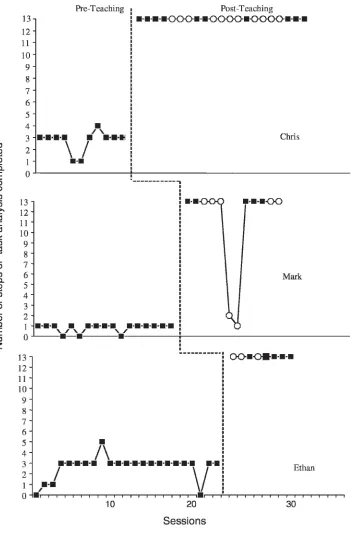
The results are shown in Figure 1. Chris had a range of one to four steps completed in baseline. He met criterion for all 13 steps in one 40-min teaching session. In postteaching, he completed all 13 steps of the task analysis during every session. Mark completed zero to one steps in baseline. He met criterion after five 40-min teaching sessions. In postteaching, he completed 1 to 13 steps, and he completed all 13 steps in 10 of 12 sessions. Ethan completed zero to five steps in baseline. He met criterion in one 40-min teaching session. In postteaching, he completed all 13 steps in every session. Thus, the number of steps completed independently increased after teaching for each participant. In addition, participants’ skills generalized to a novel computer.
Previous research has demonstrated the use of task analyses and errorless learning to teach a variety of nonleisure computer skills and other leisure activities. The present study combined the efforts of this previous research by teaching leisure skills on the computer to adults with developmental disabilities. A limitation of the present study was that it taught access to only two Web sites, an online game and a music Web site that had been determined to be preferred prior to the study. Future research should extend this method to include choice among a variety of available Web sites, because choosing among multiple activities may result in higher levels of task engagement (Tiger, Hanley, & Hernandez, 2006). A second limitation to the study was that only one
generalization computer was used and was used only during postteaching and not during baseline. Future research should evaluate stim-ulus generalization across different computers and locations as well as response generalization, such as to other Internet skills. Also, during the baseline condition participants were given only the following discriminative stimulus: ‘‘[Name], do you want to play on the computer?’’ It is possible that if participants were given more detailed instructions, they would have been able to perform more task-analysis steps. Likewise, it is possible that the delivery of edible reinforcers in the teaching condition may have resulted in increased task completion relative to baseline. Finally, although the participants completed the 13-step chain during the postteaching and generalization conditions without any prompt-ing, it was not determined whether they learned to approach a computer independently to access a Web site of choice. Future research should observe whether participants would indepen-dently initiate trained leisure skills while not under the control of a specific discriminative stimulus.
REFERENCES
DeLeon, I. G., & Iwata, B. A. (1996). Evaluation of a multiple-stimulus presentation format for assessing reinforcer preferences. Journal of Applied Behavior Analysis,29, 519–532.
Frank, A. R., Wacker, D. P., Berg, W. K., & McMahon, C. M. (1985). Teaching selected microcomputer skills to retarded students via picture prompts. Journal of Applied Behavior Analysis,18, 179–185.
Luyben, P. D., Funk, D. M., Morgan, J. K., Clark, K. A., & Delulio, D. W. (1986). Team sports for the severely retarded: Training a side-of-the-foot soccer pass using a maximum-to-minimum prompt reduc-tion strategy.Journal of Applied Behavior Analysis,19, 431–436.
Tiger, J. H., Hanley, G. P., & Hernandez, E. (2006). An evaluation of the value of choice with preschool children. Journal of Applied Behavior Analysis, 39, 1–16.
Received March 16, 2006