EXPLOITATIONS OF CLOUD COMPUTING TECHNOLOGY IN LIBRARY AND INFORMATION
CENTERS: A THEORETICAL STUDY
*,1
Getaneh Berie Tarekegn
1
Department of Computer Science, Collage of Computing and Informatics, Assosa University, Assosa, Ethiopia
2Department of Information Technology,
ARTICLE INFO ABSTRACT
The cloud computing trend of replacing software habitually installed on campus computers (and the computers themselves) with applications delivered through the internet is driven by aims of reducing universities’ information technology complexity and cost. This study examines the Exploitations of Cloud Computing in Library and Information Centers. The paper study demonstrates and elaborates the various aspects of uses of cloud computing in libraries, model
characteristics, pros and cons, benefits, how the trend of cloud computing will be impact libraries and drawback of cloud computing.
Copyright©2016, Getaneh Berie Tarekegn and Yirga Yayeh Munaye
which permits unrestricted use, distribution, and reproduction in any medium, provided the original work is properly cited.
INTRODUCTION
Today we are living in the age of information. Information technology play very vital role in libraries and information centers. For collection, Storage, organization, processing, analysis of information. Library filed facing many challenges in the profession due to applications of information technology. New concepts are being added to ease the practices in the libraries is also accepting many new technologies in the profession as they suit the present information handling and they satisfy needs of the kno society. With the advent of information technology, libraries have become automated which is the basic need towards advancement followed by networks and more effort are towards virtual libraries. The emergence of e
digital libraries, internet usage, web tools applications for libraries, consortium practices leads to the further developments in library profession. The latest technology trend in library is use of cloud computing for various purposes and for achieving economy in library functions. Since cloud computing is a new and core area the professionals should be
*Corresponding author: Getaneh Berie Tarekegn,
Department of Computer Science, Collage of Computing and Informatics, Assosa University, Assosa, Ethiopia.
ISSN: 0975-833X
Article History: Received 15th May, 2016
Received in revised form 16th June, 2016
Accepted 08th July, 2016
Published online 31st July,2016
Citation: Getaneh Berie Tarekegn and Yirga Yayeh Munaye,
theoretical study”, International Journal of Current Research Key words:
Cloud computing, Web services, Libraries, Models of Cloud Computing.
RESEARCH ARTICLE
OF CLOUD COMPUTING TECHNOLOGY IN LIBRARY AND INFORMATION
CENTERS: A THEORETICAL STUDY
Getaneh Berie Tarekegn and
2Yirga Yayeh Munaye
Collage of Computing and Informatics, Assosa University, Assosa, Ethiopia
Department of Information Technology, Collage of Computing and Informatics, Assosa University,
Assosa, Ethiopia
ABSTRACT
The cloud computing trend of replacing software habitually installed on campus computers (and the computers themselves) with applications delivered through the internet is driven by aims of reducing rsities’ information technology complexity and cost. This study examines the Exploitations of Cloud Computing in Library and Information Centers. The paper study demonstrates and elaborates the various aspects of uses of cloud computing in libraries, model
characteristics, pros and cons, benefits, how the trend of cloud computing will be impact libraries and drawback of cloud computing.
Getaneh Berie Tarekegn and Yirga Yayeh Munaye. This is an open access article distributed under the Creative Commons Att use, distribution, and reproduction in any medium, provided the original work is properly cited.
Today we are living in the age of information. Information technology play very vital role in libraries and information centers. For collection, Storage, organization, processing, analysis of information. Library filed facing many challenges ion due to applications of information technology. New concepts are being added to ease the practices in the libraries is also accepting many new technologies in the profession as they suit the present information handling and they satisfy needs of the knowledge society. With the advent of information technology, libraries have become automated which is the basic need towards advancement followed by networks and more effort are towards virtual libraries. The emergence of e-publications, nternet usage, web tools applications for libraries, consortium practices leads to the further developments in library profession. The latest technology trend in library is use of cloud computing for various purposes and nctions. Since cloud computing is a new and core area the professionals should be
Getaneh Berie Tarekegn,
Collage of Computing and
aware of it and also the application of cloud computing in libraries and information centers.
collection of books, which has treated as the source of knowledge and information but also comes as the reflection of any community. We have seen the rapid advancement in the field of communication, science, and technology, which has a great impact on many issues.
What is Cloud Computing?
A definition for cloud computing can be given as an emerging computer paradigm where data and services resi massively scalable data centers in the cloud and can be accessed from any connected devices over the internet. Cloud computing is a way of providing various services on virtual machines allocated on top of a large physical machine pool which resides in the cloud. Cloud computing comes into focus only when we think about what IT has always wanted a way to increase capacity or add different capabilities to the current setting on the fly without investing in new infrastructure, training new personnel or licensing new software. The basis of cloud computing is to create a set of virtual servers on the available vast resource pool and give it to the clients. Any web enabled device can be used to access the resources through the International Journal of Current Research
Vol. 8, Issue, 07, pp.34880-34884, July, 2016
INTERNATIONAL
Getaneh Berie Tarekegn and Yirga Yayeh Munaye, 2016. “Exploitations of cloud computing technology in library and information centers: a International Journal of Current Research, 8, (07), 34880-34884.
OF CLOUD COMPUTING TECHNOLOGY IN LIBRARY AND INFORMATION
Yirga Yayeh Munaye
Collage of Computing and Informatics, Assosa University, Assosa, Ethiopia
Collage of Computing and Informatics, Assosa University,
The cloud computing trend of replacing software habitually installed on campus computers (and the computers themselves) with applications delivered through the internet is driven by aims of reducing rsities’ information technology complexity and cost. This study examines the Exploitations of Cloud Computing in Library and Information Centers. The paper study demonstrates and elaborates the various aspects of uses of cloud computing in libraries, model of cloud computing, essential characteristics, pros and cons, benefits, how the trend of cloud computing will be impact libraries and
article distributed under the Creative Commons Attribution License, use, distribution, and reproduction in any medium, provided the original work is properly cited.
of it and also the application of cloud computing in libraries and information centers. A library is not only a collection of books, which has treated as the source of knowledge and information but also comes as the reflection of en the rapid advancement in the field of communication, science, and technology, which has a
A definition for cloud computing can be given as an emerging computer paradigm where data and services reside in massively scalable data centers in the cloud and can be accessed from any connected devices over the internet. Cloud computing is a way of providing various services on virtual machines allocated on top of a large physical machine pool in the cloud. Cloud computing comes into focus only when we think about what IT has always wanted a way to increase capacity or add different capabilities to the current setting on the fly without investing in new infrastructure, licensing new software. The basis of cloud computing is to create a set of virtual servers on the available vast resource pool and give it to the clients. Any web enabled device can be used to access the resources through the
INTERNATIONAL JOURNAL OF CURRENT RESEARCH
virtual servers. Based on the computing needs of the client, the infrastructure allotted to the client can be scaled up or down. From a business point of view, cloud computing is a method to address the Scalability and availability concerns for large scale applications which involves lesser Overhead. Since the resource allocated to the client can be varied based on the needs of the client and can be done without any fuss, the overhead is very low. As and when the amount of data increases, the Cloud computing services can be used to manage the load effectively and make the Processing tasks easier. In the era of enterprise servers and personal computers, Hardware was the commodity as the main criteria for the processing capabilities depended on the hardware configuration of the server. But with the advent of cloud Computing, the commodity has changed to cycles and bytes - i.e. in cloud computing Services, the users are charged based on the number of cycles of execution performed Or the number of bytes transferred. The hardware or the machines on which the Applications run are hidden from the user. The amount of hardware needed for Computing is taken care of by the management and the client is charged based on how the application uses these resources.
Objectives of the Study
The main objectives of the study were to explore the concept of cloud computing and what it in relation to library and information centers and its services in institutions of higher education with a main focus on academic libraries.
Literature Review
Cloud Computing
Cloud computing is a model for enabling convenient, on-demand network access to a shared pool of configurable computing resources (e.g., networks, servers, storage, applications, and services) that can be rapidly provisioned and released with minimal management effort or service provider interaction (Geelan, 2009). According to the National Institute of Standards and Technology (NIST) definition (2009), Cloud computing is a model for enabling ubiquitous, convenient on-demand network access to a shared pool of configurable computing resources (e.g., networks, servers, storage, applications, and services) that can be rapidly provisioned and released with minimal management effort or service provider interaction. Cloud computing is a model for delivery of resources as a service (Mell, Peter and Grance, Timothy 2009). Cloud computing is a style of computing in which massively scalable and elastic IT-enabled capabilities are delivered as a service to external customers using Internet technologies (Matt, 2010). Cloud Computing is the improvement of Distributed Computing, Parallel Computing, Grid Computing and Distributed Databases. And the basic principle of Cloud Computing is making tasks distributed in large numbers of distributed computers but not in local computers or remote servers (Rupesh and Gaurav, 2011). The term “Cloud Computing” is the computing services in Information Technology like infrastructure, platforms, or applications could be arranged and used through the internet. Infrastructure upon which cloud is built upon is a large scaled distributed
infrastructure in which shared pool of resources are generally virtualized, and services which are offered are distributed to clients in terms of virtual machines, deployment environment, or software. Hence it can be easily concluded that according to the requirements and current workloads, the services of cloud could be scaled dynamically. As many resources are used, they are measured and then the payment is made on the basis of consumption of those resources (Singh, 2015). Cloud computing provides a way for businesses to increase capacity and quality without investing in new infrastructure, licensing new software or training personnel (Craig et al., 2009). Cloud computing shares characteristics with autonomic computing, peer to peer, grid computing, client server model, mainframe computer and utility computing. It has various open source resources which gives different platform for better computing utilization (Alam et al., 2015).
Cloud Computing impact to libraries
Cloud computing encourages libraries and their users to participate in a network and community of libraries by enabling them to reuse information and socialize around information. The Cloud computing techniques and methods applied to libraries, not only can improve the quality of services and utilization of resources, but also can make more extensive use of cloud computing to our work life (Bhattacharjee and Purkayastha, 2013). Cloud computing simplifies management of collective resources use, remote access for multiple user selection, providing the necessary tools at some point of the training process. Collections of resources may be accessed through "Software as Services (SaaS)" (Deka and Chandra, 2016). When library systems are deployed as open cloud solutions then the library community itself can step up to create extensions to their core services and more importantly share them throughout the community using cloud solutions. Libraries can get out of the business of technology and focus on collection building, patron services and innovation. Servers can be decommissioned and no longer require replacement every five years (or less). Staff no longer has to maintain the complex software stack necessary to run local systems and worry about compatibility of the stack during upgrades. Instead technical skills can be re-deployed for extending cloud services into their environment and their environment into other cloud services (Matt, 2010).
Methodology
The theoretical methods are used for data collections. In this paper represent few points for the exploitations of Cloud Computing in library and Information centers. The author have collect data and information from national as well as international esteemed research journal library and information science and various recognized websites.
Types of Cloud Computing
Cloud computing is typically classified in two ways, location of the cloud computing and type of services offered
Classification based upon service provided
vendor’s network. This is widely known as “as a service”. Based upon the services offered, clouds are classified in the following ways.
Software as a service (SaaS)
Software package such as CRM or CAD/CAM can be accessed under cloud computing scheme. Here a customer upon registration is allowed to use software accessible through net and use it for his or his business process. The related data and work may be stored on local machines or with the service providers. SaaS services may be available on rental basis or on per use basis.
Platform as a Service (PaaS)
Cloud vendors are companies that offer cloud computing services and products. One of the services that they provide is called PaaS. Under this a computing platform such as operating system is provided to a customer or end user on a monthly rental basis. Some of the major cloud computing vendor is Amazon, Microsoft, and Google etc.
Infrastructure as a service (IaaS)
The cloud computing vendors offer infrastructure as a service. One may avail hardware services such as processors, memory, networks etc. on agreed basis for specific duration and price.
Classification based upon location
Public cloud
A public cloud is one in which the infrastructure and other computational resources that is comprises are made available to the general public over the internet. It is owned by a cloud provider selling cloud services and, by definition, is external to an organization. In this model, no access restrictions can be applied and no authorization and authentication techniques can be used. Public cloud providers such as Google or Amazon offer an access control to their clients. Examples of a public cloud includes Microsoft Azure, Google App Engine.
Private cloud
It is used to deliver services to individual or personal users from databases designed for business data. Such type of services is flexible as well as convenient while maintaining its original control security and managerial aspects. Private cloud can be owned or leased and managed by the organization or a third party and exist at on-premises or off-premises. It is more expensive and secure when compared to public cloud. In private cloud there are no additional security regulations, legal requirements or bandwidth limitations that can be present in a public cloud environment, by using a private cloud, the cloud service providers and the clients have optimized control of the infrastructure and improved security, since user’s access and the networks used are restricted. One of the best examples of a private cloud is Eucalyptus Systems.
Hybrid cloud
It is the mixture of private as well as public cloud. Generally, organizations run all the applications have the requirements of both public and private clouds. On private clouds important and secure applications are executed while public clouds are used for lengthy tasks and they run as and when required. An example of a Hybrid Cloud includes Amazon Web Services (AWS).
Community Cloud
The Cloud infrastructure is shared between the organizations of the same of community. For example, all the government agencies in a city can share the same cloud but not the non-government agencies. All libraries in a city or country sharing the same cloud.
DISCUSSION
Working of Cloud Computing
[image:3.595.45.554.593.739.2]Cloud computing system can be divided it into two fragments. These are the front end and the back end. They connect to each other through a network, usually the internet. The front end is the side the computer user, or client, sees. The back end is the cloud section of the system.
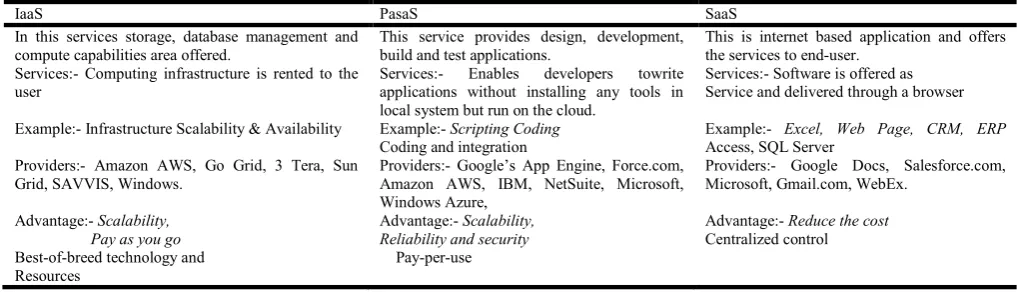
Table 1. Comparison between the three services
IaaS PasaS SaaS
In this services storage, database management and compute capabilities area offered.
This service provides design, development, build and test applications.
This is internet based application and offers the services to end-user.
Services:- Computing infrastructure is rented to the user
Services:- Enables developers towrite applications without installing any tools in local system but run on the cloud.
Services:- Software is offered as Service and delivered through a browser
Example:- Infrastructure Scalability & Availability Example:- Scripting Coding Coding and integration
Example:- Excel, Web Page, CRM, ERP Access, SQL Server
Providers:- Amazon AWS, Go Grid, 3 Tera, Sun Grid, SAVVIS, Windows.
Providers:- Google’s App Engine, Force.com, Amazon AWS, IBM, NetSuite, Microsoft, Windows Azure,
Providers:- Google Docs, Salesforce.com, Microsoft, Gmail.com, WebEx.
Advantage:- Scalability, Pay as you go Best-of-breed technology and Resources
Advantage:- Scalability, Reliability and security Pay-per-use
On the back end there are various computers, servers and data storage systems that create the cloud of computing services. A central server administers the system, monitoring traffic and client demands to ensure everything runs smoothly. It follows a set of rules called protocols Servers and remote computers do most of the work and store the data.
Use Cloud computing in library and information Centers
Cloud computing offers many interesting possibilities for libraries that may help to reduce technology cost and increase capacity reliability, and performance for some type of automation activities. Cloud computing has made strong inroads into other commercial sectors and is now beginning to find more application in library and information centers. The cloud computing pushes hardware to more abstract levels. Most of us are acquainted with fast computing power being delivered from systems that we can see and touch.
Role of Cloud computing in libraries
Cloud computing is a completely new in technology and it is known as 3rd revolution after PC and Internet. Cloud computing is an enhancement of distributed computing, parallel computing, grid computing and distributed databases. Among these, grid and utility computing are known as predecessors of cloud computing. Cloud computing has large potential for libraries. Libraries may put more and more content into the loud. Using cloud computing user would be able to browse a physical shelf of books, CDs or DVDs or choose to take out an item or scan a bar code into his mobile device. All historical and rare documents would be scanned into a comprehensive, easily searchable database and would be accessible to any researcher. Many libraries already have online catalogues and share bibliographic data with OCLC. More frequent online catalogues are linked to consortium that share resources. Data storage cloud be a main function of libraries, particularly those with digital collections storing large digital files can stress local server infrastructures. The files need to be backed up, maintained, and reproduced for patrons. This can strain the data integrity as well as hog bandwidth. Moving data to the cloud may be a leap of faith for some library professionals. It’s a new technology and on the surface it is believed that library would have some control over this data or collections. However, with faster retrieval times for patron’s requests and local server space it could improve storage solutions for libraries. Cloud computing or IT infrastructure that exists remotely , often gives users increased capacity and less need for updates and maintenance , and has gained wider acceptance among librarians. Advantages of cloud computing in libraries are cost saving, flexibility and innovation, user centric, openness, transparency, interoperability, representation, availability anytime anywhere, connect and converse, create and collaborate
Cloud Computing at Libraries
The above benefits are mostly applicable to libraries and other small-to-mid-sized organizations. Effective planning and decision regarding implementation is the most important
Financial Barriers vs. Cost Savings: Each library is facing
acute shrinkage in budget. Varieties of resources, in all forms (printed and digital) broadened the issue. Purchasing infrastructural facilities recurrently and updating /up gradation of software and hardware is becoming a bothering issue. Cloud computing offers price savings due to economies of scale and the fact that you’re only paying for the resources you actually use.
Rigidness vs. Flexibility and Innovation: Risks can be taken
for creative and innovative ideas as the new application will run on provider’s infrastructure. Libraries don’t have to decide about the bandwidth, traffic etc. Creation and configuration of virtual server for storing digital resources would be easier as the script would be run under providers own machine. As Whitfield Diffie points out that in the long run the cloud might be more restricted and rule-bound than traditional IT. He compares the cloud to public transportation providers such as airlines which rely more on rules and fixed schedules than privately-owned planes.
Cloud OPAC and Cloud ILS: As of now the libraries are
providing Union catalogue services through consortia approach, is still in its infancy. As now more and more LMS vendors are offering cloud-hosted versions of their tools, it is strongly expected that OCLC’s cloud based ILS tools that complement their existing cataloging tools (e.g. WorldCat and FirstSearch). Unified search engine and catalogue retrieving tools may help global user to access more information in real time, satisfying the fourth law of LIS.
Cloud types and LIS: There are too much hype and optimism
surrounding cloud computing. Lots of gray areas are still there which needs to be addressed promptly for implementation of cloud computing in LIS. Concerns about security, privacy and reliability are the most important among them. To mitigate the fears above the libraries choose to go for hybrid cloud model. This hybrid model would let libraries maintain more control over the applications and data stores that contain sensitive, private information about patrons. Fine tuning and adjustment of resources can also be done quickly (Ghosh, 2012).
Conclusion
procurement processes. Cloud computing enables innovation by alleviating the need of innovators to find resources to develop, test, and make their innovations available to the user community. Innovators are free to focus on the innovation rather than the logistics of finding and managing resources that enable the innovation.
Acknowledgment
The Authors would like to thank Assosa University by providing full time internet service to do this research and development. And also would like to thank the reviewers for their constructive comments.
REFERENCES
Alam, I., Panday M. and Rautary, S.S. 2015. A Comprehensive Survey on Cloud Computing. International Journal of Information Technology and Computer Science. MECS
Publishing, Vol. 02, 68-79. http://doi.org/10.5815/ijitcs.
2015.02.09.
Bhattacharjee, N. and Purkayastha, S. D. A. S. 2013. Cloud Computing and Its Application to Libraries. E-Library
Science Research Journal, 1(7), 1–6.
Bisong, Anthony et al. 2011. “An overview of the security concerns in enterprise cloud computing”. International
Journal of Network Security & Its Applications, Vol.3,
No.1, pp.30-45.
Cervone, H. Frank 2010. “An overview of virtual and cloud computing”, OCLC Systems & Services: International digital library perspectives, Vol. 26 No. 3, pp.162-165.
Craig E., M. Diana, and T. Florence, “Cloud computing an overview,” MIS 641, pp. 6, 2009.
Deka, G. C. and Chandra, D. G. 2016. Library Automation in Cloud Library Automation in Cloud, (SEPTEMBER 2013). Conference Paper. http://doi.org/10.1109/CICN.2013.104. Geelan, J. 2009. "Twenty-one experts define cloud
computing," Cloud Computing Journal, vol.4, pp. 1-5. Hayes, B. 2008. “Cloud computing”, Communications of the
ACM, Vol. 51 No.7, pp. 9-11.
Indiana University 2009. “Use of Cloud Computing”. Indiana University Articles and Papers 26, Available: http://informationpolicy.iu.edu/resources/articles/cloud_co mputing
Matt, G. 2010. Winds of change: Libraries and cloud computing. OCLC Online Computer Library Center. (Online). pp. 5. Available:http://www.oclc.org/content/
dam/oclc/events/2011/files/IFLA-windsof-change-paper.pdf.
Mell, Peter and Grance, Timothy. 2009. “The NIST Definition of Cloud Computing.” National Institute of standards and Technology, Accessed March 4, 2015.http://csrc.nist.gov/ publications/nistpubs/800-145/SP800-145.pdf.
Rupesh S. and K. Gaurav. July 2011. Cloud computing in digital and university libraries. Global Journal of Computer
Science and Technology, 11(12). pp. 37.
Singh, H. 2015. A Review of Cloud Computing. Security Issues. International Journal of Education and Management Engineering. MECS Publishing. Vol. 5, 32–41.http://doi. org/10.5815/ijeme.2015.05.04.