ISSN Online: 2161-1211 ISSN Print: 2161-1203
DOI: 10.4236/ajcm.2018.83020 Sep. 21, 2018 245 American Journal of Computational Mathematics
Hydrodynamic Mixed Convection
in a Lid-Driven Hexagonal Cavity
with Corner Heater
M. Jahirul Haque Munshi
1*, Golam Mostafa
1, A. B. S. Manik Munsi
2, Md. Waliullah
11Department of Mathematics, Hamdard University Bangladesh, Munshiganj, Bangladesh 2Department of Mathematics, Jagannath University, Dhaka, Bangladesh
Abstract
Hydrodynamic mixed convection in a lid-driven hexagonal cavity with corner heater is numerically simulated in this paper by employing finite element method. The working fluid is assigned as air with a Prandtl number of 0.71 throughout the simulation. The left and right walls of the hexagonal cavity are kept thermally insulated and the lid moves top to bottom at a constant speed
0
U . The top left and right walls of the enclosure are maintained at cold tem-perature Tc. The bottom right wall is considered with a corner heater whe-reas the bottom remaining part is adiabatic and inside the cavity a square shape heated block Th. The focus of the work is to investigate the effect of Hartmann number, Richardson number, Grashof number and Reynolds number on the fluid flow and heat transfer characteristics inside the enclo-sure. A set of graphical results is presented in terms of streamlines, isotherms, local Nusselt number, velocity profiles, temperature profiles and average Nusselt numbers. The results reveal that heat transfer rate increases with in-creasing Richardson number and Hartmann number. It is also observed that, Hartmann number is a good control parameter for heat transfer in fluid flow in hexagonal cavity.
Keywords
Mixed Convection, Lid-Driven Hexagonal Cavity, Finite Element Method, Square Block, Corner Heater
1. Introduction
Mixed convection in enclosures is encountered in many engineering systems How to cite this paper: Munshi, M.J.H.,
Mostafa, G., Munsi, A.B.S.M. and Waliullah, Md. (2018) Hydrodynamic Mixed Convec-tion in a Lid-Driven Hexagonal Cavity with Corner Heater. American Journal of Com-putational Mathematics, 8, 245-258. https://doi.org/10.4236/ajcm.2018.83020
Received: July 17, 2018 Accepted: September 18, 2018 Published: September 21, 2018
Copyright © 2018 by authors and Scientific Research Publishing Inc. This work is licensed under the Creative Commons Attribution International License (CC BY 4.0).
DOI: 10.4236/ajcm.2018.83020 246 American Journal of Computational Mathematics such as cooling of electronic components, ventilation in buildings and fluid movement in solar energy collectors, astrophysics, geology, biology and chemi-cal processes, as well as in many engineering applications. Also mixed convec-tion involving the combined effect of forced and natural convecconvec-tion has been the focus of research due to its occurrence in numerous technological, engineering and natural applications such as: cooling of electronic devices, lubrication tech-nologies, drying techtech-nologies, and food processing. Al-Amiri et al. [1] numeri-cally investigated steady mixed convection in a square lid-driven cavity under the combined buoyancy effects of thermal and mass diffusion. The results dem-onstrate the range where high heat and mass transfer rates can be attained for a given Richardson number. Sharif [2] studied numerically laminar mixed convec-tive heat transfer in two-dimensional shallow rectangular driven cavities of as-pect ratio 10. The top moving lid of the cavity is at a higher temperature than the bottom wall. The effects of inclination of the cavity on the flow and thermal fields are investigated. The stream line and isotherm plots and the variation of the local and average Nusselt numbers at the hot and cold walls are presented. Chen and Cheng [3] investigated numerically the Periodic behavior of the mixed convective flow in a rectangular cavity with a vibrating lid. The periodic flow patterns and heat transfer characteristics found are discussed with attention be-ing focused on the interaction between the frequency of the lid velocity vibration and the frequency of the natural periodic flow. Khanafer et al. [4] investigated numerically unsteady laminar mixed convection heat transfer in a lid driven cavity. M. A. Teamah et al. [5] have performed a numerical simulation of double-diffusive mixed convective flow in rectangular enclosure with insulated moving lid. Saha et al. [6] have performed the numerical effect of internal heat generation or absorption on Magneto-Hydro Dynamics (MHD) mixed convec-tion flow in a lid driven cavity. Significant reducconvec-tion in the average Nusselt number was produced as the strength of the applied magnetic field was in-creased. In addition, heat generation predicated to decrease the average Nusselt number whereas heat absorption increases it. Dawood et al. [7] investigated hy-dro-magnetic mixed Convection double diffusive in a Lid Driven Square Cavity. Hussein [8] investigated the study of mixed convection in square lid-driven with eccentric circular body. Nasrin [9] carried out an aspect ratio effect of vertical lid-driven chamber having a centered conducting solid on mixed magneto con-vection. Billah et al. [10] investigated the numerical analysis of fluid flow due to mixed convection in a lid-driven cavity having a heated circular hollow cylinder. Munshi et al. [11] investigated hydrodynamic mixed convection in a lid-driven square cavity including elliptic shape heated block with corner heater. Sivasan-karan et al. [12] examined Hydro-magnetic combined convection in a lid-driven cavity with sinusoidal boundary conditions on both sidewalls.
DOI: 10.4236/ajcm.2018.83020 247 American Journal of Computational Mathematics cavity with a corner heater and inside the square heated block. Therefore, this problem could be occurred in many engineering applications such as conveyer belt, escalator and lift as elevator, heating and cooling flows in buildings. The objective of the present study is to investigate numerically hydrodynamic mixed convection in a lid-driven hexagonal cavity with a corner heater, also increase of the lid-driven constant velocity to highlight the applicability of the approach. Numerical results are presented via streamlines, isotherms, velocity profiles, di-mensionless temperature, local Nusselt number and average Nusselt number to analyze the effect of Richardson number and Hartmann number of the fluid flow and heat transfer.
The paper is arranged in the following manner: in Section 2, we consider a physical configuration of hexagonal cavity; Section 3 presents the mathematical formulation of this model, corresponding boundary conditions and grid genera-tion for that cavity; in Secgenera-tion 4, detailed analysis of different results and corres-ponding discussions is added; finally, a brief conclusion is given in Section 5.
2. Physical Configuration
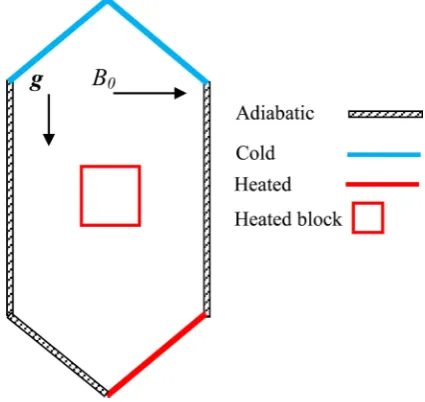
The considered two-dimensional model in the present study of mixed convec-tion in a hexagonal cavity with internal heated square block is shown in Figure 1. As seen from the schematically view, the left and right walls are lid-driven and move top to bottom with constant velocity. The upper two walls are cold. The left, right and left lower corner walls are adiabatic. A corner heater with temper-ature is located in the right lower corner. The magnetic field of strength B0 is
applied parallel to x-axis. A square block with temperature Th is located inside the enclosure at middle position.
3. Mathematical Formulation
[image:3.595.266.479.507.708.2]The fluid is considered as incompressible, Newtonian and the flow is assumed to
DOI: 10.4236/ajcm.2018.83020 248 American Journal of Computational Mathematics be laminar. Two dimensional, steady equations are written by considering a uniform applied magnetic field. It is assumed that Boussinesq approximation is valid and radiation mode of heat transfer, Joule heating and Hall effects are neg-lected according to other modes of heat transfer. Thus, using the coordinate sys-tem shown in Figure 1, the governing equations for mass, momentum and energy equation can be written in dimensional form as follows:
0 u v x y ∂ ∂ + = ∂ ∂ 2 2 2 2 1
u u p u u
u v v
x y ρ x x y
∂ + ∂ = − ∂ + ∂ +∂ ∂ ∂ ∂ ∂ ∂
(
)
2 2 2 0 2 2 1 c Bv v p v v
u v v g T T
x y y x y
σ υ β
ρ ρ ∂ ∂ ∂ ∂ ∂ + = − + + − + − ∂ ∂ ∂ ∂ ∂ 2 2 2 2
T T T T
u v
x y α x y
∂ ∂ ∂ ∂
+ = +
∂ ∂ ∂ ∂
3.1. Boundary Conditions
The boundary conditions for the present problem are specified as follows: On the top left and right walls: u v T T=0, =0, = c
On the left and right walls: u v 0, v0, Tx 0 ∂
= = − =
∂ On the lower left wall: u v 0, 0, T 0
x
∂
= = =
∂
On the lower right wall and square block: u v T T=0, =0, = h
where x and y are the distance measured along the horizontal and the vertical directions respectively, u and v are the velocity components in x and y direction
respectively, T denotes the temperature,
υ
denotes the kinematic viscosity,α
denotes the thermal diffusivity respectively, p is the pressure and ρ is the den-sity.
The governing equations are non-dimensionalized by using the following di-mensionless quantities:
2 0 0 0
, , , , , c
h c
T T
x y u v p
X Y U V P
L L U U ρU θ T T
−
= = = = = =
−
After substitution of dimensionless variable we get the non-dimensional go-verning equations which are:
0 U V X Y ∂ +∂ = ∂ ∂ 2 2 2 2
U U P U U
U V Pr
X Y X X Y
∂ + ∂ = −∂ + ∂ +∂ ∂ ∂ ∂ ∂ ∂ 2 2 2 2 2
V V P V V
U V Pr Ha PrV RiPr
X Y Y X Y θ
∂ ∂ ∂ ∂ ∂
+ = − + + − +
DOI: 10.4236/ajcm.2018.83020 249 American Journal of Computational Mathematics
2 2
2 2
1
U V
X Y RePr X Y
θ θ θ θ
∂ ∂ ∂ ∂
+ = +
∂ ∂ ∂ ∂
where U and V are the velocity components in X and Y directions respectively, P
is the pressure and θ is the non-dimensional temperature. As we know
2
/
Ri Gr Re= , when Ri≈1 both free and forced convection are equally domi-nant and the flow regime is designated as mixed convection. If Ri>1 then free convection is dominant whereas forced convection is dominant when Ri<1.
The transformed boundary conditions are: On the top left and right walls: θ =0,U=0,V=0 On the left and right walls: U 0,V 1, 0
X θ
∂
= = − =
∂ On the lower left wall: U 0,V 0, 0
X θ
∂
= = =
∂
On the lower right wall and square block: θ =1,U=0,V =0
3.2. Grid Refinement Check
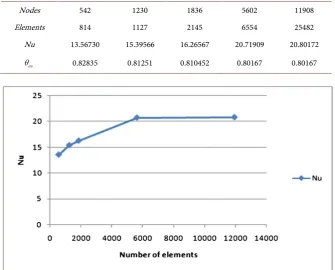
[image:5.595.206.542.417.687.2]We examined five different non-uniform grid systems with the following num-ber of elements within the resolution field. It is observed from Table 1 that grid independence is achieved with 25,482 elements where there is insignificant change in Nu with further increase of mesh elements. Five different non-uniform grids with the following number of nodes and elements were considered in Figure 2 for the
Table 1. Grid refinement check at Pr=0.71 and Ri=1.
Nodes 542 1230 1836 5602 11908 Elements 814 1127 2145 6554 25482 Nu 13.56730 15.39566 16.26567 20.71909 20.80172
αυ
θ 0.82835 0.81251 0.810452 0.80167 0.80167
Figure 2. Grid independency study on average Nusselt number in the cavity while 0.71
DOI: 10.4236/ajcm.2018.83020 250 American Journal of Computational Mathematics grid refinement tests. From these values, 11,908 nodes, 25,482 elements can be chosen throughout the simulation to optimize the relation between the accuracy required.
4. Result and Discussion
In this section, some representative results are presented to illustrate the effects of various controlling parameters on the fluid flow. These controlling parame-ters include Richardson number ranging from 0.01 to 10 and the Hartmann number varying from 0 to 50 with fixed Reynolds number Re=100 and Prandtl number Pr=0.71. The results are presented in terms of streamlines, isotherms, local Nusselt number, velocity profiles and dimensionless tempera-ture profile along the vertical wall.
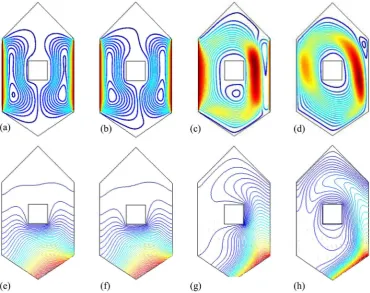
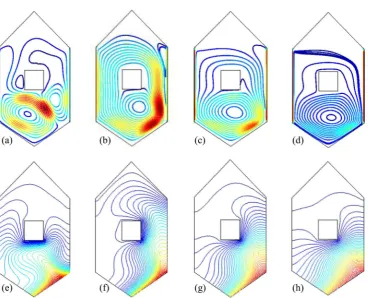
Streamlines for different values of Richardson number Ri=0.01-10 while 0
Ha= and Pr=0.71 are presented in Figure 3. At Ri=0.01 and in the ab-sence of magnetic field (Ha=0), two circular cells are formed in lower side of square heated block of the cavity shown in Figure 3(a).
[image:6.595.165.536.399.692.2]As Ri increases up to 1, the effect of mixed convection increases and both the primary and secondary circulation do increase. It is observed that moving lids become very strong. For higher Richardson number one circulation cell is formed at upper right corner of the cavity and also the increase of flow strength is shown in Figure 3(d).
DOI: 10.4236/ajcm.2018.83020 251 American Journal of Computational Mathematics Conduction dominant heat transfer is observed from the isotherms in Figures 3(e)-(h) at Ha=0 and Pr=0.71 respectively. As seen from the figures, iso-therms concentrate near the bottom wall and isotherm lines are more bending which means increasing heat transfer throw convection. For higher Richardson number, the isotherm lines are bending near right side wall that means increas-ing heat transfer throw convection are shown in Figure 3(h).
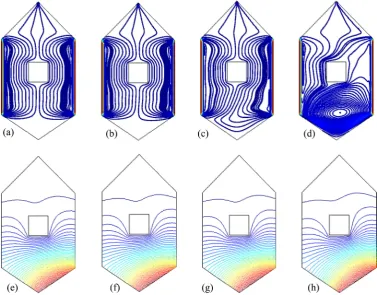
Variation of streamlines and isotherms for different values of Richardson number Ri=0.01-10 while Ha=50 and Pr=0.71 are shown in Figure 4. It can be found that the strength of buoyancy inside the cavity is significant and more fluid rises from two sided lid-driven cavity. As Ri increases, the strength of buoyancy increases and circulation cells inside the cavity appear in Figures 4(a)-(d). At Ha=50 and Ri=0.01-10, the isotherms illustrate a pure con-duction heat transfer. In Figures 4(e)-(h), the isotherm lines bending at middle of the hexagonal cavity. While Ri increases, the strength of the buoyancy in-creases and isotherm lines bend at the lower corner heater with increase of heat transfer.
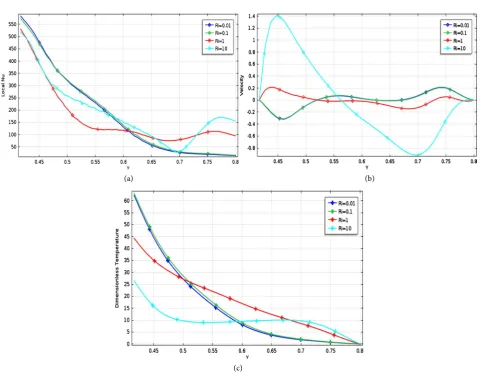
The local Nusselt Number along the vertical wall for different Richardson numbers Ri=0.01-10 with Ha=0 and Pr=0.71 of the cavity is shown in Figure 5(a). Maximum and minimum shape curves are obtained here. For
0.6
[image:7.595.160.538.397.692.2]x< maximum shape curve are found and x>0.6 the minimum shape curve are found and absolute value of local Nusselt number (that is heat transfer rate)
Figure 4. Streamlines and isotherms for different values of Richardson number Ri=0.01-10 while
50
DOI: 10.4236/ajcm.2018.83020 252 American Journal of Computational Mathematics (a) (b)
[image:8.595.59.541.58.430.2](c)
Figure 5. Variation of (a) Local Nusselt number, (b) Velocity and (c) Dimensionless Temperature for different values of Richard-son number Ri=0.01-10 while Ha=0 and Pr=0.71.
is increased with the increase of Richardson number.
Variation of the vertical velocity component along the horizontal line of the cavity with different Richardson numbers and Ha=0 is shown in Figure 5(b). From the figure it is evident that for lower values of Richardson number the value of the velocity has smaller change but for the higher values of Richardson number the value of the velocity has larger change. Figure 5(c), presents the di-mensionless temperature profiles along the horizontal wall for different values of Richardson number with Ha=0 and Pr=0.71. Maximum and minimum temperature curves are obtained here. For the lower values of Richardson num-ber the temperature increases and for the higher values of Richardson numnum-ber the temperature decreases.
DOI: 10.4236/ajcm.2018.83020 253 American Journal of Computational Mathematics (a) (b)
[image:9.595.61.541.56.394.2](c)
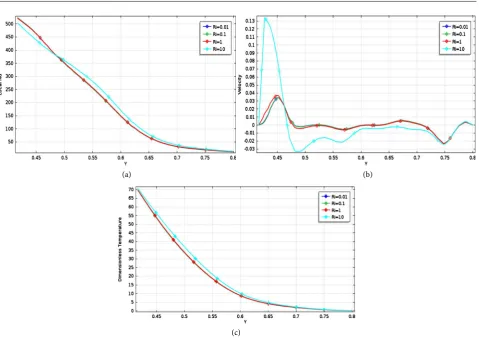
Figure 6. Variation of (a) Local Nusselt number, (b) Velocity and (c) Dimensionless Temperature for different values of Richard-son number Ri=0.01-10 when Ha=50 and Pr=0.71.
Variations of the vertical velocity component along the horizontal line of the cavity with the Richardson number and for Ha=50 are shown in Figure 6(b). It can be seen from the Figure, in whole portion of the cavity the velocity de-creases with increase of Richardson number and finally the rate of heat transfer decreases.
Figure 6(c) presents the dimensionless temperature profile along the hori-zontal wall for different values of Richardson number with Ha=50 and
0.71
Pr= . At Ha=50 the thickness of the boundary layer decreases. For the lower Richardson number temperature has more significant changes but for higher Richardson number less significant.
Streamlines for Gr=104, Re=100
DOI: 10.4236/ajcm.2018.83020 254 American Journal of Computational Mathematics Figure 7. Streamlines and isotherms for different values of Hartmann number Ha=0,10, 20,30 when Gr=104, Re=100
and Pr=0.71.
Conduction dominant heat transfer is observed from the isotherms in Figures 7(e)-(h) at Gr=104,Re=100
and Pr=0.71. At Ha=0 the isotherm lines near the bottom wall and isotherm lines are more bending which means in-creasing heat transfer throw convection. Formation of the thermal boundary layers can be found that it increases from the isotherms for Ha=0 - 30. The isotherms are almost parallel to lid-driven wall and they show a linear increase along the corner heater.
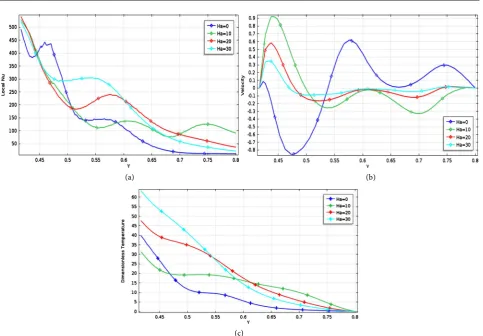
The local Nusselt Number along vertical wall for different values of Hartmann number with Gr=104, Re=100,Pr=0.71
and Ri=1 of the cavity are shown in Figure 8(a). It can be seen from the figure, in whole portion of the cavity the local Nusselt number decreases with increase of the Hartmann num-ber.
Variation of the vertical velocity component along the horizontal line of the cavity with Gr=104, Re=100, Pr=0.71, Ri=1
and different values of the Hartmann number are shown in Figure 8(b). It can be seen from the Figure that the absolute value of maximum and minimum value of velocity increases with the increase of the Hartmann number (increase of the buoyancy force).
Figure 8(c) presents the dimensionless temperature profile along the hori-zontal wall for different values of Hartmann number with Gr=104, Re=100,
0.71
DOI: 10.4236/ajcm.2018.83020 255 American Journal of Computational Mathematics (a) (b)
[image:11.595.58.542.57.393.2](c)
Figure 8. Variation of (a) Local Nusselt number; (b) Velocity and (c) Dimensionless Temperature for different values of Hart-mann number Ha=0,10, 20,30 when Gr=104, Re=100
and Pr=0.71.
Figure 9. Variation of average Nusselt number versus Hartmann number for different Richardson number Ri=0.01,0.1,1,10 when Gr=104, Re=100, Ha=50
and Pr=0.71.
The influence of Richardson number on average Nusselt number versus dif-ferent Hartmann numbers for vertical wall is displayed in Figure 9 at Gr=104,
100
[image:11.595.133.466.438.629.2]Richard-DOI: 10.4236/ajcm.2018.83020 256 American Journal of Computational Mathematics son number inside the hexagonal enclosure cause an increase in the average Nusselt number. Also rate of increment on heat transfer clearly depends on the value of Richardson number.
5. Conclusions
Numerical study on mixed convection in a lid-driven hexagonal cavity with corner heater has been performed. Results have been presented in terms of streamlines, isotherms, local Nusselt number, velocity profile and dimensionless temperature. The results are obtained for a wide range of pertinent dimension-less groups such as Richardson number and Hartmann numbers. In view of the obtained results, the following findings are précised:
1) The flow characteristics and heat transfer mechanism inside the hexagonal cavity are strongly dependent on the Richardson number.
2) The significant suppression of the convective current in the enclosure is due to increase of Hartmann numbers.
3) For all cases considered, two counter rotating eddies were formed inside the cavity regardless the Richardson number and the Hartmann numbers. The temperature distribution and the flow characteristics inside the cavity strongly depend on both the strength of the magnetic field and the Richardson number.
4) The large values of Richardson number lead to increase the lid-driven effect whereas the small values of Richardson number lead to increase effect of pres-ence of the heat source on the flow and heat characteristics.
Conflicts of Interest
The authors declare no conflicts of interest regarding the publication of this pa-per.
References
[1] Al-Amiri, A.M., Khanafer, K.M. and Pop, I. (2007) Numerical Simulation of Com-bined Thermal and Mass Transport in a Square Lid-Driven Cavity. International Journal of Thermal Sciences, 46, 662-671.
https://doi.org/10.1016/j.ijthermalsci.2006.10.003
[2] Sharif, M.A.R. (2007) Laminar Mixed Convection in Shallow Inclined Driven Cavi-ties with Hot Moving Lid on Top and Cooled from Bottom. Applied Thermal En-gineering, 27, 1036-1042. https://doi.org/10.1016/j.applthermaleng.2006.07.035 [3] Chen, C.-L. and Cheng, C.-H. (2009) Numerical Simulation of Periodic Mixed
Convective Heat Transfer in a Rectangular Cavity with a Vibrating Lid. Applied Thermal Engineering, 29, 2855-2862.
https://doi.org/10.1016/j.applthermaleng.2009.02.009
[4] Khanafer, K.M., Al-Amiri, A.M. and Pop, I. (2007) Numerical Simulation of Un-steady Mixed Convection in a Driven Cavity Using an Externally Excited Sliding Lid. European Journal of Mechanics, 26, 669–687.
https://doi.org/10.1016/j.euromechflu.2006.06.006
DOI: 10.4236/ajcm.2018.83020 257 American Journal of Computational Mathematics Moving Lid. International Journal of Thermal Sciences, 49, 1625-1638.
https://doi.org/10.1016/j.ijthermalsci.2010.04.023
[6] Saha, L.K., Uddin, K.M.S. and Taher, M.A. (2015) Effect of Internal Heat Genera-tion or AbsorpGenera-tion on MHD Mixed ConvecGenera-tion Flow in a Lid Driven Cavity. American Journal of Applied Mathematics, 3, 20-29.
https://doi.org/10.11648/j.ajam.s.2015030101.13
[7] Dawood, M.M.K. and Teamah, M.A. (2012) Hydro-Magnetic Mixed Convection Double Diffusive in a Lid Driven Square Cavity. European Journal of Scientific Re-search, 85, 336-355.
[8] Hussein, N.A. (2013) Study of Mixed Convection in Square Lid-Driven with Eccen-tric Circular Body. Journal of Babylon University/Engineering Sciences, 21, 616-634. [9] Nasrin, R. (2011) Aspect Ratio Effect of Vertical Lid Driven Chamber Having a
Centered Conducting Solid on Mixed Magneto Convection. Journal of Scientific Research, 3, 501-513. https://doi.org/10.3329/jsr.v3i3.7433
[10] Billah, M.M., Rahman, M.M., Sharif, U.M., Rahim, N.A., Saidur, R. and Hasanuz-zaman, M. (2011) Numerical Analysis of Fluid Flow Due to Mixed Convection in a Lid-Driven Cavity Having a Heated Circular Hollow Cylinder. International Com-munications in Heat and Mass Transfer, 38, 1093-1103.
https://doi.org/10.1016/j.icheatmasstransfer.2011.05.018
[11] Munshi, M.J.H., Alim, M.A., Bhuiyan, A.H. and Ali, M. (2017) Hydrodynamic Mixed Convection in a Lid-Driven Square Cavity Including Elliptic Shape Heated Block with Corner Heater. Procedia Engineering, 194, 442-449.
https://doi.org/10.1016/j.proeng.2017.08.169
[12] Sivasankaran, S., Malleswaran, A. and Lee, J. (2011) Hydro-Magnetic Combined Convection in a Lid-Driven Cavity with Sinusoidal Boundary Conditions on Both Sidewalls. International Journal of Heat and Mass Transfer, 54, 512-525.
DOI: 10.4236/ajcm.2018.83020 258 American Journal of Computational Mathematics
Nomenclatures
g Gravitational attraction X,Y Non-dimensional Cartesian coordinates Nu Nusselt number U,V Non-dimensional velocity components P Dimensional Pressure Greek Symbols
p Pressure α Thermal diffusivity
Pr Prandtl number β Volumetric coefficient of thermal expansion
Ha Hartmann number υ Kinematic viscosity of the fluid Re Reynolds number θ Non-dimensional temperature Ri Richardson number ρ Density of the fluid