EFFECT OF TRUNK STRENGTHENING EXERCISE ON FUNCTIONAL OUTCOME
Assistant Professor, Acharya Institute
ARTICLE INFO ABSTRACT
Back ground and purpose of the study:
of functional outcome in post stroke individuals. However, studies at improving trunk performance and functional outcome is sparse.
Objective of the study:
functional outcome
Study desig Participants
group 50 to 60 years
Intervention:
strengthening or no trunk strengthening exercises. The 24 subjects were assigned to experimental group and control groups. Experimental group n=12 and control
weight or partial bodyweight,
increasing the leverage for the movement task.10 minutes of warm up, 25 minutes of exercise,
down for 14 days over a period of 4 weeks and 3 sets with 8 to 10 repetition was given. The subject will receive 3 set of each exercise in one session for 3 days per week for about 6 weeks of strength training. Rest period between the sessions was 1 to 2 minutes. Each of the 5 exercises given below is repeated for 8 to 10 times per set. This repetition is based on the ability of the subject to perform number of repetition at a stretch without fatigue. performances was evaluated by T
Independence Measure (FIM) motor sub total score to evaluate the functional outcome pre and post intervention.
Results
intervention eff group was 56.66± control group 5.6±
there was significant improvement only in TIS score pre and post with p < group the TIS pre post was significant with p=0.027.
was no effect of trunk strengthening exercise strength training
Conclusion:
strengthening exercise in post stroke subjects. The result stated that there is no effect of trunk strengthening in functional outcome but there was significant improvement in trunk performance in experimental group. The conventional treatment in control group also showed no significant change in the treatment but had significant improvement in trunk performance. Though t
between groups showed no significant difference in functional outcome and trunk performance. Hence the set of exercise given in the study may not have served the purpose and a better set of exerci
the exercise.
Copyright©2016, Sumi Rose and Vasanthan. This is an open access article distributed under the Creative Commons Att unrestricted use, distribution, and reproduction in any medium, provided the original work is properly cited.
INTRODUCTION
Stroke is an increasing public health concern throughout the world, it is the second commonest cause of death and the leading cause of long term disability.1 The world Health Organization defines stroke as a clinical syndrome characterized by “rapidly developing clinical signs of focal global) disturbance of cerebral function, with symptoms lasting 24 hours or longer or leading to death with no
ISSN: 0975-833X
Article History:
Received 14th March, 2016 Received in revised form 28th April, 2016 Accepted 05th May, 2016 Published online 30th June,2016
Citation: Sumi Rose and Vasanthan, R. 2016. “Effect of trunk strengthening exercise on functional outcome in post stroke patients”,
of Current Research, 8, (06), 33658-33665.
Key Words:
Trunk performance, Stroke,
Strength,
Functional outcome.
*Corresponding author: Sumi Rose, Assistant professor, Acharya Institute of Health Sciences, College of Physiotherapy, Bangalore, Karnataka, India.
RESEARCH ARTICLE
EFFECT OF TRUNK STRENGTHENING EXERCISE ON FUNCTIONAL OUTCOME
IN POST STROKE PATIENTS
*Sumi Rose and Vasanthan, R.
Institute of Health Sciences, College of Physiotherapy, Bangalore
ABSTRACT
ground and purpose of the study: The ability to perform selective trunk movements is important predictor of functional outcome in post stroke individuals. However, studies evaluating effect of trunk strengthening aimed at improving trunk performance and functional outcome is sparse.
Objective of the study: To find out the effect of trunk strengthening exercise functional outcome
Study design: Randomized control trial
Participants: Both male and female subjects with post stroke duration of 3 months to 1 year between group 50 to 60 years who attended rehabilitation centre and home physiotherapy
Intervention: A randomized controlled trial was carried out .Patients were randomized to receive either trunk strengthening or no trunk strengthening exercises. The 24 subjects were assigned to experimental group and control groups. Experimental group n=12 and control group n=12. The source of resistance exercise is body weight or partial bodyweight, As the exercise performance increases, progression of the exercise was done by increasing the leverage for the movement task.10 minutes of warm up, 25 minutes of exercise,
down for 14 days over a period of 4 weeks and 3 sets with 8 to 10 repetition was given. The subject will receive 3 set of each exercise in one session for 3 days per week for about 6 weeks of strength training. Rest period between ssions was 1 to 2 minutes. Each of the 5 exercises given below is repeated for 8 to 10 times per set. This repetition is based on the ability of the subject to perform number of repetition at a stretch without fatigue. performances was evaluated by Trunk Impairment Scale (TIS) pre intervention and post intervention, Functional Independence Measure (FIM) motor sub total score to evaluate the functional outcome pre and post intervention.
Results: Mann Whitney Test (U test) and Wilcoxon signed rank test intervention effects. The mean age group for experimental group was 57.08 group was 56.66±3.1. The mean duration of the patients after stroke in
trol group 5.6±2.5. Gender distribution was equivalent between the groups. there was significant improvement only in TIS score pre and post with p < group the TIS pre post was significant with p=0.027. The statistical analysis
no effect of trunk strengthening exercise in trunk performance (p=0.755) and strength training (p=0.713).
Conclusion: The main aim of the study was to find the effect of trunk strengthening exercise and no trunk strengthening exercise in post stroke subjects. The result stated that there is no effect of trunk strengthening in nctional outcome but there was significant improvement in trunk performance in experimental group. The conventional treatment in control group also showed no significant change in the treatment but had significant improvement in trunk performance. Though the trunk performance improved in both the groups comparison between groups showed no significant difference in functional outcome and trunk performance. Hence the set of exercise given in the study may not have served the purpose and a better set of exerci
the exercise.
is an open access article distributed under the Creative Commons Att use, distribution, and reproduction in any medium, provided the original work is properly cited.
th concern throughout the , it is the second commonest cause of death and the The world Health Organization defines stroke as a clinical syndrome characterized by “rapidly developing clinical signs of focal (or disturbance of cerebral function, with symptoms lasting 24 hours or longer or leading to death with no apparent
cause other than vascular origin.
survey on stroke were conducted from different parts of India. The age adjusted prevalence rate was 250
population of 51,055 crude prevalence rates per 100000 population was 165 people in 1993
51,502 population.3 Stroke is more disabling than lethal with at least 30% of survivors making a incomplete recovery and a further 20% requiring assistance for activities of daily living. Murray JL anticipated that by 2020 stroke will have moved
International Journal of Current Research
Vol. 8, Issue, 06, pp.33658-33665, June, 2016
INTERNATIONAL
“Effect of trunk strengthening exercise on functional outcome in post stroke patients”,
EFFECT OF TRUNK STRENGTHENING EXERCISE ON FUNCTIONAL OUTCOME
Bangalore, Karnataka, India
The ability to perform selective trunk movements is important predictor evaluating effect of trunk strengthening aimed
exercise in improving trunk performance and
Both male and female subjects with post stroke duration of 3 months to 1 year between the age attended rehabilitation centre and home physiotherapy.
A randomized controlled trial was carried out .Patients were randomized to receive either trunk strengthening or no trunk strengthening exercises. The 24 subjects were assigned to experimental group and The source of resistance exercise is body increases, progression of the exercise was done by increasing the leverage for the movement task.10 minutes of warm up, 25 minutes of exercise, 10 minutes of cool down for 14 days over a period of 4 weeks and 3 sets with 8 to 10 repetition was given. The subject will receive 3 set of each exercise in one session for 3 days per week for about 6 weeks of strength training. Rest period between ssions was 1 to 2 minutes. Each of the 5 exercises given below is repeated for 8 to 10 times per set. This repetition is based on the ability of the subject to perform number of repetition at a stretch without fatigue. Trunk runk Impairment Scale (TIS) pre intervention and post intervention, Functional Independence Measure (FIM) motor sub total score to evaluate the functional outcome pre and post intervention. was performed to know pre and post for experimental group was 57.08±2.8 and mean age group for control f the patients after stroke in experimental group was 7.4±2.2 and 2.5. Gender distribution was equivalent between the groups. Within the experimental group there was significant improvement only in TIS score pre and post with p <0.007 when compared to within control The statistical analysis between the groups showed that there in trunk performance (p=0.755) and functional outcome after
The main aim of the study was to find the effect of trunk strengthening exercise and no trunk strengthening exercise in post stroke subjects. The result stated that there is no effect of trunk strengthening in nctional outcome but there was significant improvement in trunk performance in experimental group. The conventional treatment in control group also showed no significant change in the treatment but had significant he trunk performance improved in both the groups comparison between groups showed no significant difference in functional outcome and trunk performance. Hence the set of exercise given in the study may not have served the purpose and a better set of exercise has to be used to perform
is an open access article distributed under the Creative Commons Attribution License, which permits
cause other than vascular origin.2 Several population based survey on stroke were conducted from different parts of India. The age adjusted prevalence rate was 250-350/ 100000 in rural population of 51,055 crude prevalence rates per 100000 lation was 165 people in 1993-95 and urban 136 people in Stroke is more disabling than lethal with at least 30% of survivors making a incomplete recovery and a further 20% requiring assistance for activities of daily living.4
anticipated that by 2020 stroke will have moved INTERNATIONAL JOURNAL OF CURRENT RESEARCH
from the 6th leading cause of lost disability adjusted life years (DALY’S)to 4th. Stroke is the most common cause of disability or dependence of activities of daily living among the elderly.5Patients affected with stroke generally have difficulties in performing Activities of Daily Living after a few days of stroke. During the first week of stroke 78 to 90% are dependent in some aspects for ADL at six months 42 to 62% and at one year 33 to 55% continue to remain dependent.6 Stroke related physical disability can diminish quality of daily living, place care burden on families, and increase need for long term institutionalization.1 The personal activities which are performed by most of the normal individuals that are fundamental for self care include Mobility, Communication, Breathing, Bowel and bladder management, eating and drinking, Personal cleansing and grooming, Personal device care Work and play and Sleeping 2Trunk need to be freely movable to be brought into innumerable positions required for countless activities each person takes to fulfill the needs and wishes of daily life. trunk provides dynamic foundation for all movements. 7Trunk movement control is an indispensable basic motor ability for the execution of many functional task.9Trunk performance is an important predictor of functional outcome after stroke and is an essential factor for range of activities in daily living.3 Two groups of muscles chiefly responsible for moving or controlling the trunk are back extensors and the muscles which form the abdominal wall, because of their mechanical arrangement and their multiple segmental innervation, the abdominal muscles have peculiar property to contract in part and not just as a whole and making possible for enormous trunk movements. 8
Richard W Bohannon undertaken a study to describe and
compare the forwardand lateral trunk flexion strength of 20 patients with strokeand hemiparesis and 20 matched controls.
Trunk flexion strength was measured with a hand-held
dynamometer while subjects wereseated upright. The greatest difference between groups was in forward flexion strength. The patientsalso demonstrated weakness of the trunk on the paretic relativeto the nonparetic side. The results show that trunk muscle strengthis impaired multidirectionally in patients with stroke. Such impairments have the potential to affect function.5
Trunk control appears to be an obvious prerequisite for complex behavioral skills. The recovery of more basic motor skills might precede the appearance of more refined motor behaviors.10 Davies associates the loss of selective control in trunk with problems of speech, balance, gait, arm and hand function after the onset of hemiplegia the patient experiences difficulty in moving trunk in relation to the pull of gravity.9 Durate et al. stated that the functional recovery after stroke explained by trunk control test is 45 to 71%.15 the loss of trunk control could result from a reduction in strength and amplitude of trunk movements especially on paretic side.16 The innervation of the trunk muscles is supplied from both the cerebral hemispheres. therefore the unilateral stroke potentially deteriorate the function of the trunk muscles on both contralateral and ipsilateral sides of the body.10 The nerve supply of the trunk muscles comes from motor cortex of both hemispheres, an upper motor neuron may cause bilateral trunk muscle weaknes according to Karatas et al. Activities of Daily
Living requires head and trunk stability as well as trunk mobility. Bed mobility for instance is dependent on selective rotation of the head shoulder and pelvic girdle.12 Winzeler Mercy U and Karatas et al confirmed that the impairments of trunk muscles after stroke and showed the correlation between the paretic trunk muscles and limitations in every day activities.13 Trunk control is a crucial component to perform ADL. Some studies found that trunk control or sitting balance at an early stage could predict ADL outcome at a late stage in patients after stroke.14 The ability to maintain balance while sitting and standing is necessary for functional activities such as transferring, reaching and walking, both trunk and limb muscles are involved in the coordination and regulation of automatic postural responses. Tanaka investigated the relationship between trunk muscle strength, balance and functional disability in patients with unihemispheric stroke and results indicated that the importance of trunk muscle strength in postural stability.15
According to Davies people with hemiparesis sit with a posterior pelvic tilt to compensate for weakness in the abdominal muscles. As pelvis provides a basis of support for the trunk mobility such fixation of pelvis in posterior pelvic tilt this malalignment contributes to chronic immobility of trunk due to lack of appropriate support and flexibility of pelvis. Trunk anterior displacement is a common motor compensation used by patients with hemiparesis for arm transport during bilateral swinging reaching and for hand orientation during grasping.16 It has been recently pointed out that trunk muscle strength is impaired multidirectionally in stroke patients and that the impairment is greatest in forward flextion.17 Thanaka
et al. showed that hemiplegic patients had poorer reciprocal trunk flevor, extensor and rotatory muscle strength than healthy controls.18 Thanaka, Bohannon RC, conducted study in unihemispheric stroke patients and have demonstrated weakness of trunk flexion and extention and bilateral rotatory muscles in unihemispheric stroke patients.
Davies PM showed in the study on post stroke patients that the abdominal muscles demonstrate a remarkable loss of activity and tone post stroke.19 Impairment of trunk control in hemiplegia or paretic patients has often been documented and characterized by asymmetry in performance of rotatory and side bending activities.20 Trunk muscle strength measured with a hand held dynamometer in lateral and anterior flexion are reduced in persons with hemiparesis compared with healthy persons; the greatest difference is in anterior flexion.
Therefore the achievement of sitting balance and normal trunk function is of paramount importance in rehabilitation of stroke patients according to Verheyden G.7
Need for the study
trunk performance after stroke an assessor blinded randomized control trail was carried out on33 participants, experimental group received 10 hours of individual and supervised trunk exercise for 30 min ,4 times a week, for 5 weeks trunk performance measured by using trunk impairment scale found significant improvement in the experimental group compare to control group, beneficial effect found in dynamic sitting balance sub scale only an d later flexion movement.7 Studies evaluating trunk function is limited. Dursun et al. examined the effect of the use of angular bio feed back device in training the stroke patients with impaired sitting balance and found there was no significant difference in the sitting balance and independent ambulation between both groups at discharge. The biomedical databases Cochrane, clinical rehabilitation, Neurorehabil Neural Repair Pub Med, sage pub, were searched. The five database was searched with key terms ‘Trunk Performance’ plus ‘stroke’ and ‘Trunk strength’ plus ‘stroke’, ‘Trunk Performance’ plus ‘functional outcome’ and ‘stroke’ mentioned in title or abstract a clinical tool to measure trunk performance systematic review of the literature,16 articles regarding the activation of trunk muscles using EMG, hand held dynamometer, is okinetic dynamometer and a study on trunk movements and sitting balance with additional exercise and no articles were found giving strength training to trunk muscles to improve functional outcome. To the best of our knowledge no study evaluated physiotherapy intervention using trunk strengthening exercise to improve functional out come post stroke. Therefore it was the aim of the study to investigate effect of trunk strengthening exercises aimed at improving functional out come in post stroke patients.
Objective of the study
To findout the effect of trunk strengthening in improving functional independence.
To findout the effect of trunk strengthening in improving trunk performance
METHODOLOGY
Research Design
A randomized controlled trial was undertaken to find out the effect of trunk strengthening exercise in improving trunk performance and functional outcome.
Population
Both male and female post stroke subjects with the duration of 3 months to 1 year, with the age group between 50 to 60 years, and who were attending the rehabilitation center or taking physiotherapy treatment at community level and who satisfied the selection criteria from the population of the study.
Selection criteria
a) Inclusion criteria
Age group between50 –60 years
First ever stroke
TIS score to be 17 out of 23.
Post stroke subjects from 3 months to 12 months
Mini mental state examination(MMSE) score more than 24
and above
b) Exclusion criteria
History of neurological condition other than stroke such as Parkinson’s disease, Head injury, Nerve injuries etc
Patient who had acute back pain were screened by visual analogue scale if the score exceed 5 on movements such subjects were excluded
Medical history of heart disease or cardiac surgery conducted in the last 3 months of pre assessment.
Withdrawal criteria
Those patients who were not willing to continue their participation the study after signing the consent form were allowed to withdraw from the study.
The subject with second stroke or develops any cardiac problems during the intervention duration were also allowed to withdraw from the study.
Sampling
30 post stroke subjects were randomly distributed to control 15 and experimental group.
Sampling design
Concealed random allocation of subjects into experimental and control groups convenient sampling.
Source of data
OPD of Oxford college of physiotherapy
Suryodaya multispeciality rehabilitation centre
Physiocare
NUMBER OF POST STROKE SUBJECTS 35
TOTAL NUMBER OF SUBJECTS ASSESSED FOR
ELIGIBILITY=30
30 PATIENTS WERE ENROLLED
SUBJECTS EXCLUDED N=5 SUBJECTS WERE EXCLUDED. DID NOT WANTED TO BE THE PART OF THE STUDY=2. DEVELOPED OTHER PROBLEMS SUCH AS FALL, SECOND STROKE=3 RANDOMIZA
TION OF 25 SUBJECTS ALLOCATED TO INTERVENTION
GROUP =13 RECEIVED ALLOCATED INTERVENTION=12 DID NOT RECEIVE ALLOCATED INTERVENTION=1 AS THE SUBJECT DEVELOPED CARDIAC PROBLEM AND WAS NOT ABLE TO CONTINUE THE EXERCISE
ALLOCATED TO CONTROL GROUP =12 AND RECEIVED CONVENTIONAL TREATMENT . TRUNK STRENGTHENING EXERCISE WAS RESTRICTED. DROP
OUT N=1
ANALYSIS OF 12 SUBJECTS ASSIGNED TO EXPERIMENTAL GROUP.
G
Community level
Little sisters of poor rehabilitation centre
Duration of the study
The study was conducted over a period of 3 months .the study was an experimental design. Intervention was given for 4 weeks alternate days for 14 days.
Outcome measures
Trunk Impairment Scale(TIS)
Functional Independence Measure
Procedure
Participants
30 post stroke subjects were recruited from the center and were allotted into experimental and control group through concealed allocation randomly who fulfilling the inclusion and exclusion criteria.
Informed Consent
30 subjects who were recruited for the study were requested to read understand and sign the informed consent form. This was given in the native stable language all the participants were explained about the purpose of the activities they needed to perform for evaluation of the outcome measure, the intervention exercises, the risk and discomforts involved in the study was explained to each participants they were taken into confidence by intimating that all the information gathered will be confidential.
Intervention
Subjects are randomly divided into two groups A and B respectively by lottery method with canceled allocation.
The group A is the experimental group and B control group
who attend the rehabilitation programme.
Trunk Impairment Scale (TIS)
Trunk impairment scale examines static and dynamic
sitting balance and trunk co-ordination. maximum score (7,10 and 6)
Total score ranges from 0-23 points. TIS scale has no ceiling effect.
Functional Independence Measure (FIM)
FIM assess four categories self care, sphincter management, mobility and executive functioning. The FIM scale consist of 18 items with 13 of these targeting motor components and 5 targeting social cognitive components unit is a reliable and valid tool for measurement of ADL. In the present study motor subtotal score was utilized. Pre and post TIS and FIM scores are recorded on both experimental group A and control group B. Group A subjects undergo additional trunk strengthening
exercise, whereas the control group undergoes the
conventional rehabilitation programs.
Intervention parameters
The subject will receive 3 set of each exercise in one session for alternate days per week for about 4 weeks of strength training. Rest period between the sessions was 1 to 2 minutes. Each of the 5 exercises given below was repeated for 8 to 10 times per set. This repetition was based on the ability of the subject to perform number of repetition at a stretch without fatigue. The source of resistance exercise is body weight or partial bodyweight, which is given in antigravity position. As the exercise performance ability increases, progression of the exercise is done by increasing the leverage for the movement task. The exercise protocol will be individualized and record will be taken from the intervention group. In the beginning and end of the training session 10 mins warm up and 10 mins of cool down in the form of corridor walking and active trunk movements.
Exercise 1
Extension of the spine
Position: The subject will lie prone on the couch
Procedure: A pillow is kept under his abdomen and the subject is asked to lift the head and shoulders.
Progression of the exercise will be two pillows under the abdomen and the
Subject is asked to perform the exercise.
Exercise 2
Exercise in reclined sitting
Position: Subject will be sitting in a reclined position (1200 hip flexion)
Procedure: The subject will be in reclined position, hands on contralateral shoulders brings the trunk forward beyond 900 of hip flexion.
Progression: The subject will be asked to place the hand behind the head and perform the activity.
Progression of the exercise will be ask to lift the arms and perform the exercise.
Exercise 3
Sitting leaning backward and forward
Position: Subject sits on a stool
Procedure: The subject is asked to lean forward with hand cross over the chest and performs the activity and gradually comes back to neutral position, then the subject attempts to lean backward in the same position and gradually returns to neutral position
Progression 2: The subject will raise his both the arm and perform the activity.
Exercise 4
Trunk rotation exercise in long sitting to lying
Position: long sitting
Procedure: The subject sits in a long sitting position with the trunk rotation towards the hemiplegic side and lies down on the couch. The therapist holds the hand one shoulder width apart. (Both contralateral and ipsilateral sides has to be performed).
Exercise 5
Lateral flexion of the trunk
Position: High sitting on the chair without arm rest
Procedure: The subject place the hand to the opposite shoulder, and ask to do side flexion of the trunk ,alternatively on both the sides.
Progression 1: The subject clasp the over the occipital region and perform the activity.
Progression 2: The subject raise both the arm and perform the same activity.
At the end of the sixth week TIS and FIM is recorded post intervention.
RESULTS
Study Design: A Randomized controlled trial with 12 subjects in Experimental Group and 12 subjects in Control group was undertaken to study the effect of trunk strengthening exercises on functional outcome in post stroke
[image:5.595.306.559.118.334.2]Statistical Methods: Descriptive statistical analysis has been carried out in the present study. Results on continuous measurements are presented on Mean SD (Min-Max) and results on categorical measurements are presented in Number (%). Significance is assessed at 5 % level of significance. Mann Whitney U test (two tailed, independent) has been used to find the significance of study parameters on continuous scale between group and Wilcoxon signed rank test has been used to find the significance of outcome variables within each group. 95% confidence interval has been computed to find the significance of change or difference between pre and post. If 95% CI does not include 0, then difference (delta) is statistically significant otherwise not significant. Effect size has been computed to find the effect
Table 1. Base line charachteristics
Experimental group Control group
Duration 7.2 +2.5 (months and SD) 5.6+2.2 (months and SD)
Age 57.08+2.8 (age and SD) 56.66+3.12 (age and SD)
Gender Male- 9 Female- 3
Male- 7 Female- 5
The age, sex and duration is statistically matched in both the groups which was determined by the mean and standard deviation
Table 2. Evaluation of outcome variables in Experimental group
Outcome
variables Pre Post Delta 95%CI P value
TIS 12.50±1.57
(13.0)
14.33±1.72 (14.0)
1.83±1. 59
0.83 to 2.84
0.007**
FIM 61.42±5.94
(61.50)
62.17±5.41 (61.50)
0.75±1. 76
0.37 to 1.87
0.180
[image:5.595.306.556.440.664.2]The experimental group had a median value of 13 and 61.5 pre intervention and 14 and 61.5 post intervention with a p value of 0.007 in TIS and 0.18 in FIM. The TIS show a statistical significance but the change of score 3 in the total score of TIS which was not attained by none of the subjects. FIM shows no statistical significant change.
Table 3. Evaluation of outcome variables in control group
Outcome
variables Pre Post Delta 95%CI P value
TIS 13.08±2.54
(13.50)
14.83±3.01 (15.0)
1.75±1.96 0.50 to 2.99
0.027*
FIM 56.25±9.50
(56.0)
58.00±8.17 (60.0)
1.75±3.59 0.53 to 4.03
0.109
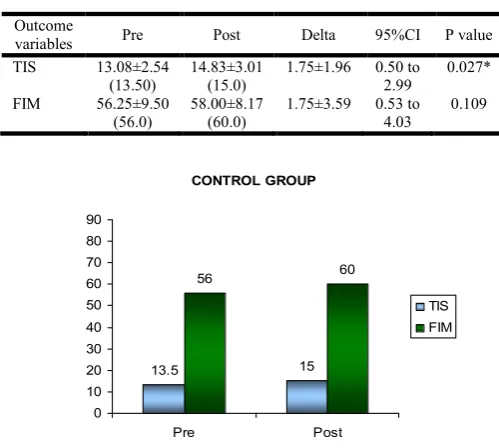
The control group had a median value of 13.5 and 56 pre intervention and 15 and 60 post intervention with a p value of 0.027 in TIS and 0.109 in FIM.
The TIS show a statistical significance but the change of score 3 in the total score of TIS which was not attained by none of the subjects. FIM shows no statistical significant change.
EXPERIMENTAL GROUP
13 14
61.5 61.5
0 10 20 30 40 50 60 70 80 90
Pre Post
TIS
FIM
CONTROL GROUP
13.5 15
56 60
0 10 20 30 40 50 60 70 80 90
Pre Post
[image:5.595.36.288.692.744.2]Table 4. Comparison of delta in two groups of patients
Outcome variables
Experimental group
Control
group P value Effect size
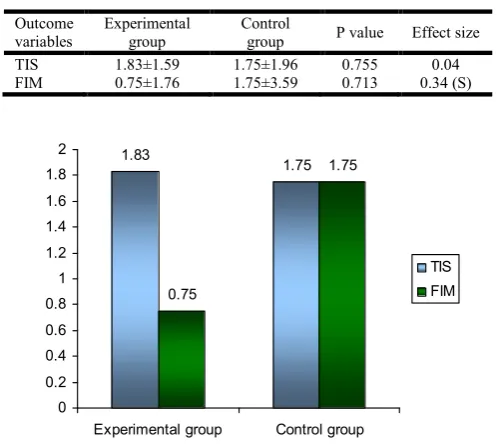
TIS 1.83±1.59 1.75±1.96 0.755 0.04
FIM 0.75±1.76 1.75±3.59 0.713 0.34 (S)
The change in experimental group in TIS was 1.83 and FIM was 0.75 pre and post intervention and change in control group in TIS was 1.75 and FIM was 1.75 pre and post intervention.
DISCUSSION
The aim of the study was to find the effect of the trunk strengthening exercise on functional outcome and trunk performance, the results suggest that that there was no significant effect of trunk strengthening on functional outcome nor in trunk performance, the effect of strengthening on functional outcome was measured by Functional Independence Measure (motor sub total score) and trunk performance was measured by Trunk Impairment Scale (TIS). There is a clinical significant change in trunk impairment scale subjects with trunk exercises and no trunk exercise and no significant effect in Functional Independence Measure with trunk strengthening exercise and no trunk strengthening exercise.
Trunk strengthening and functional outcome
There is no statistically significant difference between trunk strengthening exercise and no trunk strengthening exercise in FIM pre and post intervention i in both the groups. The lack of improvement in functional outcome can be due to the duration of the onset of stroke as the studies conducted by Wade DT, Ducan PW and Jorgensen HS in their study suggested that most of the motor and functional recovery occurs in the first 3 months after the stroke. Jensen, Jesper
et al. conducted on motor skill training and strengthening are associated with different plastic changes in central nervous system were 24 healthy subjects were investigated changes in corticospinal excitability induced by 4 weeks of heavy strength training or visuomotor skill learning. No significant change in strength. Other aspect for lack of improvement in functional outcome due to trunk strengthening can be due to the duration of the strengthening program as the four week strengthening was not effective as a study conducted by Pamela Ducan et al.
on therapeutic exercise in sub acute stroke were in the intervention included, structured, progressive, physiologically based, therapist supervised in home program of n=36, for 90 minute session over 12 weeks targeting flexibility, strength, balance endurance and upper extremity function showed recovery of mobility, balance and endurance but not strengthening, there band and body weight was used for resistance.
Trunk strengthening and trunk performance
There is a statistically significant difference between trunk strengthening exercise and no trunk strengthening exercise in TIS pre and post intervention but clinically there is no change in Trunk Impairment Scale, as a change of 3 in the total score of 23, would be considered as change and was not attained by none of the subjects in both the groups. Lack of trunk performance after strengthening can also be due to duration and also exercise that was given, as a study conducted by G Verheyden conducted a study on trunk performance after stroke; where he gave 5 trunk exercises for 33 participants for 5 weeks and found that there was no significant effect on selective trunk performance after stroke.
Limitation
Duration of the study was less to produce a remarkable change in the functional outcome and trunk performance.
The study sample is too small as compared to stroke the population.
The pre and post change of trunk impairment scale
components was not taken, if taken would have given clear idea of the change in components.
Strength was not quantified to know whether there was really a change in the strength pre and post intervention.
Recommendation
Duration of the study has to be increased
Trunk strength is an important part of stroke rehabilitation and has to be taken into consideration.
Task specific trunk strengthening exercise can have a beneficial effect on functional outcome
Conclusion
The main aim of the study was to find the effect of trunk strengthening exercise and no trunk strengthening exercise in post stroke subjects. The result stated that there is no effect of trunk strengthening in functional outcome but there was significant improvement in trunk performance in experimental group. The conventional treatment in control group also showed no significant change in the treatment but had significant improvement in trunk performance.
Though the trunk performance improved in both the groups comparison between groups showed no significant difference in functional outcome and trunk performance. Hence the set of exercise given in the study may not have served the purpose and a better set of exercise has to be used to perform the exercise.
1.83
1.75
0.75
1.75
0 0.2 0.4 0.6 0.8 1 1.2 1.4 1.6 1.8 2
Experimental group Control group
Summary
The study was done to find out the effect of trunk strengthening exercise on functional outcome in post stroke patients. The study included 24 subjects of both genders within in the age group of 50 to 60 years. Group
A(Experimental group) was treated with trunk
strengthening exercise in addition to conventional treatment; Group B (Control group) was treated with gait training, stretching exercises and strengthening exercise but trunk strengthening was restricted. The 2 groups were treated for 14 days over a period of 4 weeks. Study design was pre and post experimental design, randomized control trail.
Data was collected from various rehabilitation centers OPD, in and around Bangalore.
The result showed that there was no significant
improvement in FIM-M scores pre and post intervention of the two groups but on comparison with each other no group showed superiority over the other.
Also, each of the two groups showed statistical significant improvement in post test values of TIS, but was not clinically significant change.
Thus, trunk strengthening and no trunk strengthening exercises had no difference post intervention but had a change in trunk performance which was not significant therefore a better set of exercise may produce a significant change.
Acknowledgement
The correspondence author is grateful to Prof. Mahendran. P, staffs and management of Acharya institute of health sciences for their motivation. And grateful to Prof.R.Vasanthan for the valuable guidance for this research work.
REFERENCES
1. Sudlow CL. and Warlow C. 1996. Comparing stroke
incidence world wide. What makes studies comparable? Stroke, 27:550-8
2. World health organization. stroke 1989. Recommendation on stroke prevention and diagnosis and therapy. Report of WHO. Task force on stroke and other cerebrovascular disorders. Stroke, 20:1407-31
3. Tapas Kumar, Banerjee, Shyamal Kumar das: 2006.
Epidemiology of stroke in India. Neurology. Review article Asia, 11:1-4.
4. Joseph Kwan, 2001. Clinical epidemiology of stroke: CME
Journal Geriatric Medicine, 3(3):94-98.
5. K.P.S. Nair, A.B.Tally, 2002. Stroke rehabilitation: traditional and modern approaches, Neurology India, Volume 50, page no 85-93.
6. Christopher J. L. Murray, Alan D. Lopez: 1996. Global
Burden of Disease A comprehensive assessment of
mortality and disability from diseases, injuries, and risk factors in 1990 and projected to 2020 Harvard School of Public Health.
7. Activities of daily living available at www.medicinenet. com
8. Chae, John MD; Johnston, Mark PhD; Kim, Hekyung MD;
Zorowitz, Richard MD. 1995. Admission Motor
Impairment As A Predictor of Physical Disability After Stroke Rehabilitation. Am J Phys med Rehabil, 74:218-223. 9. Jørgensen HS, Nakayama H, Raaschou HO, 1995.
Vive-Larsen J, Støier M, Olsen TS. Outcome and time course of recovery in stroke. Part II: Time course of recovery. The Copenhagen Stroke Study. Arch Phys Med Rehabil. May;76(5):406-12
10.Wade DT, Hewer RL. 1987. Motor loss and swallowing difficulty after stroke: frequency, recovery, and prognosis.
Acta Neurol Scand., Jul;76(1):50-4.
11.Campbell FM, Ashburn Am et al. 2001. Head and pelvic movements during dynamic reaching task in sitting implications for physical therapist. Arch Phys Med Rehabl., 82:1655-60
12.Right in the middle selective trunk activity in the treatment of adult hemiplegia. Patricia M.DaviesEd.2003 page 15 13.Ching ling, and Hsich, 2002. Trunk control as an early
predictors of comprehensive activities of daily living function in stroke patients. Stroke, 33:2626-30.
14.Right in the middle selective trunk activity in the treatment of adult hemiplegia. Patricia M.DaviesEd. 2003.page 20 15.Bohannon RW., Cassidy D. and Walsh S. 1995. Trunk
muscle strength is impaired multidirectionally after stroke Clinical Rehabilitation, Vol. 9, No. 1, 47-51.
16.Davies PM. 2003. Right in the middile. Selective trunk activity in the treatment of adult hemiplegia. Springer (India). 31-65.
17.Richard W Bohannon. 1993. Muscle strength .1st ed, 187-189.
18.Carr LJ, LM Harrison et al. 1994. Evidence for bilateral innervation of certain homologous motor neuron pools.
Physiol., 475:217-27.
19.Karatas M, Cetin N Bayramoglu Mdilek. 2004. Trunk muscle strength in relation to balance and functional disability is unihemispheric stroke patients. Am J Phys Med Rehabl., 83:81-87.
20.M. Taoka1, Takashi Toda1 and Yoshiaki Iwamura1. 1998. Representation of the midline trunk, bilateral arms, and shoulders in the monkey postcentral somatosensory cortex.
Exp Brain Res., Dec;123(3):315-22.
21.Campbell FM, Asheburn Am et al. 2001. Head and pelvic movements during dynamic reaching task in sitting implications for physical therapist. Arch Phys Med Rehabl., 82:1655-60
22.Michaelsen SM, Dannenbaum R, Levin MF. 2006. Task specific training with trunk restraint on arm recovery in stroke in 30 chronic stroke subjects. Stroke, 37(1):186-102. 23.Davies PM. 1990. Lying down with trunk rotation. Right in
the middile, 104-106
24.Verheyden G, Nieuwboer A, Feys, Thijs ,Vaes, De Weerdt,
W. 2005. Discriminant ability of trunk impairment scale a
comparison between stroke patients and healthy
individuals. Disability and Rehabl., 27:1023-28
25.Bohannon RC. 1995. Recovery and correlates of trunk muscles strength after stroke. Int.J.Rehabil., 18:262-7. 26.G. Verheyden et al. 2009. Additional trunk exercise
27.Verheyden G. and Vereck L. 2006. Trunk performance after stroke and the relationship with balance, gait functional ability. Clinical Rehab., 20:451.
28.Ruth Dickstein, Yael Heffes. 1999. Activation of selected trunk muscle during symmetric functional activities in post
stroke hemiparetic and hemiplegics patients. Neurol
Neurosurg Psychiatry, 66:218-221.
29.Messier S, Bourbonnais D, Desrosiers J, Roy Yves, 2004. Dynamic analysis of trunk flexion after stroke. Arch phys Med Rehabl., 85:1619-24.
30.Verheyden G, Nieuwboer A, De Weerdt. 2007. Clinical tool to measure performance after stroke a systematic review of the literature. Clinical Rehabl., 21:387-394 31.Verheyden G, Nieuwboer A., Mertin J., Preger R., Kiekens
C. 2004. Trunk impairment scale: A new tool to measure motor impairment of the trunk. Clinical Rehabilitation, 18:326-334
32.Folstein MF. and Folstein SE. 1975. ”Mini Mental State”: A practical method for grading the cognitive state of the patients for clinician. J Psychiatr Res., 12:189-198.
33.Carolyn K, Lynn Ac. 2002. Therapeutic exercise
foundation and technique Practical body weight as source of resistance if the exercise occurs in antigravity position, 4thEd., 74-76.
34.I-P Hsueh. 2002. Comparison of the psychometric
characteristics of the functional independence measure, 5
item Barthel index, and 10 item Barthel index in patients with stroke. Journal of Neurology Neurosurgery and
Psychiatry, 73:188-190.
35.Brautigam K, Flemming A, Schulz H, Dassen T. 2002. How reliable is functional independence measure (FIM)?
Pflege., 15(3):131-6.
36.F. P. Franchignoni, MD; L. Tesio, MD; C. Ricupero, MD;
M. T. Martino, MD. 1997. Trunk Control Test as an Early Predictor of Stroke Rehabilitation Outcome. (Stroke,
28:1382-1385)
37.SC Loewen and BA Anderson. 1990. Predictors of stroke outcome using objective measurement scales. Stroke, 21:78-81
38.Wade DT, Skilbeck CE, Hewer RL. 1983. Predicting
Barthel ADL score at 6 months after an acute stroke. Arch Phys Med Rehabil., Jan;64(1):24-8.
39.Mao HF, Hsueh IP, Tang PF, Sheu CF, Hsieh CL. 2002. Analysis and Comparison of the Psychometric Properties of Three Balance Measures for Stroke Patients Stroke, April 1, 33(4): 1022 – 1027.
40.Davies PM. 1990. Problems associated with the loss of selective trunk activity in hemiplegia in: Right in the middle. Berline, Heidenberg: Springer Verlag., 31-65.
41.Collin C. and Wade D. 1990. Assessing motor
impairements after stroke a pilot reliability study. J.Neurol Neurosurg Psychiatry, 53:576-9.