Munich Personal RePEc Archive
Price-directed Consumer Search
Ding, Yucheng and Zhang, Tianle
8 March 2018
Price-directed Consumer Search
Yucheng Ding† Tianle Zhang‡
March 2018
Abstract. We extend Stahl’s (1989) model to a setting with differentiated products
to study the effects of price-directed consumer search. Consumers engage in costly
search to find out whether products meet their needs. Consumer search is directed by
prices when they are observable before search, in contrast to the case in which prices
are discovered only after search, where search is naturally random. The equilibrium
under price-directed search differs substantially from that under random search, despite
certain similarities. We show that as search costs decrease, sales become more likely
and firms earn higher expected profits under price-directed search, whereas the opposite
holds under random search. Moreover, compared with random search, under
price-directed search firms’ expected profits are always lower, but consumer surplus and
total welfare are higher provided that the search cost is sufficiently small.
Keywords: Consumer search, Observable price, Search cost
JEL Classification Number: D8, L1
†Wuhan University, China; [email protected]
‡Lingnan University, Hong Kong; [email protected]
∗We are grateful to the editor Jos´e Luis Moraga-Gonz´alez and the two referees for their
extremely valuable suggestions which have significantly improved the paper. We also
thank Mark Armstrong and Yongmin Chen for their helpful comments on a previous
1
Introduction
Consumers in many markets now have easy access to price information due to the
rapid development of Internet technology. For instance, through price search engines
or price comparison websites, a consumer can easily obtain a list of prices for various
products. With prices in hand, consumers may examine, in a deliberate order, whether
products match their preferences. In other words, consumer search may be directed by
prices. Although it is becoming more common for consumers to have access to price
information before engaging in costly search, the market implications of price-directed
consumer search have not been well studied in the literature, which typically assumes
that consumers search in a random order to acquire both product and price information
(e.g. Wolinsky, 1986; Anderson and Renault, 1999).
This paper develops an oligopolistic model to study situations where consumers may
have access to price information before engaging in sequential search among
differenti-ated products. To this end, we modify and extend Stahl’s (1989) model by introducing
simple and tractable product differentiation. In particular, each consumer has a need
and each firm provides a product or service that meets the consumer’s need with some
exogenous probability. Consumers derive a positive utility only if their needs are met.
As in Varian (1980) and Stahl (1989), there are two groups of consumers: informed and
uninformed. Informed consumers have both product and price information and thus
purchase from a matched seller with the lowest price. Uninformed consumers have to
engage in costly sequential search to examine whether products meet their needs and
to find out prices if these are not observable before search. Firms simultaneously set
their prices by taking consumer search strategies into account.
We consider both non-observable and observable price scenarios. When prices are
not observable before search, the uninformed consumers discover the product prices
(together with the product match) as they proceed with their costly search. Because
there is no ex-ante differentiation among firms, consumers naturally visit firms in a
symmetric because the order of consumer search is influenced by prices. We refer to
the former scenario as the case of random search and the latter scenario as the case of
price-directed search.
Our model has some desirable features that are lacking in recent models of
price-directed search (e.g. Armstrong and Zhou, 2011; Haan, Moraga-Gonz´alez, and Petrikaite,
2015; Choi, Dai, and Kim, 2016). As discussed in Armstrong and Zhou (2011) and
Haan, Moraga-Gonz´alez, and Petrikaite (2015), if prices are observable in search
mod-els with differentiated products such as Wolinsky (1986), there will be no pure-strategy
equilibrium because a firm has an incentive to slightly undercut its price so as to attract
all consumers to visit it first. Moreover, mixed-strategy equilibria are not tractable. To
overcome these difficulties, most existing price-directed search models build in ex-ante
product differentiation, which permits equilibria in pure-strategies to exist. In
con-trast, our model assumes no ex-ante product differentiation among firms and focuses
on equilibria in price mixing.1 We believe that our model is a better fit for market
settings where product attributes are not known by some consumers without costly
search or there is no difference among the product attributes that can be observed for
free.2
We derive an optimal search rule for consumers and characterize a unique
sym-metric equilibrium under random search and price-directed search, respectively. Under
random search, as in Stahl’s model, the uninformed consumers search randomly with
an optimalreservation price: they stop and buy if the product turns out to be a match
and the price of the product is below their reservation price. Under price-directed
search, the uninformed consumers search only firms with prices below a certain price
which we callthreshold price, and proceed from low- to high-priced firms. As the search
1
Armstrong and Zhou (2011) also study an equilibrium that involves price mixing in a Hotelling
model where a consumer’s product values are perfectly negatively correlated.
2
For example, a person located in Denver planning a trip to Beijing for the first time may need to check (on a price-comparison website) which airline provides a round-trip flight between Denver
and Beijing that fits his travelling schedule. Some studies (e.g. Golan, Karp and Perloff, 2002) find
cost decreases, the reservation price under random search decreases because the
unin-formed consumers demand a better price deal. However, under price-directed search,
the threshold price increases as the search cost decreases, because for a lower search
cost, the uninformed consumers are willing to continue searching among firms that
charge higher prices. The behavior of the reservation and threshold prices in opposite
directions with respect to the search cost is a crucial driver of many of the results in
this paper.
The price equilibrium under price-directed search has similarities with and
differ-ences from that under random search. First, under both random and price-directed
search, each firm charges a price randomly drawn from a price distribution. This is
because firms have an incentive to charge low prices to attract the informed consumers
who can compare prices directly without search but at the same time they also have
an incentive to charge high prices to exploit the uninformed consumers who have to
search among firms. Like in Stahl’s model, these two forces are balanced when firms
randomize their prices. Second, unlike in Stahl’s model, the symmetric equilibrium
price distributions in our model may have a non-convex support with a low-price and
a high-price interval. This occurs when the search cost is low under random search or
when the search cost is high under price-directed search. In particular, under random
search, on the one hand, the informed consumers who match only with one product will
accept a very high price, up to the product value. On the other hand, a firm will not be
able to sell to the uninformed consumers at a price above their reservation price. When
the reservation price is far below the product value, which occurs when the search cost
is low, firms optimally swing between targeting the matched informed consumers and
attracting the uninformed ones. Thus, the equilibrium price distribution has both a
low-price and a high-price interval, the latter being above the reservation price.
Simi-larly, under price-directed search, when the threshold price is sufficiently low because
of a high search cost, the support of the equilibrium price distribution is non-convex.
If one regards prices in the high-price interval as “regular prices” and those in the
consistent with the empirical evidence on supermarket pricing (Chevalier et al. 2003;
Kehoe and Midrigan, 2008) and from E-retailers on the Internet (Baye, Morgan, and
Scholten, 2004). We further show that when the search cost decreases, a sale at a
price in the low-price interval becomes more likely under price-directed search and
less likely under random search. Under random search, for a lower search cost, the
uninformed consumers are pickier and choose a lower reservation price. Thus, firms
increase the probability of charging a price from the high-price interval that targets
more the matched consumers. However, under price-directed search, the uninformed
consumers use a higher threshold price for a lower search cost. Thus, firms optimally
increase the probability of charging a price from the low-price interval.
We obtain some additional interesting results by comparing the effects of search
cost under random and price-directed search. First, as the search cost decreases, the
expected market price decreases when the search cost is large but then increases when
the search cost is small under both random and price-directed search. However, the
reasons for the non-monotonic relationship between the expected market price and the
search cost are quite different. For instance, under random search and for a small search
cost, firms adopt the two-interval pricing strategy. A lower search cost leads to a lower
reservation price, which induces firms to charge a price from the high-price interval
more frequently. The increased probability of the high-price interval is a dominant
force that results in a higher expected market price. Conversely, under price-directed
search and for a small search cost, the entire equilibrium price distribution is below the
threshold price of the uninformed consumers. A decrease in the search cost raises the
threshold price and thus reduces price competition among firms, resulting in higher
equilibrium prices.3 As we will discuss in detail in Section 2, our results relate to
3
For a large search cost, the opposite forces prevail in the model. In particular, the equilibrium
price distribution is below the reservation price under random search and shifts down with a lower
search cost because of a lower reservation price. Under price-directed search, firms adopt the
two-interval pricing strategy. More weight is placed on the low-price two-interval for a higher threshold price
but differ from the existing studies (e.g. Stahl, 1989; Wolinsky, 1986; Armstrong and
Zhou, 2011; Haan, Moraga-Gonz´alez, and Petrikaite, 2015; Choi, Dai, and Kim, 2016)
that examine the effect of search cost on market price.4 Second, as the search cost
decreases, firms’ expected profits weakly decrease under random search because the
uninformed consumers search more aggressively. However, when prices are observable
before search, the uninformed consumers will continue searching among firms that
charge higher prices if the search cost is lower. Consequently, firms’ expected profits
increase as search costs decrease.
We also compare the welfare implications of random and price-directed search.
Our analysis suggests that firms’ profits are always higher under random search, while
consumer surplus and total welfare are higher under price-directed search when the
search cost is small. Intuitively, if prices are observable before search, they influence
the order in which consumers search and thus the demand for firms. Hence, price
competition among firms is intensified, resulting in lower expected profits. Moreover,
comparing price-directed search with random search, the uninformed consumers search
more efficiently in the sense that they do not search firms whose posted prices are higher
than their threshold price, and always search firms with lower prices first. Therefore,
total welfare and consumer surplus tend to be higher under price-directed search than
under random search when the search cost is small. It is worthy of noticing that, in
our model, total welfare can be higher under random search than under price-directed
search when the search cost is large. This is because when the search cost is large,
firms always price below the reservation price under random search while they price
above the threshold price with some positive probability under price-directed search.
Hence, the uninformed consumers are less likely to make purchases under price-directed
search since they will not continue searching among firms that charge prices above the
threshold price. This may result in lower total welfare under price-directed search.
4
Specifically, existing studies find that equilibrium prices go up in search costs under random search
(Stahl, 1989; Wolinsky 1986) but go down under price-directed search (Armstrong and Zhou, 2011;
The remainder of this paper is organized as follows. In Section 2, we review the
related literature. In Section 3, we describe the model and conduct equilibrium analysis
under random and price-directed search, respectively. In Section 4, we compare the
effects of lower search costs on market performance and welfare under random and
price-directed search. Section 5 concludes the paper. All proofs and diagrams are
relegated to Appendix A and B, respectively.
2
Related literature
Our model is related to two classical models of sequential consumer search. Focusing on
consumer search for the best price among competing homogeneous sellers, Stahl (1989)
develops a remarkable model to show how price dispersion arises in a
homogeneous-product market due to the presence of consumers who engage in costly search to
dis-cover market prices.5 Emphasizing consumer search for the best value among
hori-zontally differentiated sellers, Wolinsky (1986) provides an influential model in which
consumers are initially uninformed about their valuation of each product or its price,
but may learn this information through costly search.6 Our model incorporates these
two important features, price dispersion and product differentiation. In particular, in
our model, price dispersion arises in equilibrium because firms adopt a mixed strategy
in pricing and consumers actively search for a product that meets their needs and a
lower price.
Several papers have studied the impact of non-random consumer search on market
performance. Arbatskaya (2007) examines a model where consumers engage in
sequen-tial search among firms selling homogenous goods. In her model, consumers have to
5
Studies extend Stahl’s model in various directions. For example, Janssen, Moraga-Gonz´alez, and
Wildenbeest (2005) relax the assumption that consumers obtain the first price quotation for free; Stahl (1996) and Chen and Zhang (2011) allow for the heterogeneity of search costs and of searchers,
respectively; and Janssen and Parakhonyak (2014) consider the possibility of costly revisits.
6
Anderson and Renault (1999) further extend Wolinsky’s model by studying the effect of consumer
visit firms in an exogenous pre-determined order. In equilibrium, prices charged by
firms decline in the order of consumer search. A consumer with a higher (lower) search
cost buys from the firm at the top (bottom) of the order paying a higher (lower) price.
Armstrong, Vickers, and Zhou (2009) investigate a model of differentiated products
where consumers visit a prominent firm before turning to non-prominent ones. They
show that the prominent firm charges a lower price and the non-prominent firms charge
higher prices, compared to the situation with random search.7 Differently, in the case
of price-directed consumer search we consider in our model, the order of consumer
search is endogenously determined by prices. Thus, the prices chosen by firms also
affect their profit by influencing the order of consumer search.
Our paper is closely related to recent papers that study situations where consumer
search is directed by prices.8 Armstrong and Zhou (2011) explore a price-directed
search model in which consumers know the prices charged by firms before they engage
in sequential search to discover product match utilities. In their model, two firms are
located at the ends of a Hotelling line and thus a consumer’s match utilities for the two
firms are perfectly negatively correlated.9 They find that equilibrium prices decrease
7
Zhou (2011) further extends Armstrong, Vickers, and Zhou (2009) to a completely ordered search
model and shows that prices rise in the order of consumer search. Rhodes (2011) shows that a
prominent retailer earns significantly more profit than others, even when the cost of gathering product
and price information is essentially zero.
8
Studies also examine the situation where firms can strategically influence the order of consumer
search. Chen and He (2006) investigate a model where firms differing in relevance of matching the
needs of consumers bid for the advertised position for their products and consumers are initially
uncertain about whether the product matches their needs but can learn this through costly search.
Wilson (2010) studies a model where a firm can choose to obfuscate itself by increasing the cost that
some consumers must incur to search for its product price. Haan and Moraga-Gonz´alez (2011) consider
an attention-directed consumer search model where consumers first visit the firm whose advertising
is most salient. Garcia and Shelegia (2015) examine directed consumer search with observational
learning.
9
Shen (2015) also studies a Hotelling model in which consumers with heterogeneous ex-ante “brand”
with search costs because a higher search cost increases a firm’s profit from being
prominent, and thus provides a higher incentive for the firm to charge a lower price.
Haan, Moraga-Gonz´alez, and Petrikaite (2015) examine a consumer search model a la
Wolinsky, but allow firms to influence the search order by adjusting prices and providing
match-value information. They find that higher search costs intensify price competition
on first visits, but relax it after first visits. Overall, the first effect may dominate and
result in unusual comparative statics. They also study price advertising decisions and
show that both firms choose to advertise prices even though equilibrium prices and
firms’ profits are lower when prices are advertised. Choi, Dai, and Kim (2016) study
an oligopoly model in which consumer search is based on partial product information
and advertised prices. They show that market prices increase with a reduction in search
cost but may increase or decrease when more information is provided to consumers.
Our price-directed search model differs from the above models in that price is the
only observable product attribute before consumers search, and consumer utilities,
conditional on matching, are independently distributed acrossN ≥2 firms. Moreover,
the nature of the equilibrium price distribution in our model is quite different from
those of the other models. Finally, an increase in search cost may also lead to lower
expected prices in our model, but for a rather different reason. In particular, in the
above models, a higher search cost intensifies price competition for first visitors and
thus leads to lower expected prices, while in our model, the uninformed consumers do
not know whether a product meets their needs before searching and thus they have to
be compensated by a lower observable price if the search cost is higher.10
10
Our paper also relates to Moraga-Gonz´alez, S´andor, and Wildenbeest (2017), who show in a
Wolinsky-type model how search costs affect both the intensive search margin (or search intensity)
and the extensive search margin (or the decision to search or not) and how equilibrium price formation
is determined by these two margins. Our price-directed search model has elements relating to the
extensive search margin in the sense that the uninformed consumers search only if observable prices
3
The model and equilibrium analysis
There is a continuum of consumers, each with a need. A consumer derives utility V
if her need is met and zero otherwise. There are N ≥ 2 firms in the market, each of
which carries a product that meets the consumer’s need with a certain probability. We
call it a “match” if a product meets the consumer’s need. The probability of a match
is assumed to be independent and identical for all firms and consumers, and is denoted
asθ ∈[0,1].11 The marginal cost is constant and normalized to zero.
Similar to Varian (1980) and Stahl (1989), there are two groups of consumers: a
fraction µ ∈ (0,1) of informed consumers who are fully aware of product and price
information (without searching) and a fraction 1−µ of uninformed consumers who
engage in costly search to find a product that matches their needs, and its price if not
observable before search. The search cost for the uninformed consumers is denoted as
s. Following the standard consumer search literature, we assume that the first search
is free.
We consider two alternative situations where prices are either non-observable or
observable before searching, respectively. In the situation where prices are not
observ-able before searching, consumer search is random because the uninformed consumers
discover whether a product is a match and obtain its price only through search. In
the situation where prices are observable before search, consumer search is directed
by prices because the uninformed consumers rationally examine the products of firms
charging lower prices first. We refer to the former situation as the random search case
and to the latter as the price-directed search case.
As in the literature, we focus on a symmetric Nash equilibrium, that is, a price
dis-11
This could arise when consumers have specific needs and the available products are so broad that
consumers have to verify whether a product can satisfy their needs. Alternatively, one can think of
a product as a bundle of characteristics. Each consumer values only a few product attributes and is
satisfied as long as a product embeds these wanted characteristics. Athey and Ellision (2011), Chen
and He (2011), and Chen and Zhang (2018) similarly assume that a firm provides a product that
tribution function and a search strategy for the uninformed consumers such that, given
the pricing strategy of firms and the search strategies of consumers, it is optimal for
each firm to price according to the price distribution, and given the price distribution,
the search strategy is optimal for the uninformed consumers.
3.1
Consumer search
We begin with consumers’ optimal search strategies. As the informed consumers
ob-serve all prices and whether the products match their needs, they purchase from the
matched firm (if one exists) with the lowest price in the market. The uninformed
consumers decide on a search strategy to maximize their expected payoffs.
Random search
In the case of random search, the optimal stopping rule for an uninformed consumer
is as follows. Given a price distribution Φ(p), the uninformed consumer will randomly
sample firms and stop searching if she finds a matched product and the price of that
product is below a reservation price ω which is determined by the equation:
θ
Z
p≤ω
(ω−p)dΦ(p) = s. (1)
Note that the left-hand side is the expected benefit of a single additional search. If the
uninformed consumer has searched all firms without finding a matched product priced
belowω, she will return to the firm that provides a matched product and charges the
lowest price provided that the price is belowV or exit the market otherwise. Note that
ω decreases as s decreases because the expected marginal benefit is lower for a lower
ω.
Price-directed search
When prices are observable before search, the order of search by the uninformed
consumer is no longer random, but directed by prices. Given that a firm charges a
higher than the search cost: θ(V −p)≥s or
p≤r=V − s
θ. (2)
We call the threshold price of the uninformed consumer r. Note that r increases as
s decreases because the uninformed consumer is willing to continue searching among
firms that charge higher prices when the search cost is lower.
Note that the uninformed consumer receives a higher expected payoff by visiting
the firm that offers a lower price. Moreover, the uninformed consumer will buy from a
firm she has visited if that firm offers a matched product or move on to search another
firm in case of no match. Therefore, an uninformed consumer’s strategy consists of (i)
a search order from low- to high-price firms; (ii) a threshold price r: searching only
if p ≤ r; and (iii) a purchase decision: purchasing from the first matched firm, if one
exists, during search.
3.2
Equilibrium price distribution
We now turn to the analysis of firms’ pricing in a symmetric Nash equilibrium. Note
that, as in Stahl’s model, our model has no pure-strategy equilibrium and the
equi-librium price distribution must be atomless on its entire support.12 As we will show
in Propositions 1 and 2, the symmetric equilibrium price distributions under random
and price-directed search have either a convex support over a continuous interval or a
non-convex support with a low-price interval and a high-price interval, depending on
the search cost. Here, we explain intuitively the driving forces behind these results
12
To see why, note that in equilibrium a firm earns a positive expected profit, by charging p=V
and selling only to those consumers whose needs are satisfied only by the firm. This implies that
equilibrium prices exceed zero. Now, if some price p was charged with positive probability in a symmetric equilibrium, there would be a positive probability of a tie at p. Therefore, it would be profitable for a firm to chargep−ǫ, because the deviating firm would give up an arbitrarily small profit to gain a positive measure of informed consumers who have more than one match. Thus, competition
would tend to drive prices down to marginal cost zero and the profit of every firm would also become
before we formally characterize the equilibria. First, note that each firm has a positive
measure of informed consumers who only match with the product of the firm in
ques-tion and can sell to them at a price up toV. At the same time, firms also compete for
the uninformed consumers. However, firms hardly sell to the uninformed consumers if
they charge a price above ω or r as the uninformed consumers may return only after
visiting all other firms in the case of random search or do not visit them at all in
the case of price-directed search. Hence, when ω or r is high and close to V, firms
optimally charge a price belowω or r to sell to both groups of consumers. Therefore,
the equilibrium price distribution is similar to that of Stahl’s model: the entire price
distribution is below ω or r with convex support. When ω or r is low and far below
V, firms optimally swing between targeting their captive matched informed consumers
and attracting the uninformed consumers. Thus, the equilibrium price distribution has
a low-price interval and a high-price interval with the latter above ω or r: each firm
randomly chooses a price from either the low-price or the high-price interval with some
probability. Moreover, the shape of the equilibrium price distribution depends on the
values of ω or r, which in turn crucially depend on s.
To ensure that the uninformed consumers engage in search, we assume thatsis not
too high. Moreover, for easier presentation, we define the following auxiliary variables:
φ= Z 1
1−θ
µN θ(1−θ)N−1+ (1−µ)[1−(1−θ)N]
µN θyN−1+ (1−µ)[1−(1−θ)N] dy
and
η= Z 1
1−θ(1−α)
µN θ(1−α)(1−θ(1−α))N−1+ (1−µ)
1−(1−θ(1−α))N
µN θ(1−α)yN−1+ (1−µ) [1−(1−θ(1−α))N] dy,
where α will be defined later. We next move to the discussion of random and
price-directed search.
Random search
Under random search, we show that if s is relatively high, the entire equilibrium
price distribution is below the reservation price of the uninformed consumers. However,
support with a high-price interval and a low-price interval. Formally, we divide the
possible values of s into (0, s1) and [s1, s2] where
s1 =
N θ(1−θ)N−1
N θµ(1−θ)N−1+ (1−µ) [1−(1−θ)N](θ−φ)V and s2 = (θ−φ)V.
Note that we can verify that s1 < s2 if µ <1. We obtain the following results.13
Proposition 1. In the case of random search, there exists a unique symmetric
equilibrium as follows.
(i) If s∈[s1, s2], each firm prices according to a mixed strategy
F(p) = 1
θ
(
1−
ω2
p (1−θ)
N−1 +1−µ
µ
ω2
p −1
1−(1−θ)N
N θ
N1−1) (3)
if p∈ "
N θµ(1−θ)N−1+ (1−µ)
1−(1−θ)N
N θµ+ (1−µ) [1−(1−θ)N] ω2, ω2
#
,
and the uninformed consumers search randomly with a reservation price ω2 = θ−sφ.In this equilibrium, each firm earns expected profit
ω2θ
µ(1−θ)N−1+ (1−µ)1−(1−θ)
N
N θ
;
(ii) If s∈(0, s1), each firm prices according to a mixed strategy
G(p) =
(1−α)Gl(p) if
µN θ(1−α)(1−θ+θα)N−1+(1−µ)[1−(1−θ+θα)N]
µN θ(1−α)+(1−µ)[1−(1−θ+θα)N] ω1 ≤p≤ω1
(1−α) if ω1 < p <(θα1−+1−θ θ)N−1V
(1−α) +αGh(p) if (θα1−+1−θ θ)N−1V ≤p≤V
where
Gh(p) = 1−
1−θ θα
"
V p
N1−1 −1
#
,
Gl(p) =
1
θ(1−α) (
1−
ω1
p (θα+ 1−θ)
N−1+1−µ
µ
ω1
p −1
1−(1−θ+θα)N
N θ(1−α)
N1−1)
,
13
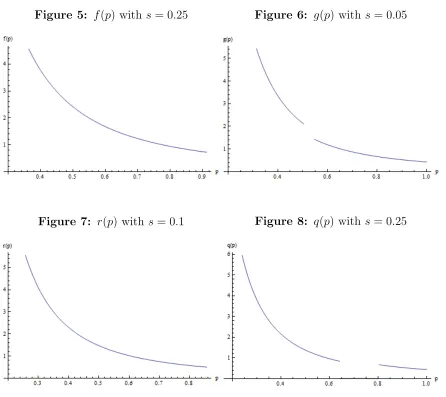
In Appendix B (Figures 5-8), we provide examples of equilibrium probability density functions
(p.d.f.s) corresponding to the equilibrium price distributions in Proposition 1. The c.d.f.s are denoted
and the uniqueα is determined by
µN θ(1−α)(θα+ 1−θ)N−1+ (1−µ)
1−(1−θ+θα)N
N θ(1−α) [θ(1−α)−η] =
V(1−θ)N−1
s , (4)
and the uninformed consumers search randomly with a reservation priceω1 = θ(1−sα)−η.
In this equilibrium, each firm earns expected profit θ(1−θ)N−1V.
The case of random search in our model is an extension of Stahl (1989). In fact,
if θ → 1, our model under random search degenerates to Stahl’s model with unit
de-mand.14 However, the equilibrium properties substantially differ from those in Stahl’s
model when the search cost is low (i.e. s ∈ (0, s1)) and θ < 1. Specifically, unlike in
Stahl’s model, the equilibrium price distribution has a non-convex support with two
disconnected intervals.15 This is because a firm sells to at least θ(1−θ)N−1 informed
matched consumers even if it prices above ω1. Moreover, by charging a price higher
than ω1, the firm may lose sales to the uninformed consumers. Thus, all prices in the
support of the high-price interval, Gh(p), must be discretely higher than ω1 because
when a firm raises its price above ω1 its demand jumps down, which must be exactly
offset by a jump-up of the price so that all prices in the equilibrium support yield the
same expected profit.16
Another interesting feature of this equilibrium that contrasts with Stahl’s model is
that recalls may occur. This is because the uninformed consumers search for both prices
and matches in our model. Even if the product matches their needs, the uninformed
consumers do not purchase immediately if the price is above ω1. If the uninformed
14
To see this, note that s1 → 0 when θ → 1. Thus, F(p) is the equilibrium price distribution.
Moreover, we can show that F(p) asymptotically approaches the equilibrium price distribution in Stahl’s model with unit demand asθ→1.
15
Note that ω2 →0 as s→0 because the reservation price increases withs. Whens=s1, α= 0
andω2=ω1. Thus, the price distribution with non-convex support converges to the one with convex
support ass→s1. 16
Chen and Zhang (2011) also find an equilibrium price distribution with two disconnected intervals.
However, in their model, firms sell homogenous products to shoppers, local searchers who buy at
random, and global consumers who search optimally. Their price distribution with two disconnected
consumers do not find a matched product with a price below ω1 after sampling all
firms, they may return to buy from the matched firm with the lowest price, and thus
recall occurs.
Price-directed Search
We will show that, under price-directed search, an equilibrium price distribution
with support over two disconnected intervals arises when s is high, in contrast to the
case of random search. The reason is that under price-directed search, the threshold
price of the uninformed consumers, r, decreases with s, while under random search,
the reservation price, ω, increases with s. Hence, a smaller s pushes r closer to V but
drives ω away from V. Therefore, the equilibrium price distributions behave quite the
opposite ass changes. We divide the possible values of s into (0, s′
1) and [s′1, s′2] :
s′1 = (1−µ)θV and s2′ = [1−µ(1−θ)N−1]θV.
The next proposition characterizes the equilibrium under price-directed search.
Proposition 2. In the case of price-directed search, there exists a unique
symmet-ric equilibrium as follows.
(i) If s∈(0, s′
1), each firm prices according to a mixed strategy
R(p) = 1− 1−θ
θ
"
r p
N1−1 −1
#
, with p∈[(1−θ)N−1r, r] (5)
and the uninformed consumers search sequentially with a threshold price r from the
low-price to the high-price firms. In this equilibrium, each firm earns an expected profit
θ(1−θ)N−1V −s
θ
;
(ii) If s∈[s′
1, s′2],each firm prices according to a mixed strategy
Q(p) =
(1−α′)Ql(p) if µ(1−θ)N−1V ≤p≤r
(1−α′) if r < p < µr
(1−α′) +α′Qh(p) if µr ≤p≤V
where
Qh(p) = 1−
1−θ θα′
"
V p
N1−1 −1
#
, (7)
Ql(p) =
1 1−α′ −
1−θ θ(1−α′)
"
µV p
N1
−1
−1 #
, (8)
and α′ = 1−θ
θ
"
µV r
N1−1 −1
#
, (9)
and the uninformed consumers search only firms whose prices are below r from the
low-price to the high-price firms. Each firm earns an expected profit µθ(1−θ)N−1V.
Similar to the case of random search, the threshold price of the uninformed
con-sumers influences the pricing strategy of firms under price-directed search. In
particu-lar, when r is close to V, which occurs when s is low, their pricing strategy is driven
mainly by the consideration of the threshold price of the uninformed consumers. Thus,
the entire equilibrium price distribution is belowr. In this equilibrium, the uninformed
consumers always find a matched product, if one exists, when searching from the
low-price to the high-low-price firms. When r is far below V, which occurs when s is high,
the support of the equilibrium price distribution consists of two price intervals, with
corresponding c.d.f.s Qh(p) and Ql(p), played with probability α′ and 1−α′,
respec-tively. In equilibrium, with probabilityα′, each firm targets only the matched informed
consumers as its price is aboveraccording to the c.d.f. Qh(p). With probability 1−α′,
each firm charges a price below r according to the c.d.f. Ql(p), trying to sell to both
informed and uninformed consumers. In this equilibrium, the uninformed consumers
may not find a matched product even if it exists as they will not visit firms that charge
prices abover.
4
Random search v.s. price-directed search
In this section, we first study and compare the effects of lowering search costs on the
price-directed search. As we illustrate below, there are several interesting results in the
comparative statics of lower search costs. Then, we compare the welfare levels under
the two cases.
4.1
The effects of lower search costs
As shown in Section 3, firms may adopt a two-interval pricing strategy under random
and price-directed search. We refer to prices in the low-price interval as “sales”, which
occur with probability (1−α) under random search and with probability (1−α′) under
price-directed search. The next result provides an interesting comparison.
Corollary 1 of Propositions 1 and 2. As the search cost decreases, sales are
less likely under random search (i.e. ∂(1−∂sα) > 0) but more likely under price-directed search (i.e. ∂(1−∂sα′) <0).
Interestingly, a lower search cost decreases the likelihood of sales under random
search but increases it under price-directed search. The intuition is as follows. Note
that a sales price is primarily used to target the uninformed consumers. In the case of
random search, whensdecreases, searching for a good price becomes less costly so that
the uninformed consumers lower their reservation price. To lock in more uninformed
consumers, a firm has to lower sales prices at the opportunity cost of a lower mark-up
for other consumers. Therefore, sales become more costly for firms as s decreases.
Consequently, firms reduce the probability of choosing a price from the low-price
inter-val. In the case of price-directed search, ass decreases, r increases. This implies that
the uninformed consumers are willing to continue searching among firms that charge
higher prices (from the low-price interval) when they do not find a match from firms
that charge lower prices. This provides incentives for firms to increase the likelihood
of the low-price interval to target more uninformed consumers.
The next proposition shows the effects of lowering the search cost under random
search and price-directed search.
in-creases when the search cost is small, but dein-creases when the search cost is large under
both random and price-directed search; (ii) a firm’s expected profit weakly decreases
under random search but weakly increases under price-directed search, and (iii)
to-tal welfare increases under price-directed search and may increase or decrease under
random search.
Under both random and price-directed search, the expected market price exhibits
similar patterns as the search cost decreases. In particular, when s is small, the
ex-pected market price increases as the search cost decreases under both random and
price-directed search. However, the reasons are quite different. In the case of random
search, firms adopt a two-interval pricing strategy when s is small. A decrease in s
imposes two opposing forces on the expected market price. On the one hand, a lower
search cost pushes down the prices in the low-price interval because of a lower ω. On
the other hand, to compensate, firms increase the probability of charging a price from
the high-price interval. It turns out that the latter force dominates and thus the
ex-pected market price increases as the search cost decreases. In the case of price-directed
search, when s is small, r is close to V and thus the entire equilibrium price
distri-bution is below r. Because r decreases with s, firms charge higher prices. Similarly,
when s is large, under random search, ω is close to V and thus the entire equilibrium
price distribution is belowω. Hence, ass decreases, the entire price distribution shifts
down and, thus, the expected market price decreases. Under price-directed search,
firms adopt a two-interval pricing strategy becauseris low whensis large. A decrease
in s results in a higher r. Consequently, firms more frequently draw prices from the
low-price interval, thereby targeting the captive matched uninformed consumers. This
has a dominant effect and the expected market price declines.
As s decreases, firms’ expected profits weakly decrease under random search but
weakly increase under price-directed search. Intuitively, under random search, a lower
search cost increases the net benefit of additional search. Thus, the uninformed
con-sumers demand a better price deal from a matched firm. Hence, under random search,
search, a lowersleads to a higher r. Thus, the uninformed consumers continue
search-ing among firms that charge higher prices. This reduces competition among firms,
which allows firms to earn higher profits.17
It is easy to see that under price-directed search, total welfare increases as s
de-creases. This is because when s is small, a consumer will end up finding a matched
product (if one exists) because the equilibrium prices are below r. In other words, a
decrease ins does not affect the probability of a transaction. This implies an increase
in total welfare due to a decrease in the search cost. Whens is large, total welfare also
increases assdecreases because firms charge a price more frequently from the low-price
interval. Hence, the probability of a transaction increases and thus total welfare
in-creases because the uninformed consumers search only those firms that charge a price
from the low-price interval.
The effect of the search cost on total welfare under random search is more subtle.
Similar to the situation under price-directed search, total welfare increases as s
de-creases when the entire equilibrium price distribution is belowω, which occurs whens
is large. However, whens is small and decreases, firms more frequently charge a price
from the high-price interval and consequently, the uninformed consumers incur more
search costs since they search more. This negative effect on consumer welfare due to a
higher expected number of visits can potentially dominate the benefit of a decrease in
the search cost. Therefore, under random search, total welfare may increase with s.18
17
One additional effect is present when firms adopt a two-interval pricing strategy: a decrease in
ω (increase inr) caused by a decrease insreduces the likelihood of a low-price (high-price) interval. Nevertheless, firms’ expected profit remains unchanged asschanges. This is because a firm earns the expected profitθ(1−θ)N−1
V when it charges p=V and by the property of a mixed strategy, the profit must be the same at every price in support.
18
This can happen when θ is sufficiently large. Note that αincreases from 0 to 1 as s decreases from s1 to 0 monotonically. Moreover, s1 →0 asθ →1. Thus, if θ is sufficiently close to 1, α has
to increase from 0 to 1 very fast (|∂α
∂s| is very large because s1 is close to 0), which dominates the
In our model, under both random and price-directed search, as s → 0, the
equi-librium price distributions do not degenerate to marginal cost. This is because each
individual firm still enjoys monopoly power over those consumers who find that the
firm is their only match. Thus, each firm sells to its own captive buyers and
simulta-neously competes for consumers who have more than one match. In this situation, all
consumers are in effect informed. Following the literature (e.g. Varian, 1980), we can
show that there exists a symmetric equilibrium such that each firm prices according to
a distribution K(p).19,20
Corollary 2 of Propositions 1 and 2. Under both random and price-directed
search, ass →0, the equilibrium price distribution converges to
K(p) = 1− 1−θ
θ
"
V p
N1−1 −1
#
, with p∈[(1−θ)N−1V, V]. (10)
4.2
Welfare comparison
We are also interested in comparing welfare levels under random and price-directed
search.
Proposition 4. Compared with random search, a firm’s expected profit is always
lower but consumer surplus and total welfare are higher under price-directed search
when the search cost is small.
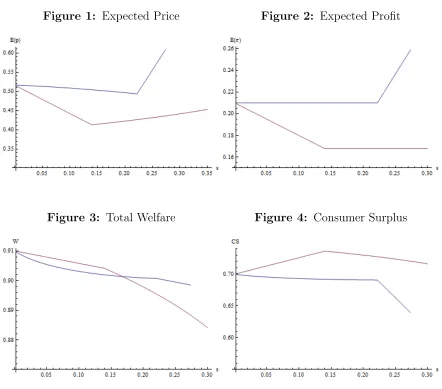
From Proposition 3, as the search cost decreases, a firm’s expected profit weakly
decreases under random search but weakly increases under price-directed search.
More-over, by Corollary 2, firms earn the same expected profits under random and
price-directed search when the search cost approaches zero. Hence, firms earn lower expected
19
As sapproaches 0, α→1 under random search and r→V under price-directed search, respec-tively. Thus, it can be shown that bothG(p) andR(p) approachK(p).
20
Another interesting asymptotic result is whenN →+∞. Under random search, it can be verified thats2→0 asN→+∞, which indicates both types of equilibria can not be supported with positive
search costs. Under price-directed search, the probability of high price intervalα′ →0 asN →+∞.
Moreover, in both types of equilibria, the expected price and profit approach zero because market
profits under price-directed search when the search cost is positive. Intuitively, if prices
are observable, they influence the order in which consumers search and thus the
de-mand for firms. Hence, price competition among firms is intensified, resulting in lower
expected profits.
When the search cost is small, by Propositions 1 and 2, the entire equilibrium
price distribution is below the threshold price under price-directed search while firms
price above the reservation price with positive probability. Hence, the probability of a
transaction is higher under price-directed search than under random search. Moreover,
comparing price-directed search with random search, the uninformed consumers search
more efficiently in the sense that they start searching at the low-price firms and do not
search firms whose posted prices are higher than the threshold price. Therefore, total
welfare and consumer surplus tend to be higher under price-directed search than under
random search when the search cost is small. It is worthy of noticing that when the
search cost is large, total welfare can be higher under random search as suggested by
Figure 3 in Appendix B. Intuitively, for a large search cost, the entire equilibrium
price distribution is below the reservation price under random search while there is
a positive probability that firms price above the threshold price under price-directed
search. Thus, total welfare can be higher under random search due to a higher chance of
a transaction, even though consumers may search more efficiently under price-directed
search. The results in Proposition 4 are illustrated in the following figures in which
blue (red) lines denote variables under random (price-directed) search.
[Insert Figure 1. Expected Price here]
[Insert Figure 2. Expected Profit here]
[Insert Figure 3. Total Welfare here]
5
Conclusion
To study the implications of price-directed search, we introduce tractable horizontal
product differentiation into Stahl (1989)’s classical model and allow the uninformed
consumers to actively search for a product that meets their needs. When prices are
ob-servable before searching, the uninformed consumers first visit firms that charge lower
prices, provided that they are below a threshold price. In contrast, when prices are not
observable before searching, the uninformed consumers engage in random search with
a reservation price. We find that the reservation price decreases while the threshold
price increases when the search cost declines.
We show that the equilibrium price distribution under random (price-directed)
search has a convex support over a continuous interval when the search cost is high
(low) and a non-convex support with both a high-price interval and a low-price
inter-val when the search cost is low (high). As the search cost decreases, sales are more
likely and firms earn higher expected profits under price-directed search while the
op-posite is true under random search. Our analysis also suggests that compared with
random search, under price-directed search firms’ expected profits are always lower,
but consumer surplus and total welfare are higher for a small search cost.
In future research, it would be interesting to examine the effects of price-directed
consumer search in the case of multi-product sellers (e.g. Zhou, 2014 and Rhodes,
2015). In particular, suppose that horizontally differentiated firms sell both low- and
high-quality products and consumers have heterogeneous tastes for product quality.
Assume that each firm can advertise only its lowest price for its products because, in
reality, limited information can be conveyed through advertisements. In this
multi-product consumer search framework, firms have extra incentives to advertise a lower
price for their low-quality products to attract consumers to search their high-quality
References
[1] S. P. Anderson and R. Renault. Pricing, product diversity, and search costs: A
bertrand-chamberlin-diamond model. The RAND Journal of Economics, pages
719–735, 1999.
[2] M. Arbatskaya. Ordered search. The RAND Journal of Economics, 38(1):119–126,
2007.
[3] M. Armstrong, J. Vickers, and J. Zhou. Prominence and consumer search. The
RAND Journal of Economics, 40(2):209–233, 2009.
[4] M. Armstrong and J. Zhou. Paying for prominence. The Economic Journal,
121(556), 2011.
[5] S. Athey and G. Ellison. Position auctions with consumer search. The Quarterly
Journal of Economics, pages 1213–1270, 2011.
[6] M. R. Baye, J. Morgan, and P. Scholten. Temporal price dispersion: Evidence
from an online consumer electronics market. Journal of Interactive Marketing,
18(4):101–115, 2004.
[7] Y. Chen and C. He. Paid placement: Advertising and search on the internet. The
Economic Journal, 121(556), 2011.
[8] Y. Chen and T. Zhang. Equilibrium price dispersion with heterogeneous searchers.
International Journal of Industrial Organization, 29(6):645–654, 2011.
[9] Y. Chen and T. Zhang. Entry and welfare in search markets. The Economic
Journal, 128(608):55–80, 2018.
[10] J. A. Chevalier, A. K. Kashyap, and P. E. Rossi. Why don’t prices rise during
periods of peak demand? evidence from scanner data. The American Economic
[11] M. Choi, A. Y. Dai, and K. Kim. Consumer search and price competition.Working
Paper, 2016.
[12] A. Golan, L. S. Karp, and J. M. Perloff. Estimating a mixed strategy: United and
american airlines. Center for Culture, Organizations and Politics, 2002.
[13] M. Haan, J. L. Moraga-Gonz´alez, and V. Petrikaite. Price and match-value
ad-vertising with directed consumer search. Working Paper, 2015.
[14] M. A. Haan and J. L. Moraga-Gonz´alez. Advertising for attention in a consumer
search model. The Economic Journal, 121(552):552–579, 2011.
[15] M. C. Janssen, J. L. Moraga-Gonz´alez, and M. R. Wildenbeest. Truly costly
sequential search and oligopolistic pricing. International Journal of Industrial
Organization, 23(5):451–466, 2005.
[16] P. J. Kehoe and V. Midrigan. Temporary price changes and the real effects of
monetary policy. Working Paper, 2008.
[17] J. L. Moraga-Gonz´alez, Z. S´andor, and M. R. Wildenbeest. Prices and
heteroge-neous search costs. The RAND Journal of Economics, 48(1):125–146, 2017.
[18] A. Rhodes. Can prominence matter even in an almost frictionless market? The
Economic Journal, 121(556):F297–F308, 2011.
[19] A. Rhodes. Multiproduct retailing. The Review of Economic Studies, pages 360–
390, 2014.
[20] S. Shelegia and D. Garcia. Consumer search with observational learning. Working
Paper, 2015.
[21] J. Shen. Ex-ante preference in a consumer search market. Working Paper, 2015.
[22] D. O. Stahl. Oligopolistic pricing with sequential consumer search. The American
[23] H. R. Varian. A model of sales. The American Economic Review, 70(4):651–659,
1980.
[24] C. M. Wilson. Ordered search and equilibrium obfuscation. International Journal
of Industrial Organization, 28(5):496–506, 2010.
[25] A. Wolinsky. True monopolistic competition as a result of imperfect information.
The Quarterly Journal of Economics, 101(3):493–511, 1986.
[26] J. Zhou. Ordered search in differentiated markets. International Journal of
In-dustrial Organization, 29(2):253–262, 2011.
[27] J. Zhou. Multiproduct search and the joint search effect. The American Economic
Review, 104(9):2918–2939, 2014.
Appendix A
Proof of Proposition 1.
We will show thatF(p) andG(p) constructed in Proposition 1 are equilibrium price
distributions when s ∈ [s1, s2] and s ∈ (0, s1), respectively. We will also establish the
uniqueness of the equilibria.
(i) The case of high search cost (s∈[s1, s2]).
Step 1. In this case, the price distribution is belowω2 and consumers will purchase
if a product meets their needs. Moreover, ω2 is determined by the following optimal
stopping rule:
θ
Z
p≤ω2
(ω2−p)dF(p) = s.
Step 2. Note that in a mixed strategy, a firm’s profits must be the same at every
(a) If p=ω2,
π =ω2µθ(1−θ)N−1+ω2(1−µ)θ[
1
N
N−1
X
i=0
(1−θ)i]
=ω2µθ(1−θ)N−1+ω2(1−µ)θ
1−(1−θ)N
N θ (11)
where the first (second) term is the firm’s profit derived from the informed (uninformed)
consumers.
(b) If p < ω2,
π =pµθ[
N−1 X i=0 N−1 i
(θ(1−F(p)))i(1−θ)N−1−i] +p(1−µ)θ[1
N
N−1
X
i=0
(1−θ)i]
=pµθ{1−θ+θ[1−F(p)]}N−1+p(1−µ)θ1−(1−θ)
N
N θ . (12)
Equating (11) and (12) leads to (3) in Proposition 1. Then, we set F(p) = 0 and
F(p) = 1 to solve for the lower and upper bounds of F(p), respectively.
Step 3. In the equilibrium, the reservation price ω2 is implicitly determined by
the optimal stopping rule. We apply a similar technique as in Janssen et al. (2005) to
solve forω2 explicitly. From (3),
p=ω2
(1−θ)N−1+1−µ µθ
1−(1−θ)N
N
[1−θF(p)]N−1+1−µ µθ
1−(1−θ)N
N
. (13)
By the definition ofE(p),
θE(p) = θ
Z ω2
p
pdF(p) = Z p
ω2
pd(1−θF(p)).
Lety= 1−θF(p).We plug (13) into E(p). Then
θE(p) = Z 1
1−θ
pdy =ω2
Z 1
1−θ
(1−θ)N−1+1−µ µθ
1−(1−θ)N
N
yN−1+1−µ µθ
1−(1−θ)N
N
dy =ω2φ.
From the optimal stopping rule, we can solve ω2 by replacingθE(p). We then have
and thus,
ω2 =
s θ−φ.
Clearly,ω2 increases withs in the equilibrium. The upper bound of ω2 isV, which
determines the largests that ensures the existence of the equilibrium. In particular,
s2 = (θ−φ)V.
Step 4. To complete the proof, we need to show prices that are not in the support
ofF(p) will yield lower expected profits. Note thatp > ω2 would lead to zero demand
and any price less than the lower bound of F(p) would lead to the same amount of
demand but at a lower price. Hence, all other prices will yield a lower profit andF(p)
is an equilibrium price distribution. Finally, the uniqueness of the equilibrium can
be established since the reservation price ω2 is uniquely determined by the optimal
stopping rule, which indicates thatF(p) is unique.
(ii) The case of low search cost (s ∈(0, s1)).
We first assume that the support of the price distribution is non-convex. Then, we
show this is indeed an equilibrium and determine the maximum values1 that ensures
the existence of the equilibrium.
Step 1. To start with, we assume that the c.d.f. of the equilibrium price
distribu-tion has the following form:
G(p) =
(1−α)Gl(p) if pl≤p≤ω1
(1−α) if ω1 < p < ph
(1−α) +αGh(p) if ph ≤p≤V
.
Again, profits must be the same at every p in the support.
(a) If p=V,
π =V µθ(1−θ)N−1+V(1−µ)θ(1−θ)N−1 =V θ(1−θ)N−1 (14)
whereV(1−µ)θ(1−θ)N−1 is the firm’s profit derived from the uninformed consumers
(b) If ω1 < p < V,
π =pµθ[
N−1 X i=0 N−1 i
(θα(1−Gh(p)))i(1−θ)N−1−i]
+p(1−µ)θ[
N−1 X i=0 N−1 i
(θα(1−Gh(p)))i(1−θ)N−1−i]
=pθ[θα(1−Gh(p)) + 1−θ]N−1 (15)
where the first (second) term is the firm’s expected profit derived from the informed
(uninformed) consumers.
(c) If p=ω1,
π =ω1µθ[
N−1 X i=0 N−1 i
(θα)i(1−θ)N−1−i] +ω1(1−µ)θ[
1
N
N−1
X
i=0
(1−θ(1−α))i]
=ω1
µθ(1−θ+θα)N−1+ (1−µ)θ1−(1−θ+θα)N
N θ(1−α)
. (16)
Note that if p = ω1, the uninformed consumers purchase immediately if the product
is a match (which occurs with probability θ) and the price is below ω1 (which occurs
with probability 1−α). Otherwise, they will move to the next firm (which occurs with
probability 1−θ(1−α)).
(d) If p < ω1,
π=pµθ[
N−1 X i=0 N−1 i
[θ(1−(1−α)Gl(p))]i(1−θ)N−1−i]
+p(1−µ)θ[ 1
N
N−1
X
i=0
(1−θ(1−α))i]
=p
µθ[1−θ(1−α)Gl(p)]N−1+ (1−µ)θ
1−(1−θ+θα)N
N θ(1−α)
. (17)
The expressions of Gh(p) and Gl(p) in Proposition 1 come from the equal-profit
con-ditions from (14) and (15), (16) and (17), respectively.
Step 2. There are two endogenous variables that we need to determine in the
equilibrium, ω1 and α. We first solve for ω1. Setting (14) equal to (16), we have
ω1 =
(1−θ)N−1
µ(1−θ+θα)N−1+ (1−µ)1−(1−θ+θα)N
N θ(1−α)
On the other hand, ω1 is endogenously determined by the optimal stopping rule:
θ
Z
p≤ω1
(ω1−p)d(1−α)Gl(p) = s.
By definition,El(p) = E[Gl(p)] and thus,
θ(1−α)El(p) = θ(1−α)
Z ω1
p
pdGl(p) =
Z p
ω1
pd[1−θ(1−α)Gl(p)].
Lety= 1−θ(1−α)Gl(p). Insertingp into the above equation, we have
θ(1−α)El(p) =
Z 1
1−θ(1−α)
pdy =ω1
Z 1
1−θ(1−α)
(1−θ+θα)N−1+ 1−µ µ
1−(1−θ+θα)N
N θ(1−α)
yN−1+ 1−µ µ
1−(1−θ+θα)N
N θ(1−α)
dy=ω1η.
By the optimal stopping rule,
s =θ(1−α)[ω1−El(p)] =θ(1−α)ω1−ω1η
and thus,
ω1 =
s
θ(1−α)−η. (19)
Step 3. From (18) and (19), we can derive (4). Next, we show that there is a
unique α ∈ [0,1] that satisfies (4). Obviously, the RHS of (4) is not affected by α.
We will show that the LHS of (4) is monotone with α and thus there is at most one
solution. Given that
1−(1−θ+θα)N
N θ(1−α) = 1
N
N−1
X
i=0
(1−θ+θα)i,
the numerator of LHS of (4) is increasing with α. Consider the denominator of LHS
of (4). Note that
θ(1−α)−η= Z 1
1−θ(1−α)
yN−1 −(1−θ(1−α))N−1
yN−1+1−µ µ
1−(1−θ+θα)N
N θ(1−α)
dy.
By chain rule,
∂
R1
1−θ(1−α)
yN−1−(1−θ(1−α))N−1
yN−1+1−µ µ
1−(1−θ+θα)N N θ(1−α)
dy ∂α = ∂ R1
1−θ(1−α)
yN−1−(1−θ(1−α))N−1
yN−1+1−µ µ
1−(1−θ+θα)N N θ(1−α)
dy
∂θ(1−α) ·
∂θ(1−α)
Moreover,
∂
R1
1−θ(1−α)
yN−1−(1−θ(1−α))N−1
yN−1+1−µ µ
1−(1−θ+θα)N N θ(1−α)
dy
∂θ(1−α) = 0−0 + Z 1
1−θ(1−α)
∂
yN−1−(1−θ(1−α))N−1
yN−1+1−µ µ
1−(1−θ+θα)N N θ(1−α)
∂θ(1−α) dy.
Note thatyN−1−(1−θ(1−α))N−1 is positive and increases with θ(1−α), and
yN−1 +1−µ
µ
1−(1−θ(1−α))N
N θ(1−α) =y
N−1+ 1−µ
µN
N−1
X
i=1
(1−θ(1−α))i
is positive and decreases with θ(1−α). Hence,
∂
R1
1−θ(1−α)
yN−1−(1−θ(1−α))N−1
yN−1+1−µ µ
1−(1−θ+θα)N N θ(1−α)
dy
∂θ(1−α) =
Z 1
1−θ(1−α)
∂
yN−1−(1−θ(1−α))N−1
yN−1+1−µ µ
1−(1−θ+θα)N N θ(1−α)
∂θ(1−α) dy >0.
Since ∂θ(1−∂αα) <0 we have
∂
R1
1−θ(1−α)
yN−1−(1−θ(1−α))N−1
yN−1+1−µ µ
1−(1−θ+θα)N N θ(1−α)
dy
∂α <0.
In summary, the LHS numerator of (4) increases withαand the denominator decreases
with α, which implies that the LHS of (4) increases monotonically with α. Therefore,
if (4) holds, α must be unique.
Step 4. We then pin down the proper range of s that ensures the existence of the
equilibrium. Given the monotonicity, we need to check only two points, α = 0 and
α= 1. Whenα= 0, we derive the largest search costs1 that supports the equilibrium.
In particular,
s1 =
N θ(1−θ)N−1
N θµ(1−θ)N−1+ (1−µ) [1−(1−θ)N](θ−φ)V.
Ifα→1, s→0 such that both sides of (4) approach infinity. Therefore, if s∈(0, s1),
the equilibrium can be supported.
Step 5. To see the uniqueness of the equilibrium, note that any p below pl will
lead to a lower profit for the firm since a lower price will not bring in more demand. In
other prices that are not in the support of G(p) will be charged with zero probability.
Therefore, the equilibrium is unique since both α and ω1 are unique.
Proof of Proposition 2
As in Proposition 1, we will show that the proposed is an equilibrium and establish
its uniqueness.
(i) The case of low search cost (s∈(0, s′ 1)).
Note that given R(p), the uninformed consumers search optimally. To show that
the proposed is an equilibrium, we thus only need to show that givenr and other firms
chooseR(p),each firm optimizes choosing anyp∈[(1−θ)N−1r, r].For any such price,
the firm’s expected profit is as follows.
(a) If p = r, in a symmetric equilibrium, no other firm would price above r, and
thus,
π =rθ(1−θ)N−1.
(b) If p < r,
π =pθ[
N−1
X
i=0
N−1
i
(θ(1−R(p)))i(1−θ)N−1−i]
=pθ[1−θ+θ(1−R(p))]N−1.
The equal profit condition yields R(p) in (5). Note that p > r would lead to zero
demand and any p < (1−θ)N−1r would result in the same amount of demand as
p= (1−θ)N−1r but at a lower price. Therefore, the firm is maximizing its profit by
choosing its price from R(p). Note that this is also the only symmetric equilibrium
because the reservation pricer and price distribution R(p) are uniquely determined.
(ii) The case of high search cost (s∈[s′ 1, s′2]).
We show that each firm optimizes following Q(p), given that other firms choose
prices according toQ(p) and the threshold price of the uninformed consumers isr.Note
matched firms. Moreover, the firm has to set a price no higher than r to sell to the
uninformed consumers. The expected profit when the firm choosesp is:
(a) If p=V,
π=V µθ(1−θ)N−1
where the firm sells to the informed consumers with only one match.
(b) If V > p > r,
π =pµθ[
N−1
X
i=0
N−1
i
(θα′(1−Qh(p)))i(1−θ)N−1−i]
=pµθ[1−θ+θα′(1−Qh(p))]N−1
where the firm can only sell to the informed consumers.
(c) If p=r,
π =rθ[
N−1
X
i=0
N−1
i
(θα′)i(1−θ)N−1−i]
=rθ[1−θ+θα′]N−1
where the firm sells to both the informed and the uninformed consumers if it charges
the lowest price among the firms that match the consumers’ needs.
(d) If p < r,
π=pθ[
N−1
X
i=0
N−1
i
(θ(1−(1−α′)Ql(p)))i(1−θ)N−1−i]
=pθ[1−θ+θ(1−(1−α′)Ql(p))]N−1
where the firm can sell to both the informed and the uninformed consumers.
Equal profit from (a) and (c) yields (9). Moreover, (7) and (8) come from the
equal-profit conditions of (a) and (b), and of (c) and (d), respectively. Similarly, it
can be proved that other prices are charged with zero probability. Therefore, the firm
optimally chooses a price according to Q(p). The values of s′1 and s′2 are derived by setting α′ equal to 0 and 1, respectively. This is a unique equilibrium because both r