http://www.scirp.org/journal/jss ISSN Online: 2327-5960
ISSN Print: 2327-5952
DOI: 10.4236/jss.2017.59010 Sep. 14, 2017 124 Open Journal of Social Sciences
The Root and Governance of Land Corruption
from the Perspective of Behavioristics: Based
on the Analysis of Four Typical Cases
Gedong Zhu, Youbin Yu
School of Government, Beijing Normal University, Beijing, China
Abstract
In recent years, land corruption frequently turns up at various major media and caught the attention of all walks of life. But very few researches on land corruption can be seen. These researches are limited to manifestation and countermeasures of land corruption, which lack depth and systematicity. On this basis, this paper is designed from the behavioral research perspective to study the behavioral rules and characteristics of land corruption. It also dis-cussed the in-depth institutional reasons for land corruption through a three-dimensional system (subject, occurrence part and method of land cor-ruption) and empirical surveys of four typical cases. The conclusion of the study may be useful for a further understanding of the real situation of land corruption.
Keywords
Land Corruption, Case Analysis, Behavioral Research, Institutional Design, Government Governance
1. Introduction
Currently, there lacks a widely recognized standard to define the connotation and scope of land corruption. But land corruption has already become the focus of many major news media reports. Many cases involved a large amount of money, multiple departments, multiple positions and a large number of people, which have caused huge social impacts. Land corruption, reform of state-owned enterprises corruption and major engineering project corruption are known as the “Three major corruptions in contemporary China”, and were deemed as one of the six major commercial bribes to be settled. According to related statistics of How to cite this paper: Zhu, G.D. and Yu,
Y.B. (2017) The Root and Governance of Land Corruption from the Perspective of Behavioristics: Based on the Analysis of Four Typical Cases. Open Journal of Social Sciences, 5, 124-138.
https://doi.org/10.4236/jss.2017.59010
Received: August 20, 2017 Accepted: September 11, 2017 Published: September 14, 2017
Copyright © 2017 by authors and Scientific Research Publishing Inc. This work is licensed under the Creative Commons Attribution International License (CC BY 4.0).
DOI: 10.4236/jss.2017.59010 125 Open Journal of Social Sciences Procuratorial Daily, the proportion of land corruption cases increased from 6.43% in 2000 to 29.14% in 2013. Hence, a profound study on land corruption and a fundamental prevention of corruption behaviors are of great significance.
1.1. Research Overview of Corruption
The generally accepted definition of corruption refers to the behaviors of civil servants who seek personal gain improperly by using public power with method of actions or lack of actions1. Internationally, the research achievements on cor-ruption are extremely abundant, which basically developed with the public poli-cy science arose after World War II and became even more active with the re-search on Good Governance in recent years. The rere-search perspective also spans across many fields such as economics, politics, sociology, and psychology, etc.
Economics have always been a major theoretical tool for researchers to study corruption. After studying the bureaucrat system of developing countries, insti-tutional economists concluded that: corruption originates from the weakness of current system, which means the bureaucrats destroy the consensus norms be-cause of their self-interests; from the perspective of market and transaction, some scholars deemed corruption as a process of transaction in “public power market” between officials and customers; some scholars also adopted Prin-ciple—Agent framework to analyze corruption and market distortion, and the influence of corruption on social welfare, or analyze the relevance between the private and state-owned property rights and the corruption degree from the property rights perspective, or study official’s corruption by using Cost—Benefit framework from the perspective of utility and public demands; rent-seeking theory is also a popular econometric tool to study corruption. In recent years, CPI (Corruption Perceptions Index), established by Transparency International, has made remarkable contributions to the study of corruption and is recognized by numerous institutions; The Institutional Economics of Corruption and Reform, written by Johann Graf Lambsdorff who is the research leader of the organization, systematically, comprehensively and objectively summarized and compared the achievements and research methods of the researches on corrup-tion conducted through economic approaches [1].
DOI: 10.4236/jss.2017.59010 126 Open Journal of Social Sciences only way for low-income civil servants for a living, and this may be accepted as a social consensus by the public [2]. The formation of this social consensus can be also explained by “conformity” and “social pressure” in psychology. Some re-searchers even deduced the concepts of “moral costs” and “risk illusion” through economic approaches, which enriched the category of corruption studies from the psychological and behavioral perspectives of civil servants [3]. The adoption of psychological analysis tools not only can analyze the logic thoughts and beha-viors of individual decisions in the corruption cases, but also can properly ex-plain the occurrence and evolution of frequent corruptions, huge-amount cor-ruptions and group corcor-ruptions.
1.2. Research Overview of Land Corruption
Currently, there are already some researches on land corruption. The content of the researches mainly includes manifestation of land corruption, causes to cor-ruption, corruption process, consequences and harm of corcor-ruption, and meas-ures to handle corruption, etc. Besides, many scholars chose some part of the process that corruption may happen easily, such as land planning, land renting approval, land expropriation, and land transfer, etc. The research methods mainly include zero tolerance theory, cost-benefit theory, principle-agent theory, rent-seeking theory, game theory, interpersonal relationship theory, public choice theory, and institutional economics, etc. [4]-[9].
In general, the research findings on land corruption are not abundant, which is a contrast to the high attention of the society. Besides, most of the researches only focus the introduction of land corruption, analysis of causes, discussion of solutions, or analysis of a specific part of land corruption. Seldom of them can study land corruption from the empirical perspective and grasp the characteris-tics of land corruption comprehensively. Hence, based on the definition of cor-ruption, this study defined land corruption as: behaviors of civil servants who seek personal gain (through the method of actions or lack of actions) by impro-perly using public power in land resources and market management. From the behavioral research perspective, the paper studied the behavioral rules and cha-racteristics of land corruption and discussed the in-depth institutional reasons for land corruption through the establishment of a three-dimensional system (subject, occurrence part and method of land corruption) and the empirical sur-veys of four typical cases, which may be useful for a further understanding of the real situation of land corruption, and raised reasonable governance policy rec-ommendations.
2. Research Methods and Case Selection
DOI: 10.4236/jss.2017.59010 127 Open Journal of Social Sciences this research are mainly cases disclosed by the Supreme People’s Procuratorate and the Supreme People’s Court of China, as well as the corruption cases pub-lished by Xinhuanet, people.com.cn, and Procuratorial Daily, which are related to land management. The study also adopted case index analysis method to summarize and extract key information from different dimensions to analyze the cases. In the past, case studies often select a single or a few events for analysis, focusing on the case itself, and it is difficult to obtain the common characteris-tics of certain events, which in turn affect the follow-up analysis. Case index analysis is a method of detailed analysis of each case by constructing a statistical index system, which can better reflect the common characteristics of corruption itself and help to achieve objective and scientific conclusions. Currently, case index analysis method is one of the best methods to solve the asymmetric infor-mation of corruption, and an effective research tool to reveal the occurrence rule and development trend of corruption.
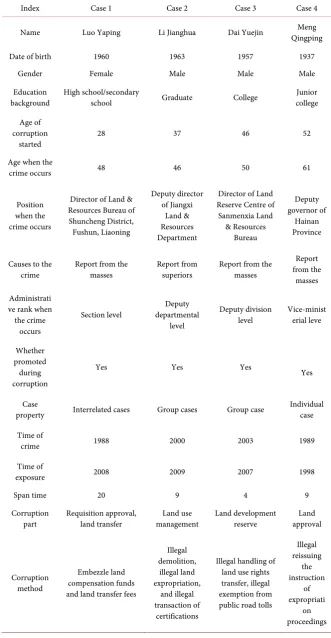
In order to increase the authenticity and typicality of the research results, this paper selected four typical cases which are typical and have more detailed in-formation from numerous cases collected. These cases have a large impact in China, in the case involved, the nature of the case, the administrative level of the offender and other aspects of a larger coverage, which increased the randomness of the research samples. Based on the selection of four typical cases, this study established a case analysis index system according to the research objectives, in-cluding 2 types of first class indexes, and 19 second class indexes. Then, based on the indexes, the study analyzed the cases one by one, extracted key information and built the analysis texts as shown in Table 1.
3. Empirical Analysis
“Behaviorism” is a genre arose in the early 20th century, which studies adminis-trative phenomenon with the perspectives and approaches of behaviorism. The purport of behaviorism is to study the motivation mode and effect of related personnel from their actual behaviors. According to the research perspective of behaviorism, a complete behavior can be described from six elements as subject, object, occurrence part, method, purpose/motivation, and harm.
From the perspective of behaviorism, land corruption behaviors can be also studied from the six aspects. But the three aspects of subject, occurrence part and method can reflect the behavior nature most. Therefore, this paper selected the three dimensions as corruption subject, occurrence part and method to es-tablish the research framework for land corruption behaviors, then concluded the empirical research results through the index statistics and content analysis of the four typical cases (see Table 2).
3.1. Subject of Land Corruption Behaviors
DOI: 10.4236/jss.2017.59010 128 Open Journal of Social Sciences Table 1. Analysis indexes of land corruption cases.
Category Indexes
Corruption subject (A)
A1 Name A2 Date of birth
A3 Gender A4 Education background A5 Age of corruption started A6 Age when the crime occurs A7 Position when the crime occurs
A8 Causes to the crime
A9 Administrative rank when the crime occurs A10 Whether promoted during corruption
Basic information of the case (B)
B1 Case property B2 Time of crime B3 Time of exposure
B4 Span time B5 Corruption part B6 Corruption method
B7 Amount involved B8 Case disposition B9 Judgment on charges
corruption subject.
3.1.1. Concentrated Ages of Land Corruption Subjects
As shown in the four typical cases, the ages of the corruption subjects are mainly ranged from 40 to 50 when the crime started, and 50 to 60 when the crime re-ported. Generally, 40 - 60 is the age when the corruption subject holds large power. They are in the peak of their career and corruption is easily to happen.
3.1.2. Involving Large Amounts of Money and Lands with Far-Reaching Influences
DOI: 10.4236/jss.2017.59010 129 Open Journal of Social Sciences Table 2. Basic information of four typical land corruption cases selected.
Index Case 1 Case 2 Case 3 Case 4
Name Luo Yaping Li Jianghua Dai Yuejin Qingping Meng
Date of birth 1960 1963 1957 1937
Gender Female Male Male Male
Education
background High school/secondary school Graduate College college Junior
Age of corruption
started 28 37 46 52
Age when the
crime occurs 48 46 50 61
Position when the crime occurs
Director of Land & Resources Bureau of Shuncheng District, Fushun, Liaoning Deputy director of Jiangxi Land & Resources Department
Director of Land Reserve Centre of Sanmenxia Land & Resources Bureau Deputy governor of Hainan Province
Causes to the
crime Report from the masses Report from superiors Report from the masses
Report from the
masses Administrati
ve rank when the crime
occurs
Section level departmental Deputy level
Deputy division
level Vice-ministerial leve
Whether promoted during corruption
Yes Yes Yes Yes
Case
property Interrelated cases Group cases Group case Individual case
Time of
crime 1988 2000 2003 1989
Time of
exposure 2008 2009 2007 1998
Span time 20 9 4 9
Corruption
part Requisition approval, land transfer management Land use Land development reserve approval Land
Corruption method
Embezzle land compensation funds and land transfer fees
Illegal demolition, illegal land expropriation, and illegal transaction of certifications
Illegal handling of land use rights transfer, illegal exemption from public road tolls
DOI: 10.4236/jss.2017.59010 130 Open Journal of Social Sciences
Continued
Amount involved (quantified-u
nit: ten thousand
yuan)
6000 574.4149 144 25
Case disposition
Sentenced to death, deprived of political rights for life, and confiscated all his
property
Life imprisonment,
deprivation of political rights,
and confiscation of
all property
Twelve years in
prison Ten years in prison
Judgment
Bribery crime, corruption crime, crime of holding a huge amount of
property with unidentified sources
Bribery crime, corruption crime, crime of holding a huge amount of
property with unidentified sources
Bribery crime Bribery crime Bribery crime
in 2008, it caused a stir in the society and produced a huge impact.
3.1.3. Most of Cases Are Group Crimes and Interrelated Crimes, with a Long-Term Latency
DOI: 10.4236/jss.2017.59010 131 Open Journal of Social Sciences years, the shortest is 4 years, and the latency of three cases has exceeded 7 years.
3.2. Corruption Part of Land Corruption Behavior
3.2.1. Analysis of Land Corruption Behavior Part and Corruption Risk Points of Corruption
The main content of land management can be summarized as following seven aspects: formulation of land policies and regulations, cadastral management, land supply and market management, land planning and land use regulation, cultivated land protection and land reclamation, farmland transference and land expropriation, land law enforcement and supervision. Some scholars pointed out that the longer the land industrial chain, the longer the power-for-money deal chain. Power-for-money deals and officer-trader collusions exist in almost each part of the land business, such as the part from land expropriation to land trans-fer, the part from paying land transfer fees to adjusting plot ratio, the part from land usage registration to property right registration, and the part from the project planning and approval to the project site selection. Any part of land purchase and storage, land demolition, land consolidation, land survey and land planning that are managed by land departments may contain huge rent-seeking space. This paper adopted index analysis method to extract keywords from the four cases, combed and sorted the data, and summarized the major corruptions parts and risk points.
1) Cadastral management
As an important part of land management, cadastral management is the basis for the country’s land management as well as the urban and rural land adminis-tration and management. Cadastral management can provide information and legal basis for land use. The researches on cadastral management mainly focused the informatization of cadastral management. Seldom scholars made special study on the corruption in cadastral management. In the four examples, the case of Li Jianghua and the case of Meng Qingping are both related with cadastral management. Hence, this paper adopted index analysis method to extract key-words and identify the corruption parts in the cadastral management. According to the analysis on the two cases, the major risk points of cadastral management corruption are reflected as making documents illegally, changing cadastral files, and adjusting land use relations, etc. Cadastral management concerns significant economic interests of the country. If any corruption occurs in this part, huge economic loss will be brought. Li Jianghua, deputy director of Jiangxi Land & Resources Department, made approvals illegally for more than 10 cases of 100,000 m2 lands, causing a total loss of more than 10 million yuan in land transfer fees and taxes and dues of the country. Meng Qingping, deputy gover-nor of Hainan Province, made instructions twice during his office term to help Zhuang (individual business) backdate, post-register land expropriation pro-ceedings, and get the lands of Po Bo village, Hai Kou. Meng cooperated with others to run the business and gained a profit of more than 250,000 yuan.
DOI: 10.4236/jss.2017.59010 133 Open Journal of Social Sciences stole and sold the demolition house, and embezzled more than 17 million yuan.
3) Land corruption behaviors and methods
The research on land management corruption behaviors and methods is helpful in understanding the crime tactics and effectively prevent corruption behaviors. Currently, land management corruption methods tend to be more diversified, professional, intelligent and convert.
First, the crime tactics are more secret. Corrupt officials used fictional and backdated land expropriation documents to illegally transact state-owned land use rights certificates. They would also use professional land planning methods to make slight adjustment on the plot ratio, making it hard to be noticed.
Secondly, the corruption methods are more convert. Many corruption officials usually conduct various methods to cover their corruption behaviors, such as false receipt for a loan, borrow money to buy houses, buy houses at a low price or resell the houses for personal earnings, invest in real estate companies or cooperate with them, as well as various seeking and accepting bribes in the name of festivals, overseas training, children’s weddings, and sick in hospital, etc. For example, Luo Yaping bought 22 housing estates in the name of her relatives to conceal the properties sources of her family.
Thirdly, corruption behaviors are more diversified. Corruption behaviors mainly include direct behaviors and indirect behaviors. The direct method means to intervene related business directly, mainly in cadastral management, land transfer and land approval domains, such as illegal transactions, letting out auction information, instructions in person and issuing instruction notes, etc. Meng Qingping, deputy governor of Hainan Province, made instructions twice during his office term to help Zhuang (individual business) backdate, post-register land expropriation proceedings, and get the lands of Po Bo village, Hai Kou. Meng cooperated with others to run the business and gained huge profits. Indi-rect methods mainly include implication, inciting, enjoinment, giving orders, organization and coordination, and exerting pressure, etc. Indirect methods are mainly used in obtaining land use rights and land approval, etc.
4. Further Discussion
4.1. Causes to Land Corruption
Institutional factors are the primary cause of corruption. The land corruption in China has revealed the design and contents problem of the existing land system. Besides, it also reflects the contradiction between the operation and practice of the land system.
4.1.1. Power Imbalance Caused by Institutional Deficiency
DOI: 10.4236/jss.2017.59010 134 Open Journal of Social Sciences national land expropriation, and the lands required by enterprises should be also provided only by the country. Specifically, the local government provides the lands. Because only state-owned lands can be transferred, and the collec-tive-owned lands have the legitimacy only if they are turned into state-owned lands. Current land law also stipulated that the local government can expropriate farmlands according to the requirements of public interests. But the definition of “public interests” is still not specific and clear. This provided a legal protection for the land corruption of local officials to some extent. In addition, the current unreasonable expropriation standard makes the cost of expropriation cost very cheap and expropriation “benefits” very enormous. The local government can obtain huge “land price differences”. Hence, the government’s monopolization on land supply as stated in relevant laws and regulations provided an institu-tional space for corrupt officials to use lands to gain illegal benefits.
More importantly, the government acts as a dual role of judge and athletes on land management. As stated in relevant laws, the government is the representa-tive of public interests who makes policies and owns the approval rights, serving as the judge; on the other aspect, the local government holds a large number of land resources who takes part in economic activities as a subject. They can both expropriate lands and sell the lands, serving as the athletes. That’s to say, the government has monopolized the approval rights for infrastructure, industry and real estate projects as well as the legal expropriation rights for the lands these projects required. After land expropriation, the local government also holds the pricing rights for the lands. If the enterprises want to get the lands for their projects, they have to seek rent from the government officials. Thus a bene-fit conveyor chain is formed.
4.1.2. Impacts of Fiscal Decentralization on Local Economic Behaviors
According to the tax-sharing system in 1994, the urban and rural land use tax, real estate tax, stamp tax, land value increment tax, and state-owned land com-pensable use tax are levied by local governments. This makes the fiscal revenue of the local government mainly from various fiscal revenues by transferring land use rights [6]. Lands become another “way of making money” after developing township enterprises.
DOI: 10.4236/jss.2017.59010 135 Open Journal of Social Sciences lands, which eventually lead to land corruption.
4.1.3. Promotion Incentives Intensified the Interests and Competition of Local Government Officials
To some extent, Chinese-style fiscal decentralization has stimulated the local government in selling lands, who taking lands as a new “way of making money”. However, the appraisal mechanism of the central government on local govern-ment officials also exerted great impacts on the economic behaviors of the offi-cials. In another word, the promotion incentives under fiscal decentralization has aggravated the rampant land corruption to a certain degree.
The central government implements target-oriented responsibility system for the appraisal of local government officials, and “one-vote negation system” for indexes of GPD growth rate, family planning and stability maintenance [10]. Under the system with GDP growth rate as the major appraisal index of pro-moting local government officials, a promotion tournament system was formed. Under such system, local government officials compete with each other to seek high GDP growth rate. To some extent, this phenomenon can explain why fiscal decentralization cannot completely explain the strong motivation of local gov-ernment in developing economy and transferring lands. Lands are important resources for local government to attract businesses and investments from en-terprises. Low-price, large-area and good-location lands are very important parts in local government’s strategies of attracting businesses and investments. Under such complicated circumstances, the purpose of local government’s transfer of state-owned land use rights is also very complicated. Their corruption behaviors are not only limited to their personal pursuing of money but pursuing of reputa-tion and higher posireputa-tions.
4.2. Governance of Land Corruption
4.2.1. Reform of Land System; Tighten Constraints on Administrative Power
DOI: 10.4236/jss.2017.59010 136 Open Journal of Social Sciences land market to prevent land corruption. Thirdly, the land approval system should be improved. Land corruption has close relations with administrative approval. Hence, the lack of constraints and supervision on approval power will sure lead to corruption. In respect to land lease, the administrative approval process should be strengthened and perfect systematic restrictive mechanisms should be established. It is also important to regulate land office’s administrative approval power. The service standards, procedures, time limit, and responsibili-ties should be made public. The public has the right to know the information about land usage, land price and registration. The rights should be balanced; a healthy collective decision-making system should be created. The approval of construction land, the management of land assets, the pricing of land and other important land issues should first be discussed within the land office before a collective decision is made. Lastly, the government should intensify their super-vision on land lease and strengthen the supervisory mechanism since the lack of an effective supervisory mechanism is a major cause of rampant land corruption.
4.2.2. Proper Division of Central and Local Government’s Financial Power and Administrative Duties
First, the existing tax system should be reformed and the allocation proportion of shared tax should be reset to properly increase the proportion of local gov-ernment (i.e. value-added tax); local governments should be empowered with relevant policy-making authority, allowing them to expand local tax categories and sources to acquire certain amount of money to replenish the fund for public goods. Secondly, local government should strengthen their management of extra-budgetary capital. In the existing tax system, most tax revenues are in the hands of central government, which is a direct cause of local government’s ex-tra-budgetary capital expansion and heavy dependence on “land finance”. Hence, local government should tighten their controls on this part of ex-tra-budgetary capital to eradicate the source of land corruption. Lastly, the in-ter-government transfer payment system should be modified. The current tax system is highly centralized; local governments rely heavily on central govern-ment’s transfer payment when trying to finish their tasks, especially in the cen-tral and western regions. Both the vertical and horizontal transfer payment should be reinforced; the proportion of recurrent special subsidies should be re-duced while the percentage of general financial subsidies should be increased. Consequently, the interest allocation structure of central and local government can be promoted; the financial power of the government will be proportional to its administrative duties, thus eradicating the internal impetus to make money through lands.
4.2.3. Establishment of Scientific Political Achievements Appraisal System; Perfection of Officials’ Selection and Appointment Mechanism
DOI: 10.4236/jss.2017.59010 137 Open Journal of Social Sciences making a profit from lands while ignoring some important expenditure on live-lihood issues. Therefore, it is urgent to reform the existing incentive system for local officials and increase some new incentive measures. This way, local officials will be encouraged to pay more attention to local populace and still be responsi-ble for their due missions. Meanwhile, the importance of GDP growth and its related indexes should be weakened. New indexes concerning livelihood and sustainable development should be added to the existing appraisal system. The level of local public service and citizens’ satisfaction should also be brought into the appraisal function. The behaviors of officials will not be constrained by po-litical tournaments, and the incentives for officials will be changed. The “vicious” competitions between local governments will eventually become “healthy”. In respect to the selection of officials, it is important to change local officials’ atti-tude towards responsibility. Most officials tend to attach great importance to the appraisal of their superior authorities while neglecting the opinions and satisfac-tion of their subordinates and the populace. Therefore, the officials should not be assigned by their direct superior authority. More channels should be provided for people to express their interest appeals. In addition, local populace should be given more rights, enabling them to form effective constraints on local officials’ behaviors through the “vote-by-hand” selection mechanism. These in-depth ad-justments can effectively restrain the source of the rampant land corruption, thus gradually eradicating land corruption.
5. Conclusions and Enlightenment
Land corruption has become increasingly rampant in recent years. This paper is an empirical analysis of 4 typical cases about land corruption. An index analysis framework is established to analyze each case. In order to study the land corrup-tion behaviors, a “three in one” logic structure is created including corrupcorrup-tion behavior subject, behavior part, and behavior methods. Furthermore, the fea-tures and laws of land management corruption are discussed to acquire the facts in land management domain.
According to this empirical research, it is found that the behavior subject in land management corruption is a feature to be dense in certain age groups, which has a tendency towards systematization and expansion; besides, group corrup-tion and collapse corrupcorrup-tion are very common. As regards the behavior part, land management corruption occurs in specific realm and includes many parts and distinct high-incidence fields (e.g. cadastral management, land supply, and market management). The corruption behavior methods are diversified, specia-lized, intelligent, and highly covert. The phenomenon of land corruption is ac-tually the performance of irrationality in the current land system, financial sys-tem and official incentive syssys-tem in China. It is necessary for the government and the people to continue to explore and optimize the system design.
DOI: 10.4236/jss.2017.59010 138 Open Journal of Social Sciences to include all the features and laws of corruption behavior. Despite these un-avoidable deficiencies, this research has presented certain knowledge of land corruption behaviors, indicating substantial research significance.
References
[1] Wedeman, A. (2007) The Institutional Economics of Corruption and Reform: Theory, Evidence, and Policy. Cambridge University Press, Cambridge.
[2] Montuclard, M. (1960) Herzberg f. mausner b. et snyderman b. b. the motivation to work. Revue Française De Sociologie, 1, 244-244.https://doi.org/10.2307/3319954
[3] Rui, D. and Xiuzhi, Z. (2013) Corruption and Its Prevention in Public Resource Transactions—A Case Study Based on the Analysis and Reflection on Land Corrup-tion. Henan Social Science, 21, 27-32.
[4] Changyi, H. and Nan, S. (2013) Economics Analysis of Corruption in Land Acquisi-tion. Management World,12, 174-175.
[5] Xiuzhi, Z. and Rui, D. (2008) Research on Land Corruption from the Perspective of Administrative Approval. Business Management Journal, 13, 67-70.
[6] Yu, C. (2014) Fiscal Decentralization, Promotion Incentive, and Power Imbal-ance—An Analytical Framework for Rampant Land Corruption. Truth Seeking, 7, 67-71.
[7] Hubei, L. and Liang, F. (2014) New Perspective on Land Corruption Prevention: Cost-Benefit Consideration Internalization Zero Tolerance. Journal of Nanchang University (Humanities and Social Sciences), 5, 73-79.
[8] Yunlong, W. (2011) Research on Land Corruption from the Perspective of Cost-Benefit Theory. Theory Research, 35, 26-27.
[9] Liangwen, W. and Jiao, H. (2014) Features and Causes of Land Corruption in Chi-na. Old Liberated Area Construction, 24, 11-13.
[10] Li, Z., Xianbin, W. and Xianxiang, X. (2011) Fiscal Incentive, Promotion Incentive and Local Officials’ Land Transfer Behaviors. China Industrial Economics, 4, 35-43.
Submit or recommend next manuscript to SCIRP and we will provide best service for you:
Accepting pre-submission inquiries through Email, Facebook, LinkedIn, Twitter, etc. A wide selection of journals (inclusive of 9 subjects, more than 200 journals)
Providing 24-hour high-quality service User-friendly online submission system Fair and swift peer-review system
Efficient typesetting and proofreading procedure
Display of the result of downloads and visits, as well as the number of cited articles Maximum dissemination of your research work