Proceedings of the 57th Annual Meeting of the Association for Computational Linguistics, pages 1388–1398 1388
Fine-tuning Pre-Trained Transformer Language Models to Distantly
Supervised Relation Extraction
Christoph Alt Marc H ¨ubner Leonhard Hennig
German Research Center for Artificial Intelligence (DFKI) Speech and Language Technology Lab
{christoph.alt, marc.huebner, leonhard.hennig}@dfki.de
Abstract
Distantly supervised relation extraction is widely used to extract relational facts from text, but suffers from noisy labels. Current re-lation extraction methods try to alleviate the noise by multi-instance learning and by pro-viding supporting linguistic and contextual in-formation to more efficiently guide the relation classification. While achieving state-of-the-art results, we observed these models to be biased towards recognizing a limited set of relations with high precision, while ignoring those in the long tail. To address this gap, we utilize a pre-trained language model, the OpenAI Gen-erative Pre-trained Transformer (GPT) (
Rad-ford et al.,2018). The GPT and similar
mod-els have been shown to capture semantic and syntactic features, and also a notable amount of “common-sense” knowledge, which we hy-pothesize are important features for recogniz-ing a more diverse set of relations. By extend-ing the GPT to the distantly supervised set-ting, and fine-tuning it on the NYT10 dataset, we show that it predicts a larger set of distinct relation types with high confidence. Manual and automated evaluation of our model shows that it achieves a state-of-the-art AUC score of 0.422 on the NYT10 dataset, and performs es-pecially well at higher recall levels.
1 Introduction
Relation extraction (RE), defined as the task of identifying the relationship between concepts mentioned in text, is a key component of many natural language processing applications, such as knowledge base population (Ji and Grishman,
[image:1.595.308.524.223.345.2]2011) and question answering (Yu et al., 2017). Distant supervision (Mintz et al.,2009;Hoffmann et al.,2011) is a popular approach to heuristically generate labeled data for training RE systems by aligning entity tuples in text with known relation instances from a knowledge base, but suffers from
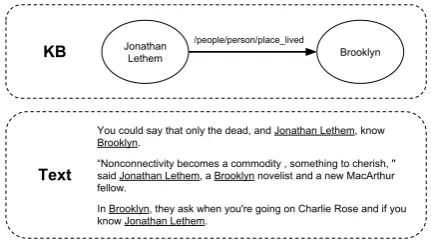
Figure 1: Distant supervision generates noisily labeled relation mentions by aligning entity tuples in a text cor-pus with relation instances from a knowledge base.
noisy labels and incomplete knowledge base in-formation (Min et al.,2013;Fan et al.,2014). Fig-ure1shows an example of three sentences labeled with an existing KB relation, two of which are false positives and do not actually express the re-lation.
Current state-of-the-art RE methods try to ad-dress these challenges by applying multi-instance learning methods (Mintz et al., 2009; Surdeanu et al., 2012; Lin et al., 2016) and guiding the model by explicitly provided semantic and syn-tactic knowledge, e.g. part-of-speech tags (Zeng et al., 2014) and dependency parse informa-tion (Surdeanu et al.,2012;Zhang et al.,2018b). Recent methods also utilize side information, e.g. paraphrases, relation aliases, and entity types (Vashishth et al., 2018). However, we ob-serve that these models are often biased towards recognizing a limited set of relations with high precision, while ignoring those in the long tail (see Section5.2).
unsupervised pre-training (Peters et al., 2018), as demonstrated by state-of-the-art performance on a wide range of natural language processing tasks (Vaswani et al., 2017; Peters et al., 2018;
Radford et al., 2018; Devlin et al., 2018), in-cluding supervised relation extraction (Alt et al.,
2019). Radford et al. (2019) even found lan-guage models to perform fairly well on answer-ing open-domain questions without beanswer-ing trained on the actual task, suggesting they capture a lim-ited amount of “common-sense” knowledge. We hypothesize that pre-trained language models pro-vide a stronger signal for distant supervision, bet-ter guiding relation extraction based on the knowl-edge acquired during unsupervised pre-training. Replacing explicit linguistic and side-information with implicit features improves domain and lan-guage independence and could increase the diver-sity of the recognized relations.
In this paper, we introduce a Distantly Super-vised Transformer for Relation Extraction (DIS-TRE). We extend the standard Transformer archi-tecture by a selective attention mechanism to han-dle multi-instance learning and prediction, which allows us to fine-tune the pre-trained Transformer language model directly on the distantly super-vised RE task. This minimizes explicit feature extraction and reduces the risk of error accumu-lation. In addition, the self-attentive architec-ture allows the model to efficiently caparchitec-ture long-range dependencies and the language model to utilize knowledge about the relation between en-tities and concepts acquired during unsupervised pre-training. Our model achieves a state-of-the-art AUC score of 0.422on the NYT10 dataset, and performs especially well at higher recall levels, when compared to competitive baseline models.
We selected the GPT as our language model be-cause of its fine-tuning efficiency and reasonable hardware requirements, compared to e.g. LSTM-based language models (Ruder and Howard,2018;
Peters et al.,2018) or BERT (Devlin et al.,2018). The contributions of this paper can be summarized as follows:
• We extend the GPT to handle bag-level, multi-instance training and prediction for dis-tantly supervised datasets, by aggregating sentence-level information with selective at-tention to produce bag-level predictions (§3).
• We evaluate our fine-tuned language model on the NYT10 dataset and show that it
achieves a state-of-the-art AUC compared to RESIDE (Vashishth et al., 2018) and PCNN+ATT (Lin et al., 2016) in held-out evaluation (§4,§5.1).
• We follow up on these results with a manual evaluation of ranked predictions, demonstrat-ing that our model predicts a more diverse set of relations and performs especially well at higher recall levels (§5.2).
• We make our code publicly available
at https://github.com/DFKI-NLP/
DISTRE.
2 Transformer Language Model
This section reviews the Transformer language model as introduced byRadford et al.(2018). We first define the Transformer-Decoder (Section2.1), followed by an introduction on how contextual-ized representations are learned with a language modeling objective (Section2.2).
2.1 Transformer-Decoder
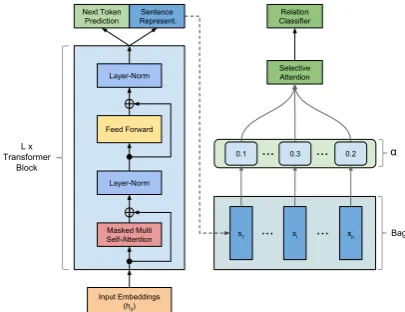
The Transformer-Decoder (Liu et al., 2018a), shown in Figure2, is a decoder-only variant of the original Transformer (Vaswani et al.,2017). Like the original Transformer, the model repeatedly en-codes the given input representations over mul-tiple layers (i.e., Transformer blocks), consisting of masked multi-head self-attention followed by a position-wise feedforward operation. In contrast to the original decoder blocks this version contains no form of unmasked self-attention since there are no encoder blocks. This is formalized as follows:
h0 =T We+Wp
hl =tf block(hl−1)∀l ∈ [1, L]
(1)
WhereT is a matrix of one-hot row vectors of the token indices in the sentence,Weis the token
em-bedding matrix, Wp is the positional embedding
matrix, L is the number of Transformer blocks, and hl is the state at layer l. Since the
Trans-former has no implicit notion of token positions, the first layer adds a learned positional embedding
ep ∈Rdto each token embeddingept ∈ Rdat
Next Token Prediction
Relation Classifier
Layer-Norm
Feed Forward
Input Embeddings (h
0) Layer-Norm
Masked Multi Self-Attention
L x Transformer
Block
... Selective Attention
sn si s1 Sentence
Represent.
Bag
...
[image:3.595.80.283.64.220.2]0.1 ... 0.3 ... 0.2 α
Figure 2: Transformer-Block architecture and training objectives. A Transformer-Block is applied at each of theLlayers to produce statesh1tohL. After encoding each sentence in a bag into its representationsi, selec-tive attention informs the relation classifier with a rep-resentation aggregated over all sentences[s1, . . . , sn].
ahead of the current token. For a more exhaus-tive description of the architecture, we refer read-ers toVaswani et al.(2017) and the excellent guide “The Annotated Transformer”.1
2.2 Unsupervised Pre-training of Language Representations
Given a corpusC ={c1, . . . , cn}of tokensci, the
language modeling objective maximizes the like-lihood
L1(C) =
X
i
logP(ci|ci−1, . . . , ci−k;θ), (2)
where k is the context window considered for pre-dicting the next tokencivia the conditional
proba-bilityP. The distribution over the target tokens is modeled using the previously defined Transformer model as follows:
P(c) =sof tmax(hLWeT), (3)
wherehL is the sequence of states after the final
layerL,Weis the embedding matrix, andθare the
model parameters that are optimized by stochastic gradient descent. This results in a probability dis-tribution for each token in the input sequence.
3 Multi-Instance Learning with the Transformer
This section introduces our extension to the orig-inal transformer architecture, enabling bag-level
1http://nlp.seas.harvard.edu/2018/04/
03/attention.html
multi-instance learning on distantly supervised datasets (Section 3.1), followed by a description of our task-specific input representation for rela-tion extracrela-tion (Secrela-tion3.2).
3.1 Distantly Supervised Fine-tuning on Relation Extraction
After pre-training with the objective in Eq. 2, the language model is fine-tuned on the relation extraction task. We assume a labeled dataset
D = {(xi, headi, taili, ri)}Ni=1, where each ex-ample consists of an input sequence of tokens
xi = [x1, . . . , xm], the positions headi andtaili
of the relation’s head and tail entity in the se-quence of tokens, and the corresponding relation labelri, assigned by distant supervision. Due to
its noisy annotation, labelri is an unreliable
tar-get for training. Instead, the relation classification is applied on a bag level, representing each entity pair(head, tail)as a set S = {x1, . . . , xn}
con-sisting of all sentences that contain the entity pair. A set representationsis then derived as a weighted sum over the individual sentence representations:
s=X
i
αisi, (4)
whereαiis the weight assigned to the
correspond-ing sentence representation si. A sentence
rep-resentation is obtained by feeding the token se-quence xi of a sentence to the pre-trained model
and using the last statehm
L of the final state
repre-sentationhLas its representation si. The set
rep-resentation s is then used to inform the relation classifier.
We use selective attention (Lin et al., 2016), shown in Figure2, as our approach for aggregat-ing a bag-level representationsbased on the indi-vidual sentence representations si. Compared to
average selection, where each sentence represen-tation contributes equally to the bag-level repre-sentation, selective attention learns to identify the sentences with features most clearly expressing a relation, while de-emphasizing those that contain noise. The weightαiis obtained for each sentence
by comparing its representation against a learned relation representationr:
αi =
exp(sir)
Pn
j=1exp(sjr)
(5)
is applied tos:
P(l|S, θ) =sof tmax(Wrs+b), (6)
whereWris the representation matrix of relations
randb∈Rdr is a bias vector. During fine-tuning
we want to optimize the following objective:
L2(D) =
|S| X
i=1
logP(li|Si, θ) (7)
According to Radford et al. (2018), introducing language modeling as an auxiliary objective dur-ing fine-tundur-ing improves generalization and leads to faster convergence. Therefore, our final objec-tive combines Eq.2and Eq.7:
L(D) =λ∗L1(D) +L2(D), (8)
where the scalar valueλis the weight of the lan-guage model objective during fine-tuning.
3.2 Input Representation
Our input representation (see Figure 3) encodes each sentence as a sequence of tokens. To make use of sub-word information, we tokenize the in-put text using byte pair encoding (BPE) (Sennrich et al.,2016). The BPE algorithm creates a vocabu-lary of sub-word tokens, starting with single char-acters. Then, the algorithm iteratively merges the most frequently co-occurring tokens into a new to-ken until a predefined vocabulary size is reached. For each token, we obtain its input representation by summing over the corresponding token embed-ding and positional embedembed-ding.
While the model is pre-trained on plain text sen-tences, relation extraction requires a structured in-put, namely a sentence and relation arguments. To avoid task-specific changes to the architecture, we adopt a traversal-style approach similar toRadford et al.(2018). The structured, task-specific input is converted to an ordered sequence to be directly fed to the model without architectural changes. Fig-ure3provides a visual illustration of the input for-mat. It starts with the tokens of the head and tail entity, separated by delimiters, followed by the to-ken sequence of the sentence containing the en-tity pair, and ends with a special classification to-ken. The classification token signals the model to generate a sentence representation for relation classification. Since our model processes the in-put left-to-right, we add the relation arguments to the beginning, to bias the attention mechanism to-wards their token representation while processing the sentence’s token sequence.
est
e5 eche
e4 e[sep]
e3 ekey
e2 e[strt]
e1 + h0 h1
e[sep]
e6 byte pair emb.
positional emb.
+ + + + +
... ...
[image:4.595.308.524.63.208.2][strt] key [sep] chest [sep] The key ... chest [clf]
Figure 3: Relation extraction requires a structured input for fine-tuning, with special delimiters to assign differ-ent meanings to parts of the input. The input embed-dingh0is created by summing over the positional em-bedding and the byte pair emem-bedding for each token. Stateshlare obtained by self-attending over the states of the previous layerhl−1.
4 Experiment Setup
In the following section we describe our ex-perimental setup. We run our experiments on the distantly supervised NYT10 dataset and use PCNN+ATTN (Lin et al., 2016) and RE-SIDE (Vashishth et al.,2018) as the state-of-the-art baselines.
The piecewise convolutional neural network (PCNN) segments each input sentence into parts to the left, middle, and right of the entity pair, fol-lowed by convolutional encoding and selective at-tention to inform the relation classifier with a bag-level representation. RESIDE, on the other hand, uses a bidirectional gated recurrent unit (GRU) to encode the input sentence, followed by a graph convolutional neural network (GCN) to encode the explicitly provided dependency parse tree infor-mation. This is then combined with named entity type information to obtain a sentence representa-tion that can be aggregated via selective attenrepresenta-tion and forwarded to the relation classifier.
4.1 NYT10 Dataset
is openly accessible online.2 The training data contains 522,611 sentences, 281,270 entity pairs and 18,252 relational facts. The test data contains 172,448 sentences, 96,678 entity pairs and 1,950 relational facts. There are 53 relation types, in-cluding NA if no relation holds for a given sen-tence and entity pair. Per convention we report
Precision@N(precision scores for the top 100, top
200, and top 300 extracted relation instances) and a plot of the precision-recall curves. Since the test data is also generated via distant supervision, and can only provide an approximate measure of the performance, we also reportP@100,P@200, and
P@300based on a manual evaluation.
4.2 Pre-training
Since pre-training is computationally expensive, and our main goal is to show its effectiveness by fine-tuning on the distantly supervised relation ex-traction task, we reuse the language model3 pub-lished by Radford et al. (2018) for our experi-ments. The model was trained on the BooksCor-pus (Zhu et al., 2015), which contains around 7,000 unpublished books with a total of more than 800M words of different genres. The model con-sists of L = 12 decoder blocks with 12 atten-tion heads and 768 dimensional states, and a feed-forward layer of 3072 dimensional states. We reuse the byte-pair encoding vocabulary of this model, but extend it with task-specific tokens (e.g., start, end, delimiter).
4.3 Hyperparameters
During our experiments we found the hyperpa-rameters for fine-tuning, reported inRadford et al.
(2018), to be very effective. We used the Adam optimization scheme (Kingma and Ba,2015) with
β1 = 0.9,β2 = 0.999, a batch size of 8, a learn-ing rate of 6.25e-5, and a linear learnlearn-ing rate de-cay schedule with warm-up over 0.2% of training updates. We trained the model for 3 epochs and applied residual and attention dropout with a rate of 0.1, and classifier dropout with a rate of 0.2.
5 Results
This section presents our experimental results. We compare DISTRE to other works on the NYT10 dataset, and show that it recognizes a more diverse
2
https://drive.google.com/file/d/ 1eSGYObt-SRLccvYCsWaHx1ldurp9eDN_
3https://github.com/openai/
finetune-transformer-lm
0.0 0.1 0.2 0.3 0.4 0.5 0.6 0.7 Recall
0.3 0.4 0.5 0.6 0.7 0.8 0.9 1.0
Precision
Precision-Recall
[image:5.595.311.525.67.222.2]DISTRE | AUC: 0.422 RESIDE | AUC: 0.415 PCNN+ATT | AUC: 0.342 Mintz | AUC: 0.106
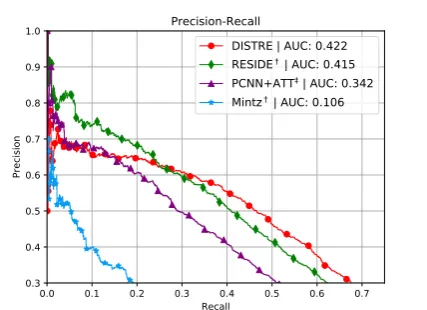
Figure 4: Precision-Recall curve on the NYT dataset. Our method (DISTRE) shows a more balanced perfor-mance across relations, especially in the long tail. †
marks results reported byVashishth et al.(2018).‡ in-dicates results we obtained with the OpenNRE4 imple-mentation.
set of relations, while still achieving state-of-the-art AUC. Even without explicitly provided side in-formation and linguistic features.
5.1 Held-out Evaluation
Table 1 shows the results of our model on the held-out dataset. DISTRE with selective atten-tion achieves a new state-of-the-art AUC value of 0.422. The precision-recall curve in Fig-ure 4 shows that it outperforms RESIDE and PCNN+ATT at higher recall levels, while preci-sion is lower for top predicted relation instances. The results of the PCNN+ATT model indicate that its performance is only better in the very beginning of the curve, but its precision drops early and only achieves an AUC value of 0.341. Similar, RE-SIDE performs better in the beginning but drops in precision after a recall-level of approximately 0.25. This suggests that our method yields a more balanced overall performance, which we believe is important in many real-world applications.
Table 1 also shows detailed precision values measured at different points along the P-R curve. We again can observe that while DISTRE has lower precision for the top 500 predicted relation instances, it shows a state-of-the-art precision of 60.2% for the top 1000 and continues to perform higher for the remaining, much larger part of the predictions.
System AUC P@100 P@200 P@300 P@500 P@1000 P@2000
Mintz† 0.107 52.3 50.2 45.0 39.7 33.6 23.4
PCNN+ATT‡ 0.341 73.0 68.0 67.3 63.6 53.3 40.0
RESIDE† 0.415 81.8 75.4 74.3 69.7 59.3 45.0
DISTRE 0.422 68.0 67.0 65.3 65.0 60.2 47.9
Table 1: Precision evaluated automatically for the top rated relation instances. †marks results reported in the original paper.‡marks our results using the OpenNRE implementation.
5.2 Manual Evaluation and Analysis
Since automated evaluation on a distantly super-vised, held-out dataset does not reflect the actual performance of the models given false positive la-bels and incomplete knowledge base information, we also evaluate all models manually. This also allows us to gain a better understanding of the difference of the models in terms of their predic-tions. To this end, three human annotators manu-ally rated the top 300 predicted relation instances for each model. Annotators were asked to label a predicted relation as correct only if it expressed a true fact at some point in time (e.g., for a
/busi-ness/person/company relationship, a person may
have worked for a company in the past, but not currently), and if at least one sentence clearly ex-pressed this relation, either via a syntactic pattern or via an indicator phrase.
Table2shows theP@100,P@200,P@300and average precision scores, averaged over all anno-tators. PCNN+ATT has the highest average preci-sion at94.3%, 3%higher than the91.2%of RE-SIDE and 5% higher than our model. However, we see that this is mainly due to PCNN+ATT’s very highP@100andP@200scores. For P@300, all models have very similar precision scores. PCNN+ATT’s scores decrease considerably, re-flecting the overall trend of its PR curve, whereas RESIDE’s and DISTRE’s manual precision scores remain at approximately the same level. Our model’s precision scores for the top rated predic-tions are around 2% lower than those of RESIDE, confirming the results of the held-out evaluation. Manual inspection of DISTRE’s output shows that most errors among the top predictions arise from wrongly labeled/location/country/capital in-stances, which the other models do not predict among the top 300 relations.
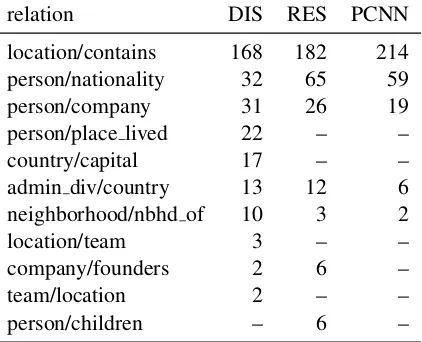
Table 3 shows the distribution over rela-tion types for the top 300 predicrela-tions of the different models. We see that DISTRE’s
top predictions encompass 10 distinct rela-tion types, more than the other two mod-els, with /location/location/contains and
/peo-ple/person/nationality contributing 67% of the
predictions. Compared to PCNN+ATT and RE-SIDE, DISTRE predicts additional relation types, such as e.g./people/person/place lived(e.g., ”Sen. PER, Republican/Democrat of LOC”) and
/lo-cation/neighborhood/neighborhood of (e.g., ”the
LOC neighborhood/area of LOC”), with high con-fidence.
RESIDE’s top 300 predictions cover a smaller range of 7 distinct relation types, but also focus on /location/location/contains
and /people/person/nationality (82% of the
model’s predictions). RESIDE’s top predictions include e.g. the additional relation types
/busi-ness/company/founders (e.g., ”PER, the founder
of ORG”) and /people/person/children (e.g., ”PER, the daughter/son of PER”).
PCNN+ATT’s high-confidence
predic-tions are strongly biased towards a very small set of only four relation types. Of these, /location/location/contains and
/peo-ple/person/nationality together make up 91%
of the top 300 predictions. Manual inspection shows that for these relations, the PCNN+ATT model picks up on entity type signals and ba-sic syntactic patterns, such as ”LOC, LOC” (e.g., ”Berlin, Germany”) and ”LOC in LOC” (”Green Mountain College in Vermont”) for
/lo-cation/location/contains, and ”PER of LOC”
(”Stephen Harper of Canada”) for
/peo-ple/person/nationality. This suggests that the
PCNN model ranks short and simple patterns higher than more complex patterns where the distance between the arguments is larger. The two other models, RESIDE and DISTRE, also identify and utilize these syntactic patterns.
cor-System P@100 P@200 P@300 Avg Prec
PCNN+ATT 97.3 94.7 90.8 94.3
RESIDE 91.3 91.2 91.0 91.2
[image:7.595.77.288.174.345.2]DISTRE 88.0 89.8 89.2 89.0
Table 2: Precision evaluated manually for the top 300 relation instances, averaged across 3 human annotators.
relation DIS RES PCNN
location/contains 168 182 214
person/nationality 32 65 59
person/company 31 26 19
person/place lived 22 – –
country/capital 17 – –
admin div/country 13 12 6
neighborhood/nbhd of 10 3 2
location/team 3 – –
company/founders 2 6 –
team/location 2 – –
person/children – 6 –
Table 3: Distribution over the top 300 predicted relations for each method. DISTRE achieves per-formance comparable to RESIDE, while predict-ing a more diverse set of relations with high con-fidence. PCNN+ATT shows a strong focus on two relations: /location/location/contains and /peo-ple/person/nationality.
rectly classified.
6 Related Work
Relation Extraction Initial work in RE uses statistical classifiers or kernel based methods in combination with discrete syntactic features, such as part-of-speech and named entities tags, morphological features, and WordNet hyper-nyms (Mintz et al.,2009;Hendrickx et al.,2010). These methods have been superseded by sequence based methods, including recurrent (Socher et al.,
2012;Zhang and Wang, 2015) and convolutional neural networks (Zeng et al.,2014,2015). Conse-quently, discrete features have been replaced by distributed representations of words and syntac-tic features (Turian et al.,2010;Pennington et al.,
2014). Xu et al.(2015a,b) integrated shortest de-pendency path (SDP) information into a LSTM-based relation classification model. Considering the SDP is useful for relation classification, be-cause it focuses on the action and agents in a sen-tence (Bunescu and Mooney,2005;Socher et al.,
2014). Zhang et al. (2018b) established a new state-of-the-art for relation extraction on the TA-CRED dataset by applying a combination of prun-ing and graph convolutions to the dependency tree. Recently, Verga et al. (2018) extended the Transformer architecture by a custom architecture for supervised biomedical named entity and rela-tion extracrela-tion. In comparison, we fine-tune pre-trained language representations and only require distantly supervised annotation labels.
Distantly Supervised Relation Extraction Early distantly supervised approaches (Mintz et al., 2009) use multi-instance learning (Riedel et al., 2010) and multi-instance multi-label learning (Surdeanu et al., 2012; Hoffmann et al.,
2011) to model the assumption that at least one sentence per relation instance correctly expresses the relation. With the increasing popularity of neural networks, PCNN (Zeng et al., 2014) became the most widely used architecture, with extensions for multi-instance learning (Zeng et al.,2015), selective attention (Lin et al.,2016;
Han et al.,2018), adversarial training (Wu et al.,
2017; Qin et al., 2018), noise models (Luo et al., 2017), and soft labeling (Liu et al., 2017;
Wang et al., 2018). Recent work showed graph convolutions (Vashishth et al., 2018) and capsule networks (Zhang et al.,2018a), previously applied to the supervised setting (Zhang et al., 2018b), to be also applicable in a distantly supervised setting. In addition, linguistic and semantic background knowledge is helpful for the task, but the proposed systems typically rely on explicit features, such as dependency trees, named entity types, and relation aliases (Vashishth et al.,
2018; Yaghoobzadeh et al., 2017), or task- and domain-specific pre-training (Liu et al., 2018b;
He et al., 2018), whereas our method only relies on features captured by a language model during unsupervised pre-training.
Language Representations and Transfer
Sentence Relation
Mr. Snow asked, referring to AyatollahAli Khamenei,Iran’s supreme leader, and Mahmoud Ahmadinejad,Iran’s president.
/people/person/nationality
InOklahoma, the Democratic governor, Brad Henry, vetoed legisla-tion Wednesday that would ban state facilities and workers from per-forming abortions except to save the life of the pregnant woman.
/people/person/place lived
Jakarta also boasts of having one of the oldest golf courses in Asia, Rawamangun , also known as the Jakarta Golf Club.
/location/location/contains
Cities like New York grow in their unbuilding: demolition tends to pre-cede development, most urgently and particularly in Lower Manhat-tan, whereNew York Citybegan.
/location/location/contains
Table 4: Examples of challenging relation mentions. These examples benefit from the ability to capture more complex features. Relation arguments are marked in bold.
pre-training. Peters et al. (2018) introduced embeddings from language models (ELMo), an approach to learn contextualized word representa-tions by training a bidirectional LSTM to optimize a disjoint bidirectional language model objective. Their results show that replacing static pre-trained word vectors (Mikolov et al., 2013; Pennington et al., 2014) with contextualized word represen-tations significantly improves performance on various natural language processing tasks, such as semantic similarity, coreference resolution, and semantic role labeling. Ruder and Howard
(2018) found language representations learned by unsupervised language modeling to signifi-cantly improve text classification performance, to prevent overfitting, and to increase sample efficiency. Radford et al. (2018) demonstrated that general-domain pre-training and task-specific fine-tuning, which our model is based on, achieves state-of-the-art results on several question an-swering, text classification, textual entailment, and semantic similarity tasks.Devlin et al.(2018) further extended language model pre-training by introducing a slot-filling objective to jointly train a bidirectional language model. Most recently (Radford et al., 2019) found that considerably increasing the size of language models results in even better generalization to downstream tasks, while still underfitting large text corpora.
7 Conclusion
We proposed DISTRE, a Transformer which we extended with an attentive selection mechanism for the multi-instance learning scenario, common
in distantly supervised relation extraction. While DISTRE achieves a lower precision for the 300 top ranked predictions, we observe a state-of-the-art AUC and an overall more balanced performance, especially for higher recall values. Similarly, our approach predicts a larger set of distinct relation types with high confidence among the top predic-tions. In contrast to RESIDE, which uses explic-itly provided side information and linguistic fea-tures, our approach only utilizes features implic-itly captured in pre-trained language representa-tions. This allows for an increased domain and language independence, and an additional error re-duction because pre-processing can be omitted.
In future work, we want to further investigate the extent of syntactic structure captured in deep language language representations. Because of its generic architecture, DISTRE allows for inte-gration of additional contextual information, e.g. background knowledge about entities and rela-tions, which could also prove useful to further im-prove performance.
Acknowledgments
References
Christoph Alt, Marc H¨ubner, and Leonhard Hennig. 2019. Improving relation extraction by pre-trained
language representations. In Proceedings of the
2019 Conference on Automated Knowledge Base Construction, Amherst, Massachusetts.
Razvan C. Bunescu and Raymond J. Mooney. 2005. A Shortest Path Dependency Kernel for Relation
Ex-traction. InProceedings of the Conference on
Hu-man Language Technology and Empirical Methods in Natural Language Processing, HLT ’05, pages 724–731. Association for Computational Linguis-tics.
Jacob Devlin, Ming-Wei Chang, Kenton Lee, and Kristina Toutanova. 2018. BERT: pre-training of deep bidirectional transformers for language
under-standing. Computing Research Repository (CoRR),
abs/1810.04805.
Miao Fan, Deli Zhao, Qiang Zhou, Zhiyuan Liu, Thomas Fang Zheng, and Edward Y. Chang. 2014.
Distant Supervision for Relation Extraction with
Matrix Completion. InProceedings of the 52nd
An-nual Meeting of the Association for Computational Linguistics (Volume 1: Long Papers), pages 839– 849, Baltimore, Maryland. Association for Compu-tational Linguistics.
Xu Han, Pengfei Yu, Zhiyuan Liu, Maosong Sun, and Peng Li. 2018. Hierarchical relation extraction with
coarse-to-fine grained attention. InProceedings of
the 2018 Conference on Empirical Methods in Nat-ural Language Processing, pages 2236–2245. Asso-ciation for Computational Linguistics.
Zhengqiu He, Wenliang Chen, Zhenghua Li, Meishan Zhang, Wei Zhang, and Min Zhang. 2018. See: Syntax-aware entity embedding for neural relation extraction. InAAAI.
Iris Hendrickx, Su Nam Kim, Zornitsa Kozareva, Preslav Nakov, Diarmuid ´O S´eaghdha, Sebastian Pad´o, Marco Pennacchiotti, Lorenza Romano, and Stan Szpakowicz. 2010. Semeval-2010 Task 8: Multi-Way Classification of Semantic Relations be-tween Pairs of Nominals. InSemEval@ACL.
Raphael Hoffmann, Congle Zhang, Xiao Ling, Luke Zettlemoyer, and Daniel S. Weld. 2011.
Knowledge-Based Weak Supervision for
Informa-tion ExtracInforma-tion of Overlapping RelaInforma-tions. In
Pro-ceedings of the 49th Annual Meeting of the Associ-ation for ComputAssoci-ational Linguistics: Human Lan-guage Technologies, pages 541–550, Portland, Ore-gon, USA. Association for Computational Linguis-tics.
Heng Ji and Ralph Grishman. 2011. Knowledge base
population: Successful approaches and challenges.
In Proceedings of the 49th Annual Meeting of the Association for Computational Linguistics: Human Language Technologies - Volume 1, HLT ’11, pages
1148–1158, Stroudsburg, PA, USA. Association for Computational Linguistics.
Diederik P. Kingma and Jimmy Ba. 2015. Adam:
A method for stochastic optimization.
Interna-tional Conference on Learning Representations, abs/1412.6980.
Yankai Lin, Shiqi Shen, Zhiyuan Liu, Huanbo Luan, and Maosong Sun. 2016. Neural Relation
Extrac-tion with Selective AttenExtrac-tion over Instances. In
Pro-ceedings of the 54th Annual Meeting of the Associa-tion for ComputaAssocia-tional Linguistics (Volume 1: Long Papers), pages 2124–2133, Berlin, Germany. Asso-ciation for Computational Linguistics.
Peter J. Liu, Mohammad Saleh, Etienne Pot, Ben Goodrich, Ryan Sepassi, Lukasz Kaiser, and Noam Shazeer. 2018a. Generating wikipedia by summa-rizing long sequences. ICLR.
Tianyi Liu, Xinsong Zhang, Wanhao Zhou, and Wei-jia Jia. 2018b. Neural relation extraction via
inner-sentence noise reduction and transfer learning. In
Proceedings of the 2018 Conference on Empirical Methods in Natural Language Processing, pages 2195–2204. Association for Computational Linguis-tics.
Tianyu Liu, Kexiang Wang, Baobao Chang, and Zhi-fang Sui. 2017. A soft-label method for
noise-tolerant distantly supervised relation extraction. In
Proceedings of the 2017 Conference on Empirical Methods in Natural Language Processing, pages 1790–1795. Association for Computational Linguis-tics.
Bingfeng Luo, Yansong Feng, Zheng Wang, Zhanxing Zhu, Songfang Huang, Rui Yan, and Dongyan Zhao. 2017. Learning with noise: Enhance distantly su-pervised relation extraction with dynamic transition
matrix. In Proceedings of the 55th Annual
Meet-ing of the Association for Computational LMeet-inguistics (Volume 1: Long Papers), pages 430–439. Associa-tion for ComputaAssocia-tional Linguistics.
Tomas Mikolov, Kai Chen, Greg Corrado, and Jef-frey Dean. 2013. Efficient estimation of word
representations in vector space. arXiv preprint
arXiv:1301.3781.
Bonan Min, Ralph Grishman, Li Wan, Chang Wang, and David Gondek. 2013. Distant Supervision for Relation Extraction with an Incomplete Knowledge Base. In Proceedings of the 2013 Conference of the North American Chapter of the Association for Computational Linguistics: Human Language Tech-nologies, pages 777–782, Atlanta, Georgia. Associ-ation for ComputAssoci-ational Linguistics.
Mike Mintz, Steven Bills, Rion Snow, and Daniel Ju-rafsky. 2009. Distant supervision for relation extrac-tion without labeled data. InACL/IJCNLP.
Matthew E. Peters, Mark Neumann, Mohit Iyyer, Matt Gardner, Christopher Clark, Kenton Lee, and Luke S. Zettlemoyer. 2018. Deep contextualized word representations. InNAACL-HLT.
Pengda Qin, Weiran XU, and William Yang Wang. 2018. Dsgan: Generative adversarial training for
distant supervision relation extraction. In
Proceed-ings of the 56th Annual Meeting of the Associa-tion for ComputaAssocia-tional Linguistics (Volume 1: Long Papers), pages 496–505. Association for Computa-tional Linguistics.
Alec Radford, Karthik Narasimhan, Tim Salimans, and Ilya Sutskever. 2018. Improving language
under-standing by generative pre-training. available as a
preprint.
Alec Radford, Jeff Wu, Rewon Child, David Luan, Dario Amodei, and Ilya Sutskever. 2019. Language
models are unsupervised multitask learners.
Sebastian Riedel, Limin Yao, and Andrew McCallum. 2010.Modeling Relations and Their Mentions
with-out Labeled Text. InProceedings of the European
Conference on Machine Learning and Knowledge Discovery in Databases (ECML PKDD ’10).
Sebastian Ruder and Jeremy Howard. 2018. Univer-sal language model fine-tuning for text classifica-tion. Association for Computational Linguistics.
Rico Sennrich, Barry Haddow, and Alexandra Birch. 2016.Neural machine translation of rare words with
subword units. InProceedings of the 54th Annual
Meeting of the Association for Computational Lin-guistics (Volume 1: Long Papers), volume 1, pages 1715–1725.
Richard Socher, Brody Huval, Christopher D. Man-ning, and Andrew Y. Ng. 2012. Semantic composi-tionality through recursive matrix-vector spaces. In EMNLP-CoNLL.
Richard Socher, Andrej Karpathy, Quoc V. Le, Christo-pher D. Manning, and Andrew Y. Ng. 2014. Grounded compositional semantics for finding and describing images with sentences. TACL, 2:207– 218.
Mihai Surdeanu, Julie Tibshirani, Ramesh Nallapati, and Christopher D. Manning. 2012. Multi-instance
Multi-label Learning for Relation Extraction. In
Proceedings of the 2012 Joint Conference on Em-pirical Methods in Natural Language Processing and Computational Natural Language Learning, EMNLP-CoNLL ’12, pages 455–465, Stroudsburg, PA, USA. Association for Computational Linguis-tics.
Joseph P. Turian, Lev-Arie Ratinov, and Yoshua Ben-gio. 2010. Word representations: A simple and gen-eral method for semi-supervised learning. InACL.
Shikhar Vashishth, Rishabh Joshi, Sai Suman Prayaga, Chiranjib Bhattacharyya, and Partha Talukdar. 2018.
Reside: Improving distantly-supervised neural
rela-tion extracrela-tion using side informarela-tion. In
Proceed-ings of the 2018 Conference on Empirical Methods in Natural Language Processing, pages 1257–1266. Association for Computational Linguistics.
Ashish Vaswani, Noam Shazeer, Niki Parmar, Jakob Uszkoreit, Llion Jones, Aidan N Gomez, Łukasz Kaiser, and Illia Polosukhin. 2017. Attention is all
you need. InAdvances in Neural Information
Pro-cessing Systems, pages 5998–6008.
Patrick Verga, Emma Strubell, and Andrew McCallum. 2018. Simultaneously self-attending to all mentions
for full-abstract biological relation extraction. In
Proceedings of the 2018 Conference of the North American Chapter of the Association for Computa-tional Linguistics: Human Language Technologies, Volume 1 (Long Papers), pages 872–884. Associa-tion for ComputaAssocia-tional Linguistics.
Guanying Wang, Wen Zhang, Ruoxu Wang, Yalin Zhou, Xi Chen, Wei Zhang, Hai Zhu, and Huajun Chen. 2018. Label-free distant supervision for
re-lation extraction via knowledge graph embedding.
In Proceedings of the 2018 Conference on Empiri-cal Methods in Natural Language Processing, pages 2246–2255. Association for Computational Linguis-tics.
Yi Wu, David Bamman, and Stuart Russell. 2017.
Ad-versarial training for relation extraction. In
Proceed-ings of the 2017 Conference on Empirical Methods in Natural Language Processing, pages 1778–1783. Association for Computational Linguistics.
Kun Xu, Yansong Feng, Songfang Huang, and Dongyan Zhao. 2015a. Semantic relation classifica-tion via convoluclassifica-tional neural networks with simple negative sampling. InEMNLP.
Yan Xu, Lili Mou, Ge Li, Yunchuan Chen, Hao Peng, and Zhi Jin. 2015b. Classifying relations via long short term memory networks along shortest
depen-dency paths. In Proceedings of the 2015
Confer-ence on Empirical Methods in Natural Language Processing, pages 1785–1794. Association for Com-putational Linguistics.
Yadollah Yaghoobzadeh, Heike Adel, and Hinrich Sch¨utze. 2017. Noise mitigation for neural entity
typing and relation extraction. In Proceedings of
the 15th Conference of the European Chapter of the Association for Computational Linguistics: Volume 1, Long Papers, pages 1183–1194. Association for Computational Linguistics.
Daojian Zeng, Kang Liu, Yubo Chen, and Jun Zhao. 2015. Distant Supervision for Relation Extraction
via Piecewise Convolutional Neural Networks. In
Proceedings of the 2015 Conference on Empirical Methods in Natural Language Processing, pages 1753–1762, Lisbon, Portugal. Association for Com-putational Linguistics.
Daojian Zeng, Kang Liu, Siwei Lai, Guangyou Zhou, and Jun Zhao. 2014. Relation classification via
con-volutional deep neural network. InProceedings of
COLING 2014, the 25th International Conference on Computational Linguistics: Technical Papers, pages 2335–2344. Dublin City University and As-sociation for Computational Linguistics.
Dongxu Zhang and Dong Wang. 2015. Relation classi-fication via recurrent neural network.arXiv preprint arXiv:1508.01006.
Ningyu Zhang, Shumin Deng, Zhanling Sun, Xi Chen, Wei Zhang, and Huajun Chen. 2018a. Attention-based capsule networks with dynamic routing for
re-lation extraction. InProceedings of the 2018
Con-ference on Empirical Methods in Natural Language Processing, pages 986–992. Association for Com-putational Linguistics.
Yuhao Zhang, Peng Qi, and Christopher D. Manning. 2018b. Graph Convolution over Pruned
Depen-dency Trees Improves Relation Extraction. In
Pro-ceedings of the 2018 Conference on Empirical Meth-ods in Natural Language Processing, pages 2205– 2215, Brussels, Belgium. Association for Computa-tional Linguistics.