30
REflex: Flexible Framework for Relation Extraction in Multiple Domains
Geeticka Chauhan MIT CSAIL [email protected]
Matthew B. A. McDermott MIT CSAIL
Peter Szolovits MIT CSAIL [email protected]
Abstract
Systematic comparison of methods for relation extraction (RE) is difficult because many ex-periments in the field are not described pre-cisely enough to be completely reproducible and many papers fail to report ablation stud-ies that would highlight the relative contribu-tions of their various combined techniques. In this work, we build a unifying framework for RE, applying this on three highly used datasets (from the general, biomedical and clinical do-mains) with the ability to be extendable to new datasets. By performing a systematic explo-ration of modeling, pre-processing and train-ing methodologies, we find that choices of pre-processing are a large contributor performance and that omission of such information can fur-ther hinder fair comparison. Other insights from our exploration allow us to provide rec-ommendations for future research in this area.
1 Introduction
Relation Extraction (RE) has gained a lot of in-terest from the community with the introduction of the Semeval tasks from 2007 by (Girju et al.,
2007) and 2010 by (Hendrickx et al.,2009). The task is a subset of information extraction (IE) with the goal of finding semantic relationships between concepts in a given sentence, and is an impor-tant component of Natural Language Understand-ing (NLU). Applications include automatic knowl-edge base creation, question answering, as well as analysis of unstructured text data. Since the in-troduction of RE tasks in the general and medical domains, many researchers have explored the per-formance of different neural network architectures on the datasets (Socher et al., 2012; Zeng et al.,
2014;Liu et al.,2016b;Sahu et al.,2016). However, progress in RE is hampered by repro-ducibility issues as well as the difficulty in assess-ing which techniques in the literature will general-ize to novel tasks, datasets and contexts. To assess
the extent of these problems, we performed a man-ual review of 53 relevant neural RE papers1citing
the three datasets (Hendrickx et al.,2009; Segura-Bedmar et al., 2013; Uzuner et al., 2011). The procedure for finding these papers is highlighted in (Chauhan,2019).
Reproducibility Reproducibility is important for validating previous work and building upon it (Fokkens et al.,2013). Lack of reproducibility can be attributed to many factors such as difficulty in availability of source code (Ince et al., 2012) and omission of sources of variability such as hyperpa-rameter details (Claesen and De Moor,2015). We found that only 16 out of the 53 relevant papers had released their source code. 14 out of 53 pa-pers were evaluated on multiple datasets, but the source code was publicly available for only five of those. Despite this, much of this code was lack-ing in modularity to be easily extendable to new datasets. In many cases, the process of reproduc-ing the paper results was often unclear and lack of documentation made this more difficult. Even though most papers mentioned some hyperparam-eter details, important details were missing such as number of epochs, batch size, random initial-ization seed, if any, and details about early stop if that technique was applied.
Ablation Studies Lack of generalizability is caused by a dearth of appropriate empirical evalu-ation to identify the source of modeling gains. Ab-lation studies are important for identifying sources of improvements in results. Among the 53 papers that we looked at, 20 of the 24 papers in the gen-eral domain performed ablation studies. However, only 10 out of 29 papers in the medical domain performed one. Among these ablation studies,
1The 53 papers were filtered from a list of 728 papers
key details related to pre-processing were missing, which we found critical in our experiments.
In the absence of such information about causes of large variability of results, fair comparisonof models becomes difficult. In this paper, we present an open-source unifying framework enabling the comparison of various training methodologies, pre-processing, modeling techniques, and evalu-ation metrics. The code is available athttps: //github.com/geetickachauhan/ relation-extraction.
The experimental goals of this framework are identification of sources of variability in results for the three datasets and provide the field with a strong baseline model to compare against for future improvements. The design goals of this framework are identification of best practices for relation extraction and to be a guide for approach-ing new datasets.
By performing systematic comparison on three datasets, we find that 1) pre-processing choices can cause the largest variations in performance, 2) reporting scores on one test set split is problem-atic due to split bias. We perform other analyses in section5and also include recommendations for future research in this field in section7.
Upon testing various combinations of our ap-proaches, we achieve results near state of the art ranges for the three datasets: 85.89% macro F1 for Semeval 2010 task 8 dataset (Hendrickx et al.,
2009) i.e. semeval, 71.97% macro F1 for DDI Extraction 2013 (Segura-Bedmar et al.,2013) i.e.
ddi and 71.01% micro F1 for i2b2/VA 2010 re-lation classification dataset (Uzuner et al., 2011) i.e. i2b2. We refer toddi andi2b2as medi-cal datasets, as they belong to the biomedimedi-cal and clinical domains, respectively.
Dataset Rel Eval Agreement Det
semeval 18 Macro 0.6-0.95 No
ddi 5 Macro >0.8; 0.55-0.72 Yes
i2b2 8 Micro - Yes
Table 1: Dataset information, with columns Rel = number of relations, Eval = evaluation metric (all F1 scores), Agreement = Inter-annotator agreement, Det = whether detection task from section3.4was evaluated on. Rel column only includes relations used in offi-cial evaluation metric. ddi was built from two sep-arately annotated sources and therefore contains two inter-annotator agreements.
2 Datasets
We summarize important information about these datasets in table 1. We introduce detection and classificationtasks in section3.4, but also indicate the tasks evaluated for each dataset in table1.
Semeval 2010 semevalconsists of 8000 train-ing sentences and 2,717 test sentences for the multi-way classification of semantic relations be-tween pairs of nominals. Not included in the offi-cial evaluation is anOtherclass which is consid-ered noisy, with annotators choosing this class if no fit was found in the other classes. It is impor-tant to note that this is a synthetically generated dataset, and detectionscores were not calculated due to the noisy nature of theOtherclass.
DDI Extraction ddi consists of 1,017 texts with 18,491 pharmacological substances and 5,021 drug-drug interactions from Pubmed articles in the pharmacological literature. Noneclass in-dicating no interaction between the drug pairs is included in the evaluation metric calculation.
i2b2/VA 2010 relations i2b2 consists of dis-charge summaries from Partners Healthcare and the MIMIC II Database (Saeed et al.,2011). They released 394 training reports, 477 test reports and 877 unannotated reports. After the challenge, only a part of the data was publicly released for re-search. Nonerelation was present in the data and not considered in the official evaluation.
3 Methodology
Our framework breaks up processing into dif-ferent stages, allowing for future modular addi-tion of components. First, a formatter con-verts the raw dataset into a common comma sep-arated value (CSV) input format accepted by the
pre-processor, and this information is then
fed to themodel, which performs the training, af-ter whichevaluationis performed on the test set. With our framework, we test the following variations in the main components:
3.1 Pre-Processing
We test various pre-processing methods after per-forming simple tokenization and lower-casing of the words: entity blinding used by Liu et al.
related replacement (we call this NER blinding). We used the spaCy framework2 for tokenization and to identify punctuation and digits.
Entity blinding and NER blinding are similar concept blinding techniques where the first is per-formed based on gold standard annotations, while the second is performed by running NER on the original sentence. We replace the words in the sentence matching the entity or named entity span with the target label and use those for training and testing.
Entity labels for semeval were not anno-tated with type information, whereasddi identi-fied drugs andi2b2identified medical problems, tests and treatments. Therefore, entity labels for
semeval were ENTITY, for ddi were DRUG
and fori2b2werePROBLEM,TREATMENTand TEST. In this paper, we usefine-grained concept typeto refer to the presence of more than one con-cept type, as in the the case ofi2b2.
NER labels for semeval consisted of those provided by the large english model by spaCy and provided standard types such asPERSONand ORGANIZATION, whereas those for the medical datasets was provided by the scispacy medium size model3and did not provide types. In this case, blinding consisted of replacing the words in the sentence byEntity.
We chose the spaCy model for NER to com-plement the extendable design goals ofREflex. Other options such as cTAKES (Savova et al.,
2010) for clinical data and MetaMAP4 for biomedical data are highly specific to the dataset type and require running additional scripts outside of theREflexpipeline.
3.2 Modeling
We employ a baseline model based upon (Zeng et al., 2014), (Santos et al., 2015) and (Jin et al.,
2018), which is a convolutional neural network (CNN) with position embeddings and a ranking loss (referred to as CRCNN in this paper). We initialize the model with pre-trained word em-beddings: the senna embeddings by Collobert et al. (2011) for the general domain dataset and
thePubMed-PMC-wikipediaembeddings
re-leased by Pyssalo et al. (2013) for the medical domain. We test several perturbations on top of
CRCNNmodel, such as piecewise max-pooling, as
2
https://github.com/explosion/spaCy
3
https://allenai.github.io/scispacy/
4https://metamap.nlm.nih.gov
suggested byZeng et al.(2015) and the more re-cent ELMo embeddings byPeters et al.(2018). To compare different featurizations of contextualized embeddings, we also employ the embeddings gen-erated by the BERT model (rather than the stan-dard fine-tuning approach). For ELMo, we use the Original (5.5B) model weights in semeval
and PubMed contributed model weights in the medical datasets released by (Peters et al.,2018). For BERT, we use the BERT-large uncased model (without whole word masking) in semeval re-leased by (Devlin et al., 2018), BioBERT by (Lee et al., 2019) in ddi and Clinical BERT by (Alsentzer et al.,2019) ini2b2.
The fine-tuning approach, which tends to be computationally expensive, has been thoroughly explored for multiple tasks, including medical re-lation extraction by Lee et al. (2019), but the approach of featurizing them with an existing model has not been explored in the literature as much. We tested different ways of featurizing the BERT contextualized embeddings for researchers who want to utilize a less computationally inten-sive technique, while still aiming for performance gains for their task.
Because ELMo provides token level embed-dings, we chose to concatenate them with the word and position embeddings from CRCNN be-fore the convolution phase. However, BERT pro-vides word-piece level as well as sentence level embeddings. The first was concatenated similar to ELMo (which we call BERT-tokens), while the second was concatenated with the fixed size sen-tence representation outputted after convolution of word and position embeddings (BERT-CLS).
3.3 Training
We explore two ways of doing hyperparame-ter tuning: manual tuning and random search (Bergstra and Bengio,2012).
Evaluating on three datasets meant that we needed to identify a default list of hyperparame-ters by tuning on one of the datasets before we could identify the hyperparameter list for the other two. We chose semeval for initial tuning due to its larger literature and because the CRCNN
of thesemevaldataset. These default hyperpa-rameters5 were used as starting points for manual tuning on the medical datasets as well as random search for all datasets.
We perform manual tuning on a subset of the hyperparameters, mentioned in table 2. In or-der to avoid overfitting in cross validation pointed out by Cawley and Talbot (2010), we perform a nested cross validation procedure, keeping a dev fold for hyperparameter tuning and a held out fold for score reporting.
On these dev folds, we perform paired t-tests for each of the perturbations to the parameters listed in table2. Our first pass involves changing one hy-perparameter per experiment and noting the ones that cause a statistically significant improvement, which helps us identify a narrower list of hyperpa-rameters to tune on. We further refine the hyper-parameter values in our second pass by testing on values similar to those that were leading to statis-tically significant improvements in the first pass. For example, if we noticed that lower epoch val-ues were helpful in the first pass, we tested them in combination with the other optimal hyperparame-ter values (from first pass) in the second pass.
For each of the datasets, we tuned based on their official challenge evaluation metrics listed in sec-tion 2. ddi and i2b2 had 5-fold nested cross validation performed on them, whereassemeval
had 10-fold cross validation performed.
Random search was performed based on the official evaluation metrics for each dataset, on a fixed dev set randomly sampled from the training data. Final distributions are listed in table3.
3.4 Evaluation
The official challenge problems for all datasets compared models based on multi-class classifica-tion, but for the medical datasets, we were also interested in looking at the changes in model per-formance if we treated the task as a binary classi-fication problem. This was based on the rationale that in the drug literature, for example, pharma-cologists would not want to sacrifice the ability to identify a potentially life threatening drug in-teraction pair, even if the type of the drug pair is not known. Therefore, we report results for both multi-class and binary classification scenarios. For clarity, we refer to them in the rest of the paper as classificationanddetectionrespectively.
5listed in source code
Detectionresults were obtained using our eval-uation scripts by treating existing relations as one class, ignoring the types outputted by the model. The other class in this task was theNoneorOther class, representing non-existing relations. Note that we did not re-train our model for this.
In addition to evaluating on two tasks for the medical and one task for the general dataset, we comment on the implications of different evalua-tion metrics in secevalua-tion5.5.
4 Results
For experiments on the medical datasets i.e.i2b2
and ddi, we used hyperparameters found from manual search individually performed on them.
semeval had the default hyperparameters used
for its experiments. These sets of hyperparame-ters were used in all experiments other than those reported in table 6, where we compare hyperpa-rameter tuning methodologies.
Once we had a fixed set of hyperparameters for each dataset, we tested the perturbations for pre-processing as well as modeling in tables 4 and
5. Perturbations on the hyperparameter search are listed in table 6 and compare performance with different hyperparameter values found using dif-ferent tuning strategies.
We generate the standardclassificationand the additional detection scores by the procedure de-scribed in section3.4, and report these results un-der theClassandDetectcolumns.
We also report additional experiments in tables
7and8based on the improvements found in tables
4 and5. For all results tables, we report official test set results at the top, with accompanying cross validated results (averaged over all folds with their standard deviation) in smaller font below them.6
5 Discussion
Recently, CNNs have achieved strong perfor-mance for text classification and are typically more efficient than recurrent architectures (Bai et al.,2018;Kalchbrenner et al.,2014;Wang et al.,
2015;Zhang et al.,2015b). The speed of our
base-lineCRCNN model allows us to explore multiple
alternatives for every stage of our pipeline. We discuss these results pertaining to the classifica-tiontask for all datasets and thedetectiontask for
6Results tables for metrics other than the official ones
Hyperparameter Values
epoch {50,100,150,200}
lr decay [1e-3, 1e-4, 1e-5]
sgd momentum {T, F}
early stop {T, F}
pos embed {10, 50, 80, 100} filter dimension {50, 150}
filter size 2-3-4, 3-4-5
[image:5.595.100.266.62.178.2]batch size {70, 30}
Table 2: Hyperparameters explored for the first pass of manual search. lr decay means learning rate decay at [60, 120] epochs, pos embed refers to the position embedding size.
Hyperparameter Distributions
epoch uniform(70, 300)
lr {constant, decay}
lr init uniform(1e-5, 0.001)
filter size 2-3, 2-3-4, 2-3-4-5 3-4-5, 3-4-5-6
early stop {T, F}
batch size uniform(30, 70)
Table 3: Hyperparameter distributions for random search. Those written in{}are picked with equal prob-abilities. The learning rate (lr) was uniformly initial-ized, and decayed from 0.001 to the intialized value at half of the number of epochs. If early stop was true, patience was set to a fifth of the number of epochs. We ran 100-120 experiments for each dataset to search for optimal hyperparameters.
the medical datasets.
5.1 Pre-processing
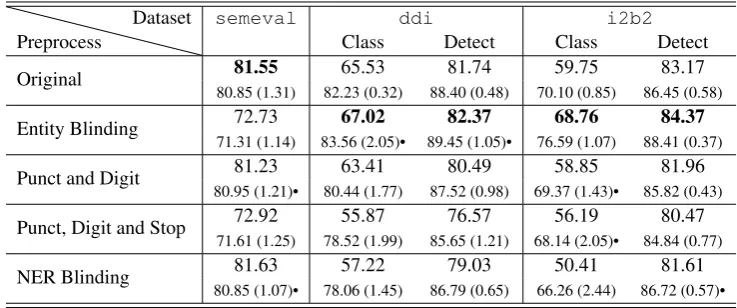
Often, papers fail to mention the importance of pre-processing in performance improvements. Ex-periments in table 4 reveal that they can cause larger variations in performance than modeling.
We applied pre-processing changes with the
CRCNN model with default hyperparameters for
semeval and manual hyperparameters for the
medical datasets. All comparisons are per-formed against the original pre-processing tech-nique, which involved using the original dataset sentences in training and test.
Punctuation and digits hold more importance for theddidataset, which is a biomedical dataset, compared to the other two datasets. We looked at examples where this technique led to an incor-rect prediction, but original pre-processing led to a correct one to investigate the source of perfor-mance further. The examples indicate that removal
of punctuation is driving worse performance com-pared to the normalization of digits. A detailed analysis for these is present in (Chauhan,2019).
Stop word removal is a common technique in Natural Language Processing (NLP) to simplify the sentence by cutting out commonly used words such astheandisin order to simplify the sentence. We found that stop words seem to be important for relation extraction for all three datasets that we looked at, to a smaller degree fori2b2compared to the other two datasets. Looking at examples misclassified by this technique revealed important stop words for different relations, which indicates that the removal of stop words is not beneficial in the relation extraction setting. Example types are shown in (Chauhan,2019).
The availability of fine-grained concept types is likely to boost performance in relation extrac-tion settings. The i2b2 dataset provided fine-grained concept types in the form of medical prob-lem, test and treatments. Entity blinding causes almost 9% improvement in classification perfor-mance and 1% improvement indetection perfor-mance. In contrast,ddionly provided gold stan-dard annotations for drug types in the sentence, and while this does not cause statistically signifi-cant improvements for cross validation, it does im-prove test set classification performance by about 1.5% and detection performance by 1%. For these medical datasets, NER blinding consisted of re-placing the detected named entities byEntity be-cause named entity types were not available. Due to the coarse-grained nature of the entities, it hurts classification performance significantly, and de-tectionperformance a little.
While entity blinding hurts performance for
semeval, possibly due to the coarse-grained
na-ture of the replacement, NER blinding does not hurt performance. Looking at misclassified exam-ples for entity blinding and NER blinding tech-niques supports this hypothesis (Chauhan,2019).
To recall, entity blinding involved replacement of entity words byEntity, while NER blinding in-volved replacing named entities in the sentence with labels such as ORGANIZATION and PER-SON. In settings where fine-grained entity blind-ing may not be helpblind-ing, they may be helpful as added features into the model, as shown by (Socher et al.,2012).
[image:5.595.96.266.249.350.2]pre-Preprocess
Dataset semeval ddi i2b2
Class Detect Class Detect
Original 81.55 65.53 81.74 59.75 83.17
80.85 (1.31) 82.23 (0.32) 88.40 (0.48) 70.10 (0.85) 86.45 (0.58)
Entity Blinding 72.73 67.02 82.37 68.76 84.37
71.31 (1.14) 83.56 (2.05)• 89.45 (1.05)• 76.59 (1.07) 88.41 (0.37)
Punct and Digit 81.23 63.41 80.49 58.85 81.96
80.95 (1.21)• 80.44 (1.77) 87.52 (0.98) 69.37 (1.43)• 85.82 (0.43)
Punct, Digit and Stop 72.92 55.87 76.57 56.19 80.47
71.61 (1.25) 78.52 (1.99) 85.65 (1.21) 68.14 (2.05)• 84.84 (0.77)
NER Blinding 81.63 57.22 79.03 50.41 81.61
80.85 (1.07)• 78.06 (1.45) 86.79 (0.65) 66.26 (2.44) 86.72 (0.57)•
Table 4: Pre-processing techniques with CRCNNmodel. Row labels Original = simple tokenization and lower casing of words, Punct = punctuation removal, Digit = digit removal and Stop = stop word removal. Test set results at the top with cross validated results (average with standard deviation) below. All cross validated results are statistically significant compared to Original pre-processing (p <0.05) using a paired t-test except those marked with a •
Modeling
Dataset semeval ddi i2b2
Class Detect Class Detect
CRCNN 81.55 65.53 81.74 59.75 83.17
80.85 (1.31) 82.23 (0.32) 88.40 (0.48) 70.10 (0.85) 86.45 (0.58)
Piecewise pool 81.59 63.01 80.62 60.85 83.69
80.55 (0.99)• 81.99 (0.38)• 88.47 (0.48)• 73.79 (0.97) 89.29 (0.61)
BERT-tokens 85.67 71.97 86.53 63.11 84.91
85.63 (0.83) 85.35 (0.53) 90.70 (0.46) 72.06 (1.36) 87.57 (0.75)
BERT-CLS 82.42 61.3 79.63 56.79 81.91
80.83 (1.18)• 82.71 (0.68)• 88.35 (0.77)• 67.37 (1.08) 85.43 (0.36)
ELMo 85.89 66.63 83.05 63.18 84.54
[image:6.595.113.482.62.216.2]84.79 (1.08) 84.53 (0.96) 90.11 (0.56) 72.53 (0.80) 87.81 (0.34)
Table 5: Modeling techniques with original pre-processing. Test set results at the top with cross validated results (average with standard deviation) below. All cross validated results are statistically significant compared toCRCNN model (p <0.05) using a paired t-test except those marked with a •. In terms of statistical significance, comparing contextualized embeddings with each other reveals that BERT-tokens is equivalent to ELMo fori2b2, but for semevalBERT-tokens is better than ELMo and forddiBERT-tokens is better than ELMo only for detection.
processing techniques, detection is relatively un-affected. In a setting where one cares more about detection of relationships rather than multi-class classification, one would be able to get away with using non-complicated pre-processing techniques to maintain reasonable performance.
5.2 Split Bias
All three datasets evaluate models based on one score on the test set, which is common practice for NLP challenges. Reporting one score as op-posed to a distribution of scores has been shown to be problematic by Reimers and Gurevych(2017) for sequence tagging. Recently,Crane(2018) dis-cuss similar problems for question-answering. We show that even if you keep the same random
ini-tialization seed (all our experiments have a fixed random initialization seed), split bias can be an-other source of variation in scores.
insignif-Hyperparam Tuning
Dataset semeval ddi i2b2
Class Detect Class Detect
Default 81.55 62.55 80.29 55.15 81.98
80.85 (1.31) 81.62 (1.35) 87.76 (1.03) 67.28 (1.83) 86.57 (0.58)
Manual Search - 65.53 81.74 59.75 83.17
82.23 (0.32)• 88.40 (0.48)• 70.10 (0.85) 86.45 (0.58)•
Random Search 82.2 62.29 79.04 55.0 80.77
[image:7.595.103.495.64.166.2]81.10 (1.26)• 75.43 (1.48) 83.54 (0.60) 60.66 (1.43) 82.73 (0.49)
Table 6: Hyperparameter tuning methods with original pre-processing and fixedCRCNNmodel. Test set results at the top with cross validated results (average with standard deviation) below. All cross validated results are statistically significant compared to Default withp <0.05except those marked with a •. Note that hyperparameter tuning can involve much higher performance variation depending on the distribution of the data. Therefore, even though there is no statistical significance in the manual search case for the held out fold in the ddi dataset, there was statistical significance for the dev fold which drove those set of hyperparameters. For both ddi and i2b2 datasets, manual search is better than random search withp <0.05.
Technique Task
Classification Detection
E + ent 70.46 86.17
77.70(1.26) 89.36 (0.50)
B + ent 70.56 85.66
76.72 (1.04) 88.63 (0.33)
E + piece + ent 70.62 86.14
79.41 (0.53) 90.37 (0.44)
B + piece + ent 71.01 86.26
79.51 (1.09) 90.34 (0.53)
piece + ent 69.73 85.44
78.12 (1.10) 89.74 (0.44)
E + piece 63.19 84.92
74.76 (0.68) 89.90 (0.37)
B + piece 63.23 85.45
74.67 (0.89) 89.61 (0.68)
Table 7: Additional experiments fori2b2. E = ELMo, B = BERT-tokens, ent = entity blinding, piece = piece-wise pooling. All results are statistically significant compared to BERT-tokens and ELMo models respec-tively from table5and piece + ent row is statistically significant compared to piecewise pool model as well as entity blinding model. These are all statistically sig-nificantly better than theCRCNNmodel from table5
icant.
No statistical significance is seen even when the test set result worsens in performance for BERT-CLS in table5where it hurts test set performance on ddi but is not statistically significant when cross validation is performed.
5.3 Modeling
In table 5, we tested the generalizability of the commonly used piecewise pooling technique pro-posed in (Zeng et al., 2015), a variant of which
Technique Task
Classification Detection
E + ent 68.69 83.72
86.25 (1.54) 91.35 (0.90)
B + ent 70.66 85.35
[image:7.595.322.510.281.358.2]85.79 (1.54) 91.26 (0.63)
Table 8: Additional experiments forddi. E = ELMo, B = BERT-tokens, ent = entity blinding. Results are not statistically significant compared to BERT-tokens and ELMo models respectively from table5and not from each other either.
was applied in the model byLuo et al. fori2b2. We also tested the improvements offered by differ-ent featurizations of contextualized embeddings, which has not been explored much for relation ex-traction.
Modeling changes were applied with the original pre-processing technique for the
CRCNN model with default hyperparameters
for semeval and manual hyperparameters
for the medical datasets. All comparisons are performed with the baseline performance of the
CRCNNmodel.
While piecewise pooling helps i2b2 by 1%, it hurts test set performance onddi and doesn’t affect performance on semeval. While it may be intuitive to split pooling by entity location, this technique is not generalizable to other datasets.
[image:7.595.86.277.282.482.2]datasets, but that BERT-CLS hurt performance for the medical datasets. While BERT-CLS boosted test set performance forsemeval, this was not found to be a statistically significant difference for cross validation. Note that we featurized ELMo similarly to BERT-tokens and the details are present in section3.2.
This indicates that the technique of featurizing the contextualized embeddings is important for a CNN architecture. Concatenating the contextual-ized embeddings with the word embeddings keeps a tighter coupling, which is helpful for relation ex-traction where the word level associations are es-sential in predicting the relation type.
5.4 Hyperparameter Tuning
Bergstra and Bengio (2012) show the superior-ity of random search over grid search in terms of faster convergence, but leave to future work automating the procedure of manual tuning, i.e. sequential optimization. Bayesian optimization strategies could help with this (Snoek et al.,2012) but often require expert knowledge for correct ap-plication. We tested how manual tuning, requiring less expert knowledge than Bayesian optimization, would compare to the random search strategy in table6. For bothi2b2andddicorpora, manual search outperformed random search.
5.5 Evaluation Metrics
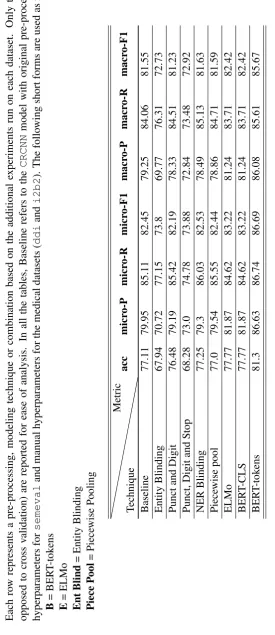
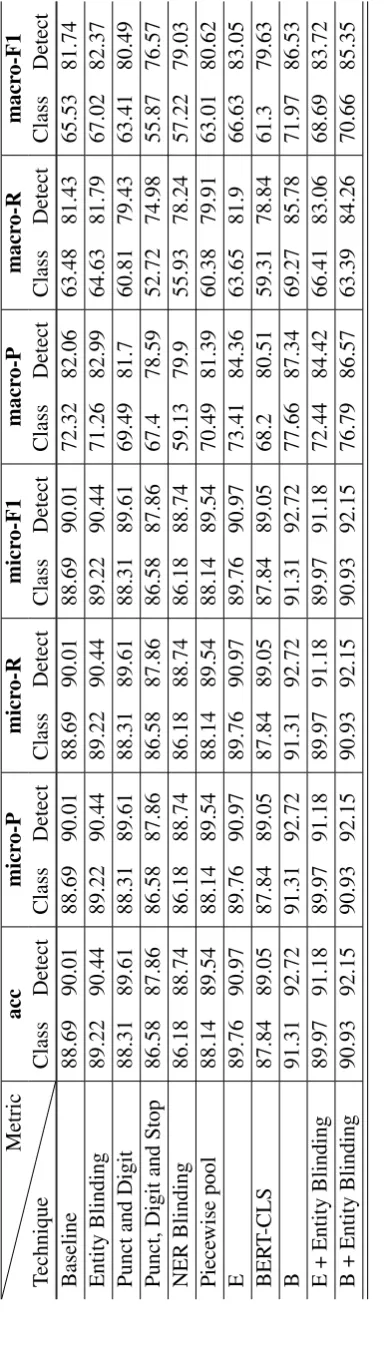
Picking the right evaluation metric for a dataset is critical, and it is important to choose a metric that has the biggest delta between different model per-formances for example types we care about. Ta-bles for different metric results for all datasets are provided in AppendixB.
When using micro and macro statistics (preci-sion, recall and F1), class imbalance dictates the one to pick. Macro statistics are highly affected by imbalance, whereas micro statistics are able to recover well. Despite suffering due to class imbal-ance, though, macro statistics may be more appro-priate than micro as they provide stronger discrim-inative capabilities by providing equal importance to classes of smaller sizes. However, micro statis-tics are as discriminative as macro statisstatis-tics in set-tings when the classes are relatively balanced. We are going to talk about theclassification tasks in the next two paragraphs.
Compared to semeval, ddi and i2b2 suf-fer from stark class imbalances. semevalhas a
number of examples in non-Other classes rang-ing from 200 or 300 to 1000. Other class has about 3000 examples which are not included in the official metric calculations.ddihas one class with 228 examples, while the others have about 1000 examples. TheNoneclass has 21,948 exam-ples which is included for the official score cal-culations. i2b2 has five classes in the 100-500 range, while the others contain about 2000 exam-ples. Noneis the largest class with 19,934 exam-ples.
Using micro statistics is reasonable for i2b2
because the highly imbalanced class is not in-cluded in the calculations. Therefore, this metric is able to be as discriminative as macro statistics. For example, test set micro F1 between baseline and entity blinding techniques is 59.75 and 68.76, while that for macro F1 is 36.44 and 43.76. In con-trast, using micro statistics is a bad idea forddi
because the performance on theNoneclass would drive most of the predictive results of the model. For example, micro-F1 between baseline and NER blinding is 88.69 and 86.18, whereas macro-F1 is 65.53 and 57.22. semevaldoes not have a stark contrast between micro and macro scores due to Otherclass not being included in the calculation. Using either metric to evaluate models is reason-able for this dataset.
The detection task does not suffer from such variations due to the lower class imbalance. For example,ddidataset micro-F1 between baseline and NER blinding model is 90.01 and 88.74, while macro-F1 is 81.74 and 79.03. This further sug-gests that modeling differences and pre-processing differences cause more variation in performance in settings when the class imbalance is higher.
6 Comparison with SOTA
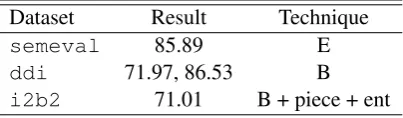
The best classification test set results found are listed in table 9. Note that we do not compare theextractiontask for datasets other thanddi be-cause the official challenges only compared classi-ficationresults. Even though the official challenge did not rank models based on thedetection task, recent papers in theddi literature mention these results.
Wang et al. (2016) report a result of 88% on
semeval and do not provide any public source
Dataset Result Technique
semeval 85.89 E
ddi 71.97, 86.53 B
i2b2 71.01 B + piece + ent
Table 9: Best test set classification results for all datasets, exceptddiwheredetectionresults are men-tioned after the classification results. piece = Piece-wise pooling, ent = entity blinding, E = ELMo, B = BERT-tokens. Result corresponds to F1 scores, macro forsemevalandddi, but micro fori2b2.
this dataset.Zheng et al.(2017) report the best re-sult onddi(77.3%) but perform negative instance filtering, which is a highly specific pre-processing technique that does not fit with the flexible na-ture ofREflex. This technique cuts specific ex-amples from the dataset, but the paper is unclear about whether train as well as test data are short-ened. If the test data is being shortened, the per-formance comparison becomes unfair due to eval-uation on different test samples. Unfortunately, source code was not publicly available to answer these questions.
Note thatZhao et al.(2016) show that negative instance filtering causes a 4.1% improvement in test set performance. IfREflexwere to use this pre-processing technique, it would reach close to the state-of-the-art (SOTA) number on the classi-ficationtask. On the other hand, results from the detectionresultsoutperformthis model by 2.53%.
Sahu et al. (2016) (code unavailable) report a state of the art result of 71.16% oni2b2, which the results in table9are able to match. Note that (Rink et al.,2011) report a result of 73.7% with a support vector machine, but they used a larger ver-sion of the dataset. Comparison against different subsets of the dataset would not be fair.
Comparison against these numbers demon-strates that REflex is the only open-source framework, providing performance near SOTA ranges for the three datasets. Therefore,REflex
can be used as a strong baseline model in future relation extraction studies.
7 Conclusion
Our findings reveal variations offered by pre-processing and training methodologies, which of-ten go unreported. They indicate that comparing models without having these techniques standard-ized can make it difficult to assess the true source
of performance gains. Our key findings are:
1. Pre-processing can have a strong effect on performance, sometimes more than modeling techniques, as is the case ofi2b2. Concept types seem to offer useful information, perhaps reveal-ing more general semantic information in the sen-tence that can help with predictions. Fine-grained Gold standard annotated concept types are most beneficial, but those from automatically extracted packages may also be useful as long as they con-sist of multiple types. Punctuation and digits may hold more importance in biomedical settings, but stop words hold significance in all settings.
2. Reporting on one test set score can be prob-lematic due to split bias, and a cross validation ap-proach with significance tests may help ease some of this bias. Drug blinding forddiis commonly used in the literature but does not seem to offer any statistically significant improvements. Therefore, it is unnecessary to use in this domain.
3. Contextualized embeddings are generally helpful but the featurizing technique is important: for CNN models, concatenating them with the word embeddings before convolution is most ben-eficial.
4. Picking the right hyperparameters for a dataset is important to performance. We suggest an initial manual hyperparameter search based on cross validation significance tests because that may be sufficient in most cases. If one is not pressed for time, random search is a reasonable au-tomated option for hyperparameter tuning, but re-quires more experience for picking the right search space and the right distributions for the hyperpa-rameters.
5. Picking the right evaluation metrics for a new dataset should be driven by class imbalance issues for the classes chosen to be evaluated on.
Acknowledgments
[image:9.595.81.283.63.122.2]References
Heike Adel, Benjamin Roth, and Hinrich Sch¨utze. 2016. Comparing convolutional neural networks to traditional models for slot filling. InProceedings of the 2016 Conference of the North American Chap-ter of the Association for Computational Linguis-tics: Human Language Technologies, pages 828– 838. Association for Computational Linguistics.
Emily Alsentzer, John R Murphy, Willie Boag, Wei-Hung Weng, Di Jin, Tristan Naumann, and Matthew McDermott. 2019. Publicly available clinical bert embeddings. arXiv preprint arXiv:1904.03323.
Shaojie Bai, J Zico Kolter, and Vladlen Koltun. 2018. An empirical evaluation of generic convolu-tional and recurrent networks for sequence model-ing. arXiv preprint arXiv:1803.01271.
James Bergstra and Yoshua Bengio. 2012. Random search for hyper-parameter optimization. Journal of Machine Learning Research, 13(Feb):281–305.
Rui Cai, Xiaodong Zhang, and Houfeng Wang. 2016. Bidirectional recurrent convolutional neural network for relation classification. In Proceedings of the 54th Annual Meeting of the Association for Compu-tational Linguistics (Volume 1: Long Papers), vol-ume 1, pages 756–765.
Gavin C Cawley and Nicola LC Talbot. 2010. On over-fitting in model selection and subsequent selection bias in performance evaluation. Journal of Machine Learning Research, 11(Jul):2079–2107.
Geeticka Chauhan. 2019. REflex: Flexible Framework for Relation Extraction in Multiple Domains. Mas-ter’s thesis, Massachusetts Institute of Technology.
Veera Raghavendra Chikka and Kamalakar Karla-palem. 2018. A hybrid deep learning approach for medical relation extraction.CoRR.
Marc Claesen and Bart De Moor. 2015. Hyperpa-rameter search in machine learning. arXiv preprint arXiv:1502.02127.
Ronan Collobert, Jason Weston, L´eon Bottou, Michael Karlen, Koray Kavukcuoglu, and Pavel Kuksa. 2011. Natural language processing (almost) from scratch. Journal of Machine Learning Research, 12(Aug):2493–2537.
Matt Crane. 2018. Questionable answers in question answering research: Reproducibility and variability of published results.Transactions of the Association of Computational Linguistics, 6:241–252.
Jacob Devlin, Ming-Wei Chang, Kenton Lee, and Kristina Toutanova. 2018. Bert: Pre-training of deep bidirectional transformers for language understand-ing. arXiv preprint arXiv:1810.04805.
Javid Ebrahimi and Dejing Dou. 2015. Chain based rnn for relation classification. InProceedings of the 2015 Conference of the North American Chapter of the Association for Computational Linguistics: Hu-man Language Technologies, pages 1244–1249.
Antske Fokkens, Marieke Van Erp, Marten Postma, Ted Pedersen, Piek Vossen, and Nuno Freire. 2013. Offspring from reproduction problems: What repli-cation failure teaches us. In Proceedings of the 51st Annual Meeting of the Association for Compu-tational Linguistics (Volume 1: Long Papers), vol-ume 1, pages 1691–1701.
Roxana Girju, Preslav Nakov, Vivi Nastase, Stan Sz-pakowicz, Peter Turney, and Deniz Yuret. 2007. Semeval-2007 task 04: Classification of semantic re-lations between nominals. InProceedings of the 4th International Workshop on Semantic Evaluations, pages 13–18. Association for Computational Lin-guistics.
Kazuma Hashimoto, Makoto Miwa, Yoshimasa Tsu-ruoka, and Takashi Chikayama. 2013. Simple cus-tomization of recursive neural networks for semantic relation classification. InProceedings of the 2013 Conference on Empirical Methods in Natural Lan-guage Processing, pages 1372–1376.
Bin He, Yi Guan, and Rui Dai. 2018a. Classifying medical relations in clinical text via convolutional neural networks. Artificial intelligence in medicine.
Bin He, Yi Guan, and Rui Dai. 2018b. Convolutional gated recurrent units for medical relation classifica-tion. CoRR, abs/1807.11082.
Iris Hendrickx, Su Nam Kim, Zornitsa Kozareva, Preslav Nakov, Diarmuid ´O S´eaghdha, Sebastian Pad´o, Marco Pennacchiotti, Lorenza Romano, and Stan Szpakowicz. 2009. Semeval-2010 task 8: Multi-way classification of semantic relations be-tween pairs of nominals. In Proceedings of the Workshop on Semantic Evaluations: Recent Achievements and Future Directions, pages 94–99. Association for Computational Linguistics.
Degen Huang, Zhenchao Jiang, Li Zou, and Lishuang Li. 2017. Drug-drug interaction extraction from biomedical literature using support vector machine and long short term memory networks. Information Sciences, 415.
Darrel C Ince, Leslie Hatton, and John Graham-Cumming. 2012. The case for open computer pro-grams. Nature, 482(7386):485.
Wen Juan Hou and Bamfa Ceesay. 2018. Extraction of drug-drug interaction using neural embedding. Journal of Bioinformatics and Computational Biol-ogy, 16.
Nal Kalchbrenner, Edward Grefenstette, and Phil Blun-som. 2014. A convolutional neural network for modelling sentences. In Proceedings of the 52nd Annual Meeting of the Association for Computa-tional Linguistics (Volume 1: Long Papers), pages 655–665. Association for Computational Linguis-tics.
Ramakanth Kavuluru, Anthony Rios, and Tung Tran. 2017. Extracting drug-drug interactions with word and character-level recurrent neural networks. 2017 IEEE International Conference on Healthcare Infor-matics (ICHI), pages 5–12.
Jinhyuk Lee, Wonjin Yoon, Sungdong Kim, Donghyeon Kim, Sunkyu Kim, Chan Ho So, and Jaewoo Kang. 2019. Biobert: pre-trained biomed-ical language representation model for biomedbiomed-ical text mining. arXiv preprint arXiv:1901.08746.
Omer Levy, Minjoon Seo, Eunsol Choi, and Luke Zettlemoyer. 2017. Zero-shot relation extraction via reading comprehension. In Proceedings of the 21st Conference on Computational Natural Lan-guage Learning (CoNLL 2017), pages 333–342. As-sociation for Computational Linguistics.
Fei Li, Meishan Zhang, Guohong Fu, and Donghong Ji. 2017. A neural joint model for entity and relation extraction from biomedical text. BMC bioinformat-ics, 18(1):198.
Jiwei Li and Dan Jurafsky. 2015. Do multi-sense em-beddings improve natural language understanding? arXiv preprint arXiv:1506.01070.
Q. Li, Z. Yang, L. Luo, L. Wang, Y. Zhang, H. Lin, J. Wang, L. Yang, K. Xu, and Y. Zhang. 2018a. A multi-task learning based approach to biomed-ical entity relation extraction. In 2018 IEEE International Conference on Bioinformatics and Biomedicine (BIBM), pages 680–682.
Yifu Li, Ran Jin, and Yuan Luo. 2018b. Classifying relations in clinical narratives using segment graph convolutional and recurrent neural networks (seg-gcrns). Journal of the American Medical Informat-ics Association, 26(3):262–268.
Sangrak Lim and Jaewoo Kang. 2018a. Chemicalgene relation extraction using recursive neural network. InDatabase.
Sangrak Lim and Jaewoo Kang. 2018b. Drug drug in-teraction extraction from the literature using a recur-sive neural network. InPloS one.
Sangrak Lim, Kyubum Lee, and Jaewoo Kang. 2018. Drug drug interaction extraction from the literature using a recursive neural network. Plos one, 13:1–17.
Shengyu Liu, Kai Chen, Qingcai Chen, and Buzhou Tang. 2016a. Dependency-based convolutional neu-ral network for drug-drug interaction extraction. 2016 IEEE International Conference on Bioinfor-matics and Biomedicine (BIBM), pages 1074–1080.
Shengyu Liu, Buzhou Tang, Qingcai Chen, and Xiao-long Wang. 2016b. Drug-drug interaction extraction via convolutional neural networks. Computational and mathematical methods in medicine, 2016.
Yuan Luo. 2017. Recurrent neural networks for classi-fying relations in clinical notes. Journal of Biomed-ical Informatics, 72.
Yuan Luo, Yu Cheng, ¨Ozlem Uzuner, Peter Szolovits, and Justin Starren. 2017. Segment convolutional neural networks (seg-cnns) for classifying relations in clinical notes. Journal of the American Medical Informatics Association, 25(1):93–98.
Xinbo Lv, Yi Guan, Jinfeng Yang, and Jiawei Wu. 2016. Clinical relation extraction with deep learn-ing. InInternational Journal of Hybrid Information Technology.
Makoto Miwa and Mohit Bansal. 2016. End-to-end re-lation extraction using lstms on sequences and tree structures. InProceedings of the 54th Annual Meet-ing of the Association for Computational LMeet-inguistics (Volume 1: Long Papers), pages 1105–1116. Asso-ciation for Computational Linguistics.
Dat Quoc Nguyen and Karin Verspoor. 2018. Convolu-tional neural networks for chemical-disease relation extraction are improved with character-based word embeddings. arXiv preprint arXiv:1805.10586.
Thien Huu Nguyen and Ralph Grishman. 2015. Com-bining neural networks and log-linear models to im-prove relation extraction. CoRR, abs/1511.05926.
Matthew Peters, Mark Neumann, Mohit Iyyer, Matt Gardner, Christopher Clark, Kenton Lee, and Luke Zettlemoyer. 2018. Deep contextualized word repre-sentations. InProceedings of the 2018 Conference of the North American Chapter of the Association for Computational Linguistics: Human Language Technologies, Volume 1 (Long Papers), pages 2227– 2237. Association for Computational Linguistics.
Sampo Pyssalo, Filip Ginter, Hans Moen, Tapio Salakoski, and Sophia Ananiadou. 2013. Distribu-tional semantics resources for biomedical text pro-cessing. In Proceedings of the 5th International Symposium on Languages in Biology and Medicine, Tokyo, Japan, pages 39–43.
Pengda Qin, Weiran Xu, and Jun Guo. 2016. An empirical convolutional neural network approach for semantic relation classification. Neurocomput., 190:1–9.
Nils Reimers and Iryna Gurevych. 2017. Reporting score distributions makes a difference: Performance study of lstm-networks for sequence tagging. In Proceedings of the 2017 Conference on Empirical Methods in Natural Language Processing, pages 338–348, Copenhagen, Denmark. Association for Computational Linguistics.
Bryan Rink, Sanda Harabagiu, and Kirk Roberts. 2011. Automatic extraction of relations between medical concepts in clinical texts. Journal of the American Medical Informatics Association, 18(5):594–600.
Jonathan Rotsztejn, Nora Hollenstein, and Ce Zhang. 2018. Eth-ds3lab at semeval-2018 task 7: Effec-tively combining recurrent and convolutional neural networks for relation classification and extraction. InProceedings of The 12th International Workshop on Semantic Evaluation, pages 689–696. Associa-tion for ComputaAssocia-tional Linguistics.
Mohammed Saeed, Mauricio Villarroel, Andrew T Reisner, Gari Clifford, Li-Wei Lehman, George Moody, Thomas Heldt, Tin H Kyaw, Benjamin Moody, and Roger G Mark. 2011. Multiparameter intelligent monitoring in intensive care ii (mimic-ii): a public-access intensive care unit database. Critical care medicine, 39(5):952.
Sunil Sahu, Ashish Anand, Krishnadev Oruganty, and Mahanandeeshwar Gattu. 2016. Relation extraction from clinical texts using domain invariant convolu-tional neural network. In Proceedings of the 15th Workshop on Biomedical Natural Language Pro-cessing, pages 206–215. Association for Computa-tional Linguistics.
Sunil Kumar Sahu and Ashish Anand. 2018. Drug-drug interaction extraction from biomedical texts us-ing long short-term memory network. Journal of Biomedical Informatics, 86:15 – 24.
Cicero Nogueira dos Santos, Bing Xiang, and Bowen Zhou. 2015. Classifying relations by ranking with convolutional neural networks. arXiv preprint arXiv:1504.06580.
Guergana K Savova, James J Masanz, Philip V Ogren, Jiaping Zheng, Sunghwan Sohn, Karin C Kipper-Schuler, and Christopher G Chute. 2010. Mayo clin-ical text analysis and knowledge extraction system (ctakes): architecture, component evaluation and ap-plications. Journal of the American Medical Infor-matics Association, 17(5):507–513.
Isabel Segura-Bedmar, Paloma Mart´ınez, and Mar´ıa Herrero Zazo. 2013. Semeval-2013 task 9: Extraction of drug-drug interactions from biomedical texts (ddiextraction 2013). In Second Joint Conference on Lexical and Computational Semantics (* SEM), Volume 2: Proceedings of the Seventh International Workshop on Semantic Evaluation (SemEval 2013), volume 2, pages 341–350.
Jasper Snoek, Hugo Larochelle, and Ryan P Adams. 2012. Practical bayesian optimization of machine learning algorithms. InAdvances in neural informa-tion processing systems, pages 2951–2959.
Richard Socher, Brody Huval, Christopher D Manning, and Andrew Y Ng. 2012. Semantic compositional-ity through recursive matrix-vector spaces. In Pro-ceedings of the 2012 joint conference on empirical methods in natural language processing and com-putational natural language learning, pages 1201– 1211. Association for Computational Linguistics.
Simon Suster, Madhumita Sushil, and Walter Daele-mans. 2018. Revisiting neural relation classifica-tion in clinical notes with external informaclassifica-tion. In Proceedings of the Ninth International Workshop on Health Text Mining and Information Analysis, pages 22–28. Association for Computational Linguistics.
¨
Ozlem Uzuner, Brett R South, Shuying Shen, and Scott L DuVall. 2011. 2010 i2b2/va challenge on concepts, assertions, and relations in clinical text. Journal of the American Medical Informatics Asso-ciation, 18(5):552–556.
Ngoc Thang Vu, Heike Adel, Pankaj Gupta, and Hin-rich Sch¨utze. 2016. Combining recurrent and convo-lutional neural networks for relation classification. InProceedings of the 2016 Conference of the North American Chapter of the Association for Computa-tional Linguistics: Human Language Technologies, pages 534–539. Association for Computational Lin-guistics.
Linlin Wang, Zhu Cao, Gerard De Melo, and Zhiyuan Liu. 2016. Relation classification via multi-level at-tention CNNs. InProceedings of the 54th annual meeting of the Association for Computational Lin-guistics (volume 1: long papers), volume 1, pages 1298–1307.
Peng Wang, Jiaming Xu, Bo Xu, Chenglin Liu, Heng Zhang, Fangyuan Wang, and Hongwei Hao. 2015. Semantic clustering and convolutional neural net-work for short text categorization. InProceedings of the 53rd Annual Meeting of the Association for Computational Linguistics and the 7th International Joint Conference on Natural Language Processing (Volume 2: Short Papers), volume 2, pages 352–357.
Wei Wang, Xi Yang, Canqun Yang, Xiao-Wei Guo, Xi-ang ZhXi-ang, and Chengkun Wu. 2017. Dependency-based long short term memory network for drug-drug interaction extraction. BMC Bioinformatics, 18.
Kun Xu, Yansong Feng, Songfang Huang, and Dongyan Zhao. 2015a. Semantic relation clas-sification via convolutional neural networks with simple negative sampling. arXiv preprint arXiv:1506.07650.
with data augmentation. InProceedings of COLING 2016, the 26th International Conference on Compu-tational Linguistics: Technical Papers, pages 1461– 1470. The COLING 2016 Organizing Committee.
Yan Xu, Lili Mou, Ge Li, Yunchuan Chen, Hao Peng, and Zhi Jin. 2015b. Classifying relations via long short term memory networks along shortest depen-dency paths. InProceedings of the 2015 conference on empirical methods in natural language process-ing, pages 1785–1794.
Wenpeng Yin, Katharina Kann, Mo Yu, and Hin-rich Sch¨utze. 2017. Comparative study of cnn and rnn for natural language processing. CoRR, abs/1702.01923.
Mo Yu, Matthew Gormley, and Mark Dredze. 2014. Factor-based compositional embedding models. In NIPS Workshop on Learning Semantics, pages 95– 101.
Daojian Zeng, Kang Liu, Yubo Chen, and Jun Zhao. 2015. Distant supervision for relation extraction via piecewise convolutional neural networks. In Pro-ceedings of the 2015 Conference on Empirical Meth-ods in Natural Language Processing, pages 1753– 1762.
Daojian Zeng, Kang Liu, Siwei Lai, Guangyou Zhou, and Jun Zhao. 2014. Relation classification via con-volutional deep neural network. In Proceedings of COLING 2014, the 25th International Conference on Computational Linguistics: Technical Papers, pages 2335–2344.
Dongxu Zhang and Dong Wang. 2015. Relation classi-fication via recurrent neural network.arXiv preprint arXiv:1508.01006.
Shu Zhang, Dequan Zheng, Xinchen Hu, and Ming Yang. 2015a. Bidirectional long short-term memory networks for relation classification. InProceedings of the 29th Pacific Asia Conference on Language, Information and Computation, pages 73–78.
Xiang Zhang, Junbo Zhao, and Yann LeCun. 2015b. Character-level convolutional networks for text clas-sification. In Advances in neural information pro-cessing systems, pages 649–657.
Yuhao Zhang, Peng Qi, and Christopher D. Manning. 2018. Graph convolution over pruned dependency trees improves relation extraction. InProceedings of the 2018 Conference on Empirical Methods in Nat-ural Language Processing, pages 2205–2215. Asso-ciation for Computational Linguistics.
Zhehuan Zhao, Zhihao Yang, Ling Luo, Hongfei Lin, and Jian Wang. 2016. Drug drug interac-tion extracinterac-tion from biomedical literature using syn-tax convolutional neural network. Bioinformatics, 32(22):3444–3453.
![Table 2: Hyperparameters explored for the first passof manual search. lr decay means learning rate decayat [60, 120] epochs, pos embed refers to the positionembedding size.](https://thumb-us.123doks.com/thumbv2/123dok_us/180075.514883/5.595.96.266.249.350/table-hyperparameters-explored-learning-decayat-epochs-refers-positionembedding.webp)