Model Architectures for Quotation Detection
Christian Scheible, Roman Klinger and Sebastian Pad´o Institut f¨ur Maschinelle Sprachverarbeitung
Universit¨at Stuttgart
{scheibcn,klinger,pado}@ims.uni-stuttgart.de
Abstract
Quotation detection is the task of locating spans of quoted speech in text. The state of the art treats this problem as a sequence labeling task and employs linear-chain con-ditional random fields. We question the ef-ficacy of this choice: The Markov assump-tion in the model prohibits it from making joint decisions about the begin, end, and internal context of a quotation. We per-form an extensive analysis with two new model architectures. We find that (a), sim-ple boundary classification combined with a greedy prediction strategy is competitive with the state of the art; (b), a semi-Markov model significantly outperforms all others, by relaxing the Markov assumption.
1 Introduction
Quotations are occurrences of reported speech, thought, and writing in text. They play an impor-tant role in computational linguistics and digital humanities, providing evidence for, e.g., speaker relationships (Elson et al., 2010), inter-speaker sen-timent (Nalisnick and Baird, 2013) or politeness (Faruqui and Pado, 2012). Due to a lack of general-purpose automatic systems, such information is often obtained through manual annotation (e.g., Agarwal et al. (2012)), which is labor-intensive and costly. Thus, models forautomatic quotation detec-tionform a growing research area (e.g., Pouliquen et al. (2007); Pareti et al. (2013)).
Quotation detection looks deceptively simple, but is challenging, as the following example shows:
[The pipeline], the company said, [would be built by a proposed joint venture . . . , and Trunkline . . . will “build and operate” the system . . . ].1
1Penn Attributions Relation Corpus (PARC),wsj 0260
Note that quotations can (i) be signalled by lexi-cal cues (e.g., communication verbs) without quota-tion marks, (ii) contain misleading quotaquota-tion marks; (iii) be discontinuous, and (iv) be arbitrarily long.
Early approaches to quotation detection use hand-crafted rules based on syntactic mark-ers (Pouliquen et al., 2007; Krestel et al., 2008). While yielding high precision, they suffered from low recall. The state of the art (Pareti et al., 2013; Pareti, 2015) treats the task as a sequence classifi-cation problem and uses a linear-chain conditional random field (CRF). This approach works well for the prediction of the approximate location of quo-tations, but yields a lower performance detecting their exact span.
In this paper, we show that linear-chain sequence models are a sub-optimal choice for this task. The main reason is their length, as remarked above: Most sequence labeling tasks in NLP (such as most cases of named entity recognition) deal with spans of a few tokens. In contrast, the median quotation length on the Penn Attributions Relation Corpus (PARC, Pareti et al. (2013)) is 16 tokens and the longest span has over 100 tokens. As a result of the strong Markov assumptions that linear-chain CRFs make to ensure tractability, they cannot capture “global” properties of (almost all) quotations and are unable to make joint decisions about the begin point, end point, and content of quotations.
As our first main contribution in this paper, we propose two novel model architectures designed to investigate this claim. The first issimplerthan the CRF. It uses token-level classifiers to predict quotation boundaries and combines the boundaries greedily to predict spans. The second model is
more expressive. It is a semi-Markov sequence
model which relaxes the Markov assumption, en-abling it to consider global features of quotation spans. In our second main contribution, an analysis of the models’ performances, we find that the
pler model is competitive with the state-of-the-art CRF. The semi-Markov model outperforms both of them significantly by 3 % F1. This demonstrates that the relaxed Markov assumptions help improve performance. Our final contribution is to make implementations of all models publicly available.2
2 The Task: Quotation Detection
Problem Definition Following the terminology established by Pareti et al. (2013), we deal with the detection ofcontent spans, the parts of the text that are being quoted. To locate such spans, it is helpful to first detect cues which often mark the begin-ning or end of a quotation. The following example shows an annotated sentence from the PARC cor-pus; each content span (CONT) is associated with
exactly one cue span (CUE):
Mr. Kaye [denies]CUE [the suit’s
charges]CONT and [says]CUE [his only
mistake was taking on Sony in the marketplace]CONT.3
Pareti et al. (2013) distinguish three types of quo-tations. Direct quotations are fully enclosed in quotation marks and are a verbatim reproduction of the original utterance.Indirectquotations para-phrase the original utterance and have no quotation marks. Mixed quotations contain both verbatim and paraphrase content and may thus contain quo-tation marks. Note that the type of a content span is assigned automatically based on its surface form using the definitions just given.
Quotation Detection as Sequence Modeling In this paper, we compare our new model architec-tures to the state-of-the-art approach by Pareti (2015), an extension of Pareti et al. (2013). Their system is a pipeline: Its first component is thecue
model, a token-levelk-NN classifier applied to the
syntactic heads of all verb groups. After cues are detected, content spans are localized using the
con-tent model, a linear-chain conditional random field
(CRF) which makes use of the location of cues in the document through features.
As their system is not publicly available, we re-implement it. Our cue classifier is an averaged perceptron (Collins, 2002) which we describe in more detail in the following section. It uses the
2http://www.ims.uni-stuttgart.de/data/qsample 3PARC,wsj 2418
C1. Surface form, lemma, and PoS tag for all tokens within a window of±5.
C2. Bigrams of surface form, lemma, and PoS tag C3. Shape ofti
C4. Is any token in a window of±5 a named entity? C5. Does a quotation mark open or close atti(determined by
counting)? Istiwithin quotation marks?
C6. Istiin the list of reporting verbs, noun cue verbs, titles,
WordNet persons or organizations, and its VerbNet class C7. Do a sentence, paragraph, or the document begin or end
atti,ti−1, orti+1?
C8. Distance to sentence begin and end; sentence length C9. Does the sentence contain ti a pronoun/named
en-tity/quotation mark?
C10. Does a syntactic constituent starts or ends atti?
C11. Level oftiin the constituent tree
C12. Label and level of the highest constituent in the tree starting atti; label ofti’s the parent node
C13. Dependency relation with parent or any child ofti(with
and without parent surface form) C14. Any conjunction of C5, C9, C10
Table 1: Cue detection features for a token ti at
positioni, mostly derived from Pareti (2015)
S1. Is a direct or indirect dependency parent ofticlassified
as a cue, in the cue list, or the phrase “according to”? S2. Was any token in a window of±5 classified as a cue? S3. Distance to the previous and next cue
S4. Does the sentence containingtihave a cue?
S5. Conjunction of S4 and all features from C14
Table 2: Additional features for content span detec-tion, mostly derived from Pareti (2015)
features in Table 1.4 Our content model is a CRF
with BIOE labels. It uses all features from Table 1 plus features that build on the output of the cue classifier, shown in Table 2.
3 New Model Architectures
While Pareti (2015) apply sequence modeling for quotation detection, they do not provide an analysis what the model learns. In this paper, we follow the intuition that a linear-chain CRF mostly makes local decisions about spans, while ignoring their global structure, such as joint information about the context of the begin and end points. If this is true, then (a) a model might work as well as the CRF without learning from label sequences, and (b) a model which makes joint decisions with global information might improve over the CRF.
This motivates our two new model architectures for the task. We illustrate the way the different architectures make use of information in Figure 1. Our simpler model (GREEDY) makes strictly
lo-cal classification decisions, completely ignoring
ti CRF:
GREEDY:
SEMIMARKOV:
ti+1 ti+2 ti+3 ti+4 ti+5 ti+6
ti ti+1 ti+2 ti+3 ti+4 ti+5 ti+6
[image:3.595.74.290.61.129.2]ti ti+1 ti+2 ti+3 ti+4 ti+5 ti+6
Figure 1: Information usage by model architecture. Frames indicate joint decisions on token labels.
cue classifier
begin
classifier classifierend
greedy combination
(GREEDY)
semi-Markov model (SEMIMARKOV)
cue detection
boundary detection
span detection
linear-chain conditional random field
(Pareti et al. 2013, Pareti
2015)
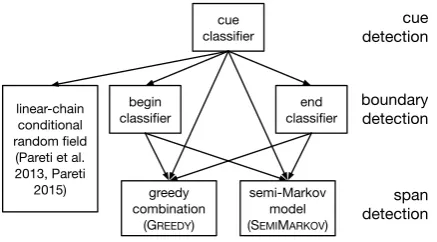
Figure 2: Information flow in all three models
those around it. The CRF is able to coordinate decisions within a window, which is propagated through Viterbi decoding. The more powerful model (SEMIMARKOV) takes the full span into
account and makes a joint decision about the begin and end points.
Our intuition about the shortcomings of the CRF is based on an empirical analysis. However, to sim-plify the presentation, we postpone the presentation of this analysis to Section 6 where we can discuss and compare the results of all three models.
3.1 Model Decomposition and Formalization
We first introduce a common formalization for our model descriptions. Our problem of interest is
con-tent span detection, the task of predicting a setSof
content spans(tb, te)delimited by their begin and
end tokens. The CRF solves this task by classifying tokens as begin/end/inside/outside tokens and thus solves a proxy problem. The problem is difficult because corresponding begin and end points need to be matched up over long distances, a challenge for probabilistic finite state automata such as CRFs.
In our model,cue detection, the task of detect-ing cue tokenstc(cf. Section 2), remains the first
step. However, we then decompose the content span problem solved by the CRF by introducing the intermediary task ofboundary detection. As illustrated in Figure 2, this means identifying the sets of allbeginandendtokens,tbandte, ignoring
their interdependencies. We then recombine these
Algorithm 1GREEDYcontent span algorithm
Input: List of documentsD; feature functionsfxfor cue, begin, and end (x ∈ c, b, e); distance parameterdmax;
length parameter`max
Output: Content span labelingS
1: θc,θb,θe←TRAINCLASSIFIERS(D,fc,fb,fe) 2: fordinDdo
3: S ←∅
4: fortokentinddo
5: if θc·fc(t)>0 then
6: tb←next token right oft .next begin
whereθb·fb(t)>0
7: te←next token right oftb .next end
whereθe·fe(t)>0 8: if|tb−tc| ≤dmax
and|te−tb| ≤`max
andOVERLAPPING(tb, te) =∅ then
9: S ← S ∪{(tb, te)} .add span
predictions with two different strategies, as detailed in Section 3.2 and Section 3.3. This decomposition has two advantages: (a), we expect that boundary detection is easier than content span detection, as we remove the combinatorial complexity of match-ing begin and end tokens; (b), begin, end, and cue detection are now three identical classification tasks that can be solved by the same machinery.
We model each of the three tasks (cue/begin/end detection) with a linear classifier of the form
scorex(t) =θx·fx(t) (1)
for a tokent, a classx ∈ {c, b, e}(forcue,begin, andend), a feature extraction functionfx(t), and a weight vectorθx. We re-use the feature templates
from Section 2 to remain comparable to the CRF. We estimate all parameters θx with the
per-ceptron algorithm, and use parameter averaging (Collins, 2002). Since class imbalances, which occur in the boundary detection tasks, can have strong effects (Barandela et al., 2003), we train the perceptron with uneven margins (Li et al., 2002). This variant introduces two learning margins:τ−1 for the negative class andτ+1for the positive class. Increasingτ+1 at a constant τ−1 increases recall (as failure to predict this class is punished more), potentially at the loss of precision, and vice versa.
3.2 Greedy Span Detection
Our first new model, GREEDY(Figure 2, bottom
[image:3.595.72.291.180.301.2]we add all spans within a given distancedmaxfrom the cue whose length is below a given maximum
`max. If the candidate span is OVERLAPPINGwith any existing spans, we discard it. Analogously, we search for spans to the left of the cue. The algo-rithm is motivated by the structure of attribution relations: each content span has one associated cue.
3.3 Semi-Markov Span Detection
Our second model extends the CRF into a semi-Markov architecture which is able to
han-dle global features of quotation span candidates
(SEMIMARKOV, Figure 2 bottom right).
Follow-ing previous work (Sarawagi and Cohen, 2004), we relax the Markov assumption inside spans. This al-lows for extracting arbitrary features on each span, such as conjunctions of features on the begin and end tokens or occurrence counts within the span.
Unfortunately, the more powerful model archi-tecture comes at the cost of a more difficult predic-tion problem. Sarawagi and Cohen (2004) propose a variant of the Viterbi algorithm. This however does not scale to our application, since the maxi-mum length of a span factors into the prediction runtime, and quotations can be arbitrarily long. As an alternative, we propose a sampling-based ap-proach: we draw candidate spans (proposals) from an informed, non-uniform distribution of spans. We score these spans to decide whether they should be added to the document (accepted) or not (rejected). This way, we efficiently traverse the space of po-tential span assignments while still being able to make informed decisions (cf. Wick et al. (2011)).
To obtain a distribution over spans, we adapt the approach by Zhang et al. (2015). We introduce two independent probability distributions: Pb is
the distribution of probabilities of a token being a
begin token;Peis the distribution of probabilities
of a token being anend token. We sample a single content span proposal (DRAWPROPOSAL) by first
sampling theorderin which the boundaries are to be determined (begin token or end token first) by sampling a binary variabled∼Bernoulli(0.5). If the begin token is to be sampled first, we continue by drawing a begin tokentb ∼Pband finally draw
an end token te ∼ Pe within a window of up to `maxtokens to the right oftb. If the end token is to
be sampled first, we proceed conversely. We also propose empty spans, i.e., the removal of existing spans without an replacement.
For the distributions Pb and Pe, we reuse our
Algorithm 2SEMIMARKOVinference algorithm
Input: Documentd; probability distributions for begin and end (Pb,Pe); feature function for spansg; maximum span length`max; number of proposalsN
Output: Set of content spansS 1: S ←∅
2: θ←0
3: forn= 1toNdo
4: (tb, te)←DRAWPROPOSAL(Pb, Pe)
5: score←θ·g(tb, te) 6: O ←OVERLAPPING(tb, te)
7: scoreO←P(t0
b,t0e)∈Oθ·g(t 0
b, t0e)
8: ifscore>scoreOthen
9: S ← S \ O .remove overlapping 10: S ← S ∪{(tb, te)} .accept proposal
11: ifISTRAININGand¬CORRECT(tb, te)then
12: PERCEPTRONUPDATE .wrongly accepted
13: else
14: REJECT(tb, te)
15: ifISTRAININGandCORRECT(tb, te)then
16: PERCEPTRONUPDATE .wrongly rejected
boundary detection models from Section 3.1. For each classx∈ {b, e}we form a distribution
Px(t)∝exp(scorex(t)/Tx) (2)
over the tokenstof a document using the scores from Equation 1.Txis a temperature
hyperparam-eter. Temperature controls the pronouncedness of peaks in the distribution. Higher temperature flat-tens the distribution and encourages the selection of tokens with lower scores. This is useful when exploration of the sample space is desired.
The proposed candidates enter into the decision algorithm shown in Algorithm 2. As shown, the candidates are scored using a linear model (again as defined in Equation 1). We use the features of the previous models (Table 1 and 2) on the begin and end tokens. As we now judge complete span assignments rather than local label assignments to tokens, we can add a new span-global feature functiong(tb, te). We introduce the features shown
in Table 3. If the candidate’s score is higher than the sum of scores of all spans overlapping with it, we accept it and remove all overlapping ones.
This model architecture can be seen as a mod-ification of the pipeline of the GREEDY model
(cf. Figure 2). We again detect cues and boundaries, but then make an informed decision for combining begin and end candidates. In addition, the sampler makes “soft” selections of begin and end tokens based on the model scores rather than simply ac-cepting the classifier decisions.
Setting Direct Indirect Mixed Overall
P R F P R F P R F P R F
strict
Pareti (2015) as reported therein 94 88 91 78 56 65 67 60 63 80 63 71 CRF (own re-implementation) 94 93 94 73 58 64 81 68 74 79g 67 72
GREEDY 92 91 91 69 59 64 72 64 68 75 67 71 SEMIMARKOV 93 94 94 73 65 69 81 66 73 79g 71cg 75cg
Combination: CRF+SEMIMARKOV 94 93 94 73 64 69 81 68 74 79g 71cg 75cg
partial
Pareti (2015) as reported therein 99 93 96 91 66 77 91 81 86 93 73 82 CRF (own re-implementation) 98 96 97 87 70 77 94 83 88 90g 77 83
GREEDY 97 95 96 83 76 79 93 85 89 88 81c 84
SEMIMARKOV 97 95 96 83 75 79 92 81 86 88 80 84
[image:5.595.89.507.64.215.2]Combination: CRF+SEMIMARKOV 98 96 97 83 75 79 94 83 88 88 81c 84c
Table 4: Results on the test set of PARC3. Best overall strict results in bold. Models as in Figure 2.
g: significantly better than GREEDY;c: significantly better than CRF (both withα= 0.05).
G1. Numbers of named entities, lowercased tokens, commas, and pronouns inside the span
G2. Binned percentage of tokens that depend on a cue G3. Location of the closest cue (left/right?), percentage of
dependents on that cue
G4. Number of cues overlapped by the span
G5. Is there a cue before the first token and/or after the last token of the span (within the same sentence)? first or after the last token of the span?, and their conjunction G6. Do both the first and the last token depend on a cue? G7. Binned length of the span
G8. Does the span match a sentence exactly/off by one token? G9. Number of sentences covered by the span
G10. Does the span match one or more constituents exactly? G11. Is the span direct, indirect, or mixed?
G12. Is the # of quotation marks in the span odd or even? G13. Is the span is direct and does it contain more than two
quotation marks?
Table 3: Global features for content span detection
span, we perform a negative update (Line 12 in Algorithm 2). If a correct span is rejected, we make a positive update (Line 16). We iterate over the documents in random order for a fixed number
Eof epochs. As the sampling procedure takes long to fully label documents, we employ GREEDYto
make initial assignments. This does not constitute additional supervision, as the sampler can remove any initial span and thus refute the initialization. This reduces runtime without affecting the result in practice.
4 Experimental Setup
Data We use the Penn Attribution Relations Cor-pus, version 3 (henceforth PARC3), by Pareti (2015).5 It contains AR annotations on the Wall
Street Journal part of the Penn Treebank (2,294
5Note that the data and thus the results differ from those previously published in (Pareti et al., 2013).
news documents). As in related work, we use sec-tions 1–22 as training set, section 23 as test set, and section 24 as development set. We perform the same preprocessing as Pareti: We use gold tokenization, lemmatization, part-of-speech tags, constituency parses, gold named entity annotations (Weischedel and Brunstein, 2005), and Stanford parser dependency analyses (Manning et al., 2014).
Evaluation We report precision, recall, and micro-averaged F1, adopting the two metrics in-troduced by Pareti et al. (2013):Strict match con-siders cases as correct where the boundaries of the spans match exactly.Partial matchmeasures cor-rectness as the ratio of overlap of the predicted and true spans. In both cases, we report numbers for each of the three quotation types (direct,
indi-rect,mixed) and their micro averages. Like Pareti
(2015), we exclude single-token content spans from the evaluation. To test for statistical significance of differences, we use the approximate randomiza-tion test (Noreen, 1989) at a significance level of
α= 0.05.
Implementation and Hyperparameters We use the CRF implementation in MALLET (Mc-Callum, 2002). We optimize all hyperparameters of the models on the development set. Our best models use positive margins ofτ+ = 25for the boundary andτ+ = 15for the span models, fa-voring recall. The SEMIMARKOVsampler uses a
temperature ofTx = 10for all classes. We
per-form 15 epochs of training after which the models have converged, and draw 1,000 samples for each document. For the GREEDYmodel, we obtain the
The high values mirror the presence of very long spans in the data.
5 Results
Cue We first evaluate the cue classifier. We ob-tain an F1of 86 %, with both precision and recall at 86 %, which is very close to the 85 % F1 of Pareti.
CRF Table 4 summarizes the content span re-sults. First, we compare Pareti’s results to our reim-plementation (the rows denoted withPareti (2015) andCRF). There are some differences in how well the model performs on certain types of spans: while our precision is lower for indirect spans, it is higher on mixed spans. Additionally, our implementa-tion generally has higher recall than Pareti’s. Her system includes several features using proprietary lists (such as a manually curated list of titles) we were unable to obtain, and complex feature tem-plates that we may interpret differently. We suspect that these differences are due to the typical replica-tion problems in NLP (cf. Fokkens et al. (2013)). Overall, however, our model performs quite simi-larly to Pareti’s, with our model scoring an overall F1 of 72 % (vs. Pareti’s 71 %) and a partial F1of 83 % (vs. 82 %).
GREEDY Next, we compare the GREEDYmodel
to the CRF. We find its overall performance to be comparable to the CRF, confirming our expecta-tions. While strict precision is statistically signif-icantly lower for GREEDY(75 % vs. 79 %), strict
recall is not significantly different (bot at 67 %). Considering partial matches, GREEDYhas
signif-icantly higher recall (81 % vs. 77 %) but signifi-cantly lower precision (88 % vs. 90 %) than the CRF, with an overall comparable F1. This result bolsters our hypothesis that the CRF learn only a small amount of useful sequence information. Al-though GREEDYignores label sequences in
train-ing completely, it is able to compete with the CRF. Furthermore, the partial match result that GREEDY
is a particularly good choice if the main interest is the approximate location of content spans in a document: The simpler model architecture makes it easier and more efficient to train and apply. The caveat is that GREEDYis particularly bad at
locat-ing mixed spans (as indicated by a precision of only 72 %): Quotation marks are generally good indica-tors for span boundaries and are often returned as false positives by the boundary detection models, so GREEDYtends to incorrectly pick them.
SEMIMARKOV Overall, the SEMIMARKOV
model outperforms the CRF significantly in terms of strict recall (71 % vs. 67 %) and F1 (75 % vs. 72 %), while precision remains unaffected (at 79 %). The model performs particularly well on indirect quotations (increasing F1 by 5 points to 69 %), the most difficult category, where local con-text is insufficient. Meanwhile, on partial match, the SEMIMARKOV model has a comparable
re-call (80 vs. 77 %), but significantly lower precision (88 % vs. 90 %). The overall partial F1 results are not significantly different. The improvement on the strict measures supports our intuition that better features help in particular in identifying theexact boundaries of quotations, a task that evidently prof-its from global information.
Model Combination The complementary strengths of the CRF and SEMIMARKOV (CRF
detects direct quotations well, SEMIMARKOV
indirect quotations) suggest a simple model combination algorithm based on the surface form of the spans: First take alldirectandmixedspans predicted by the CRF; then add allindirectspans from the SEMIMARKOVmodel (except for those
which would overlap). This result is our overall best model under strict evaluation, although it is not significantly better than the SEMIMARKOV
model. Considering partial match, its results are essentially identical to the SEMIMARKOVmodel.
6 Analysis
We now proceed to a more detailed analysis of the performance of the three models (CRF, GREEDY,
and SEMIMARKOV) and their differences in order
to gain insights into the nature of the quotation detection task. In the interest of readability, we organize this section by major findings instead of the actual analyses that we have performed, and adduce for each finding all relevant analysis results.
Finding 1: Variation in length does not explain the differences in model performance. A pos-sible intuition about our models it that the improve-ment of SEMIMARKOVover CRF is due to a better
[0,10)
[10,20) [20,30) [30,40) [40,50)
[50,100)
Span length
Recall
0.0 0.2 0.4 0.6 0.8
[0,10)
[10,20) [20,30) [30,40) [40,50)
[50,100)
Span length
Recall
0.0 0.2 0.4 0.6 0.8
[0,10)
[10,20) [20,30) [30,40) [40,50)
[50,100)
Span length
Recall
[image:7.595.83.518.66.172.2]0.0 0.2 0.4 0.6 0.8
Figure 3: Strict recall by span length for CRF (left), GREEDY(center), and SEMIMARKOVmodel (right)
Category Count
B I E
looking left 27 14 7 looking right 1 13 30
cue 11 10 7
other lexical 31 21 22 structural/syntactic 27 44 35 punctuation 31 25 36
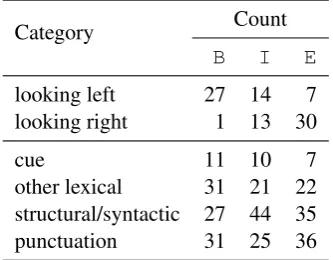
Table 5: Categories of top positive and negative CRF features for begin (B), inside (I), and end (E)
difficult since any wrong intermediary decision can falsify the prediction. In fact, the CRF model is even the best model among the three for very long spans (which are rare). Those spans exceed the 55 and 75 token limits`maxof the GREEDYand SEMIMARKOVmodels. Intuitively, for the CRF,
most spans are long: even spans which are short in comparison to other quotations are longer than the window within which the CRF operates. This is why span length does not have an influence.
Finding 2: Quotations are mostly defined by their immediate external context. A feature analysis of the CRF model reveals that many impor-tant features refer to materialoutsidethe quotation itself. For each label (B,I,E), we collect the 50 features with the highest positive and negative val-ues, respectively. We first identify the subset of those features that looks look left or right. As the upper part of Table 5 shows, a substantial number ofB(begin) features look to the left, and a number ofE(end) features look to the right. Thus, these features do not look at the quotation itself, but at its immediate external context.
We next divide the features into four broad cate-gories (cues, other lexical information, structural and syntactic features, and punctuation including
[image:7.595.98.265.218.348.2]quotation marks). The results in the lower part of Table 5 show that the begin and end classes rely on a range of categories, including lexical, cue and punctuationoutsidethe quotation. The situation is different for inside tokens (I), where most features express structural and syntactic properties of the quotation such as the length of a sentence and its syntactic relation to a cue. Together, these observa-tions suggest that one crucial piece of information about quotations is their lexical and orthographic context: the factors that mark a quotation as a quo-tation. Another crucial piece are internal structural properties of the quotation, while lexical proper-ties of the quotation are not very important: which makes sense, since almost anything can be quoted.
The feature analysis is bolstered by an error anal-ysis of the false negatives in the high-precision low-recall CRF. The first reason for false nega-tives is indeed the occurrence of infrequent cues which the cue model fails to identify (e.g.,reador
acknowledge). The second one is that the model
does attempt to learn syntactic features, but that the structural features that can be learned by the CRF (such as C7, C10 or S4) can model only local windows of the quality of the quotation, but not its global quality. This leads us to our third finding.
asym-GREEDY CRF SEMIMARKOV
cue-near 76 74 76
[image:8.595.335.498.63.189.2]cue-far 72 71 75
Table 6: Recall on boundaries by cue position
metry and perform considerably worse (3 % and 4 %, respectively) on the cue-far boundary. This asymmetry is considerably weaker for the SEMI
-MARKOVmodel, where both boundary types are
recognized almost on par. The reason behind this finding is that neither the GREEDYmodel nor the
CRF can condition the choice of the cue-far bound-ary on the cue-near boundbound-ary or on global proper-ties of the quotation – the GREEDYmodel, because
its choices are completely independent, and the CRF model, because its choices are largely inde-pendent due to the Markov assumption.
Finding 4: The SEMIMARKOV model benefits
the most from its ability to handle global fea-tures about content spans. This leads us to our final finding about why the SEMIMARKOVmodel
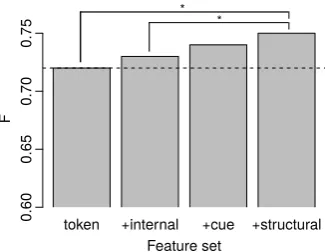
outperforms the CRF – whether it is the model ar-chitecture itself, or the new global features that it allows us to formulate. We perform an ablation study whose results are shown in Figure 4. We be-gin with only the token-level features on the bebe-gin, end, and interior tokens of the span, as introduced in Section 2, i.e., the features that the CRF has at its disposal. We find that this model performs on par with the CRF, thus the model architecture on its own does not help. We then incrementally add the feature templates containing count statistics of the internal tokens (Template G1 in Table 3) and advanced cue information (G2–G6). Both give the model incremental boosts. Adding syntactic coher-ence features (G7–G13) completes our full feature set and yields the best results.
Thus, the difference comes from features that describe global properties of the quotation. One of the most informative (negative) features is the conjunction from G6. It enforces the constraint that each content span is associated with a single cue. As in the CRF, the actual content of a content span does not play a large role. The only semantic features the model considers concern the presence of named entities within the span.
These observations are completed by analysis of the quotation spans that were correctly detected by the SEMIMARKOVmodel, but not the CRF (in
token +internal +cue +structural Feature set
F
0.60
0.65
0.70
0.75
* *
Figure 4: Strict F1for different feature sets in the SEMIMARKOVmodel. *: Difference statistically
significant. Dashed line: CRF result.
terms of strict recall). We find a large amount of spans with highly ambiguous cue-near tokens such asto(10 % of the cases)that(16 %). We find that often the errors are also related to the frequency or location of cues. As an example, in the sentence
[...] he has said [that when he was on the winning side in the 1960s, he knew that the tables might turn in the future]CONT.6
the CRF model incorrectly splits the content span at the second cue candidateknew. This is, however, an embedded quotation that the model should ignore. In contrast, the SEMIMARKOVmodel makes use
of the fact the tokens of the span depend on the same cue, and predicts the span correctly. For these tokens, the distinction between reported speech and factual descriptions is difficult. Arguably, it is the global features that help the model make its call.
7 Related Work
Quotation detection has been tackled with a number of different strategies. Pouliquen et al. (2007) use a small set of rules which has high precision but low recall on multilingual text. Krestel et al. (2008) also pursue a rule-based approach, focusing on the roles of cue verbs and syntactic markers. They evaluate on a small set of annotated WSJ documents and again report high precision but low recall. Pareti et al. (2013) develop the state-of-the-art sequence labeling approach discussed in this paper.
Our sampling approach builds on that of Zhang et al. (2015), who pursue a similar strategy for pars-ing, PoS taggpars-ing, and sentence segmentation. Simi-lar semi-Markov model approaches have been used for other applications, e.g. by Yang and Cardie
(2012) and Klinger and Cimiano (2013) for sen-timent analysis. They also predict spans by sam-pling, but they draw proposals based on the token or syntactic level. This is not suitable for quotation detection as we deal with much longer spans.
8 Conclusion
We have considered the task of quotation detection, starting from the hypothesis that linear-chain CRFs cannot take advantage of all available sequence in-formation due to its Markov assumptions. Indeed, our analyses find that the features most important to recognize a quotation consider its direct con-text of orthographic evidence (such as quotation marks) and lexical evidence (such as cue words). A simple, greedy algorithm using non-sequential models of quotation boundaries rivals the CRF’s performance. For further improvements, we in-troduce a semi-Markov model capable of taking into accountglobalinformation about the complete span not available to a linear-chain CRF, such as the presence of cues on both sides of the quotation candidate. This leads to a significant improvement of 3 points F1over the state of the art.
On a more general level, we believe that quota-tion detecquota-tion is interesting as a representative of tasks involving long sequences, where Markov as-sumptions become inappropriate. Other examples of such tasks include the identification of chemical compound names (Krallinger et al., 2015) and the detection of annotator rationales (Zaidan and Eis-ner, 2008). We have shown that a more expressive semi-Markov model which avoids these assump-tions can improve performance. More expressive models however come with harder inference prob-lems which are compounded when applied to long-sequence tasks. The informed sampling algorithm we have described performs such efficient inference for our semi-Markov quotation detection model.
Acknowledgments
This work was funded in part by the DFG through the Sonderforschungsbereich 732. We thank Silvia Pareti for kindly providing the PARC dataset as well as for much information helpful for replicating her results. Further thanks go to Anders Bj¨orkelund and Kyle Richardson for discussion and comments.
References
Apoorv Agarwal, Augusto Corvalan, Jacob Jensen, and Owen Rambow. 2012. Social network analysis of alice in wonderland. InProceedings of the NAACL-HLT 2012 Workshop on Computational Linguistics for Literature, pages 88–96, Montr´eal, Canada, June. Association for Computational Linguistics.
Ricardo Barandela, Jos´e Salvador S´anchez, Vicente Garc´ıa, and Edgar Rangel. 2003. Strategies for learning in class imbalance problems. Pattern Recognition, 36(3):849–851.
Michael Collins. 2002. Discriminative training meth-ods for Hidden Markov Models: Theory and exper-iments with perceptron algorithms. InProceedings of the Conference on Empirical Methods in Natural Language Processing, pages 1–8, Philadelphia, PA. David Elson, Nicholas Dames, and Kathleen
McKe-own. 2010. Extracting social networks from liter-ary fiction. InProceedings of the 48th Annual Meet-ing of the Association for Computational LMeet-inguistics, pages 138–147, Uppsala, Sweden.
Manaal Faruqui and Sebastian Pado. 2012. Towards a model of formal and informal address in English. InProceedings of the 13th Conference of the Euro-pean Chapter of the Association for Computational Linguistics, pages 623–633, Avignon, France. Antske Fokkens, Marieke van Erp, Marten Postma,
Ted Pedersen, Piek Vossen, and Nuno Freire. 2013. Offspring from reproduction problems: What repli-cation failure teaches us. In Proceedings of the 51st Annual Meeting of the Association for Compu-tational Linguistics, pages 1691–1701, Sofia, Bul-garia.
Roman Klinger and Philipp Cimiano. 2013. Bi-directional inter-dependencies of subjective expres-sions and targets and their value for a joint model. InProceedings of the 51st Annual Meeting of the As-sociation for Computational Linguistics, pages 848– 854, Sofia, Bulgaria.
Martin Krallinger, Florian Leitner, Obdulia Rabal, Miguel Vazquez, Julen Oyarzabal, and Alfonso Va-lencia. 2015. CHEMDNER: The drugs and chemi-cal names extraction challenge. Journal of Chemin-formatics, 7(Suppl 1):S1.
Ralf Krestel, Sabine Bergler, and Ren´e Witte. 2008. Minding the source: Automatic tagging of reported speech in newspaper articles. InProceedings of the International Conference on Language Resources and Evaluation, pages 2823–2828, Marrakech, Mo-rocco.
Christopher D. Manning, Mihai Surdeanu, John Bauer, Jenny Finkel, Steven J. Bethard, and David Mc-Closky. 2014. The Stanford CoreNLP Natural Language Processing Toolkit. In Proceedings of ACL System Demonstrations, pages 55–60, Balti-more, MD.
Andrew K. McCallum, 2002. MALLET: A Machine Learning for Language Toolkit. User’s manual.
Eric T. Nalisnick and Henry S. Baird. 2013. Character-to-character sentiment analysis in shakespeare’s plays. InProceedings of the 51st Annual Meeting of the Association for Computational Linguistics (Vol-ume 2: Short Papers), pages 479–483, Sofia, Bul-garia, August. Association for Computational Lin-guistics.
Eric W. Noreen. 1989. Computer intensive methods for hypothesis testing: An introduction. Wiley, New York.
Silvia Pareti, Tim O’Keefe, Ioannis Konstas, James R. Curran, and Irena Koprinska. 2013. Automatically detecting and attributing indirect quotations. In Pro-ceedings of the 2013 Conference on Empirical Meth-ods in Natural Language Processing, pages 989– 999, Seattle, WA.
Silvia Pareti. 2015. Attribution: A Computational Ap-proach. Ph.D. thesis, University of Edinburgh.
Bruno Pouliquen, Ralf Steinberger, and Clive Best. 2007. Automatic detection of quotations in multi-lingual news. In Proceedings of Recent Advances in Natural Language Processing, pages 487–492, Borovets, Bulgaria.
Sunita Sarawagi and William W. Cohen. 2004. Semi-markov conditional random fields for information extraction. In Proceedings of Advances in Neural Information Processing Systems, pages 1185–1192, Vancouver, BC.
Ralph Weischedel and Ada Brunstein. 2005. BBN pro-noun coreference and entity type corpus. Linguistic Data Consortium, Philadelphia.
Michael Wick, Khashayar Rohanimanesh, Kedar Bel-lare, Aron Culotta, and Andrew McCallum. 2011. Samplerank: Training factor graphs with atomic gra-dients. In Proceedings of the 28th International Conference on Machine Learning, pages 777–784, Bellevue, WA.
Bishan Yang and Claire Cardie. 2012. Extracting opin-ion expressopin-ions with semi-Markov conditopin-ional ran-dom fields. InProceedings of the 2012 Joint Con-ference on Empirical Methods in Natural Language Processing and Computational Natural Language Learning, pages 1335–1345, Jeju Island, South Ko-rea.
Omar Zaidan and Jason Eisner. 2008. Modeling notators: A generative approach to learning from an-notator rationales. InProceedings of the 2008 Con-ference on Empirical Methods in Natural Language Processing, pages 31–40, Honolulu, HI.