Semi-Supervised Learning for Neural Machine Translation
Yong Cheng#, Wei Xu#, Zhongjun He+, Wei He+, Hua Wu+, Maosong Sun†and Yang Liu† ∗ #Institute for Interdisciplinary Information Sciences, Tsinghua University, Beijing, China
†State Key Laboratory of Intelligent Technology and Systems Tsinghua National Laboratory for Information Science and Technology
Department of Computer Science and Technology, Tsinghua University, Beijing, China +Baidu Inc., Beijing, China
[email protected] [email protected] {hezhongjun,hewei06,wu hua}@baidu.com
{sms,liuyang2011}@tsinghua.edu.cn
Abstract
While end-to-end neural machine transla-tion (NMT) has made remarkable progress recently, NMT systems only rely on par-allel corpora for parameter estimation. Since parallel corpora are usually limited in quantity, quality, and coverage, espe-cially for low-resource languages, it is appealing to exploit monolingual corpora to improve NMT. We propose a semi-supervised approach for training NMT models on the concatenation of labeled (parallel corpora) and unlabeled (mono-lingual corpora) data. The central idea is to reconstruct the monolingual corpora us-ing an autoencoder, in which the source-to-target and target-to-source translation models serve as the encoder and decoder, respectively. Our approach can not only exploit the monolingual corpora of the target language, but also of the source language. Experiments on the Chinese-English dataset show that our approach achieves significant improvements over state-of-the-art SMT and NMT systems.
1 Introduction
End-to-end neural machine translation (NMT), which leverages a single, large neural network to directly transform a source-language sentence into a target-language sentence, has attracted increas-ing attention in recent several years (Kalchbren-ner and Blunsom, 2013; Sutskever et al., 2014; Bahdanau et al., 2015). Free of latent structure design and feature engineering that are critical in conventional statistical machine translation (SMT) (Brown et al., 1993; Koehn et al., 2003; Chi-ang, 2005), NMT has proven to excel in
model-∗ Yang Liu is the corresponding author.
ing long-distance dependencies by enhancing re-current neural networks (RNNs) with the gating (Hochreiter and Schmidhuber, 1993; Cho et al., 2014; Sutskever et al., 2014) and attention mecha-nisms (Bahdanau et al., 2015).
However, most existing NMT approaches suf-fer from a major drawback: they heavily rely on parallel corpora for training translation mod-els. This is because NMT directly models the probability of a target-language sentence given a source-language sentence and does not have a sep-arate language model like SMT (Kalchbrenner and Blunsom, 2013; Sutskever et al., 2014; Bahdanau et al., 2015). Unfortunately, parallel corpora are usually only available for a handful of research-rich languages and restricted to limited domains such as government documents and news reports. In contrast, SMT is capable of exploiting abundant target-side monolingual corpora to boost fluency of translations. Therefore, the unavailability of large-scale, high-quality, and wide-coverage par-allel corpora hinders the applicability of NMT.
As a result, several authors have tried to use abundant monolingual corpora to improve NMT. Gulccehre et al. (2015) propose two methods, which are referred to as shallow fusion and deep fusion, to integrate a language model into NMT. The basic idea is to use the language model to score the candidate words proposed by the transla-tion model at each time step or concatenating the hidden states of the language model and the de-coder. Although their approach leads to signifi-cant improvements, one possible downside is that the network architecture has to be modified to in-tegrate the language model.
Alternatively, Sennrich et al. (2015) propose two approaches to exploiting monolingual corpora that is transparent to network architectures. The first approach pairs monolingual sentences with dummy input. Then, the parameters of encoder
bushi yu shalong juxing le huitan bushi yu shalong juxing le huitan
Bush held a talk with Sharon
Bush held a talk with Sharon
Bush held a talk with Sharon bushi yu shalong juxing le huitan
encoder decoder
encoder decoder
[image:2.595.120.478.62.216.2](a) (b)
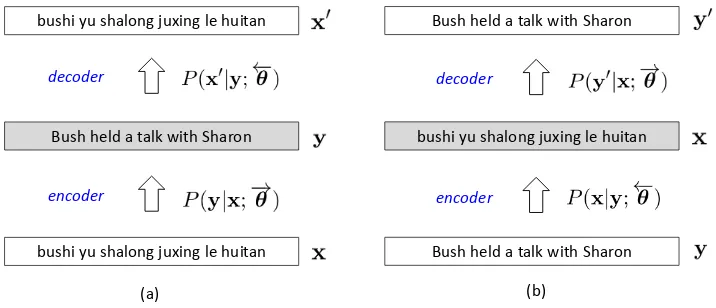
Figure 1: Examples of (a) source autoencoder and (b) target autoencoder on monolingual corpora. Our idea is to leverage autoencoders to exploit monolingual corpora for NMT. In a source autoencoder, the source-to-target model P(y|x;−→θ) serves as an encoder to transform the observed source sentencex
into a latent target sentencey(highlighted in grey), from which the target-to-source modelP(x0|y;←−θ)
reconstructs a copy of the observed source sentence x0 from the latent target sentence. As a result,
monolingual corpora can be combined with parallel corpora to train bidirectional NMT models in a semi-supervised setting.
and attention model are fixed when training on these pseudo parallel sentence pairs. In the sec-ond approach, they first train a nerual translation model on the parallel corpus and then use the learned model to translate a monolingual corpus. The monolingual corpus and its translations con-stitute an additional pseudo parallel corpus. Simi-lar ideas have also been suggested in conventional SMT (Ueffing et al., 2007; Bertoldi and Federico, 2009). Sennrich et al. (2015) report that their ap-proach significantly improves translation quality across a variety of language pairs.
In this paper, we propose semi-supervised learning for neural machine translation. Given la-beled (i.e., parallel corpora) and unlala-beled (i.e., monolingual corpora) data, our approach jointly trains source-to-target and target-to-source trans-lation models. The key idea is to append a re-construction term to the training objective, which aims to reconstruct the observed monolingual cor-pora using an autoencoder. In the autoencoder, the source-to-target and target-to-source models serve as the encoder and decoder, respectively. As the inference is intractable, we propose to sample the full search space to improve the efficiency. Specif-ically, our approach has the following advantages:
1. Transparent to network architectures: our ap-proach does not depend on specific architec-tures and can be easily applied to arbitrary end-to-end NMT systems.
2. Both the source and target monolingual cor-pora can be used: our approach can bene-fit NMT not only using target monolingual corpora in a conventional way, but also the monolingual corpora of the source language.
Experiments on Chinese-English NIST datasets show that our approach results in significant im-provements in both directions over state-of-the-art SMT and NMT systems.
2 Semi-Supervised Learning for Neural Machine Translation
2.1 Supervised Learning
Given a parallel corpus D = {hx(n),y(n)i}N n=1,
the standard training objective in NMT is to max-imize the likelihood of the training data:
L(θ) =XN
n=1
logP(y(n)|x(n);θ), (1)
whereP(y|x;θ)is a neural translation model and θ is a set of model parameters. D can be seen aslabeled data for the task of predicting a target sentenceygiven a source sentencex.
languages, the available domains are unbalanced and restricted to government documents and news reports. Therefore, the availability of large-scale, high-quality, and wide-coverage parallel corpora becomes a major obstacle for NMT.
2.2 Autoencoders on Monolingual Corpora
It is appealing to explore the more readily avail-able, abundant monolingual corpora to improve NMT. Let us first consider an unsupervised set-ting: how to train NMT models on a monolingual corpusT ={y(t)}T
t=1?
Our idea is to leverageautoencoders(Vincent et al., 2010; Socher et al., 2011): (1)encodingan ob-served target sentence into a latent source sentence using a target-to-source translation model and (2) decoding the source sentence to reconstruct the observed target sentence using a source-to-target model. For example, as shown in Figure 1(b), given an observed English sentence “Bush held a talk with Sharon”, a target-to-source translation model (i.e., encoder) transforms it into a Chinese translation “bushi yu shalong juxing le huitan” that is unobserved on the training data (highlighted in grey). Then, a source-to-target translation model (i.e., decoder) reconstructs the observed English sentence from the Chinese translation.
More formally, let P(y|x;−→θ) and P(x|y;←−θ)
be source-to-target and target-to-source transla-tion models respectively, where−→θ and←−θ are cor-responding model parameters. An autoencoder aims to reconstruct the observed target sentence via a latent source sentence:
P(y0|y;−→θ,←−θ)
= X
x
P(y0,x|y;−→θ,←θ−)
= X
x
P(x|y;←−θ) | {z }
encoder
P(y0|x;−→θ) | {z }
decoder
, (2)
where y is an observed target sentence, y0 is a
copy of y to be reconstructed, and x is a latent source sentence.
We refer to Eq. (2) as a target autoencoder. 1
Likewise, given a monolingual corpus of source languageS ={x(s)}S
s=1, it is natural to introduce
a source autoencoderthat aims at reconstructing 1Our definition of auotoencoders is inspired by Ammar et
al. (2014). Note that our autoencoders inherit the same spirit from conventional autoencoders (Vincent et al., 2010; Socher et al., 2011) except that the hidden layer is denoted by a latent sentence instead of real-valued vectors.
the observed source sentence via a latent target sentence:
P(x0|x;−→θ,←−θ)
= X
y
P(x0,y|x;←−θ)
= X
y
P(y|x;−→θ) | {z }
encoder
P(x0|y;←θ−) | {z }
decoder
. (3)
Please see Figure 1(a) for illustration.
2.3 Semi-Supervised Learning
As the autoencoders involve both source-to-target and target-to-source models, it is natural to com-bine parallel corpora and monolingual corpora to learn birectional NMT translation models in a semi-supervised setting.
Formally, given a parallel corpus D =
{hx(n),y(n)i}N
n=1, a monolingual corpus of target
languageT ={y(t)}T
t=1, and a monolingual
cor-pus of source languageS ={x(s)}S
s=1, we
intro-duce our new semi-supervised training objective as follows:
J(−→θ,←−θ)
= XN
n=1
logP(y(n)|x(n);−→θ)
| {z }
source-to-target likelihood
+ XN
n=1
logP(x(n)|y(n);←θ−)
| {z }
target-to-source likelihood
+λ1
T
X
t=1
logP(y0|y(t);−→θ,←−θ)
| {z }
target autoencoder
+λ2
S
X
s=1
logP(x0|x(s);−→θ,←θ−)
| {z }
source autoencoder
, (4)
whereλ1andλ2are hyper-parameters for
balanc-ing the preference between likelihood and autoen-coders.
The optimal model parameters are given by
− →θ∗
= argmax ( N
X
n=1
logP(y(n)|x(n);−→θ) +
λ1
T
X
t=1
logP(y0|y(t);−→θ,←−θ) +
λ2
S
X
s=1
logP(x0|x(s);−→θ,←−θ) )
(5)
←θ−∗
= argmax ( N
X
n=1
logP(x(n)|y(n);←−θ) +
λ1
T
X
t=1
logP(y0|y(t);−→θ,←−θ) +
λ2
S
X
s=1
logP(x0|x(s);−→θ,←−θ) )
(6)
It is clear that the source-to-target and target-to-source models are connected via the autoencoder and can hopefully benefit each other in joint train-ing.
2.4 Training
We use mini-batch stochastic gradient descent to train our joint model. For each iteration, be-sides the mini-batch from the parallel corpus, we also construct two additional mini-batches by ran-domly selecting sentences from the source and tar-get monolingual corpora. Then, gradients are col-lected from these mini-batches to update model parameters.
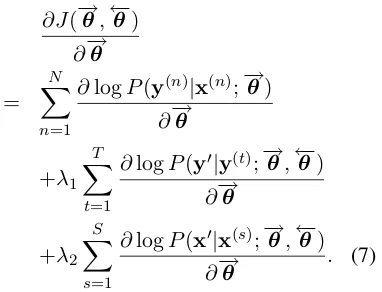
The partial derivative ofJ(−→θ,←θ−)with respect to the source-to-target model−→θ is given by
∂J(−→θ,←−θ)
∂−→θ
= XN
n=1
∂logP(y(n)|x(n);−→θ)
∂−→θ
+λ1
T
X
t=1
∂logP(y0|y(t);−→θ,←−θ)
∂−→θ
+λ2
S
X
s=1
∂logP(x0|x(s);−→θ,←−θ)
∂−→θ . (7)
The partial derivative with respect to←−θ can be cal-culated similarly.
Unfortunately, the second and third terms in Eq. (7) are intractable to calculate due to the exponen-tial search space. For example, the derivative in
Chinese English
# Sent. 2.56M
Parallel # Word 67.54M 74.82M
Vocab. 0.21M 0.16M
# Sent. 18.75M 22.32M
Monolingual # Word 451.94M 399.83M
[image:4.595.102.293.545.691.2]Vocab. 0.97M 1.34M
Table 1: Characteristics of parallel and monolin-gual corpora.
the third term in Eq. (7) is given by
P
x∈X(y)P(x|y;←−θ)P(y0|x;−→θ)∂logP(y 0|x;−→θ)
∂−→θ P
x∈X(y)P(x|y;←θ−)P(y0|x;−→θ)
. (8)
It is prohibitively expensive to compute the sums due to the exponential search space ofX(y).
Alternatively, we propose to use a subset of the full spaceX˜(y)⊂ X(y)to approximate Eq. (8):
P
x∈X˜(y)P(x|y;←−θ)P(y0|x;−→θ)∂logP(y 0|x;−→θ)
∂−→θ P
x∈X˜(y)P(x|y;←−θ)P(y0|x;−→θ)
. (9)
In practice, we use the top-k list of candidate translations ofyasX˜(y). As|X˜(y)| X |(y)|, it is possible to calculate Eq. (9) efficiently by enumerating all candidates in X˜(y). In practice, we find this approximation results in significant
improvements and k = 10 seems to suffice to
keep the balance between efficiency and transla-tion quality.
3 Experiments 3.1 Setup
We evaluated our approach on the Chinese-English dataset.
Iterations
0.0 0.5 1.0 1.5 2.0 2.5 3.0 3.5 4.0
BLEU
30.0 30.5 31.0 31.5 32.0 32.5 33.0 33.5 34.0
× 104
[image:5.595.76.282.70.231.2]k=15 k=10 k=5 k=1
Figure 2: Effect of sample sizekon the Chinese-to-English validation set.
Iterations
0.0 0.5 1.0 1.5 2.0 2.5 3.0 3.5 4.0
BLEU
15.0 15.5 16.0 16.5 17.0 17.5
[image:5.595.310.516.72.231.2]k=15 k=10 k=5 k=1
Figure 3: Effect of sample sizekon the English-to-Chinese validation set.
For Chinese-to-English translation, we use the NIST 2006 Chinese-English dataset as the vali-dation set for hyper-parameter optimization and model selection. The NIST 2002, 2003, 2004, and 2005 datasets serve as test sets. Each Chi-nese sentence has four reference translations. For English-to-Chinese translation, we use the NIST datasets in a reverse direction: treating the first English sentence in the four reference transla-tions as a source sentence and the original input Chinese sentence as the single reference trans-lation. The evaluation metric is case-insensitive BLEU (Papineni et al., 2002) as calculated by the
multi-bleu.perlscript.
We compared our approach with two state-of-the-art SMT and NMT systems:
1. MOSES(Koehn et al., 2007): a phrase-based
SMT system;
Iterations
0.0 0.5 1.0 1.5 2.0 2.5 3.0 3.5 4.0
BLEU
30.0 30.5 31.0 31.5 32.0 32.5 33.0 33.5 34.0
× 104
[image:5.595.311.515.292.454.2]0% OOV 10% OOV 20% OOV 30% OOV
Figure 4: Effect of OOV ratio on the Chinese-to-English validation set.
Iterations
0.0 0.5 1.0 1.5 2.0 2.5 3.0 3.5 4.0
BLEU
6.0 8.0 10.0 12.0 14.0 16.0 18.0
× 104
0% OOV 10% OOV 20% OOV 30% OOV
Figure 5: Effect of OOV ratio on the English-to-Chinese validation set.
2. RNNSEARCH (Bahdanau et al., 2015): an
attention-based NMT system.
For MOSES, we use the default setting to train
the phrase-based translation on the parallel corpus and optimize the parameters of log-linear models using the minimum error rate training algorithm (Och, 2003). We use the SRILM toolkit (Stolcke, 2002) to train 4-gram language models.
For RNNSEARCH, we use the parallel corpus to
train the attention-based neural translation models. We set the vocabulary size of word embeddings to 30K for both Chinese and English. We follow Luong et al. (2015) to address rare words.
On top of RNNSEARCH, our approach is
[image:5.595.77.283.293.454.2]λ2 = 0when we add the target monolingual
cor-pus, andλ1 = 0andλ2 = 0.1for source
monolin-gual corpus incorporation. The threshold of gra-dient clipping is set to 0.05. The parameters of our model are initialized by the model trained on parallel corpus.
3.2 Effect of Sample Sizek
As the inference of our approach is intractable, we propose to approximate the full search space with the top-klist of candidate translations to improve efficiency (see Eq. (9)).
Figure 2 shows the BLEU scores of various
set-tings of k over time. Only the English
mono-lingual corpus is appended to the training data. We observe that increasing the size of the approx-imate search space generally leads to improved BLEU scores. There are significant gaps between
k = 1 and k = 5. However, keeping
increas-ingkdoes not result in significant improvements and decreases the training efficiency. We find that k = 10achieves a balance between training effi-ciency and translation quality. As shown in Fig-ure 3, similar findings are also observed on the English-to-Chinese validation set. Therefore, we setk= 10in the following experiments.
3.3 Effect of OOV Ratio
Given a parallel corpus, what kind of monolingual corpus is most beneficial for improving transla-tion quality? To answer this questransla-tion, we investi-gate the effect ofOOV ratioon translation quality, which is defined as
ratio= P
y∈yJy /∈ VDtK
|y| , (10)
whereyis a target-language sentence in the mono-lingual corpusT,yis a target-language word iny,
VDt is the vocabulary of the target side of the
par-allel corpusD.
Intuitively, the OOV ratio indicates how a sen-tence in the monolingual resembles the parallel corpus. If the ratio is 0, all words in the mono-lingual sentence also occur in the parallel corpus.
Figure 4 shows the effect of OOV ratio on the Chinese-to-English validation set. Only En-glish monolingual corpus is appended to the par-allel corpus during training. We constructed four monolingual corpora of the same size in terms of sentence pairs. “0% OOV” means the OOV ra-tio is 0% for all sentences in the monolingual cor-pus. “10% OOV” suggests that the OOV ratio is
no greater 10% for each sentence in the mono-lingual corpus. We find that using a monomono-lingual corpus with a lower OOV ratio generally leads to higher BLEU scores. One possible reason is that low-OOV monolingual corpus is relatively easier to reconstruct than its high-OOV counterpart and results in better estimation of model parameters.
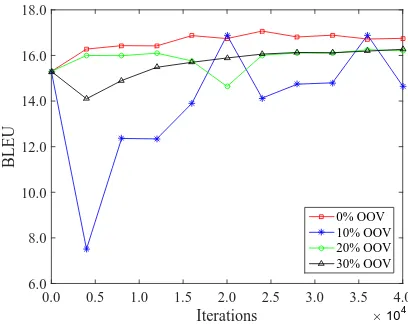
Figure 5 shows the effect of OOV ratio on the English-to-Chinese validation set. Only English monolingual corpus is appended to the parallel corpus during training. We find that “0% OOV” still achieves the highest BLEU scores.
3.4 Comparison with SMT
Table 2 shows the comparison between MOSES
and our work. MOSES used the monolingual
corpora as shown in Table 1: 18.75M Chinese sentences and 22.32M English sentences. We find that exploiting monolingual corpora dramat-ically improves translation performance in both Chinese-to-English and English-to-Chinese direc-tions.
Relying only on parallel corpus, RNNSEARCH
outperforms MOSES trained also only on
par-allel corpus. But the capability of making
use of abundant monolingual corpora enables MOSESto achieve much higher BLEU scores than
RNNSEARCHonly using parallel corpus.
Instead of using all sentences in the monolin-gual corpora, we constructed smaller monolinmonolin-gual corpora with zero OOV ratio: 2.56M Chinese sen-tences with 47.51M words and 2.56M English English sentences with 37.47M words. In other words, the monolingual corpora we used in the experiments are much smaller than those used by MOSES.
By adding English monolingual corpus, our approach achieves substantial improvements over RNNSEARCH using only parallel corpus (up to
+4.7 BLEU points). In addition, significant im-provements are also obtained over MOSES using
both parallel and monolingual corpora (up to +3.5 BLEU points).
An interesting finding is that adding English monolingual corpora helps to improve English-to-Chinese translation over RNNSEARCHusing only
parallel corpus (up to +3.2 BLEU points), sug-gesting that our approach is capable of improving NMT using source-side monolingual corpora.
Chi-System Training DataCE C E Direction NIST06 NIST02 NIST03 NIST04 NIST05
MOSES
√ × × C→E 32.48 32.69 32.39 33.62 30.23
E→C 14.27 18.28 15.36 13.96 14.11
√
× √ C→E 34.59 35.21 35.71 35.56 33.74
√ √
× E→C 20.69 25.85 19.76 18.77 19.74
RNNSEARCH
√
× × CE→→CE 30.7415.71 35.1620.76 33.7516.56 16.8534.63 31.7415.14 √
× √ CE→→CE 35.6117.59∗∗++++ 38.7823.99∗∗++++ 18.9538.32++∗∗++ 18.8538.49++∗∗++ 36.4517.91∗∗++++
√ √
[image:7.595.80.517.60.193.2]× CE→→CE 35.0121.12++∗++ 38.2029.52∗∗∗∗++++ 20.4937.99∗∗∗∗++++ 38.1621.59∗∗∗∗++++ 36.0719.97++∗∗++
Table 2: Comparison with MOSES and RNNSEARCH. MOSES is a phrase-based statistical machine
translation system (Koehn et al., 2007). RNNSEARCHis an attention-based neural machine translation
system (Bahdanau et al., 2015). “CE” donates Chinese-English parallel corpus, “C” donates Chinese monolingual corpus, and “E” donates English monolingual corpus. “√” means the corpus is included in the training data and×means not included. “NIST06” is the validation set and “NIST02-05” are test sets. The BLEU scores are case-insensitive. “*”: significantly better than MOSES (p < 0.05); “**”: significantly better than MOSES (p < 0.01);“+”: significantly better than RNNSEARCH (p < 0.05);
“++”: significantly better than RNNSEARCH(p <0.01).
Method CETraining DataC E Direction NIST06 NIST02 NIST03 NIST04 NIST05 Sennrich et al. (2015) √√ ×√ √ C→E 34.10 36.95 36.80 37.99 35.33
× E→C 19.85 28.83 20.61 20.54 19.17
this work
√
× √ CE→→CE 35.6117.59∗∗ 38.7823.99∗∗ 18.9538.32∗∗ 18.8538.49∗ 36.4517.91∗∗
√ √
× EC→→CE 35.0121.12∗∗∗∗ 38.2029.52∗∗∗∗ 20.4937.99∗∗ 21.5938.16∗∗ 19.9736.07∗∗∗∗
Table 3: Comparison with Sennrich et al. (2015). Both Sennrich et al. (2015) and our approach build on top of RNNSEARCHto exploit monolingual corpora. The BLEU scores are case-insensitive. “*”:
significantly better than Sennrich et al. (2015) (p <0.05); “**”: significantly better than Sennrich et al. (2015) (p <0.01).
nese monolingual corpus leads to more benefits to English-to-Chinese translation than adding En-glish monolingual corpus. We also tried to use both Chinese and English monolingual corpora through simply setting all the λto0.1 but failed to obtain further significant improvements.
Therefore, our findings can be summarized as follows:
1. Adding target monolingual corpus improves over using only parallel corpus for source-to-target translation;
2. Adding source monolingual corpus also im-proves over using only parallel corpus for source-to-target translation, but the improve-ments are smaller than adding target mono-lingual corpus;
3. Adding both source and target monolingual corpora does not lead to further significant improvements.
3.5 Comparison with Previous Work
We re-implemented Sennrich et al. (2015)’s method on top of RNNSEARCHas follows:
1. Train the target-to-source neural translation modelP(x|y;←θ−)on the parallel corpusD=
{hx(n),y(n)i}N n=1.
2. The trained target-to-source model ←θ−∗ is used to translate a target monolingual corpus
T = {y(t)}T
t=1 into a source monolingual
corpusS˜={x˜(t)}T t=1.
3. The target monolingual corpus is paired with its translations to form a pseudo parallel cor-pus, which is then appended to the original parallel corpus to obtain a larger parallel cor-pus:D˜ =D ∪ hS˜,T i.
[image:7.595.95.503.321.401.2]Monolingual hongsen shuo , ruguo you na jia famu gongsi dangan yishenshifa , name tamen jiang zihui qiancheng .
Reference hongsen said, if anylogging companiesdare to defy the law, then they will
destroy their own future.
Translation hun sen said , if any ofthose companiesdare defy the law , then they will have their own fate. [iteration 0]
hun sen said if anytree felling companydared to break the law , then they wouldkill themselves. [iteration 40K]
hun sen said if anylogging companies dare to defy the law , they would
destroy the future themselves. [iteration 240K]
Monolingual dan yidan panjue jieguo zuizhong queding , ze bixu zai 30 tian nei zhixing . Reference But once the final verdict is confirmed, it must be executed within 30 days
.
Translation however , in the final analysis , it must be carried out within 30 days . [iteration 0]
however ,in the final analysis, the final decision will be carried out within 30 days . [iteration 40K]
[image:8.595.94.507.62.347.2]however , oncethe verdict is finally confirmed, it must be carried out within 30 days . [iteration 240K]
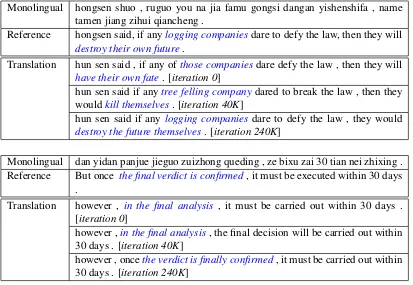
Table 4: Example translations of sentences in the monolingual corpus during semi-supervised learning. We find our approach is capable of generating better translations of the monolingual corpus over time.
Table 3 shows the comparison results. Both the two approaches use the same parallel and mono-lingual corpora. Our approach achieves signifi-cant improvements over Sennrich et al. (2015) in both Chinese-to-English and English-to-Chinese directions (up to +1.8 and +1.0 BLEU points). One possible reason is that Sennrich et al. (2015) only use the pesudo parallel corpus for parame-ter estimation for once (see Step 4 above) while our approach enables source-to-target and target-to-source models to interact with each other itera-tively on both parallel and monolingual corpora.
To some extent, our approach can be seen as an iterative extension of Sennrich et al. (2015)’s ap-proach: after estimating model parameters on the pseudo parallel corpus, the learned model param-eters are used to produce a better pseudo parallel corpus. Table 4 shows example Viterbi transla-tions on the Chinese monolingual corpus over it-erations:
x∗ = argmax
x
n
P(y0|x;−→θ)P(x|y;←θ−)o. (11)
We observe that the quality of Viterbi transla-tions generally improves over time.
4 Related Work
Our work is inspired by two lines of research: (1) exploiting monolingual corpora for machine trans-lation and (2) autoencoders in unsupervised and semi-supervised learning.
4.1 Exploiting Monolingual Corpora for Machine Translation
Closely related to Gulccehre et al. (2015) and Sennrich et al. (2015), our approach focuses on learning birectional NMT models via autoen-coders on monolingual corpora. The major ad-vantages of our approach are the transparency to network architectures and the capability to exploit both source and target monolingual corpora.
4.2 Autoencoders in Unsupervised and Semi-Supervised Learning
Autoencoders and their variants have been widely used in unsupervised deep learning ((Vincent et al., 2010; Socher et al., 2011; Ammar et al., 2014), just to name a few). Among them, Socher et al. (2011)’s approach bears close resemblance to our approach as they introduce semi-supervised recur-sive autoencoders for sentiment analysis. The dif-ference is that we are interested in making a bet-ter use of parallel and monolingual corpora while they concentrate on injecting partial supervision to conventional unsupervised autoencoders. Dai and Le (2015) introduce a sequence autoencoder to reconstruct an observed sequence via RNNs. Our approach differs from sequence autoencoders in that we use bidirectional translation models as encoders and decoders to enable them to interact within the autoencoders.
5 Conclusion
We have presented a semi-supervised approach to training bidirectional neural machine translation models. The central idea is to introduce autoen-coders on the monolingual corpora with source-to-target and source-to-target-to-source translation models as encoders and decoders. Experiments on Chinese-English NIST datasets show that our approach leads to significant improvements.
As our method is sensitive to the OOVs present in monolingual corpora, we plan to integrate Jean et al. (2015)’s technique on using very large vo-cabulary into our approach. It is also necessary to further validate the effectiveness of our approach on more language pairs and NMT architectures. Another interesting direction is to enhance the connection between source-to-target and target-to-source models (e.g., letting the two models share the same word embeddings) to help them benefit more from interacting with each other.
Acknowledgements
This work was done while Yong Cheng was vis-iting Baidu. This research is supported by the 973 Program (2014CB340501, 2014CB340505), the National Natural Science Foundation of China (No. 61522204, 61331013, 61361136003), 1000 Talent Plan grant, Tsinghua Initiative Research Program grants 20151080475 and a Google Fac-ulty Research Award. We sincerely thank the viewers for their valuable suggestions.
References
Waleed Ammar, Chris Dyer, and Noah Smith. 2014. Conditional random field autoencoders for
unsuper-vised structred prediction. InProceedings of NIPS
2014.
Dzmitry Bahdanau, KyungHyun Cho, and Yoshua Bengio. 2015. Neural machine translation by jointly learning to align and translate. In Proceed-ings of ICLR.
Nicola Bertoldi and Marcello Federico. 2009. Do-main adaptation for statistical machine translation. InProceedings of WMT.
Peter F. Brown, Stephen A. Della Pietra, Vincent J. Della Pietra, and Robert L. Mercer. 1993. The mathematics of statistical machine translation: Pa-rameter estimation. Computational Linguisitics.
David Chiang. 2005. A hierarchical phrase-based
model for statistical machine translation. In
Pro-ceedings of ACL.
Kyunhyun Cho, Bart van Merri¨enboer, Dzmitry Bah-danau, and Yoshua Bengio. 2014. On the properties of neural machine translation: Encoder-decoder ap-proaches. InProceedings of SSST-8.
Andrew M. Dai and Quoc V. Le. 2015.
Semi-supervised sequence learning. In Proceedings of
NIPS.
Qing Dou, Ashish Vaswani, and Kevin Knight. 2014. Beyond parallel data: Joint word alignment and
de-cipherment improves machine translation. In
Pro-ceedings of EMNLP.
Caglar Gulccehre, Orhan Firat, Kelvin Xu, Kyunghyun Cho, Lo¨ıc Barrault, Huei-Chi Lin, Fethi Bougares, Holger Schwenk, and Yoshua Bengio. 2015. On using monolingual corpora in neural machine trans-lation. arXiv:1503.03535 [cs.CL].
Sebastien Jean, Kyunghyun Cho, Roland Memisevic, and Yoshua Bengio. 2015. On using very large tar-get vocabulary for neural machine translation. In
Proceedings of ACL.
Nal Kalchbrenner and Phil Blunsom. 2013.
Recur-rent continuous translation models. InProceedings
of EMNLP.
Diederik P Kingma, Shakir Mohamed, Danilo Jimenez Rezende, and Max Welling. 2014. Semi-supervised
learning with deep generative models. InAdvances
in Neural Information Processing Systems.
Alexandre Klementiev, Ann Irvine, Chris Callison-Burch, and David Yarowsky. 2012. Toward statisti-cal machine translation without paralel corpora. In
Proceedings of EACL.
Philipp Koehn, Franz J. Och, and Daniel Marcu. 2003. Statistical phrase-based translation. InProceedings of NAACL.
Philipp Koehn, Hieu Hoang, Alexandra Birch, Chris Callison-Burch, Marcello Federico, Nicola Bertoldi, Brooke Cowan, Wade Shen, Christine Moran, Richard Zens, Chris Dyer, Ondrej Bojar, Alexandra Constantin, and Evan Herbst. 2007. Moses: Open source toolkit for statistical machine translation. In
Proceedings of ACL (demo session).
Minh-Thang Luong, Ilya Sutskever, Quoc V. Le, Oriol Vinyals, and Wojciech Zaremba. 2015. Addressing the rare word problem in neural machine translation. InProceedings of ACL.
Franz Och. 2003. Minimum error rate training in sta-tistical machine translation. InProceedings of ACL. Kishore Papineni, Salim Roukos, Todd Ward, and Wei-Jing Zhu. 2002. Bleu: a methof for automatic
eval-uation of machine translation. In Proceedings of
ACL.
Sujith Ravi and Kevin Knight. 2011. Deciphering for-eign language. InProceedings of ACL.
Rico Sennrich, Barry Haddow, and Alexandra Birch. 2015. Improving nerual machine translation models with monolingual data. arXiv:1511.06709 [cs.CL]. Richard Socher, Jeffrey Pennington, Eric Huang,
An-drew Ng, and Christopher Manning. 2011. Semi-supervised recursive autoencoders for predicting
sentiment distributions. InProceedings of EMNLP.
Andreas Stolcke. 2002. Srilm - am extensible lan-guage modeling toolkit. InProceedings of ICSLP. Ilya Sutskever, Oriol Vinyals, and Quoc V. Le. 2014.
Sequence to sequence learning with neural net-works. InProceedings of NIPS.
Nicola Ueffing, Gholamreza Haffari, and Anoop Sarkar. 2007. Trasductive learning for statistical machine translation. InProceedings of ACL.
Pascal Vincent, Hugo Larochelle, Isabelle Lajoie, Yoshua Bengio, and Pierre-Autoine Manzagol. 2010. Stacked denoising autoencoders: Learning useful representations in a deep network with a local
denoising criterion. Journal of Machine Learning
Research.