Dependency Forest based Word Alignment
Hitoshi Otsuki1, Chenhui Chu2, Toshiaki Nakazawa2, Sadao Kurohashi1 1Graduate School of Informatics, Kyoto University
2Japan Science and Technology Agency
{otsuki, kuro}@nlp.ist.i.kyoto-u.ac.jp, {chu,nakazawa}@pa.jst.jp
Abstract
A hierarchical word alignment model that searches fork-best partial alignments on target constituent 1-best parse trees has been shown to outperform previous mod-els. However, relying solely on 1-best parses trees might hinder the search for good alignments because 1-best trees are not necessarily the best for word align-ment tasks in practice. This paper in-troduces a dependency forest based word alignment model, which utilizes target de-pendency forests in an attempt to mini-mize the impact on limitations attributable to 1-best parse trees. We present how k-best alignments are constructed over target-side dependency forests. Alignment experiments on the Japanese-English lan-guage pair show a relative error reduction of 4% of the alignment score compared to a model with 1-best parse trees.
1 Introduction
In statistical machine translation (SMT), word alignment plays an essential role in obtaining phrase tables (Och and Ney, 2004; Koehn et al., 2003) or syntactic transformation rules (Chiang, 2007; Shen et al., 2008). IBM models (Brown et al., 1993), which are based on word sequences, have been widely used for obtaining word align-ments because they are fast and their implementa-tion is available as GIZA++.1
Recently, a hierarchical alignment model (whose implementation is known as Nile2) (Riesa et al., 2011), which performs better than IBM models, has been proposed. In the hierarchi-cal alignment model, both source and target
con-1http://www.statmt.org/moses/giza/GIZA++.html 2http://jasonriesa.github.io/nile/
stituency trees are used for incorporating syntactic information as features, and it searches for k-best partial alignments on the target constituent parse trees. It achieved significantly better results than the IBM Model4 in Arabic-English and Chinese-English word alignment tasks, even though the model was trained on only 2,280 and 1,102 par-allel sentences as gold standard alignments. How-ever, their models rely only on 1-best source and target side parse trees, which are not necessarily good for word alignment tasks.
In SMT, forest-based decoding has been pro-posed for both constituency and dependency parse trees (Mi et al., 2008; Tu et al., 2010). A forest is a compact representation ofn-best parse trees. It provides more alternative parse trees to choose from during decoding, leading to significant im-provements in translation quality. In this paper, we borrow this idea to build an alignment model us-ing dependency forests rather than 1-best parses, which makes it possible to provide the model with more alternative parse trees that may be suitable for word alignment tasks. The motivation of using dependency forests instead of constituency forests in our model is that dependency forests are more appropriate for alignments between language pairs with long-distance reordering, such as the one we study in this paper. This is because they are more suitable for capturing the complex semantic rela-tions of words in a sentence (Kahane, 2012).
We conducted alignment experiments on the Japanese-English language pair. Experimental re-sults show a relative error reduction of 4% of the alignment score compared to the model with 1-best parse trees.
2 Model Description
2.1 Dependency Forest
We first briefly explain dependency forests that are used in our model before describing the alignment
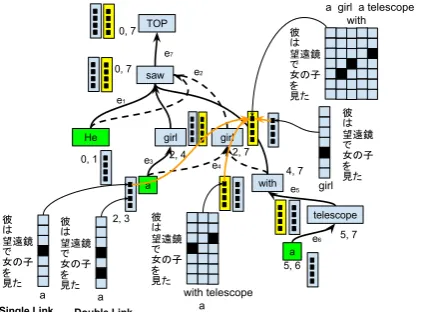
Figure 1: Bottom-up search for alignments over target-side dependency forest (This forest encodes 2-best parse trees for the sentence “he saw a girl with a telescope.” The source sentence is “彼(He) は望遠鏡(telescope)で(with)女の子(girl)を見た
(saw)”. There are two interpretations for this sen-tence; either “with a telescope” depends on “saw” or “boy.”)
construction method. A dependency forest is rep-resented by a hypergraph⟨V, E⟩, whereV is a set of nodes andEis a set of hyperedges.
A hyperedgeeconnects nodes in the forest and is defined to be a triple⟨tails(e), head(e), score⟩, wheretails(e)is a set of dependents ofe,head(e) is the head of e, and score is the score of e that is usually obtained by heuristics (Tu et al., 2010). For example, e1 in Figure 1 is equal to⟨(he0,1, boy2,4, with4,7), saw0,7,1.234⟩. In our model, we use Algorithm 1 to compute hyperedge scores. Edges in a hyperedge are defined to be the ones obtained by connecting each tail with the head (Line 11). Hyperedge score is the sum of all the scores of edges in it (Line 12). The score of an edge is the normalized sum of the scores of all parses which contain the edge (Line 7).
Every node in a dependency forest corresponds to a word attached with aspan, which is a range of word indices covered by the node. Following (Tu et al., 2010), a span is represented in the formi, j, which indicates the node covers all the words from i-th to(j−1)-th word. This requires dependency forests to be projective. Separate nodes are used for a word if the nodes in dependency trees have different spans. For example, in Figure 1 there are two nodes for the word “boy” because they have different spans (i.e., (2, 4) and (2, 7)).
The construction of a dependency forest from
Input : n-best dependency parses{Ti}ni=1
of a sentence Score ofTi Scorei Output: A forestF of{Ti}ni=1
1 F =
CreateForestStructure({Ti}ni=1) 2 edgeScores={}
3 minScore=Min({Scorei}ni=1) 4 fori= 1tondo
5 Scorei−=minScore 6 foredge∈Tido
7 edgeScores[edge] + = n1Scorei 8 end
9 end
10 forhyperEdge∈F do 11 foredge∈hyperEdgedo 12 hyperEdge.score+ =
edgeScores[edge] 13 end
14 end
Algorithm 1:Computation of a hyperedge score
dependency trees is done by sharing the common nodes and edges (Line 1). The common nodes are those with the same span and part-of-speech (POS) . Note that the dependency forest obtained from this method does not necessarily encode ex-actly the dependency trees from which they are created. Usually there are more trees that can be extracted from the dependency forests (Boullier et al., 2009). In our experiment, when we use the term “an-best dependency forest”, we indicate a dependency forest that is created fromn-best de-pendency trees.
2.2 Finding Alignments over Forest
Following the hierarchical alignment model (Riesa et al., 2011), our model searches for the best alignment by constructing partial alignments (hypotheses) over target dependency forests in a bottom-up manner as shown in Figure 1.
cov-ered by the node. In Figure 1, each partial align-ment is represented as a black square. Scores of the partial alignments are a linear combination of features. There are two types of features: local and non-local features. A featuref is defined to be cal if and only if it can be factored among the lo-cal productions in a tree, and non-lolo-cal otherwise (Huang, 2008).
We visit the nodes in the topological order, to guarantee that we visit a node after visiting all its tail nodes (Line 1). For each node, we first gen-erates partial alignments, which are one column alignment matrices for its word. Because of time complexity, we only generates null, single link and double link alignment (Line 5). A single and dou-ble link alignment refer to a column matrix having exactly one and two alignments, respectively, as shown in Figure 1. For each partial alignment, we compute its score using local features (Line 7) and pushed to a priority queueBv(Line 8). These
par-tial alignments are represented by black squares in a blue container in Figure 1. Then, we compute partial alignments for the target words covered by the node, by combining tails’ partial alignments and one column alignments for its word using non-local features (Line 10 - 14), which is represented by the orange arrows in Figure 1. k-best com-bined partial alignments are put in Yv (Line 14).
They are represented by black squares in a yellow container in Figure 1. Here, we use cube prun-ing (Chiang, 2007) to get the approximate k-best combinations. Note that in the search over con-stituency parse trees, one column alignment ma-trices are generated only on the leaf node (Riesa et al., 2011), whereas we generate them also on non-leaf nodes in the search over dependency forests.
2.3 Features
The features we used include those used in Nile except for the automatically extracted rule and constellation features. This is because these fea-tures are not easily applicable to dependency forests. As shown in our experiments, these fea-tures have a contribution to the alignment score. However, our primary purpose is to show the ef-fect of using forests on alignment quality.
Several features in Nile such as source-target POS local feature and coordination feature have to be customized for dependency forests, because it is possible that there are multiple nodes that cor-respond to the same word. We decided to consider all nodes corresponding to a word by counting the
Input : Source and target sentences,t
Dependency forestFsovers
Dependency forestFtovert
Set of feature functionsh
Weight vectorw
Beam sizek
Output: Ak-best list of alignments overs
andt
1 forv∈TopologicalSort(Ft)do 2 links=∅
3 Bv =∅
4 i=word-index-of(v)
5 links={(0, i)} ∪SingleLinks(i)
∪DoubleLinks(i) 6 forlink∈linksdo
7 score=w·h(links, v,s,t, Fs, Ft) 8 Push(Bv,⟨score, link⟩,k) 9 end
10 forhyperEdge∈InHyperEdges(v)
do
11 c=hyperEdge.tail
12 Push(αv,⟨Yc1,· · · , Yc|c|, Bv⟩) 13 end
14 Yv =CubePruning(αv,k,w,h,v,s,
t,Fs,Ft)
15 end
Algorithm 2:Construction of alignments
frequency of each POS tag of a node, and normal-izing it with the total frequency of POS tags in the forest. For example, suppose there are four nodes which correspond to the same word, whose POS tags are JJ, VBG, JJ, VGZ. In this case the features JJ=0.5”, “src-tgt-pos-feature-VBG=0.25” and “src-tgt-pos-feature-VBZ=0.25” are activated.
Besides the features used in Nile, our model uses a contiguous alignment local feature and a hyperedge score non-local feature. The contigu-ous alignment feature fires when a target word is aligned to multiple source words, and these words are contiguous on a forest. Preliminary experi-ments showed, however, that none of these fea-tures contributed to the improvement of the align-ment score.
3 Experiments
3.1 Experimental Settings
parsers, we used KNP (Kawahara and Kurohashi, 2006) for Japanese and Berkeley Parser (Petrov and Klein, 2007) for English. We converted con-stituent parse trees obtained by Berkeley Parser to dependency parse trees using rules.3We used 300, 100, 100 sentences from ASPEC-JE2 for train-ing, development and test data, respectively.4 Our model as well as Nile has a feature called third party alignment feature, which activates for an alignment link that is presented in the alignment of a third party model. The beam sizekwas set to 128. We used different number of parse trees to create a target forest, e.g., 1, 10, 20, 50, 100 and 200.5 The baseline in this experiment is a model with 1-best parse trees on the target side. For reference, we also experimented on Nile6, the Bayesian subtree alignment model (Nakazawa model) (Nakazawa and Kurohashi, 2011) and IBM Model4.7 We used Nile without automatically ex-tracted rule features and constellation features to make a fair comparison with our model.
3.2 Results
Table 1 shows the alignment results evaluated on precision, recall and F-score for each experimen-tal setting. The first row shows the names of dif-ferent experimental settings. Each number in the row shows the number ofn-best parse trees used to create target forests.
We can observe that using forests improves the score. However, the improvement does not mono-tonically increase with the number of trees on the target side. When 100-best is used in target side, it achieved the highest error reduction of4% com-pared to the baseline model.8
We also conducted experiments on different number of beam size k, e.g, 200 and 300, from the insight that a larger number of trees encoded in a forest indicates that more noisy partial align-ments are generated, using the samekas the 1-best model is not sufficient. However, we could not ob-serve significant improvements.
3The conversion program is available at
https://github.com/hitochan777/mt-tools/releases/tag/1.0.1
4http://lotus.kuee.kyoto-u.ac.jp/ASPEC/
5In the experiments, we used 1-best parse trees for the
source side. Although our model also allows to use forests on the source side, preliminary experiments showed that using forests on the source side does not improve the alignment score.
6Note that Nile uses 1-best constituency parse tree 7The alignments from Nakazawa model and IBM Model
4 were symmetrized with the grow-diag-final heuristic.
8(82.39−81.66)/(100−81.66)≈4%
4 Discussion
We observed the improvement of alignments by using forests. We checked whether good parse trees were chosen when higher F-scores were achieved. It turned out that better parse trees led to higher F-scores, as shown in Figure 2a, but it was not always the case.
Figure 2a shows an improved example by us-ing 100-best trees on the target side. In the fig-ure, we can observe that “の” and “of” are
cor-rectly aligned. We observe that the English 1-best parse tree is incorrect, whereas 100-best model were able to choose a better tree.
Figure 2b shows a worsened example by using 200-best trees on the target side. We can see that the 200-best model aligned many words unneces-sarily and the wrong tree is chosen even though the 1-best parse is good. There were many cases in which forests are harmful for alignments. There are two possible reasons. Firstly, most of the fea-tures in our model comes from Nile, but they are not informative enough to choose better parses from forests. Secondly, our model is likely to suf-fer from the data sparseness because using forests generates more noise than 1-best parses.
For our model to benefit from forests we have to consider the following: Firstly, our model’s fea-ture is based on the assumption that source and target forests contain trees with similar structures to each other. However the projectivity of forests prohibits our model from generating (choosing) target trees that are similar to the ones in source forests. Secondly, we observed the cases where no parse in forests captures the correct root and the difference ofn-best parses are mainly POS tags of words.
Our model performs on par with Nile because our model is based on Nile. However, our model outperforms the Nakazawa model and IBM Model4. This is because our model is supervised but these models are unsupervised. The Nakazawa model outperformed IBM Model4 because it uti-lizes dependency trees, which provide richer in-formation.
5 Related Work
Model 1 10 20 50 100 150 200 Nile Nakazawa IBM Model 4 Precision 82.56 82.90 83.51 83.28 83.77 83.34 83.39 83.26 70.59 63.21
[image:5.595.73.551.62.121.2]Recall 80.79 80.88 80.62 80.75 81.05 80.66 80.75 81.52 82.67 74.25 F-score 81.66 81.87 82.04 81.99 82.39 81.98 82.05 82.38 76.16 68.29
Table 1: Precision, Recall and F-score for ASPEC-JE. The numbers in the first row refer to the number ofk-best parse trees used to generate forests.
(a) 1-best and 100-best model comparison in the alignment of “onto a single row of detectors on” and “上(on)の(of)単一
(single)列(row)の(of)検出器(detectors)”
(b) 1-best and 200-best model comparison in the alignment of “in comparison with one in 2000” and “2030(2030)年(year) には(in)”
Figure 2: Alignment result: Black boxes represent golden alignments. Triangles represent 1-best model alignments. Circles represent the alignments of proposed model. Black and red arcs represent 1-best parses and chosen parses respectively.
They introduced a way to extract phrase pairs and estimate their probabilities. Their proposed method outperformed the baseline which uses n-best alignments. Venugopal et al. (2008) used n-best alignments and parses to generate fraction counts used for machine translation downstream estimation. While their approaches are to use n-best alignments already obtained from some align-ment models, our model findsk-best list of align-ments for given sentences.
Mi et al. (2008) and Tu et al. (2010) used packed constituency forests and dependency forests re-spectively for decoding. The best path that is suit-able for translation is chosen from the forest dur-ing decoddur-ing, leaddur-ing to significant improvement in translation quality. Note that they do not use forests for obtaining word alignments.
The approaches for modeling word alignment can be divided into two categories: discrimi-native models (Dyer et al., 2011; Setiawan et al., 2010) and generative models (Brown et al., 1993; Nakazawa and Kurohashi, 2011). Gener-ative models such as the IBM models (Brown et al., 1993) have the advantage that they do not re-quire golden alignment training data annotated by
humans. However, it is difficult to incorporate arbitrary features in these models. On the other hand, discriminative models can incorporate arbi-trary features such as syntactic information, but they generally require gold training data, which is hard to obtain in large scale. For discriminative models, word alignment models using deep neural network have been proposed recently (Tamura et al., 2014; Songyot and Chiang, 2014; Yang et al., 2013).
6 Conclusion
In this work, we proposed a hierarchical alignment model based on dependency forests, which ad-vanced an alignment model that uses constituency parse trees (Riesa et al., 2011) to allow to use more suitable parse trees for word alignment. Experi-mental results on the Japanese-English language pair show a relative error reduction of 4% of the alignment score compared to a model with 1-best parse trees that using forest on the target side.
[image:5.595.81.434.169.307.2]The experimental results show that Nile, which uses 1-best constituency parses , had almost the same F-score as our proposed method with 100-best parse trees. It will be interesting to see the effect of using forests in Nile.
Moreover, we are considering to investigate the efficacy of our model with different parsers and language pairs.
Finally, we are also considering using training data with richer information such as the one de-scribed in (Li et al., 2010).
Acknowledgements
We thank Graham Neubig for his valuable com-ments during a pre-submission mentoring pro-gram, which had greatly improved the quality of the manuscript. We also thank the anonymous re-viewers for their helpful comments.
References
Pierre Boullier, Alexis Nasr, and Benoˆıt Sagot. 2009. Constructing parse forests that include exactly the n-best pcfg trees. In Proceedings of the 11th International Conference on Parsing Technologies (IWPT’09), pages 117–128, Paris, France, October. Association for Computational Linguistics.
Peter F Brown, Vincent J Della Pietra, Stephen A Della Pietra, and Robert L Mercer. 1993. The mathemat-ics of statistical machine translation: Parameter esti-mation. Computational linguistics, 19(2):263–311. David Chiang. 2007. Hierarchical phrase-based
trans-lation. Computational Linguistics, 33(2):201–228. Chris Dyer, Jonathan Clark, Alon Lavie, and Noah A
Smith. 2011. Unsupervised word alignment with ar-bitrary features. InProceedings of the 49th Annual Meeting of the Association for Computational Lin-guistics: Human Language Technologies-Volume 1, pages 409–419. Association for Computational Lin-guistics.
Liang Huang. 2008. Forest reranking: Discriminative parsing with non-local features. InAssociation for Computational Linguistics, pages 586–594.
Sylvain Kahane. 2012. Why to choose dependency rather than constituency for syntax: a formal point of view. J. Apresjan, M.-C. L’Homme, M.-C. Iomdin, J. Milicevic, A. Polgu`ere, and L. Wanner, ed-itors, Meanings, Texts, and other exciting things: A Festschrift to Commemorate the 80th Anniversary of Professor Igor A. Mel’cuk, pages 257–272.
Daisuke Kawahara and Sadao Kurohashi. 2006. A fully-lexicalized probabilistic model for japanese syntactic and case structure analysis. InProceedings of the Human Language Technology Conference of
the NAACL, Main Conference, pages 176–183, New York City, USA, June. Association for Computa-tional Linguistics.
Philipp Koehn, Franz Josef Och, and Daniel Marcu. 2003. Statistical phrase-based translation. In
Proceedings of the 2003 Conference of the North American Chapter of the Association for Computa-tional Linguistics on Human Language Technology-Volume 1, pages 48–54. Association for Computa-tional Linguistics.
Xuansong Li, Niyu Ge, Stephen Grimes, Stephanie Strassel, and Kazuaki Maeda. 2010. Enriching word alignment with linguistic tags. In Language Resources and Evaluation Conference.
Yang Liu, Tian Xia, Xinyan Xiao, and Qun Liu. 2009. Weighted alignment matrices for statistical machine translation. InProceedings of the 2009 Conference on Empirical Methods in Natural Language Pro-cessing: Volume 2-Volume 2, pages 1017–1026. As-sociation for Computational Linguistics.
Haitao Mi, Liang Huang, and Qun Liu. 2008. Forest-based translation. InAssociation for Computational Linguistics, pages 192–199.
Toshiaki Nakazawa and Sadao Kurohashi. 2011. Bayesian subtree alignment model based on depen-dency trees. In International Joint Conference on Natural Language Processing, pages 794–802. Franz Josef Och and Hermann Ney. 2004. The
align-ment template approach to statistical machine trans-lation.Computational Linguistics, 30(4):417–449. Slav Petrov and Dan Klein. 2007. Improved
infer-ence for unlexicalized parsing. InHuman Language Technologies 2007: The Conference of the North American Chapter of the Association for Computa-tional Linguistics; Proceedings of the Main Confer-ence, pages 404–411, Rochester, New York, April. Association for Computational Linguistics.
Jason Riesa, Ann Irvine, and Daniel Marcu. 2011. Feature-rich language-independent syntax-based alignment for statistical machine translation. In Pro-ceedings of the Conference on Empirical Methods in Natural Language Processing, pages 497–507. Association for Computational Linguistics.
Hendra Setiawan, Chris Dyer, and Philip Resnik. 2010. Discriminative word alignment with a function word reordering model. InProceedings of the 2010 Con-ference on Empirical Methods in Natural Language Processing, pages 534–544. Association for Com-putational Linguistics.
Theerawat Songyot and David Chiang. 2014. Improv-ing word alignment usImprov-ing word similarity. In Em-pirical Methods in Natural Language Processing, pages 1840–1845. Citeseer.
Akihiro Tamura, Taro Watanabe, and Eiichiro Sumita. 2014. Recurrent neural networks for word align-ment model. In Antenna Measurement Techniques Association, pages 1470–1480.
Zhaopeng Tu, Yang Liu, Young-Sook Hwang, Qun Liu, and Shouxun Lin. 2010. Dependency for-est for statistical machine translation. In Proceed-ings of the 23rd International Conference on Com-putational Linguistics, pages 1092–1100. Associa-tion for ComputaAssocia-tional Linguistics.
Ashish Venugopal, Andreas Zollmann, Noah A Smith, and Stephan Vogel. 2008. Wider pipelines: N-best alignments and parses in mt training. In Proceed-ings of Antenna Measurement Techniques Associa-tion, pages 192–201. Citeseer.