DEVELOPMENT AND VALIDATION OF STABILITY-INDICATING
RP-HPLC METHOD FOR SIMULTANEOUS ESTIMATION OF
RAMIPRIL, ATORVASTATIN CALCIUM AND ASPIRIN IN A
COMBINED CAPSULE DOSAGE FORM
Kshipra S. Karnik*1, Dr. Ashok P. Pingle1, Dr. Aarya Jadhav2
1
University of Pune, Department of Pharmaceutical Chemistry, MVP Samaj’s College of
Pharmacy, Nashik-422002, India.
2University of Pune, Department of Pharmacology, MVP Samaj’s College of Pharmacy,
Nashik-422002, India.
ABSTRACT
A simple, sensitive, accurate and rapid reverse phase high performance
liquid chromatographic method is developed for the simultaneous
estimation of ramipril, aspirin and atorvastatin calcium in a combined
capsule dosage form. The chromatography was performed on a 4.6ID x
250mm, Particle size: 5 micron, C18 Grace column with a mobile
phase consisting of methanol:potassium dihydrogen phosphate buffer
10mM adjusted to pH 3 (70:30v/v), at a flow rate of 0.9ml/min. The
detection was carried out at a wavelength of 215nm. Total run time
was 10min; the retention times were about 3.751 for Aspirin, 4.077 for
Ramipril and 6.448 for Atorvastatin Calcium respectively. The
developed method was validated according to ICH guidelines for
linearity, accuracy, precision, robustness, limit of detection and limit of
quantitation. Limits of detection were 0.023, 0.048 and 0.35 ng mL-1 and limits of
quantitation were 0.070, 0.147 and 1.060 ng mL-1 for ramipril, atorvastatin and aspirin
respectively.All the three drugs were subjected to acid and alkali hydrolysis and oxidation
degradation. As the method could effectively separate the drug from its degradation products,
it can be employed as a stability- indicating one. The validated method was successfully used
for quantitative analysis of marketed preparations.
Volume 4, Issue 7, 1612-1625. Research Article ISSN 2277– 7105
Article Received on 30 April 2015,
Revised on 25 May 2015, Accepted on 20 June 2015
*Correspondence for Author
Kshipra S. Karnik University of Pune,
Department of
Pharmaceutical
Chemistry, MVP Samaj’s
College of Pharmacy,
INTRODUCTION
Atorvastatin calcium is chemically known as (βR
,8R)-2-(4-fluorophenyl)-α,δ-dihydroxy-5-(1-methylethyl)-3-phenyl-4-[(phenylamino)carbonyl]1H-pyrrole-1-heptanoic acid trihydrate,[1,2]
is 3-hydroxy-3-methylglutaryl-coenzyme A (HMG CoA) reductase inhibitor used in
Hyperlipoproteinemia. Ramipril
(2s,3aS,6aS)-1-[(S)-2-[[(S)-1-(ethoxycarbonyl)-3phenylpropyl]amino] propanoyl]octahydrocyclopenta[b]pyrrole-2-carboxylic acid,[2] is an
angiotensin converting enzyme inhibitor used in the treatment of hypertension and
congestive heart failure. Aspirin which is chemically known as Acetyl salicylic acid is a
non-steroidal anti-inflammatory drug which comes under the class of Non-selective COX
inhibitors. [1, 2, 3]
Literature survey revealed that stability-indicating RP-HPLC methods are determined for
Atorvastatin calcium, Ramipril as well as Aspirin as a single dosage form.[4,5,6,7] These drugs
are also determined in the combination dosage form simultaneously by RP-HPLC.[8,9,10] Also
the above three drugs are successfully determined individually or in combination by
HPTLC,[11,12,13,14,15] UV.[16] and Spectrophotometry,[17,18] respectively. Referring to the
literature survey, there is no published stability-indicating RP-HPLC method for the
simultaneous estimation of Atorvastatin calcium, Ramipril and Aspirin respectively in a
capsule dosage form. The present paper describes a simple, sensitive, accurate and rapid
reverse phase high performance liquid chromatographic method is developed for the
simultaneous estimation of ramipril, aspirin and atorvastatin calcium in a combined capsule
dosage form. Also the above developed method is optimized and validated as per the
International Conference on Harmonization (ICH) guidelines.[19]
(b)
(c)
Figure.1 Chemical structures of (a) Atorvastatin calcium (b) Ramipril, (c) Aspirin. MATERIALS AND METHODS
Instrument
The chromatographic separation was done on Analytical Technologies Ltd. HPLC Binary
Gradient System (HPLC 3000 series) equipped with P-3000-M (40MPa) Reciprocating pump
and UV 3000-M detector with 20μl loop volume.
Chemicals and Reagents
Methanol (HPLC grade)
Potassium dihydrogen phosphate (AR grade)
Pure working standards of Atorvastatin calcium, Ramipril and Aspirin were obtained as gift
samples. The marketed formulation Ramitorva (Atorvastatin-10mg/capsule, Ramipril-
5mg/capsule and Aspirin-75mg/capsule) manufactured by Zydus Medica, Ltd. was purchased
from local market.
Method
Chromatographic conditions
Chromatographic separation was achieved on Grace C18 column (250mm x 4.6mm) at an
ambient temperature using mobile phase as Methanol: Potassium dihydrogen phosphate
buffer 10mM (70:30 v/v); pH was adjusted to 3 using dil. ortho phosphoric acid. The flow
rate was kept at 0.9ml/min with the detection wavelength at 215nm. The injection volume
was 20μl. The mobile phase was filtered through a 0.45μ membrane filter and was sonicated
for 5 min.
Preparation of standard stock solution
10mg each of Ramipril, Aspirin and Atorvastatin calcium was weighed and transferred into a
10ml volumetric flask. The diluent methanol was used to dissolve the drug and the final
volume was made with the same diluents to obtain a concentration of 1000μg/ml of each
drug. Further the stock solution was diluted to obtain a concentration of 5-25μg/ml of
Ramipril, 10-50μg/ml of Atorvastatin calcium and 75-375μg/ml of Aspirin.
Method Development
The concentration of the mobile phase buffer was changed keeping the other
chromatographic conditions constant with a flow rate of 1ml/min. Initially 20mM buffer was
taken but that resulted in the splitting of peak. Then 10mM buffer was selected with
decreasing the flow rate to 0.9ml/min which resulted in good resolution with acceptable peak
area alongwith other system suitability parameters.
Analysis of Marketed Formulation
Ten capsules were weighed individually and their average weight was determined. The
powder sample equivalent to 10mg of Atorvastatin calcium, 5mg of Ramipril and 75mg of
Aspirin was weighed accurately and transferred to a 20ml volumetric flask containing 5ml of
methanol and was sonicated for 15mins. Then the volume was made up to the mark with
methanol. From the above prepared stock, 1ml was transferred to 10ml volumetric flask and
concentration. The sample was injected and the peak area of each drug along with the amount
of drug present per capsule was calculated.
Method Validation
The proposed method was validated as per ICH guidelines for specificity, linearity, accuracy,
precision, robustness, limit of detection and limit of quantitation.
1) Specificity
The specificity of the proposed method was checked by comparing the chromatograms
obtained from standard and sample.
2) Linearity
Linearity of response for Aspirin, Ramipril as well as Atorvastatin calcium was performed
using standard solution in a range of 75-375μg/ml, 5-25μg/ml and 10-50μg/ml respectively.
3) Accuracy (%Recovery)
For the analysis if accuracy, recovery studies were carried out by adding known amount of
standard drug solution to the pre-analyzed sample solutions at three different levels 50%,
100% and 150%. Amount of Atorvastatin calcium, Ramipril and Aspirin were quantified and
% recovery was calculated from amount found and actual amount added.
4) Method precision (Repeatability)
Samples of a single batch of sample was prepared six times and analyzed as per the test
method and the relative standard deviation is thus measured.
5) Robustness
Robustness was evaluated following small deliberate variations were made in the method and
samples were analyzed in triplicate. The flow rate of the method was changed and the effect
was analysed by determining the linearity and coefficient of correlation from the results
obtained.
6) Limit of Detection
The detection limit of an individual analytical procedure is the lowest amount of analyte in a
It may be calculated based on standard deviation (SD) of the response and slope of the
curve(S).
LOD =
Where, SD = Standard deviation,
S = Slope of the curve
7) Limit of Quantification
The quantitation limit of an individual analytical procedure is the lowest amount of analyte in
a sample which can be quantitatively determined with suitable precision and accuracy.
It may be calculated based on standard deviation (SD) of the response and slope of the
curve(S).
LOQ =
Where, SD =Standard deviation,
S = Slope of the curve.
Forced degradation studies a) Acid degradation
The powder sample equivalent to 10mg of Atorvastatin calcium, 5mg of Ramipril and 75mg
of Aspirin was weighed accurately and transferred to a 100ml volumetric flask. To this add
10ml of diluent methanol and sonicate for 15min with intermittent shaking. To it add about
5ml of 1N HCl and heat on a water bath for 30min, cool to room temperature. To the sample
add 1mL of 1N NaOH, mix sonicate for about 10 minutes with intermittent shaking, cool the
solution and make up the volume with diluent methanol and mix well.
(b) Alkali degradation
The powder sample equivalent to 10mg of Atorvastatin calcium, 5mg of Ramipril and 75mg
of Aspirin was weighed accurately and transferred to a 100ml volumetric flask. To this add
10ml of diluent methanol and sonicate for 15min with intermittent shaking. To it add about
5ml of 1N NaOH and heat on a water bath for 30min, cool to room temperature. To the
sample add 1mL of 1N HCl, mix sonicate for about 10 minutes with intermittent shaking,
(c) Peroxide degradation
The powder sample equivalent to 10mg of Atorvastatin calcium, 5mg of Ramipril and 75mg
of Aspirin was weighed accurately and transferred to a 100ml volumetric flask. To this add
10ml of diluent methanol and sonicate for 15min with intermittent shaking. To it add about
30% hydrogen peroxide and reflux on a water bath for 30min, cool to room temperature and
make up the volume with diluent methanol and mix well.
RESULTS AND DISCUSSION 1) Specificity
There was no observation of any interference from the excipients or additives found to be
present in the capsule (Figure 2).
(1) 3. 75 1' (2) 4. 07 7' (3) 6. 44 8' -60 0 60 120 180 240 300 360 420 480 540 m V
2 4 6 8 10 12 14 16 18 20 22 m in
(a) (1) 3. 77 1' (2) 4. 09 2' (3) 6. 44 6' 0 300 600 900 1200 1500 1800 2100 m V
2 4 6 8 10 12 14 16 18 20 22 m in
(b)
2) Linearity
A linear correlation was obtained between the peak areas as well as the concentrations of all
three drugs measuring the coefficient of correlation and slope of the calibration curves (Table
1).
Table. 1 Regression analysis results of the calibration curves for aspirin, ramipril and atorvastatin calcium by the proposed RP-HPLC method.
Parameter Aspirin Rampril Atorvastatin
calcium
Slope 46255 25163 52375
Intercept -650506 -50650 -431600
Correlation
coefficient (r) 0.9997 0.9967 0.9977
3) Accuracy (%Recovery)
The results obtained are tabulated in the Table 2, 3 and 4 below for aspirin, ramipril and
atorvastatin calcium respectively.
Table. 2Result and Statistical data of Accuracy (Aspirin 75mg/capsule) Sr.
No.
Conc.
Level Area
Conc. Found (µg/mL) % Recovery Average % Recovery % RSD
1. 50%
2888134 50.52 101.04
101.16 0.012
2935937 51.39 102.72
2850189 49.86 99.72
2. 100%
9363222 99.84 99.84
99.99 0.0011
9379238 100.01 100.01
9390577 100.13 100.13
3. 150%
13930634 149.13 99.42
99.46 0.0004
13934334 149.17 99.44
13945314 149.29 99.52
Table. 3Result and Statistical data of Accuracy (Ramipril 5mg/capsule). Sr.
No.
Conc.
Level Area
Conc. Found (µg/mL) % Recovery Average % Recovery % RSD
1. 50%
75734 49.87 99.74
99.99 0.0021
76128 50.13 100.26
75918 49.99 99.98
2. 100%
474914 101.07 101.07
100.70 0.0025
472240 100.50 100.50
472426 100.54 100.54
3. 150% 696696 148.73 99.15 99.99 0.0059
705286 150.56 100.37
[image:9.595.94.491.88.316.2]
Table 4.Result and Statistical data of Accuracy (Atorvastatin 10mg/capsule) Sr.
No.
Conc.
Level Area
Conc. Found (µg/mL) % Recovery Average % Recovery % RSD
1. 50%
156179 50.00 100
99.99 0.0035
155481 49.78 99.56
156840 50.21 100.42
2. 100%
1096041 99.52 99.52
99.99 0.061
1096976 99.60 99.60
1110883 100.87 100.87
3. 150%
2226357 150.14 100.09
99.99
0.034
2214013 149.31 99.54
2232362 150.54 100.36
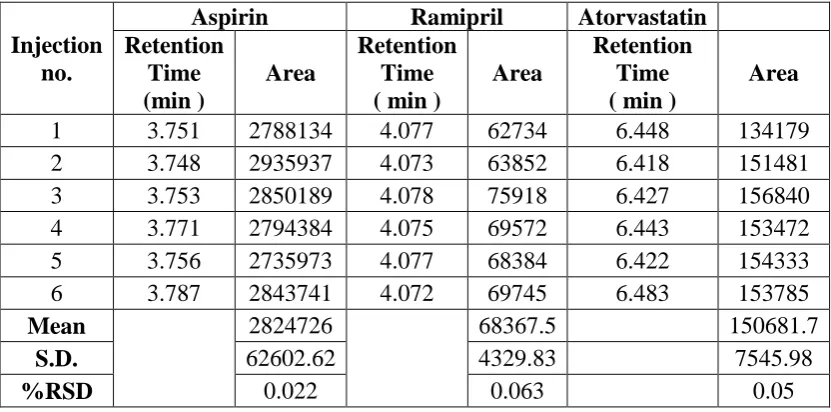
4) Method Precision
Relative standard deviation of the areas of six replicate injections are measured which
indicates the developed method is precise.
Table. 5 Results for Precision of Aspirin, Ramipril and Atorvastatin calcium. Injection
no.
Aspirin Ramipril Atorvastatin
calcium Retention Time (min ) Area Retention Time ( min )
Area
Retention Time ( min )
Area
1 3.751 2788134 4.077 62734 6.448 134179
2 3.748 2935937 4.073 63852 6.418 151481
3 3.753 2850189 4.078 75918 6.427 156840
4 3.771 2794384 4.075 69572 6.443 153472
5 3.756 2735973 4.077 68384 6.422 154333
6 3.787 2843741 4.072 69745 6.483 153785
Mean 2824726 68367.5 150681.7
S.D. 62602.62 4329.83 7545.98
%RSD 0.022 0.063 0.05
5) Limit of Detection and Limit of Quantification
The LODs as well as LOQs are quantitated in Table 6 below:
Table. 6 Results of LOD and LOQ of Rampril, Atorvastatin calcium and Aspirin. Ramipril (ng ml-1) Atorvastatin (ng ml-1) Aspirin (ng ml-1)
[image:9.595.90.506.421.627.2]6) Robustness
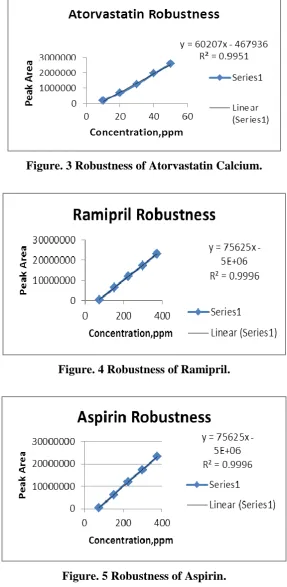
The proposed method was found to robust as the results were not significantly affected by the
[image:10.595.160.438.147.308.2]small and deliberate change in the flow rate.
Figure. 3 Robustness of Atorvastatin Calcium.
[image:10.595.153.441.155.744.2]Figure. 4 Robustness of Ramipril.
7) System suitability test
The %RSD for Aspirin, Ramipril and Atorvastatin calcium was found to be 0.024, 0.068 and
0.054, respectively which was found under the given ICH limit.
Stability-indicating or Forced degradation studies
(1) 3. 75 1' (2) 4. 07 7' (3) 6. 44 8' -60 0 60 120 180 240 300 360 420 480 540 m V
2 4 6 8 10 12 14 16 18 20 22 m in
Figure. 6 Chromatogram of an untreated sample; Aspirin (3.751min), Ramipril (4.077min). and Atorvastatin calcium (6.448min).
(1) 3. 85 8' (2) 4. 21
1' (3) 6.
52 1' 0 300 600 900 1200 1500 1800 2100 m V
2 4 6 8 10 12 14 16 18 20 22 m in
Figure. 7 Chromatogram of acid treated sample; Aspirin (3.858min), Ramipril (4.211min). and Atorvastatin calcium (6.521min).
(1) 3. 78 0' (2) 4. 11
6' (3) 6.
44 3' 0 300 600 900 1200 1500 1800 2100 m V
2 4 6 8 10 12 14 16 18 20 22 m in
[image:11.595.123.498.158.336.2] [image:11.595.133.469.364.536.2] [image:11.595.134.466.570.731.2](1)
3.
33
2'
(2)
3.
75
8'
(3)
4.
09
3' (4) 6.
38
6'
0 300 600 900 1200 1500 1800 2100 m V
[image:12.595.139.461.72.229.2]2 4 6 8 10 12 14 16 18 20 22 m in
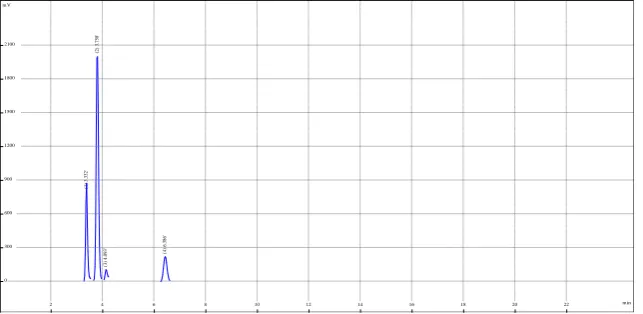
Figure. 9 Chromatogram of Peroxide treated sample; Aspirin (3.758min), Ramipril (4.093min). and Atorvastatin calcium (6.386min).
The chromatogram of peroxide treated sample showed an additional peak at RT of 3.332. The
% degradation with respect to the untreated sample is calculated in Table 7 below:
Table. 7 %degradation with respect to the untreated sample.
Name of the drug Peroxide (H2O2) Acid (HCl) Base (NaOH)
Aspirin 4.87 4.76 4.86
Ramipril 14.70 12.19 12.31
Atorvastatin
calcium 16.29 15.63 16.21
As the % degradation of all the three drugs is between 5-30% hence the method is termed to
be stability-indicating.
CONCLUSION
The developed RP-HPLC method is simple, sensitive, accurate, robust and
stability-indicating. It can be used for the successful determination of Atorvastatin calcium, Ramipril
and Aspirin simultaneously in a combined dosage form without any interference from the
excipients and additives present in the dosage form. As the developed method has less flow
rate as well as short run time of approximately 10min, the method proves to be economical
and cheap in the sense of usage of mobile phase. The time of analysis is also reduced due to
relatively short run time. The drugs are resistant to degradation, hence the method is termed
to be a stability-indicating one.
ACKNOWLEDGEMENT
It is with immense gratitude that expresses my benevolent thanks to my reverent teacher and
guide, Dr. Ashok. P. Pingle, Director & Professor, Dept. of Pharmaceutical Chemistry,
[image:12.595.73.515.338.410.2]REFERENCES
1. Indian Pharmacopoeia 1996, Published by the Controller of Publications, Delhi,
Government of India, Ministry of Health and Family Welfare: Volume I & II, pp. 69,
486,749, 1574.
2. Indian Pharmacopoeia 2007, Published by the Government of India, Ministry of Health
and Family Welfare, the Indian Pharmacopoeia commission, New Delhi: Volume I & II,
pp. 131,1036.
3. British Pharmacopoeia 2007, Published by the Stationary office, on behalf of the
Medicine and Healthcare products.
4. Zaheer Z, Farooqui MN, Mangle AA, Nikalje AG. Stability-indicating high performance
liquid chromatographic determination of Atorvastatin Calcium in Pharmaceutical Dosage
form. Afr J Pharm Pharmacol, 2008; 2(10): 204-210.
5. Abdelattef HE. Spectrophotometric and Spectrofluorometric methods for the
determination of Ramipril in its pure and dosage form. Spectrochim Acta A, 2001; 66:
701-706.
6. Krishnaiah V, Rami Reddy YV. Development and validation of HPLC method for the
determination of Aspirin. J Chem Pharm Res, 2012; 4(3): 2349-2353.
7. Bernard S, Mathew M, Senthilkumar KL, Girija KN. A Validated Stability-indicating
RP-HPLC method for the determination of Atorvastatin Calcium. International Journal of
Drug Formulation and Research, 2013; 4(1): 9-16.
8. Panchal HJ, Suhagia BN, Patel NJ, Rathod IS, Patel BH. Simultaneous estimation of
Atorvastatin Calcium, Ramipril and Aspirin in Capsule Dosage form by RP-LC,
Chromatographia, 2009; 69: 91-95.
9. Patole SM, Potale LV, Khodke AS, Damle MC. A Validated HPLC method for analysis
of Atorvastatin Calcium, Ramipril and Aspirin as the Bulk drug and in Combined Dosage
forms. Int J Pharm Sci Rev Res, 2010; 4(3): 40-45.
10.Sharma R, Khanna S, Mishra GP. Development and Validation of RP-HPLC method for
Simultaneous estimation of Ramipril, Aspirin and Atorvastatin in Pharmaceutical
Preparations. E-Journal of Chemistry, 2012; 9(4): 2177-2184.
11.Dhaneshwar SS, Dhaneshwar SR, Deshpande P, Patil M. Development and Validation of
a method for simultaneous densitometric estimation of Atorvastatin Calcium and
Ezetimibe as the bulk drug and in tablet dosage form. Acta Chromatographica, 2007; 19:
12. Deshpande PB, Shridharan G, Anandi L, Jadhav D, Damle MC, Gandhi SV. Validated
method development for estimation of Atorvastatin Calcium and Fenofibrate in fixed
dose combination by HPTLC. Pharma Review, 2009; 151-153.
13.Chaudhari BG, Patel NM, Shah PB, Modi KP. Development and Validation of a HPTLC
method for the simultaneous estimation of Atorvastatin Calcium and Ezetimibe. Indian J
Pharm Sci, 2006; 793-796.
14.Kowalczuk D, Pietra R, Hopka H. Development and Validation of an HPTLC –
Densitometric method for the determination of ACE inhibitors. Chromatographia, 60:
245-249.
15. Panchal HJ, Suhagia BN, Patel NJ. Simultaneous HPTLC analysis of Atorvastatin
Calcium, Ramipril and Aspirin in capsule dosage form. J Planar Chromatogr, 22:
265-271.
16.Patil PR, Rakesh SU, Dhabale PN.Simultaneous Estimation of Ramipril and Amlodipine
by UV Spectrophotometric method. Research J Pharm Tech, 2009; 2(2): 304-307.
17.Baldha RG, Patel VB, Bapna M. Simultaneous spectrophotometric determination of
Atorvastatin Calcium and Ezetimibe in tablet dosage form. Int J ChemTech Res, 2009;
1(2): 233-236.
18.Zambare YB, Karajgi SR, Simpi CC. Simultaneous estimation of Atorvastatin and
Ramipril by First Derivative Spectrophotometric method. J Pharm Res, 2009; 2(5):
874-877.
19.ICH-Q2 (R1): Validation of Analytical Procedures: Text and Methodology, FDA, Vol 60,
1March; 1995; 11260.
20.ICH-Q1A (R2): Stability Testing of New Drug Substances and Products (Second