Proceedings of the First International Workshop on
Adversarial Information Retrieval on the Web
AIRWeb 2005
Held in conjunction with the 14
thInternational World Wide Web Conference, 10 May 2005,
Chiba, Japan.
Edited by
Brian D. Davison
Department of Computer Science and Engineering,
Lehigh University, Bethlehem, PA USA
Sponsored by
Contents
Welcome
iv
Overview
v
Workshop Organizers
vi
Program
vii
Contributing Authors
ix
Full Papers
Blocking Blog Spam with Language Model Disagreement
1
Gilad Mishne, David Carmel and Ronny Lempel
Cloaking and Redirection: A Preliminary Study
7
Baoning Wu and Brian D. Davison
Pagerank Increase under Different Collusion Topologies
17
Ricardo Baeza-Yates, Carlos Castillo and Vicente López
SpamRank -- Fully Automatic Link Spam Detection
25
András A. Benczúr, Károly Csalogány, Tamás Sarlós, and Máté Uher
Web Spam Taxonomy
39
Zoltán Gyöngyi and Hector Garcia-Molina
Synopses
An Analysis of Factors Used in Search Engine Ranking
48
Albert Bifet, Carlos Castillo, Paul-Alexandru Chirita and Ingmar Weber
Optimal Link Bombs are Uncoordinated
58
Sibel Adali, Tina Liu and Malik Magdon-Ismail
Web Spam, Propaganda and Trust
70
Welcome
Dear Participant:
Welcome to the First International Workshop on Adversarial Information Retrieval on
the Web (AIRWeb). This workshop is intended to bring together researchers and
practitioners that are concerned with the on-going efforts in adversarial information
retrieval on the Web. We have a total of eight peer-reviewed papers to be presented --
five research presentations and three synopses of work in progress. All convey the latest
results in adversarial web IR, and address topics such as web spam, blog spam, cloaking,
redirection, link optimization for PageRank, automated link spam detection, link bombs,
reverse engineering of ranking algorithms, and propaganda. In addition, we will have a
panel session in which workshop participants may raise additional questions of interest to
industry experts and researchers.
I extend my thanks to the authors and presenters, and to the members of the program
committee for their work in contributing to the material that forms an outstanding first
workshop. I also sincerely thank Ask Jeeves for their support of the workshop, enabling
us to partially cover travel costs for many of the student presenters. It is my hope that you
will find the work presented interesting enough that you will ask questions, contribute
ideas, and perhaps get involved in future work in this area.
Overview
Search is the single most common application used on the Web. The attraction of hundreds of
millions of searches per day provides significant incentive to content providers to do whatever
necessary to rank highly in search engine results. The use of techniques that push rankings higher
than they belong is often called spamming a search engine (or spamdexing). Such methods
typically include textual as well as link-based techniques. Like e-mail spam, search engine spam
is a form of adversarial information retrieval; the conflicting goals of accurate results of search
providers and high positioning by content providers provides an interesting and real-world
environment to study techniques in optimization, obfuscation, and reverse engineering, in
addition to the application of information retrieval and classification.
The AIRWeb'05 workshop solicited technical papers on any aspect of adversarial information
retrieval on the Web. Particular areas of interest included, but were not limited to:
•
search engine spam and optimization,
•crawling the web without detection,
•link-bombing,
•
reverse engineering of ranking algorithms,
•advertisement blocking, and
•
web content filtering.
Workshop Program
9:00am
Welcome
9:15am
Session 1
•
Web Spam Taxonomy
Zoltán Gyöngyi, Stanford University
Hector Garcia-Molina, Stanford University
•
Synopsis: An Analysis of Factors Used in Search Engine Ranking
Albert Bifet, Technical University of Catalonia
Carlos Castillo, University of Chile
Paul-Alexandru Chirita, L3S Research Center
Ingmar Weber, Max-Planck-Institute for Computer Science
•
Synopsis: Web Spam, Propaganda and Trust
Panagiotis T. Metaxas, Wellesley College
Joseph DeStefano, College of the Holy Cross
10:30am
Morning Break
11:00am
Session 2
•
Pagerank Increase under Different Collusion Topologies
Ricardo Baeza-Yates, ICREA-Univ. Pompeu Fabra and University of Chile
Carlos Castillo, Universitat Pompeu Fabra
Vicente López, Universitat Pompeu Fabra
•
Cloaking and Redirection: A Preliminary Study
Baoning Wu, Lehigh University
Brian D. Davison, Lehigh University
•
Synopsis: Optimal Link Bombs are Uncoordinated
Sibel Adali, Renssalaer Polytechnic Institute
Tina Liu, Renssalaer Polytechnic Institute
Malik Magdon-Ismail, Renssalaer Polytechnic Institute
12:30pm
Lunch
2:00pm
Expert Panel Session
•Moderator:
o
Brian D. Davison, Lehigh University
•Panelists:
o
Andrei Broder, IBM Research
oSoumen Chakrabarti, IIT Bombay
oDavid Cohn, Google
o
Tim Converse, Yahoo
4:00pm
Session 3
•
Blocking Blog Spam with Language Model Disagreement
Gilad Mishne, University of Amsterdam
David Carmel, IBM Research
Ronny Lempel, IBM Research
•
SpamRank -- Fully Automatic Link Spam Detection
András A. Benczúr, Hungarian Academy of Sciences (MTA SZTAKI) and Eötvös Univ.
Károly Csalogány, Hungarian Academy of Sciences (MTA SZTAKI) and Eötvös Univ.
Tamás Sarlós, Hungarian Academy of Sciences (MTA SZTAKI) and Eötvös University
Máté Uher, Hungarian Academy of Sciences (MTA SZTAKI)
5:00pm
Discussion
Workshop Organizers
Program Chair
Brian D. Davison, Lehigh University
Program Committee Members
Andrei Broder, IBM Research
David Carmel, IBM Research Haifa
Tim Converse, Yahoo
Nick Craswell, Microsoft Research Cambridge
Matt Cutts, Google
Dennis Fetterly, Microsoft Research
David Gibson, IBM Research
David Hawking, CSIRO
David D. Lewis, Independent Consultant
Mark Manasse, Microsoft Research
Kevin McCurley, IBM Research
Urban Mueller, Search.ch
Marc Najork, Microsoft Research
Jan Pedersen, Yahoo
Bernhard Seefeld, Search.ch
Baoning Wu, Lehigh University
Contributing Authors
Sibel Adali,
Renssalaer Polytechnic Institute
Ricardo Baeza-Yates,
ICREA-Univ. Pompeu Fabra and University of Chile
András A. Benczúr,
Hungarian Academy of Sciences (MTA SZTAKI) and Eötvös University
Albert Bifet,
Technical University of Catalonia
David Carmel,
IBM Research
Carlos Castillo,
University of Chile and Universitat Pompeu Fabra
Paul-Alexandru Chirita,
L3S Research Center
Károly Csalogány,
Hungarian Academy of Sciences (MTA SZTAKI) and Eötvös University
Brian D. Davison,
Lehigh University
Joseph DeStefano,
College of the Holy Cross
Hector Garcia-Molina,
Stanford University
Zoltán Gyöngyi,
Stanford University
Ronny Lempel,
IBM Research
Tina Liu,
Renssalaer Polytechnic Institute
Vicente López,
Universitat Pompeu Fabra
Malik Magdon-Ismail,
Renssalaer Polytechnic Institute
Panagiotis T. Metaxas,
Wellesley College
Gilad Mishne,
University of Amsterdam
Tamás Sarlós,
Hungarian Academy of Sciences (MTA SZTAKI) and Eötvös University
Máté Uher,
Hungarian Academy of Sciences (MTA SZTAKI)
Blocking Blog Spam with Language Model Disagreement
Gilad Mishne
Informatics Institute, University of Amsterdam Kruislaan 403, 1098SJ Amsterdam
The Netherlands
David Carmel, Ronny Lempel
IBM Research Lab in Haifa Haifa 31905, Israel
{
carmel,rlempel
}@il.ibm.com
ABSTRACT
We present an approach for detecting link spam common in blog comments by comparing the language models used in the blog post, the comment, and pages linked by the com-ments. In contrast to other link spam filtering approaches, our method requires no training, no hard-coded rule sets, and no knowledge of complete-web connectivity. Prelimi-nary experiments with identification of typical blog spam show promising results.
Categories and Subject Descriptors
H.3.3 [Information Storage and Retrieval]: Information Search and Retrieval - search engine spam; I.7.5 [Docu-ment Capture]: Docu[Docu-ment analysis - docu[Docu-ment classifi-cation, spam filtering; K.4.1 [Computers and Society]: Public Policy Issues - abuse and crime involving computers, privacy
General Terms
Algorithms, Languages, Legal Aspects
Keywords
Comment spam, language models, blogs
1.
INTRODUCTION
The growing popularity of internet search as a primary access point to the web has increased the benefits of achiev-ing top rankachiev-ings from popular search engines, especially for commercially-oriented web pages. Combined with the suc-cess of link analysis methods such as PageRank, this led to a rapid growth in link spamming – creating links which are “present for reasons other than merit” [6]. A well-known example of link spamming is link farms – link exchange pro-grams existing for the sole purpose of boosting the link-based prestige of participating sites; these farms are fairly easily identified by topological analysis. However, in recent years search engines are facing a new link spam problem which is harder to track down: comment spam.
Comment spam is essentially link spam originating from comments and responses added to web pages which support dynamic user editing. With the massive increase in the num-ber of blogs in recent years, such pages have proliferated; additional editable web pages which are often the target of
Copyright is held by the author/owner(s). AIRWeb’05, May 10, 2005, Chiba, Japan.
comment spammers are wikis1 and guestbooks. Blogs have made the life of comment spammers easy: instead of setting up complex webs of pages linking to the spam page, the spammer writes a simple agent that visits random blog and wiki pages, posting comments that link back to her page. Not only is spamming easier, but the spammer also bene-fits from the relatively high prestige that many blogs enjoy, stemming both from the rapid content change in them and the density of links between them. Comment spam, and link spam in general, poses a major challenge to search engines as it severely threatens the quality of their ranking. Com-mercial engines are seeking new solutions to this problem [9]; accordingly, the amount of research concerning link spam is increasing [8, 2, 6].
In this paper, we follow a language modeling approach for detecting link spam in blogs and similar pages. Our intuition is simple: we examine the use of language in the blog post, a related comment, and the page linked from the comment. In the case of comment spam, these language models are likely to be substantially different: the spammer is usually trying to create links between sites that have no semantic relation, e.g., a personal blog and an adult site. We exploit this divergence in the language models to effectively classify comments as spam or non-spam. Our method can be deployed in two modes: in retrospective manner, when inspecting a blog page which already has comments (this is particularly useful for crawlers); or in an online manner, to be used by the blog software to block spammers on the fly.
The rest of the paper is organized as follows. In Sec-tion 2 we survey existing work in the area of link spam. Our language modeling approach is presented and formal-ized in Section 3. Section 4 follows with a description of preliminary experiments conducted using this method; we conclude in Section 5. This paper discusses ongoing work and is meant to provide the conceptual framework and ini-tial results, rather than a complete analysis of our proposed solution.
2.
RELATED WORK
2.1
Comment Spam
Most approaches to preventing comment spam are tech-nical in nature, and include:
• Requiring registration from comment posters;
• Requiring commenters to solve a captcha – a simple Turing test mechanism [17];
• Preventing HTML in comments; • Preventing comments on old blog posts;
• Using lists of forbidden or allowed IP addresses for commenters (“blacklists” and “whitelists”);
• Using internal redirects instead of external links in comments;
• Limiting the number (or rate) of comments being added (“throttling”).
While some of these mechanisms can be quite effective, they also have disadvantages. Methods which require user effort such as registration reduce the number of spontaneous responses which are important to many blog maintainers. Additionally, they do not affect the millions of commented web pages already “out there”, and only address new com-ments. Preventing commenting altogether, or limiting it to plain text, or enforcing redirects on links in it, limits also legitimate comments and links contained in them, reducing the effectiveness of link analysis methods. Blacklists and whitelists require constant maintenance, and are bypassed by spammers using proxies and spoofed legitimate IP ad-dresses. Throttling can reduce the amount of spam from a single page, but not the phenomenon altogether; spammers will simply post to more blogs.
Recently, a number of major search engines such as Ya-hoo, MSN Search and Google announced that they are col-laborating with blogging software vendors and hosts to fight comment spam using a special attribute added to hypertext links [13]. This tag, rel="nofollow", tells search engines that the links are untrusted, and will effectively prevent ap-plication of link-analysis scores to links associated with it – maybe even prevent crawling them altogether. However, the usage of this attribute is problematic for a number of rea-sons, including harming the inter-linked nature of blogs and possible abuse by webmasters; indeed, it is disputed within the blogging community [14, 4], and many do not intend to use it (e.g., at the time of writing, Yahoo’s own search blog – which announced the tag – does not implement it).
2.2
Content Filtering and Spam
A different set of approaches for fighting comment spam works by analyzing the content of the spam comment, and possibly also the contents of pages linked by the comment (e.g., [12]). All these techniques are currently based on de-tecting a set of keywords or regular expressions within the comments. This approach suffers from the usual drawbacks associated with a manual set of rules, i.e. high maintenance load as spammers are getting more sophisticated. Typically, content-based methods require training with a large amount of spam and non-spam text, and correcting mistakes that are made; failure to continuously maintain the learner will decrease its accuracy, as it will create an inaccurate concep-tion of what’s spam and what’s not. Having said that, regu-lar expression based methods are fairly successful currently, partly due to the relatively young history of link spamming. It is expected that, similarly to the email spam world, as comment spammers enhance their methods, rule-based ap-proaches will become less effective.
Published work on spam refers mostly to email spam, which was popular long before comment spam was, and was
therefore targeted from many industrial and academic an-gles. In the email domain, machine learning and language modeling approaches have been very effective in classifying spam [10, 3]. An important difference between email spam and comment spam stems from the fact that comment spam isnot intended for humans. No comment spammer actually expects anyone to click on the link that was added: this link is meant solely for the purpose of being followed by web crawlers. Thus, the spammer can (and does) use any type of words/features in his comment: the main goal is to have the link taken into account by search engine ranking schemes, and strings which have been reported as good discriminators of email spam such as over-emphasized punctuation [16] are not necessarily typical of comment spam.
2.3
Identifying Spam Sites
An altogether different approach to spam filtering is not to classify individual links as spam links or legitimate links, but to classify pages or sites as spam; recent work in this area includes usage of various non-content features [8] and link analysis methods [2]. The drawback of these approaches is that spam is essentially not a feature of pages, but of links between pages; sites can have both legitimate and spam in-coming links (this is true for many online shops). Addition-ally, usage of some of these methods requires full connectiv-ity knowledge of the domain, which is beyond the abilities of most bloggers.
In comparison to the existing methods presented, our ap-proach requires no training, no maintenance, and no knowl-edge of additional information except that present on the commented web page.
3.
COMMENT SPAM AND LANGUAGE
MODELS
In this section we outline our language model based ap-proach to identifying comment spam.
In the previous section, we noted that email spam is easier to classify than comment spam since it tends to have charac-terizing features – features which are supposed to convince a human to respond to the spam mail. On the other hand, comment spam has an advantage (from the filtering per-spective) that email spam does not have. While every email needs to be classified as spam in an isolated manner, blog comments are presented within acontext: a concrete seman-tic model in which the comment was posted. Our main as-sumption is that spam comments are more likely to violate this context by presenting completely different issues and topics. We instantiate the semantic models of the context, the comment and the page linked by the comment using language models.
increasingly popular [15, 11].
As noted earlier, we identify three types of languages, or language models, involved in the comment spam problem (see Figure 1). First, there is the model of the original blog post. Then, every comment added to the post adds two more models: the language used in the comment, and the language used in the page linked by the comment.
Figure 1: Three types of language models: the model of the blog post, the models of the comments, and the models of the pages linked by the comments.
To compare the models, we follow a variation on the In-terpolated Aggregate Smoothing used by Allanet. al. in [1]. In practice, this measure calculates the smoothed Kullback-Leibler divergence between the language model of a short fragment of text and a combined language model of knowl-edge preceding this text. Formally, the KL-divergence be-tween two probability distributions Θ1,Θ2 is
KL(Θ1kΘ2) =
X
w
p(w|Θ1) log
p(w|Θ1)
p(w|Θ2)
wherep(w|Θi) is the probability of observing the wordw ac-cording to the model Θi. In Interpolated Aggregate Smooth-ing, probabilities are estimated using maximum likelihood models and smoothed with Jelinek-Mercer smoothing. The two language models we are comparing are any pair of the triplet (blog post, comment, page linked by commet); let’s examine the comparison between the model of the blog post (ΘP), and the model of a comment to this post (ΘC). We estimate the probabilities using maximum likelihood and smooth using a general probability model of words on the internet obtained from [7]. This gives us:
p(w|ΘP) = λ1p(w|ΘM L(post))
+ (1−λ1)p(w|ΘM L(internet))
p(w|ΘC) = λ2p(w|ΘM L(comment)) + (1−λ2)p(w|ΘM L(internet))
WhereM L(hsourcei) are maximum likelihood estimates. The language models used here are unigram models, but it is possible to use n-grams of higher orders in the same manner.
3.2
Spam Classification
Once we have a language model for each comment and a score based on its similarity to the language model of the
blog post, we use these scores to classify the comment as spam or non-spam. Although this can be done using a sim-ple threshold, we follow a different approach. We assume that the spammed blog page is parsed by a crawler, and the crawler is trying to assess which links (from the comments) should be used for link analysis methods and which not. In this case, the crawler views a range of comments, and must distinguish the good ones from the bad. As a first stage, the crawler calculates the KL-divergence for all comments as indicated above. The values obtained can then be seen as drawn from a probability distribution which is a mixture of Gaussians: each Gaussian represents a different language model. The Gaussian with the lowest mean – the least dis-tance from the language model of the original blog post – represents the language model which is closest to the origi-nal post. Subsequent Gaussians represent language models which have a larger deviation from the original one, and are therefore more likely to constitute spam comments.
For our model, we assume the KL-divergence scores to be drawn from a 2-Gaussian distribution: the “legitimate” language model, and all other (spam) models (see example of the distribution in one of the blog pages in Figure 2). To estimate the parameters of the Gaussians, we use the EM algorithm.
2 2.5 3 3.5 4 4.5 5 2 2.5 3 3.5 4 4.5 5
Figure 2: Gaussian mixture model estimated from the KL-divergence values of 10 comments on a blog post, and its underlying Gaussians
Finally, a comment is classified as spam if its KL-divergence from the blog post is more likely to be drawn from the spam Gaussian than from the legitimate one. For this purpose, we calculate a discriminating value between the two Gaus-sians – a number for which lower values are more likely to be drawn from the Gaussian with lower mean, and higher values are more likely to be drawn from the other Gaus-sian. Visually, this threshold can be viewed as the best vertical separator between the two distributions. Note that this threshold value provides us with an easy mechanism for changing the likelihood of identifying false positives (“le-gitimate” comments classified as spam) and false negatives (unidentified spam). Decreasing the threshold (“moving” the separator left) will result in a more strict requirement from the language model divergence between the comment and the post, effectively increasing the number of false pos-itives and reducing false negatives; increasing the threshold value (“moving” the line to the right) will cause our method to be more tolerant to higher KL-divergence values, reduc-ing false positives at the cost of increased false negatives. Usually, the cost of false positives is considered higher than that of false negatives; in general, we can use a threshold multiplier value to adjust the original threshold (where a multiplier of 1.0 will leave the threshold unchanged).
Blog comments can be very short, and this is true also for some blog posts. This results in sparse language models, containing a relatively low number of words. We therefore propose to enrich the models of both the post and the com-ment, to achieve a more accurate estimation of the language model. An intuitive way to do so is to follow links present in the post and the comment, and add their content to the post and the comment, respectively; in the case of the post, it is also possible to follow incoming links to the blog and add their content. Taking this a step further, it is also possi-ble to continue following links up to depth N, although this potentially causes topic (and language model) drift.
3.4
Limitations and Solutions
An easy way for spammers to “cheat” our model (or any other model which compares the contents of the post and the comment) is to generate comments with a similar language model to the original blog post. This makes the link-spam bots slightly more complicated since they must identify the post contents and use its model for generating a close one (e.g., by copying phrases) – but spammers have shown to overcome much higher obstacles.
However, in this case of language model faking, a new op-portunity arises: assuming the spammer posts multiple com-ments in many different blogs (as a means of increasing the PageRank), there are now many comments with completely different language models to the same spam site. This is easily detectable at the search engine level which has a con-nectivity server at its hand; it can also be detected by an iterative HITS-like method by the blogger, following the link to the spam site and then its incoming links.
As any other spam filtering method, ours is not foolproof and can make mistakes; comments which are formulated with a sufficiently different vocabulary than the blog post might be mistaken for spam. However, this is precisely the reason for the robustness of our approach: it is very hard for the spammer to create comments that will be both sim-ilar to the blog language and to the spam site language. To account for these mistakes, an alternative to using our method as a binary spam/non-spam classifier is to use it for assigning a weight to links found in comments according to their language model divergence; the weight can be used to decrease PageRank of malicious sites, using methods such as the one reported in [5].
4.
EXPERIMENTAL SETTING
We now present some preliminary experiments in identi-fying comment spam in blogs using our approach.
We collected 50 random blog posts, along with the 1024 comments posted to them; all pages contain a mix of spam and non-spam comments. The number of comments per post ranged between 3 and 96, with the median being 13.5 (duplicate and near-duplicate comments were removed). We manually classified the comments: 332 (32%) were found to be “legitimate” comments, some of them containing links to related pages and some containing no links; the other 692 comments (68%) were link-spam comments2.
The link-spam comments we encountered in our corpus are of diverse types; while some of them are simple keyword
2The collection can be obtained from
http://ilps.science.uva.nl/Resources/blogspam/
lists, accompanied by links to the spam sites, others employ more sophisticated language (see Figure 3 for some sample comments). A typical blog page from our corpus contains a mix of different comment spam types.
6708 sports bettingonline sports bettingmarch madnessbasketball bettingncaa bettingsports ... Link: gambling site
%syn(Cool|Nice|Rulezz)% %syn(blog,|portal|site)% hope to make %syn(my own|own weblog|my diary)%, not worse than yours ;)
Link: adult site
A common mistake that people make when trying to design something completely foolproof was to underestimate the ingenuity of complete fools. Link: pharmacy site
i was looking for plus size lingerie but google sent me here
Link: fashion shop
Figure 3: Samples of comment spam in our collec-tion (top to bottom): [1] keyword based, with a random number to prevent duplicate detection; [2] revealing internal implementation of the spamming agent; [3] using quotes – in this case, from Dou-glas Adams – as “trusted” language; [4] disguising as random surfer
In this set of experiments, we compared only the language models of the post and the comments, and did not take into account the model of the page linked by the comments. This was done due to time constraints. The values of λi (see previous section) were both set to 0.9.
4.1
Results
The results of our experiments are shown in Table 1. False negatives are spam comments which were not identified as spam by our method, while false positives are non-spam comments which were classified as spam. The threshold mul-tiplier is the value used to modify the separator between the two language models as described in section 3.2.
As a naive baseline, we use the maximum likelihood prob-abilities for the comment type in our model; as noted earlier, 68% of the comments were spam, so we assume an ad-hoc fixed probability of 0.68 for a comment to contain link spam. We achieve reasonable performance with our model, and can clearly see the trade-off between misclassifying spam and misclassifying non-spam, resulting from different modifica-tions to the language model threshold.
in-Table 1: Blog link-spam classification results
Threshold False False
Method Multiplier Correct Negatives Positives
Baseline (avg. 100 runs) N/A 581 (57%) 223 (21.5%) 220 (21.5%)
KL-divergence 0.75 840 (82%) 65 (6.5%) 119 (11.5%)
KL-divergence 0.90 834 (81.5%) 69 (6.5%) 121 (12%)
KL-divergence 1.00 823 (80.5%) 88 (8.5%) 113 (11%)
KL-divergence 1.10 850 (83%) 87 (8.5%) 87 (8.5%)
KL-divergence 1.25 835 (81.5%) 111 (11%) 78 (7.5%)
tuition is correct: the language used in spam comments does diverge from the language of the blog post substan-tially more than the language used in legitimate comments. An analysis of the misclassified comments reveals that many of them are very short – containing 3-4 words, usu-ally a non-content response to the post (e.g., “That sounds cool”). However, the vast majority of these comments con-tain no external links, or an email link only – so their mis-classification will not result in actual search engine spam (in the case of false negatives) and not change the “true” link-analysis prestige of pages (in the case of false positives). While it is possible to integrate language divergence with comment length and other features into a hybrid comment spam classification system, we focused on the language as-pect only and did not explore usage of additional knowledge.
Model Expansions.
As mentioned earlier, a possible solu-tion to the sparseness of some of the blog posts is to expand the language model in various ways. We performed a lim-ited amount of experiments involving such expansions, by following all links present in the blog post and adding the content present in the target pages to the content of the blog post, before estimating the language model. Of the 50 blog posts in our corpus, 31 posts had valid links to other pages (some posts did not contain links at all, and some contained expired and broken links). The average number of links followed (for the 31 pages with expansions) was 3.4. Un-fortunately, using the expanded models did not improve the overall classification accuracy. In fact, while for some blog posts – most notably shorter ones – the expansion helped substantially, we experienced a degradation of 2%-5% in the average performance over the entire corpus. However, both the fairly small number of pages which were expanded and the limited experiments performed prevent us from formu-lating a definite statement regarding model expansion at this stage.5.
CONCLUSIONS
We presented an approach for classifying blog comment spam by exploiting the difference between the language used in a blog post and the language used in the comments to that post (and pages linked from those comments). Our method works by estimating language models for each of these components, and comparing these models using well-known methods. Preliminary experiments using our method to classify typical comment spam show promising results; while in this paper we discuss blogs, the problem and the solution are relevant to other types of comment spam, such as wiki spam.
6.
REFERENCES
[1] J. Allan, C. Wade, and A. Bolivar. Retrieval and novelty detection at the sentence level. InSIGIR ’03: Proceedings of the 26th annual international ACM SIGIR conference on Research and development in informaion retrieval, pages 314–321. ACM Press, 2003. [2] E. Amitay, D. Carmel, A. Darlow, R. Lempel, and
A. Soffer. The connectivity sonar: detecting site functionality by structural patterns. InHYPERTEXT ’03: Proceedings of the fourteenth ACM conference on Hypertext and hypermedia, pages 38–47. ACM Press, 2003.
[3] I. Androutsopoulos, J. Koutsias, K. V. Chandrinos, and C. D. Spyropoulos. An experimental comparison of naive bayesian and keyword-based anti-spam filtering with personal e-mail messages. InSIGIR ’00: Proceedings of the 23rd annual international ACM SIGIR conference on Research and development in information retrieval, pages 160–167. ACM Press, 2000.
[4] Nofollow tag cheers bloggers, but fails blogs, URL: http://www.platinax.co.uk/news/archives/2005/ 01/new_nofollow_ta.html.
[5] R. Baeza-Yates and E. Davis. Web page ranking using link attributes. InWWW Alt. ’04: Proceedings of the 13th international World Wide Web conference on Alternate track papers & posters, pages 328–329. ACM Press, 2004.
[6] B. Davison. Recognizing nepotistic links on the web. InAAAI-2000 workshop on Artificial Intelligence for Web Search, pages 23–28. AAAI Press, 2000. [7] The Berkeley/Stanford Web Term Document
Frequency and Rank project, URL: http://elib.cs.berkeley.edu/docfreq/.
[8] D. Fetterly, M. Manasse, and M. Najork. Spam, damn spam, and statistics: using statistical analysis to locate spam web pages. InWebDB ’04: Proceedings of the 7th International Workshop on the Web and Databases, pages 1–6. ACM Press, 2004.
[9] M. R. Henzinger, R. Motwani, and C. Silverstein. Challenges in web search engines.SIGIR Forum, 36(2):11–22, 2002.
[10] J. M. G. Hidalgo. Evaluating cost-sensitive unsolicited bulk email categorization. InSAC ’02: Proceedings of the 2002 ACM symposium on Applied computing, pages 615–620. ACM Press, 2002.
pages 120–127. ACM Press, 2001.
[12] Movable Type Blacklist Filter, with content filtering, URL:
http://www.jayallen.org/projects/mt-blacklist/. [13] Joint statement from Yahoo, Google, and others
regarding the “nofollow” tag, URLs:
http://www.google.com/googleblog/2005/01/ preventing-comment-spam.html,http:
//www.ysearchblog.com/archives/000069.html. [14] No nofollow: fight spam, not blogs, URL:
http://www.nonofollow.net.
[15] J. M. Ponte and W. B. Croft. A language modeling approach to information retrieval. InSIGIR ’98: Proceedings of the 21st annual international ACM SIGIR conference on Research and development in information retrieval, pages 275–281. ACM Press, 1998.
[16] M. Sahami, S. Dumais, D. Heckerman, and E. Horvitz. A bayesian approach to filtering junk E-mail. InLearning for Text Categorization: Papers from the 1998 Workshop, Madison, Wisconsin, 1998. AAAI Technical Report WS-98-05.
Cloaking and Redirection: A Preliminary Study
Baoning Wu
and
Brian D. Davison
Computer Science & Engineering
Lehigh University
{
baw4,davison
}
@cse.lehigh.edu
Abstract
Cloaking and redirection are two possible search en-gine spamming techniques. In order to understand cloaking and redirection on the Web, we downloaded two sets of Web pages while mimicking a popular Web crawler and as a common Web browser. We estimate that 3% of the first data set and 9% of the second data set utilize cloaking of some kind. By checking manually a sample of the cloaking pages from the sec-ond data set, nearly one third of them appear to aim to manipulate search engine ranking.
We also examined redirection methods present in the first data set. We propose a method of detecting cloaking pages by calculating the difference of three copies of the same page. We examine the different types of cloaking that are found and the distribution of different types of redirection.
1
Introduction
Cloaking is the practice of sending different content to a search engine than to regular visitors of a web site. Redirection is used to send users automatically to another URL after loading the current URL. Both of these techniques can be used in search engine spam-ming [13, 7]. Henzinger et al. [8] has pointed out that search engine spam is one of the major challenges of web search engines and cloaking is among the spamming techniques used today. Since search en-gine results can be severely affected by spam, search engines typically have policies against cloaking and some kinds of dedicated redirection [5, 16, 1].
Google [5] describes cloaking as the situation in which “the webserver is programmed to return dif-ferent content to Google than it returns to regular
Copyright is held by the author/owner(s). AIRWeb’05, May 10, 2005, Chiba, Japan.
users, usually in an attempt to distort search engine rankings.” An obvious solution to detect cloaking is that for each page, calculate whether there is a differ-ence between a copy from a search engine’s perspec-tive and a copy from a web browser’s perspecperspec-tive. But in reality, this is non-trivial. Unfortunately, it is not enough to know that corresponding copies of a page differ; we still cannot tell whether the page is a cloaking page. The reason is that web pages may be updated frequently, such as in a news web-site or a blog webweb-site, or simply that the web web-site puts a time stamp on every page it serves. Even if two crawlers were synchronized to visit the same web page at nearly the same moment, some dynamically generated pages may still have different content, such as a banner advertisement that is rotated on each ac-cess.
Besides the difficulty of identifying cloaking, it is also hard to tell whether a particular instance of cloaking is considered acceptable or not. We de-fine the cloaking behavior that has the effect of ma-nipulating search engine ranking results as semantic cloaking. Unfortunately, the various search engines may have different criteria for defining unacceptable cloaking. As a result, we have focused on the simpler, more basic task — when we mention cloaking in this paper, we usually refer to the simpler case of whether different content is served to automated crawlers ver-sus web browsers, but not different content to every visitor. We name this cloaking as syntactic cloak-ing. So, for example, we will not consider dynamic advertisements to be cloaking.
In order to investigate this issue, we collected two data sets: one is a large data set containing 250,000 pages and the other is a smaller data set containing 47,170 pages. The detail of these two data set will be given in Section 3. We manually examined a number of samples of those pages and found several differ-ent kinds of cloaking techniques. From this study we make an initial proposition toward building an
mated cloaking detection system. Our hope is that these results may be of use to researchers to design better and more thorough solutions to the cloaking problem.
Since redirection can also be used as a spamming technique, we also calculated some statistics based on our crawled data for cloaking. Four types of redirec-tion are studied.
Few publications address the issue of cloaking on the Web. As a result, the main contribution of this paper is to begin a discussion of the problem of cloak-ing and its prevalence in the web today. We pro-vide a view of actual cloaking and redirection tech-niques. We additionally propose a method for detect-ing cloakdetect-ing by usdetect-ing three copies of the same page.
We next review those few papers that mention cloaking. The data sets we use for this study are introduced in Section 3. The results of cloaking and redirection are shown in Section 4 and 5 respectively. We conclude this paper with a summary and discus-sion in Section 6.
2
Related Work
Henzinger et al. [8] mentioned that search engine spam is quite prevalent and search engine results would suffer greatly without taking measures. They also mentioned that cloaking is one of the major search engine spam techniques.
Gy¨ongyi and Garcia-Molina [7] describe cloaking and redirection as spam hiding techniques. They showed that web sites can identify search engine crawlers by their network IP address or user-agent names. They also described the use of refresh meta tags and JavaScript to perform redirection. They ad-ditionally mention that some cloaking (such as send-ing search engine a version free of navigational links, advertisements but no change to the content) are ac-cepted by search engines.
Perkins [13] argues that agent-based cloaking is spam. No matter what kind of content is sent to search engine, the goal is to manipulate search en-gines rankings, which is an obvious characteristic of search engine spam.
Cafarella and Cutting [4] mention cloaking as one of the spamming techniques. They said that search engines will fight cloaking by penalizing sites that give substantially different content to different browsers.
None of the above papers discuss how to detect cloaking, which is one aspect of the present work. In
one cloaking forum [14], many examples of cloaking and methods of detecting cloaking are proposed and discussed. Unfortunately, generally these discussions can be taken as speculation only, as they lack strong evidence or conclusive experiments.
Najork filed for patent [12] on a method for ing cloaked pages. He proposed an idea of detect-ing cloaked pages from users’ browsers by installdetect-ing a toolbar and letting the toolbar send the signature of user perceived pages to search engines. His method does not distinguish rapidly changing or dynamically generated Web pages from real cloaking pages, which is a major concern for our algorithms.
3
Data set
Two data sets were examined for our cloaking and redirection testing. For convenience, we name the first data as HITSdata and the second as HOTdata.
3.1
First data set: HITSdata
In related work to recognize spam in the form of link farms [15], we collected Web pages in the neighborhood of the top 100 results for 412 queries by following the HITS data collection process [9]. That is, for each query presented to a popular search engine, we collected the top 200 result references, and for each URL we also retrieved the outgoing link set, and up to 100 incoming link pages. The resulting data set contains 2.1M unique Web pages. From these 2.1M URLs, we randomly selected 250,000 URLs. In order to test for cloaking, we crawled these pages simultaneously from a univer-sity IP address (Lehigh) and from a commercial IP address (Verizon DSL). We set the user-agent
from the university address to be Mozilla/4.0
(compatible; MSIE 5.5; Windows 98) and the
one from the commercial IP to be Googlebot/2.1
(+http://www.googlebot.com/bot.html). From
3.2
Second data set: HOTdata
We also want to know the cloaking ratio within the top response lists for hot queries.
The first step is to collect hot queries from popular search engines. To do this, we collected 10 popular queries of Jan 2005 from Google Zeigeist [6], top 100 search terms of 2004 from Lycos [10], top 10 searches for the week ending Mar 11, 2005 from Ask Jeeves [3], and 10 hot searches in each of 16 categories ending Mar 11, 2005 from AOL [2]. This resulted in 257 unique queries from these web sites.
The second step is to collect top response list for these hot queries. For each of these 257 queries, we re-trieved the top 200 responses from the Google search engine. The number of unique URLs is 47,170. Like the first data set, we downloaded four copies for each of these 47,170 URLs, two from a browser’s perspec-tive and two from a crawler’s perspecperspec-tive. But all these copies are downloaded from machines with a university IP address. For convenience, we name these four copies HC1, HB1, HC2 and HB2 re-spectively. This order also matches the time order of downloading them.
4
Results of Cloaking
In this section, we will show the results for the cloak-ing test.
4.1
Detecting Cloaking in HITSdata
Intuitively, the goal of cloaking is to give differ-ent contdiffer-ent to a search engine than to normal web browsers. This can be different text or links. We use two techniques to compare versions retrieved by a crawler and a browser — we consider the number of differences in the terms and links used over time to detect cloaking.
As we mentioned earlier in Section 1, calculat-ing the difference between pages from the browser’s and crawler’s viewpoints is not strong enough to tell whether the page does cloaking. Our proposed method is that we can use three copies of a pageC1,
C2 and B1 to decide if it is a cloaking page. The detail is that for each URL, we first calculate the dif-ference betweenC1 andC2 (for convenience, we use
N CC to represent this number). Then we calculated the difference between B1 and C1 (for convenience, we use N BC to represent this number). Finally if
N BC is greater than N CC, then we mark it as a
1 10 100 1000 10000
1 10 100 1000 10000 100000
Number of URLs
[image:19.612.315.537.74.186.2]Difference between NCC and NBC
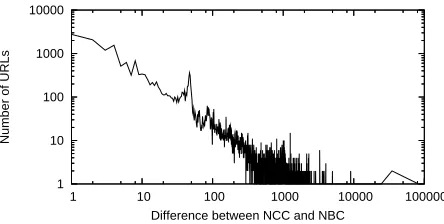
Figure 1: Distribution of the difference ofN CC and
N BC.
cloaking candidate. The intuition is that the page may change frequently, but if the difference between the browser’s copy and the crawler’s copy is bigger than the difference between two crawler copies, the evidence may be enough that the page is cloaking.
We used two methods to calculate the difference between pages — the difference in terms used, and the difference in links provided. We describe each below, along with the results obtained.
4.1.1 Term Difference
The first method for detecting cloaking is to use term difference among different copies. Instead of using all the terms in the HTML files, we used the “bag of words” method for analyzing the web pages, i.e., we parse the HTML file into terms and only count each unique term once no matter how many times this term appears. Thus, each page is marked by a set of words after parsing.
For each page, we first calculated the number of different terms between the copiesC1 andC2 (desig-natedN CC, as described above). We then calculated the number of different terms between the copiesC1 and B1, (designated N BC). We then select pages that have a biggerN BC thanN CCas candidates of cloaking. For this data set, we marked 23,475 candi-dates of the original 250K data set.
The distribution of the difference of these 23,475 pages forms a power-law-like distribution, shown in Figure 1.
To check what threshold for this difference between
N CCandN BCis a good indication for real cloaking, first, we put the 23,475 URLs into ten different buck-ets based on the difference value. The range for each bucket and the number of pages within each bucket are shown in Table 1.
Then, from each bucket we randomly selected
Bucket ID RANGE No. of Pages
1 x <= 5 8084
2 5< x <= 10 2287 3 10< x <= 20 1938 4 20< x <= 40 2065 5 40< x <= 80 2908 6 80< x <= 160 1731 7 160< x <= 320 1496 8 320< x <= 640 912 9 640< x <= 1280 1297
[image:20.612.79.295.72.194.2]10 1280< x 757
Table 1: Buckets of term difference
Figure 2: The ratio of syntactic cloaking in each bucket based on term difference.
thirty pages and checked them manually to see how many from these thirty pages are real syntactic cloak-ing pages within each bucket. The result is shown in Figure 2.
The trend is obvious in Figure 2. The greater the difference, the higher proportion of cloaking that is contained in the bucket. In order to know which is the optimal threshold to choose, we calculated the precision, recall and F-measure based on the range of these buckets. For these three measures, we fol-low the definitions in [11] and select α to be 0.5 in the F-measure formula to give equal weight to recall and precision. Precision is the proportion of selected items that the system got right; Recall is the propor-tion of the target items that the system selected; F-measure is the F-measure that combines precision and recall. The results of these three measures are shown in Table 2. If we choose F-measure as the criteria, buckets 4 and 5 have the highest value. Since the range of bucket 4 and 5 is around 40 in Table 1, we can set the threshold to be 40 and declare that all pages with the difference above 40 to be categorized as cloaking pages. In that case, the precision and
Threshold PRECISION RECALL F value
1 0.355 1.000 0.502
5 0.423 0.828 0.560
10 0.480 0.799 0.560
20 0.534 0.758 0.627
40 0.580 0.671 0.622
80 0.633 0.498 0.588
160 0.685 0.388 0.496
320 0.695 0.262 0.380
640 0.752 0.196 0.311
1280 0.899 0.086 0.157
Table 2: F-measure for different thresholds based on term difference.
recall are 0.580 and 0.671 respectively.
From Figure 2, we can make an estimation of what percentage of our 250,000 page set are cloaking pages. Since we know the total number of pages within each bucket and the number of cloaking pages within the 30 manually checked pages from each bucket, the esti-mation of total number of cloaking pages is the prod-uct of the number of pages within each bucket and the ratio of cloaking pages within the 30 pages. The re-sult is 7,780, so we expect that we can identify nearly 8,000 cloaking pages (about 3%) within the 250,000 pages.
4.1.2 Link Difference
Similar to term difference, we also analyzed this data sets on the basis of link differences. Here link differ-ence means the number of different links between two corresponding pages.
First we calculated the link difference between the copy ofC1 andC2 (termedLCC).We then calculated the link difference between the copy of C1 and B1 (termedLBC). Finally we marked the page that have a higherLBC thanLCC as cloaking candidates. In this way, we marked 8,205 candidates. The frequency of these candidates also approximates a power-law distribution like term cloaking. It is shown in Figure 3.
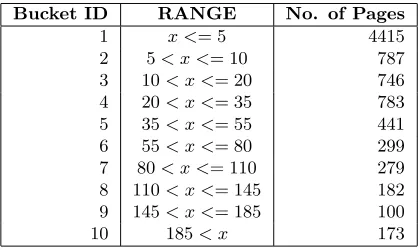
As with term difference, we also put these 8,205 candidates into 10 buckets. The range and number of pages within each bucket is shown in Table 3.
1 10 100 1000 10000
1 10 100 1000 10000 100000
Number of URLs
[image:21.612.76.300.74.185.2]Difference between LCC and LBC
Figure 3: Distribution of the difference ofLCC and
LBC.
Bucket ID RANGE No. of Pages
1 x <= 5 4415
2 5< x <= 10 787 3 10< x <= 20 746 4 20< x <= 35 783 5 35< x <= 55 441 6 55< x <= 80 299 7 80< x <= 110 279 8 110< x <= 145 182 9 145< x <= 185 100
[image:21.612.316.540.74.187.2]10 185< x 173
Table 3: Buckets of link difference
range of each bucket. The result is shown in Table 4. We can tell that 5 is an optimal threshold with the best F value.
Since the number of pages having link difference is smaller than the ones having term difference in reality, fewer cloaking pages can be found by using link difference alone, but are more accurate.
Threshold PRECISION RECALL F value
1 0.479 1.000 0.648
5 0.727 0.700 0.713
10 0.822 0.627 0.711
20 0.906 0.520 0.660
35 0.910 0.340 0.496
55 0.900 0.236 0.374
80 0.900 0.167 0.283
110 0.900 0.104 0.186
145 0.878 0.060 0.114
185 0.866 0.038 0.072
Table 4: F-measure for different thresholds based on link difference.
[image:21.612.82.291.242.367.2]Figure 4: The ratio of syntactic cloaking in each bucket based on link difference.
Figure 5: Intersection of the four copies for a Web page.
4.2
Detecting Cloaking in HOTdata
Based on the experience of manually checking for cloaking pages for the first data set, we attempted to detect syntactic cloaking automatically by using all four copies of each page.
4.2.1 Algorithm of detecting cloaking auto-matically
Our assumption about syntactic cloaking is that the web site will send something consistent to the crawler but send something different yet still consistent to the browser. So, if there exists such terms that only appear in both of the copies sent to the crawler but never appear in any of the copies send to the browser or vice versa, it is quite possible that the page is doing syntactic cloaking. Here when getting the terms out of each copy, we still use the “bag of words” approach, i.e., we replace all the non-word characters within an HTML file with blank and then get all the words out of it for the intersection operation.
To easily describe our algorithm, the intersection of four copies are shown as a Venn diagram in
[image:21.612.334.514.255.328.2]Bucket RANGE No. Accuracy
1 x <= 1 725 40%
2 1< x <= 2 540 30% 3 2< x <= 4 495 30% 4 4< x <= 8 623 40% 5 8< x <= 16 650 90% 6 16< x <= 32 822 100% 7 32< x <= 64 600 100% 8 64< x <= 128 741 100% 9 128< x <= 256 420 100%
10 256< x 1120 100%
Table 5: Buckets of unique terms in area A and G
ure 5. We use capital letters from A to M to repre-sent each intersection component of four copies. For example, the area L contains content that only ap-pears inHC1, but never appear in HC2,HB1 and
HB2; area F is the intersection of four copies, i.e., the content that appears on all of the four copies. The most interesting components to us are areas A and G. Area A represents terms that appear on both browsers’ copies but never appear on any of the crawlers’ copies, while area G represents terms that appear on both crawlers’ copies but never appear on any of the browsers’ copies.
So our algorithm of detecting syntactic cloaking automatically is that for each web page, we calculate the number of terms in area A and the number of terms in area G. If the sum of these two numbers is nonzero, we may mark this page as a cloaking page.
There are false negative examples for this algo-rithm. A simple example is that suppose there is a dynamic picture on the page, every time the web server will randomly select one from 4 JPEG files (a1.jpg to a4.jpg) to serve the request. It happens that a1.jpg is sent every time when our crawler visits this page, but a2.jpg and a3.jpg are sent when our browser visit this page. By our algorithm, the page will be marked as cloaking, but it can be easily ver-ified that this is not the case. So, again we need a threshold for the algorithm to work more accurately. For the 47,170 URLs, we found 6466 pages that have the sum of number of terms in area A and G greater than 0. Again, we put them into 10 buckets, as shown in Table 5. The third column is the number of pages within this bucket.
From each bucket, we randomly selected 10 pages and manually checked to see whether this page is real syntactic cloaking. The accuracy is shown in the fourth column in Table 5. We also calculated the F-measure, the results are shown in Table 6.
Thresholds PRECISION RECALL F value
0 0.647 1.000 0.785
1 0.703 0.965 0.813
2 0.766 0.952 0.849
4 0.836 0.940 0.885
8 0.902 0.881 0.891
16 0.922 0.756 0.831
32 0.960 0.599 0.738
64 0.979 0.470 0.635
128 0.972 0.358 0.523
[image:22.612.314.533.227.372.2]256 1.000 0.267 0.422
Table 6: F-measure of different threshold
0 1 2 3 4 5 6 7 8 9
0 50 100 150 200
The Cumulative Percentage of Cloaking pages
Top Results
Figure 6: Percentage of syntactic cloaking pages within google’s top responses.
Since the 4th and 5th bucket have highest F value in Table 6, we choose the threshold to be the range between bucket 4 and bucket 5, i.e., 8. So, our au-tomated cloaking algorithm is revised to only mark pages with the sum of area A and G greater than 8 as cloaking pages. So, for our second data set, all pages in bucket 5 to bucket 10 are marked cloaking pages. Finally, we marked 4,083 pages out of the 47,170 pages, i.e., about 9% of pages from the hot query data set are syntactic cloaking pages.
4.2.2 Distribution of syntactic cloaking within top rankings
A. Autos B. Companies C. Computing D. Entertainment
E. Games F. Health G. House H. Holidays
I. Local J. Movies K. Music L. Research
M. Shopping N. Sports O. TV P. Travel
Figure 7: Category-specific Cloaking.
may be helpful for these pages to be ranked high. Since we retrieved top 10 hot queries from each of 16 categories from AOL, we can consider the topic of the cloaking pages. Intuitively some popular cate-gories, such as sports or computers, may contain more cloaking pages in the top ranking list. So we also calculated the fraction of cloaking pages within each category. The results are shown in Figure 7. Some categories, such as Shopping and Sports, are more likely to have cloaked results than other categories.
4.2.3 Syntactic vs Semantic cloaking
Not all syntactic cloaking is considered unacceptable to search engines. For example, a page sent to the crawler that doesn’t contain advertising content or a PHP session identifier which is used to distinguish different real users is not a problem to search engines. In contrast to acceptable cloaking, we define seman-tic cloaking as cloaking behavior with the effect of manipulating search engine results.
To make one more step about our cloaking study, we randomly selected 100 pages from the 4,083 pages we have detected as syntactic cloaking pages and manually checked the percentage of semantic cloak-ing among them. In practice, it is difficult to judge whether some behavior is harmful to search engine rankings. For example, some web sites will send login page to browser, while send full page to crawler. So, we end up with three categories: acceptable cloaking, unknown and semantic cloaking.
From these 100 pages, we classified 33 pages as se-mantic cloaking, 32 as unknown and 35 as acceptable cloaking.
4.3
Different types of cloaking
In the process of manually checking 600 pages for the above sections, we found several different types of cloaking.
4.3.1 Types of term cloaking
We identified many different methods of sending dif-ferent term content to crawlers and web browsers. They can be categorized by the magnitude of the dif-ference.
We first consider the case in which the content of the pages sent to the crawler and web browser are quite different.
• The page provided to the crawler is full of detail, but the one to the web browser is empty, or only contains frames or JavaScript.
• The web site sends text page to the crawler, but sends non-text content (such as macrome-dia Flash content) to web browser.
• The page sent to the crawler incorporates tent, but the one sent to the web browser con-tains only a redirect or 404 error response. The second case is when content differs only par-tially between the pages sent to the crawler and the browser and the remaining content is identical, or one copy has slightly more content than the other.
• The pages sent to the crawler contain more text content than the ones to web browser. For ex-ample, only the page sent to the crawler contains keywords shown in Figure 8.
• Different redirection target URLs are contained in the pages sent to the crawler and to the web browser.
• The web site sends different titles, meta-description or keywords to the crawler than to web browser. For example, the header to browser uses “Shape of Things movie info at Video Uni-verse” as the meta-description, while the one to the crawler uses “Great prices on Shape of Things VHS movies at Video Universe. Great service, secure ordering and fast shipping at ev-eryday discount prices.”
• The page sent to the crawler contains JavaScript, but no such JavaScript is sent to the browser, or the pages have different JavaScripts sent to the crawler than to web browser.
game computer games PC games console games video games computer action games adventure games role playing games simulation games sports games strategy games contest contests prize prizes game cheats hints strategy computer games PC games computer action games adventure games role playing games Nintendo Playstation simula-tion games sports games strategy games contest contests prize prizes game computer games PC games computer action games adventure games role playing games simulation games sports games strategy games contest contests prize prizes.
Figure 8: Sample of keywords content only sent to the crawler.
• Pages to the crawler do not contain some banner advertisements, while the pages to web browser do.
• The NOSCRIPT element is used to define an
alternate content if a script is not executed. The page sent to web browser has the NOSCRIPT
tag, while the page sent to the crawler does not.
4.3.2 Types of link cloaking
For link cloaking, we again group the situations by the magnitude of the differences between different versions of the same page. In one case, both pages contain similar number of links and the other is that both pages have quite different number of links.
For the first situation, examples found include:
• There are the same number of links within the page sent to the crawler and web browser, but the corresponding link pairs have a different for-mat. For example, the link to web browser may contain a PHP session id while the link to the crawler does not. Another example is that the page to the crawler only contains absolute URLs, while the page to the browser contains relative URLs that are in fact pointing to the same tar-gets as the absolute ones.
• The links in the page to the crawler are direct links, while the corresponding links within the page to web browser are encoded redirections.
• The links to web browser are normal links, but the links to the crawler are around small images instead of texts.
• The website shows links to different style sheets to web browser than to the crawler. For example, the page to the crawler contains “href=/styles/styles win ie.css”, while the page to the browser contains “href=/styles/styles win ns.css”.
In some cases, the number of links within the page to the crawler and the page to the web browser can be quite different.
• More links exist in the page sent to the crawler than the page sent to web browser. For example, these links may point to a link farm.
• The page sent to web browser has more links than the page sent to the crawler. For example, these links may be navigational links.
• The page sent to the browser contains some nor-mal links, but in the same position of the page sent to the crawler, only error messages saying “no permission to include links” exist.
From the results shown within this section, it is obvious that cloaking is not rare in the real Web. It happens more often for hot queries or popular topics.
5
Results of Redirect
As we have discussed in Section 1, redirection can also be used as a spamming technique. To get an insight into how often the redirection appear and distribution of different redirect methods, we use the HITSdata set mentioned in Section 3. We don’t use all four copies but only compare two copies for each page: one from the simulated browser’s set (BROWSER) and the other from the crawler’s set (CRAWLER).
5.1
Distribution
We check the distribution of four different types of redirection: HTTP 301 Moved Permanently and 302 Moved Temporarily responses, the HTML meta re-fresh tag, and the use of JavaScript to load a new page.
TYPE CRAWLER BROWSER
301 20 22
302 56 60
Refresh tag 4230 4356
JavaScript 2399 2469
Table 7: Number of pages using different types of redirection.
is even more complicated for redirection purpose. For the first step, we just count the appearance of “<meta http-equiv=refresh>” tag for the third type and count the appearance of “location.replace” and “window.location” for the fourth type. The results for this first step are shown in Table 7.
To get a more accurate number of appearances of the HTTP refresh tag, we examined this further. In reality, theRefreshtag may just mean refreshing, not necessarily to redirection to another page. For exam-ple, theRefreshtag may be put inside aNOSCRIPT
tag for browsers that do not support JavaScript. To estimate the number of real redirection by using this refresh tag, we randomly selected 20 pages from the 4,230 pages that use the refresh tag and checked them manually. We found that 95% of them are real redi-rection and only 5% are inside aNOSCRIPTtag. Be-sides, some pages may have identical target URL as themselves in theRefreshtag to keep refreshing them-selves. We also counted these numbers. There are 47 pages out of 4,230 pages within the CRAWLER
data set and 142 pages out of 4,356 pages within the
BROWSERdata set that refresh to themselves.
We did one more step for the 4,214 (4,356 - 142) pages that are pages usingRefreshtag and refresh to a different page. Usually there is a time value assigned within the refresh tag to show how long to wait before refreshing. If this time is small enough, i.e., 0 or 1 seconds, users can not see the origin page but are redirected to a new page immediately. We fetched this time value for these 4,214 pages and draw the distribution of different time values from the range of 0 seconds to 30 seconds in Figure 9. More than 50% of these pages refresh to a different URL after 0 seconds and about 10% refresh after 1 second.
To estimate the real distribution of the JavaScript refresh method, we randomly selected 40 pages from the 2,399 pages that have been identified as candi-dates for using JavaScript for redirection in the first step. After manually checking these 40 files, we found the 20% of them are real redirections, 32.5% of them are conditional redirections, and the rest are not for redirection purpose, such as to avoid showing the
0 10 20 30 40 50 60
0 5 10 15 20 25 30
Percentage of Pages
[image:25.612.88.286.69.129.2]Number of seconds before refresh
Figure 9: Distribution of delays before refresh.
page within a frame.
Sometimes the target URL and origin URL are within the same site, while other times they are on different sites. In order to know the percentage of redirections that redirection to the same sites, we also analyzed our collected data set for this information. Since the JavaScript redirection is complicated, we only count the first three types of redirection here. The sum of the first three types of redirection is 4,306. Within the CRAWLER data set, there are 2,328 pages within these 4,306 pages redirecting to the same site, while for theBROWSERdata set, the number is 2,453.
5.2
Redirection Cloaking
As we have mentioned in Section 4.3, the site may return pages redirecting to different locations in case of different user agents. We consider this redirection cloaking.
We found that there are 153 pairs of pages out of 250,000 pairs that have different response code for a crawler and a normal browser when doing redirecting. Usually these web sites will send 404 or 503 response code to one and send 200 response code to the other. We even found that there are 10 pages that use dif-ferent redirection method for a crawler and normal web browser. For example, they may use 302 or 301 for the crawler, but use refresh tag with the response code 200 for a normal web browser.
6
Summary and Discussion
Detection of search engine spam is a challenging re-search area. Cloaking and redirection are two
tant spamming techniques.
This study is based on a sample of a quarter of mil-lion pages and top responses from a popular search engine to hot queries on the Web. We identified dif-ferent kinds of cloaking and gave an estimate of the percentage of pages that are cloaked in the sample and also show an estimation of distribution of differ-ent redirect.
There are four issues that we would like to see ad-dressed in future work. The first is that of a bias in the dataset used. Our data sets (pages in or near the top results for queries) do not nearly reflect the Web as a whole. However, it might be argued that it re-flects the Web that is important (at least for the pur-poses of finding pages that might affect search engine rankings through cloaking). The second is that this paper does not address IP-based cloaking, so there are likely pages that do indeed provide cloaked con-tent to the major engines when they recognize the crawling IP. We would welcome the partnership of a search engine to collaborate on future crawls.
The final issue is the bottom line. While search engines may be interested in finding and eliminat-ing instances of cloakeliminat-ing, our proposed technique re-quires three or four crawls. Ideally, a future technique would incorporate a two-stage approach that identi-fies a subset of the full web that is more likely to contain cloaked pages, so that a full crawl using a browser identity would not be necessary.
Our hope is that this study can provide a realistic view of the use of these two techniques and will con-tribute to robust and effective solutions to the iden-tification of search engine spam.
References
[1] AskJeeves / Teoma Site Submit managed by in-eedhits.com: Program Terms, 2005. Online at http://ask.ineedhits.com/programterms.asp.
[2] America Online, Inc. AOL Search: Hot searches, Mar. 2005. http://hot.aol.com/hot/hot.
[3] Ask Jeeves, Inc. Ask Jeeves About, Mar. 2005. http://sp.ask.com/docs/about/jeevesiq.html.
[4] M. Cafarella and D. Cutting. Building Nutch: Open source. ACM QUEUE, 2, Apr. 2004.
[5] Google, Inc. Google information
for webmasters, 2005. Online at
http://www.google.com/webmasters/faq.html.
[6] Google, Inc. Google Zeitgeist, Jan. 2005. http://www.google.com/press/zeitgeist/zeitgeist-jan05.html.
[7] Z. Gy¨ongyi and H. Garcia-Molina. Web spam taxon-omy. InFirst International Workshop on Adversarial Information Retrieval on the Web (AIRWeb), 2005.
[8] M. R. Henzinger, R. Motwani, and C. Silverstein. Challenges in web search engines. SIGIR Forum, 36(2), Fall 2002.
[9] J. M. Kleinberg. Authoritative sources in a hyper-linked environment.Journal of the ACM, 46(5):604– 632, 1999.
[10] Lycos. Lycos 50 with Dean: 2004 web’s most wanted, Dec. 2004. http://50.lycos.com/121504.asp.
[11] C. D. Manning and H. Schutze. Foundations of sta-tistical natural language processing, chapter 8, pages 268–269. MIT press, 2001.
[12] M. Najork. System and method for identifying cloaked web servers, Jul 10 2003. Patent Applica-tion number 20030131048.
[13] A. Perkins. White paper: The classifica-tion of search engine spam, Sept. 2001. On-line at http://www.silverdisc.co.uk/articles/spam-classification/.
[14] WebmasterWorld.com. Cloaking, 2005. Online at http://www.webmasterworld.com/forum24/.
[15] B. Wu and B. D. Davison. Identifying link farm spam pages. InProceedings of the 14th International World Wide Web Conference, Industrial Track, May 2005.
[16] Yahoo! Inc. Yahoo! Help -
Ya-hoo! Search, 2005. Online at
Pagerank Increase under Different Collusion Topologies
Ricardo Baeza-Yates
ICREA-Univ.Pompeu Fabra
and University of Chile
Carlos Castillo
Dept. of Technology
Universitat Pompeu Fabra
Vicente L´opez
C´atedra Telef´onica
Universitat Pompeu Fabra
[email protected]
Abstract
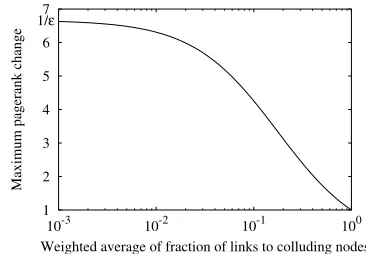
We study the impact of collusion –nepotistic linking– in a Web graph in terms of Pagerank. We prove a bound on the Pagerank increase that depends both on the reset probabil-ity of the random walkεand on the original Pagerank of the colluding set. In particular, due to the power law dis-tribution of Pagerank, we show that highly-ranked Web sites do not benefit that much from collusion.
1
Introduction
This paper studies the effects of different linking topolo-gies in the ranking function induced by the Pagerank algo-rithm [13]. The Pagerank algoalgo-rithm receives as input an adjacency matrixLN×N, whereN is the number of Web pages, and renormalizes each row ofLto sum 1, generat-ing a transition matrixA. This transition matrix is slightly modified by adding a “random jump”, i.e.: a transition from each node to each of the other nodes using the uni-form transition matrix – a matrixUsuch thatui j=1/N.
P= (1−ε)A+εU (1)