Quantum-enhanced absorption
refrigerators
Luis A. Correa1,2,3, Jose´ P. Palao1,4, Daniel Alonso1,2& Gerardo Adesso3
1IUdEA Instituto Universitario de Estudios Avanzados, Universidad de La Laguna, La Laguna 38203, Spain,2Dpto. Fı´sica Fundamental, Experimental, Electro´nica y Sistemas, Universidad de La Laguna, La Laguna 38203, Spain,3School of Mathematical Sciences, The University of Nottingham, University Park, Nottingham NG7 2RD, UK,4Departamento de Fı´sica Fundamental II, Universidad de La Laguna, La Laguna 38204, Spain.
Thermodynamics is a branch of science blessed by an unparalleled combination of generality of scope and formal simplicity. Based on few natural assumptions together with the four laws, it sets the boundaries between possible and impossible in macroscopic aggregates of matter. This triggered groundbreaking achievements in physics, chemistry and engineering over the last two centuries. Close analogues of those fundamental laws are now being established at the level of individual quantum systems, thus placing limits on the operation of quantum-mechanical devices. Here we study quantum absorption refrigerators, which are driven by heat rather than external work. We establish thermodynamic performance bounds for these machines and investigate their quantum origin. We also show how those bounds may be pushed beyond what is classically achievable, by suitably tailoring the environmental fluctuations via quantum reservoir engineering techniques. Such superefficient quantum-enhanced cooling realises a promising step towards the technological exploitation of autonomous quantum refrigerators.
A
n absorption or heat-driven quantum refrigerator is a system capable of establishing a net steady-state transport of energy from a cold bath (c) to a hot bath (h), assisted only by the residual heat coming from an additional work reservoir (w)1–3. In this picture, the cold bath would play the role of the macroscopic or mesoscopic object to be cooled. In addition to their potential technological applications, these autonomous quantum-thermal devices are also appealing from the fundamental perspective, as they are naturally well suited for the study of thermodynamics at the level of individual open quantum systems1,4–6.In spite of the increasing interest that quantum absorption cooling has attracted over the last few years5,7–12, the field is far from new. A heat-driven quantum fridge is just one specific configuration of the more general quantum heat pump, that can function either as a heater, a chiller or even an engine. The use of three-level solid-statemasers
as physical support for heat pumps was already discussed in the late 1950s13,14, when spin refrigeration was also experimentally demonstrated15. The consistent quantum-thermodynamic description of these elementary three-level prototypes was object of further study1,4and, just recently, alternative finite-dimensional quantum systems realising autonomous heat pumps have been put forward in the literature2,3.
The different designs of quantum heat pumps share limitations that can be understood from the assumptions on their interactions with the environments. Under the familiar conditions usually met in the quantum-optical regime, the dissipative processes may be assumed purely Markovian17–19, which severely restricts the performance of any heat-driven device, and confers a distinctive spectral structure to the environmental fluctuations16. In particular, once their steady state builds up, quantum heat pumps are governed by formal analogues of the laws of thermodynamics and, as a consequence, their absolute efficiency ideally saturates to the corresponding Carnot limitseC, albeit at vanishing ‘cooling power’14, i.e. in the reversible limit, the exchange of any finite amount of
energy with the heat baths is performed in infinite time.
For practical purposes, however, one needs to operate at nonvanishing power. In this case, the relevant issue to assess the functionality of these devices demands the optimisation of more practical figures of merit such as the efficiency at maximum cooling powere*. The natural question arises whethere*can approacheCarbitrarily
closely even at finite cooling power, or if, on the contrary, it is upper bounded by some fundamental limit. The efficiency at maximum ‘mechanical’ power is extensively used to benchmark the operation of heat engines and a lot of effort has been devoted to establish a universal upper bound therefor20–22. Unfortunately, the general arguments used for engines do not provide simple bounds when the cycle is reversed into a refrigerator, and consequently, a different approach is needed to arrive to model-independent performance bounds. Here, we rigorously prove that the ‘smallest’ quantum absorption refrigerators, supported on ideal three-level masers, are
SUBJECT AREAS:
QUANTUM MECHANICS
THERMODYNAMICS
MOLECULAR MACHINES AND MOTORS
QUBITS
Received 15 January 2014
Accepted 16 January 2014
Published 4 February 2014
limited in their efficiency at maximum power by a fraction ofeC, only
related to the spectral properties of the environmental fluctuations at low frequencies. We show that this general performance bound applies as well to ‘larger’ and non-ideal designs2,3,8, as it is independ-ent of the details of the working material of the refrigerator.
Achieving a good understanding of the quantum-mechanical ori-gin of the limitations of heat pumps can also provide key clues about how to surmount them. We show indeed that, by feeding an absorp-tion fridge with engineered thermal resources, one can push its per-formance bounds considerably further, allowing for classically impossible superefficient quantum cooling. Namely, at given fixed environmental temperatures, the addition of squeezing to the work bath leads to efficiencies aboveeCand, most interestingly, to a
sys-tematic enhancement of the output harnessed power. This is achieved strictly within the framework of quantum thermodynamics and thus, in no violation of its laws6,23.
Results
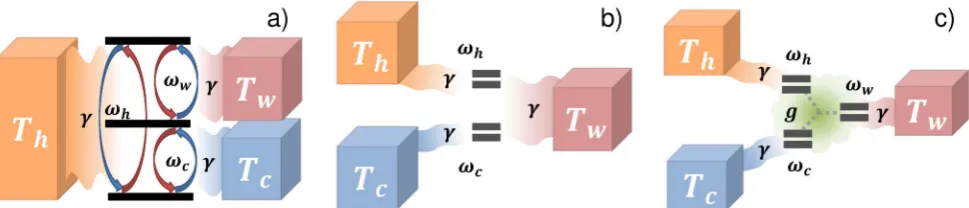
Models of absorption refrigerator.As already advanced, a minimal model of autonomous heat pump13consists of a three-level system with each of its transitions weakly coupled to one of the three independent heat baths [see Fig. 1(a)]. Essentially, as the steady state builds up, the ‘heat’ collected from the cold bath is dumped into the hot bath with the assistance of the extra energy provided by the work bath, which closes the cooling cycle. Of course, the opposite heating cycle also takes place in the steady-state, and it is the imbalance between these two stationary processes which renders the device either a refrigerator or a heater. As we shall see below, refrigeration occurs as long as the frequency of the transition coupled to the cold bath remains below a certain thresholdvc#vc,max1.
We shall also consider the two-qubit design3,6of Fig. 1(b) in which the cold and the hot bath are each addressed through a two-level contact, while the work reservoir introduces dissipation in the sub-space {j0cæflj1hæ, j1cæflj0hæ}, where j0aæ and j1aæ stand for the ground and excited states of contactag{h, c}. This allows for energy
flows between the hot and cold ends, and eventually results in net refrigeration. Remarkably, this fridge works within the same cooling window (vc#vc,max) as the three-level prototype.
Finally, we shall comment on another model2,5,7featuring three contact qubits connected via a three-body interaction [see Fig. 1(c)]. Practically-oriented issues have been recently studied in connection with this design, including its potential experimental realisations9,10 and the investigation of its efficiency at maximum power8.
The first and second laws.When the interaction of the working material with the environments is sufficiently weak, one can tackle its effective dynamics via a quantum master equation like
d
dt%^ð Þt ~ðDwzDhzDcÞ%^ð Þt : ð1Þ
It is an equation of motion for the reduced state of the heat pump%^ð Þt , whereDa are the dissipation super-operators associated with each bath. An initial preparation r^ð Þ0~%^ð Þ06aX^aT, factorised between system and baths degrees of freedom is assumed. The intrinsic dynamics has been eliminated by taking the interaction picture with respect to the free Hamiltonian of the working materialH^wm.
If the dissipation is much slower than both the environmental fluctuations and the coherent evolution of the heat pump, the Born, Markov and rotating-wave approximations may be safely applied16. This leads to dissipation super-operators of the well known Lindblad-Gorini-Kossakovski-Sudarshan (LGKS) type17,18, which are the workhorse of quantum thermodynamics23. We shall specif-ically denote them byLain what follows:
La%^~
X
v
Cv,a A^að Þ^v%A^{að Þv { 1 2 A^
{
að ÞvA^að Þv ,%^
z
: ð2Þ
Here, {
?
,?
}1stands for an anticommutator andA^að Þv, for thejump operator associated with the decay process into channelv, which occurs at a rate given by the corresponding element of the spectral correlation tensorCv,a. For equilibrium reservoirs, these latter relate via the detailed balance condition16C{v,a~e
{hv=kBTaC
v,a: ð3Þ
Individually, each LGKS dissipatorLagenerates a completely pos-itive and trace preserving contractive dynamics of the working material, converging towards its local stationary thermal state ^ta!exp {H^wm
kBTa
19. As time goes to infinity, this
contractiv-ity translates into (see Methods for details)
_ Qw
Twz
_ Qh
Thz
_ Qc
Tcƒ0, ð4Þ
where Ta are the equilibrium temperatures of the baths and
_
Qa~trH^wmLa%^ð Þ?
[image:2.595.56.541.536.640.2]
represents the energy per unit time flowing from bathainto the pump once in the steady state. In particular, we will refer toQ_cas the ‘cooling power’ or just power.
Figure 1| (a) Schematic representation of the three-level heat pump. The three independent baths are taken as infinite collections of uncoupled modes with HamiltonianH^Ba~
X
mvm^b{a,m^ba,m. The dissipative interactions in each bath-transition pair are modeled by terms like e.g.H^cint~pffiffifficðj i0h j1z 1
j ih jÞ0 6B^c, withB^a~Pmga,m ^ba,mz^b{a,m
. Here, the coupling constantsga,mare proportional to ffiffiffiffiffiffivm p
, which results in flat spectral densities, and the
parameterccontrols the overall strength of the interaction16. The three-stroke cooling and heating processes are depicted with blue and red arrows respectively. (b) Diagram of a two-qubit heat pump, where we shall always assumevh.vc. Energy transport between the two contacts is mediated by
dissipation into the work bath thanks to a coupling term of the formH^intw~ðj i1c h j0hzj i0c h j1hÞ6B^w 3
Since Hwm^ is time-independent, the stationarity of the average energy at^%ð?Þimplies
_
QwzQ_hzQ_c~0: ð5Þ
This balance equation plays the role of afirst lawin quantum ther-modynamics as soon as one identifies the steady-state currentsQ_a with heat flows. Similarly, Eq. (4) can be regarded as a quantum-thermodynamic statement of Clausius theorem, i.e. thesecond law.
The combination of Eqs. (4) and (5) places the ultimate ther-modynamic bounds on the efficiency of a heat pump in its various modes of operation14. For instance, in the chiller configuration (i.e.
_
Qcw0,Q_ww0 andQ_hv0), the efficiency is defined as the ratio of the cooling power to the input heat (per unit time) provided by the work bath, i.e.e:Q_c
_
Qw. Using Eq. (5) to eliminateQ_hfrom Eq. (4),
yields
e~Q_c
_ Qw
ƒ Tw {Th
ð ÞTc
Th{Tc
ð ÞTw:eC, ð6Þ
whereeCis nothing but the Carnot efficiency of a (macroscopic) heat
driven quantum absorption fridge operating between baths at tem-peratures {Tw,Th,Tc}24.
The cooling window.We now want to delimit the region within the space of parameters of a quantum heat pump where cooling is permitted by the second law. This is of course highly model-dependent but one can always stick to n-dimensional working materials with the basic three-stroke cooling mechanism of the three-level maser built in13. If the bathacouples to the heat pump only allowing for transitions with a gap ofhvaamong the eigenstates ofH^wm, and if the resonance conditionvh5vc1vwholds, one
should have
_ Qa
_ Qb
~vavb: ð7Þ
This was already acknowledged as a distinctive feature of ideal three-level heat pumps in the seminal paper by Geusic et al.14, and it is easy to see that it remains true for the two-qubit design of Fig. 1(b). Eq. (7) essentially says that in a cooling cycle, every single cold excitation is traded for one hot excitation at the expense of consuming a single work excitation7.
Hence, combining Eq. (4) with (7) yields vw
Tw{
vh
Thz
vc Tcƒ0
[vcƒvc,max: Tw {Th
ð ÞTc
Tw{Tc
ð ÞThvh:
ð8Þ
This inequality defines the ‘cooling window’. Note that the work temperatureTwmust be larger thanTh(andTc) in order to have a positivevc,max.
In principle, the efficiency of any ideal heat pump satisfying Eq. (7) saturates to the Carnot bound in thereversiblelimit ofvcRvc,max,
i.e. when the contact transitions locally equilibrate with their corres-ponding baths so that the equality in Eq. (4) holds.
On the contrary, the operation of a heat pump might become intrinsically irreversible if additional mechanisms of energy exchange were present. For instance, the three-qubit device of Fig. 1(c) only behaves as an ideal heat pump when the effects of the global interaction term HI^ on the dissipative dynamics are entirely neglected [see caption of Fig. 1(a)]. Indeed, explicit analytical formulas for its steady state consistent with Eq. (7) may be written down in that limit7. However, since the contact transitions are chosen among the eigenstates of H^0rather than those of H^wm~H^0zHI^ , dissipation is always strictly ‘delocalised’ regardless of the interaction strength, and neither Eq. (7), nor the equality in Eq. (4) can be
satisfied. Consequently, this specific design is an example of non-ideal heat pump, as it is unable to reach the Carnot efficiency8.
Efficiency at maximum cooling power: a model-independent bound.In spite of its fundamental importance, the attainability of the Carnot efficiency in microscopic quantum heat pumps7,11is not the central issue for practical applications. Indeed, when operating at the reversible limit the power exactly vanishes.
One would like instead to run a refrigeration cycle, carefully tun-ing the design parameters so that efficiency and power are maximised
jointly, pretty much in the spirit of finite-time thermodynamics. The practically relevant questions would then be whether there exists a tight upper bound for the efficiency at maximum powere*other than eC, and whether such bound is model-independent. Long-standing
problems of this sort have been intensively studied in classical mac-roscopic heat engines and refrigerators20–22,25,26, as well as in their quantum-mechanical counterparts27–33. In particular, a specific bound fore*has been recently established for the model of Fig. 1(c) based on a numerical analysis, together with design prescriptions for its saturation8.
In this paper, under natural assumptions on the environmental fluctuations, we prove analytically that the efficiency at maximum cooling power of any ideal fridge made up of elementary three-level heat pumps is tightly upper bounded by
eƒ dc
dcz1eC, ð9Þ
wheredcstands for the spatial dimensionality of the cold bath. This applies directly to the ideal absorption refrigerators of Figs. 1(a) and 1(b), but we verify that Eq. (9) holds as well for the non-ideal refri-gerator of Fig. 1(c), thus validating and generalising the bound obtained in8. Eq. (9), which is the first main result of this paper, establishes then a quantum-thermodynamic limitation which holds for all the models of quantum absorption fridges existing in current literature, and is manifestly independent of the details of the working material of the refrigerators. While full details are deferred to the Methods section, we sketch a proof of the bound in what follows.
One may generically characterise the dissipation into ad -dimen-sional free bosonic fieldaat thermal equilibrium with flat spectral density, by decay rates of the form16
Cv,a~
c0vdað1zNað ÞvÞ vw0
c0j jv
daN
aðj jvÞ vv0
(
, ð10Þ
whereNað Þv ~½expðhv=kBTaÞ{1 {1
. Eq. (10) follows just from the application of the Born and Markov approximations to a general microscopic model of relaxation into a bosonic bath. From it, one can see that the cooling power of a three-level fridge [Fig. 1(a)] writes as
_
Qcð Þx ~xdcp xð Þ a1e
{b1x{a2e{b2x
, ð11Þ
wherex;vc/vc,max,aiandbiare positive real constants, andp(x) is a
positive function. The cooling power vanishes at both edges of the cooling windowQ_cð Þ0~Q_cð Þ1~0 and is a concave function ofx. Eq.
(11) can always be conveniently recast as _
Qcð Þx~P xð Þxdcð1{xÞ:P xð Þf xð Þ, ð12Þ
withP(x) again a positive function (see Eq. (41) in Methods). The maximum ofQ_cð Þx is attained at somex*such that
_
Q’cð Þx ~P’ð Þx f xð Þ zP xð Þ f’ð Þx ~0, ð13Þ
where the prime denotes differentiation with respect tox. Note that the positive and concave functionf(x) is maximised precisely atx5
Previous literature on performance bounds for heat engines has established that the efficiency at maximum power is maximised in the limit of smalleC21,34, as it is also the case for quantum absorption
fridges8. We shall therefore expandP(x) arounde
CR0, where in fact P(x),p(x) [see Eq. (41)], and study its analytical properties. We then prove the claim byreductio ad absurdum. Let us first assume thatx*.dc/(dc11), so that the bound in Eq. (9) would not hold [recall Eqs. (7) and (8)].P9(x) has at most one root in the intervalxg
[0, 1] and can be seen to be negative in the neighbourhood ofx5dc/ (dc11), for vanishingeC. Being bothP(x) andf(x) positive in the
whole unit interval, the violation of the bound Eq. (9) would contra-dict Eq. (13). Therefore, one must have insteadx*#dc/(dc11) and
hence,
e~ vc,
vw
ƒ dc
dcz1eC, ð14Þ
the bound being saturated ifP9(x*)50.
Now, we shall consider the two-qubit model [Fig. 1(b)]. We find that its steady-state heat currents can be broken up as (see Methods for details)
_
Qc~vcðq1zq2Þ ð15aÞ
_
Qh~{vhðq1zq2Þ ð15bÞ
_
Qw~vwðq1zq2Þ, ð15cÞ
where allqi.0. There are two contributions to the total heat fluxes,
namely Q_ð Þa1
~vaq1and Q_ð Þ2 a
~vaq2, which individually satisfy the first and second law of Eqs. (5) and (4) within the cooling window
delimited by Eq. (8). Furthermore, Q_ð Þai
. _ Qð Þbi
~vavbfori5{1, 2} and hence, each three-level component behaves as an ideal
refri-gerator on its own. Most importantly, the cold fluxesQ_ð Þci have the
same analytic structure of Eq. (11), so that their efficiency at max-imum power is limited byeð Þi.eCƒdc=ðdcz1Þ. As a consequence, the performance of the combination of the two is also bounded byeC dc/(dc11), since
e~
eð Þ1ð Þx Q_ 1 ð Þ
w ð Þx zeð Þ2ð Þx Q_ 2 ð Þ
w ð Þx _
Qð Þw1ð Þx zQ_ 2 ð Þ
w ð Þx
ƒ dc
dcz1eC: ð16Þ
The heat currents of the three-qubit fridge [Fig. 1(c)] are much more involved analytically. However, extensive numerical evidence con-firms that Eq. (9) also applies to this case8[see Fig. 2(c)].
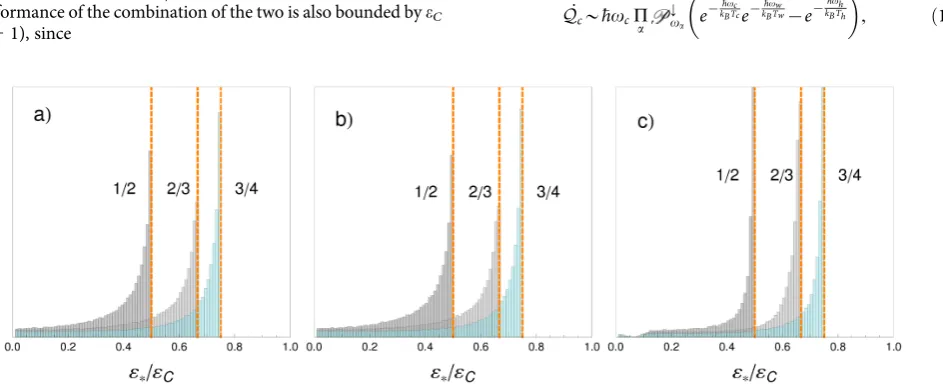
A numerical investigation, presented in Fig. 2, certifies that the bound of Eq. (9) istightfor all the three models. One can further see that choosingvw=Tw,h=1 is a sufficient condition to approach it
closely under large temperature differencesTc=Th=1. These are to be regarded as analytical design prescriptions for the practical imple-mentation of optimal quantum heat pumps, e.g. following recent proposals involving superconducting qubits or arrays of quantum dots9,10. Note as well that the limitTc=Th
=1 also implieseveC=1, as should be expected.
Our bound has been analytically established as a constraint on the performance of the fridge operation mode of the three-level maser and that of any ideal absorption refrigeration cycle reducible to three-level systems, and it has been also shown to hold for fundamentally different non-ideal devices. It is in order to remark, however, that Eq. (9) has in fact ageneralvalidity transcending specific models. Let us consider a totally generic model of quantum absorption fridge: We can always write the leading contribution to its cooling powerQ_cas a
sum of terms of the form
_
Qc*hvc :vc
: vw
; vh
{ ;
vc
; vw
: vh
, ð17Þ
where :;vastands for excitation/relaxation rates of the contact tran-sitions atva. Eq. (17) just formalises the imbalance between the elementary three-stroke cooling and heating cycles which has to underly any implementation of quantum absorption cooling, and contains no details on the specific working material of the refriger-ator, nor about the spectral properties of the reservoirs to which it couples. Given that these three reservoirs are in thermal equilibrium, we can make use of the detailed balance condition of Eq. (3) and thus arrive to
_
Qc*hvcP a
; va e
{hvc
kBTce{kBTwhvw{e{
hvh kBTh
[image:4.595.71.543.456.652.2]
, ð18Þ
Figure 2|Histograms of the efficiency at maximum powere*/eCfor,105random (a) three-level, (b) two-qubit and (c) three-qubit absorption fridges, as
introduced in Figs. 1(a), 1(b), and 1(c), respectively. The temperatures {Ta}, the hot frequencyvh, the dissipation rates, and–-for the case (c)–the
interaction strengthg, were all chosen completely at random, but always respecting the conditionsc=kBTaandc=fhva,gg, that guarantee the
applicability of the master equation Eq. (1). In each case, we found the optimal pair {vw,vc} so thatQ_cwas maximised, and computed the corresponding
efficiency. This is equivalent to a global numerical optimisation ofe*over all free parameters of the models. In each of the panels above, we show three data
sets that correspond to the same heat pump operating between 1d, 2dand 3dbaths. In agreement with Eq. (9),e*is bounded by
1 2eC,
2 3eCand
3 4eC,
which is formally identical to Eq. (11), with the positive function
p xð Þ!Pa ;vað Þx
xdc{1. Therefore, the whole line of reasoning between Eqs. (11)–(14) is still applicable, provided that the condition
p9(x*)#0 is verified. This weak assumption is sufficient for Eq. (9) to hold, regardless of the physical support of the refrigerator and the specific properties of the baths. Under these premises, we conclude that our bound is model-independent for quantum absorption refrigerators.
Let us eventually connect this result with the other known bounds from finite-time thermodynamics. In the seminal work by Curzon and Ahlborn20, an upper limit to the efficiency at maximum power was derived for a Carnot engine under theendoreversible approxi-mation35. In spite of its seemingly limited scope, such bound succeeds in capturing the universal behaviour ofe*at small efficiencies21,34, and recurrently appears in different models of heat engines22,27,31,34,36, including the three-level maser in its engine configuration34. However, the obtention of similar results for refrigerators would require a more careful phenomenological modeling of their main sources of irreversibility, and can lead to highly model-dependent performance bounds37–39.
In analogy with the Curzon-Ahlborn limit, our result in Eq. (9) accurately represents e*at low efficiencies for all embodiments of quantum absorption refrigerators, which encompass fundamentally different models. The same limit holds as a strict upper bound to the efficiency at maximum power of ‘classical’ endoreversible absorption chillers39. It must be noted as well, that it relies on a consistent microscopic description of the system-baths interactions rather than on a phenomenological ansatz. From the physical point of view, such a model-independent bound can be understood from the intuitive notion that the maximisation of the cooling power in the steady state must be governed by the low-frequency dependence of the corres-ponding cold decay rate [see Eq. (10)].
Superefficiency: squeezing the second law.Up to now, we have seen how the standard laws of thermodynamics place fundamental constraints on heat pumps, even when they are made up of a single finite-dimensional open quantum system. This is perhaps not surprising taking into account that there is nothing really ‘quantum’ about the operation of these devices, other than the discreteness of their energy spectra8. For instance, the ideal fridges of Figs. 1(a) and 1(b) operate in completely classical (diagonal) steady states, while the quantum coherence that builds up asymptotically in the non-ideal fridges of Fig. 1(c) does not seem to affect their performance in any crucial way. Even if steady-state bipartite entanglement may exist in this case, it usually appears only in the regime of very low efficiencies and vanishing cooling power11. Likewise, other types of quantum correlations, though widely present, do not have any influence on optimal cooling8.
Is it then possible at all for quantum heat pumps to operate past the ‘classical’ limits? Ideally, one would like to devise tricks to push their performance bounds further, of course remaining always within the standard framework of quantum thermodynamics and not advoc-ating any violation of its laws. We shall devote this section to illus-trate how one can indeed go beyond Eqs. (6) and (9), by exploiting non-equilibrium environmental features that can be mimicked with suitable quantum reservoir engineering techniques.
The whole idea would consist in initialising the work reservoir in a
squeezed-thermalstate
^ XT,r
w :^Sð Þj X^wT^S{ð Þj: ð19Þ
Such a state results from the action of the unitary squeezing oper-ator40
^
Sð Þj:P mexp
1 2j
^b2 m{
1 2j
^
b{m 2
ð20Þ
on a thermal preparationX^wT, where ^bm,^b{m
n o
stand for creation and annihilation operators on modemof the work reservoir. The para-meterj;rexpihis in general a complex number, although for our purpose we can set the phasehto zero and consider a real squeezing parameterj~r[R. Thequantumnessof a squeezed state resides in
the asymmetry of the variances of its field quadraturesX^m+~^bm+^b{ m, as opposed to a (classical) coherent state, for whichDX^zm~DX^{m.
It is well known that squeezed states, even in absence of entan-glement, allow for quantum enhancement in several applications of information theory41, including quantum cryptography42, and most notably precision measurements43 and quantum metrology below shot noise44, with applications e.g. for gravitational wave interferometry45–47.
The key property to be exploited here is the non-stationarity of squeezed preparations. This results in a periodic time modulation of the correlation functions of the work reservoir, which is somewhat equivalent to the action of an external driving on the heat pump. In this sense, the work reservoir may now play an active role in the cooling process. As we shall now see, this is achieved without com-promising the thermodynamic consistency of the whole setting.
In order to account for the squeezing of the work reservoir, the quantum master equation Eq. (1) must be replaced by
d dt^%ð Þt ~
r
wzLhzLc
^
%ð Þt , ð21Þ
where the modified work dissipator r
w:LrwzDLrwcan be cast in
the standard LGKS form16(see Methods for details).
Clearly, if the work heat current is suitably redefined as _
Qw~tr H^wm rw^%ð?Þ
, the asymptotic stationarity of energy implies again the first law as stated in Eq. (5).
However, the dissipator r
w will not generally bring the
corres-ponding contact transition to thermal equilibrium at temperature
Tw, but to some other steady states^wð Þr . Still, the LGKS form of
the overall generator of the dynamical map in Eq. (21) guarantees its full contractivity19, so that the second law generalises to
{tr r
w%^ð Þ? logs^wð Þr
zQ_h Th
zQ_c Tc
ƒ0: ð22Þ
It is convenient to fit ^swð Þr by a thermal state of the form
^
swð Þr !exp {H^wm
kBTwef fð Þr
, with a suitable squeezing-depend-ent work temperatureTwef fð Þr . Since the contact with the work res-ervoir only involves two levels, this is always possible. Eq. (22) may be thus rewritten in the more familiar way
_ Qw Tef f
w ð Þr zQ_h
Thz
_ Qc
Tcƒ0: ð23Þ
For anyr.0, the effective temperatureTwef fð Þr exceedsTw, and it
diverges forrR‘. Therefore, the generalised squeezed-dependent Carnot efficiency will always exceed its classical value
eCð Þr ~ Tc
Th{Tc 1{
Th Tef f
w ð Þr
weCð Þ0: ð24Þ
Note that, as should be expected, in the limit ofrR‘, Eq. (24) saturates to the maximum efficiency of a power-driven refrigerator (i.e. a reversed heat engine)eC(‘)5Tc/(Th2Tc)14.
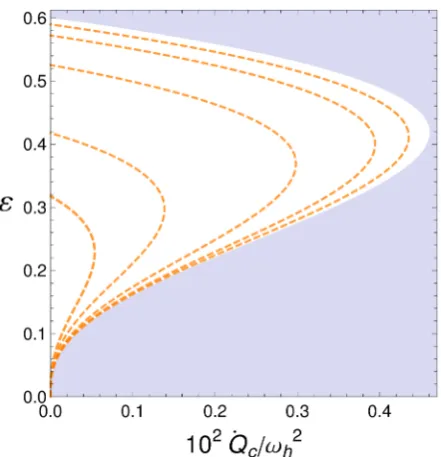
fact that the efficiency at maximum powerandthe cooling power itself systematically increasejointly with the squeezing parameter. This is a striking consequence of the non-equilibrium environmental fluctuations.
In the macroscopic domain, the practical drawbacks of an absorp-tion chiller48, as compared to an equivalent work-driven refrigeration cycle, are typically its much lower efficiency and output power. Nevertheless, as we can see in Fig. 3, a quantum-enhanced heat-driven fridge does not only outperform its purely thermal counter-part, but is also capable of approaching very closely the performance of a Carnot fridge, when provided with a finiteamount of envir-onmental squeezing. Thus, as opposed to the classical case, quantum absorption cooling may compete on an equal footing with conven-tional refrigeration, when combined with reservoir engineering tech-niques49–51to allow for the exploitation of non-equilibrium squeezed environmental fluctuations. This observation could be a promising first step towards a number of applications of heat-driven refrigera-tion to a new generarefrigera-tion of quantum and nanoscale technologies.
Discussion
Let us start by summarising the two main results of this paper. On the one hand, we proved that the efficiency at maximum power of all the known models of quantum absorption refrigerator (both ideal and non-ideal) is tightly upper bounded by a fraction of the Carnot efficiencyeC, which is independent of the details of the device and
only relates to the spectral properties of the thermal fluctuations of the environment. On the other hand, we showed most remarkably how by squeezing the heat source that drives an absorption cooling cycle, one may boost its performance to the extent of making it comparable to a conventional power-driven cooling device.
A key path to the optimisation of autonomous quantum heat pumps is thus found to reside in applying suitable reservoir
engineering techniques49–51rather than in exploiting any resource intrinsic to their quantum mechanical working materials8,11. Indeed, the importance of reservoir manipulation has been very recently acknowledged in the context of quantum thermodyn-amics: It has been recently speculated that superefficient opera-tion of quantum heat engines, in apparent violaopera-tion of the second law, may be achieved e.g. by reservoir squeezing52or using more general types of non-equilibrium reservoirs53,54, and by connect-ing the workconnect-ing material to an adiabatically isolated ancilla55. However, to our knowledge, this paper represents the first demonstration of asystematic enhancement in the performance of a quantum-mechanical thermal device. Furthermore, this unconditional enhancement is, in principle, achievable without manipulating the working material or the given hot and cold baths: It is only the arguably controllable heat source that needs to be tailored.
At this point, one could wonder if generating squeezing in the work reservoir is really worth the effort when one could raise instead its equilibrium temperature to obtain effectively the same results. Back to Fig. 3, we see that a squeezing parameter of r 5 1.5 (,13 dB, which is currently at reach45), would already take the heat pump close to its best equivalent power-driven counterpart. In order to achieve a comparable amplification without squeezing, one should increase the work temperature by at least one order of magnitude, which might just not be possible in engineered or natural environ-ments. Thus, it seems reasonable that in many concrete situations, reservoir squeezing could be indeed the best and most natural way to boost the performance of a heat-driven fridge. However, supporting the claim that a quantum-enhanced absorption refrigerator can really compete with a heat pump driven by work is a more delicate issue: To mimic a non-stationary state for the work bath49–51, one has pay an extra cost that should be added to the overall efficiency bal-ance for a fair comparison. Again, depending of the specifics of the implementation, it may well be that a quantum-enhanced quantum absorption chiller came to cool cheaper than the corresponding quantum ‘compression’ cycle. Furthering this issue demands a study on its own.
We also wish to make clear the realm of validity of our analysis. In all of the above, we have taken the fulfilment of the first and second laws as a guarantee of thermodynamic consistency, but we have neither discussed the third law, nor probed the neighbourhood of the absolute zero6. Since we approach the open system dynamics from a LGKS-type master equation, the Markov approximation should better hold, which in turn implies that the thermal fluctua-tions must be sufficiently fast as compared with the dissipation time scales. Thus, to be always on the safe side, we must limit our envir-onmental temperatures from below.
When it comes to the experimental realisation of quantum-enhanced absorption technologies it is worth mentioning the pio-neering refrigeration experiments by Geusic et al.15using the energy level structure of Cr31ions in a ruby crystal as support for a three-level maser. As already mentioned, detailed proposals exist as well for the non-ideal three-qubit model of Fig. 1(c) using superconducting qubits9, and quantum dots10. The squeezing can be engineered by coherently driving the work transition, potentially involving auxili-ary levels and vacua; feasible schemes have been proposed e.g. invol-ving trapped ions or Rydberg atoms49–51.
In conclusion, we have demonstrated the possibility of genuine quantum-enhanced absorption refrigeration beyond the fun-damental bounds imposed by classical thermal environments. The application of reservoir engineering techniques to autonomous quantum heat pumps might render them practically useful and com-petitive for many applications of quantum technologies,in primis
[image:6.595.58.279.49.278.2]quantum cooling. Moreover, the distinctive simplicity of these devices is ideal to get a clean glimpse of how thermodynamics looks like beyond the standard scenario.
Figure 3|Parametric plot of power vs. efficiency of a three-level maser operating between three-dimensional bosonic reservoirs at temperatures Tw5170,Th580 andTc530 (h5kB51),for different values of the squeezing parameter of the work reservoirr5{0, 0.5, 1, 1.5, 2}.BothQ_c,e* and the maximumeincrease withr. In each curve, the hot frequency was fixed atvh550, whilevcranges from 0 up tovc,max(r). The frontier
Methods
Quantum master equation.We will now write down explicitly the equation of
motion for the working material of a quantum heat pump, introduced in Eqs. (1) and (21). The total Hamiltonian is generically (see caption of Fig. 1)
^
H~H^wmzX a
^
HBaz X
a
^
Hint
a , ð25Þ
where the dissipative system-reservoir interactionsH^int
a may be taken as
^
Hint
a !ðj i0ah j1azj i1ah j0aÞ6B^a:s^a6B^a: ð26Þ
Here, the ground and excited states of the two-levelcontact portwith bath
aare denoted byj0aæandj1aærespectively. Let us first assume that all three reservoirs are prepared in thermal equilibrium. Under the further assumptions of vanishing initial correlations between system and environments, weak system-environment interaction and separation of time scales of free and dissipative dynamics (Born, Markov and rotating-wave approximations), one arrives to the
well known LGKS-type quantum master equation16with dissipators as those of
Eq. (2).
The elements of the spectral correlation tensor, given explicitly in Eq. (10), follow from the power spectrum of the environmental correlations
Cv,a~2Re ð?
0
ds eivs B^{
að ÞtB^aðt{sÞ
D E
. On the other hand,A^að Þv result from the decomposition ofs^aas eigenoperators ofH^wm16, and the discrete indexvlabels all the open decay channels, i.e. all the energy differences that correspond to non-vanishing jump operators.
In the case of an ideal fridge, for whichj0aæandj1aæare picked among the eigen-states ofH^
wm, Eq. (1) rewrites as
d^%
dt~
X
a X
v[V
Ca,v s^ { a%^^s
z a{
1 2 ^s
z as^
{ a,%^
zz
e{hv=kBTa^sz a%^^s
{ a{
1 2e
{hv=kBTa ^s{
as^ z a,%^
z
,
ð27Þ
where^sz
a~j i1ah j0a and^s{~ð^szÞ {
and the inner summation runs over the frequenciesV5{vw,vh,vc}. Eq. (27) accounts for the reduced dynamics of the
three-level and two-qubit heat pumps of Figs. 1(a) and 1(b). The case of the non-ideal three-qubit model of Fig. 1(c) is more involved. All the details may be found elsewhere8.
Let us now relax the assumption of equilibrium environments to allow for squeezing in the work reservoir. The key difference is that the ratesCa,vbecome explicitly time-dependent as a consequence of the non-stationarity of squeezed pre-parations. After performing the rotating-wave approximation, new terms appear in the work dissipator16, that becomes
r
w~LrwzDLrw~
X
v
Cr
w,v A^wð Þv%^A^{wð Þv{
1 2 A^
{
wð ÞvA^wð Þv,%^
z
zLr
w,vA^wð Þv%^A^wð ÞvzA^{wð Þv%^A^
{
wð Þv
{A^
wð Þv2%^{%^A^{wð Þv2
,
ð28Þ
where the squeezing-dependent coefficientsCr
w,vandLrw,vare given by
Cr w,v~
c0vdw Nr
wð Þvz1
vw0
c0j jvdwNr
wðj jvÞ vv0
(
ð29aÞ
Lr w,v~
1 2c0j jv
dwMr
wðj jvÞ, ð29bÞ
withNr
wð Þv~Nwð Þvcosh 2rzsinhr2andMrw~sinh 2rð2Nwð Þvz1Þ=2. A new set
of jump operators can always be found so that the work dissipator in Eq. (28) takes the standard LGKS form of Eq. (2), which in turn, guarantees that the effective dynamics of the working material remains that of adynamical semigroup(i.e. completely positive and trace-preserving) in spite of the squeezing17.
The second law at steady state.It is known that the entropy production of a
dynamical semigroup is a strictly positive quantity19. It is defined as X
^
%ð Þt ½ :{d
dtS%^ð Þjjt ^%
0
§0, ð30Þ
whereS%^jj%^0~tr^%log^%{log%^0is the quantum relative entropy and^%0is a steady state of the dissipative dynamics. Each of the dissipators appearing in Eq. (1) individually satisfies the inequality
trðLa%^Þlog^%0a
{tr½ðLa%^Þlog%^§0, ð31Þ
where%^0ais now stationary to thelocaldissipatorLaalone, i.e.La%^0a~0. Now, summing Eq. (31) overayields
X
a
trðLa%^Þlog%^0a zd
dtSð Þ%^§0, ð32Þ
whereSð Þ^%~{tr½%^log%^stands for the von Neumann entropy. We may replace%^in Eq. (32) with the steady state of the full dynamics%^ð?Þ, and the local steady states^%0
a, with equilibrium statese{^Hwm=kBTa. Note that indeedL
ae
{^Hwm=kBTa
~019. We thus obtain
{X a
trH^wmLa^%ð?Þ
kBTa
§0[
_ Qw Tw z _ Qh Th z _ Qc Tc
ƒ0, ð33Þ
that is, we recover the second law as stated in Eq. (4). When the work reservoir is prepared in a squeezed thermal state, the derivation remains exactly the same, only replacingTwwith the squeezing-dependent effective temperature52
Tef f
w ð Þr~
hvw
kBlog
tanh2rzexphvw=kBTw
1ztanh2rexphvw=kBTw
§Tw: ð34Þ
Twef fð Þr is such that rwe
{^Hwm=kBTwef fð Þr~0. This leads to the modified second law of
Eq. (22).
Efficiency at maximum power of a three-level fridge.We will devote this section to
prove the ultimate bounde*#dc/(dc11)eCon the efficiency at maximum power for
the three-level prototype of absorption refrigerator of Fig. 1(a). From Eq. (27), the steady state of the three level system may be readily found to be
%11ð?Þ~
CvcCvwzCvcCvhzC{vwCvh
D ð35aÞ
%22ð?Þ~
C{vhCvwzC{vcCvwzC{vcCvh
D ð35bÞ
%33ð?Þ~
C{vhCvczC{vhC{vwzC{vcCvw
D : ð35cÞ
Here, the ground, first and second excited states ofH^wmare labeledj1æ,j2æandj3æ
respectively and all coherences asymptotically vanish.Cvais a shorthand forCa,va
and the denominatorDis given by
D~CvcCvwzC{vhCvwzC{vcCvwzCvcCvhzC{vwCvh
zC{vcCvhzC{vhCvczC{vhC{vwzC{vcC{vw:
ð35dÞ
Combining the excitation and relaxation ratesC{vc,Cvc, of the cold transition with its steady-state populations%11(‘),%22(‘) one obtains a stationary heat currentQ_c
given by
_
Qc~vcðC{vc%11ð?Þ{Cvc%22ð Þ?Þ
~vcCvhC{vwC{vc{C{vhCvwCvc
D ,
ð36Þ
which, using the detailed balance relations, becomes (from now on we will seth5kB
51)
_
Qc~vcCvhCvwCvce
{vc=Tce{vw=Tw{e{vh=Th
D : ð37Þ
Given the constraintvh5vc1vw, we may fix the values of {vw,Tw,Th,Tc} and take x:vc=ðvweCÞas the only independent variable in Eq. (37). Of course, one would
obtain the same results by fixingvhinstead ofvw. This brings us back to Eq. (11)
_
Qcð Þx~xdcp xð Þa
1e{b1x{a2e{b2x
, ð38Þ
wherea1~e{vw=Tw,a2~e{vw=Th,b1~vweC=Tc,b2~vweC=Thandp(x) is positive.
As already mentioned, the cold heat currentQ_cð Þx is concave and positive in the unit
interval, vanishing at the boundariesQ_cð Þ0~Q_cð Þ1~0.
Let us take a closer look tog zð Þ:zdc a
1e{b1z{a2e{b2z
. Its analytic continuation into the complex plane has, in addition to its zeroes on the real axis, the following complex roots
zn~1z 2pi ThTw
vwðTw{ThÞ
n n[Z\f g0 : ð39Þ
By applying the Hadamard factorisation theorem56, one may conveniently rewrite
g(z) as
g zð Þ~zdcae{czð1{zÞ
sinh 1{z
2 vw
Tw{Th Tw{Th
1{z
ð Þsinh vw 2
Tw{Th TwTh
witha,c[Rz. In particular,c5vweC(Tc1Th)/2TcTh. Back into the real axis,Q_cð Þx
becomes
_
Qcð Þx~ae
{cxp xð Þsinh ð1{xÞ
1{x
ð Þsinh x
dcð1{xÞ, ð41Þ
that is, we recover Eq. (12) by identifying the first factor in the r.h.s with the positive functionP(x). The dimensionless constant is defined as :ðTw{ThÞvw=2TwTh.
From there, the performance bounde*,dc/(dc11) follows without difficulties [see
Eqs.(12)–(14)]. Note that, the fact thatP9(x) has at most one zero in the unit interval follows from the concavity ofQc_ð Þx.
From Eq. (41), one sees that takingeCR0 yieldsP(x),p(x), whilep(x) itself tends
to the constant valueQ_
cð Þx: That is,Q_cð Þx
_
Qcð Þx*xdcð1{xÞ:f xð Þ. To probe this limit, one can just expandP(x) aroundeCR0 and take its derivative with respect
toxatx5dc/(dc11). This yields
P’ð Þx x~dc dcz1
~cosh {cosh ð1{dcÞ
dcz1
{2dc sinh
dcz1 ð Þ2 zO e
dcz2
C
, ð42Þ
which is a strictly negative function of . Consequently,P9(x)#0 atx5dc/(dc11) for
eCR0. Indeed, it can be seen thatP9(x)#0;xg(0, 1) in this limit.
Three-level breakup of the two-qubit fridge.We shall finally show how the
two-qubit fridge of Fig. 1(b) can be broken up into two coupled three-level masers. As a consequence, following the steps of the preceding section, one can prove that the performance bound of Eq. (9) also applies to the two-qubit refrigerator.
Let us denote the eigenstates of the working materialH^wmby {j0h0cæ,j0h1cæ,j1h0cæ,
j1h1cæ}, with energies {0,vc,vh,vh1vc}. The cold bath couples locally to the cold
qubit [see Fig. 1(b)] and thus, it only drives the transitionsj0h0cæ «j0h1cæandj1h0cæ «j1h1cæ. On the other hand, the hot bath is connected toj0h0cæ «j1h0cæandj0h1cæ «j1h1cæ, while the work reservoir operates in the subspacej0h1cæ «j1h0cæ[see Fig. 4].
Intuitively, one can already see that the two-qubit fridge is comprised of two elementary three-level masers sharing the work transition. To make this statement more precise, let us write down explicitly the stationary heat currents
_
Qc~vcðh0h1cjLc%^ð?Þj0h1cizh1h1cjLc^%ð?Þj1h1ciÞ
_
Qh~vhðh1h0cjLh%^ð?Þj1h0cizh1h1cjLh^%ð?Þj1h1ciÞ
_
Qw~vwh1h0cjLw%^ð?Þj1h0ci,
wherevw5vh2vc(vh.vc). From here, we can recover Eqs. (15) by just defining
q1~h0h1cjLc^%ð?Þj0h1ci~{h1h0cjLh%^ð?Þj1h0ci q2~h1h1cjLc^%ð?Þj1h1ci~{h1h1cjLh%^ð?Þj1h1ci q1zq2~h1h0cjLw%^ð?Þj1h0ci:
As already pointed out, within the cooling windowvc#vc,max, the heat currents of each of the two three-level componentsQ_ð Þai behave as those of two ideal fridges, individually satisfying the first and the second laws of Eqs. (5) and (4). Closed formulas forQ_ð Þ1
c andQ_
2
ð Þ
c , analogous to Eq. (37), may be obtained from the
steady-state solution of Eq. (27), namely
_
Qð Þci~vc
~
Ci
vcC~i{vwC~i{vc{C~i{vhC~ivwC~ivc
~
Di
~vcZi01Zi10
CvhC{vwC{vc{C{vhCvwCvc
~
Di ,
ð43Þ
where
~
C1
vc~Z011Cvc, C~1{vc~C{vc ð44aÞ
~
C1
vh~Z101Cvh, C~1{vh~C{vh ð44bÞ
~
C1
vw~Z101ðCvwza1CvhC{vcÞ ð44cÞ
~
C1
{vw~Z011ðC{vwza1C{vhCvcÞ ð44dÞ
and
~
C2
vc~Z101C{vc, C~2{vc~Cvc ð45aÞ
~
C2
vh~Z102C{vh, C~2{vh~Cvh ð45bÞ
~
C2
vw~Z102ðC{vwza2C{vhCvcÞ ð45cÞ
~
C2
{vw~Z201ðCvwza2CvhC{vcÞ: ð45dÞ
The denominatorD~ihas the same form of Eq. (35d), only replacingCvawithC~
i
va. The remaining constants in Eqs. (44) and (45) are
a1~ðCvhzCvcÞ
{1, a
2~ðC{vhzC{vcÞ
{1
Z1 01~
CvhzCvc
CvhzCvczC{vh , Z1
10~
CvhzCvc
CvhzCvczC{vc
Z201~
C{vhzC{vc
C{vhzC{vczCvh , Z210~
C{vhzC{vc
C{vhzC{vczCvc :
It is clear that bothQ_ð Þc1 andQ_ð Þc2 can be cast in the generic form of Eq. (38), so that their associated efficiencies at maximum power must be bounded by
eð Þi
vdc=ðdcz1Þ.
1. Palao, J. P., Kosloff, R. & Gordon, J. M. Quantum thermodynamic cooling cycle.
Phys. Rev. E64, 056130 (2001).
2. Linden, N., Popescu, S. & Skrzypczyk, P. How small can thermal machines be? the smallest possible refrigerator.Phys. Rev. Lett.105, 130401 (2010).
3. Levy, A. & Kosloff, R. Quantum absorption refrigerator.Phys. Rev. Lett.108, 070604 (2012).
4. Geva, E. & Kosloff, R. The quantum heat engine and heat pump: An irreversible thermodynamic analysis of the three-level amplifier.J. Chem. Phys.104, 7681 (1996).
5. Brunner, N., Linden, N., Popescu, S. & Skrzypczyk, P. Virtual qubits, virtual temperatures, and the foundations of thermodynamics.Phys. Rev. E85, 051117 (2012).
6. Levy, A., Alicki, R. & Kosloff, R. Quantum refrigerators and the third law of thermodynamics.Phys. Rev. E85, 061126 (2012).
7. Skrzypczyk, P., Brunner, N., Linden, N. & Popescu, S. The smallest refrigerators can reach maximal efficiency.J. Phys. A: Math. Theor.44, 492002 (2011). 8. Correa, L. A., Palao, J. P., Adesso, G. & Alonso, D. Performance bound for
quantum absorption refrigerators.Phys. Rev. E87, 042131 (2013). 9. Chen, Y.-X. & Li, S.-W. Quantum refrigerator driven by current noise.EPL
(Europhysics Letters)97, 40003 (2012).
10. Venturelli, D., Fazio, R. & Giovannetti, V. Minimal self-contained quantum refrigeration machine based on four quantum dots.Phys. Rev. Lett.110, 256801 (2013).
11. Brunner, N.et al. Entanglement enhances performance in microscopic quantum
fridges. E-print arXiv: 1305.6009v1.
12. Mari, A. & Eisert, J. Cooling by heating: Very hot thermal light can significantly cool quantum systems.Phys. Rev. Lett.108, 120602 (2012).
13. Scovil, H. E. D. & Schulz-DuBois, E. O. Three-level masers as heat engines.Phys. Rev. Lett.2, 262–263 (1959).
14. Geusic, J. E., Schulz-DuBios, E. O. & Scovil, H. E. D. Quantum equivalent of the carnot cycle.Phys. Rev.156, 343–351 (1967).
15. Geusic, J., Bois, E., De Grasse, R. & Scovil, H. Three level spin refrigeration and maser action at 1500 mc/sec.Journal of Applied Physics30, 1113–1114 (1959). 16. Breuer, H. & Petruccione, F.The Theory of Open Quantum Systems(Oxford
University Press, USA, 2002).
17. Lindblad, G. On the generators of quantum dynamical semigroups.Comm. Math.
Phys.48, 119–130 (1976).
18. Gorini, V., Kossakowski, A. & Sudarshan, E. Completely positive dynamical semigroups of n-level systems.Journal of Mathematical Physics17, 821 (1976).
19. Spohn, H. Entropy production for quantum dynamical semigroups.Journal of
Mathematical Physics19, 1227 (1978).
20. Curzon, F. & Ahlborn, B. Efficiency of a carnot engine at maximum power output.
[image:8.595.378.553.53.221.2]Am. J. Phys.43, 22 (1975).
21. Van den Broeck, C. Thermodynamic efficiency at maximum power.Phys. Rev. Lett.95, 190602 (2005).
22. Esposito, M., Kawai, R., Lindenberg, K. & Van den Broeck, C. Efficiency at maximum power of low-dissipation carnot engines.Phys. Rev. Lett.105, 150603 (2010).
23. Kosloff, R. Quantum thermodynamics: A dynamical viewpoint.Entropy15,
2100–2128 (2013).
24. Gordon, J. M. & Ng, K. C.Cool thermodynamics(Cambridge international science publishing Cambridge, 2000).
25. Velasco, S., Roco, J. M. M., Medina, A. & Herna´ndez, A. C. New performance bounds for a finite-time carnot refrigerator.Phys. Rev. Lett.78, 3241–3244 (1997). 26. Wang, Y., Li, M., Tu, Z. C., Herna´ndez, A. C. & Roco, J. M. M. Coefficient of
performance at maximum figure of merit and its bounds for low-dissipation carnot-like refrigerators.Phys. Rev. E86, 011127 (2012).
27. Geva, E. & Kosloff, R. A quantum-mechanical heat engine operating in finite time. a model consisting of spin-1/2 systems as the working fluid.The Journal of chemical physics96, 3054 (1992).
28. Allahverdyan, A. E., Hovhannisyan, K. & Mahler, G. Optimal refrigerator.Phys. Rev. E81, 051129 (2010).
29. Zhou, Y. & Segal, D. Minimal model of a heat engine: Information theory approach.Phys. Rev. E82, 011120 (2010).
30. Abe, S. Maximum-power quantum-mechanical carnot engine.Phys. Rev. E83,
041117 (2011).
31. Wang, J., He, J. & Wu, Z. Efficiency at maximum power output of quantum heat engines under finite-time operation.Physical Review E85, 031145 (2012). 32. Abah, O.et al. Single-ion heat engine at maximum power.Phys. Rev. Lett.109,
203006 (2012).
33. Gelbwaser-Klimovsky, D., Alicki, R. & Kurizki, G. Minimal universal quantum heat machine.Phys. Rev. E87, 012140 (2013).
34. Esposito, M., Lindenberg, K. & Van den Broeck, C. Universality of efficiency at maximum power.Phys. Rev. Lett.102, 130602 (2009).
35. Hoffmann, K. H., Burzler, J. M. & Schubert, S. Endoreversible thermodynamics (1997).
36. Esposito, M., Kawai, R., Lindenberg, K. & Van den Broeck, C. Quantum-dot
carnot engine at maximum power.Phys. Rev. E81, 041106 (2010).
37. Wu, C., Chen, L., Sun, F. & Chen, W. General performance characteristics of a finite-speed carnot refrigerator.Applied Thermal Engineering16, 299–303 (1996). 38. Chen, J. New performance bounds of a class of irreversible refrigerators.Journal of
Physics A: Mathematical and General27, 6395 (1994).
39. Chen, J. & Yan, Z. Unified description of endoreversible cycles.Phys. Rev. A39, 4140–4147 (1989).
40. Walls, D. & Milburn, G.Quantum optics(Springer Verlag, 2008).
41. Yamamoto, Y. & Haus, H. A. Preparation, measurement and information capacity of optical quantum states.Rev. Mod. Phys.58, 1001–1020 (1986).
42. Hillery, M. Quantum cryptography with squeezed states.Phys. Rev. A61, 022309 (2000).
43. Caves, C. M. Quantum-mechanical noise in an interferometer.Phys. Rev. D23, 1693–1708 (1981).
44. Giovannetti, V., Lloyd, S. & Maccone, L. Advances in quantum metrology.Nature Photonics5, 222–229 (2011).
45. Eberle, T.et al. Quantum enhancement of the zero-area sagnac interferometer topology for gravitational wave detection.Phys. Rev. Lett.104, 251102 (2010).
46. Aasi, J.et al. Enhanced sensitivity of the ligo gravitational wave detector by using squeezed states of light.Nature Photonics7, 613–619 (2013).
47. Abadie, J.et al. A gravitational wave observatory operating beyond the quantum shot-noise limit.Nature Physics7, 962–965 (2011).
48. Einstein, A. & Szilard, L. Refrigeration.Appl. US Patent16(1927).
49. Poyatos, J. F., Cirac, J. I. & Zoller, P. Quantum reservoir engineering with laser cooled trapped ions.Phys. Rev. Lett.77, 4728–4731 (1996).
50. Lu¨tkenhaus, N., Cirac, J. I. & Zoller, P. Mimicking a squeezed-bath interaction: Quantum-reservoir engineering with atoms.Phys. Rev. A57, 548–558 (1998). 51. Shahmoon, E. & Kurizki, G. Engineering a thermal squeezed reservoir by
energy-level modulation.Physical Review A87, 013841 (2013).
52. Huang, X. L., Wang, T. & Yi, X. X. Effects of reservoir squeezing on quantum systems and work extraction.Phys. Rev. E86, 051105 (2012).
53. Dillenschneider, R. & Lutz, E. Energetics of quantum correlations.EPL (Europhysics Letters)88, 50003 (2009).
54. Abah, O. & Lutz, E. Efficiency of heat engines coupled to nonequilibrium reservoirs. E-print arXiv:1303.6558.
55. Boukobza, E. & Ritsch, H. Breaking the carnot limit without violating the second law: A thermodynamic analysis of off-resonant quantum light generation.Phys. Rev. A87, 063845 (2013).
56. Krantz, S. G.Handbook of complex variables(Springer, 1999).
Acknowledgments
The authors are grateful to K. Hovhannisyan, P. Skrzypczyk, N. Brunner, M. Huber, R. Silva, J. Goold, K. Modi, R. Kosloff, J. Rossnagel, J. G. Coello, A. Acı´n, and S. Lloyd for fruitful discussions and useful comments. This project was funded by the Spanish MICINN (Grant No. FIS2010-19998) and the European Union (FEDER), by the Canary Islands Government through the ACIISI fellowships (85% co funded by European Social Fund), by the COST Action MP1006, by the University of Nottingham through an Early Career Research and Knowledge Transfer Award and an EPSRC Research Development Fund Grant (PP-0313/ 36), and by the Brazilian funding agency CAPES (Pesquisador Visitante Especial-Grant No. 108/2012).
Author contributions
L.A.C. and J.P.P. conceived the main idea. L.A.C., J.P.P., D.A. and G.A. participated in the mathematical derivations, the discussion of the results and the preparation of the manuscript.
Additional information
Competing financial interests:The authors declare no competing financial interests.
How to cite this article:Correa, L.A., Palao, J.P., Alonso, D. & Adesso, G.
Quantum-enhanced absorption refrigerators.Sci. Rep.4, 3949; DOI:10.1038/srep03949 (2014).
This work is licensed under a Creative Commons