https://www.scirp.org/journal/jep ISSN Online: 2152-2219
ISSN Print: 2152-2197
DOI: 10.4236/jep.2019.1010078 Oct. 16, 2019 1317 Journal of Environmental Protection
Nicotine Content in Electronic Cigarette Refill
Solutions and Its Release in Aerosols
Sharifah Mazrah Sayed Mohamed Zain1* , Sara Khalida Jamal Khair2, Nadia Mohamad1, Mohd Fairulnizal Md. Noh3, Dinash Aravind Radhakrishnan2
1Environmental Health Research Centre, Institute for Medical Research, Ministry of Health Malaysia, Selangor, Malaysia 2National Pharmaceutical Regulatory Agency, Ministry of Health Malaysia, Selangor, Malaysia
3Nutrition, Metabolic and Cardiovascular Research Centre, Institute for Medical Research, Ministry of Health Malaysia, Selangor,
Malaysia
Abstract
Electronic cigarette (EC) is a device that imitates conventional cigarettes, which vaporizes a solution, with or without nicotine. This study evaluates the nicotine levels in EC refill solutions, its release in aerosols and comparison to the amount stated on the label. Seventy-two (72) different EC refill solutions were obtained from local shops in Selangor, Malaysia consisting of 40 nico-tine-containing (3 - 12 mg) and 32 nicotine-free (0 mg) solutions. Aerosols were obtained by using an air tight syringe connected to an EC device to draw aerosol through an XAD-4 sorbent tube that trapped the nicotine. Nicotine in solution and aerosol samples are analyzed using gas chromatography-mass spectrometry equipment. Quantified nicotine in 40 nicotine-containing solu-tions ranged from 0.224 - 17.306 mg/mL. Nicotine is detected in 3 of the 32 nicotine-free solutions. Percentage of nicotine released into aerosols from re-fill solutions varied from 0.54% - 28.2%. Out of the 40 samples, thirty-two (32) had nicotine content that violated by more than ±10% from the value on the label. In comparing the labels, 19 samples have 0.3% - 77% higher nico-tine level and 13 samples have 0.2% - 96.3% lower niconico-tine content. The in-consistency between the labelled and true levels of nicotine content indicates that commercial information may be misleading. The presence of nicotine in the nicotine-free refill solutions and higher nicotine content in aerosols may be addictive and may have negative health effects on users.
Keywords
Electronic Nicotine Delivery Systems, Tobacco Products, Tobacco Industry, Vapers
How to cite this paper: Zain, S.M.S.M., Khair, S.K.J., Mohamad, N., Noh, M.F.Md. and Radhakrishnan, D.A. (2019) Nicotine Content in Electronic Cigarette Refill Solu-tions and Its Release in Aerosols. Journal of Environmental Protection, 10, 1317-1332. https://doi.org/10.4236/jep.2019.1010078
Received: August 9, 2019 Accepted: October 13, 2019 Published: October 16, 2019
Copyright © 2019 by author(s) and Scientific Research Publishing Inc. This work is licensed under the Creative Commons Attribution International License (CC BY 4.0).
http://creativecommons.org/licenses/by/4.0/
DOI: 10.4236/jep.2019.1010078 1318 Journal of Environmental Protection
1. Introduction
An electronic cigarette (EC) is a battery-operated device that emulates a conven-tional cigarette. The basic operation of EC is by activating the power button and heating elements that vaporize the solution in the cartridge or tank, generating aerosol that is later inhaled by the user [1] [2]. The EC products such as the refill solutions have been widely spread through the global market that can be pur-chased from almost anywhere, online stores, retail outlets and in shopping malls. The refill solutions availably vary in nicotine amount to nicotine-free with variety of flavors, with or without glycerine (VG) and propylene glycol (PG) [3] [4]. The VG and PG are the most common solvents for nicotine as when they are heated, they form an aerosol that imitates the cigarette smoke [5]. Following the trend, the usage of EC has become well-known in Malaysia. A population study has reported the prevalence of EC users among Malaysian adults is 3.2% with an estimated number of 602,122 [6]. In the report, 45% of the 4288 respondents agree that EC is less harmful than tobacco smoking [6]. Another local popula-tion survey reported the respondent’s perceppopula-tion that only 27% (n = 277) agree that conventional cigarettes are more harmful than EC while 47% believe that EC delivers less nicotine than cigarettes [7].
Nicotine has been reported to be highly addictive that can cause acute toxicity at high dose and may suppress the immune system [8]. This has led the policy-makers to set related regulation on EC which varies across countries ranging from no regulation to banning them entirely [9]. For countries that have yet es-tablished a regulation on EC products, the quality of the products produced is questionable. Lack of manufacturing standards has led to contradictions of nico-tine amount in the refill solution with the amount on the label and inconsisten-cies across the same brand [5] [10] [11] [12]. Furthermore, nicotine was also de-tected in the EC refill solutions that were labelled as not containing any nicotine [13]. In 2012, American E-Liquid Manufacturing Standards Association (AEMSA) started a voluntary self-regulating standard on the manufacturing of EC cartridges and refill liquids. According to AEMSA, all EC products produced must be within the tolerance level of ±10% nicotine content in the final product [14].
DOI: 10.4236/jep.2019.1010078 1319 Journal of Environmental Protection as comparing the measured nicotine to the value stated on the label.
2. Methods
2.1. Study Design and Setting
We conducted an experimental study started in January to December 2016. The EC refill solutions were purchased in June 2016 within all ten (10) districts area in Klang valley, Selangor, Malaysia. All samples were analyzed within three months of purchase.
2.2. Refill Solution
2.2.1. Test Samples
The study team purchased the refill solution samples directly from different local shops and night markets. The refill solutions were bought based on the nicotine content varying from 0 to 12 mg/mL, referring to the label. We bought different flavors and brands of refill solutions consisting of nicotine-free (0 mg) and nico-tine-containing solutions (3 - 12 mg). The selection of the refill solutions was based on popular and best-seller brands as claimed by the local vendors.
2.2.2. Sample Characteristics
The characteristics of all refill solution samples were evaluated based on the information of the packaging labels. The amount of nicotine, shelf-life infor-mation, levels of PG and VG were extracted from the label. The materials used in the manufacturing of refill solution bottles were observed visually. The pH-indicator strips (pH 0 - 14) by Merck KGaA (Darmstadt, Germany), a universal indicator are used to rapidly measure the pH of each refill solution sample. The nicotine in the free form was calculated using the Hender-son-Hasselbach equation based on the measured pH and quantified nicotine [15].
2.2.3. EC Device and Apparatus
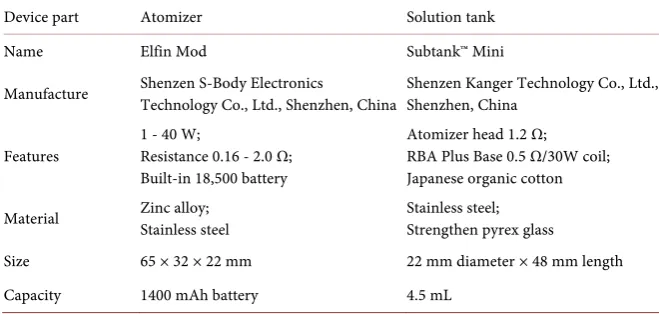
The EC device was purchased from a local shop, which consisted of an ato-mizer and solution tank. The characteristics of the atoato-mizer and solution tank used for generating aerosol samples are elaborated in Table 1. To avoid cross contamination and carryover of samples, each of the device part was cleaned us-ing laboratory detergent and sonicated in an ultrasonic bath with solution con-taining detergent for 30 minutes. The parts were then rinsed and sonicated in tap water for 30 minutes and finally dried in an oven at 60˚C for 5 minutes.
DOI: 10.4236/jep.2019.1010078 1320 Journal of Environmental Protection
Table 1. Characteristics of the EC atomizer and solution tank used for aerosol sampling.
Device part Atomizer Solution tank
Name Elfin Mod Subtank™ Mini
Manufacture Shenzen S-Body Electronics Technology Co., Ltd., Shenzhen, China Shenzen Kanger Technology Co., Ltd., Shenzhen, China
Features
1 - 40 W;
Resistance 0.16 - 2.0 Ω; Built-in 18,500 battery
Atomizer head 1.2 Ω; RBA Plus Base 0.5 Ω/30W coil; Japanese organic cotton
Material Zinc alloy; Stainless steel Stainless steel; Strengthen pyrex glass
Size 65 × 32 × 22 mm 22 mm diameter × 48 mm length
Capacity 1400 mAh battery 4.5 mL
2.2.4. Aerosol Collection
At the time of publication, there was no established smoking machine that was designed for the EC sampling. To produce aerosol from the liquid solution, firstly the EC device was activated and then the atomizer heated up the liquid and transformed it into aerosol. In order to provide reproducible and quantita-tive results, a simple sampling device was adapted from Herrington and Myers (2015) approach using a gas tight syringe connected to a sorbent tube and then to the EC device. In this study, the 50 mL gas tight syringe was connected to one end of an XAD®-4 sorbent tube using a 3/16-inch ID latex tubing. The other end of the sorbent tube was connected to the EC device using the 1/4-inch ID latex tubing (Figure 1). After the refill solution was filled into the solution tank, the EC device was activated (LED light up) to heat the refill solution until aerosol was produced. The EC was observed to light each time the aerosol was drawn through the sorbent tube. The syringe was used to draw 40 mL of the aerosol from the EC device and in addition to the single puff sample, 13-puff with 4 s/puff separated by 10 seconds intervals between puffs sample was taken in order to mimic a smoking regime corresponding to the average amount of puffs per vaping event [16]. A total of 520 mL of aerosol was taken from each refill solu-tion and all testing procedures were carried out using the same condisolu-tions. Ni-cotine that was presence in the aerosol was drawn through the sorbent tube and trapped by the front and back sections of the tube. Sorbent tubes were then pre-pared to be analyzed.
2.3. Nicotine Analysis in Refill Solution and Aerosol
2.3.1. Sample Preparation-Refill Solution
The refill solution samples were prepared by taking 5 µL of sample from the re-fill solution bottle, and added with 10.0 µg/mL caffeine internal standard solu-tion. The samples were then diluted to 1.5 mL methanol (1:300 dilution) in 2 mL vials. The resulting solution was sonicated for 10 minutes prior to analysis.
2.3.2. Sample Preparation-Aerosol Samples
DOI: 10.4236/jep.2019.1010078 1321 Journal of Environmental Protection
Figure 1. Apparatus set-up for aerosol sampling consists of 50 mL Hamilton
air-tight syringe, latex tubings, XAD®-4 sorbent tube and e-cigarette devices.
the front section (80 mg) of the tube into a 2 mL vial, while the back section (40 mg) was placed in a separate vial. A desorbing solution of 0.01% trimethylamine in ethyl acetate was prepared; 1 mL of desorbing solution was added into each vial. All vials were placed in an ultrasonic bath for 15 minutes to facilitate de-sorption. A range of 0.1 - 0.8 mL of the resulting solution was pipetted into a vial and added with 10.0 µg/mL of caffeine standard solution (internal standard). Each sample was further diluted with methanol, capped and ready to be ana-lyzed.
2.3.3. Chemicals
All analytical standards and solvents used were of an analytical grade. Methanol and ethyl acetate were obtained from Merck & Company, Inc., (New Jersey, USA). Trimethylamine, ≥99% and (-)-nicotine solution, 1.010 g/mL were pur-chased from Sigma-Aldrich Corporation (Missouri, USA). Caffeine (used as in-ternal standard) is a secondary reference standard that was obtained from the Reference Standard Section of National Pharmaceutical Regulatory Agency Ma-laysia.
2.3.4. Analytical Method
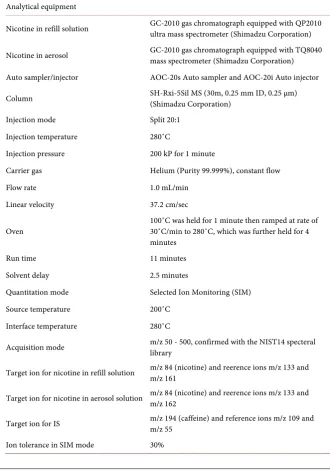
Nicotine in refill solutions and aerosol were analyzed using gas chromatogra-phy-mass spectrometer detector (GC-MS, Shimadzu Corporation). The analyti-cal conditions and parameters were described in Table 2. The calibration for re-fill solution samples was prepared by diluting the (-)-nicotine standard solution (1.010 g/mL) with methanol to produce concentrations of 1.0 µg/mL (limit of detection), 5.0 µg/mL (limit of quantitation), 10.0 µg/mL, 20.0 µg/mL, 25.0 µg/mL and 30.0 µg/mL. The nicotine working standards were spiked with 10.0 µg/mL of caffeine standard solution as internal standard. The calibration curve was established by plotting the ratio of peak area (response factor) against the concentration ratio with R2 = 0.9993. This method has good precision with the percentage relative standard deviation (% RSD) of 5.4% and excellent recovery of 99.3% (±4.0).
The method for the determination of nicotine in the air was based on NIOSH 2551 standard with modification [17]. The calibration curve was constructed by diluting the (-)-nicotine standard solution (1.010 g/mL) with methanol to cover
3/16-inch ID latex tubing
¼-inch ID latex tubing
50 mL Hamilton syringe
Atomizer XAD®-4 sorbent
tube
DOI: 10.4236/jep.2019.1010078 1322 Journal of Environmental Protection the range of nicotine concentration from 5.0 to 35 µg/mL. The range correspon-dent to cumulative nicotine levels in aerosol from 0.009 to 2.625 mg. The limit of detection is 0.5 µg/mL and the quantitation limit is 1.0 µg/mL. This nicotine working standards were spiked with 10.0 µg/mL of caffeine standard solution as internal standard. The calibration curve is established by plotting the ratio of peak area (response factor) against the concentration ratio with R2 = 0.9994. Quality control samples were analyzed before and after each analysis to ensure that the method was able to produce accurate results. The accuracy of these me-thods was established during the method validation based on the result of preci-sion, linearity and specificity parameters.
Table 2. Analytical system and parameters used for determination of nicotine refill
solutions and aerosol using gas chromatography-mass spectrometry (GC-MS).
Analytical equipment
Nicotine in refill solution GC-2010 gas chromatograph equipped with QP2010 ultra mass spectrometer (Shimadzu Corporation)
Nicotine in aerosol GC-2010 gas chromatograph equipped with TQ8040 mass spectrometer (Shimadzu Corporation)
Auto sampler/injector AOC-20s Auto sampler and AOC-20i Auto injector
Column SH-Rxi-5Sil MS (30m, 0.25 mm ID, 0.25 µm) (Shimadzu Corporation)
Injection mode Split 20:1
Injection temperature 280˚C
Injection pressure 200 kP for 1 minute
Carrier gas Helium (Purity 99.999%), constant flow
Flow rate 1.0 mL/min
Linear velocity 37.2 cm/sec
Oven
100˚C was held for 1 minute then ramped at rate of 30˚C/min to 280˚C, which was further held for 4 minutes
Run time 11 minutes
Solvent delay 2.5 minutes
Quantitation mode Selected Ion Monitoring (SIM)
Source temperature 200˚C
Interface temperature 280˚C
Acquisition mode m/z 50 - 500, confirmed with the NIST14 specteral library
Target ion for nicotine in refill solution m/z 84 (nicotine) and reerence ions m/z 133 and m/z 161
Target ion for nicotine in aerosol solution m/z 84 (nicotine) and reerence ions m/z 133 and m/z 162
Target ion for IS m/z 194 (caffeine) and reference ions m/z 109 and m/z 55
DOI: 10.4236/jep.2019.1010078 1323 Journal of Environmental Protection 2.4. Ethical Consideration
This study protocol was approved by the Ministry of Health Research and Ethics Committee, Ministry of Health Malaysia with exemption as no ethical issues in-volved.
3. Results
3.1. Sample Characteristics
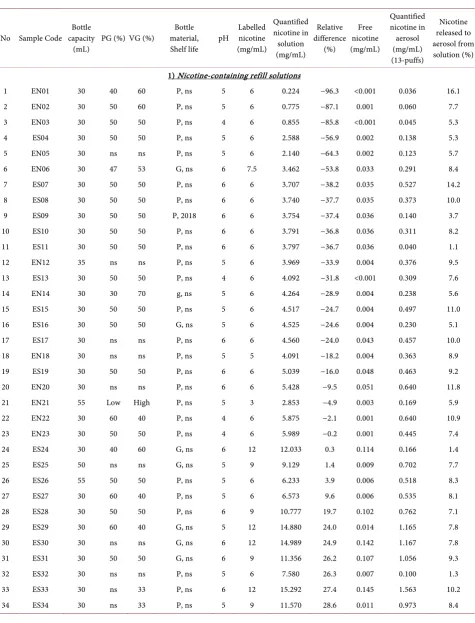
Seventy-two (72) EC refill solutions were analyzed through different flavors from more than 60 brands. Samples consisted of 32 nicotine-free (0 mg) and 40 nicotine-containing refill solutions (3 - 12 mg). The characteristics of EC sam-ples are presented in Table 3. In most samples (75%), the amount of nicotine, PG, and VG were declared in the ingredients. Sweetener, artificial food flavoring, food coloring, and warning statement are also stated in general. The supplier’s information or address was not mentioned in any of the samples, however, most samples showed the supplier’s website addresses in social media. The shelf life information and country of manufacture are the least mentioned on the label.
Based on the labels of 40 nicotine-containing refill samples, the most common amount of nicotine is 6 mg/mL (65%). Of 72 samples, 67 (93%) did not state the shelf life information of the product. The amount of PG in the nico-tine-containing refill solutions is slightly higher (30% - 60%) compared to the amount in the nicotine-free refill solutions (0% - 60%). However, the VG con-tent in the nicotine-containing solutions is lower (33% to 70%) compared to its amount in the nicotine-free solutions (40% to 100%). The average amounts of PG and VG in the nicotine-containing samples are found to be equal, 50% ± 7% and 50% ± 8%, respectively. However, the average amount of VG is much higher (72% ± 23%) compared to the amount of PG (27% ± 23%) in the nicotine-free samples. A total of 18 out of 72 (25%) refill samples have no information on the compositions of both PG and VG. In terms of warning statement, these are among the stated, “Keep out of reach of children and animal”; ”Not for use by pregnant women and under 18 years of age”, “18+”; “Shake before use” and “Keep in cool place”; “Nicotine can be poisonous”; “Do not drink” and “Stop smoking”. Most of the refill bottle packaging is made of plastic (52 out of 72, 79%) and the rest are manufactured in glass. The capacity of the free-nicotine solution bottles is slightly smaller (20 - 40 mL) compared to the nico-tine-containing solution bottles (30 - 55 mL). The most common (85%) volume of the refill solution bottle is 30 mL. The average of pH value is lower in the ni-cotine-free refill solutions, pH 4.5 ± 0.8 and slightly increased for the nico-tine-containing refill solutions; pH 5.2 ± 0.7 (6 mg/mL nicotine); pH 5.6 ± 0.5 (9 mg/mL nicotine) and pH 5.8 ± 0.8 (12 mg/mL nicotine).
3.2. Nicotine in Refill Solutions
DOI: 10.4236/jep.2019.1010078 1324 Journal of Environmental Protection
Table 3. Characteristics of refill solution samples including the bottle capacity, percentage of polypropylene glycol, vegetable
glycerin, bottle material and pH values, as well as the levels of nicotine analyzed in refill solutions, relative difference between the quantified and label, free nicotine content and levels of nicotine released to aerosol.
No Sample Code capacity Bottle (mL)
PG (%) VG (%) material, Bottle Shelf life
pH Labelled nicotine (mg/mL)
Quantified nicotine in solution (mg/mL)
Relative difference
(%)
Free nicotine (mg/mL)
Quantified nicotine in aerosol (mg/mL) (13-puffs)
Nicotine released to aerosol from solution (%)
1) Nicotine-containingrefillsolutions
1 EN01 30 40 60 P, ns 5 6 0.224 −96.3 <0.001 0.036 16.1
2 EN02 30 50 60 P, ns 5 6 0.775 −87.1 0.001 0.060 7.7
3 EN03 30 50 50 P, ns 4 6 0.855 −85.8 <0.001 0.045 5.3
4 ES04 30 50 50 P, ns 5 6 2.588 −56.9 0.002 0.138 5.3
5 EN05 30 ns ns P, ns 5 6 2.140 −64.3 0.002 0.123 5.7
6 EN06 30 47 53 G, ns 6 7.5 3.462 −53.8 0.033 0.291 8.4
7 ES07 30 50 50 P, ns 6 6 3.707 −38.2 0.035 0.527 14.2
8 ES08 30 50 50 P, ns 6 6 3.740 −37.7 0.035 0.373 10.0
9 ES09 30 50 50 P, 2018 6 6 3.754 −37.4 0.036 0.140 3.7
10 ES10 30 50 50 P, ns 6 6 3.791 −36.8 0.036 0.311 8.2
11 ES11 30 50 50 P, ns 6 6 3.797 −36.7 0.036 0.040 1.1
12 EN12 35 ns ns P, ns 5 6 3.969 −33.9 0.004 0.376 9.5
13 ES13 30 50 50 P, ns 4 6 4.092 −31.8 <0.001 0.309 7.6
14 EN14 30 30 70 g, ns 5 6 4.264 −28.9 0.004 0.238 5.6
15 ES15 30 50 50 P, ns 5 6 4.517 −24.7 0.004 0.497 11.0
16 ES16 30 50 50 G, ns 5 6 4.525 −24.6 0.004 0.230 5.1
17 ES17 30 ns ns P, ns 6 6 4.560 −24.0 0.043 0.457 10.0
18 EN18 30 ns ns P, ns 5 5 4.091 −18.2 0.004 0.363 8.9
19 ES19 30 50 50 P, ns 6 6 5.039 −16.0 0.048 0.463 9.2
20 EN20 30 ns ns P, ns 6 6 5.428 −9.5 0.051 0.640 11.8
21 EN21 55 Low High P, ns 5 3 2.853 −4.9 0.003 0.169 5.9
22 EN22 30 60 40 P, ns 4 6 5.875 −2.1 0.001 0.640 10.9
23 EN23 30 50 50 P, ns 4 6 5.989 −0.2 0.001 0.445 7.4
24 ES24 30 40 60 G, ns 6 12 12.033 0.3 0.114 0.166 1.4
25 ES25 50 ns ns G, ns 5 9 9.129 1.4 0.009 0.702 7.7
26 ES26 55 50 50 P, ns 5 6 6.233 3.9 0.006 0.518 8.3
27 ES27 30 60 40 P, ns 5 6 6.573 9.6 0.006 0.535 8.1
28 ES28 30 50 50 P, ns 6 9 10.777 19.7 0.102 0.762 7.1
29 ES29 30 60 40 G, ns 5 12 14.880 24.0 0.014 1.165 7.8
30 ES30 30 ns ns G, ns 6 12 14.989 24.9 0.142 1.167 7.8
31 ES31 30 50 50 G, ns 6 9 11.356 26.2 0.107 1.056 9.3
32 ES32 30 ns ns P, ns 5 6 7.580 26.3 0.007 0.100 1.3
33 ES33 30 ns 33 P, ns 6 12 15.292 27.4 0.145 1.563 10.2
DOI: 10.4236/jep.2019.1010078 1325 Journal of Environmental Protection
Continued
35 ES35 30 ns ns P, ns 5 12 15.544 29.5 0.015 1.735 11.2
36 ES36 30 60 40 P, ns 5 6 7.791 29.9 0.007 0.641 8.2
37 EN37 30 ns ns P, ns 5 6 8.573 42.9 0.008 0.495 5.8
38 EN38 30 50 50 P, ns 7 12 17.306 44.2 1.509 1.528 8.8
39 ES39 30 50 50 G, ns 6 9 13.614 51.3 0.129 0.890 6.5
40 ES40 30 40 60 P, ns 5 6 10.617 77.0 0.010 0.049 0.5
2) Nicotine-freerefillsolutions
1 FS01 30 50 50 P, ns 5 0 4.783 - 0.005 1.349 28.2
2 FN02 30 ns ns P, ns 5 0 1.269 - 0.001 0.099 7.8
3 FS03 30 ns ns G, ns 4 0 2.093 - <0.000 0.088 4.2
4 FS04 30 60 40 P, ns 5 0 ND - ND - -
5 FS05 30 ns ns P, ns 5 0 ND - ND - -
6 FS06 30 ns ns P, ns 5 0 ND - ND - -
7 FN07 30 ns ns P, ns 5 0 ND - ND - -
8 FN08 30 0 100 P, ns 5 0 ND - ND - -
9 FS09 30 33.33 66.67 P, ns 4 0 ND - ND - -
10 FS10 30 33.33 66.67 P, ns 5 0 ND - ND - -
11 FN11 30 50 50 P, ns 4 0 ND - ND - -
12 FN12 30 ns ns P, ns 4 0 ND - ND - -
13 FS13 30 60 40 P, ns 4 0 ND - ND - -
14 FS14 40 0 100 P, ns 5 0 ND - ND - -
15 FN15 20 10 90 P, ns 5 0 ND - ND - -
16 FN16 20 10 90 P, ns 4 0 ND - ND - -
17 FS17 30 20 80 G, 5 July 2017 4 0 ND - ND - -
18 FS18 30 20 80 G, 15 June 2017 4 0 ND - ND - -
19 FN19 30 0 100 P, ns 4 0 ND - ND - -
20 FN20 30 0 100 P, ns 5 0 ND - ND - -
21 FS21 30 0 100 P, ns 5 0 ND - ND - -
22 FS22 30 0 100 P, ns 4 0 ND - ND - -
23 FN23 32 50 50 P, ns 4 0 ND - ND - -
24 FN24 32 50 50 P, ns 4 0 ND - ND - -
25 FS25 30 50 50 G, ns 4 0 ND - ND - -
26 FS26 30 ns ns P, ns 4 0 ND - ND - -
27 FS27 20 10 90 P, ns 5 0 ND - ND - -
28 FS28 20 10 90 P, ns 4 0 ND - ND - -
29 FS29 30 ns 50 G, ns 4 0 ND - ND - -
30 FS30 30 50 50 G, June 2019 4 0 ND - ND - -
31 FS31 30 50 50 P, 2018 5 0 ND - ND - -
32 FN32 30 ns ns P, ns 5 0 ND - ND - -
DOI: 10.4236/jep.2019.1010078 1326 Journal of Environmental Protection from 0.224 mg/mL to 17.306 mg/mL (Table 3). The average nicotine measured was 6.947 ± 4.605 mg/mL. Nicotine was detected in three (3) out of 32 nico-tine-free samples, ranging between 1.269 and 4.783 mg/mL. The nicotine in a free form was calculated for 43 solutions that were identified to contain nicotine. The amount ranged was within <0.001 to 1.509 mg/mL with a trend of increas-ing free-base nicotine content as the quantified nicotine increased. About half of the samples, 53% (23 of 43) had free form nicotine concentration less than 0.010 mg/mL while 7% (3 of 43) showed negligible amount of free-base nicotine level of <0.001 mg/mL.
3.3. Nicotine in Aerosols
Aerosol was visibly produced during the 13 puffs taken from each refill solutions tested. Nicotine in aerosols was detected in 43 samples, including in three sam-ples from nicotine-free solutions that were confirmed to contain nicotine (Table 3). Nicotine in aerosols that were released from the nicotine-containing solu-tions varied from 0.036 mg/mL to 1.735 mg/mL with an average of 0.535 ± 0.452 mg/mL. The percentage of nicotine released from the refill solutions into the aerosol was between 0.5% and 28.2% with an average of 7.9% ± 4.5%. The high-est nicotine released into the aerosol occurred in a nicotine-free solution sample, FS01 that was supposed to not contain any nicotine.
3.4. Comparison of Nicotine Content
Thirty-two (32) of the 40 nicotine-refill solutions have nicotine content that vi-olated by more than ±10% of the values stated on the packaging, which is the to-lerance level set by AEMSA in their standards [14]. Seventeen (17) nico-tine-containing solutions out of 40 samples were identified to have nicotine content higher than what was claimed, ranging from 0.3% to 77% higher (Table 3). The other twenty-three (23) solutions showed lower nicotine amount than what was written on the label, ranging between 0.2% and 96.3% lower. Overall, the trend of the average differences (%) of nicotine content compared to the la-bel was 9.6% lower.
4. Discussion
DOI: 10.4236/jep.2019.1010078 1327 Journal of Environmental Protection Generally, the most common type (65%) of the EC bottle is labelled as 6 mg/mL nicotine in 30 mL volume in a low-density plastic bottle. Overall, the trend of PG and VG content was different in both nicotine-containing and tine-free solutions. The concentrations of PG and VG are equivalent in the nico-tine-containing samples, however, the VG is higher with an average of 72% ± 23% in the nicotine-free samples. We observed that the EC refill solutions have similar pattern across the samples with lack of important information, such as the manufacturer’s information, shelf-life and compositions of the PG and VG. The least information given on the packaging was the name, volume, nicotine level and list of ingredients. More than 90% of the samples did not declare the life span of the sample. Missing information on the concentrations of nicotine, PG and VG of EC products are also reported in other studies [3] [18]. The low-quality labeling of the EC might be due to the lack of manufacturing stan-dards, monitoring and inspection on the making of the products. The absence of regulation on the EC industry might expose it to an illegal production of EC re-sulting in poor labeling information. There are possibilities that the sellers pro-duced the solutions at their personal residence or might have made it for do-it-yourself (DIY) purposes. A study found refill solution samples that were intended for DIY are in high excess of nicotine [18]. The label on the bottle is important for the EC users to get important input before using it especially the nicotine amount and the expiry date. Using the EC products beyond its shelf-life might cause negative health effects to the users.
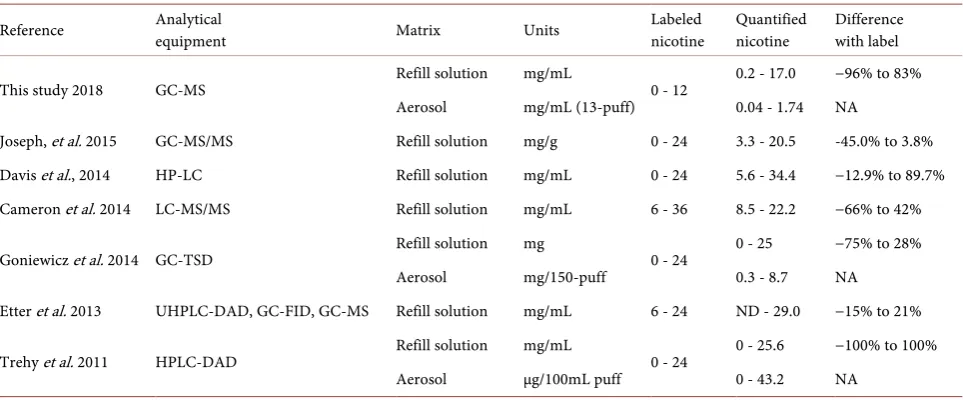
Overall, the varied amount of nicotine was quantified in 40 refill solutions la-beled as containing 3 - 12 mg/mL nicotine. Nicotine appeared to exist in 3 of 32 refill solutions that were labeled as 0 mg/mL nicotine. There were a few studies reporting on the nicotine amount measured in EC refill solutions as shown in
Table 4. Other research showed higher range of nicotine-containing refill
solu-tions that were measured ranging from 0 - 36 mg/mL compared to the samples engaged in this study, ranging from 0 - 12 mg/mL. The basis on the selection of samples varied between the studies depending on the popularity of samples and the preferred amount of nicotine to be evaluated. Similar to several studies, ni-cotine was also detected in the nini-cotine-free refill solutions [10] [18]. However, in contrast, there is a report showing that nicotine was not detected in 4 of 12 nicotine-containing refill solutions [19].
DOI: 10.4236/jep.2019.1010078 1328 Journal of Environmental Protection
Table 4. Other studies conducted regarding nicotine content in EC refill solutions and aerosols, the percentage difference from
the label and analytical method used.
Reference Analytical
equipment Matrix Units
Labeled nicotine
Quantified nicotine
Difference with label
This study 2018 GC-MS Refill solution mg/mL 0 - 12 0.2 - 17.0 −96% to 83%
Aerosol mg/mL (13-puff) 0.04 - 1.74 NA
Joseph, et al. 2015 GC-MS/MS Refill solution mg/g 0 - 24 3.3 - 20.5 -45.0% to 3.8%
Davis et al., 2014 HP-LC Refill solution mg/mL 0 - 24 5.6 - 34.4 −12.9% to 89.7%
Cameron et al. 2014 LC-MS/MS Refill solution mg/mL 6 - 36 8.5 - 22.2 −66% to 42%
Goniewicz et al. 2014 GC-TSD Refill solution mg 0 - 24 0 - 25 −75% to 28%
Aerosol mg/150-puff 0.3 - 8.7 NA
Etter et al. 2013 UHPLC-DAD, GC-FID, GC-MS Refill solution mg/mL 6 - 24 ND - 29.0 −15% to 21%
Trehy et al. 2011 HPLC-DAD Refill solution mg/mL 0 - 24 0 - 25.6 −100% to 100%
Aerosol µg/100mL puff 0 - 43.2 NA
GC-MS, gas chromatography coupled with mass spectrometry; GC-MS/MS, gas chromatography coupled with triple quadrupole mass spectrometer; HP-LC, high performance liquid chromatography; LC-MS/MS, liquid chromatography coupled with triple quadrupole mass spectrometer; GC-TSD, gas chromato-graphy coupled with thermionic specific detector; UHPLC-DAD, ultra-high performance liquid chromatochromato-graphy coupled with diode array detector; GC-FID, gas chromatography coupled with flame ionization detector; ND, not detected; HPLC-DAD, high performance liquid chromatography coupled with diode array detector; NA, not applicable
was calculated in this study ranged from 0.01% - 8.72%. The free or un-protonated form of nicotine is more readily absorbed by the EC user than the protonated forms, accumulating the degree of nicotine inhaled by the user [21]. However, these values are relatively small as compared to another study, 60% - 90% [20]. The major difference in the results of free-nicotine percentage between this study and the study by Joseph et al. [20] is may be due to the different ap-proaches in measuring the pH. This study used rapid method to measure the pH using strip indicator that might have underestimated the pH values resulting in the calculated free nicotine content lower than the actual. EC users taking solu-tions at higher nicotine content might have absorbed higher amount of free-nicotine when the aerosol was inhaled.
DOI: 10.4236/jep.2019.1010078 1329 Journal of Environmental Protection 21% and 85% is reported. In our study, 520 mL (13-puff) of aerosols is taken while study [11] reported to sample of more than 20 times of volume, 10.5 L (150-puff). The amount of nicotine vaporized into aerosol possibly has high correlation to the amount of aerosol volume sampled. We implemented the human use topography (puffs) by [16] in our sampling technique as it deter-mines the actual levels of user exposure to nicotine. The usage of rubber tub-ing in the apparatus set-up of aerosol sampltub-ing might have absorbed a portion of nicotine present in the aerosols. This was likely partly the reason for lower nicotine values quantified in the aerosol than the actual [10]. This finding might indicate that following a puff, nicotine in aerosol is delivered into the user’s mouth and lungs by inhalation which the level accumulated is parallel to the amount of puff.
This study reported discrepancies of nicotine concentrations in the refill solu-tions as compared to the labels on the packaging. Majority of our samples (80%) have nicotine content which differs by more than ±10% the tolerance level set by AEMSA in their standard [14]. In general, most nicotine contents are lower than the labeled values, with many being 20% and lower. Lower amount of nicotine was found from 23 solutions labeled as 6 - 7.5 mg/mL nicotine. Meanwhile, higher amount of nicotine originated from 6 - 12 mg/mL labeled nicotine sam-ples. It is observed that the higher amount of nicotine has higher possibility to produce bigger difference of nicotine level to what is claimed. Similar findings of contradictions between label and true value were also found in other studies
(Table 4). These studies reported significantly lower amount of nicotine than
the value on the bottle. This was supported by other researchers [5] [12] [19] which the majority of the refill solutions contained lower nicotine than the manufacturer’s information. Different trends were reported in other studies, showing higher values of nicotine in most of the EC refill solutions [10] [18]. The deviation between the nicotine true levels and what were claimed was probably due to the absence of good manufacturing practice, inspection and monitoring as well as unregulated. The EC industry was not bound to any stan-dards or procedure therefore it probably can be prepared as DIY products or based on customer’s request. The solutions accurate labeling of nicotine content on EC products is essential as nicotine is both addictive [25] and toxic [26]. The improper labeling might raise potential nicotine overexposure.
DOI: 10.4236/jep.2019.1010078 1330 Journal of Environmental Protection
5. Conclusion
In conclusion, EC refill solutions were inconsistently matched with the label specification with poor information on the label indicating that significant labe-ling issues were found to exist. EC users should be given reliable information on nicotine content and important information, such as the shelf-life of the prod-ucts. The greatest concern was the presence of nicotine in the refill solutions la-beled to contain no nicotine as it might cause addictive effects to EC users that only take 0 mg/mL of EC. Higher amount of nicotine than what is claimed might lead to misconception among users who believe EC delivers less nicotine com-pared to conventional smoking. The deviation of nicotine values showed lack of integrity in manufacturing the EC products and there was a need to establish guidelines to improve the reliability of production for EC devices and solutions.
Acknowledgements
The authors would like to gratefully acknowledge the financial support from the Ministry of Health Malaysia (grant number NMRR-16-164-28981) and to the Director General of Health Malaysia for the permission to publish. We would like to extend our sincere gratitude to the Environmental Health Research Cen-tre, Institute for Medical Research (IMR), Malaysia and National Pharmaceutical Regulatory Agency Malaysia, who gave us permission to use all the required equipment and necessary materials to complete the task. We thank Dorothy L. Southern for providing scientific advice and critically reviewing the manuscript.
Conflicts of Interest
The authors declare no conflicts of interest regarding the publication of this paper.
References
[1] Trtchounian, A. and Talbot, P. (2010) Electronic Nicotine Delivery Systems: Is There a Need for Regulations? TobaccoControl, 20, 47-52.
https://doi.org/10.1136/tc.2010.037259
[2] Brown, C.J. and Cheng, J.M. (2014) Electronic Cigarettes: Product Characterisation and Design Considerations. TobaccoControl, 23, ii4-ii10.
https://doi.org/10.1136/tobaccocontrol-2013-051476
[3] Flora, J.W., Wilkinson, C.T., Sink, K.M., et al. (2016) Nicotine-Related Impurities in e-Cigarette Cartridges and Refill e-Liquids. Journalof LiquidChromatography&
RelatedTechnologies, 39, 824-829.https://doi.org/10.1080/10826076.2016.1266500
[4] World Health Organization (2017) Electronic Nicotine Delivery Systems and Elec-tronic Non-Nicotine Delivery Systems (ENDS/ENNDS). Tobacco Free Initiative (TFI).
http://www.who.int/tobacco/communications/statements/eletronic-cigarettes-janua
ry-2017/en
DOI: 10.4236/jep.2019.1010078 1331 Journal of Environmental Protection https://doi.org/10.1093/ntr/nts103
[6] National e-Cigarette Survey (NECS) (2016) Prevalence, Pattern and Perception Re-garding e-Cigarette and Vape Use among Malaysian Adults. Institute for Public Health, Ministry of Health Malaysia, Kuala Lumpur.
[7] Mohamed Elkalmi, R., Bhagavathul, A.S., Adamu Ya’u,A., et al. (2016) Familiarity, Perception, and Reasons for Electronic-Cigarette Experimentation among the Gen-eral Public in Malaysia: Preliminary Insight. Journal of Pharmacy and Bioallied
Science, 8, 240-247.https://doi.org/10.4103/0975-7406.180768
[8] Department of Health and Human Services, Centers for Disease Control and Pre-vention, National Center for Chronic Disease Prevention and Health Promotion, Office on Smoking and Health (2014) The Health Consequences of Smoking—50 Years of Progress: A Report of the Surgeon General. Atlanta.
[9] Electronic Cigarette, Wikipedia. https://en.wikipedia.org/wiki/Electronic_cigarette [10] Trehy, M.L., Ye, W., Hadwiger, M.E., et al. (2011) Analysis of Electronic Cigarette
Cartridges, Refill Solutions, and Smoke for Nicotine and Nicotine Related Impuri-ties. JournalofLiquidChromatography&RelatedTechnologies, 31, 1442-1458.
https://doi.org/10.1080/10826076.2011.572213
[11] Goniewicz, M.L., Hajek, P. and McRobbie, H. (2013) Nicotine Content of Electronic Cigarettes, Its Release in Vapour and Its Consistency across Batches: Regulatory Implications. Addiction, 109, 500-507.https://doi.org/10.1111/add.12410
[12] Cameron, J.M., Howell, D.N., White, J.R., et al. (2014) Variable and Potentially Fat-al Amounts of Nicotine in e-Cigarette Nicotine Solutions. Tobacco Control, 23, 77-78.https://doi.org/10.1136/tobaccocontrol-2012-050604
[13] Goniewicz, M.L., Gupta, R., Lee, Y.H., et al. (2015) Nicotine Levels in Electronic Cigarette Refill Solutions: A Comparative Analysis of Products from the US, Korea, and Poland. TheInternationalJournalonDrugPolicy, 26, 583-588.
https://doi.org/10.1016/j.drugpo.2015.01.020
[14] AEMSA (2017) E-Liquid Manufacturing Standards 2017. Version 2.3.2, 4.
[15] Department of Health and Human Services (1999) Notice Regarding Requirement for Annual Submission of the Quantity of Nicotine Contained in Smokeless Tobac-co Products Manufactured, Imported, or Packaged in the United States. Federal
Register, 64, 14086-14096.
[16] Farsalinos, K.E., Romagna, G., Tsiapras, D., et al. (2013) Evaluating Nicotine Levels Selection and Patterns of Electronic Cigarette Use in a Group of ‘‘Vapers’’ Who Had Achieved Complete Substitution of Smoking. SubstanceAbuse, 7, 139-146.
https://doi.org/10.4137/SART.S12756
[17] National Institute for Occupational Safety and Health (1998) NIOSH Manual of Analytical Methods (NMAM). Fourth Edition, Issue 1, Dated 15 January 1998. Ni-cotine: Method 2551.
[18] Davis, B., Dang, M., Kim, J. and Talbot, P. (2014) Nicotine Concentrations in Elec-tronic Cigarette Refill and Do-It-Yourself Fluid. Nicotine&TobaccoResearch
Ad-vance, 17, 134-141.https://doi.org/10.1093/ntr/ntu080
[19] Etter, J.F., Zäther, E. and Svensson, S. (2013) Analysis of Refill Liquids for Electron-ic Cigarettes. Addiction, 108, 1671-1679.https://doi.org/10.1111/add.12235
[20] Joseph, G.L., Hang, T., Stephen, B.S., et al. (2015) Chemical Composition and Eval-uation of Nicotine, Tobacco Alkaloids, pH and Selected Flavors in E-Cigarette Car-tridges and Refill Solutions. Nicotine&TobaccoResearch, 17, 1270-1278.
DOI: 10.4236/jep.2019.1010078 1332 Journal of Environmental Protection
[21] Tomar, S.L. and Henningfield, J.E. (1997) Review of the Evidence That pH Is a De-terminant of Nicotine Dosage from Oral Use of Smokeless Tobacco. Tobacco Con-trol, 6, 219-225.https://doi.org/10.1136/tc.6.3.219
[22] Williams, M. and Tyalbot, P. (2011) Variability among Electronic Cigarettes in the Pressure Drop, Airflow Rate, and Aerosol Production. Nicotine & Tobacco
Re-search, 13, 1276-1283.https://doi.org/10.1093/ntr/ntr164
[23] Ingebrethsen, B.J., Cole, S.K. and Aldermen, S.L. (2012) Electronic Cigarette Aero-sol Particle Size Distribution Measurements. Inhalation Toxicology, 24, 976-984.
https://doi.org/10.3109/08958378.2012.744781
[24] Herrington, J.S. and Myers, C. (2015) Electronic Cigarette Solutions and Resultant Aerosol Profiles. JournalofChromatographyA, 1418, 192-199.
https://doi.org/10.1016/j.chroma.2015.09.034
[25] World Health Organization (2010) Gender, Woman and the Tobacco Epidemic: Addiction to Tobacco. Geneva, 137-149.
[26] Mishra, A., Chaturvedi, P., Datta, S., et al. (2015) Harmful Effects of Nicotine.
In-dian Journal of Medical and Paediatric Oncology, 36, 24-31.