Role of the rumen in copper and thiomolybdate absorption
L. Gould and N. R. Kendall*
School of Veterinary Medicine and Science, University of Nottingham, Sutton Bonington Campus, Sutton Bonington, Loughborough LE12 5RD, UK
Abstract
The rumen is the site of significant interactions between Cu, S and Mo. It also shows reactions between Cu, S and Fe. The interaction between Mo and S results in the formation of thiomolybdates, which in the absence of adequate quantities of rumen Cu are absorbed into the animal and bind to Cu in biological compounds. This is the cause of thiomolybdate toxicity, often misleadingly called Cu deficiency. The effects of thiomolybdates being absorbed into the animal are considered, especially how thiomolybdates bind to Cu-containing compounds such as enzymes, decreasing their activity without removing the active Cu component. The sources of Cu, Mo, Fe and S are examined, including the impacts of water and soil on the animal’s intake. Within the present review we have been able to provide evidence that: all classes of thiomolybdates are formed in the rumen; in the absence of available Cu all thiomolybdates can be absorbed into the animal rapidly though the rumen wall or via the small intestine; thiomolybdates bind to Cu in biological compounds and are able to cause problems; effects of thiomolybdate are reversiblein vivoandin vitroon cessation of thiomolybdate challenge; the tetra-thiomolybdate form is the most potent Cu binder with decreased potency with decreasing S in the compound. Fe will exacerbate a thiomolybdate problem but will not directly cause it.
Key words:Thiomolybdate toxicity: Molybdenum: Sulfur: Iron
The present review will seek to review the research on Cu and Mo metabolism within the rumen with relevance to thiomolybdate toxicity in ruminant animals. It will demon-strate that the production of thiomolybdates is a clinical problem and actually causes a thiomolybdate toxicity rather than inducing a Cu deficiency.
The problem of Fe, S and Mo interactions with Cu has been a contentious and confused issue in recent times(1 – 4). Signs attributed to ‘clinical Cu deficiency’ in ruminants are usually, in the field, non-specific and ‘subcli-nical’ and include: reduced weight gain, decreased food intake, reduced efficiency of food conversion, alteration in hair/wool texture and pigmentation (spectacles around eyes), delayed puberty, reduced conception rate, inhibition of oestrus, swayback. These do not tend to be the conten-tion, but whether they are caused by a ‘lock up’ of Cu (induced or secondary Cu deficiency) or by the toxic effects of thiomolybdates is. However, much of the histori-cal research into this area has been overlooked, hence the requirement for the present review.
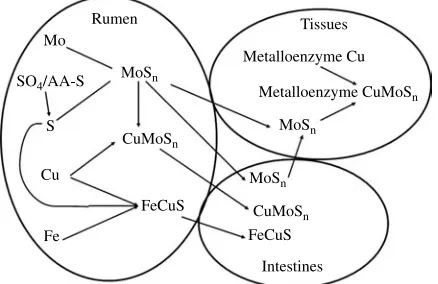
The review will be based on the mechanism outlined in Fig. 1 and each stage will be examined individually in order to elucidate the mechanism. Briefly, Mo, S (as sulfate, sulfide or S amino acids), Cu and Fe all enter the rumen via feed, soil, water or supplements. Reactions occur between
Mo and S enabling the formation of thiomolybdate com-pounds which will readily bind Cu. In the absence of rumen-available Cu (rumen-labile Cu), thiomolybdates are able to be absorbed through the rumen wall and small intestine, allowing them to bind to Cu-containing substances, including enzymes whose activity will be reduced, thus causing clinical problems often quoted as Cu deficiency, even though it is strictly a thiomolybdate toxicity. Another interaction between Fe, S and Cu will intensify the thiomolybdate problem by making Cu una-vailable to bind to the thiomolybdates. In the absence of Mo and Fe interactions, the absolute dietary requirement for Cu is very low; experimentally this has been shown to be, 1·6 mg/kg DM(5).
What does TCA-soluble and -insoluble copper measure?
Much of the literature discussed within the present review uses TCA-insoluble fractions as an experimental result. In order to understand this, we need to appreciate what the TCA precipitation is measuring. The TCA precipitation method involves the addition of equal volumes of TCA sol-ution (5 – 10 %) to the sample, the precipitate is then removed by filtration or centrifugation and the liquid fraction can be measured by the same methodology as
*Corresponding author:Dr Nigel Kendall, email [email protected]
qThe Authors 2011. The online version of this article is published within an Open Access environment subject to the conditions of the Creative Commons Attribution-NonCommercial-ShareAlike licence,http://creativecommons.org/licenses/by-nc-sa/2.5/.. The written permission of Cambridge University Press must be obtained for commercial re-use.
Nutrition
Resear
ch
Re
vie
the unprecipitated sample. The TCA-insoluble fraction can either be assessed by difference or by digestion of the precipitate/filtrate.
As early as 1975, Dick et al.(6)showed that the in vitro addition of increasing amounts of di- (MoS2O222),
tri-(MoS3O22), or tetra-thiomolybdate (MoS242), to plasma
(which was derived as the filtrate fraction from previous TCA precipitation) resulted in decreased Cu within the TCA-soluble filtrate until at approximately 3mg/ml plasma all of the Cu was found in the TCA precipitate. In vitro addition of molybdate with or without sulfate had no effect on the Cu in the TCA precipitate. In the absence of thiomolybdates, the Cu was in the TCA-soluble fraction with Cu in the TCA precipitate being negligible. This suggested that TCA-insoluble Cu can be used as an indirect measure of thiomolybdate, differentiating thiomolybdate effects from Mo and S in non-thiomolybdate form.
Are thiomolybdates produced in the rumen?
Dicket al.(6)showed that duodenal administration of thio-molybdates increased the Cu content in the TCA precipitate of blood plasma, whereas a duodenal infusion of molyb-date (with or without S) had no effect whatsoever on the blood plasma TCA-insoluble Cu. This study indicates but does not prove that the thiomolybdate must be absorbed to affect the TCA-insoluble Cu in plasma and also that thiomolybdates are not formed in the duodenum. A suspen-sion of rumen micro-organisms was incubated in a solution containing molybdate and sulfate; this resulted in the pro-duction of a mixture of di-, tri- and tetra-thiomolybdates which were identified by their absorption spectra(6). This led to Dick et al.(6) suggesting the following mechanism: sulfates are first reduced to sulfides by ruminal micro-organisms, the sulfide then reacts with the molybdate to form the thiomolybdates, the thiomolybdates then react with Cu to form insoluble Cu thiomolybdates, thus limiting the absorption of dietary Cu. In the field, situations with high dietary or water sulfides often have exacerbated ‘copper’ problems. The reduction of sulfate to sulfide in
the proposed mechanism explains the increased potency found with increased dietary or water sulfide intakes.
Bray et al.(7) found tri- and tetra-thiomolybdates to be the predominant species found in cultured rumen fluid. Using non-fermentation ruminal conditions, Clarke & Laurie(8) showed the formation of the relative thiomolyb-dates to be pH- and S (given as sulfide):Mo molar ratio-dependent. Clarke & Laurie(8)showed at pH 7·0 that molar S:Mo ratios of, 3 only produced mono-thiomolybdates, 5 – 10:1 resulted in di-thiomolybdates, above 10 quickly transformed to tri-thiomolybdates, but found total con-version to tetra-thiomolybdate occurring at about 300:1. An S:Mo molar ratio of 62:1 at pH 8·0 resulted in the di-thiomolybdate being the predominant form (with no significant tetra-thiomolybdate), whereas at pH 6·5 the tri form dominated, and as pH decreased the tetra-thiomolyb-date form increased. The modern dairy cow has a much lower ruminal pH than the older-type hay-fed dairy cow. They also reported S:Mo ratios found in the field and in supplementation trials to range from 6:1 up to 8000:1, suggesting that many field conditions would produce mainly tetra-thiomolybdates. Bray et al.(9) showed that the actual thiomolybdate production in rumen fermenta-tion condifermenta-tions, especially the producfermenta-tion of tetra-thiomo-lybdate, was much greater than the Clarke & Laurie(8) work predicted. A third of molybdate was found to be converted to tetra-thiomolybdate over a wide range (4 – 12mg Mo per ml) of Mo inputs and at S:Mo molar ratios of , 10. The molar ratios of S:Mo required for production of the tetra-thiomolybdate in this fermentative culture system were much lower than Clarke & Laurie(8) found for their non-fermentation culture. The system used by Clarke & Laurie(8) was also a closed system with no removal or binding of the product produced and was therefore allowed to come to equilibrium.
Incubations of sieved (through a 0·9£0·9 mm muslin mesh) rumen fluid (from cattle fed no Mo) with molybdate (0·1 mM) and sulfate (2·4 mM) by Elgalladet al.(10)resulted in the production of an absorption spectra indicative of tetra-thiomolybdate (239, 317 and 467 nm) with no peaks indicative of di- or tri-thiomolybdates (392 and 394 nm), indicating that only tetra-thiomolybdate was produced in significant amounts. However, when Cu was added to the culture before the incubation there was no evidence of tetra-thiomolybdates in the rumen fluid culture. Trans-ferring their work into the whole animal, Elgalladet al.(10) showed that in cattle fed 100 mg Mo per kg DM, 3 g S per kg DM and 200 mg Cu per kg DM, there was no TCA-inso-luble Cu and little albumin-bound Cu. However, when Cu was reduced to 1 mg/kg DM the TCA-insoluble Cu content increased and greater than 80 % of this was associated with albumin, Mo and Cu; the caeruloplasmin concentrations were also reduced. When a Cu injection was given to these low-Cu (1 mg/kg DM)-fed cattle, the plasma Cu increased, as did the plasma Mo, and both the total
Rumen Mo
MoSn
SO4/AA-S
CuMoSn
Cu
Fe
FeCuS
Intestines FeCuS
CuMoSn
MoSn
MoSn
Metalloenzyme CuMoSn
Metalloenzyme Cu Tissues
[image:2.595.57.276.72.214.2]S
Fig. 1.Ruminal mechanism for the interaction of Cu, Mo, S and Fe and routes of absorption for the interaction products. MoSnis used diagrammati-cally to represent the thiomolybdate series (MoSnO22ð42nÞ, where n is 1 to 4).
Nutrition
Resear
ch
Re
vie
amount and proportion of Cu in the TCA-insoluble fraction were increased.
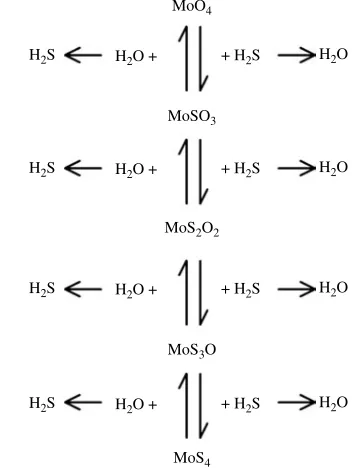
The mechanism by which the thiomolybdates are formed is a stepwise dehydrolysis of molybdate with an O being replaced by an S from a sulfide donor at each stage, the O being released as a water molecule(11). This reaction is reversible and equilibria are temperature and pH dependent. The formation is outlined in Fig. 2.
The study by Price et al.(12) in which a large dose of
99Mo-labelled tetra-thiomolybdate was administered
intra-ruminally and 99Mo-labelled tri- and di-thiomolybdates were recovered from the rumen digesta indicated the reversibility of this reaction in the rumen.
Whether the thiomolybdates are associated with the liquid or the solid phase of the rumen digesta is also of importance, as association with the solid phase imparts some stability on the thiomolybdates formed in the rumen, whereas the thiomolybdate in the liquid phase when remaining unbound, or unabsorbed is readily hydro-lysed, reversing the reaction outlined above(12). Available Cu within the digesta is also largely associated with the solid phase(12), therefore potentially facilitating the intrar-uminal formation of Cu – thiomolybdate complexes.
It is doubtful that the equilibria are reached under rumen conditions due to the availability of the substrates, molyb-date and S (as sulfide, or after rumen bug conversion to sulfide), along with the constant removal of the tetra-thio-molybdate. Therefore the reaction is most probably driven to the constant formation of thiomolybdates. The tetra-thio-molybdate would seem to have the following potential fates: (1) absorbed through the rumen wall; (2) passed
with digesta through to the abomasum; (3) intra-ruminally bound to Cu, forming insoluble copper thiomolybdates which are egested; (4) bound to the solid phase which seems to incur some chemical stability; (5) hydrolysed in the liquid phase (i.e. involved in the equilibria). This makes this a very dynamic system.
Do thiomolybdates transfer into the animal and how?
Kelleher et al.(13) showed that 99Mo-radiolabelled tetra-and tri-thiomolybdates administered directly into the rumen of sheep by stomach tube appear within the plasma within 5 min, mainly in a TCA-insoluble form. However, when 99Mo-radiolabelled molybdate was admi-nistered by the same route, only small traces were found in the plasma over the first 60 min, with these predomi-nantly in the TCA-soluble plasma fraction; after 2 h the amounts of 99Mo in the plasma increased rapidly and from 4 h the radiolabel was predominantly in the TCA-inso-luble fraction, suggesting that appearance of the label into the TCA-soluble or -insoluble fraction is rate dependent – rapid uptake from a large ruminal thiomolybdate dose gives a large insoluble TCA fraction, whereas a slower digestive trickle feed gives more in the TCA-soluble frac-tion. Further, this indicates that more of the thiomolybdate from the large dose appears in plasma in a non-protein-bound form, whereas the trickle dose results in a greater proportion of the thiomolybdate being protein bound. The trickle dose of thiomolybdates gives ‘free’ or ‘rumen-available’ Cu much more opportunity to ‘detoxify’ the thio-molybdates. It must be remembered that the above effects are ruminal, as these sheep had duodenal re-entrant can-nulae fitted, which allowed the digestion and absorption from the rumen to be totally separate from the intestinal digestion and absorption, as digesta was exchanged between the rumen output of one sheep and the duodenal input of the partner sheep and vice versa. Initially after starting to receive the exchange digesta, the proportion of TCA-soluble 99Mo in plasma for both tetra- and tri-thiomolybdate for the rumen administered/duodenal absorbed sheep was increased in comparison with the rumen administered/rumen absorbed partner (first 80 h), but the TCA-insoluble fraction was similar after 30 h. For the molybdate-administered sheep the digesta-exchanged sheep had virtually entirely TCA-soluble99Mo for the first 4 h, but between 4 and 6 h the TCA-insoluble fraction increased rapidly but to only half of the level of the TCA-soluble fraction. The TCA-soluble fraction declined more rapidly than the TCA-insoluble fraction.
Hynes et al.(14)showed, using 99Mo-labelled molybdate administered to cattle, that there was maximal plasma concentration of labelled Mo after 20 h, although similar to Kelleheret al.(13)this was initially mainly in the TCA-soluble fraction and the TCA-insoluble fraction lagged behind but remained more persistent as the TCA-soluble labelled Mo declined. Hynes et al.(14) also showed that protein-bound
MoO4
H2S H2O
MoSO3
MoS2O2
MoS3O
MoS4
H2O + + H2S
H2S H2O + + H2S H2O
H2S H2O + + H2S H2O
[image:3.595.73.251.450.685.2]H2S H2O + + H2S H2O
Fig. 2.Reactions that occur to form thiomolybdate in the rumen. The reac-tions are reversible. The direction is driven by the availability of molybdate and sulfide and the removal of the formed thiomolybdates by absorption and binding to the solid phase of forming the copper thiomolybdate complex within the rumen.
Nutrition
Resear
ch
Re
vie
99Mo-labelled compounds were present. They eluted this
protein with unlabelled tetra-thiomolybdate and displaced significant proportions of di- and tri-thiomolybdate and trace amounts of molybdate. They were unable to elute any tetra-thiomolybdate using this technique; however, whether this was as none was present or that unlabelled tetra-thiomolybdate was unable to displace the labelled tetra-thiomolybdate (both would have similar affinities) remains unclear. Masonet al.(15)showed similar effects in sheep with no apparent production of tetra-thiomolybdate; however, they used the same elution technique and no account was made of the Cu content of the animal or diet. In steers either given or not given a Cu injection immedi-ately before an injection of radiolabelled tri-thiomolybdate, the steers with the Cu injection had virtually all of the radi-olabel remaining in the plasma, whereas the steers not injected with Cu only had 40 – 50 % of the administered radiolabel (from tri-thiomolybdate) in the plasma (mainly in the TCA-insoluble fraction)(14). Price et al.(12) from their own and the work of others (discussed above) con-cluded that tetra-thiomolybdate was produced in the rumen, but remained absent from the liquid fraction and available for absorption until the solid fraction became saturated. The liquid fraction was the supernatant fraction of strained rumen fluid (through a single layer of muslin) after centrifugation at 2200g, the solid fraction being the fine particulate material. The saturation of the solid fraction is probably related to the ruminally available Cu content of the solid fraction and this is at least partially shown by the Cu supplementation in the work of Hynes et al.(14) discussed above. This is supported by work by Price & Chesters(16) that showed available Cu in the digesta to be mainly in the solid phase of the rumen fluid. It is further supported by the tetra-thiomolybdate having a greater affinity for Cu and therefore the tetra-thiomolybdates will react with available Cu before the tri- and subsequently di-thiomolybdates and therefore not be available for absorption whereas the less reactive species are. Price et al.(12)showed the presence of Cu(I)tetra-thiomolybdate (CuS2MoS2Cu) in rumen digesta as well as
Cu(I)tri-thiomolybdate and Cu(I)di-Cu(I)tri-thiomolybdate. This Cu(I) tetra-thiomolybdate was also found to have completely exchangeable tetra-thiomolybdate given excess copper iodide.
Suttle & Field(17) also concluded that tetra-thiomolyb-dates caused effects of Cu and Mo antagonism, whereas the di-thiomolybdate was shown not to play an important role in the Cu and Mo antagonism.
What effects do absorbed thiomolybdates have in the animal?
Chidambaram et al.(18) showed tetra-thiomolybdate to inhibit in vitroall of the following Cu-containing oxidase enzymes (value in parentheses is the concentration of tetra-thiomolybdate required for 50 % inhibition):
caeruloplasmin (p-phenylenediamine 3·0mM;o-dianisidine 2·7mM); cytochrome oxidase (2·0mM); superoxide dismutase (5·0mM); ascorbate oxidase (1·0mM); tyrosinase (dopachro-me formation 3·0mM, catecholase acivity 4·5mM). These
levels of inhibition are physiologically relevant. Phillippo et al.(19)measured plasma Mo concentrations ranging from below the detection limit of 0·015mg/ml (0·156mM) for
control and Fe-supplemented treatments up to 0·16mg/ml (1·67mM) for Mo-supplemented groups which would indi-cate that these levels could potentially be achieved in plasma, with the large caveat that it is not possible to show how much of the plasma Mo is in the form of thiomolybdates. Chidambaram et al.(18) also showed using atomic absorption that caeruloplasmin and tetra-thiomolybdate-treated caeruloplasmin both contained six coppers, i.e. tetra-thiomolybdate does not remove Cu from caeruloplas-min to inactivate it. The tetra-thiomolybdate was suggested to bind to the caeruloplasmin through the sulfide (2S) groups, reducing the Cu (II) to Cu (I) (Fig. 3).
Chidambaram et al.(18) also showed that, on a mole basis, ten tetra-thiomolybdate molecules bind to each caer-uloplasmin, which suggests that some non-specific binding of tetra-thiomolybdate to caeruloplasmin must also occur; this had been previously shown to occur with non-specific binding of tetra-thiomolybdate to albumin. This reaction was reported to be irreversible. However, both Hynes et al.(14) and Lannon & Mason(20) reported reversibility of tri- and tetra-thiomolybdate effects both in vivo and in vitro.In vitro, Lannon & Mason(20)showed the reaction to reverse after gel filtration of the plasma, whilstin vivo the reaction began to reverse on cessation of the tetra-thiomolybdate infusion.
Lannon & Mason(20) showed that infusion of tetra-and tri-thiomolybdates both reduced the caeruloplasmin p-phenylenediamine oxidase activity and TCA solubility of Cu, with the tetra form more potent than the tri form. They also found an increase in Cu associated with albumin. The reaction was apparently reversible, as full p-phenyle-nediamine oxidase activity of caeruloplasmin returned in vitro after gel filtration of the plasma, and in vivo as activity began to return upon cessation of thiomolybdate infusion. It was also noted that during infusion the total Cu content of the blood increased (24 % over 24 h); how-ever, there was no reduction in caeruloplasmin Cu associ-ated with the increased Cu, which is in agreement with Chidambaram et al.(18) showing that Cu is not removed from the caeruloplasmin to reduce the enzymic activity. The increase in plasma Cu is something also shown by Kendall et al.(21), who found the total Cu concentration of plasma to be increased by a continuous infusion of
Cu(I)nCp S
S S S
Mo MoS42– + Cu(II)nCp
Fig. 3.Reaction for the binding of thiomolybdate to caeruloplasmin (Cp)(18).
Nutrition
Resear
ch
Re
vie
1 mg tetra-thiomolybdate per h in sheep. By 1-week post-cessation of infusion, thiomolybdate and control infused sheep had similar concentrations of plasma Cu. The TCA-soluble plasma Cu concentration remained consistent with the tetra-thiomolybdate infusion having a significant TCA-insoluble fraction. The caeruloplasmin p-phenylene-diamine oxidase activity was also decreased by the tetra-thiomolybdate infusion, but at the 1-week post-infusion sample full activity was regained. It was only the measure of whole blood superoxide dismutase activity which remained depressed at 1 week after cessation of the 5 d tetra-thiomolybdate infusion.
Kumaratilake & Howell(22) found in Cu-loaded sheep (fed 2 % solution of copper sulfate at 10 ml/kg body weight for 5 d per week until a rise in alkaline phosphatase was observed) (range 55 – 149 d) that the administration of tetra-thiomolybdate (50mg intravenously twice per week) for 11 weeks significantly reduced liver Cu concentrations from 813·76 (SD 74·77) to 305·78 (SD 48·25) mg/kg wet weight (ww); Cu concentrations also decreased in the non-thiomolybdate-treated controls but only to 594·57 (SD
104·29) mg/kg ww. Also there were significantly increased liver Mo concentrations (0·93 to 87·25 (SD 16) mg/kg ww)
in the Cu-loaded animals.
Haywood et al.(23) found a pituitary endocrinopathy in sheep associated with therapeutic administrations of thio-molybdates for the treatment of Cu toxicity. Williams et al.(24,25) have shown similar effects in sheep feed Mo and S.
The role of iron: how does it react in the rumen?
Phillippoet al.(19,26)showed Fe and S supplementation to reduce the blood plasma Cu content of cattle to hypocu-praemic status (1·89 – 2·67mM and 3·15 – 3·78mMcompared with control group minimums of 10·54 and 15·73mM for two experiments, respectively; the internationally recog-nised threshold for Cu deficiency is 9.4mM(27)) without
inducing the symptoms of ‘clinical Cu deficiency’ (reduced weight gain, decreased food intake, reduced efficiency of food conversion, alteration in hair texture, delayed pub-erty, reduced conception rate and inhibition of oestrus). Fe and Mo supplementation both reduced liver Cu and plasma Cu concentrations. Bremneret al.(28) showed that Fe supplementation (4.5, 9 and 13·5 mmol Fe/kg DM) had no effect on Cu status in preruminant calves, but decreased plasma and liver Cu when fed post-wearing although this did not induce a ‘clinical’ Cu deficiency until Mo was also fed. The effects of Fe and Mo were additive at the relatively low levels administered; previous trials with high supplement rates did not indicate an additive effect.
Campbellet al.(29) showed Fe supplementation (30 mg/ kg live weight) to reduce liver Cu from 179 mg/kg DM down to 7 mg/kg DM, with plasma Cu concentrations start-ing to reduce after depletion of liver Cu to 40 mg/kg DM.
The Cu-dependent enzymes amine oxidase and caerulo-plasmin were measured in this trial only after blood Cu had already been significantly reduced and were lower for the Fe-dosed group compared with the control group. These animals had a basal diet containing 1·5 mg Mo/kg DM and 10·7 mg Cu/kg DM.
No effect of high Fe supplementation (1 g/kg diet) was noted on serum, liver or spleen Cu concentration by Rosa et al.(30); however, these sheep were being fed a low-S diet.
Standish & Ammerman(31)showed iron sulfate (1·6 g/kg Fe, 0·28 % sulfate) to significantly reduce the blood Cu con-centration when compared with iron citrate (1·6 g/kg Fe) and no supplement. However, blood Cu concentrations when fed sodium sulfate (0·28 % sulfate) were reduced but not significantly, and not to the degree that the iron sul-fate reduced the blood Cu concentration.
In the rumen the Fe can react with sulfide and Cu either to produce an Fe – Cu – S complex which is not absorbed by the animal; an alternative hypothesis is that the Fe and sul-fide combine to form an iron sulsul-fide, and the Cu then exchanges with the Fe to form a copper sulfide (comment by C. F. Mills in Suttle & Peter(32)). Both will therefore reduce the amount of Cu available within the rumen and will hence reduce the Cu available to participate in the Mo and S (thiomolybdate) and Cu interactions. However, there is little direct evidence in the literature to support either hypothesis, although what is clear is that there is an Fe – Cu – S interaction and it does decrease Cu availability.
Sources of copper, molybdenum, sulfur and iron
The complex interaction between these elements is explained above, but it is important to remember how these elements reach the rumen and in what form. The major routes of entry are in the diet and in the drinking water. The diet includes the elemental composition of the plant material consumed, dietary inclusion and sup-plements containing minerals (for example, mineral licks) and soil consumption, both as feed contamination and direct consumption. Soil can account for up to 25 % of DM intake in certain situations; for example, in sheep graz-ing pasture with short grass either in very wet conditions (poaching) or with very dry and dusty conditions, where the annual soil consumption can exceed the live weight of the animal(33). Other sources confirm this, with over-wintered grazing cattle ingesting between 140 and 1400 g soil per d(34). Drinking water can also be an important elemental entry route, whether it is mains water, spring water, stream water or from a borehole. Borehole water, especially, tends to be individual to the farm and can have a high sulfide content which as outlined above makes the S much more potent in the thiomolybdate for-mation reactions. The Fe in borehole water also often tends to be in the highly reactive ferrous form.
Nutrition
Resear
ch
Re
vie
Water-logging of soil in addition to increasing poaching and increasing soil consumption will also increase the uptake of Fe to plant material (four- to five-fold in young green shoots), with the Fe in the highly bioactive ferrous form(29). When soil (contamination) is ensiled with forages the fermentation process appears to increase the Fe bioac-tivity(35). The Mo uptake by plants, especially legumes, is also increased when grown in wet soils(36). In general, Mo content is higher in vegetable protein supplements (for example, soya) and legumes (for example, clover)(37). Mo uptake is also increased with increasing pH of the soil (liming pasture increases Mo uptake) and generally increases throughout the growing season(37). S tends to be related to protein concentration.
There are also differences found between continuous and discontinuous feeding on sulfide production(32); this will also affect rumen pH. Therefore, a continuous feeding system (for example, total mixed ration; TMR) will give a more consistent but moderately higher rumen pH with a stable sulfide content whereas a single or twice-daily feed will give a rapid decrease in rumen pH and peak pro-duction of sulfide, both of which will revert over time before the next meal.
Summary
Within the present review we have been able to provide evidence that: all classes of thiomolybdates are formed in the rumen; in the absence of available Cu all thiomolyb-dates can be absorbed into the animal rapidly though the rumen wall or more sedately via the small intestine; thio-molybdates can bind to Cu in biological compounds and are able to cause problems; effects of thiomolybdate are reversible in vivoandin vitroon cessation of thiomolyb-date challenge; the tetra-thiomolybthiomolyb-date form is the most potent Cu binder with decreased potency with decreased S in the compound. Fe will exacerbate a thiomolybdate problem but will not directly cause it.
Acknowledgements
This research received no specific grant from any funding agency in the public, commercial or not-for-profit sectors. N. K. was the major contributor. L. G. had some small but significant input.
There are no conflicts of interest.
References
1. Laven RA & Livesey CT (2005) The diagnosis of copper related disease, part 2: copper responsive disorders. Cattle Pract13, 55 – 60.
2. Telfer SB, Kendall NR, Illingworth DV,et al. (2005) The diag-nosis of copper related disease, part 2: copper responsive disorders.Cattle Pract13, 284 – 286.
3. Laven RA & Livesey CT (2006) Caeruloplasmin: plasma copper ratios in cows.Vet Rec159, 608.
4. Telfer SB, Kendall NR, Illingworth DV,et al. (2006) Caerulo-plasmin: plasma copper ratios in cows. Vet Rec 159, 607 – 608.
5. Moeini MM (1997) The effect of interactions between copper, molybdenum, iron and sulphur on metabolism and fertility in ruminant animals. PhD Thesis, University of Leeds. 6. Dick AT, Dewey DW & Gawthorne JM (1975) Thiomolyb-dates and copper – molybdenum – sulfur interaction in rumi-nant nutrition.J Agric Sci85, 567 – 568.
7. Bray AC, Suttle NF & Field AC (1982) The determination of thiomolybdates in continuous cultures of rumen micro-organisms.Proc Nutr Soc41, A66 – A66.
8. Clarke NJ & Laurie SH (1980) Copper – molybdenum antag-onism in ruminants. 1. Formation of thiomolybdates in animal rumen.J Inorg Biochem12, 37 – 43.
9. Bray AC, Suttle NF & Field AC (1982) The formation of tri-thiomolybdates and tetra-thiomolybdates in continuous cultures of rumen microorganisms and their adsorption onto fiber.Proc Nutr Soc41, A67 – A67.
10. Elgallad TT, Mills CF, Bremner I, et al. (1983) Thiomolyb-dates in rumen contents and rumen cultures. J Inorg Biochem18, 323 – 334.
11. Harmer MA & Sykes AG (1980) Kinetics of the interconver-sion of sulfido- and oxomolybdate(VI) species MoOxS22
42x in aqueous solutions.Inorg Chem19, 2881 – 2885.
12. Price J, Will AM, Paschaleris G,et al. (1987) Identification of thiomolybdates in digesta and plasma from sheep after administration of 99Mo-labelled compounds into the rumen.Br J Nutr58, 127 – 138.
13. Kelleher CA, Ivan M, Lamand M,et al. (1983) The absorption of labeled molybdenum compounds in sheep fitted with re-entrant cannulae in the ascending duodenum.J Comp Pathol
93, 83 – 92.
14. Hynes M, Woods M, Poole D,et al. (1985) Some studies on the metabolism of labeled molybdenum compounds in cattle.J Inorg Biochem24, 279 – 288.
15. Mason J, Lamand M & Kelleher CA (1982) The effects of duo-denal infusion of tri- and dithiomolybdate on plasma copper and on the diamine oxidase activity of caeruloplasmin (EC1.16.3.1) in sheep.J Comp Pathol92, 509 – 518. 16. Price J & Chesters JK (1985) A new bioassay for assessment
of copper availability and its application in a study of the effect of molybdenum on the distribution of available Cu in ruminant digesta.Br J Nutr53, 323 – 336.
17. Suttle NF & Field AC (1983) Effects of dietary-supplements of thiomolybdates on copper and molybdenum metabolism in sheep.J Comp Pathol93, 379 – 389.
18. Chidambaram MV, Barnes G & Frieden E (1984) Inhibition of ceruloplasmin and other copper oxidases by thiomolybdate. J Inorg Biochem22, 231 – 239.
19. Phillippo M, Humphries W, Atkinson T,et al. (1987) The effect of dietary molybdenum and iron on copper status, puberty, fertility and estrous cycles in cattle.J Agric Sci109, 321 – 326. 20. Lannon B & Mason J (1986) The inhibition of bovine cerulo-plasmin oxidase activity by thiomolybdates in vivo and in vitro: a reversible interaction.J Inorg Biochem26, 107 – 115. 21. Kendall NR, Illingworth DV & Campbell BK (2005) The effect of an intra-venous infusion of thiomolybdate on copper status and ovarian function in sheep. In Proceedings of the 12th International Symposium on Trace Element Metabolism in Man and Animals (TEMA-12) Abstracts, p. 60 (poster P26) [M Bonham, EM Duffy, LB McAnena and JJ Strain, editors]. Coleraine, UK: University of Ulster. 22. Kumaratilake JS & Howell JM (1989) Intravenously
adminis-tered tetra-thiomolybdate and the removal of copper from the liver of copper-loaded sheep. J Comp Pathol 101, 177 – 199.
Nutrition
Resear
ch
Re
vie
23. Haywood S, Dincer Z, Jasani B,et al. (2004) Molybdenum-associated pituitary endocrinopathy in sheep treated with ammonium tetrathiomolybdate.J Comp Pathol130, 21 – 31. 24. Williams CL (2004) The effects of molybdenum, iron and
sulphur on copper metabolism and physiology of sheep. PhD Thesis, Harper Adams University College.
25. Williams CL, Haywood S, Wilkinson RG, et al. (2005) The effects of dietary molybdenum, sulphur and iron on the pituitary gland trace element content and function. In Proceedings of the 12th International Symposium on Trace Element Metabolism in Man and Animals (TEMA-12) Abstracts, pp. 79 – 80 (poster P63) [M Bonham, EM Duffy, LB McAnena and JJ Strain, editors]. Coleraine, UK: University of Ulster.
26. Phillippo M, Humphries WR, Bremner I, et al. (1985) Molybdenum-induced infertility in cattle. In Proceedings of the Fifth International Symposium on Trace Elements in Man and Animals, pp. 176 – 180 [CF Mills, I Bremner and JK Chesters, editors]. Farnham Royal, UK: Commonwealth Agricultural Bureaux.
27. Radostits OM, Gay CC, Hinchcliff KW, et al. (2007) Veterinary Medicine – A Textbook of the Diseases of Cattle, Horses, Sheep, Pigs, and Goats. London: Saunders Elsevier. 28. Bremner I, Humphries WR, Phillippo M, et al. (1987)
Iron-induced copper deficiency in calves: dose – response relationships and interactions with molybdenum and sulfur. Anim Prod45, 403 – 414.
29. Campbell AG, Coup MR, Bishop WH,et al. (1974) Effect of elevated iron intake on the copper status in grazing cattle. NZ J Agric Res17, 393 – 399.
30. Rosa IV, Ammerm CB & Henry PR (1986) Interrelationships of dietary copper, zinc and iron on performance and tissue mineral concentration in sheep.Nutr Rep Int34, 893 – 902.
31. Standish JF & Ammerman CB (1971) Effect of excess dietary iron as ferrous sulfate and ferric citrate on tissue mineral composition of sheep.J Anim Sci33, 481 – 484.
32. Suttle NF & Peter DW (1985) Rumen sulphide metabolism as a major determinant of copper availability in the diets of sheep. In Proceedings of the Fifth International Symposium on Trace Elements in Man and Animals, pp. 367 – 370 [CF Mills, I Bremner and JK Chesters, editors]. Farnham Royal, UK: Commonwealth Agricultural Bureaux.
33. Healy WB (1974) Ingested soil as a source of elements to grazing animals. InTrace Element Metabolism in Animals – 2. Proceeding of the Second International Symposium on Trace Element Metabolism in Animals, pp. 448 – 450 [WG Hoekstra, JW Suttie, HE Ganther and W Mertz, editors]. Baltimore, MD: University Park Press.
34. Thornton I (1974) Biochemical and soil ingestion studies in relation to the trace-element nutrition of livestock. InTrace Element Metabolism in Animals – 2. Proceeding of the Second International Symposium on Trace Element Metab-olism in Animals, pp. 451 – 454 [WG Hoekstra, JW Suttie, HE Ganther and W Mertz, editors]. Baltimore, MD: University Park Press.
35. Hansen SL & Spears JW (2009) Bioaccessibility of iron from soil is increased by silage fermentation. J Dairy Sci 92, 2896 – 2905.
36. Kubota J (1975) Areas of molybdenum toxicity to grazing animals in western states. J Range Manag 28, 252 – 256.
37. Mills CF & Davis GK (1987) Molybdenum. InTrace Elements in Human and Animal Nutrition, vol. 1, 5th ed., pp. 429 – 464 [W Mertz and EJ Underwood, editors]. London: Academic Press.