Exogenous enzymes have been used extensively to remove anti-nutritional factors from feeds, to increase the digestibility of existing nutrients, and to supplement the activity of the endogenous en-zymes of poultry (Classen et al., 1991; Bedford, 1993). Currently most of the enzymes that are used in feeds are xylanases for wheat and rye-based diets and β-glucanases for barley and oat-based diets. The targets of those enzymes are the non-starch polysaccharides (NSP) that are found in cereals; they include xylanases for xylans and β-gluca-nases for β-glucans. The use of NSP enzymes in the animal feed industry has greatly expanded in the last five years especially in countries like Iran,
which utilizes large quantities of cereals such as barley and wheat in poultry diets. When added to diets especially for poultry, these enzymes have been shown to improve the efficiency of feed uti-lization, increase the rate of growth, improve the health of the gastrointestinal tract, and reduce en-vironmental pollution due to a decreased output of manure and gases such as ammonia (Bedford, 1997; Choct, 1997; Marquardt, 1997). The arab-inoxylans and β-glucans present in the endosperm cell walls of cereal grain have been identified as a major cause of poor growth rate and low nutrient digestibility (Ward and Marquardt, 1987) in broil-er chickens. These anti-nutritive effects of NSPs
Comparison of performance and digestibility
characteristics of broilers fed diets containing
treated hulled barley or hulless barley
A. MOHARRERY
Animal Science Department, Agricultural College, Shahrekord University, Shahrekord, Iran
ABSTRACT: This study was performed with growing chickens (14 to 56 days of age) to evaluate the effects of feeding a barley-based diet. The treatments were maize diet (1) as a control, barley diet with (4) or without (2) the commercial enzyme β-glucanase, barley treated with rumen fluid without protozoa (3) and hulless barley (5). The effects of treatments were investigated in a 42-day trial using 360 sexed broiler chickens. In a digestibility trial, 15 male broiler chicks were used at 45 days of age. In this regard, five treatments were offered to chickens in three replications individually. The experimental design for performance investigation was a completely ran-domised one with a 5 × 2 factorial arrangement of treatments. Each of the five treatments was replicated three times per sex (n = 3). The levels of barley in treatments (2) to (5) were 35% during the growing (14 to 42 days) and finishing (42 to 52 days) period. At the end of trial, two birds from each pen were selected and slaughtered. Blood samples were taken just before slaughter of birds. No significant differences (P > 0.05) were observed between (3) to (5) treatments with maize diet in weight gains, feed intake and feed conversion, but barley with no treatment (2) showed lower weight gaincomparedto the enzyme treatment and hulless barley diet (P < 0.05). Ether extract digestibility decreased significantly in all barley diets compared with maize diet (P < 0.05). Digestibility of DM, CP, and NFE was lower in barley diet with no treatment, in comparison with other treatments (P < 0.05). Reduc-tion of serum cholesterol was observed in birds on hulless barley diet (P < 0.05), but serum triacylglycerols and glucose did not show any significant differences between treatments (P > 0.05). Mean percentage yield of breast showed the highest percentage in barley diet with no treatment (P < 0.05) and abdominal fats were produced in lowest amounts in carcasses on hulless barley diets (P < 0.05).
Keywords: broiler; barley; hulless barley; enzyme; cholesterol; digestibility
are attributed to an increase in intestinal digesta viscosity (Choct and Annison, 1992b). Therefore, the addition of exogenous enzymes is necessary to reduce the anti-nutritive effects of viscous NSPs (Choct and Annison, 1992a). The NSP-degrading enzymes markedly increase the nutritive value of wheat (Choct et al., 1995) and rye (Bedford and Classen, 1993) in broiler chickens.
In ruminants, microorganisms play a role through their enzymes in digestive processes. Complete di-gestion of complex feeds such as hay or grain liter-ally requires hundreds of enzymes (McAllister et al., 2001). The diversity of enzyme activities present in rumen fluid is advantageous because a single product can target a wide variety of substrates (Moharrery and Das, 2001).
Hulless barley has a higher AME and protein con-tent than hulled barley because of the diluting effect of the fibrous hull (Classen et al., 2000). Based on chemical analysis, Edney et al. (1992) determined that hulless barley had higher crude protein (CP) than did hulled barley. Removal of the hull from barley increases its digestible energy content, but it also increases the proportion of starch.
The first objective of this study was to explore the possibility of using a practical procedure for barley treatment with rumen fluid. Furthermore, the removal of the hull is expected to result in mod-est increases in metabolizable energy and protein levels of hulless barley compared to regular barley. For this reason, comparison of the effects of hulless barley (the same percentage as of regular barley) or hulled barley (treated or untreated) and maize on performance and digestive characteristics of broiler chickens and evaluation of their blood metabolites and carcass characteristics were other objectives of this study.
MATERIAL AND METHODS
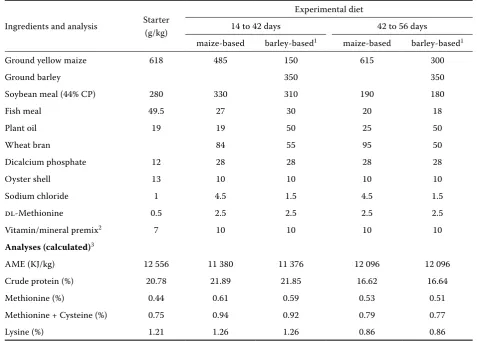
Animals anddiets. Three hundred and sixty 1-day-old sexed commercial broiler chickens (Ross, Iranian Agency) were housed separately for each sex in floor pens containing litter composed of wood shavings and received a maize-based starter diet (Table 1). At 14 days of age, all the chickens from each sex were divided into 15 groups, 12 chickens per group. Each of the 5 experimental diets was fed to 3 groups of chickens (in each sex) for 42 days. Dietary treatments as grower and finisher diets (Table 1) consisted of:
1. Maize-based diet as a control.
2. Hulled barley-based diet without any treatment or enzyme addition.
3. The same diet as mentioned under (2) but bar-ley was treated with rumen fluid without protozoa. The rumen fluid was collected from the rumen con-tent in slaughterhouses and strained through four layers of cheesecloth and centrifuged once at 1 000 g for 10 min. The supernatant fluid was decanted and diluted with water (50:50). This fluid was mixed with ground barley thoroughly and transferred to a large plastic barrel and kept anerobically at about 20°C for 48 hours. Then the barrel was evacuated on a plastic sheet for drying in sunlight. This type of barley called processed barley was included in grower and finisher diet at the same amount as another type of barley for treatment No. 3.
4. The exogenous enzyme used in this treat-ment was the commercial powdered preparation Endofeed, Reg No. 280003 (GNC Bioferm INC. Saskatchewan, Canada, S7H 3A6) with β-glucanase activities. The enzyme preparation was added to the barley-based diet (the same percent as in treat-ment 2 and 3) at the level of 0.5 g/kg of diet.
5. Normal hulless barley-based diet (the same percent as in treatment 2 to 4) without any treat-ment or enzyme addition. The CP content in this grain was about 2% higher than in hulled barley but the removal of the hull is expected to result in modest increases in metabolizable energy, which can adjust the energy/protein levels in the same way as regular barley. This is why the same amount of hulless barley was used for comparison with hulled barley.
Feed and water were supplied ad libitum through-out the whole experiment. Body weights were de-termined at 14, 42 and 56 days of age and feed intake over these periods was recorded. Feed con-version (g feed per body mass – FC) was calculated after dividing the cumulated feed consumption for each pen to the total bird mass of that pen.
was carefully removed, and the excreta were stored in containers at –25°C. Excreta samples were subse-quently dried in an oven at 80°C, weighed, ground through a 0.5 mm sieve, and stored in an airlock plastic vessel at 4°C until analysis.
Carcass characteristics and blood samples col-lection. At the end of the experiment (56 days of age), two birds of each pen were bled by cutting the carotid artery and blood was taken from this artery. The blood samples were centrifuged for 15 min at 2 500 × g, and the serum was harvested and stored at –80°C.
The carcass feather removal was accomplished in a free-action picker after subscalding at approxi-mately 60°C. Heads and shanks were removed, and the remaining carcasses were dissected to breast,
thigh, wings, neck, gizzard, liver, abdominal fat and weighed. The percentage yield of each part was cal-culated on the basis of carcass weight. The meat sam-ples (musculus pectoralis major, m. pectoralis minor, and m. sartorius) were used for determination of fat, protein, ash and glycogen. The samples were minced twice and then homogenized and kept at –25°C.
[image:3.595.59.537.102.443.2]Chemical measurements. Total fat contents of feed, meat and excreta were determined by extraction of samples with petroleum ether. The determination of nitrogen in feed and excreta was performed with the macro-Kjeldahl method. Because a part of nitrogen in excreta originates from uric acid, the faecal nitrogen should be cor-rected for uric acid nitrogen. In this regard, the excreta were calculated as total nitrogen minus
Table 1. Composition of experimental diets
Ingredients and analysis Starter (g/kg)
Experimental diet
14 to 42 days 42 to 56 days
maize-based barley-based1 maize-based barley-based1
Ground yellow maize 618 485 150 615 300
Ground barley 350 350
Soybean meal (44% CP) 280 330 310 190 180
Fish meal 49.5 27 30 20 18
Plant oil 19 19 50 25 50
Wheat bran 84 55 95 50
Dicalcium phosphate 12 28 28 28 28
Oyster shell 13 10 10 10 10
Sodium chloride 1 4.5 1.5 4.5 1.5
DL-Methionine 0.5 2.5 2.5 2.5 2.5
Vitamin/mineral premix2 7 10 10 10 10
Analyses (calculated)3
AME (KJ/kg) 12 556 11 380 11 376 12 096 12 096
Crude protein (%) 20.78 21.89 21.85 16.62 16.64
Methionine (%) 0.44 0.61 0.59 0.53 0.51
Methionine + Cysteine (%) 0.75 0.94 0.92 0.79 0.77
Lysine (%) 1.21 1.26 1.26 0.86 0.86
1in diets (2) to (5) the same levels of barley were used but with different types of treatment or variety
2the premix supplied the following vitamins and elements (mg/kg diet): retinol 3.6 (about 1.1 IU/KJ), cholecalciferol 0.075 (about 0.26 IU/KJ), biotin 1, DL-α-tocopherylacetate 10, riboflavin 10, pantothenate 20, choline 2 000, niacin 100, thiamine 10, pyridoxine 10, menadin sodium bisulphate 1.5, cyanocobalamine 0.1, folic acid 2, ethoxyquin 150, Mn 100, Fe 100, Cu 10, Co 1, I 1, Zn 100
nitrogen in uric acid. The apparent metabolizable energy of each diet was calculated from the gross energy values of the diet and dried excreta. Gross energy values were measured using a bomb calo-rimeter (Shimadzu Automatic Bomb Calocalo-rimeter CA-3). The glycogen content in meat samples was measured as described by Djawdan et al. (1998).
Serum samples were also analysed for triacylg-lycerols using an enzymatic and colorimetric pro-cedure (Kit 10-525, Ziestchem Diagnostic kit, Tehran, Iran) and for cholesterol by an enzymatic procedure (Kit 10-508, Ziestchem Diagnostic kit, Tehran, Iran) and for glucose by a colorimetric procedure (Kit 10-518, Ziestchem Diagnostic kit, Tehran, Iran).
Statistical analysis. The complete randomised model was used to analyse digestibility data. In this regard, five treatments were offered to chickens in three replications individually. The experimental de-sign for performance investigations was a completely randomised one with a 5 × 2 factorial arrangement of treatments. Each of the five treatments was rep-licated three times per sex (n = 3). The data were analysed using a general linear model procedure of SAS (1988). Duncan’s multiple range test (SAS, 1988) (P < 0.05) was used to test the significance of differ-ences between means. The percentage values were transformed to arcsine and analysed, but the values that are reported were converted to the initial form. The values are given as means, and the homogeneity of variance was checked.
RESULTS AND DISCUSSION
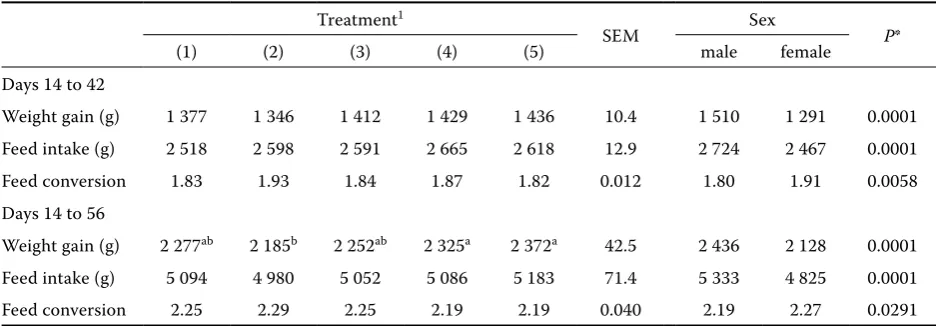
Growth performance. Growth performance, feed intake and feed conversion are shown in Table 2. No differences (P > 0.05) in feed intake or feed conversion were observed through day 42 or 56. Weight gain was reduced significantly (P < 0.05) by treatment (2) at day 42 and 56. The barley di-ets which were treated with rumen fluid or com-mercial enzyme showed the same results as the maize-based diet and superior performance than barley without any treatment (2), indicating that the efficiency of dietary utilisation increased in chicks fed these regimens. A significant reduction in weight gain that occurred in broilers fed regi-men (2) compared to regiregi-men (5) suggested that the insoluble fibre may play its role because the β-glucan concentration in hulless barley is higher than in hulled barley.
At present there are two major types of hulless barley, normal and waxy. The normal type has the traditional ratio of amylose to amylopectin starch fractions as found in regular barley. The waxy type has a very high percentage of amylopectin starch. Markets for waxy barley are being developed.
[image:4.595.63.533.521.684.2]Improvements in the performance of poultry fed diets containing barley to which enzymes had been added were first reported more than 45 years ago (Jensen et al., 1957). In the present study it was shown that the addition of enzyme to the diet (treatment No. 4) increased the weight attained
Table 2. Growth performance of broilers fed maize or barley-based diets from 14 to 42 or 56 days of age
Treatment1
SEM Sex P*
(1) (2) (3) (4) (5) male female
Days 14 to 42
Weight gain (g) 1 377 1 346 1 412 1 429 1 436 10.4 1 510 1 291 0.0001
Feed intake (g) 2 518 2 598 2 591 2 665 2 618 12.9 2 724 2 467 0.0001
Feed conversion 1.83 1.93 1.84 1.87 1.82 0.012 1.80 1.91 0.0058
Days 14 to 56
Weight gain (g) 2 277ab 2 185b 2 252ab 2 325a 2 372a 42.5 2 436 2 128 0.0001
Feed intake (g) 5 094 4 980 5 052 5 086 5 183 71.4 5 333 4 825 0.0001
Feed conversion 2.25 2.29 2.25 2.19 2.19 0.040 2.19 2.27 0.0291
1(1) = maize, (2) = hulled barley, (3) = hulled barley treated with rumen fluid, (4) = hulled barley treated with enzyme, (5) = hulless barley
abmeans in the row with different superscripts differ significantly (P < 0.05) SEM = standard error of the mean
by broilers at 8 weeks of age by over 6% (P < 0.05). Corresponding improvements in feed conversion efficiency were shown for this treatment. The nega-tive effect of hulled barley inclusion in the diets was not proved in this study. The reason for this aspect is partly related to the inclusion of hulled barley to the diet after 2 weeks of age. During the first 2 weeks of age the gastrointestinal tract, especially the small intestine epithelium, is not completely mature (cellularity and enzymology); for this rea-son the chicks could not observe any inconven-ient material such as non-starch polysaccharides (NSP) in their diets (Petersen et al., 1976; Henning, 1979; McNab and Smithard, 1992). The processed barley in treatment (3) provided the same results of weight gain, feed intake and feed conversion as barley treated with the commercial enzyme. The improvement in the nutritive value of processed barley is partly connected with the rumen micro-bial action and partly with soaking it in the fluid. Gohl (1977) presented evidence to indicate that the stimulation of endogenous β-glucanase and its subsequent action on β-glucan, as takes place dur-ing maltdur-ing (Bamforth, 1982), was one of the factors contributing to the increase in the nutritive value of barley as a result of water treatment. Beneficial alterations to the structure of starch (Potter et al., 1965) were also proposed as contributory factors. In this study hulless barley brought interesting results compared to the other treatments, but the β-glucan content in this treatment (5) was higher than in other diets (data is not shown). The result of this study suggested that the β-glucan was not a unique factor for negative effects of barley. The combination of β-glucan along with insoluble fi-bre (hull) may act as a synergic status producing negative effects. Newman et al. (1985) reported the alkaline viscosity of unpearled barley to be 2.27 cp, and of pearled 1.99 cp. By removing one of the factors such as β-glucan (adding the enzyme (3) or (4)) or insoluble fibre (hulless barley) bet-ter performance is to be expected. This result is in contrast with Scott et al. (1998), who reported that the hulless barley cultivars significantly re-duced excreta dry matter (DM), feed intake, 17-day body weight (BW), and increased the feed to gain ratio. They stated that the enzyme had a greater effect on the hulless variety. In agreement with the results of the present study Classen et al. (2000) reported that hulless barley had higher apparent metabolizable energy (AME) and protein content than hulled barley because of the diluting effect of
the fibrous hull. They also mentioned that within hulless barley cultivars, the low fibre content was suggested to further enhance the nutritive value for broiler chickens.
The feed conversion of female broilers will usu-ally be higher (less efficient) than in male birds of corresponding weight, after about 30 days of age. The reason for this finding is that female birds tend to deposit proportionally more fat in the carcass (Ryley et al., 1970).
Feed digestibility and metabolizable energy. Table 3 shows excreta and digestibility data in this experiment. Chicks on the maize diet (1) produced the lowest amount of moisture in excreta (P < 0.05). The enzyme treated barley (4) and hulless barley (5) produced similar percentages of excreta moisture and the excreta were slightly drier compared to un-treated (2) and processed barley (3) (P > 0.05). This finding could be partly explained by the capacity of nonstarch polysaccharides to bind water (Langhout and Schutte, 1996). The increase in digesta water is thus the primary mechanism by which water-solu-ble nonstarch polysaccharides exert antinutritive properties (Bedford and Classen, 1993). Cellulose, hemicellulose, pectin, lignin, and digestion resist-ant starch have modifying effects on digesta water in the non-ruminant intestinal tract (Craig et al., 1998). Inclusive of these fibre fractions are solu-ble and insolusolu-ble β-glucans, which are found in higher percentages in barley diet compared to maize-based diet.
difference was observed between these treatments and maize-based diet (1), but after correction for the uric acid concentration a significant difference was observed (P < 0.05). The reason for this result is partly explained by the excretion of nitrogen through uric acid. In this regard, decreasing uric acid by enzyme supplementation could be related to better availability and digestibility of protein and therefore it could eliminate the excretion of nitro-gen as the main material of uric acid production. Consequently, a reduction in uric acid excretion may decrease the environmental contamination. In future this could lead to the lower rate of crude protein in broiler rations treated with enzyme sup-plementation. On the other hand, in barley-fed birds, with an increase in microbial fermentation there would be a higher loss of nitrogen, leading to a reduction in apparent nitrogen digestibility, as was
seen. This result agrees with the finding of Smits et al. (1997), who demonstrated a significant reduc-tion in apparent nitrogen digestibility after feeding higher NSP to the birds. Angkanaporn et al. (1994) demonstrated that water-soluble pentosans in the diet significantly raised the endogenous losses in broiler birds.
[image:6.595.62.536.101.256.2]The apparent metabolizable energy values are presented as means in Table 4. Rumen fluid (3) and enzyme (4) treatment of barley increased the en-ergy value from 10 054 to 11 481 and 10 837 KJ/kg, respectively. The AME value for hulless barley (5) is 1 063 KJ more than for hulled barley. It is important to note that the improvement in AME of barley-based diets following the rumen fluid or enzyme treatment is due to the improvement in nutrient (protein, fat, etc.) digestibility and not due to the availability of NSP themselves to act as an energy
Table 3. Mean values of excreta moisture and digestibility coefficients of diets (in %)
Treatments
SEM
(1) (2) (3) (4) (5)
Excreta moisture 53.85b 75.30a 75.85a 72.59a 71.82a 0.356
Digestibility coefficients
Dry matter 70.53a 66.13b 72.23a 71.27a 73.13a 0.011
Protein2 42.81ab 38.46b 53.16a 46.45ab 53.83a 0.034
Corrected protein3 75.24bc 74.75c 79.60ab 75.75bc 81.73a 0.013
Ether extract 91.33a 88.73b 88.13b 87.63b 88.57b 0.006
Nitrogen free extract 77.77bc 75.73c 82.17a 79.83ab 80.67a 0.008
1(1) = maize, (2) = hulled barley, (3) = hulled barley treated with rumen fluid, (4) = hulled barley treated with enzyme, (5) = hulless barley
abmeans in the row with different superscripts differ significantly (P < 0.05) SEM = standard error of the mean
2(nitrogen × 6.25)
3faecal nitrogen in the excreta was corrected as total nitrogen minus nitrogen in uric acid
Table 4. Apparent metabolizable energy ME (KJ/kg) of maize, treated or untreated barley and total diets
Treatments
SEM
(1) (2) (3) (4) (5)
Total diet 12 092 11 749 12 247 12 021 12 046 342.6
Particular cereals1 14 008a 10 054b 11 481b 10 837b 11 117b 798.7
abmeans within a row lacking a common superscript differ (P < 0.05)
1(1) = maize, (2) = hulled barley, (3) = hulled barley treated with rumen fluid, (4) = hulled barley treated with enzyme, (5) = hulless barley
[image:6.595.62.533.629.697.2]source for the chicken. This result agrees with the finding of other researchers (Danicke et al., 1995; Schutte et al., 1995), who demonstrated the same result when they used wheat-based diets.
Blood serum metabolites. The data related to serum metabolites are shown in Table 5. The con-sumption of hulled barley-based diet significantly decreased (P < 0.05) total cholesterol by 15%. There were no significant differences between treatments in serum triacylglycerols and glucose. No differ-ences between the sexes in serum total cholesterol or glucose concentration were found (P > 0.05). However, compared to females, male chicks showed a markedly decreased (P = 0.1026) concentration of serum triacylglycerols by 20%. The
[image:7.595.62.532.102.189.2]cholesterol-lowering activity of barley is believed to be attrib-utable to β-glucan in the soluble fibre fraction of this cereal grain (Delaney et al., 2003). In hulled barley-fed birds the efficiency of bile acid in the digesta might be lowered, which could explain not only the low lipid digestibility (Table 3) but also the low serum cholesterol concentration as second-ary features. This result agrees with the finding of other researchers who reported an increase in NSP in the intestinal content, reduced cholesterol absorption and plasma cholesterol concentration in broiler chickens (Smits et al., 1997) and ham-sters (Gallaher et al., 1993; Carr et al., 1996). The experimental findings of lower serum triacylglyc-erol levels in male birds in comparison with female
Table 5. Some blood serum metabolites of chickens fed maize or barley-based diets (in mg/dl)
Treatments1
SME Sex P*
(1) (2) (3) (4) (5) male female
Total cholesterol 93.41a 79.53b 86.07ab 97.70a 85.14ab 4.36 89.85 86.26 0.3109
Triacylglycerols 56.57 54.07 55.90 54.90 53.63 8.15 48.96 61.07 0.1026
Glucose 242.6 270.1 274.6 255.5 286.5 14.4 265.3 266.5 0.9285
1(1) = maize, (2) = hulled barley, (3) = hulled barley treated with rumen fluid, (4) = hulled barley treated with enzyme,
(5) = hulless barley
abmeans in the row with different superscripts differ significantly (P < 0.05)
SEM = standard error of the mean *probability
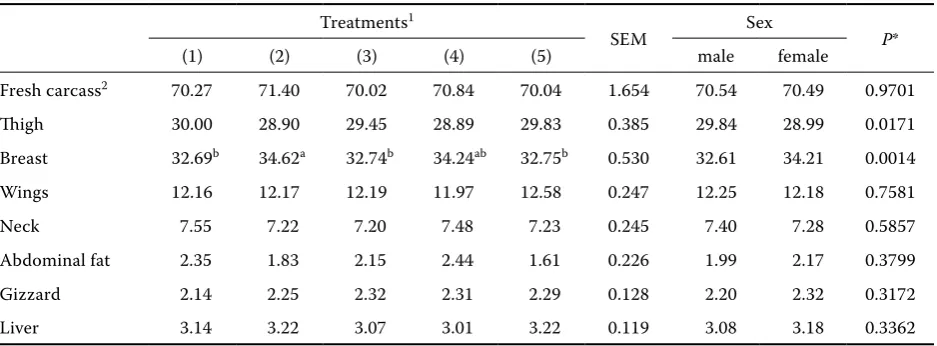
Table 6. Effect of different treatments on the yield of parts as percentages of broiler carcass weight (in %)
Treatments1
SEM Sex P*
(1) (2) (3) (4) (5) male female
Fresh carcass2 70.27 71.40 70.02 70.84 70.04 1.654 70.54 70.49 0.9701
Thigh 30.00 28.90 29.45 28.89 29.83 0.385 29.84 28.99 0.0171
Breast 32.69b 34.62a 32.74b 34.24ab 32.75b 0.530 32.61 34.21 0.0014
Wings 12.16 12.17 12.19 11.97 12.58 0.247 12.25 12.18 0.7581
Neck 7.55 7.22 7.20 7.48 7.23 0.245 7.40 7.28 0.5857
Abdominal fat 2.35 1.83 2.15 2.44 1.61 0.226 1.99 2.17 0.3799
Gizzard 2.14 2.25 2.32 2.31 2.29 0.128 2.20 2.32 0.3172
Liver 3.14 3.22 3.07 3.01 3.22 0.119 3.08 3.18 0.3362
1(1) = maize, (2) = hulled barley, (3) = hulled barley treated with rumen fluid, (4) = hulled barley treated with enzyme, (5) = hulless barley
abmeans in the row with different superscripts differ significantly (P < 0.05) 2carcass yields as percentages of live weight
[image:7.595.64.533.497.670.2]chickens are in agreement with Qureshi et al. (1983) and Konjufca et al. (1997).
Carcass characteristics. The mean percentage of carcass parts in different treatments is documented in Table 6. Except for breast parts and abdominal fat, no significant effects of treatments on carcass parts could be found. A higher percentage of breast parts in hulled barley based-fed birds may refer to lower deposition of fat or higher protein in this part. Higher protein is associated with higher wa-ter, which altogether increased the breast weight. A similar result was found for carcass yield, which was numerically higher in hulled barley based-fed birds. The results of the current study demonstrated that the NSP concentration from barley reduced abdominal fat. This result agrees with the finding of Esteve-Garcia et al. (1997), who reported that broiler diets based on barley reduced abdominal fat to 2.5% of carcass weight. Deposits of fat in the ab-dominal region of the broiler are considered a waste by the poultry industry. Abdominal fat is not only a loss, but also it represents an added expense for the processing effluent treatment. In further processing, it appears that the larger the quantity of abdomi-nal fat, the lower the processing yields (Yusrizal and Chen, 2003). The effects of the birds’ sex on the yield of parts are shown in Table 6. Females yielded a higher proportion of breasts (P = 0.0014), but a smaller proportion of thigh than males (P = 0.0171). This result completely agrees with Young et al. (2001), who reported the same results.
[image:8.595.63.532.114.234.2]Data on the chemical composition of meat samples (musculus pectoralis major, m. pectoralis minor, and
Table 7. Effect of different treatments on meat (musculus pectoralis major, m. pectoralis minor, m. sartorius) com-position
Treatments1
SEM Sex P*
(1) (2) (3) (4) (5) male female
Moisture 74.96ab 74.73ab 73.33bc 72.50c 75.51a 0.562 74.09 74.32 0.6563 Protein 20.91ab 21.80a 19.50b 20.25ab 19.68b 0.564 20.80 20.06 0.1639
Fat 2.68 b 1.97b 5.33a 5.71a 3.18ab 0.798 3.39 4.16 0.2986
Glycogen 0.09b 0.09b 0.14a 0.15a 0.09b 0.015 0.11 0.11 0.8896
Ash 1.37 1.41 1.70 1.39 1.54 0.144 1.61 1.35 0.0625
1(1) = maize, (2) = hulled barley, (3) = hulled barley treated with rumen fluid, (4) = hulled barley treated with enzyme, (5) = hulless barley
abmeans in the row with different superscripts differ significantly (P < 0.05) SEM = standard error of the mean
*probability
m. sartorius) are presented in Table 7. As the results show, higher protein and lower fat percentage in meat samples are accompanied by higher moisture content. This relationship was discussed in greater detail by Velu et al. (1972), Sibbald and Wolynetz (1986), and Wolynetz and Sibbald (1990). If the protein intake does not limit the potential of the animals to respond to changes in energy intake, the general rule is the greater the energy intake, the fat-ter the carcass at any weight (Griffiths et al., 1977). Glycogen content in meat samples is significantly (P < 0.05) highest in treated barley diets (3 and 4) and lowest and same in other treatments. Post mortem, glycogen is converted anaerobically to lactic acid, which causes a decline in pH. This decline can oc-cur only if sufficient glycogen is available (Wal et al., 1999). It is an unfavourable indication if the pH value does not fall to 6.1 or below (Gracey, 1981).
REFERENCES
Angkanaporn K., Choct M., Bryden W.L., Annison E.F. (1994): Effects of wheat pentosans on endogenous amino acid losses in chickens. J. Sci. Food Agric., 66, 399–404.
Bamforth C.W. (1982): Barley β-glucans their role in malting and brewing. Brewers Digest., 57, 22–27. Bedford M.R. (1993): Mode of action of feed enzymes. J.
Appl. Poult. Res., 2, 85–92.
(eds.): Enzyme in Poultry and Swine Nutrition. Inter-national Development Research Centre, Ottawa, ON, Canada. 19–28.
Bedford M.R., Classen H.L. (1993): An invitro assay for prediction of broiler intestinal viscosity and growth when fed rye-based diets in the presence of exogenous enzymes. Poult. Sci., 72, 137–143.
Carr T.P., Gallaher D.D., Yang C.H., Hassel C.A. (1996): Increase intestinal contents viscosity reduces choles-terol absorption efficiency in hamsters fed hydroxy-propyl methylcellulose. J. Nutr., 126, 1463–1469. Choct M. (1997): Enzymes in animal nutrition: the
un-seen benefits. In: Marquardt R.R., Han Z. (eds.): En-zyme in Poultry and Swine Nutrition. International Development Research Centre, Ottawa, ON, Canada. 45–51.
Choct M., Annison G. (1992a): Anti-nutritive effect of wheat pentosans in broiler chickens: roles of viscosity and gut microflora. Brit. Poult. Sci.,33, 821–834. Choct M., Annison G. (1992b): The inhibition of nutrient
digestion by wheat pentosans. Brit. J. Nutr., 67, 123– 132.
Choct M.R., Hlighes J., Trimble R.P., Angkanaporn K., Annison G. (1995): Non-starch polysaccharides-de-grading enzymes increase the performance of broiler chickens fed wheat of low apparent metabolizable en-ergy. J. Nutr., 125, 485–492.
Classen H.L., Graham H., Inborr J., Bedford M.R. (1991): Growing interest in feed enzymes to lead to new prod-ucts. Feedstuffs,63, 22–24.
Classen H.L., Zhi Yuan Niu, Rossnagel B.G., Scott T.A. (2000): Nutritional value of low fibre cultivars of hulless barley for broiler chickens. Poult. Sci., 79, 304. Craig S.A.S., Holden J.F., Troup J.P., Auerbach M.H., Frier H.I.
(1998): Polydextrose as soluble fibre: Physiological and analytical aspects. Cereal Foods World, 43, 370–376. Danicke S., Simon O., Jeroch H., Bedford M. (1995): Effect
of fat source and xylanase supplementation on the per-formance and intestinal viscosity in rye fed birds. In: van Hartingsveldt W., Hessing M., van der Lugt J.P., Somers W.A.C. (eds.): Proc. 2nd Europ. Symp. Feed
Enzymes, 25–27 October, Noordwijkerhout, Nether-lands. TNO Nutrition and Food Research Institute, Zeist, Netherlands. 102–106.
Delaney B., Nicolosi R.J., Wilson T.A., Carlson T., Frazer S., Zheng G.H., Hess R., Ostergren K., Haworth J., Knut-son N. (2003): Βeta-glucan fractions from barley and oats are similarly antiatherogenic in hypercholestero-lemic Syrian golden hamsters. J. Nutr., 133, 468–495. Djawdan M., Chippindale A.K., Rose M.R., Bradley T. J.
(1998). Metabolic reserves and evolved stress resist-ance in Derosophila melanogaster. Physiol. Zool., 71, 584–594.
Edney M.J., Tkachuk R., MacGregor A.W. (1992):
Nutri-ent composition of the hulless barley cultivar, Condor. J. Sci. Food Agric., 60, 451–456.
Esteve-Garcia E., Brufau J., Pe´rez-Vendrell A., Miquel A., Duven K. (1997): Bioefficacy of enzyme prepara-tions containing b-glucanase and xylanase activities in broiler diets based on barley or wheat, in combination with flavomycin. Poult. Sci.,76, 1728–1733.
Furuse M., Yang S.I., Niwa H., Okumura J. (1991): Effect of short chain fatty acids on the performance and in-testinal weight in germ free and conventional chicks. Brit. Poult. Sci., 32, 159–165.
Gallaher D.D., Hassel C.A., Lee K.J. (1993). Relationship between viscosity hydroxypropyl methylcellulose and plasma cholesterol in hamster. J. Nutr., 123, 1732–1738. Gohl B. (1977): Effects of hydrocolloids on productive
value and feeding characteristics of barley [Ph.D. The-sis.] The Swedish University of Agricultural Sciences. Uppsala.
Gracey J.F. (1981): Thornton’s Meat Hygiene. 7th ed.
Mac-millan Publishing Co. Inc., New York.
Griffiths L., Leeson S., Summers J.D. (1977): Fat deposi-tion in broilers: effect of dietary energy to protein bal-ance, and early life caloric restriction on productive performance and abdominal fat pad size. Poult. Sci.,
56, 538–646.
Henning S.J. (1979): Biochemistry of intestinal develop-ment. Environ. Health Perspect., 33, 9–16.
Huhtanen C.N., Pensack J. (1965): The role of Streptococ-cus faecalis in the antibiotic growth effect in chickens. Poult. Sci., 44, 830–834.
Jensen L.S., Fry R.E., Allred J.B., McGinnis J. (1957): Im-provement in the nutritional value of barley for chick by enzyme supplementation. Poul. Sci., 36, 919–921. Konjufca V.H., Pesti G.M., Bakalli R.I. (1997): Modulation
of cholesterol levels in broiler meat by dietary garlic and copper. Poult. Sci., 76, 1264–1271.
Langhout D.J., Schutte J.B. (1996): Nutritional implica-tions of pectins in chicks in relation to esterification and origin of pectins. Poult. Sci., 75, 1236–1242. Marquardt R.R. (1997): Enzyme enhancement of the
nu-tritional value of cereals: role of viscous, water-soluble, nonstarch polysaccharides in chick performance. In: Marquardt R.R., Han Z. (eds.): Enzyme in Poultry and Swine Nutrition, International Development Research Centre, Ottawa, ON, Canada. 5–17.
McAllister T.A., Hristov A.N., Beauchemin K.A., Rode L.M., Cheng K.J. (2001): Enzymes in ruminant diets. In: Bedford M.R., Partridge G.G. (eds.): Enzymes in Farm Animal Nutrition. CABI Publishing. 273–278. McNab J.M., Smithard R.R. (1992): Barley β-glucan: An
antinutritional factor in poultry feeding. Nutr. Res. Rev., 5, 45–60.
under different treatments. Reprod. Nutr. Dev.,41, 513–529.
Newman R.K., Newman C.W., Eslick R.F. (1985): Effect of fungal fermentation and other treatments on nutri-tional value of waxy barley fed to chicks. Poult. Sci.,
64, 1514–1518.
Osborne D.L., Seidel E.R. (1989): Microflora derived polyamines modulate obstruction induced colonic mu-cosal hypertrophy. Am. J. Physiol., 256, G1049–1057. Petersen C.F., Meyer G.B., Sauter E.A. (1976): Compari-son of metabolizable energy values of feed ingredient for chicks and hens. Poult. Sci., 55, 1163–1165. Potter L.M., Stutz M.W., Matterson L.D. (1965):
Metab-olizable energy and digestibility coefficients of barley for chicks as influenced by water treatment or by pres-ence of fungal enzyme. Poult. Sci., 44, 565–573. Ryley J.W., Moir K.W., Pepper P.M., Burton H.W. (1970):
Effect on hexoestrol implantation and body size on the chemical composition and body components of chick-ens. Brit. Poult. Sci., 11, 83–91.
Qureshi A.A., Din Z.Z., Abuirmeileh N., Burger W.C., Ahmed Y., Elson C.E. (1983): Suppression of avian he-patic lipid metabolism by solvent extracts of garlic: impact on serum lipids. J. Nutr., 113, 1746–1755. Sakata T. (1987): Stimulatory effect of short-chain fatty
acids on epithelial cell proliferation in the rat intestine: a possible explanation for trophic effects of fermenta-ble fibre, gut microbes and luminal trophic factors. Brit. J. Nutr., 58, 95–103.
SAS (1988): User’s Guide. Statistics, Version 6.03, 4th ed.
SAS Inst., Inc., Cary, NC.
Salih M.E., Classen H.L., Campbell G.L. (1991): Re-sponses of chickens fed on hulless barley to dietary β-glucanase at different ages. Anim. Feed Sci. Technol.,
33, 139–149.
Scott T.A., Silversides F.G., Swift H.L., Bedford M.R., Hall J.W. (1998): A broiler chick bioassay for measuring the feeding value of wheat and barley in complete diets. Poult. Sci., 77, 449–455.
Schutte J.B., de Jong J., Langhout D.J. (1995): Effect of a xylanase enzyme supplementation to wheat-based di-ets in broiler chicks in relation to dietary factors. In: van Hartingsveldt W., Hessing M., van der Lugt J.P., Somers W.A.C. (eds.): Proc. 2nd Europ. Symp. Feed
Enzymes, 25–27 October, Noordwijkerhout, Nether-lands. TNO Nutrition and Food Research Institute, Zeist, Netherlands. 95–101.
Sibbald I.R., Wolynetz M.S. (1986): Measurement of li-pids in chicken carcass dry matter. Poult. Sci., 65, 2299–2303.
Smits C.H.M., Veldman A., Verstegen M.W.A., Beynen A.C. (1997): Dietary carboxymethylcellulose with high instead of low viscosity reduces macronutrient diges-tion in broiler chickens. J. Nutr., 127, 483–487. Velu J.G., Baker D.H., Scott H.M. (1972): Regression
equations for determining body composition of young chicks. Poult. Sci., 51, 698–699.
Wal P.G. van der, Reimert H.G.M., Goedhart H.A., Engel B., Uijttenboogaart T.G. (1999): The effect of feed with-drawal on broiler blood glucose and nonesterified fatty acid levels, postmortem liver pH values, and carcass yield. Poult. Sci., 78, 569–573.
Ward A.T., Marquardt R.R. (1987): Antinutritional activ-ity of a water-soluble pentosan-rich fraction from rye grain. Poult. Sci., 66, 1655–1674.
Wolynetz M.S., Sibbald I.R. (1990): Estimates of body components in broiler chickens from body weight and dry matter. Poult. Sci., 69, 1318–1324.
Young L.L., Northcutt J.K., Buhr R.J., Lyon C.E., Ware G.O. (2001): Effects of age, sex, and duration of post-mortem aging on percentage yield of parts from broiler chicken carcasses. Poult. Sci., 80, 376–379.
Yusrizal, Chen T.C. (2003): Effect of adding chicory fructans in feed on broiler growth performance, serum cholesterol and intestinal length. Int. J. Poult. Sci., 2, 214–219.
Received: 2004–11–22 Accepted after correction: 2005–10–05
Corresponding Author
Dr. Ali Moharrery, PhD., Department of Animal Science, Agricultural College, Shahrekord University, Shahrekord, Iran