1 A sequence analysis of patterns in self-harm in young people with and without experience of
being looked-after in care
Wadman, R.a, Clarke, D.a, Sayal, K.b, Armstrong, M.c, Harroe, C.d, Majumder, P.c, Vostanis, P.e and Townsend, E.a.
aSchool of Psychology, University Park, The University of Nottingham, Nottingham, NG7
2RD, UK
bDivision of Psychiatry & Applied Psychology, School of Medicine, University of
Nottingham, Nottingham, NG7 2UH, UK
cChild and Adolescent Mental Health Service, Nottinghamshire Healthcare NHS Foundation
Trust, Thorneywood CAMHS, Porchester Rd, Nottingham, NG3 6LF, UK dHarmless, 7 Mansfield Road, Nottingham, NG1 3FB, UK
eSchool of Neuroscience, Psychology and Behavior, Centre for Medicine, University of
Leicester, University Road, Leicester, LE1 7RH, UK
Corresponding author: Ruth Wadman, Department of Health Sciences, University of York, York, UK, YO10 5DD. Email [email protected]. Telephone +44 (0)1904 321650
Acknowledgements
This report is independent research commissioned and funded by the Department of Health Policy Research Programme (The 'Listen-up!' project: understanding and helping looked-after young people who self-harm, 023/0164). The views expressed in this publication are those of the author(s) and not necessarily those of the Department of Health. We would like to thank our participants who generously gave their time and our advisory group of young people. We would also like to thank the professionals in CAMHS, Children’s Social Care and Harmless
2
Abstract
Objectives: Young people in the public care system (‘looked-after’ young people) have high levels of self-harm. Design: This paper reports the first detailed study of factors leading to self-harm over time in looked-after young people in England, using sequence analyses of the Card Sort Task for Self-harm (CaTS). Methods: Young people in care (looked-after group: n = 24; 14-21 years) and young people who had never been in care (contrast group: n = 21; 13-21 years) completed the CaTS, describing sequences of factors leading to their first and most recent episodes of self-harm. Lag sequential analysis
determined patterns of significant transitions between factors (thoughts, feelings, behaviours, events) leading to self-harm across six months. Results: Young people in care reported feeling better immediately following their first episode of self-harm. However, fearlessness of death, impulsivity and access to means were reported most proximal to recent self-harm. Although difficult negative emotions were salient to self-harm sequences in both groups, young people with no experience of being in care reported a greater range of negative emotions and transitions between them. For the contrast group, feelings of depression and sadness were a significant starting point of the self-harm sequence six months prior to most recent self-harm. Conclusions: Sequences of factors leading to self-harm can change and evolve over time, so regular monitoring and assessment of each self-harm episode is needed. Support around easing and dealing with emotional distress is required. Restricting access to means to carry out potentially fatal self-harm attempts, particularly for the young persons with experience of being in care, is recommended.
3
Practitioner Points
• Self-harm (and factors associated with self-harm) can change and evolve over time;
assessments need to reflect this.
• Looked-after young people reported feeling better after first self-harm; fearlessness of
death, access to means and impulsivity were reported as key in recent self-harm.
• Underlying emotional distress, particularly depression and self-hatred were important
in both first and most recent self-harm.
• Looked-after young people should undergo regular monitoring and assessment of
each self-harm episode and access to potentially fatal means should be restricted.
• The CaTS would have clinical utility as an assessment tool
• Recruiting participants can be a significant challenge in studies with looked-after
children and young people.
4 A sequence analysis of patterns in self-harm in young people with and without experience of
being looked-after in care
Young people living in public care (living in foster or residential care – referred to as ‘looked-after’ young people in the UK) are at increased risk of self-harm (Stanley, Riordan,
& Alaszewski, 2005), yet there is limited research in this group. Self-harm refers to any self-injury or self-poisoning regardless of suicidal intent (Hawton et al., 2007). This can be a sign of serious emotional distress, and a history of self-harm is strongly associated with the risk of eventual suicide (Hawton et al., 2011; D. Owens, Horrocks, & House, 2002). Cohort studies in Sweden and North America indicate that young people in care should be regarded as a high-risk group for suicide attempts and completed suicide, with risk estimates around two- to four times that of the general population (Hjern, Vinnerljung, & Lindblad, 2004; Katz et al., 2011; Pilowsky & Wu, 2006; Vinnerljung, Hjern, & Lindblad, 2006). It is, therefore, essential to better understand self-harm in care settings and to consider how to best support young people in care who self-harm. This paper describes findings from the first detailed study on self-harm in young people looked-after in care in England. ‘Looked-after’ children and young people are children in local authority care living away from their families as a result of an interim, emergency protection or full care order (child at significant risk of harm) or the request of their parent(s). Care placements include foster family care, kinship family care and care in a residential home. Young people cease to be looked-after at age 18, though most are entitled to leaving care support until 21 years of age (referred to here as ‘care leavers’).
5 current) that are risk factors for self-harm and suicide (Hawton, Saunders, & O’Connor, 2012; Madge et al., 2011). These include physical or sexual abuse in childhood,
dysfunctional family background, maladaptive parenting and relational difficulties
(Fergusson & Lynskey, 1995; Johnson et al., 2002; O'Connor, Rasmussen, & Hawton, 2009; O'Connor, Rasmussen, Miles, & Hawton, 2009). In addition, a range of psychiatric disorders are associated with self-harm and suicidal behaviour (Hawton, K., Evans, & Weatherall, 2002; M.K. Nock et al., 2009), and the rate of mental health problems in children in care is high (Ford, Vostanis, Meltzer, & Goodman, 2007); 45% of children in care surveyed in the UK met criteria for mental health disorder (Meltzer, Gatward, Corbin, Goodman, & Ford, 2003). Furthermore, a lack of care placement security and/or permanency has been found to predict mental health problems (Tarren-Sweeney, 2008) and prevalence of psychiatric disorder is seen to be particularly high in young people with multiple recent changes of placement (Ford et al., 2007). Other psychological risk factors may play a role in self-harm in young people in care, such as attachments problems and impulsivity (e.g. Howe & Fearnley, 2003). It should however be noted that recent evidence suggests that a large proportion of looked-after children will have average or better performance in some domains of
functioning (be that emotional health, cognitive ability or educational attainment) and cautions against over-generalising the level of difficulties experienced in this group (Rees, 2013).
Self-harm in Young People in Care
6 (Stanley et al., 2005). A small interview study of 38 young people presenting at hospital for self-harm in England (one-third of whom were currently or had been in care) found that, compared to those with no experience of being in care, looked-after young people were more likely to have started self-harming in childhood and to have previously presented at hospital for self-harm (Storey, Hurry, Jowitt, Owens, & House, 2005). More recently, a survey study of young people in care in Scotland found that 32% had harmed or thought about self-harming (Harkess-Murphy, Macdonald, & Ramsay, 2013). Taken together, these studies suggest that rates of reported self-harm in looked-after young people are higher than that estimated for young people in general (10 - 20%) (Doyle, Treacy, & Sheridan, 2015; Madge et al., 2008). However, these prevalence rates for self-harm in looked-after children and young people should be treated with caution given the small sample sizes and reliance in some studies on case-note or hospital presentation data.
Self-harm in the looked-after population should also be considered in a broader clinical context in which these young people are likely to experience mental health difficulties including depression and anxiety, but also complex attachment- and trauma-related symptomatology (Brunner et al., 2014; Tarren-Sweeney, 2013). Those who self-harm face multiple life events and problems including relationship, alcohol and mental health difficulties (Townsend, Ness, et al., 2016), which has implications for the development of clinical services for self-harm and also for developing research methodologies in the field. In recent years, the particular emotional needs of young people in care have started to be
7 currently lacking. The current paper will build on this body of research by analysing in detail the patterns of thoughts, feelings, behaviours and events leading to self-harm in young people looked-after in public care who have self-harmed in the last six months.
Study Overview
The aim of this study was to describe and compare patterns of thoughts, feelings, events and behaviours experienced prior to self-harm, using sequence analysis of the Card Sort Task for Self-harm (CaTS). The CaTS and full details of the method of sequence analysis used are described elsewhere (Townsend, Wadman, et al., 2016). We compare patterns of factors reported as being important in leading to self-harm in a group of young people in care (looked-after group) and a group of young people who have never been in care (contrast group). This is of particular interest, because there may be important differences between the two groups in terms of risk factors, which could have important clinical
8 and symptomatology (Nock, Prinstein, & Sterba, 2009). The CaTS task offers the potential to explore a large number of factors associated with this multidimensional and complex issue, from the young people’s perspective (allowing young people to choose the factors they perceive are important to their self-harm). Understanding how young people felt in their ‘self-harm’ journey is vital, given the known discrepancy in perceived motivations for self-harm between service users and professionals (Hawton, Cole, O'Grady, & Osborn, 1982).
Method
Participants
Young people with experience of being in care of the State, aged 11-21 years
(including care leavers), who had self-harmed in the past six months were eligible to take part in the study. The contrast group included young people also with history of self-harm in the past six months but no experience of being in care. Participants were recruited from 1) clinical services (CAMHS), 2) Children’s Social Care and 3) community settings (self-harm support organisations, secondary schools and colleges) in the East Midlands region of England. Participants were also recruited more widely across England via social media. The number of participants recruited in each of these settings is given in Table 1.
Forty-five young people participated; 24 with experience of being looked-after in care (looked-after group – including eight care leavers) and 21 young people who had never been in care (contrast group). Previous published research utilizing sequence analysis has used samples of a similar size (Lawrence, Fossi, & Clarke, 2010).
9 by the national Social Care Research Ethics Committee (as part of the NHS Health Research Authority) and the University department Research Ethics Committee.
Background Information
Demographic information (age, gender, ethnicity) was collected along with
information about current education and/or employment status. Young people in the looked-after group were asked about the number and type of care placements they had experienced (e.g. foster care, residential care).
Self-harm
Participants were asked to report the methods of self-harm they had used (ever) by using an adapted checklist (Hawton et al., 2002). The participants reported the age at which they first self-harmed and the method used, and when they had most recently self-harmed and method used. The participants also self-reported any mental health diagnoses received from CAMHS.
Pre- and Post- Emotional State
Participants rated their current emotional state (“How are you feeling”) before and after the research session on a visual analogue scale (VAS), with response options between 0- worst possible emotional state (illustrated with a sad face) and 10- best possible emotional state (illustrated with a happy face). In line with previous research addressing concerns that taking part in self-harm research may cause distress (Biddle et al., 2013), this scale was used to assess changes in emotional well-being in the course of the taking part in the research. A referral pathway to support participants was available from a qualified clinician.
10 The CaTS is a novel task developed to collect detailed information about thoughts, feelings, behaviours and events leading up to an episode of self-harm. Participants selected items relevant to a specified episode of self-harm from a set of 117 cards with thoughts, feelings, events, behaviours, self-harm supports/services and factors occurring after self-harm printed on them. Participants were asked to think about a specific self-harm incident (in this case, their first and most recent episode) and arrange cards that were important or significant in leading to that episode. Time stamp cards were provided (6 months before, 1 month before, 1 week before, 1 day before, 1 hour before, self-harm, afterwards) to allow participants to arrange the cards in chronological order along a six-month timeline. In the looked-after group, three participants did not complete the CaTS for their first episode of self-harm (two participants could not remember this episode sufficiently and one misunderstood) and one looked-after participant did not want to complete the CaTS for their most recent episode. The mean length of time spent completing the card sort task was 20 minutes in the looked-after group (range 5 to 35) and 22 minutes in the contrast group (range 15 to 40).
Analysis
11 “6 months before” and “I self-harmed” were also included in the sequence analysis as key
time-points (the remaining time cards were omitted from the analysis in order to limit the number of items included in the analyses).
In the sequence analysis, the frequency of each possible two-item (antecedent – sequitur; AB) pairing were tabulated in a transition frequency matrix; a two-way contingency table,
with antecedent cards (lag 0) in rows and sequitur cards (lag 1) in columns. The sequence analysis determined whether given a particular antecedent event, a subsequent event occurs more or less often than would be expected by chance. Chi-squared analysis provided a
statistical test of cross-dependency and standardised normal residuals (SNRs) over the critical value of 2.0 indicated significant interdependence or transitions between two factors, that is, the likelihood of an item pairing occurring was significantly above what is expected by chance (Bakeman & Gottman, 1997; Colgan & Smith, 1978). Chi-squared analysis and SNRs have been similarly used to determine sequential patterns in data in recent studies utilising sequence analysis, and state transition diagrams are a recognised way of presenting sequence analysis findings (e.g. Keatley, Barsky & Clarke, 2017; Lawrence, Fossi, & Clarke, 2010; Taylor, Keatley & Clarke, 2017).
State Transition Diagrams
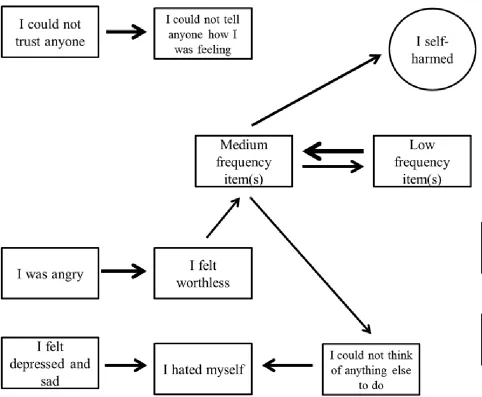
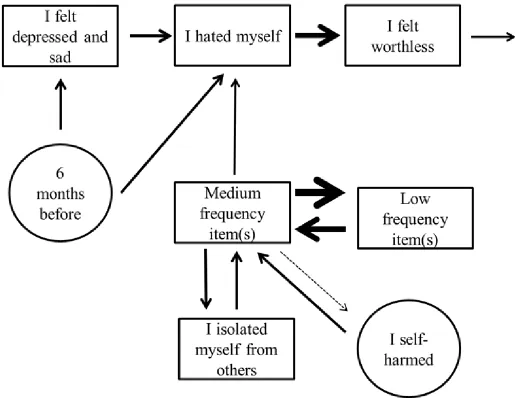
The significant transitions occurring between items (where SNRs > 2.0) in the self-harm sequences for LAC first episode, contrast first episode, LAC most recent episode and contrast most recent episode are presented in four state transition diagrams (Figures 1 to 4
respectively). Arrows represent links between two items (AB) which reached the critical
12 felt better after self-harm” followed “I self-harmed” in the card sort sequence more
frequently than expected by chance (SNR = 4.1, see Table S1 in the supplementary
materials). Transitions with larger SNRs are indicated by wider arrows and the SNRs are also given in the tables in the supplementary materials. Note that only items with significant transitions in the sequence analysis are included in the state transition diagrams, and this includes the pooled ‘medium frequency item(s)’ and ‘low frequency item(s)’ as single items.
Only the time stamp cards for ‘6 months before’ and ‘I self-harmed’ are included in the diagrams, and only when they shared a significant transition with another item.
Participant Characteristics
The looked-after group were aged between 14 and 21 years (M = 16.79) and the contrast group were aged between 13 and 21 years (M = 17.19). There were four male participants in the looked-after group and two in the contrast group. The majority of participants in the looked-after group (75%) and the contrast group (81%) were White British. Most participants were in further education (looked-after group 58.3%, contrast 47.6%), followed by secondary school (looked-after group 29.2%, contrast group 47.6%) and university (after group 4.2%, contrast group 28.3%). Two participants in the looked-after group were unemployed and one member of the contrast group was in employment.
Care Placements
The majority of looked-after participants (66.7%) reported first becoming
accommodated in care between the ages of 13 and 15 years, with the remainder reporting first being accommodated in care between the age of 0 and 9 years (29.2%, data missing for one participant). Half of the looked-after group had lived in between two and five care
13 residential care homes, five in foster care homes and one in supported accommodation) and eight care leavers (two in foster care homes, one in supported accommodation, two living with biological parents(s) and three living independently). Details on the participants’ legal status with regard to care orders were not available.
Results
Self-harm Type, Frequency and Onset
The age of first self-harm ranged between 7 and 16 years (M = 12.31) in the looked-after group and 10 and 15 years (M = 12.74) in the contrast group. On average, both groups had been self-harming for more than four years (looked-after group: range 1 to 13 years, M = 4.48; contrast group: range 1 to 10 years, M = 4.45). When asked about frequency of self-harm, most participants reported multiple episodes that fluctuated in frequency over the years, rather than providing an exact number of episodes. The self-harm methods that participants reported they had ever used are given in Table 2. The majority of participants in both groups reported self-cutting as a method that they had ever used (looked-after group, 95.8%; contrast group, 85.7%).
14 Around half the participants self-reported having received a diagnosis of a mental health condition (54.2% in the looked-after group and 47.6% in the contrast group), including depression, anxiety and eating disorders.
Frequency Analysis
We identified the most frequently used items in the CaTS, for the first and the most recent episodes of self-harm in the looked-after group and the contrast group. The remaining items were pooled as “medium frequency” and “low frequency”. This allowed us to best
capture the heterogeneity in the data whilst making the data analysis, interpretation and presentation manageable. The high frequency items used by the looked-after and the contrast group are shown in Table 3 (first episode of self-harm) and Table 4 (most recent episode of self-harm).
For the first and most recent episodes of self-harm, feelings of depression, sadness and self-hatred were frequently reported by both groups, although the young people also indicated that they could not tell anyone how they were feeling. Prior to the first time they self-harmed, many participants from both groups reported that they were not able to sleep and that they isolated themselves. The looked-after young people also frequently selected the items “I had access to the means to hurt myself” and “I felt better after self-harm”, whereas
the contrast group reported more negative thoughts and feelings prior to their first episode of self-harm.
15 not escape and not being afraid of death, along with access to means and the impulsiveness of the act of self-harm.
Sequence Analysis of First Self-harm Episode
The first episode self-harm sequences were analysed separately for the looked-after group and the contrast group using lag sequence analysis. The items included in the analysis were the high frequency items, the pooled medium and low frequency item(s) and the “6 months before” and “I self-harmed” time stamps.
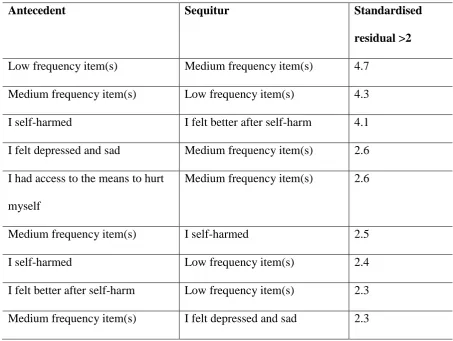
A chi square test indicated that the observed frequencies of consecutive card pairs (two-factor transitions) in the looked-after group data strings were significantly different from that expected by chance: χ2 (100) = 253.56, p <.001. Significant transitions in the sequences of first episode of self-harm in the looked-after group are given in Figure 1 (see also Table S1 in the supplementary materials). Medium frequency items preceded self-harm indicating a range of different factors were reported immediately prior to the first self-harm episode. Items with significant transitions to these medium frequency items were having access to means, and feeling depressed and sad. Looked-after young people also reported feeling better immediately after self-harm.
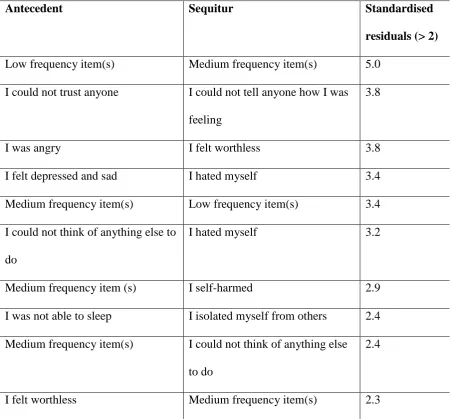
16 transition from not trusting anyone and not telling anyone suggests that young people are keeping these negative feelings to themselves. There was also a behavioural transition from sleep problems to isolating the self from others.
Sequence Analysis of Most Recent Self-harm Episode
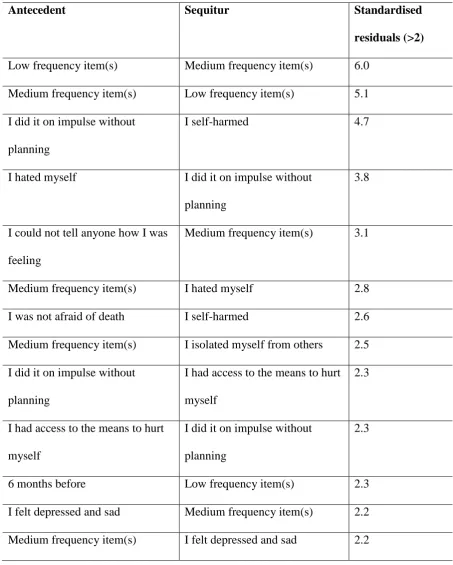
Sequence analysis of the most recent self-harm sequences indicated that the observed frequency of two-factor transitions was significantly different to that expected by chance in the looked-after group data (χ2 (144) = 349.17, p <.001) and the contrast group data (χ2 (144) = 348.64, p <.001). The significant transitions for the looked-after and the contrast group are given in the supplementary materials (Table S3 and Table S4 respectively).
The significant transitions in the sequences for the most recent episode of self-harm in the looked-after group are presented in Figure 3. Acting impulsively and not fearing death are reported immediately prior to self-harm, and having access to means and self-hatred occur just prior to acting impulsively to self-harm. Relevant factors reported up to six months before the self-harm are more heterogeneous, with low frequency items at six months leading to medium frequency items. These medium frequency items are linked to not being able to tell anyone about their feelings, along with feelings of depression and sadness. Generally, there were more significant transitions between a larger number of factors reported by the looked-after young people in relation to their most recent self-harm as compared to the first episode.
17 transitions immediately to self-harm emerged. Note that the transition to self-harm (from medium frequency item(s)) did not reach criterion but, as the immediate transition to self-harm is of key interest, it is represented in the state transition diagram as a broken line.
Emotional State Before and After the CaTS
The mean score on the emotional state VAS for the looked-after group before the session was 6.77 (SD = 2.02), and at the end of the session was 6.60 (SD = 1.83). The mean score for the contrast group before the session was 6.40 (SD = 2.11) and afterwards was 6.79 (2.03). Thus, scores were similar and towards the positive end of the scale. A significant change in emotional state after completing the CaTS was not indicated in either the looked-after group (t (23) = 0.65, p = .53) or the contrast group (t (20) = -1.42, p = .17).
Discussion
Feelings of depression, sadness and self-hatred were frequently identified as
important factors leading to self-harm (first and most recent episodes) by looked-after young people and young people with no experience of being in care. The prominence of negative emotions is notable, and in line with existing research on the function of self-harm as emotional regulation (Klonsky, 2009). Negative emotions were quite prominent in the most frequently used items in the self-harm sequences. A study using Ecological Momentary Assessment in young people with a history of NSSI found that individuals who reported self-injury during the study experienced increased negative affect prior to an episode of NSSI, and these changes in affect were apparent hours beforehand (Armey, Crowther, & Miller, 2011). Emphasising the emotional distress associated with self-harm is important, particularly given the ‘attention-seeking’ stigma potentially surrounding self-harm amongst caregivers and
18 For both episodes of self-harm, the contrast (not in care) group reported a wider range of negative thoughts and feelings than the looked-after (in care) group. It may be that young people in care remember their self-harm episodes in less detail, have difficulties in
identifying and labelling different emotions, or find it intolerable to think about or share their internal emotional world. In comparison, young people with no experience of being in care described unbearable emotional pain, worthlessness and burdensomeness. A recent
qualitative analysis of young people’s online discussion about attending emergency
departments for self-harm found that feelings of guilt, self-loathing and unworthiness were experienced, and that such feelings may prevent young people from seeking healthcare help (C. Owens, Hansford, Sharkey, & Ford, 2016).
Patterns of Self-harm in Young People in Care (Looked-after Young People)
The frequency analyses highlighted those factors that young people commonly reported as important in leading to self-harm. Sequence analysis allowed us to determine significant patterns in how thoughts, feelings, behaviours and events unfold over time in relation to an episode of self-harm. The sequence analysis of the first episode of self-harm in the looked-after group indicates that a range of medium frequency factors immediately preceded their first episode of self-harm. These heterogeneous factors are in turn preceded by having access to means; a salient issue for young people in care. Future research with larger samples of young people in care would allow further unpicking of this heterogeneity of factors immediately before self-harm.
19 behaviour. Firstly, having access to means and acting on impulse are regarded as factors associated with acting upon thoughts of suicide in the volitional phase of the integrated motivational-volitional model of suicidal behaviour (O’Connor, 2011). Adults who attempt suicide differ from those with suicidal thoughts in terms of fearlessness about death and impulsivity, as well as exposure to suicidal behaviour (Dhingra, Boduszek, & O'Connor, 2015). Furthermore, the emergence of fearlessness of death in more recent episodes of self-harm fits with the concept of acquired capability (that is, overcoming the natural instinct to stay alive and to engage with suicidal behaviours) in the interpersonal theory of suicidal behaviour (Joiner, 2005; Joiner et al., 2009).
Looked-after young people reported feeling better after the first episode of self-harm but by their most recent episode they reported that they were not afraid to die. This is
important: just because a young person initially indicates they self-harm to feel better does not mean that their motivations (including possible intention to die or not worrying about the possibility of accidental death in the process) will not change over time. Thus, young people in care should undergo regular monitoring and assessment of each self-harm episode.
conducted in line with evidence-based guidance (e.g. National Collaborating Centre for Mental Health commissioned by the National Institute for Health and Clinical Excellence, 2011). Moreover, appropriate support should be arranged early. Recent Cochrane reviews have shown that Dialectical Behavioural Therapy and Mentalisation Therapy may be helpful for young people who self-harm (Hawton et al., 2015), and that for those over the age of 18 years short-term Cognitive Behavioural Therapies help prevent repetition of self-harm and reduce symptoms of depression, hopelessness and suicide ideation (Hawton et al., 2016).
20 Gask, Hines, & Platt, 2013). Thus, looked-after young people’s access to potentially lethal means to self-harm should be restricted, if the young person has repeated self-harm and appears to be overcoming their fear of death. The care environments that young people can be placed in are diverse (foster, residential, secure and custodial, or care by family and friends) and restricting access to means is not without challenges, with difficulties with high turnover of staff in residential homes and potential tensions with the goal of developing a sense of belonging or ‘normality’ in care (Colton & Roberts, 2007).
Patterns of Self-harm in Young People Not in Care
The first episode of self-harm in young people not in care was somewhat similar to that of looked-after young people, with a variety of (medium frequency) factors immediately prior to self-harm. Feelings of worthlessness and anger were reported before these most proximal and varied factors. There was also a behavioural transition apparent prior to self-harm, whereby the young people have problems sleeping and isolate themselves from others. Adolescents with sleep difficulties are significantly more likely to report self-harm than adolescents without sleep problems (Hysing, Sivertsen, Stormark, & O'Connor, 2015), and social isolation is associated with self-harm and is a barrier to help-seeking (Wu, Chang, Huang, Liu, & Stewart, 2013). This is a pattern that could signal that a young person is having difficulties, and is thus a point to intervene and encourage help-seeking (bearing in mind the significant transition between mistrust and not telling anyone about their emotional distress). Using the CaTS in clinical settings could help young people broach the topic of self-harm and begin to communicate their emotional distress.
21 young people with no experience of being in care appear to report a range of negative
emotions months prior to self-harm. This raises the possibility that for a substantial period of time, young people are coping with extreme emotional distress, and possibly a depressive episode, without turning to self-harm. Future research could usefully examine what factors may play a role in delaying self-harm in this way.
Limitations
The transitions mapped out in the state transition diagrams represent significant cross-dependencies between two items as antecedent – sequitur pairings only. Any longer
sequences apparent in the first-order sequence diagrams must be interpreted with caution. We cannot state with confidence that a three-factor sequence ABC exists in the data, only that the inter-dependence between AB and BC are significant. Larger samples are
needed to provide sufficient data to explore longer sequences of factors, and would likely be illuminating. Larger samples would also allow for more items to be included in the sequence analyses and to further unpick the role of key factors (such as access to means and feeling better after self-harm) in relation to self-harm. For example, a larger sample would allow us to explore notable sequences occurring prior to self-harm at the specific time-points (e.g. one month/week/day/hour before self-harm).
The completion of the CaTS relied on retrospective recall of specific episodes of self-harm, some of which occurred several years prior to the task. The CaTS is in the early stages of development and further research could seek to address this issue by, for example,
22 exposure to early adversity including maltreatment was not available (in some cases the relevant services were unwilling to share this information despite appropriate ethical and governance approvals being in place, and also some participants self-referred themselves to the study from community settings). Furthermore, clinical information (e.g. diagnoses and interventions received) was self-reported. Future research utilising the CaTS would benefit from recruiting a larger sample of clinical participants in a more systematic way (e.g. a rolling recruitment strategy) in order to have a focused clinical sample and confirmation of relevant clinical and social care data. In addition, this recruitment strategy would allow us to further stratify the sample and better assess possible impacts of care histories, clinical diagnosis, potential sampling bias and the characteristics of non-responders.
There has been very little targeted research examining mental health and wellbeing in young people in public care. Significant barriers to improving evidence-based mental health care for looked-after young people have been reported and include frequent changes of placement, changes in social workers and lack of inter-agency cooperation (Richardson & Lelliott, 2003). Recruiting participants though Children’s Social Care was a significant challenge for the present study, as evidenced by the recruitment figures in Table 1. Steps were taken to address the widespread concern regarding the potential detrimental effect of taking part in self-harm research on a young person’s well-being. Previous research has found that asking questions about self-harm does not lower mood (Biddle et al., 2013). The pre- and post-emotional state ratings taken in our study also suggest the participants did not
experience a change in well-being through taking part in the research.
Conclusions
24
References
Armey, M. F., Crowther, J. H., & Miller, I. W. (2011). Changes in ecological momentary assessment reported affect associated with episodes of nonsuicidal self-injury. Behavior Therapy, 42, 579-588. doi: 10.1016/j.beth.2011.01.002
Bakeman, R., & Gottman, J. M. (1997). Observing interaction: An introduction to sequential analysis. Cambridge: Cambridge University Press.
Biddle, L., Cooper, J., Owen-Smith, A., Klineberg, E., Bennewith, O., Hawton, K., . . . Gunnell, D. (2013). Qualitative interviewing with vulnerable populations:
Individuals’ experiences of participating in suicide and self-harm based research.
Journal of Affective Disorders, 145, 356-362. doi: 10.1016/j.jad.2012.08.024
Brunner, R., Kaess, M., Parzer, P., Fischer, G., Carli, V., & Hoven, C. W. (2014). Life-time prevalence and psychosocial correlates of adolescent direct self-injurious behavior: A comparative study of findings in 11 European countries. Journal of Child Psychology and Psychiatry, 55, 337-348. doi: 10.1111/jcpp.1216
Callaghan, J., Young, B., Pace, F., & Vostanis, P. (2004). Evaluation of a new mental health service for looked-after children. Clinical Child Psychology & Psychiatry, 9, 130-148. doi: 10.1177/1359104504039177
Cole-King, A., Green, G., Gask, L., Hines, K., & Platt, S. (2013). Suicide mitigation: a compassionate approach to suicide prevention. Advances in Psychiatric Treatment, 19, 276-283. doi: 10.1192/apt.bp.110.008763
Colgan, P. W., & Smith, T. J. (1978). Multidimensional contingency table analysis. In P. W. Colgan (Ed.), Quantitative Ethology. New York: Wiley.
25 Department for Education. (2014). Children looked after in England (including adoption and
care leavers) year ending 31 March 2014. SFR 36/2014.
Dhingra, K., Boduszek, D., & O'Connor, R. C. (2015). Differentiating suicide attempters from suicide ideators using the Integrated Motivational-Volitional model of suicidal behavior. Journal of Affective Disorders, 186, 211-218. doi:
10.1016/j.jad.2015.07.007
Doyle, L., Treacy, M. P., & Sheridan, A. (2015). Self-harm in young people: Prevalence, associated factors, and help-seeking in school-going adolescents. International Journal of Mental Health Nursing, 24, 485-494. doi: 10.1111/inm.12144
Fergusson, D. M., & Lynskey, M. T. (1995). Childhood circumstances, adolescent adjustment, and suicide attempts in a New Zealand birth cohort. Journal of the American Academy of Child and Adolescent Psychiatry, 34, 612-622. doi:
10.1097/00004583-199505000-00013
Ford, T., Vostanis, P., Meltzer, H., & Goodman, R. (2007). Psychiatric disorder among British children looked Psychiatric disorder among British children looked after by local authorities: comparison with children living in private households. British Journal of Psychiatry, 190, 319-325. doi: 10.1192/bjp.bp.106.025023
Harkess-Murphy, E., Macdonald, J., & Ramsay, J. (2013). Self-harm and psychosocial characteristics of looked after and looked after and accommodated young people. Psychology, Health & Medicine, 18, 289-299. doi: 10.1080/13548506.2012.712706
Hawton, K., Bergen, H., Casey, D., Simkin, S., Palmer, B., Cooper, J., . . . Owens, D. (2007). Self-harm in England: a tale of three cities. Multicentre study of self-harm. Social Psychiatry and Psychiatric Epidemiology, 42, 513-521. doi:
26 Hawton, K., Bergen, H., Kapur, N., Cooper, J., Steeg, S., Ness, J., & Waters, K. (2011).
Repetition of self-harm and suicide following self-harm in children and adolescents. Journal of Child Psychology and Psychiatry, 53, 1212-1219. doi:
10.1111/j.1469-7610.2012.02559.x.
Hawton, K., Cole, D., O'Grady, J., & Osborn, M. (1982). Motivational aspects of deliberate self-poisoning in adolescents. The British Journal of Psychiatry,, 141, 286-291. doi: 10.1192/bjp.141.3.286
Hawton, K., K., R., Evans, E., & Weatherall, R. (2002). Deliberate self harm in adolescents: self report survey in schools in England. British Medical Journal, 325, 1207-1211. doi: 10.1136/bmj.325.7374.1207
Hawton, K., Saunders, K. E., & O’Connor, R. C. (2012). Self-harm and suicide in adolescents. The Lancet, 379, 2373–2382. doi: 10.1016/S0140-6736(12)60322-5 Hawton, K., Witt, K. G., Taylor Salisbury, T. L., Arensman, E., Gunnell, D., Hazell, P., . . .
van Heeringen, K. (2016). Psychosocial interventions for self-harm in adults. Cochrane Database of Systematic Reviews, 5. (Art. No.: CD012189). doi:
10.1002/14651858.CD012189
Hawton, K., Witt, K. G., Taylor Salisbury, T. L., Arensman, E., Gunnell, D., Townsend, E., . . . Hazell, P. (2015). Interventions for self-harm in children and adolescents.
Cochrane Database of Systematic Reviews, 12(Art. No.: CD012013). doi:
10.1002/14651858.CD012013
27 Howe, D., & Fearnley, S. (2003). Disorders of attachment in adopted and fostered children:
recognition and treatment. Clinical Child Psychology and Psychiatry, 8, 369-387. doi:10.1177/1359104503008003007
Hysing, M., Sivertsen, B., Stormark, K. M., & O'Connor, R. C. (2015). Sleep problems and self-harm in adolescence. British Journal of Psychiatry, 207, 306-312. doi:
10.1192/bjp.bp.114.146514
Johnson, J. G., Cohen, P., Gould, M. S., Kasen, S., Brown, J., & Brook, J. S. (2002).
Childhood adversities, interpersonal difficulties, and risk for suicide attempts during late adolescence and early adulthood. Archives of General Psychiatry, 59, 741-749. doi:10.1001/archpsyc.59.8.741
Joiner, T. (2005). Why people die by suicide. Harvard: Harvard University Press.
Joiner, T., Van Orden, K., Witte, T., Selby, E., Ribeiro, J., Lewis, R., & Rudd, M. D. (2009). Main predictions of the interpersonal-psychological theory of suicidal behavior: Empirical tests in two samples of young adults. Journal of Abnormal Psychology, 118, 634-646. doi: 10.1037/a0016500
Katz, L. Y., Au , W., Singal, D., Brownell, M., Roos, N., Martens, P. J., . . . Sareen, J. (2011). Suicide and suicide attempts in children and adolescents in the child welfare system. Canadian Medical Association Journal, 22, 1977-1981. doi: 10.1503/cmaj.110749
Keatley, D.A., Barsky, A.D. & Clarke, D.D. (2017). Driving under the influence of alchohol: a sequence analysis approach. Crime & Law, 23, 135-146. doi:
10.1080/1068316X.2016.1228933
28 Law, G., Rostill-Brookes, H., & Goodman, D. (2009). Public stigma in health and
non-healthcare students: Attributions, emotions and willingness to help with adolescent self-harm. International Journal of Nursing Studies, 46, 108–119. doi:
10.1016/j.ijnurstu.2008.08.014
Lawrence, C., Fossi, J. J., & Clarke, D. (2010). A sequential examination of offenders' verbal strategies during stranger rapes: the influence of location. Psychology, Crime & Law, 16, 381-400. doi: 10.1080/10683160902754964
Madge, N., Hawton, K., McMahon, E. M., Corcoran, P., De Leo, D., de Wilde, E. J., . . . Arensman, E. (2011). Psychological characteristics, stressful life events and deliberate self-harm: findings from the Child & Adolescent Self-harm in Europe (CASE) Study. European Child and Adolscent Psychiatry, 20, 499-508.
doi:10.1007/s00787-011-0210-4
Madge, N., Hewitt, A., Hawton, K., de Wilde, E. J., Corcoran, P., Fekete, S., . . . Ystgaard, M. (2008). Deliberate self-harm within an international community sample of young people: comparative findings from the Child & Adolescent Self-harm in Europe (CASE) Study. Journal of Child Psychology and Psychiatry, 49, 667-677. doi: 10.1111/j.1469-7610.2008.01879
Meltzer, H., Gatward, R., Corbin, T., Goodman, R., & Ford, T. (2003). The mental health of young people by local authorities in England: TSO (The Stationery Office).
National Collaborating Centre for Mental Health commissioned by the National Institute for Health and Clinical Excellence. (2011). Self-harm: longer-term management (Vol. National Clinical Guideline Number 133). London: The British Psychological Society and the Royal College of Psychiatrists,.
29 disorders and suicidal behavior: findings from the WHO World Mental Health
Surveys. PLoS Med, 6. doi: 10.1371/journal.pmed.1000123
Nock, M. K., Prinstein, M. J., & Sterba, S. K. (2009). Revealing the form and function of self-injurious thoughts and behaviors: A real-time ecological assessment study among adolescents and young adults. Journal of Abnormal Psychology, 118, 816-827. doi: 10.1037/a0016948
O'Connor, R. C., Rasmussen, S., & Hawton, K. (2009). Predicting deliberate self-harm in adolescents: a six month prospective study. Suicide and Life Threatening Behavior, 39, 364-375. doi: 10.1521/suli.2009.39.4.364.
O'Connor, R. C., Rasmussen, S., Miles, J., & Hawton, K. (2009). Self-harm in adolescents: self-report survey in schools in Scotland. British Journal of Psychiatry, 194, 68-72. doi: 10.1192/bjp.bp.107.047704
O’Connor, R. C. (2011). The integrated motivational-volitional model of suicidal behavior.
Crisis, 32, 295-298. doi: 10.1027/0227-5910/a000120
Owens, C., Hansford, L., Sharkey, S., & Ford, T. (2016). Needs and fears of young people presenting at accident and emergency department following an act of self-harm: secondary analysis of qualitative data. The British Journal of Psychiatry, 208, 286-291. doi: 10.1192/bjp.bp.113.141242
Owens, D., Horrocks, J., & House, A. (2002). Fatal and nonfatal repetition of self-harm: Systematic review. British Journal of Psychiatry, 181, 193-199. doi:
10.1192/bjp.181.3.193
30 Rees, P. (2013). The mental health, emotional literacy, cognitive ability, literacy attainment
and ‘resilience’ of ‘looked after children’: A multidimensional, multiple-rater
population based study. British Journal of Clinical Psychology, 52, 183–198. doi: 10.1111/bjc.12008
Richardson, J., & Lelliott, P. (2003). Mental health of looked after children. Advances in Psychiatric Treatment, 9, 249-251. doi: 10.1192/apt.9.4.249
Stanley, N., Riordan, D., & Alaszewski, H. (2005). The mental health of looked after children: matching response to need. Health and Social Care in the Community, 13, 239-248. doi: 10.1111/j.1365-2524.2005.00556.x
Storey, P., Hurry, J., Jowitt, S., Owens, D., & House, A. (2005). Supporting young people who repeatedly self-harm. Journal of the Royal Society for the Promotion of Health, 125, 71-75. doi: 10.1177/146642400512500210
Tarren-Sweeney, M. (2008). Retrospective and concurrent predictors of the mental health of children in care. Children and Youth Services Review, 30, 1-25. doi:
10.1016/j.childyouth.2007.05.014
Tarren-Sweeney, M. (2013). An investigation of complex attachment- and trauma-related symptomatology among children in foster and kinship care. Child Psychiatry and Human Development, 44, 717-741. doi: 10.1007/s10578-013-0366-x
Taylor, O., Keatley, D.A. & Clarke, D.D. (2017). A behavior sequence analysis of
perceptions of alcohol-related violence surrounding drinking establishments. Journal of Interpersonal Violence. doi: 10.1177/0886260517702490.
Townsend, E., Ness, J., Waters, K., Kapur, N., Turnbull, P., Cooper, J., . . . K., H. (2016). Self-harm and life problems: findings from the Multicentre Study of Self-harm in England. Social Psychiatry and Psychiatric Epidemiology,, 51, 183-192.
31 Townsend, E., Wadman, R., Sayal, K., Armstrong, M., Harroe, C., Majumder, P., . . . Clarke,
D. (2016). Uncovering key patterns in self-harm in adolescents: Sequence analysis using the Card Sort Task for Self-harm (CaTS). Journal of Affective Disorders, 206, 161-168. doi: 10.1016/j.jad.2016.07.004
Turner, B. J., Cobb, R. J., Gratz, K. L., & Chapman, A. L. (2016). The role of interpersonal conflict and perceived social support in nonsuicidal self-injury in daily life. Journal of Abnormal Psychology, 125, 588-598. doi: 10.1037/abn0000141
Vinnerljung, B., Hjern, A., & Lindblad, F. (2006). Suicide attempts and severe psychiatric morbidity among former child welfare clients--a national cohort study. Journal of Child Psychology and Psychiatry, 47, 723-733. doi:
10.1111/j.1469-7610.2005.01530.x
32 Table 1. Number of participants recruited from clinical service, social services and in the community
Recruitment setting Looked-after group % (n) Contrast group % (n)
Clinical services (CAMHS) 33.3% (8) 33.3% (7)
Children’s Social Care 25.0% (6) 0.0% (0)
Community (including online) 41.7% (10) 66.7% (14)
33 Table 2. Self-harm methods (ever used) reported by participants
Self-harm method (ever
used)
Looked-after
group % (freq)
Contrast group %
(freq)
Total % (freq)
Cutting 95.8% (23) 85.7% (18) 91.1% (41)
Overdose 62.5% (15) 57.1% (12) 60.0% (27)
Scratching 41.7% (10) 47.6% (10) 44.4% (20)
Punching self or a wall/window
37.5% (9) 28.6% (6) 33.3% (15)
Banging head 25.0% (6) 38.1% (8) 31.1% (14)
Burning 20.8% (5) 42.9% (9) 31.1% (14)
Biting 29.2% (7) 19.0% (4) 24.4% (11)
Preventing wounds from healing
20.8% (5) 23.8% (5) 22.2% (10)
Sticking sharp objects into self
16.7% (4) 23.8% (5) 20.0% (9)
Pulling out hair 12.5% (3) 19.0% (4) 15.5% (7)
Rubbing glass on to skin 12.5% (3) 9.5% (2) 11.1% (5)
Poisoning self 8.3 (2) 14.3% (3) 11.1% (5)
Rubbing sandpaper over skin
0% (0) 0% (0) 0% (0)
Using bleach to scrub skin 0.0% (0) 0.0% (0) 0% (0)
Breaking bones 0.0% (0) 0.0% (0) 0% (0)
34 Table 3. High frequency items describing first episode of self-harm
Looked-after group Contrast group
Item/card Frequency Item/card Frequency
I could not tell anyone how I was feeling
16 I felt depressed and sad 19
I isolated myself from others 15 I hated myself 17
I felt depressed and sad 13 I felt worthless 15
aI had access to the means to
hurt myself
13 I could not trust anyone 14
I hated myself 11 I could not tell anyone how I was feeling
14
I was not able to sleep 11 I could not think of anything else to do
13
aI felt better after self-harm 11 I was angry 13
I was not able to sleep 13 I isolated myself from others 13 aHigh frequency items unique to looked-after group
Note. The item ‘I felt better after self-harm’ fell just below the threshold for high frequency items in the contrast group (frequency 12) and ‘I had access to the means to hurt myself’ was
35 Table 4. High frequency items describing most recent episode of self-harm
Looked-after group Contrast group
Item/card Frequency Item/card Frequency
I felt depressed and sad 19 I felt depressed and sad 19 aI could not tell anyone how I
was feeling
18 I felt like a burden on people 17
aI was not able to sleep 16 I felt very hopeless about the
future
17
I isolated myself from others 16 I hated myself 16 aI felt I could not escape from
feelings or situations
15 The mental pain was unbearable
15
aI did it on impulse without
planning
15 I felt worthless 15
aI was not afraid of death 14 I isolated myself from others 15
I hated myself 13 I could not think of anything else to do
14
aI had access to the means to
hurt myself
13 I felt exhausted 14
aHigh frequency items unique to looked-after group
Note. The item ‘I felt better after self-harm’ was used with medium frequency in both groups (LAC group frequency 12; contrast group frequency 7). The ‘access to means’ item was just
Table S1. Significant two-item transitions for first episode of self-harm in looked-after group
Antecedent Sequitur Standardised
residual >2
Low frequency item(s) Medium frequency item(s) 4.7 Medium frequency item(s) Low frequency item(s) 4.3 I self-harmed I felt better after self-harm 4.1 I felt depressed and sad Medium frequency item(s) 2.6 I had access to the means to hurt
myself
Medium frequency item(s) 2.6
Medium frequency item(s) I self-harmed 2.5
I self-harmed Low frequency item(s) 2.4
Table S2. Significant two-item transitions for first episode of self-harm in contrast group
Antecedent Sequitur Standardised
residuals (> 2)
Low frequency item(s) Medium frequency item(s) 5.0 I could not trust anyone I could not tell anyone how I was
feeling
3.8
I was angry I felt worthless 3.8
I felt depressed and sad I hated myself 3.4
Medium frequency item(s) Low frequency item(s) 3.4 I could not think of anything else to
do
I hated myself 3.2
Medium frequency item (s) I self-harmed 2.9
I was not able to sleep I isolated myself from others 2.4 Medium frequency item(s) I could not think of anything else
to do
2.4
I felt worthless Medium frequency item(s) 2.3
Table S3. Significant two-item transitions for most recent episode of self-harm in looked-after group
Antecedent Sequitur Standardised
residuals (>2)
Low frequency item(s) Medium frequency item(s) 6.0 Medium frequency item(s) Low frequency item(s) 5.1
I did it on impulse without planning
I self-harmed 4.7
I hated myself I did it on impulse without planning
3.8
I could not tell anyone how I was feeling
Medium frequency item(s) 3.1
Medium frequency item(s) I hated myself 2.8
I was not afraid of death I self-harmed 2.6
Medium frequency item(s) I isolated myself from others 2.5 I did it on impulse without
planning
I had access to the means to hurt myself
2.3
I had access to the means to hurt myself
I did it on impulse without planning
2.3
6 months before Low frequency item(s) 2.3
Table S4. Significant two-item transitions for most recent episode of self-harm in contrast group
Antecedent Sequitur Standardised
residuals (> 2)
Medium frequency item(s) Low frequency item(s) 6.5 Low frequency item(s) Medium frequency item(s) 5.5
I hated myself I felt worthless 5.0
I felt depressed and sad I hated myself 2.9
I isolated myself from others Medium frequency item(s) 2.5
6 months before I hated myself 2.5
Medium frequency item(s) I isolated myself from others 2.3
6 months before I felt depressed and sad 2.3
I self-harmed Medium frequency item(s) 2.3
I felt worthless The mental pain was unbearable 2.1
Medium frequency item(s) I hated myself 2.1
Medium frequency item(s) I self-harmed 1.1
Note. The transition to self-harm (from medium frequency item(s)) did not reach SNR