Systematic review protocol
Protocol for a prospective collaborative systematic review and meta-analysis of individual patient data from randomised controlled trials of vasoactive drugs in acute stroke: the Blood pressure in Acute Stroke Collaboration, stage-3 (BASC-3)
The Blood pressure in Acute Stroke Collaboration Investigators * See Acknowledgement section
Corresponding author: Professor Philip Bath Stroke Trials Unit
Division of Clinical Neurosciences University of Nottingham
City Hospital campus Nottingham NG5 1PB UK
Tel: 0115 823 1765 Fax: 0115 823 1767
Email: [email protected]
Word count abstract: 249 Word count body: 3757 Tables: 1
Key words: Acute stroke; blood pressure lowering; hypertension; intracerebral haemorrhage; ischaemic stroke; modified Rankin Scale
Writing Committee
Else Charlotte Sandset1, Nerses Sanossian2, Lisa J Woodhouse3, Craig Anderson4, Eivind Berge5, Kennedy R Lees6, John F Potter7, Thompson G Robinson8, Nikola Sprigg3, Joanna M Wardlaw9, Philip M Bath3
Contact details for Writing Committee
ABSTRACT
Rationale
Despite several large clinical trials assessing blood pressure lowering in acute stroke, equipoise remains, particularly for ischaemic stroke. The ‘Blood pressure in Acute Stroke Collaboration’ (BASC) commenced in the mid 1990s focusing on systematic reviews and meta-analysis of blood pressure lowering in acute stroke. From the start, BASC planned to assess safety and efficacy of blood pressure lowering in acute stroke using individual patient data.
Aims
To determine the optimal management of blood pressure in patients with acute stroke, encompassing both intracerebral haemorrhage and ischaemic stroke. Secondary aims are to assess which clinical and therapeutic factors may alter the optimal management of high blood pressure in patients with acute stroke and to assess the effect of vasoactive treatments on haemodynamic variables.
Methods and design
Individual patient data from randomised controlled trials of blood pressure
management in participants with ischaemic stroke and/or intracerebral haemorrhage enrolled during the ultra-acute (pre-hospital), hyper-acute (<6 hours), acute (<48 hours) and sub-acute (<168 hours) phases of stroke.
Study outcomes
The primary effect variable will be functional outcome defined by the ordinal distribution of the modified Rankin Scale; analyses will also be carried out in prespecified subgroups to assess the modifying effects of stroke-related and pre-stroke patient characteristics. Key secondary variables will include clinical,
haemodynamic and neuroradiological variables; safety variables will comprise death and serious adverse events.
Discussion
Study questions will be addressed in stages, according to the protocol, before
INTRODUCTION AND RATIONALE
High blood pressure is common in both acute ischaemic stroke and primary intracerebral haemorrhage, and is associated independently with poor short- and long-term outcome (1, 2). There is general agreement on intensive lowering of elevated blood pressure in intracerebral haemorrhage, as reflected in international guidelines based on the results of the INTERACT-2 trial (3-5); following publication of the neutral results of the ATACH-2 trial(6), guidelines have been further updated. Despite results of large clinical trials (7-9), equipoise remains regarding the question of whether to treat or not to treat blood pressure in patients with ischaemic stroke. Systematic reviews of trials of blood pressure management have been performed using published summary data and these suggest that lowering blood pressure in the first few hours after ischaemic stroke might be most effective (10). However, such meta-analyses neither allow effects to be assessed easily in subgroups nor multiple variable analyses. In contrast, meta-analyses using individual patient data facilitate these and are considered to be the gold-standard (11). Additional questions also need addressing, including the management of blood pressure before, during and after reperfusion therapies such as intravenous thrombolysis and mechanical
thrombectomy.
AIMS AND METHODS
The Blood Pressure in Acute Stroke Collaboration (BASC)
The BASC project commenced in the mid-1990s. Early work focused on developing systematic reviews and meta-analyses based on summary (group) data and these were published in the Cochrane Database of Systematic Reviews. The first review (2001) identified randomised controlled trials specifically aiming to alter blood pressure (BASC-1) and was followed by a wider review that included all trials involving a vasoactive drug, whether or not this was given to alter blood pressure (BASC-2). At this stage, there were insufficient data to lead to definitive conclusions on the management of blood pressure in acute stroke. These reviews have been updated periodically (10, 12).
It was always intended that a third phase (BASC-3) would be based on individual patient data (IPD), and data were shared with the collaboration through to 2003. Since then, several larger clinical trials have been published and a detailed update is now warranted. The collaborative group consists of leading international investigators of individual clinical trials.
The results will be published under the banner of BASC Collaborators, where allowed by journals. Collaborators will be listed in the appendix by trial. The papers will be written by a Publication Committee and then distributed to all Collaborators for
comment, interpretation, changes and additions. Shared data will not be used for any purpose other than in collaborator-approved BASC analyses.
Objectives
The overall objective of BASC is to determine the optimal management of blood pressure in patients with acute stroke. Specific objectives are:
1. To determine the optimal management of high blood pressure in patients with acute intracerebral haemorrhage.
2. To determine the optimal management of high blood pressure in patients with acute ischaemic stroke.
3. To assess which factors may alter the optimal management of high blood pressure in patients with acute stroke.
4. To assess effects of different strategies (target blood pressure, intervention classes), and continuing versus stopping pre-stroke antihypertensive therapy. 5. To assess the effect of vasoactive treatment on haemodynamic measures. 6. To assess the effect of vasoactive treatment on neuroimaging outcomes. 7. To increase understanding of the hypertensive response in acute stroke.
Eligible Studies
Randomised controlled trials of blood pressure management in acute stroke will be included involving participants with ischaemic stroke and/or intracerebral
haemorrhage, and covering the ultra-acute (pre-hospital), hyper-acute (<6 hours), acute (<48 hours) and sub-acute (<168 hours) phases of stroke. Trials will be sought using electronic searches (Cochrane Library, EMBASE, PubMed and Web of Science) and in the reference lists of published systematic reviews and ad hoc reviews. Studies that have provisional investigator agreement for inclusion in BASC-3 are listed in the supplemental table.
Data sharing
and predefined and appropriate use of data according to this BASC protocol. Data will be shared electronically, and stored on password-protected, encrypted hard disks in a locked room, with daily backup facilitating disaster recovery.
Baseline variables Clinical data will include:
Demographic: Age, sex, country of recruitment, pre-morbid mRS
Medical history: Vascular risk factors
Haemodynamic parameters: systolic/diastolic blood pressure, heart rate, measures of variability
Stroke: type (ischaemic stroke, intracerebral haemorrhage, stroke mimics), severity (stroke scale), syndrome, level of consciousness (Glasgow Coma Scale)
Blood pressure treatment: time from onset to randomisation (as a surrogate for time to treatment), strategy (target blood pressure, intervention class), route of administration
Imaging data will be collected from trials where this is available to assess acute stroke lesion characteristics:
Ischaemic stroke: infarct visibility, severity of attenuation change, extent, location, mass effect, intravascular thrombus, haemorrhagic transformation
Intracerebral haemorrhage: location, size, presence of intraventricular or subarachnoid blood
Both: pre-existing changes - brain atrophy, white matter lesions, prior stroke lesions
STUDY OUTCOMES
Primary outcome
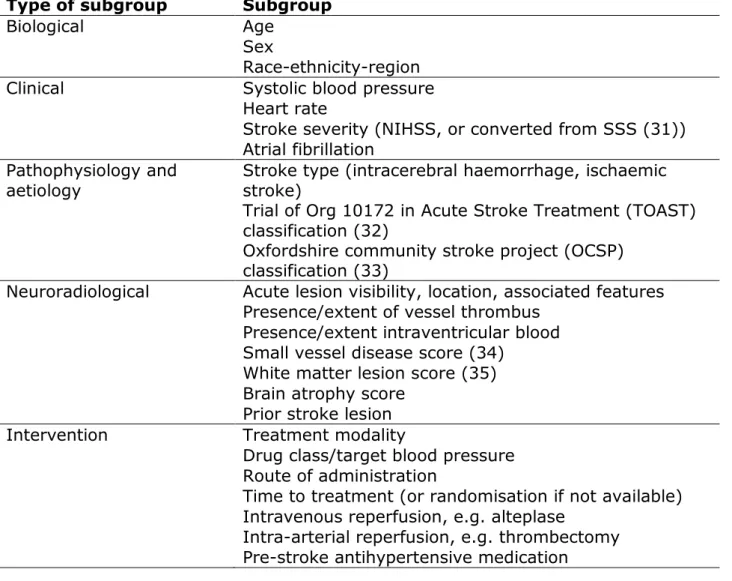
The primary effect variable will be functional outcome defined by the ordered distribution of the modified Rankin Scale (mRS) at the end of trial follow-up (3 or 6 months). In the case of missing data, the last recorded score will be carried forward. Analyses will be carried out in the entire study population and then in prespecified subgroups, as identified in Table 1. Patients without available data, and where the above procedure for missing data cannot be applied, will be excluded from analyses. However, sensitivity analyses will use complete data based on multiple imputation where end-of-trial mRS is missing.
Secondary outcomes
The effect of blood pressure lowering treatment on secondary outcome variables will also be studied:
Clinical parameters
Death or dependency at the end of follow-up (mRS 3-6)
Death or neurological deterioration (increase in NIHSS by >=4 points, or decrease in Glasgow Coma Scale by >=2 points (13)) at end of treatment
Death at end of treatment
Vascular death at end of follow-up (as defined by each individual trial)
Recurrent stroke (as defined by each individual trial)
Symptomatic hypotension (as defined by each individual trial)
Symptomatic hypertension (as defined by each individual trial)
Haemodynamic measures
Diastolic blood pressure (DBP)
Mean arterial pressure (MAP)
Pulse pressure (PP = SBP-DBP)
Systolic blood pressure variability (SBPV = standard deviation for SBP)
Systolic blood pressure variability index (SBPVI = SBPV/SBP)
Heart rate (HR)
Heart rate variability (HRV = standard deviation for HR)
Heart rate variability index (HRVI = HRV/HR)
Rate pressure product (RPP = SBP x HR)
Safety outcomes
Serious adverse events
o Deep vein thrombosis or pulmonary embolism o Headache
o Myocardial infarction o Pneumonia
o Renal events
Radiological outcomes during or at end of treatment
Acute changes, IS: Infarct volume, mass effect, hyperdense artery
Acute changes, ICH: Haematoma volume, perihaematoma oedema, mid-line shift, spot sign (if angiography)
General: Atrophy score, previous stroke lesions, white matter hyperintensity
Proposed stages of BASC-3
The analyses will be carried out in consecutive stages addressing specific study questions, before integrating these into a final overarching analysis. Individual statistical analysis plans for each stage will be finalised and published before data analysis. Trials for inclusion are listed in the Supplemental Table.
1. Nitric oxide donors in acute stroke. To assess safety and efficacy of nitric oxide donors in acute stroke. This work has been published (14) and will be updated once ongoing trials (15) have reported.
2. Continuation versus stopping pre-stroke antihypertensive therapy. To assess safety and efficacy of continuation versus stopping pre-stroke antihypertensive therapy in acute stroke. This work has been published (16).
3. Primary intracerebral haemorrhage. To assess safety and efficacy of blood pressure lowering in patients with primary intracerebral haemorrhage. The analyses will include data from trials focussing on ICH alone, and ICH patients in trials studying a mixed population of stroke.
4. Acute ischaemic stroke patients receiving thrombolysis. To assess safety and efficacy of blood pressure lowering in patients who receive thrombolysis. The analyses will include patient data from trials where thrombolysis was administered before blood pressure lowering, where thrombolysis was administered in parallel with blood pressure lowering, and where thrombolysis was administered after blood pressure lowering.
5. Ischaemic stroke. To assess safety and efficacy of blood pressure lowering in patients with ischaemic stroke. The analyses will include data from trials focussing on ischaemic stroke alone, and ischaemic stroke patients in trials studying a mixed population of stroke.
Crosscutting neuroimaging theme
Of relevance to all of the above questions will be assessment of baseline brain scans (CT or MRI) and, where available, on-treatment neuroimaging. Although much work has already been published on these for individual trials (e.g. (17-19)), aggregation of data will provide additional statistical power, especially in subgroups. Such analyses will be facilitated by the commonality of data collected across the trials.
Statistical analysis
A full statistical analysis plan is not given here because of the multi-phasic nature of this programme of work. The analyses will be performed using the intention-to-treat dataset from each trial, as defined by each individual trial. Initial internal analyses will compare baseline and outcome data from each trial with their published results to ensure that data are complete and transferred without error. Baseline characteristics will also be compared between individual trials to identify differences in patient
characteristics. Since individual trial results have already been published, results from analysis of individual trials will not be identifiable in BASC publications.
The primary effect variable (mRS) will be analysed using ordinal logistic regression; the assumption of proportionality of odds will be tested using the likelihood ratio test. Mixed effect analyses will be performed with adjustment for key baseline variables including age, sex, pre-morbid mRS, stroke type (ischaemic, haemorrhagic), stroke severity, stroke syndrome, systolic blood pressure, and time from stroke onset to randomisation; the source trial will be added as a random effect. For completeness, unadjusted analyses will also be performed. Analyses will be performed in key
subgroups, as listed in Table 1, with addition of an interaction term to a mixed-effects OLR model. Subgroup analyses will include tests for heterogeneity by adding an
interaction term into the adjusted ordinal logistic regression model. The effect of time from onset to treatment on potential efficacy (mRS) and hazard (death) will be
assessed using a multiple variable regression model, as used previously for alteplase, thrombectomy and glyceryl trinitrate (14, 20, 21). Since each phase of the
programme is likely to be analysed only once or twice, adjustment for multiple repeat analyses, as proposed for thrombectomy (22), will not be performed.
DISCUSSION
Phase III of the Blood Pressure in Acute Stroke Collaboration (BASC) will use pooled individual patient data from completed randomised controlled trials to address the role of blood pressure management in the acute phase of stroke. Conflicting results from multiple clinical trials indicate that blood pressure reduction is not a straightforward question of whether to treat or not. Rather, this problem is complex and needs to take account of patient characteristics, physiological parameters including baseline blood pressure, stroke type, timing of treatment, strategy and class of antihypertensive agent, route of administration, and dose or target blood pressure. The question of whether or not to reduce blood pressure in stroke has been debated for decades. Observational data have indicated consistently that acute elevation in blood pressure is common in stroke (75% of IS and 80% of ICH), is usually present during the first 24 hours, and is often self-limiting (2). Further, high blood pressure is a poor
prognostic sign for all stroke types and subtypes.
For ICH, elevated baseline systolic blood pressure is associated with haematoma expansion (23), perihaematoma oedema formation (24), and increased mortality (25). There is increasing evidence that intensive lowering of blood pressure reduces haematoma enlargement (26), is safe and tolerable, does not alter cerebral blood flow (27), and decreases rates of neurological deterioration. Current guidelines recommend lowering blood pressure early in the course after ICH and that targeting a goal of SBP<140 mmHg is probably safe in patients presenting with a SBP of 150 to 220 mm Hg (4, 5). Nevertheless, the neutral findings of ATACH-2 (6) emphasise that
re-appraisal of all published data is again required. Although guidelines recognise the need for very early treatment, none address the role of pre-hospital blood pressure reduction.
In ischaemic stroke, the rationale for lowering blood pressure is based on associations of acute high blood pressure with early recurrence and late death and dependency (2). It has been argued that high BP protects the brain by preserving ischaemic penumbra and that antihypertensive therapy may reduce cerebral perfusion, leading to poor outcomes. Elevated BP in the setting of failed autoregulation may maintain cerebral perfusion, but comes at the cost of increased cerebral oedema and
haemorrhagic transformation. Clinical studies have shown mixed results, in part differentiated by drug class: whilst trials of angiotensin receptor antagonists, ß-receptor antagonists and first-generation calcium channel blockers were negative, studies of enalapril and glyceryl trinitrate were neutral (7, 28, 29). Provisional evidence suggests that glyceryl trinitrate given within 4-6 hours might be beneficial (8, 30), as is being tested prospectively (15). Hence, whether to lower blood pressure per se may not be the relevant question in IS; rather, it may be what is the
appropriate agent and timing in which to do so, and can this be done without compromising cerebral blood flow.
Furthermore, the influence of patient characteristics that are present prior to the ICH or ischaemic stroke on BP lowering interventions is unknown, although these same variables are known to worsen long term recovery after both ICH and ischaemic stroke. These include having a prior stroke, white matter lesions or brain atrophy.
The Blood Pressure in Acute Stroke Collaboration is an ongoing international
which subjects were randomised to blood pressure treatment versus control in the acute phase of stroke.
ACKNOWLEDGEMENT
The paper is written on behalf of the Blood pressure in Acute Stroke Collaboration (BASC, convener P Bath). BASC comprises:
ATACH-2: Adnan I. Qureshi, Yuko Palesch CATIS: Jiang He, Yonghong Zhang
CHHIPS: John Potter COSSACS: Tom Robinson ENCHANTED: Craig Anderson
ENOS: Philip M Bath, Nikola Sprigg, Joanna M Wardlaw FAST-Mag: Jeff Saver, Nerses Sanossian
GTN-1/2/3, RIGHT: Philip M Bath ICH-ADAPT: Ken Butcher
IMAGES: Kennedy R Lees, Keith W Muir INTERACT: Craig Anderson
INTERACT-2: Craig Anderson, Hisatomi Arima PILFAST: Gary Ford
SCAST: Eivind Berge, Else Charlotte Sandset STAR: Nikola Sprigg
VENUS: Janneke Horn
Funding
BASC has not received specific grants from any funding agency in the public,
commercial, or not-for-profit sectors. Potential trials for inclusion have reported their own funding. PMB is Stroke Association Professor of Stroke Medicine. PMB and TGR are NIHR Senior Investigators.
Competing Interests
All authors declare: no support from any organisation for the submitted work; no financial relationships with any organisations that might have an interest in the submitted work in the previous three years; and no other relationships or activities that could appear to have influenced the submitted work.
Ethical Approval
BASC will utilise anonymised data from completed published trials, in particular
REFERENCES
1. Qureshi AI, Ezzeddine MA, Nasar A, et al. Prevalence of elevated blood pressure in 563,704 adult patients with stroke presenting to the ED in the United States. Am J Emerg Med 2007;25(1):32-8.
2. Leonardi-Bee J, Bath PM, Phillips SJ, Sandercock PA, Group ISTC. Blood pressure and clinical outcomes in the International Stroke Trial. Stroke
2002;33(5):1315-20.
3. Anderson CS, Heeley E, Huang Y, et al. Rapid blood-pressure lowering in patients with acute intracerebral hemorrhage. N Engl J Med 2013;368(25):2355-65. 4. Steiner T, Al-Shahi SR, Beer R, et al. European Stroke Organisation (ESO) guidelines for the management of spontaneous intracerebral hemorrhage. Int J Stroke 2014.
5. Hemphill JC, 3rd, Greenberg SM, Anderson CS, et al. Guidelines for the Management of Spontaneous Intracerebral Hemorrhage: A Guideline for Healthcare Professionals From the American Heart Association/American Stroke Association. Stroke 2015;46(7):2032-60.
6. Qureshi AI, Palesch YY, Barsan WG, et al. Intensive Blood-Pressure Lowering in Patients with Acute Cerebral Hemorrhage. N Engl J Med 2016;375(11):1033-43. 7. Sandset EC, Bath PM, Boysen G, et al. The angiotensin-receptor blocker
candesartan for treatment of acute stroke (SCAST): a randomised, placebo-controlled, double-blind trial. Lancet 2011;377(9767):741-50.
8. Investigators ET, Bath PM, Woodhouse L, et al. Efficacy of nitric oxide, with or without continuing antihypertensive treatment, for management of high blood
pressure in acute stroke (ENOS): a partial-factorial randomised controlled trial. Lancet 2015;385(9968):617-28.
9. He J, Zhang Y, Xu T, et al. Effects of Immediate Blood Pressure Reduction on Death and Major Disability in Patients With Acute Ischemic Stroke: The CATIS Randomized Clinical Trial. JAMA 2014;311(5):479-89.
10. Bath PM, Krishnan K. Interventions for deliberately altering blood pressure in acute stroke. Cochrane Database Syst Rev 2014;10:CD000039.
11. Clarke MJ, Stewart LA. Obtaining data from randomised controlled trials: how much do we need for reliable and informative meta-analyses? BMJ
1994;309(6960):1007-10.
13. Anderson CS, Heeley E, Huang Y, et al. Rapid blood-pressure lowering in patients with acute intracerebral hemorrhage. N Engl J Med 2013;368(25):2355-65. 14. Bath PM, Woodhouse L, Krishnan K, et al. Effect of Treatment Delay, Stroke Type, and Thrombolysis on the Effect of Glyceryl Trinitrate, a Nitric Oxide Donor, on Outcome after Acute Stroke: A Systematic Review and Meta-Analysis of Individual Patient from Randomised Trials. Stroke Res Treat 2016;2016:9706720.
15. Appleton JP, Scutt P, Dixon M, et al. Ambulance-delivered transdermal glyceryl trinitrate versus sham for ultra-acute stroke: Rationale, design and protocol for the Rapid Intervention with Glyceryl trinitrate in Hypertensive stroke Trial-2 (RIGHT-2) trial (ISRCTN26986053). Int J Stroke 2017:1747493017724627.
16. Woodhouse LJ, Manning L, Potter JF, et al. Continuing or Temporarily Stopping Prestroke Antihypertensive Medication in Acute Stroke: An Individual Patient Data Meta-Analysis. Hypertension 2017;69(5):933-41.
17. Carcel C, Wang X, Sato S, et al. Degree and timing of intensive blood pressure lowering on hematoma growth in intracerebral hemorrhage: Intensive Blood Pressure Reduction in Acute Cerebral Hemorrhage Trial-2 Results. Stroke 2016;47:1-3.
18. Krishnan K, Scutt P, Woodhouse L, et al. Glyceryl Trinitrate for Acute
Intracerebral Hemorrhage: Results From the Efficacy of Nitric Oxide in Stroke (ENOS) Trial, a Subgroup Analysis. Stroke 2016;47(1):44-52.
19. Morotti A, Boulouis G, Romero JM, et al. Blood pressure reduction and noncontrast CT markers of intracerebral hemorrhage expansion. Neurology 2017;89(6):548-54.
20. Emberson J, Lees KR, Lyden P, et al. Effect of treatment delay, age, and stroke severity on the effects of intravenous thrombolysis with alteplase for acute ischaemic stroke: a meta-analysis of individual patient data from randomised trials. The
Lancet;384(9958):1929-35.
21. Saver JL, Goyal M, van der Lugt A, et al. Time to Treatment With Endovascular Thrombectomy and Outcomes From Ischemic Stroke: A Meta-analysis. JAMA
2016;316(12):1279-88.
22. MacIsaac RL, Khatri P, Bendszus M, et al. A collaborative sequential meta-analysis of individual patient data from randomized trials of endovascular therapy and tPA vs. tPA alone for acute ischemic stroke: ThRombEctomy And tPA (TREAT)
23. Kazui S, Minematsu K, Yamamoto H, Sawada T, Yamaguchi T. Predisposing factors to enlargement of spontaneous intracerebral hematoma. Stroke
1997;28(12):2370-5.
24. Vemmos KN, Tsivgoulis G, Spengos K, et al. Association between 24-h blood pressure monitoring variables and brain oedema in patients with hyperacute stroke. J Hypertens 2003;21(11):2167-73.
25. Zhang Y, Reilly KH, Tong W, et al. Blood pressure and clinical outcome among patients with acute stroke in Inner Mongolia, China. J Hypertens 2008;26(7):1446-52. 26. Anderson CS, Huang Y, Arima H, et al. Effects of early intensive blood pressure-lowering treatment on the growth of hematoma and perihematomal edema in acute intracerebral hemorrhage: the Intensive Blood Pressure Reduction in Acute Cerebral Haemorrhage Trial (INTERACT). Stroke 2010;41(2):307-12.
27. Butcher KS, Jeerakathil T, Hill M, et al. The Intracerebral Hemorrhage Acutely Decreasing Arterial Pressure Trial. Stroke 2013;44(3):620-6.
28. Barer DH, Cruickshank JM, Ebrahim SB, Mitchell JR. Low dose beta blockade in acute stroke ("BEST" trial): an evaluation. Br Med J (Clin Res Ed)
1988;296(6624):737-41.
29. Wahlgren NG, MacMahon DG, De Keyser J, Indredavik B, Ryman T. Intravenous Nimodipine West European Stroke Trial (INWEST) of Nimodipine in the Treatment of Acute Ischaemic Stroke. Cerebrovascular Diseases 1994;4(3):204-10.
30. Ankolekar S, Fuller M, Cross I, et al. Feasibility of an ambulance-based stroke trial, and safety of glyceryl trinitrate in ultra-acute stroke: the rapid intervention with glyceryl trinitrate in Hypertensive Stroke Trial (RIGHT, ISRCTN66434824). Stroke 2013;44(11):3120-8.
31. Gray LJ, Ali M, Lyden PD, Bath PM, Virtual International Stroke Trials Archive Collaboration. Interconversion of the National Institutes of Health Stroke Scale and Scandinavian Stroke Scale in acute stroke. Journal of Stroke and Cerebrovascular Diseases 2009;18(6):466-8.
32. Adams HP, Bendixen BH, Kappelle LJ, et al. Classification of subtype of acute ischemic stroke. Definitions for use in a multicenter clinical trial. Stroke 1993;24:35-41.
34. Staals J, Makin S, Doubal F, Dennis M, Wardlaw J. Stroke subtype, vascular risk factors, and total MRI brain small-vessel disease burden. Neurology 2014;83:1228-34.
Table 1. Prespecified subgroup analyses based on baseline characteristics.
Type of subgroup Subgroup
Biological Age
Sex
Race-ethnicity-region Clinical Systolic blood pressure
Heart rate
Stroke severity (NIHSS, or converted from SSS (31)) Atrial fibrillation
Pathophysiology and
aetiology Stroke type (intracerebral haemorrhage, ischaemic stroke) Trial of Org 10172 in Acute Stroke Treatment (TOAST) classification (32)
Oxfordshire community stroke project (OCSP) classification (33)
Neuroradiological Acute lesion visibility, location, associated features Presence/extent of vessel thrombus
Presence/extent intraventricular blood Small vessel disease score (34)
White matter lesion score (35) Brain atrophy score
Prior stroke lesion Intervention Treatment modality
Drug class/target blood pressure Route of administration
Time to treatment (or randomisation if not available) Intravenous reperfusion, e.g. alteplase
Intra-arterial reperfusion, e.g. thrombectomy Pre-stroke antihypertensive medication