Adjustable current-induced magnetization switching
utilizing interlayer exchange coupling
Yu Sheng, Kevin William Edmonds, Xingqiao Ma, Houzhi Zheng and Kaiyou Wang*
Prof. K. Wang, Prof. H. Zheng
State Key Laboratory of Superlattices and Microstructures Institute of Semiconductors
Chinese Academy of Sciences Beijing 100083, P. R. China Email:[email protected]
Y. Sheng, Prof. X. Ma Department of Physics
University of Science and Technology Beijing Beijing 100083, P. R. China
Dr. K. W. Edmonds
School of Physics and Astronomy University of Nottingham
Nottingham NG7 2RD, United Kingdom. Prof. K. Wang, Prof. H. Zheng
College of Materials Science and Opto-Electronic Technology University of Chinese Academy of Science
Beijing 100049, P. R. China Prof. K. Wang
Center for Excellence in Topological Quantum Computation University of Chinese Academy of Science
Keywords: spintronictcs, spin-orbit torque, field-free switching, interlayer exchange coupling
Electrical current-induced deterministic magnetization switching in a magnetic multilayer structure without external magnetic field is realized by utilizing interlayer exchange coupling. Two ferromagnetic Co layers, with in-plane and out-of-plane anisotropy respectively, are separated by a spacer Ta layer, which plays a dual role of inducing antiferromagnetic interlayer coupling, and contributing to the current-induced effective magnetic field through the spin Hall effect. The current-induced magnetization switching behavior can be tuned by pre-magnetizing the in-plane Co layer. The antiferromagnetic exchange coupling field increases with decreasing thickness of the Ta layer, reaching 630 ±5 Oe for a Ta thickness of 1.5nm. The magnitude of the current-induced perpendicular effective magnetic field from spin-orbit torque is 9.2 Oe/(107Acm-2). The large spin Hall angle of Ta, opposite in sign to that of Pt, results in a low critical current density of 9×10⁶A/cm2. This approach is
promising for the electrical switching of magnetic memory elements without external magnetic field.
1. Introduction
the next generation of data storage and logic devices, has been widely investigated in recent years.[1–9] Compared with magnetization switching by magnetic field, current-induced switching enables higher storage density, faster writing speed, and lower energy consumption. In normal metal (NM)/ferromagnetic metal (FM)/normal metal stacks, the switching caused by spin-orbit torques (SOTs) commonly consists of a damping-like torque along ݉ሬሬ⃑×(ߪറ×݉ሬሬ⃑) and a field-like torque along ݉ሬሬ⃑×ߪറ, where ݉ሬሬ⃑ is the magnetic moment, and ߪറis the spin polarization of spin current.[3,6,10–12]The field-like torque, mainly arising from the Rashba effect caused by the asymmetry normal to the film, can affect the threshold switching current.[13]The damping-like torque together with an in-plane magnetic field are commonly considered as the main factors determining the switching direction.[6,10] The damping-like torque in ferromagnetic
layers comes from the absorption of electron spins induced by spin Hall effect in adjacent normal metal layers like Pt, Ta, Hf and W,[3,6,12,14–19] or antiferromagnetic materials (AFM) layers like PtMn and IrMn.[4,20,21]
effectively due to its insensitivity to magnetic field, so the interlayer exchange cannot be used tune the current-induced magnetization switching behavior. Current-induced magnetization switching without external magnetic field has also been achieved in stacks of Pt/FM/Ru/FM/AFM using interlayer exchange coupling (IEC), where the AFM layer is used to fix the magnetization orientation of the adjacent FM layer.[23]The Ru layer in these stacks enables strong IEC, but has small spin Hall angle (θSH) of
0.0056 of the same sign of Pt layer,[24] whileθSHof Pt is 0.013 – 0.1,[26,27]. Therefore the Ru layer generates negligible spin current when charge current is injected into the device, and only increases the power consumption.
In this work, field-free current-induced magnetization switching is achieved in a Ta/Pt/Co/Ta/Co/Pt structure. The two ferromagnetic Co layers with different thickness are antiferromagnetically coupled through the Ta spacer layer. The thinner bottom Co layer has perpendicular magnetic anisotropy and the thicker top Co layer has in-plane magnetic anisotropy. This removes the need for the AFM layer used in previous reports.[23] The magnetization orientation of the in-plane Co layer was set by external
magnetic field along the current direction before measurement. This pre-magnetizing step directly affects the current-induced switching direction, as described below. The spacer layer Ta has a large spin Hall angle of 0.07 of opposite sign to that of Pt, [26] which can effectively assist current-induced magnetization switching.[19]The threshold current density for switching the magnetization is 9×10⁶A/cm2for a device with 1.5 nm
compared to the previous report using a Ru spacer.[23] With the top Co layer
pre-magnetized along the current direction, deterministic current-induced switching of the bottom Co layer magnetization can be realized. Reversing the top layer magnetization reverses the direction of current-induced magnetization switching. The coupling field is as large as 630 ±5 Oe when the spacer Ta is 1.5 nm thick, which decreases with increasing the thickness of the spacer layer. Current-induced shifts of the magnetization hysteresis loops indicate a perpendicular effective field of 9.2 Oe/(107Acm-2).
2. Results and discussion
2.1. Properties of ferromagnetic stacks and Hall bar devices
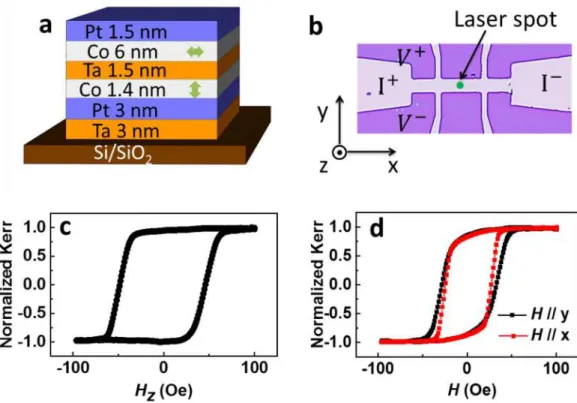
layers. (b) Optical microscope image of a device. Both magnetic-optical Kerr effect and anomalous Hall effect are used to detect the magnetization of device. (c) and (d) magnetization hysteresis loops measured using a MOKE magnetometer in polar and longitudinal configurations, respectively.
Material stacks studied in this work are made up of Ta(3)/Pt(3)/Co(1.4)/Ta(tTa)/Co(6)/Pt(2) from bottom to top (thickness in nanometers) with tTa=1.5, 2, 3 and 5 nm, respectively (Figure 1a). Sample Ta(3)/Pt(3)/Co(1.4)/Ta(1)/Pt(2) without top ferromagnetic layer is also studied as reference. All layers were sputter-deposited at room temperature on a thermally oxidized Si/SiO2 substrate. The films were patterned into Hall bar devices with
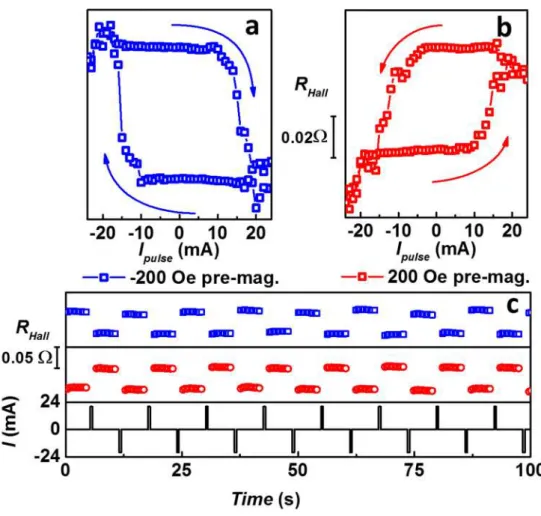
Figure 2.Deterministic current-induced magnetization switching under zero magnetic field. Anomalous Hall resistance (RHall) was measured to normal component of magnetization of device withtTa=1.5 nm. (a)RHallversusIpulseafter the device was pre-magnetized by -200 Oe alongxaxis. (b)RHallversusIpulsewith 200 Oe pre-magnetized. (c)RHallversus time, measured after device was pre-magnetized by -200 Oe (up panel) and -200 Oe (middle panel), with positive and negative current pulses (bottom panel) applied.
Figure 2demonstrates the current-induced magnetization switching of the device under zero magnetic field. Firstly, the magnetization state of the top Co layer was set by applying a magnetic field Hx along thex-axis of -200 Oe (Figure 2a) or +200 Oe (Figure 2b).
Then the magnetic field was set to zero, and current pulses (Ipulse) of width 400 ms and varying amplitude were applied to the device. The Hall resistance (RHall) was measured after each pulse at a low current of 0.1 mA to probe the magnetization state of the bottom Co layer. As shown in Figure 2a, a clockwise magnetization switching induced by the electrical current was observed after pre-magnetizing withHx= -200 Oe, where the current sweeping from positive to negative favors the up magnetization and that from negative to positive favors the down magnetization. Pre-magnetizing withHx = +200 Oe results in the opposite direction of magnetization switching, as shown in Figure 2b. The critical current density, which was calculated utilizing the current where RHallis half switched, is 9×10⁶A/cm2. Compared with the previously reported device with Ru spacer[23], the threshold current was reduced by around a factor of 3.
pre-magnetized along y direction. For the reference sample, without the top Co layer, current-induced magnetization switching was only observed in the presence of an
external magnetic field |Hx|600 Oe (See Supporting information Figure S2).
2.3. Determination of the interlayer exchange coupling field.
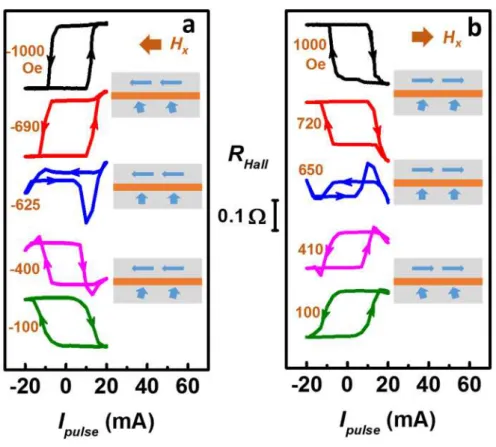
To understand how the top magnetic Co layer affects the current-induced magnetization switching, we investigate the current pulse-induced switching of the anomalous Hall resistance under different fixedHx. As shown inFigure 3a, with fixed magnetic fields of -1000 Oe and -690 Oe applied in the current direction, an anti-clockwise current-induced magnetization switching was observed, which is similar to that of the reference sample (See the Supporting Information Figure S2). With -625 Oe applied, the current-induced magnetization loop becomes much smaller, indicating very weak deterministic switching. Interestingly, with further decreasing the external magnetic field, the deterministic current-induced magnetization switching was observed again. However, opposite sign (clockwise) of current-induced magnetization switching was observed for external magnetic fields of -400 Oe and -100 Oe, compared to that of the 1000 Oe case. The sign change of the current-induced magnetization switching cannot be explained by the stray field from the top Co layer, which is antiparallel to the top layer magnetization with amplitude smaller than 0.001 mT, nor by the stray field created by correlated surface roughness because the Néel orange-peel mechanism always favors parallel alignment of the layers[23].
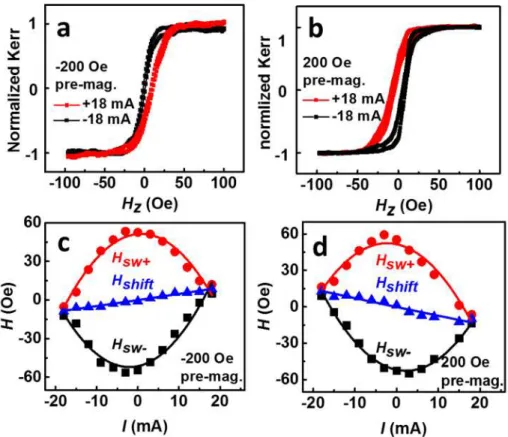
Figure 4. Perpendicular effective field induced by current. a), b) Perpendicular magnetization measured by polar MOKE against out-of-plane magnetic field, while currents of +/- 18mA are applied to the devices with zero in-plane external magnetic field. Red (black) circles indicate positive (negative) current. c), d)Hsw-,Hsw+andHshift
change with current, the full lines are the fit curve using function Hsw-(+)=H0sw-(+)+(-)αρJ2+βJ.Before the polar MOKE measurements, the device was magnetized by
-200 Oe [a), c)] or +200 Oe [b), d)].
2.4. Perpendicular effective field induced by current.
Oe in-plane external magnetic field, as shown in Figure 4a, the magnetization loops shift to the negative (positive) fields with current of -18mA (+18mA) applied. With the sample pre-magnetized byHx= +200 Oe, opposite behavior was observed as shown in Figure 4b. We extracted the switching fields with magnetization from -zto +z(Hsw+) and +zto -z(Hsw-), which are shown in Figure 4c and d. The magnitudes of both Hsw-andHsw-decrease with increasing the current intensity due to Joule heating. It is worth noting, as shown in Figure 4c, the extreme value forHsw-is atI<0 andHsw+is atI>0 for -200 Oe pre-magnetized situation. However, opposite behavior was observed for +200 Oe pre-magnetized situation shown in Figure 4d. As a result, the switching field contributed from both SOTs and Joule heating can be expressed as Hsw-(+)=H0sw-(+)+(-)αρJ2+βJ, where the first term in the right sideH0sw-(+)is the switching field from
+z to -z (-z to +z) at room temperature without electrical current applied, J is the averaged current density, ρ is the averaged resistivity of the device, the second term (-)αρJ2is the dependence ofHswon the Joule heating with the parameterα, and the third
Hx= -(+)200 Oe.Hshiftwas defined as (Hsw-+Hsw+)/2, which linearly varies with a slope than depends of the direction of the pre-magnetizing field. Hshift characterizes the effective magnetic field normal to the film plane, which has its magnitude linearly changed with the applied current and direction determined by the magnetization orientation of the top Co layer.
3. Conclusion
In summary, without external magnetic field, we have realized spin orbit torque induced magnetization switching utilizing interlayer exchange coupling in Ta(3)/Pt(3)/Co(1.4)/Ta(1.5)/Co(6)/Pt(2) devices (thickness in nanometers). The two ferromagnetic Co layers were found to be antiferromagnetic exchange coupled. The antiferromagnetic exchange coupling field was found to be 630 ±5 Oe fortTa= 1.5nm, which decreases with increasing the thickness of the Ta layer. The current-induced switching behavior can be tuned by changing the pre-magnetization the in-plane Co layer. The magnitude of the current-induced perpendicular effective magnetic field from spin-orbit torque is about 9.2 Oe/(107Acm-2). Due to the large spin Hall angle of the Ta layer, compared to previously studied devices with Ru as spacer, the critical current density (9×10⁶A/cm2) of the current-induced magnetization switching was reduced roughly by a factor of 3.
4. Experimental Section:
sputtering, where tTa is 1.5, 2, 3 and 5 nm, respectively. Sample Ta(3)/Pt(3)/Co(1.4)/Ta(1)/Pt(2) without top ferromagnetic layer is also studied as a
reference. The deposition rates for Ta, Pt, Co films were controlled to be ≈0.018 nm s−1,
0.027 nm s−1and 0.014 nm s−1, respectively. The base pressure is less than 10-8 Torr before deposition. The pressure of the sputtering chamber is 0.8 mTorr during deposition. Then the multilayers were patterned into Hall bar devices with channel width of 10 µm.
Measurements: The anomalous Hall effect measurements were carried out at room temperature with Keithley 2602B as the sourcemeter and Keithley 2182 as the nano-voltage meter. The Kerr measurement was taken using a NanoMoke3 magneto optical magnetometer.
Acknowledgements:
This work was supported by National Key R&D Program of China No.2017YFA0303400 and 2017YFB0405700. This work was supported also by the NSFC Grant No. 11474272, and 61774144. The Project was sponsored by Chinese Academy of Sciences, grant No. QYZDY-SSW-JSC020, XDPB0603, XDPB0802 and K. C. Wong Education Foundation as well.
References
[1] P. He, X. Qiu, V. L. Zhang, Y. Wu, M. H. Kuok, H. Yang,Adv. Electron. Mater.2016,2, 1600210.
F. Pan, C. Song,Adv. Electron. Mater.2016,2, 1600219.
[3] K. Cai, M. Yang, H. Ju, S. Wang, Y. Ji, B. Li, K. W. Edmonds, Y. Sheng, B. Zhang, N. Zhang, S. Liu, H. Zheng, K. Wang,Nat. Mater.2017,16, 712. [4] Y.-W. Oh, S.-H. Chris Baek, Y. M. Kim, H. Y. Lee, K.-D. Lee, C.-G. Yang,
E.-S. Park, K.-S. Lee, K.-W. Kim, G. Go, J.-R. Jeong, B.-C. Min, H.-W. Lee, K.-J. Lee, B.-G. Park,Nat. Nanotechnol.2016,11, 878.
[5] G. Yu, P. Upadhyaya, Y. Fan, J. G. Alzate, W. Jiang, K. L. Wong, S. Takei, S. A. Bender, L.-T. Chang, Y. Jiang, M. Lang, J. Tang, Y. Wang, Y.
Tserkovnyak, P. K. Amiri, K. L. Wang,Nat. Nanotechnol.2014,9, 548. [6] M. Yang, K. Cai, H. Ju, K. W. Edmonds, G. Yang, S. Liu, B. Li, B. Zhang, Y.
Sheng, S. Wang, Y. Ji, K. Wang,Sci. Rep.2016,6, 20778.
[7] N. Zhang, B. Zhang, M.-Y. Yang, K.-M. Cai, Y. Sheng, Y.-C. Li, Y.-C. Deng, K.-Y. Wang,Acta Phys. Sin.2017,66, 27501.
[8] T. Koyama, H. Hata, K. J. Kim, T. Moriyama, H. Tanigawa, T. Suzuki, Y. Nakatani, D. Chiba, T. Ono,Appl. Phys. Express2013,6, 33001.
[9] U. H. Pi, K. W. Kim, J. Y. Bae, S. C. Lee, Y. J. Cho, K. S. Kim, S. Seo,Appl. Phys. Lett.2010,97, 162507.
[10] L. Liu, O. J. Lee, T. J. Gudmundsen, D. C. Ralph, R. a. Buhrman,Phys. Rev. Lett.2012,109, 96602.
[11] E. Jué, C. K. Safeer, M. Drouard, A. Lopez, P. Balint,Nat. Mater.2016,15, 272.
D. Beach,Appl. Phys. Lett.2014,105, 222401.
[13] X. Zhang, C. H. Wan, Z. H. Yuan, Q. T. Zhang, H. Wu, L. Huang, W. J. Kong, C. Fang, U. Khan, X. F. Han,Phys. Rev. B2016,94, 1.
[14] K.-U. Demasius, T. Phung, W. Zhang, B. P. Hughes, S.-H. Yang, A. Kellock, W. Han, A. Pushp, S. S. P. Parkin,Nat. Commun.2016,7, 10644.
[15] T. A. Moore, I. M. Miron, G. Gaudin, G. Serret, S. Auffret, B. Rodmacq, A. Schuhl, S. Pizzini, J. Vogel, M. Bonfim,Appl. Phys. Lett.2008,93, 262504. [16] L. Liu, C.-F. Pai, Y. Li, H. W. Tseng, D. C. Ralph, R. A. Buhrman,Science
2012,336, 555.
[17] M. Akyol, G. Yu, J. G. Alzate, P. Upadhyaya, X. Li, K. L. Wong, A. Ekicibil, P. Khalili Amiri, K. L. Wang,Appl. Phys. Lett.2015,106, 162409.
[18] M. Akyol, W. Jiang, G. Yu, Y. Fan, M. Gunes, A. Ekicibil, P. Khalili Amiri, K. L. Wang,Appl. Phys. Lett.2016,109, 22403.
[19] S. Woo, M. Mann, A. J. Tan, L. Caretta, G. S. D. Beach,Appl. Phys. Lett.
2014,105, 212404.
[20] W. J. Kong, Y. R. Ji, X. Zhang, H. Wu, Q. T. Zhang, Z. H. Yuan, C. H. Wan, X. F. Han, T. Yu, K. Fukuda, H. Naganuma, M. J. Tung,Appl. Phys. Lett.
2016,109, 132402.
[21] S. Fukami, C. Zhang, S. DuttaGupta, A. Kurenkov, H. Ohno,Nat. Mater.2016, 15, 535.
476, 189.
[23] Y.-C. Lau, D. Betto, K. Rode, J. Coey, P. Stamenov,Nat. Nanotechnol.2016, 11, 758.
[24] Z. Wen, J. Kim, H. Sukegawa, M. Hayashi,AIP Adv.2017,6, 56307. [25] S. Wang, M. Yang, C. Zhao, Deterministic switching of perpendicularly
magnetic layers by spin orbital torque through stray field engineering, https://arxiv.org/abs/1710.08282, accessed: Oct. 2017.
[26] H. L. Wang, C. H. Du, Y. Pu, R. Adur, P. C. Hammel, F. Y. Yang,Phys. Rev. Lett.2014,112, 197201.
[27] D. Qu, S. Y. Huang, B. F. Miao, S. X. Huang, C. L. Chien,Phys. Rev. B2014, 89, 140407.