~
.~
-iiiiii.-
---KENNEDY
.~
I "
'-.iiiiiii- .
---" ~
KENNEDV · mUALITV · COUNT ON IT
Our name
will get to you
$0
t"JoHO
OMU-
lrne'\rJesfc
G(eylPu-ocessDD'Ug
™$YS'~eU"fll
TheCMC1800
o
Heralding the next generation
of data entry, the CMC 1S00 does it all-foreground editing, background editing, remote job entry, and provides modularity for future growth - all at a price that's hard to beat.
The CM C 1800 starts small
with just a few keystations, storage for 25,000 SO-character data records, and a processor with 64K bytes of core memory. But it grows big with storage for over 300,000 records, 160K bytes of memory, KOBOL™ (Keystation On-Line Business Oriented Language), RPG II, and up to 64 keystations.
The CMC 1800,
while the newest member of the KeyProcessing Family, is a family all by itself. It's cost effective for keypunch replacement applications, throughput oriented for high volume requirements, and sophisticated enough to handle today's jobs and tomorrow's challenges.
CRCLE 4 ON READER CARD
o
CMC KeyProcessing Systems
are installed throughout the world.
Get to us,
you'll be pleasantly surprised. Call or write today for more information.
KeyProcessing is a trademark of
Computer Machinery Corporation
2500 Walnut Avenue, Marina Del Rey P.O. Box 92300
2
Itel has the cure
for absent-minded computers.
Monolithic Main Memory.
Not only does it remember more than 18M's
design can, but it remembers more for less. On the
360/22 up through most 370 models.
On the 370/158, for example, Itel Monolithic
Memory can increase your main memory capacity a
fuIl100%-from four megabytes to eight megabytes.
Looking for other ways to improve your
com-puter's memory? Then look into Itel's 7330 Disk Drive
Subsystem for 360/50, 360/65 and all 370 systems.
It's a compact, waist-high unit that handles massive
data bases up to 3,200,000,000 bytes. With an
aver-age access time of just 27 milliseconds.
At Itel, we couldn't have acql.ired over a billion
dollars in IBM computer leasing experience without
solving at least a few of your problems.
:ITEL
Your financial alternative.
~
One Embarcadero Center, San Francisco, California 94111, Phone (415) 983-0000
DRTRMRTIIDN®
VOLUME 21 NUMBER 10 This issue 120,600 copies OCTOBER 1975
FEATURES
Uncovering Hidden Savingo C:.
E!rpDnGC~~
Managers have become acutely cost-conscious. In looking to 1976 budgets they are carefully scrutinizing obvious major expenses like hardware and nonobvious "incidentals" like insur-ance. These expenses they can iden-tify, measure, and sometimes cleverly reduce. Meanwhile, pending privacy safeguard legislation threatens them with new and more insidious hidden expenses.
56 MOVING FROM THE 370 TO THE 360
Ira Freireich and Donald Harder. Reverting to an older machine saved money and increased throughput.
60 BURNING DOWN THE DATA CENTER
H. A. Chadwick. Losing the accounts receivable file could hurt a business more than flood or fire - so in-sure against that too.
65 THE COSTS OF PRIVACY
Robert C. Goldstein. Complying with privacy regula-tions could conceivably cost some users $1 for every transaction they make against their own files.
NEWS IN PERSPECTIVE
112 BANKING
Electronic Funds Transfer: To consumers it's mostly a lot of plastic while to bankers it's a system mired in legal and regulatory confusion; EFT: Everybody is a rule maker.
117 CONFERENCES:
Although the atmosphere was one of cost-cutting, INFO '75 drew a larger turnout in New York last month than the year before; How the automated clearing houses are meeting consumer resistance.
121 ANTITRUST
IBM tells the supreme court the peripherals industry is a broad market.
123 MAIN FRAMERS
Amdahl Corp.'s fast 470 machine is picking up momentum.
DEPARTMENTS
7 LETTERS
Remembering the 704, a PLl1 draft exchange, reevalu-ating the college degree, and certifying software.
11 PEOPLE
L. Edwin Donegan: third time up; Robert Lowry: solu-tions; John Cool: first things second.
17 LOOK AHEAD 22 CALENDAR
A "Revolution" in Boston, dp in Brazil, & other shows.
27 SOURCE DATA
Reviews of Health Information Systems Evaluation and IBM's structured programming books; State Govern-ment Systems & other reports; vendor literature, cour-ses, periodicals.
October,
1975
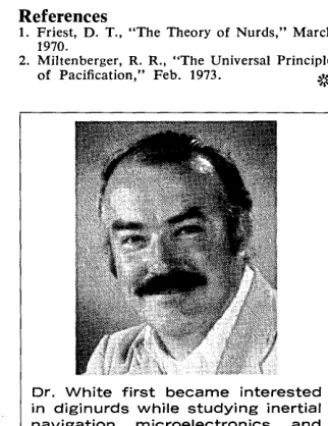
72 ON DIGINURDS
S. A. White. The existence of these error-provoking agents was first suspected during World War II. Three decades later, only their effects are known for certain.
79 BACKING INTO AN INFORMATION SYSTEM
Matthew J. Orkins and Stephan F. Weiss. Proving again that ten times 100 statements is more than one times 1,000.
95 STRETCHING OS UTILITIES
Label Klahr. That special package may be an unneces-sary expense.
106 APL GOES COMMERCIAL
Ellen Klein. Is the black sheep of the computer lan-guages finally moving into the fold?
111 IBM AND THE INDUSTRY
Let's consider the software situation ... and beware of short-term solutions.
169 THE FORUM
Philip Kraft and Gerald E. Weinberg. Will we be cer-tifying a level of programmer incompetence?
125 INTERCONNECTION
New York public utilities commission asks for direct connection after showing that certification really works.
129 INTERNATIONAL
Blind bank customers receive their statements in Braille; N. V. Philips is bowling out of Unidata.
131 COMMUNICATIONS
Queuing up for packet service; International packet switched service is in the works at WUI; Datran now is studying a flat rate service.
134 BENCHMARKS
IBM thinking small; More worries for Xerox, Memorex settlement; Consolidation question; Microprocessor agreement; In and out at GA; Software dispute; Mergers; Moving out; Training for retailers; Science Fair broadened; Mini group chartered; Continuous forms continue to earn; Keyboard-to-storage market.
55 EDITOR'S READOUT
It's not too late to make HR1984 what it should be.
144 HARDWARE
Graphics terminal prices drop to the level of standard crt terminals; Nixdorf's new S/3 and S/32 competitor bows.
154 SOFTWARE & SERVICES
Two COBOL preprocessors debut; COGENT is a mach-ine independent compiler generator; on-lmach-ine payroll/ personnel.
163 ADVERTISERS' INDEX
ABOUT THE COVER Uncovering the surprises, bl')th good and bad, in budget planning is a series of succes-sive steps in the process of closer scrutiny. Our design in black, white and money green is by Barbara Benson.
4
Why business relies
on Datamation and
Technical Publishing Company
now more than evee
The more perplexing business conditions get in the '70s, the more industry leaders turn to "Technical" ... for information, education and advertising value.
In addition to Datamation, Technical Publishing Company publishes six other national business/professional magazines: Consulting Engineer, Plant Engineering, Pollution Engineering, Power Engineering, Purchasing World, and Research/Development. Our publications are recognized as prime sources for technical and business information.
And they give business finely focused selling vehicles for spearheading product sales efforts. In fact, six of our seven publications are among the top 100 specialized business magazines in advertising revenues. We also serve business and industry with specialized mailing list rental, market research and product post card services.
Our TPC Training Systems provide a new, innovative, economical method for training maintenance craftsmen. And DBI Books, Inc., (formerly Digest Books, Inc.) serves the consumer leisure market with over 55 titles devoted to sports, hobbies and crafts.
Technical Publishing Company is a growth company concentrating in growth fields. We are publicly-owned and our stock is traded over-the-counter. For information on any of our properties or the company, write James B. Tafel, President and Chief Executive Officer.
1-1-.1
Technical Publishing CompanyIf!'
1301 South Grove Avenue Barrington, illinois 60010CFlTRMRTICN(~
EDITORIAL STAFF Editor
Articles Editor International Editor European Editor Communications Editor Industry Editor Products Editor Source Data Editor Calendar Editor Reprints Editor News Editor Bureau Managers
San Francisco Los Angeles Washington, D.C. New Vork New England
Cor~espondents
Minneapolis Southwest Australia Editorial Advisor Technical Advisor Contributing Editors
EDITORIAL OFFICES
John L. Kirkley Richard A. McLaughlin Angeline Pantages Nancy Foy Phil Hirsch W. David Gardner Michael Cashman Daniel P. Schlosky Gloria Tidstrand Laura R. Ochinero Tom McCusker Edward K. Vasaki Edith D. Myers Phil Hirsch Pamela Evans Angeline Pantages W. David Gardner James K. Johnson Robert F. Alexander Frederick A. Bland Robert L. Patrick Lowell Amdahl Paul Armer, Howard Bromberg, Philip H. Dorn, Louis B. Marienthal, Ray W. Sanders, Milton R. Wessel, F. G. Withington Headquarters: 1801 S. La Cienega Blvd., Los An-geles, CA 90035. Phone (213) 559-5111. Eastern: 35 Mason St., Greenwich, CT 06830, (203) 661-5400. 134 Mt. Auburn St., Cambridge, Mass. 02138, (617) 354-2125; 9805 Singleton Dr., Bethesda, MD 20034, (301) 530-7271. Southwestern: 2711 Cedar Springs, Dallas, TX 75201. (214) 744-0161. West-ern: 2680 Bayshore Frontage Rd., Suite 401, Moun-tain View, CA 94043, (415) 965-8222. Foreign: a Pellerin Rd., London N. 16; (01) 249-1177; 64/90
Blues Point Rd., McMahons Point, NSW 2060, Australia.
GRAPHIC DESIGN & PRODUCTION Art & Production
Director Cleve Marie Boutell Advertising
Production Manager Production Assistant CIRCULATION
Marilee Pitman Alberta R. Martin 35 Mason Street, Greenwich, CT 06830 Circulation Manager Suzanne A. Ryan Marketing Research
Manager Publisher Assistant Publisher Circulation audited by Business Publications Audit
Deborah Dwelley James M. Morris F. Douglas De Carlo
-American Member A/t.BP
BusinessNn Press, Inc.
DATAMATION is
pub-ID
IIshed monthly on or ~ about the first day of every month by Tech-nical Publishing Company, 1301 South Grove Ave., Barrington, Illinois 60010; Arthur L. Rice, Jr., Chairman of the Board; James B. Tafel, President; Gardner F. Landon, Executive Vice President. Executive, Circulation and Advertising offices, 35 Mason Street, Greenwich, CT 06830, (203) 661-5400. Editorial offices, 1801 S. La Cienega Blvd., Los Angeles, CA 90035. Published at Chicago, III. DATAMATION is circulated without charg,e by name and title to certain qualified individuals who are employed by companies involved with automatic information handling equipment. Avail-able to others by subscription at the rate of $24; $40 Air Mail annually in the U.S. and Canada. Re-duced rate for qualified students, $14. Foreign subscriptions are available for £16.80 or for the equivalent of $40 U.S. in most West European cur-rencies. Sole agent for all subscriptions outside the U.S.A. and Canada is J. B. Tratsart, Ltd. 154 A Greenford Road, Harrow, Middlesex HA13QT, En-gland. No subscription agency is authorized by us to solicit or take orders for subscriptions. Con-trolled circulations paid at Columbus, OH and Form 3579 to be sent to TeChnical Publishing Com-pany, P.O. Box 2000. Greenwich, CT 06830. ©Copyright 1975 Technical Publishing Company. ®
"Datamation" registered trademark of Technical Publishing Company. Microfilm copies of DATA-MATION may be obtained from University Micro-films, A Xerox Company, 300 No. Zeeb Road, Ann Arbor, Michigan 48106. Printed by Beslow Associ-ates, Inc.
Todays Graphics.
8ecauseyou
can't wait for
tomorrow's solutions.
Tektronix' Graphic Terminal Family is steps ahead of however else you're now using your computer data.
Providing the most efficient utiliza-tion of that data. Faster than printout. More efficient than mere hard copy. Making analyzing extremely profit-able. Giving you the
answers now, when you need them.
Pictured is our 4014-1 Graphic Display Ter-minal, the biggest 19-inch, flicker-free display in the busi-ness. Priced at $9,995. Also, our
4010 Graphic Display Terminal. An 11-inch version of the same power-ful Graphics tool, at $4195. Both giving you your ideas in pictures.
Team either of these with our 4631 Hard Copy Unit at $3895, and you've got a copy to refer to, add to,
change, and then work with some more. Then there's our Flexible Disc Memory from $3695 for user- . controlled storage, off-line or aux-iliary. Add our Graphic Tablets from $2995 for fast, freehand digitizing, and your Graphics capacity is greater still.
But there's more to our Graphics than just low cost, more than
advanced problem solving. There's more peripherals,
more strong software support, more
advantages. Call your area Tektronix Applications Engineer for all the information.
Or write us, today.
Tektronix, Inc.
Information Display Division P. O. Box 500
Beaverton, Oregon 97077
TEKTRCNIX®
What's new In printers! AskCentronlcs.
Just because you need
a faster printer doesn't
mean you have to leave
thefamil~
Our speeds are way up. But our prices aren't. And when you select products from the Centronics family, you get the extra advantages of proven reliability, printer compatibility, and
commonality of parts.
Our new Model 104 printer delivers 200 lines per minu teo Which is more full 132-column lines per minute for the money than any other printer in our family.
The low price includes a quiet, fully-enclosed design. Clean, consistent high quality printing. A choice of over 20 foreign language character sets. Special character sets. Boldface characters on com-mand. Automatic on-off motor control. Exclusive off-line self-test switch. LSI electronics. Optional upper/lower case printing. And much, much more. All this - plus the best warranty in the business. For reliability proven in tens of thousands of instal-lations, and for optimum price/performance, look to Centronics. You'll find the biggest selection of printers anywhere. With a broad range of computer interfaces and communications adapters. Plus features and options available nowhere else. High-volume production assures prompt delivery. Service and parts always available through a net-work of field service offices. Call our nearest office for full information. Centronics Data Computer Corp., Hudson, New Hampshire 0305l.
Tel: (6031 883-011l.
Eastern Region: Burlington, Mass., (6171272-8545 Central Region: Kettering, Ohio, (5131294-0070 Western Region: Santa Ana, Calif., (7141979-6650 Centronics Data Computer (Canada) Ltd.: Ontario, Canada, (603) 883-0111
Centronics of Puerto Rico, Inc.: Dorado, P.R., (8091796-1881
Centronics International Corp.: Brussels, Belgium 02-762-3572
®
I:EnTRDnll:S
CENTRONICS/the largest and fastest-growing family
of
medium-speed printers
letters
Repeal the PL/I draft
After years of effort, the Draft Pro-posed American National Standard for Programming Language PL! I has been issued by the Computer and Business Equipment Manufacturers Assn. ( CBEMA). It is a 380 page book. It is written as a single algorithm expressed in a uniform metalanguage which has been especially created for the stan-dard and is defined in the stanstan-dard.
The standard is intended to be pre-cise and unambiguous and the commit-tee has gone to great pains to achieve this goal. The committee concluded that the necessary level of precision could not be reached by writing in English but instead felt it necessary to devise a new metalanguage specifically for the purpose of defining PL! 1.
As it stands, the standard cannot be understood without first learning the metalanguage. The committee knows that the standard will be incompre-hensible to most of those who will use PL!I to program. They claim, however, that it can be understood by those who must implement the language, that is, by those who· will create PL/ I com-pilers.
If a standard is to achieve its basic purpose of facilitating interchangeabil-ity, it must have a precision appropri-ate t9 its use. Imprecision or ambiguity in a standard works against its useful-ness. Consequently, we can applaud the committee's desire and efforts to achieve a level of precision for the PL! I standard superior to that of earlier lan-guage standards. However, in its search for precision, the committee has moved so far toward abstract and al-gorithmic statement and so far from common English as to sacrifice the ability to be understood by those who must accept and use it.
In spite of the vast effort put into this standard, in spite of our need for a standard to govern PL! I, and in spite of the need for language standards to be precise and unambiguous, I suggest that this Draft Standard be rejected on the grounds that it is comprehensible to very few, that this incomprehensibil-ity is not necessary to the standardiza-tion of PL! I, and that a useful language standard must be comprehensible to p
substantial portion of those who will use it to program and who have to refer to it.
The public comment period for the Draft Standard has ended. The only action available to those who wish to oppose this standard is to request the
October, 1975
organizations which represent them to ANSI to vote against final approval. I urge those concerned to do so.
ERIC A. WEISS Springfield, Pennsylvania
Mr. Weiss is manager of Planning and Administration of Sun Services Corp., the computing subsidiary of Sun Oil Co. Among the seven textbooks he has authored or edited are "The PL/I Converter" (1965) and "Computer Usage/Fundamentals" (McGraw-Hili, 2nd ed., 1975).
. . . An immediate reply
I must take exception to Eric Weiss' comments on the PL/ I standard.
1. He states all the reasons why the standard should be precise: The FORTRAN and COBOL standards are ambiguous; PL! I is not.
2. Einstein's Theory of Relativity was once similarly branded as unintel-ligible-only a handful of individuals were acquainted with the notation used in his original paper. His theory and the notation survived, and simplifica-tion and oversimplificasimplifica-tions to explain the theory abound.
3. The Vienna Definition Language used in PL/ I is cumbersome to read, but it is precise. There exist computer programs which check VDL statements for consistency and completeness.
May I suggest that Mr. Weiss take the opportunity of reading the
stan-
1-dard for its content. Peripherally, it will help to bring him technically up-to-date.
ERIC H. CLAMONS Phoenix Computer Operations Honeywell Information Systems, Inc.
Phoenix, Arizona
Don't burn that sheepskin yet
Carl Hall ("Evaluating Prospective Employees," August, p. 32) ... belit-tled the importance of a college degree in the interviewee's professional pro-file. In fact, he· states: "a computer science degree actually has a negative correlation with a person's prepared-ness for dp work." ...
To be sure, our industry is populated with many persons with degrees whose actual productivity and professional-ism leave much to be desired. How-ever, the attaining of a college degree does show two important character-istics of the employment candidate:
The ability to set his sights on a long range goal and to attain it.
The ability to put up with a lot of "manure" on the way to a goal and to succeed in spite of it.
These characteristics are important in our industry. Many system develop-ment efforts are both of long duration and characterized often by irrational demands and prejudices on the part of (Continued on page 8)
The IBM 704: First in the Hearts
of its Users, Anyway
SAGE was before the 704
I enjoyed Mr. McLaughlin's excel-lent article on the IBM 704 (Aug., p. 45). Your readers may be inter-ested in knowing that the indexing scheme used was actually developed for the AN/FSQ-7 Project, better known as the SAGE air defense sys-tem. The 704 was the first commer-cial use of the Branch and Index instruction. I believe that the index register concept dates back to Wil-liams work at Manchester Univ. and to the Datatron of Consoli-dated Engineering Corp. The SAGE index scheme, including the Branch and Index instruction, is covered in U.S. patent 2,914,248. The inven-tors are Harold D. Ross, Bernard L. Sarahan, Morton M. Astrahan, Bennett Housman and Walker H. Thomas.
MORTON M. ASTRAHAN IBM Research Division San Jose, California
Electro-Data was first
IBM did not have the first commer-cially available computer with index registers. The first one was the Datatron, built by Electro-Data
Corp. which was later absorbed into the Burroughs Corp.
J ORN BOLSTAD Stanford Univ. Stanford, California
The fate of the "last" one
The junk man came and took the 704 away. [The one in the August story ... ed.J The machine was sold intact by our man to a dealer in Dallas. The eventual fate of the hardware is uncertain-probably scrap silver and copper.
We got rid of the machine at just the right time. Power company rates rose sharply this summer and we are able to operate with about 15 tons less air conditioning. The 7094 is working fine; it's really a wonderful machine and should take care of us for a long time.
EUGENE U SDIN Southwestern Computing Service, Inc. Tulsa, 0 klahoma P.S. Last week I picked up a spare motor generator and power distribu-tion units for the 7094, giving us a 100% set of spares. I found them at (Continued on page 8)
letters
the system users.
A lack of a degree may indicate the candidate possesses a negative trait-an inability to communicate. It is diffi-cult for a person to attain a degree without being able to communicate his thoughts satisfactorily, both in writing and orally. (This is, unfortunately, not true of most high schools.) I have per-sonally found that non-degreed persons often lack communications skills. I al-so believe that the primary reaal-sons for failures of dp development efforts are
8
The IBM 704 . . .
a metal salvage yard in Attalla, Ala. They had a complete 7094 and were wrecking it to get at the gold con-taots. A scene one would expect to read about in Gibbon. Or Spengler.
One less bell
Several of us SHARE old-timers were discussing the 704 article recently. And we all agreed that the convert instructions Amdahl was so fond of were not on the 704. They first showed up on the 709.
. . . a lovely, touching story for those few of us who were around in those days, heard the bell, tried to figure out how to test the drum's bearings, and walked the carpeted floors (static wasn't a problem). When they unplug the 7094, I want to be there!
PHILIP H. DORN New York, New York
The author replies: To set the rec-ord straight, or at least unbend it
a little, the concept of registers has been around at least as long as the 1949 Univ. of Manchester ma-chine's "B lines." In keeping with the industry's lack of concern for
the lack of well written, comprehensive documentation, and the failure of project management and project per-sonnel to express their thoughts clearly through the medium of the spoken word ....
MARK H. WALLIS Vice President Unicorn Systems Company Los Angeles, California
Software certification
I want to thank you for bringing the forthcoming SRI report on software certification to everyone's attention (Editor's Readout, July, p. 35). I am especially interested since it bears
di-its history, the records of the
devel-opment from there on are difficult to find. Very likely, the first com-mercially available computer with index registers was the Datatron line from Consolidated Engineering Corp. (which was later named Elec-tro-Data Corp., and finally was bought out by Burroughs).
According to John Alrich, a proj-ect engineer on Datatron, Dr. Harry Huskey brought the idea from the Manchester group to Dr. Ernst Sel-mer, Datatron's architect. It seems certain that Datatron machines with one "B" register were delivered
about a year before the first 704 was installed. So far, it's still a toss-up as to which company's line had floating-point hardware first; friends at Burroughs are looking through closets now to help clear up that point.
In response to Mr. Dorn's com-ment, Dr. Amdahl agrees that his memory slipped in attributing table look-up instructions to his 704; he had intended them for the 704 but the schedule was too tight and they first appeared on the 709.
And we blushed to admit that our typewriters slipped in misspel-ling John Backus' name. Sorry,
John, we really knew better. Finally, IBM's files did yield an-other old picture of the 704 for SHARE Old-timers and other aficio-nados. Here it is.
rectly on the operations of the Quan-tum Chemistry Program Exchange.
QCPE disseminates computer soft-ware to some 1;500 worldwide mem-bers in the area of calculational chem-istry. We put the software through a rather simple-minded certification cedure. All we require is that a pro-spective contributor's program gener-ates the same results that the author claims for it, using the sample input he provides, but on a different computer. We don't say the program is correct; we simply say that it will reproduce results.
I suspect that a major scientific cal-culational system can never be looked upon as completely certified. There may be a high probability that a system is bug-free, but any statement stronger than that seems to me somewhat non-credible. To my mind, the degree to which a system is certified would be some function of the number of prob-lems successfully run through the sys-tem ....
For dp systems where the number and types of processes can be counted explicitly, it may be more reasonable to talk of a "completely certified" system than is the case with large, scientific calculational systems. However, be-cause a given dp system is certified under a given compiler, on a particular as, and in a specific environment, this does not imply the system is considered certified in a completely general sense. Two questions which haunt the whole effort are "how certified is Cer-tified?" and "how much certification can I buy for how much money?" . . . RICHARD W. COUNTS
Quantum Chemistry Program Exchange Indiana University Bloomington, Indiana
The SRI report, "On the Feasibility of Software Certification," is scheduled for review in an upcoming issue.
A long count
In reference to the information on EFTS (July, p. 90), please be advised that there are 12 Federal Home Loan Bank Districts, not 120 as indicated. It
also stated that the network would be "ultimately capable of supporting elec-tronic funds transfer services through-out much of the U.S." The "ultimate-ly" may be a long time coming since there are no present plans to develop such a nationwide network. However, there is no technical reason that could not be done at some future time.
MARVIN J. SENDROW Contract Administrator EFTS Switch Project Federal Home Loan Bank Board Washington, D. C.
The number 120 was a printing error which however appears corrected later
System/3 computer users
have been liberated!
(Spread the wordJ
When we announced the
Honeywell Liberator/3 to
replace System/3 computers,
we knew our cause was just.
And already our cause has
been joined by companies like
Certified Oil of Columbus, Ohio;
Shurfine-Central of Northlake,
Illinois; Echo Communications of
Cedarburg, Wisconsin; Veriflo of
Richmond, California, and
many others.
We're striking a blow against
inflation, spiraling costs, and
reduced earnings by providing
more capacity, power and
function-ality for about the same money users
are now spending for System/3.
In addition to liberating System/3
users, we're also helping users of
other equipment, even some
first-time users.
Liberator/3 is a combination of
hardware and software. The
hard-ware is Honeywell's Level 62
system, which includes our
October, 1975
new Model 62/40, the latest
model in our Series 60 line.
The software provides an
automatic transition from your
current System/3 to the Level 62
system.
Liberator/3 is in operation today.
It's the Honeywell Information
System for System/3 users.
See for yourself. Call your local
Honeywell representative right
now. Or send us the coupon. Make
it your Declaration of Independence.
10
What can possibly be so great
about this terminal?
Other people make high-quality, super-fast,
microprocessor-driven typewriter terminals.
The better ones even use our quiet, dependable
HyType I printer mechanism with its many quick-change
type fonts.
Why have we come out with our new Model 3010?
Not because it looks nice with our name on it, but
because of some things you can't immediately see:
Graphics. It has 1/60" horizontal resolution and 1/48"
vertical, so you can print neat charts, curves, formulas,
musical scores, or whatever.
Diagnostics. If there's a malfunction anywhere in the
system, the operator can use the control panel to track
it down, or the host computer can be asked to find the
problem.
Speed. It improves on the 30 cps of most other
HyType I terminals because you can instruct it to print
both forward and backward, thus saving carriage-return
time.
Support. It's made and maintained by Xerox.
The 3010 will upgrade even the most advanced
text-processing systems and APL applications.
Great is perhaps too strong a word for it, though. It's
merely the best.
For more information, call (213) 679-4511, ext. 950. Or write Xerox Corporation, Dept. I 5-08, 701 Aviation Blvd., EI Segundo, California 90245.
In Europe, contact RANK XEROX LID., York House, Empire Way, Wembley, Mddx, England. Phone 01-903-4521
XEROX<ll> and HyType I<ll> are trademarks of XEROX CORPORATION.
CIRCLE 5 ON READER CARD
XEROX
people
What He Always
Wanted to Do
When we last left L. Edwin Donegan, Jr., he was a captain without a ship: his RCA computer division had been scuttled by RCA corporate managementin 1971. Donegan, a man accustomed to responsibility and the corporate high life-he once headed IBM'S Service Bureau Corporation and had been thought of highly-enough at RCA to
have been under consideration for that firm's presidency-had found suddenly that he had little to do.
He resigned and went to that mys-terious pasture land peopled by many former top computer executives and from which they seldom return: Donegan became a consultant. But now, Donegan is back in the industry, this time running Keydata, the pio-neering time-sharing firm.
"I feel I've been at bat three times," says Donegan, and he adds quickly with a laugh: "But this isn't the third strike."
The quick Irish wit and the bound-less enthusiasm are obviously still there, but there is a more pressing question about Donegan: does he have the business acumen to make Keydata a winner?
There is some information already available that hints at the answer to that question. Donegan has been at the helm of Keydata for a year and a half now and in that time he has moved the 1
°
year old firm out of a chronically-ill financial position to a position of steadily increasing sales and profits. The firm logged a record $13.3 million in sales in its last fiscal year and $450,000 in profits. He joined the Watertown, Mass., firm as president in July 1974."Where do we fit in the industry?" asks Donegan rhetorically. "Our big-gest customer has traditionally been the small guy, the first time user who' doesn't want dp in his plant. We're keeping that base and I don't foresee a time when our users will be able to do any better than us."
Keydata also has its large and so-phisticated users, too, but usually they use the time-sharing service as an en-hancement to their in-house dp instal-lation. One bi'g new bright area for the firm is manufacturing applications. In a sense, manufacturing applications represent a natural follow-on for
Key-October, 1975
data's distribution applications where the firm's strength has been for years. For instance, once Keydata gets a manufacturer's distribution dp work, the company tries to make it attractive for the user to use Keydata for its manufacturing applications, too.
And how do people feel about Key-data being run by the man who was running RCA when that firm threw in
the towel in computers? "At first, I felt there was a certain stigma," says Donegan. "But I found that whenever I talked with a customer he knew who I was and that's always a big plus."
Donegan feels that the passage of time has blunted the negative feelings of the RCA debacle. Moreover, he points out with justification, the RCA
base has done well for Univac and that is an indication that RCA'S products were strong in the marketplace. Done-gan's friends say the whole experience humbled him, but that he is still con-vinced he could have made a success of the RCA computer operation.
Donegan is something of a zealot on the subject of the computer industry ("I hardly go through a day when I'm not happy I'm in the business"). Un-like most other businesses, Donegan feels the computer industry requires an almost total commitment by the people working in it. He recalls his years at
IBM and remembers that everyone he
knew at that firm had the attitude that "your life was the computer business." Donegan's associates say he is al-most always "on the job," taking work home with him nights and weekends. He relaxes with a vigorous game of tennis, but he is the first to admit that his business and his hobbies are the same. "I'm not very good-at t~rning the switch off at 6 p.m.," he says.
He feels that his experience at both
IBM and RCA was valuable, although
unquestionably, IBM has left a bigger
mark on the man and, in fact, at RCA
Donegan was noted for his IBM style. While he feels that RCA instilled a good entrepreneurial style in its executives, Donegan seems to have carried away with him IBM'S method of tackling
problems.
"IBM takes a student approach to the
business," says Donegan. "The com-pany just overwhelms a problem. At Keydata, I know I can research every element of a problem, so I try to rec-ognize the critical elements and then get some staff work done on those."
Donegan can't stifle his IB'M sales training. His easygoing manner begins to leave him when he talks shop which, of course, is Keydata these days. He begins to ignite when he talks about his
L. EDWIN DONEGAN JR. experience humbled him
new company. The enthusiasm builds up slowly but steadily and Donegan is soon a business revival preacher warm-ing up his audience. "You know," he says, "what I've always wanted to do was to run a successful business. And I'm doing it now."
From Work to School
JOHN COOL First things can be different
First things first means different things to different people. For most, educa-tion comes before professional expe-rience. Not for John Cool.
At the age of 20, Cool was Western Regional Service Manager for Packard Bell Computer. On his twenty-second birthday he joined Max Palevsky's Sci-entific Data Systems. At SDS he started and directed field engineering. He did this for five years. These were pre-Xerox years.
Then he went back to school. He selected Oregon State Univ. in Corval-lis, Ore. He chose it, he says, because· Corvallis is rural, picturesque, and not too far away from things.
He earned degrees in electrical engi-neering and computer science at osu and made some friends who helped
people
shape the course of his professional life as much as his studies did. These were people who became utility company engineers. Cool became interested in the computing needs of utility com-panies and found that long life with no down time was the big need. "One second down could cost a utility com-pany thousands of dollars."
So when he got out of school, he purchased a one-third interest in a computer maintenance company called Valcomp (formerly Valley com-puter) headquartered in Los Angeles' San Fernando Valley. Valcomp's spe-cialty is assuring long operating life for process control computer systems.
Cool didn't spend all his time
study-ing at osu. He did some teachstudy-ing too. A professor of his was teaching a course at Oregon State Penitentiary and asked him to give a guest lecture on computers. Cool did and liked the interest it evoked. He decided a regular computer course at the penitentiary would be a good thing. He talked XDS (SDS had by then been acquired by Xerox Corp.) into donating a Sigma 3. He says it was easier talking XDS into donating the computer than it was talking the state of Oregon into accept-ing it. He still is in contact with some of his former inmate-students.
Valcomp, since Cool bought into it and became president late in 1971, has grown from 10 people and $250,000 in revenues to 25 people and $11;2 million in annual revenues. Valcomp was ac-quired by Tymshare, Inc. in January of 1973.
A Solution Looking For a Problem
I
ROBERT K. LOWRY We want them to know what they're
getting into ...
The epithet "a solution looking for a problem," often used to describe a product not well accepted in the mar-ketplace, doesn't bother Robert K. Lowry, cofounder (with George Wells) of Technology Marketing, Inc.
In New PostS ...
at all. In fact, that phrase best de-scribes what the six-year old Costa Mesa, California, firm does. "We offer solutions to problems that companies don't want to, or cannot solve them-selves, using a pool of technical talent which few, if any, manufacturing companies could afford to maintain. With technology accelerating at an ever increasing rate, tremendous pres-sure is placed on production oriented companies, .and they are vulnerable because of it. If they can't move a product to market fast enough, at best they've lost their competitive advan-tage. At worst, they go out of busi-ness."
TMI designed eight totally different computers during 1974, possibly more than any other company anywhere, but the products wound up in oth-er, well-known manufacturers' stables.
Lowry is no newcomer to the com-puter industry, having been a cofound-er of anothcofound-er successful Orange Coun-ty computer firm, Microdata. He left Microdata "because I was afraid I might kill it. In those days I knew a lot more about how to be an entrepreneur and get something going than about
how to keep it going." Lowry also was on the staff of Decisional Control
As-sociates, later to become Varian Data Machines, and is credited by some with having developed the first 16-bit minicomputer. Lowry tired of conven-tional roles and, among other enter-prises, founded TMI. "We originally
thought the company would be prod-uct oriented, but when we asked our-selves what markets we knew well enough to survive in, we decided we didn't know a single one. We didn't want to become consultants-a con-sultant is a guy who borrows your watch, tells you what time it is, keeps the watch, and sends you a bill for it. We're kind of unprofessional consul-tants. We take full responsibility for a project and guarantee our work."
TMI may yet enter the product field. "We think we'd like to get into the banking business somehow. But we don't know anything about banking. So, we have just recently started a bank. It's going very well-we now have two branches that are worth somewhere around $20 million. Soon we'll take a good hard look at the operation and try to figure out just how our particular talents could be used to improve the bank's operation, and then we'll try to interest other banks."
Is there some particular difference in this company that enables it to tackle tough engineering jobs so successfully? "I'd say we hire the best people we can find and then figure out how we can restructure the company to best make use of their talents. And after they've done one type of project, we light a fire under them to do something else-even to become entrepreneurial and step out and do their own thing. You know, people don't fit organizational charts or rectangular boxes very well-even when they're dead. When we think we like someone, we hire them as a consultant-at full consultant rates, just so they can get to know us, and vice versa. We want them to know what kind of place they're getting into."
GEORGE VOSATKA, former president of Varian Data Machines, was elected senior vice president of General Automation, Inc . . . . HOWARD M. SELLAND was promoted to data processing manager at Aeroquip Corp .... DICK H. BRANDON resigned from Brandon Applied Systems, Inc., a company he founded, to "pursue consulting and other interests." ... BAILEY V. COWART was elected treasurer of ~tone & Webster Management Consultants Inc. . . . ROGER K. SMITH was named director of manage-ment information systems for Cutler-Hammer, Inc . . . . LOUIS FRIED was appointed manager, corporate man-agement information systems for Ampex Corp. . . . THOMAS J. SWIATKOWSKI was elected assistant vice
president in the systems and research department of Marine Midland Banks, Inc. . . . RICHARD SARDELL was ap-pointed director-management information services for As-sociated Spring Corp., Bristol, Conn . . . . MAJ. GEN. DA VID D. BRADBURN is the new vice commander of the Electronic Systems Div. of the Air Force Systems Com-mand ... T. DAVID MC FARLAND was named executive director of the Data Processing Management Assn. . . . MARK W. SCHIEDINGER joined Control Data Corp. as vice president, finance, peripheral products . . . JON A. GRIFFIN was named national sales manager, TRW Data
Systems. :/.~
Why
Boeing
Computer
Services?
Because a broad range of your DP
require-ments can be supported by the most
experi-enced professionals in the U.S. You may be
looking for nationwide timesharing services.
BCS
Mainstreamlinks your terminal or ours
,..;"",,,\'<'<='-""1IJto multiple IBM 370/168's and CDC CYBER
74's for TSO, CTS and
scientific-engi-neering applications. Maybe your needs
call for a turnkey minicomputer system,
such as the one at National Spice
Company, a distributor. Or on-line
infor-mation retrieval like the Wichita Police
Department. We can help. Perhaps
you require solutions to critical data
communications and engineering computing
problems like the people building the
trans-Alaska pipeline. Fine. With BCS you
get more than 20 years of practical
experi-ence. A staff of more than 4,200. You
can also call us for advanced training
courses like structured programming,
or to compare our APL with your
current service. Or simply to ask
about a capacity management
system that helps you increase
productivity. Whether you're
in a small or large organization
and whatever your computer
service needs ... we can
help. Call the BCS
office near you, or
mail the
coupon.
Gentlemen: My application is _ _ _ _ _ _ _ _ _ _ _
MAINSTREAM nationwide timesharing services ... including CTS. TSO and scientific-engineering applications
October, 1975
Name Title
Company or Organization Address
City State
Zip Telephone Number
We can help.
I :
S
~
BOEING COMPUTER SERVICES, INCP.O. Box 708, Dover, New Jersey 078Q1 0 (201) 361-2121
.ciRCLE 78 ON READER CARD
SARA: exclusive system for computer capacity management
Management and programmer training ...
systems design and custom programming
How come most big computers
never seem big enough.
Most big computer systems
are batch-type processors.
So no matter how big they are,
they can still do only one job
ata time.
These days, with more and
more people demanding more
and more work on computers,
almost anylarge-scale system
can look pretty small.
Almost any large-scale system
but ours. The DECsystem-l0.
Because the DECsystem-l0
is a different kind of large-scale
computer.
It
can do interactive,
batch, remote batch, on-line
EDP, real-time and transaction
processing, and can be used for
networks and hierarchical
sys-tems too. Which means lots of
people in lots of locations can
October, 1975
use it in lots of different ways.
ment system, and our famous
All at the same time.
TOPS-I0 operating
system-Because the DECsystem-l0
all
supported by us, instead
is a truly flexible big computer.
of you.
It
can handle from 640K to
Best of all, the
DECsys-20 million characters of mem-
tem-l0 costs about half what
ory.
It
can accommodate up to
other big systems do. And it's
512 jobs at the same time. Each backed by Digital's experience
individual user can program
with over 50, 000 computer
with up to 1, 280K characters
installations worldwide.
of directly addressable memory.
To find out how
organiza-It
offers COBOL, FORTRAN, tions like yours are using the
ALGOL, APL, BASIC, and
DE C system-l 0, simply call or
MACRO, complete with
write for our new "How I Got
de-bugging aids. (There's even More Computer for Less
a new low-cost APL terminal.)
Money" brochure.
It
offers you both virtual and
You really can't afford not to.
cache memory and an advanced
Digital Equipment
Corpora-Business Instruction Set.
It
has tion, Marlborough, Mass. 01754,
complete systems software -
617 -481-9511, ext. 6885.
MCS, DBMS, a file
manage-~DmDDmD
DECsystem-10.
l.l~~rtban
you
need,
.
:I.;ilILejt;
§()J11e.yyou could need
It.
",i>;;;;,><',,',"';<'
Erb~I~F·124().Modll
pack.
Because all double-density disk creases. In addition, unlike conventional required is screwed Into place, which
packs conform to certain industry .
disk packs, double-density disks must eliminates the potential for shifting
in-standards, you mightthink they're all
be magnetically oriented, which calls
herent in a conventional adhesive
equal. They aren't. The important dif-
for even more sophisticated technol-
. weighting system.
,
ference is the extentto which a manu- ogy. For these reasons, we've dis-
And to make sure ...
facturer is willing to go in orderto
carded conventional coating methods
We test our 1246 disk packs to
exceed industry standards. Because in favor of an
exct~siveprocess using
standards much tighter than those of
there may be times when your disk
our own BASF-designed equipment.
the leading equipment supplier. If
any-pack will have to survive excessive
A polished performance
thing unpleasant should happen, we'd
head loading, temperature variations,
Following the coating operation, much prefer it happen here than on
extended use, and other unexpected we use our own exclusive polishing
your drive. As a regular procedure, we
trials, we make a pack that will go the
process to achieve optimum surface
do scratch tests to check coating
extradistanceforyou. Let's lookata
regularity. Here again, we're dealing
thickness, impacttests to determine
few su perior poi nts of the BAS F 1246 with a d ou ble-density medi u min
head crash resistance, detergent tests
double-density pack.
which the heads fly much closer to the to check resistance to wear and
tem-The binder that won't quit
disk surface than in conventional disk
perature variations, and drop tests to
As you probably know, mag-
packs. With our new polishing proc-
make sure balance and alignment
netic coating doesn'tsticktothealumi- ess, we've been able to achieve a
don'tshiftduring shipment. Wetestto
num diskall by itself. We use a special surface measurably smoother than the make sure our 1246 disk packs are
binding agentto produce an incredi-
industry norm ... soflatthatthe possi- error-free.
bly strong bond. The disk is sealed to
bility of a head crash being caused by
Finally
prevent oxidation, so you can be sure uneven disks is completely eliminated.
Our 1246 costs no more than
thatthe coating won't peel orflake off. yve might,mention here
~hatthe c~at-other double-density disk packs.
Our own coating process
In,g and
~lnderform~la~lon, com~lnedYou're already paying for BASF
quali-At this high level of packing den- With c,?atlng and
pollshl~g tec~nl~ues,ty ... you might as well have it. For
sity, it is even more important to moni- all are
Importantfacto~s I~ achlevl~,gmore information on the 1246 or other
tor the thickness of coating deposited surface hardness, which IS
t~eability
BASF disk packs or cartridges, write to
on the disk. The problem is com-
o,fthe coated surface to
sU~lveexces-
BASF Systems, Crosby Drive,
Bed-pounded by the necessity for progres- slve or extended head loading.
ford, MA 01730 ... or cal! our nearest
sively varying the coating thickness
Achieving balance
regional office: in Los Angeles,
from the'outside toward the inside of
Like any rapidly rotating object,
(213) 386-7023; in Chicago,
the disk, because packing density is
a disk pack will behave strangely if not (312) 343-6618; and in Clifton, NJ,
greater as the circumference de-
perfectly balanced. In our preCision
(201) 473-8424.
balancing operation, any weighting
_
.
~l
You're already paying for BASF quality, you might as well have it.
l~
__
J
~~
LOOK ArEAD
~~
THE IBM 5100--FIRST OF A FAMILY
There is more to IBM's 5100 portable computer than meets the eye.
General
Systems Div. is hatching a whole new family of small computers styled around
the 5100, all to be marketed by a special dedicated sales force.
As of now,
the 3100 is slated as the next to come.
Among those most interested in the
5100 are minicomputer manufacturers making small control computers, who are
eyeing the new equipment apprehensively.
One of the first sales of the 5100
was to Digital Equipment Corp.
Elsewhere, the grey giant has delayed its 370 upgrade announcement, but the
project--called the E Series internally--is still scheduled to go.
Essentially,
the plan is to soup up memories of the lower end of the 370, with the new models
to be called 118, 128, 138 and 148.
AMDAHL CORP.: HOW FAST IS FASTER?
People who have'run jobs through the new Amdahl 470 computer report a mixture of
speed comparisons.
At the first installation of this LSI machine--NASA's
Institute for Space Studies--they're saying the Amdahl computer is 2.5 times
faster than an IBM 158. NASA's Paul Schneck, pleased with the performance in
the first few months of usage, looks for even higher throughput when NASA goes
to VM.
But another organization on the East Coast, a publishing company which asks
not to be identified, says its benchmark
jobran only 10% faster than
a
168..;.3.
They're currently running under MVT and wish to stay
with~thatsystem,but the
Amdahl people say they think the benchmark would run faster under virtual.
The Univ. of Alberta, in Edmonton, is in line to get delivery of a 470 late
this month (see p.123).
Jerry Gabel, systems progrannning manager, says the .470
was 30 to 40% faster than a 168-3. The test was a simulation designed to learn
the response times for a varying number of terminals, from 50 to 150, along with
the elapsed time for a batch stream and the cpu time taken to do the various
batch jobs.
Both the response and elapsed times improved on the 470 a.s more
terminals were simulated, but performance suffered above 100 terminals as the
system began thrashing.
FLOPPIES: PRICE EROSION EASING
An
end to drastic price cutting in the fiercely competitive flexible disc drive
market is in sight. That's the observation of marketeers at Magnetic Peripherals,
Inc., Hawthorne, Calif., who say they've noted a degree of stability within the
last three months.
The company, a j oint venture of Control Data and Honeywell,
sells its model 9400 floppy drive for about $400 in large quantities. Three
years ago, some suppliers were talking of a $700 price tag for their offerings.
Studies by the company indicate the 14 major suppliers in that business will
ship between 60,000 and }5,000 drives to oem markets in 1976.
That would double
this year's expected shipments of 30,000 to 35,000. The studies also show that
some 200,000 units will be shipped in 1980, with as few as five suppliers holding
about 80-90% of that market.
Magnetic Peripherals, which recently harvested. orders for some 50,000 units to
be shipped over the next three to five years to Honeywell, Data General and
Burroughs, now plans to set up a second production line in Oklahoma City.
Its
facilities in Hawthorne, sold recently to aerospace manufacturer Northrop Corp.,
will be moved later to a second location--possibly in the eastern U.S., but
Europe is not being ruled out.
DAVID STRIKES BACK
LOOK ArEAD
Qume already has won a minor scrimmage in what looks like a long ballgame (trial ~ate has be~n tentatively set for June ofI976). In a Sept. 9 hearing, U.S. District Court Judge Charles B. Renfrew denied from the bench a Xerox petition for a preliminary injunction to keep Qume from inducing Diablo em-ployees from revealing trade secrets. "That amounts to asking for an injunction against illegal activity," said Schroeder. Next step in the legal go-round is a status conference before Judge Renfrew in November.
AUSTRALIA'S FIRST IS A MINI
The first Australian-made computer will be a mini--the model CM-202, a l6-bit machine developed by Computer Manufacturers Australia, of Artarmon, New South Wales, which sells Honeywell 316-based key-to-disc data entry systems in that country. The CM-202, with 16K of semiconductor memory expandable to 64K in 16K increments, and priced at $7,500, was announced early in September by the 84-person company. It plans to make 20 to 30 a year, some of which will be in-corporated into its shared processor line. Next offering would be a CM-203, with a 25% increase in processing speed over the 202's single precision add of 1.9 microseconds, double precision of 2.8, multiply of 4.6 and divide of 8.4 microseconds.
BUY NEW~ SAYS USED DEALER
In a strange switch, IBM is becoming a used computer dealer, after a fashion, while some of the bona fide used computer dealers are specializing in selling
~ IBM equipment. To wit: IBM won't guarantee customers a new 370/158 any-more, while Continental Information Systems Corp., Syracuse, will. The turn-about is explained by the fact that Continental has order positions from IBM for new l58s, while IBM is getting returns of l58s . . Moreover, the new equipment can be more valuable to customers who can take advantage of investment tax credits which can surpass $200,000 for a 158. Continental figures it will move more than $16 million of new 158s this year.
CDC: NEW ASSIGNMENTS FOR THE LOAN COMPANY?
Control Data has been saying that the appointment this month of veteran computer executive Paul G. Miller to the presidency of its. financial subsidiary Commercial Credit Corp. coincides with a plan by Connnercial Credit to offer data processing related services. Miller, who joined CDC in 1957, had been president of its marketing company~ Part of the plan may be the installation in the subsidiary's 800 loan. offices of CDC's computer assisted instruction network, called PLATO. Terminals would be used in the training of loan clerks during the day and in offering self-enhancement courses to the public in the evening. There's a vigorous "courseware" program under development at both CDC and the Univ. of Illinois to run on the PLATO network. An announcement may be made early next year.
The financial subsidiary also is being considered as an avenue into the small business market where, in addition to financial services, it would offer data processing services--perhaps even a small. business computer. There are some at CDC who think there would be interest .in a version of the company t s Cyberdata
key entry system, announced last month for distribution in the U.S. It's a System l7-based product the company has been selling overseas for two years.
WHERE HAVE ALL THE PICKETS GONE?
More than a year after it started, a strike by Burroughs customer engineers against the corporation's New York financial branch (June,p. 18) was still going but maybe not as strong as it was going at its height when picketing was active at 35 sites, including user installations. A spokesman ·for the New York Federal Reserve Bank, a big Burroughs user, said in mid-September that he hadn't seen a picket in "a week or two" although picketing had been continuous for "a couple of months.H
The strike started on Aug. 26, 1974. In late September representatives of the union, Local 3 of the International Brotherhood of Electrical l~orkers,
STARAN translates
billions of bleeps into undersea
pools of oil.
Before risking millions of
dollars for offshore drilling rights,
exploration teams have to spend
hundreds of hours recording sound
waves reflected from the ocean floor.
But the job of processing these
billions of bits of data can drown
even a powerful scientific computer.
That's why energy companies are
evaluating Goodyear's STARAN@
associative parallel array processor.
Ordinary digital computers
process only one or a few discrete
points of an image at a time. But the
STARAN system combines content
addressability with parallel array
arithmetic to process an entire
hydrophone array, consisting of
thousands of data points, at once.
And because this unique
capability dramatically speeds
operations, massive improvements
in throughput are possible. That's
why the STARAN processing
system is unmatched in its ability to
solve problems requiring operations
on many similar data streams or
high-speed searches of many similar
file records.
So before you invest a lot of
money in a processing system,
invest a little time. Look into
ST ARAN. The more severe your
requirements, the more money
it may save you.
For complete information, just
write to Wayne Brubaker, Goodyear
Aerospace Corporation, Akron, Ohio
44315. Or call him at (216) 794-3631.
GOODIi'EAR
CIRCLE 72 ON READER CARD
o
AEROSPACE
.
.
.
.
.
.
.
.
-0
.
.
.
.
.
.
.
.
.
.
.
.
.
.
.
.
.
.
.
.
.
.
.
. .
. .
·
.
.
. .
.
.
.
.
. .
.
.. .
. .
.
·
·
·
·
·
·
.
.
.
·
·
·
·
·
.
·
·
·
·
·
·
·
.
·
·
·
.
.
.
.
.
.
.
.
.
.
.
...
...
:
~
.
..
:
. '
\
.
.
::::
.
.
.
.
.
.
.
.
. .
.
.
. .
.
.
.
.
.
.
.
.
.
. .
".
.
. .
"
.
.. ..
. .
:
.
.
·
·
·
·
·
·
·
·
·
·
·
·
·
·
siLENT 700
electronic data terminals
Texas Instruments
"Silent 700"
programmable data terminals:
A price you can afford.
Performance you can count on.
And copy you can keep.
"Silent 700*" Model 742
pro-grammable data terminals offer
a lot more than mere
intelli-gence for business
manage-ment systems.
They give you a complete
terminal package in locations
where most business
informa-tion is generated and used ...
such as remote offices,
ware-houses, stores or hospitals.
A quiet, self-contained
thermal printer gives you a
retainable audit trail of
transac-tions for easy reference,
rout-ing and filrout-ing.
The simple TICOl
lan-guage lets you generate your
own user programs on the
ter-minal itself, with no separate
equipment or central computer
support required.
And the same terminal
package holds all the
com-munications features and
options you need to move data
to and from your computer or
other terminals.
Versatile "Silent 700" programmable data terminal offers easy operation and powerful options for many business management systems.