---~---.:;-- --~.
1603299
8Q01:
FRED L RICHARD
02
CONTROL DATA CORP
36
5950 6TH AVE.SO SUITE 20
87
SEATTLE WA -98108
.
/ '
~
I~
:IID
!~
hl
,~oo
~t~
~
~
~'7
~ (~
----,©
. _ - - - _._. __
._-_
...-Varian Data Machines'
nevv 520/i dual
environment-computer gives you
.;
2 computers in 1
,L
... . almost.
We've designed our new 520ji computer with enough hardware power to handle dual, independent tasks that would often require two computers. That's why we've called it a dual-environment computer.
With its two complete, independent sets of hardware registers, including index registers, the 520ji efficiently runs parallel programs or efficiently processes background and foreground information.
Since each program uses its own set of registers, a single 1.5 microsecond instruction transfers control from one environment to the other. This dual-programming capability keeps housekeeping to an absolute minimum. And whatever your data format or word length, the 520ji performs arithmetic in 8-, 16-, 24-, or 32-bit lengths within the same program! And each program can change its own precision at any time.
So if you think you have enough work for two computers-see if the 520ji will do the job. The new Varian Data 520ji with a 4K memory sells for $7500. If you would like to know more about it, write for a Varian 520ji brochure.
~varian
data machines
0 " , • • : : : : . . . .
. , ... .
. , ... :
...
,'::
..
'... ::: . . ~,
\
...•...
....
" , o • • ~.:: •'
..
::':':'.::,:
Tally makes the broadest line of data communications equipment on the market today. And if you have a "mixed bag" systems problem which calls for data entry or high speed printout in conjunction with data communications, we have the answer. Tally systems take source data from perforated tape, magnetic tape, or punched cards and transmit it at 1200 words per minute (12 times faster than TWX) over ordinary telephone lines. The new Tally Serial Printer prints out hard copy data at 60 characters per second. The Tally 4021 "stand alone" send/receive 112 "
magnetic tape terminal operates with any Tally
transmission system to provide computer compatible tape. Tally has a nationwide network of service stations working directly with the Seattle Test Center to solve any problem quickly and economically.
For full information, please write or call Tally Corporation, 1310 Mercer Street, Seattle,Washington 98109. Phone: (206) 624-0760, or contact one of the regional offices listed below.
New York: 45 N. Village, Rockville Centre 516-678-4220 Chicago: 33 N. Addison Rd., Addison, Ill. 312-279-9200
Washington, D.C.: 1901 Ft. Myer Dr., Arlington, Va. 703-525-8500 San Francisco: 420 Market St., San Francisco, Calif. 415-989-5375 England: 6a George St., Croydon, Surrey MUN-6838
(CeQ)
m
[Q)(1JJ
1r@ [f
[p)eQ)~@[f
~eQ) eQ)~1r@
[[
RCA Spectra 70/35 .
gives you twice the
Here's what you get
from twice the power.
You save money.
The extra speed you get withthe 70/35
means you get more work done during an average day. So you have lower operating costs. Another economy is the RCA rental policy. You can use
your computer all day, every day, with-out paying for extra shifts.
Multiprogramming.
For more efficient task handling, you can have 6-level multiprogramming. It gives you multi-job streaming with. monitor control, an advanced feature that reduces software overhead.
Software support.
Take your choice. You can have COBOL, FORTRAN, Assembler, RPG and Disc Operating System. And with it you can do batch processing. Scien-tific computing. Or build a communi-cations-oriented system.
Flexible memory assignment.
The 70/35 eliminates a lot of perma-nent programs that crowd memory and impede processing. Instead, it moves programs in and out of memory as they are needed. So most users can do a thorough job of processing with just the basic 32K memory.
System growth.
Memory expands to 65K. And you can add a lot more peripherals to your original configuration. Tapes, mass random access memories, up to 16 disc drives. And 1401, 1440 and RCA 301 emulation.
360 compatibility.
If you're a 360 user, conversion to Spectra 70/35 is fast and easy. And there's no retraining of personnel. No extensive reprogramming. No disrup-tion of your work load. And you get the. total support you'd expect from RCA. Our systems specialists help design your system, train your personnel and bring the system into full operation.
For more details, call or write your nea~by RCA sales office.
ATLANTA
John J. Murphy ..•••.... 634-6131 BOSTON
Paul H. McNamara ... 536-0880 CHARLOTTE
Haines A. Maxwell ... 377-5971 CHICAGO-NORTH
Gordon W. Moore ... 782-0700 CHICAGO-SOUTH
Joseph P. Ganley ... 782-0700 CLEVELAND
C. M. Young ... 579-0880 DALLAS
William T. C. Gaskill ...•. 351-5361 DAYTON
Frank W. Irvin ... 293-6907 DENVER
William P. Perry ... 399-1460 DETROIT
William L. Bones ... 356-6150 HARTFORD
Dean A. Holdiman ... 527-4143 HOUSTON
M. E. Heisley ... 529-7601 INDIANAPOLIS
Robert J. Clark ... 546-1188 LOS ANGELES-NORTH
Walter L. Brousard ... 461-9171 LOS ANGELES-SOUTH
Charles R. Williams ... 385-2071 MIAMI
Robert B. Henry ... 445-5487 MONTREAL-RCA Victor Co. Ltd.
R. J. Campbell ... 933-7551 NEWARK
Rollin S. Thompson ... 621-7035 NEW YORK-DOWNTOWN
Henry H. Staehling ... 689-7200 NEW YORK-UPTOWN
John A. Hunter ... 689-7200 PHILADELPHIA
Alan L. Reade ... 568-8150 PITTSBURGH
D. H. Arnold ... 261-1080 SACRAMENTO
Loren R. Watts ... 444-3480 SAN FRANCISCO
John A. Kopas ... 981-5600 ST. LOUIS
R. A. Fullerton ... 726-5322 SYRACUSE
Ralph E. Butt ....•... 472-9111 TALLAHASSEE
C. W. Hartung ... 224-4188 WASHINGTON-COMMERCIAL
Richard J. Gaspari ... 337-8500 WASHINGTON-GOVERNMENT
W. R Lonergan ... 337-8500
nell
Information
4
You can read us
like a book.
Wouldn't it be great if everything that came out
of your computer could be read as easily as your
favor-ite book?
If
you're presently making copies from line
printer output it's no pleasure to read. Or to handle.
If
you're using traditional typesetting methods
you're concerned with turn-around time, human error
and costs.
Now, Alphanumeric offers the solution with a
brand new service that combines the speed and
accu-racy of the computer with the graphic arts quality of
type. We call it TAPE-TO-TYPETM.
Now you can add a new dimension of
communi-cations effectiveness to your computer generated data.
The greatest choice of type styles and sizes. Bold type.
Light type. Italics. And you'll save in page count. Time.
And printing costs. The risk of typesetting errors is
vir-tually eliminated because data goes from tape to type
within the computer.
T APE-TO-TYPE operating procedures are just
as easy as the Tape-to-Print procedures you presently
use. Find mit for yourself. Write for the Alphanumeric
T APE-TO-TYPE Users Guide. It's free. See how your
output tapes can be used to generate graphic arts
quality type. Seeing is believing.
4~nlJmeric
~
INCORPORATEO10 Nevada Drive, Lake Success, N. Y. 11040 (516) 437 -9000
CIRCLE 6 ON READER CARD
september
1968
volume 14
Publisher Editor
number 9
GARDNER F. LANDON ROBERT B. FOREST
Managing Editor & Art Director Associate Editors
CLEVE MARIE BOUTELL WilLIAM J. ROLPH AUBREY DAHL WENDY REID JANET EYLER F. BARRY NELSON ANGELINE PANTAGES PHil HIRSCH EDITH GOODMAN PEARCE WRIGHT HOWARD BROMBERG ROBERT V. HEAD PHILIP H. DORN PHil HIRSCH
Assistant Editors
'Eastern Editors
Midwestern Editor European Editor Contributing Editors
Washington Reporter Editorial Adviser Technical Consultant Production Manager Director of Circulation Circulation Fulfillment
ROBERT l. PATRICK LOWELL AMDAHL MARILEE PITMAN FRANK DeCARLO AlGENE TRAINA
ADVERTISING OFFICES
Eastern Disfrid Manage" JAMES M. MORRIS WARREN A. TIBBETTS A. TREAT WALKER
35 Mason Street, Greenwich, Conn. 06830 (203) 661-5400
New England Oistrid Manager WARREN A. TIBBETTS
& Vice President 112 West Haven Rd., Manchester, N.H., 03104 (603) NAtional 5-9498
Midwest Oisfrid Manager JOHN BRENNAN
205 West Wacker Drive, Chicago, III. 60606 (312)' Financial 6-1026 Western Distrid Manager HAMILTON S. STYRON
& Senior Vice President 94 So. Los Robles Ave.,
Dm1
Pasadena, Cal., 91101 (213) 795-9721 (213) 681-8486-from Los Angeles EDITORIAL OFFICES
94 So. Los Robles Ave. Pasadena, Calif. 91101
CIRCULATION OFFICES 35 Mason Street Greenwich, Conn. 06830 Circulation audited by
Business Publications Audit
Member, American Business Press, Inc.
DATAMATION is published monthly on or about the te~th day of every month by F. D. Thompson Publications, Inc., Fr~nk D. T~ompson, Chairman;. Gardn.er F. landon, ~r.es
ident· Gilbert Thayer Senior Vice PreSident. Executive, CIrCulation and AdvertiSing offices 35 Mason St'reet, Greenwich, Conn. 06830 (203) 661-5400. Editorial offices, 94 So. 'Los Robles Ave., Pasadena, California 91101. Publishe~ at Chicago, .111. .. DATAMATION is circulated without charge by name and title to certain qualified individuals who are employed by companies involved with automatic information han-dling equipment. Available to others by subscription at t~~ rate of $15.00 a.nnually; Single issues (when available) $1.50. Reduced rate for qualified students. Forelg~ s~b
scriptions are on a paid basis only at a rate of $25.00 annually .. No subSCription agency is authorized by us to solicit or take orders for subSCriptions. Control.led circulation paid at Columbus, O. and Form 3579 to be sent to F. D. Thompson Publica· tions, Inc., P.O. Box 2000, Greenwich, Conn 06830. Copyright 19.68, F. D. Th.omp~on
Publications, Inc. Microfilm copies of DATAMATION may be obtained from University Microfilms, Inc., 313 No. First St., Ann Arbor, Michigan.
Printed by Beslow Associates, Inc.
This issue 79,047 copies
#
, I
our name
oun
•.
,
uler
rallon •.
We changed our name in order to identify more clearly with the
strength and financial responsibility provided by our association with
Greyhound. This well-known name and its famous registered servicemark
-the dashing Greyhound-will be an extremely valuable factor in our
marketing activities. This change should help to eliminate confusion of
this Greyhound company with other computer leasing organizations.
We're a full service computer organization. We're America's oldest
and largest third-party computer lessor. We offer stra"tegically located
computer service centers, and highly experienced project management.
We will shortly go nationwide with time-sharing. And we've just
announced a new subsidiary, Greyhound Computer of Canada, Ltd.
Offices in principal cities. Or write Greyhound Computer Corporation,
10 S. Riverside Plaza, Chicago, Illinois 60606. Phone (312) 372-7562.
,'\
..
, ..
september
1968
volume 14 number 9
.
automatIc
information
processIng
for business
industry
&
science
®
22 INSTRUCTIONAL USES OF INTERACTIVE COMPUTER SYSTEMS,
by Karl
L.
Zinno
Although the use of computers as an aid to instruction has been studied for about 10 years, the field is still changing fast and there is a need for more investment of money and time.
28 CURRENT PROBLEMS IN CAl,
by James
L.
Rogers.
Gaps in the instructional process, limitations imposed by systems characteristics, and a shortage of teaching materials are three maior problems impeding CAl progress.
34 CAl LANGUAGES: CAPABILITIES AND APPLICATIONS,
by Charles
H.
Frye.
Several CAl languages have been developed that enable course authors to pre-. pare their own material without a lot of programming lore.
38 CAl-THE NEW DEMONOLOGY?,
by Joseph
H.
Kanner.
Motion pictures, television, teaching machines, and programmed instruction have all been hailed in turn as the solution to education problems. Is CAl ;ust the
latest fad? '
41 PLANIT -A LANGUAGE FOR CAl,
by Samuel
L.
Feingold.
A programming language used for computer-assisted instruction should allow for easy instructor/computer communication as well as student interaction.
49 COM~UTERS AND THE LAW OF PRIVACY,
by Richard I. Miller.
Whether the invader is a government agency or a private organization, the legal definition of privacy needs extension for individuals to cope with the computer.
56 INFORMATION SYSTEMS NEED NURSES,
by
Howard
W.Runck
A registered nurse takes the pulse of automated hospital information systems and prescribes nurses' aid in their design.
62 NEW WIDEBAND DATA COMMUNICATIONS SERVICES,
by
Robert
L.
Davis.
A continual attempt to design faster and cheaper services for an expanding market.
71 DEC'S TIME SHARE-8.
The firm modifies the ubiquitous 8 again, this time to offer low-cost time-sharing.
73 NEWS SCENE.
McCall Corp. seeks direct access to wideband satellite channels . .. Private com-mittee declares CAl costs prohibitive . .. French hope to find their own path to fourth generation . .. Standard security identification number offers hope for be-leagured brokers . .. Dr. Milton Mohr explains Bunker-Ramo's turnaround.
112 SYSTEM SPOTLIGHT.
A new department highlighting unusual applications and equipment configura-tions kicks off with a look at on-line analysis of oil well logs at Mobil Oil .
datamation departments
9 Calendar
11 Letters to the Editor 17 Look Ahead 21 The Editor's Readout 81 News Briefs
115 New Products 133 New Literature
139 Books 145 People 151 World Report 157 Washington Report 172 Datamart
There's more
to
interactive
graphics than
way
out
hardware
8
If you're using computer graphics for engineering or scientific simulation, for data analysis, or for machine-aided design, then you need the right kind of software to make your investment really payoff - no matter how great the display-system hardware.
You need a resident monitor that was designed specifically for on-line man/machine interaction. You need a full set of graphics operators so that you can display, construct, manipulate, and store CRT i mages. You need routi nes for com mu n icati ng with the central computer facility, and I/O utilities for peripherals and
graphics devices. You need a FORTRAN compiler, and a macro assembler, and an editor.
This is the software package we deliver our customers with every Adage Graphics Terminal. It turns on our way-out hardware.
For a brochure describing our standard software, write D. R. Sudkin, Marketing Services,Manager, Adage, Inc., 1079 Commonwealth Avenue, Boston, Massachusetts 02215.
CIRCLE 9 ON READER CARD
\ v'
* *
calendar
DATE TITLE LOCATION SPONSOR/CONTACT
Oct. 6-10 10th Annual Montreal, Nat'l. Retail Mer-EDP Conf. Canada chants Assn., 100
W. 31 St., N.Y. N.Y. 10001
Od.18 Symposium: New York ACM/J.M. Spring,
Application of Com- Computer Methods
\
,
puters to the Problems Corp., 866 Thirdof Urban Society Ave., N.Y., N.Y.
Oct. 20-23 International Systems St. Louis Systems & Procedures
Meeting Assn., 24587 Bagley
Rd., Cleveland, Ohio
Oct. 24-25 Mgt. Conference: Detroit ADAPSO, 420 Lexing-Marketing, Man- ton Ave., N.Y., N.Y.
power, Management 10017
Oct. 24-25 Symposium: Cybernetics Gaithersburg, Amer. Soc. for Cyber-& the Management of Md. netics/Dr. Carl Hammer, Large Scale Systems Univac, 2121 Wisconsin
Ave., N.W., Washington, D.C. 20007
Oct. 28-31 23rd Annual New York ISA,530 Wm. Conf. & Exhibit Penn Pl., Pittsburgh,
Pa. 15219
Oct. 28- 10th Annual Chicago BEMA,235
Nov. 1 Exposition & Conf. E. 42 St., N.Y.,N.Y. 10017
Nov. 20-22' Seminar: File-68 Copenhagen, Danish EDP Council, Denmark 1 Vesterbrogade, 1620
Copenhaghen V, Denmark
Dec. 2-4 2nd Conf. on Applica- New York SHARE-ACM-IEEE-SCI/ tions of Simulation Julian Reitman,
Norden-United Aircraft Corp., Norwalk, Conn. 06856
Dec. 4-6 Conference: Impact Hollywood, International Business of OCR on Computerized Fla. Forms Industries, 20
Information Mgt. Chevy Chase Circle,
N.W.,
Washington, D.C. 20015
Dec. 9-11 Fall Joint Computer San Francisco AFIPS, 345 E. 47 St.
Conference N.Y., N.Y. 10017
Dec. 9-11 24th Annual National Chicago NEC, 1211 W. 22nd St., Electronics Conference Oak Brook, III. 60521
..
,
& Exhibition
Jan. 15-17 2nd Annual Simulation Tampa Simulation Symposium,
Symposium P.O. Box 1155, Tampa,
Fla. 33601
,
,
Jan. 22-24 2nd Hawaii Interna- Honolulu Norman Abramson, Dept. tional Conf. on System of Electrical Engineering,Sciences Univ. of Hawaii,
ii~H!~!,.rI"li' ~'H'liif:; 'Jji :ik:: [dk,~~j~h i~i~II*\i "(~H:~~j;!
:1~!i(;t 1;\i( ((\.i~i~(~k\''': .'lii,Hr~~ !:'~\II'i'!:,IM.~I:,t:i!J!'~~i; :I.':~~tH'i,;'.i~(~H.l!W, t\~!~ll.'{¥(/~inf '.til !"~,ii1H!!I~"jhl
'. ti'i lihmt~l::\~
I
~.J.I~)£:(~(rl}. \~,~n,
'~j >:;11 :",((j ~:: ~ ~O,~~l:*r.~ /caf,~il;;,j):!j l~~y;:~j~\V,~~"1 l.,..hH.~,.",,,, ".,' ... J,,{ .. , ... ,.,.,'lJL
~
..
\~'1Jt~") <g~~~nnf~,~~E;~l' (f~rKrf.1~;:{n~J lt~~~Jt~~,h
in~t~~(ti~l~l~~t;j (t};~~}
i(H~H)h~~~~1 (~~1~t~:
IWjti~i !~I~~'A
':ful~t ifrf,!W·jJ~Yo\ il~n~;'t\
r'
,~
* .
letters
cobol comments
Sir:
Re: "COBOL Versus UNCOBOL" (June, p.67).
I appreciated Mr. De Blasi's article because as a COBOL programmer I know what he means when he says a program should be intelligible. I for one, hQwever, never thought of using the remarks paragraph to its fullest po-tential as an aid in documentation and I also think I have learned a little in how to use disc in a COBOL program.
I would, however, like to make a few further remarks which my experience has proven to be of some aid in making a COBOL program more intelligible. First of all, I think that COBOL is much easier to read if in the DATA ,DIVISION the size clauses are further down the line. For example, 01 RATE-RECO~D.
(sic) 02 FILLER 02 RATE-TYPE 88 GROUP-A 88 GROUP-B 02 FILLER 02 RATE 02 FILLER 02 FILLER-DATA
SIZE 10. SIZE 3. VALUE "GPA" VALUE "GPB" SIZE 2.
PICTURE 999v99, SIGNED
SIZE 5
SIZE 35
This facilitates keypunching espe-cially in longer records and I think makes it look neater. I personally tend to leave commas out of this DIVISION. Incidentally, at least in my computer, a SIZE statement automatically assumes alphanumeric, that is, the entire COBOL character set.
My second suggesti.on would be to have only one sentence of paragraph on a line. For example,
FIRST-STEP.
DISPLAY "BEGIN UPDATE RATE FILE" UPON OPERATOR-CONSOLE.
OPEN INPUT TRANSACTION-FILE, IN-INPUT-OUTPUT RATE-FILE. MOVE TODAYS-DATE TO
DATE-OF-LIST.
WRITE PRINT-RECORD FROM LlST-HEADING.
MOVE ZERO TO TALLY.
This would facilitate making changes to a program. If a sentence is more than one line its continuation on the next line should be indented a character or two (I tend to make this
homogeneous throughout the pro-gram).
IRWIN LASKIN
Arlington, Virginia
analysts training course
Sir:
I wish to point out an error of fact in News Briefs (June, p. 98).
ESL, of which I am the managing director, and of which Training Sys-tems International Ltd., is the Ameri-can marketing subsidiary, devised the Basic Systems Analysts Training Course for the National Computing Centre, and we have also prepared an international edition. We hold the ex-clusive license to manufacture and sell this package in any country in the world outside the U.K. and whilst we are flattered to read that S.R.A. is to handle the sales of the kit in the U.S.A., this does not happen to be the case. We will be announcing the name of the distributor we have selected and I will be pleased at that time to pro-vide you with the proper information for your records.
R.
J.
FoxMiddlesex, England
a universal code
Sir:
Look Ahead (July, p. 17) mentioned the changing from other codes' to ASCII as having slight effect on programs written in higher level languages. If you are thinking of modern systems and complete systems, you should per~ haps re-evaluate your statement.
The collate sequence of machines has been ignored in the design of higher level languages; yet if files con-sist of mixed alphanumeric and special characters, then the sorting of these files and logical processing of them is dependent upon that machine's collat-ing sequence. We don't have to re-pro-gram to go to ASCII-we have to re-sys-temize.' We must perhaps re-order or change the control characters within our files and further must re-examine our programs for the insidious one of checking a code and saying, "If a high or low, condition exists, then perform some operation." Every "if" statement in a COBOL program should be re-ana~
lyzed to make sure that the collating sequence of the machine has not
de-stroyed the current program logic. I think that the idea of going to a universal code structure is excellent, but not easy-but I suggest an arbi-trary structure that interposes special characters before, between and behind the alphabet and the numeric digits is not what we need. Let us not stan-dardize on a system reminiscent of our English based system of weights and measures, but rather let us design a logical system that has, some mnemon-ic value.
T. Y. JOHNSTON
Sacramento, California
obsolescent equipment
Sir:
With respect to Robert Patrick's "Let's Reprice Obsolescent Equipment" (July, p. 21) I would like to comment that he has presented a view which has certainly crossed many of our minds. Mr. Patrick was trying to use the laws of economics to arrive at
re-prIcmg policies for older computer equipment. In applying the laws of economics, Mr. Patrick has overlooked the most basic one: each entity desires to maximize its own economic interest. The problem with his proposal is that there would be no incentive, and
manu-letters
facturer's rental revenue would be se-verely cut and if the old equipment were completely repriced downward to reRect true productivity as com-pared with the new item, then there surely would be no incentive for the user to change because the old product would be economically cost effective and would not require any changes in programming or procedures. In addi-tion to a tremendous decrease in rev-enues, the computer manufacturer would then find a relatively small mar-ket for his new equipment.
As things stand now, because the new equipment is so much more cost effective, everyone orders it and the manufacturer's production lines swing into full gear. Many pieces of the old equipment are turned back to the manufacturer (if they were on rent) and he can find a second economic life for most of these pieces in other coun-tries that are willing to settle for less technologically advanced computer systems than the United States. This, of course, solves political problems since we are keeping the most ad-vanced equipment for ourselves rather than passing it on to possible
competi-tors in other countries.
Needless to say, if the equipment were sold instead of rented, then the manufacturer would have even less in-centive for repricing the obsolescent equipment downward since this would only more obviously depreciate his older purchased equipm~nt and annoy previous customers who purchase~ at no possible advantage to the manufac-turer.
There is still another factor which we' would want to take into considera-tion. Even though new equipment in terms of basic, raw potential for pro-cessing work may have a substantial advantage over older equipment, the fact that the software and systems for the older equipment have been well developed usually keeps it far more competitive in throughput than raw speed comparisons would show. Thus, we can say that the older equipment does not immediately become obsoles-cent, and in fact, only approaches ob-solescence as software development for the new equipment matures 'over time to make throughput on the latest gen-eration truly more effective. In ~ddi tion, of course, we have so much trou-ble measuring throughput standards to compare computers in the same gener-ation that it would be very difficult to arrive at a standard for ~epricing' old
SEEI{ING
SOPHISTICATED
INVESTMENT COUNSEL?
If you are confused as to the best investment counsel firm to handle your portfolio, perhaps we can help. We analyze investment counsel firms and suggest which ones are particularly appropriate given your invest;. ment objectives. Our dispassionate view, together with appropriate suggestions, recommendations, and introductions can be useful toinsti-tutions and private investors seeking better management for their funds. Inquiries are invited from individuals or trustees whose accounts exceed
$250,000.
F or further information. without obligation please write or telephone Mr. E. P. Mager.
12
SEIDEN
&
DE OUEVAS
INCORPORATED
Members New York, Boston, Midwest, Pacific Coast Stock Exc/umgfs Philadelphia-Baltimore- Washington Slock Exc/w1lgf
Associate Members American Stock Exchange
110 Wall Street, New York, N. Y. 10005 • (212) 943-2887
CIRCLE 11 ,ON READER CARD
0-1
equipment downwards as Mr. Patrick suggests.
To summarize, I think Mr. Patrick presents a point of view that has oc-curred to almost all of us in the
com-p~ter ,field who have any economic training. The problem is that there is no practical way for implementing his suggestion other than by legislative fiat. Were this to happen, there is no question that the cost of cQmputing would drop in the shortrun, but the long-term effects would be very'disas-trous since the lower cost of computing would be reRected in lower revenues for computer mairlJ.facturers and a sig-nificant 'reduction of the incentive to improve machines and to technolog-iCally progress. Unfortunately, there-fore, we have to conclude that our only salvation is to stand~rdize on lan-guages that will enable rapid and rather painless conversions from one machine to another and solve the prob-lem of the tremendous waste of scarce manpower that goes into conversion.
GEORGE SCHUSSEL
Huntsville, Alabama
Mr. Patrick replies: The above letter is worth rereading. It says the users must subsidize the manufacturers to keep factories producing at full capacity. Just how do we cry ENOUGH? To the 'contrary, if a manufacturer has the choice of longer life at reduced rent or no rent at all, I believe he is rational enough to accept the lesser figure if it exceeds his maintenance costs.
It is specious reasoning to believe that just be-cause a computer is new and has a ,low price that it is profitable to manufacture. The profit doesn't come until the cost has been re'paid_ While it might seem heretical, the benefits to us as individuals, a profession and as' a c~untry
accrues only when we fill a need of society. The
growth of' the field fills that need.' The un-reasoned replacement of equipment due to an aberration of pricing is not progress w~en the users stand still for two years while the factories run full. If the mechanism I proposed is unwork-able, let us find a way to make it work or pro-pose another - the problem still exists. Magic languages are not the answer for an important class of problems.
program testing
Sir:
Testing and validating of programs is a time-consuming and demanding part of. programming as pointed out by Pro-fessor Gruenberger (July, p. 39). I have had to learn the pitfalls and short cuts by trial and error, and would have appreciated some lessons in the tech-nique when I first entered this field.
Even with much experience in test-ing one still can fall prey to the hidden traps laid' by a program. Professor Gruenberger in his discussion on con-trols mentions, "hash totals" and then illustrates testing a p'ayroll file using social security numbers for the hash to-tal. His illustration yields a hash total
:DATAMATION
"I
difference of 387093834. He then states, "We then know that we're probably off by one record .... "
Depending on how the social securi-ty numbers are stored in file, he could have more than one. If stored as xxx-xx-xxx there could be three miss:" ing files, such as 1270, 129-03-1280, 129-03-1284 which would add up to 387-09-3834. If the number were stored as a single 9 digit number then the number missing could just as' easily be more.
H Professor Gruenberger's statement had read, "We then know that we may be off by one record ... " it would have been more accurate.
The number of tests that need be made depend on the complexity of the program and files. In the cited hash to-tal test, a complete guarantee that the files are correct with 0 difference is not assured but is likely.
I was a bit disappointed that Profes-sor Gruenberger had not indicated,
even briefly, his recommendations for the 12 exercises at the end of his arti-cle. I would have famid it interesting to compare his methods to those I would d-evise.
NORMAN A. BONSALL
New York, N.Y.
Professor Gruenberger replies: Mr. Bonsall is absolutely correct; His observation points up that program testing is an art, and that there .are no set .rules for it; each new problem re-quires its OWn test and the programmer's in~
genuity. It is fuil to take the "airtight" tests that students invent and drive a truck through the gaping holes in their logic. For example, if
any logical step in the problem's solution can be delet~d and their test still seems to work, then it is invalid.
sales to the east
Sir:
I could not help getting the impression that Mr. Perkinson (July, p. 31) is wholeheartedly in favor of East/West
§eptember 1968
trade. He did not come out and state this, but the tone of his article was stich that there could be no 'mistake about his position.
A number of responsible individuals have serious doubts about the long-range benefits to our country of ex-porting advanced technology to Com-ri:1Unistic dictatorships so that they will be in a position to increase their threat to our way of life.
I' recognize that Mr. Perkinson makes his living seiling wares incorpo-rating advanced technology produced under a free enterprise system to Com-munistic dictatorships and that he can-not afford to upset his customers too much or else they may deny him visa, and thus access to his markets. How-ever, I think it is only fair to ask indi-viduals like Mr. Perkinson who believe that it is possible to separate business from politics in dealing with the Com-munists, to be a little more discreet in their support of this philosophy when they use a technical forum such as
DATAMATION.
F. O. GULBRANDSEN
San Diego, California
Mr. Perkinson replies: Mr. Gulbrandsen is quite correct in his assumption that I am in favor of East/West trade, as is the U. S. State Department which has to approve of these transactions insofar as they involve American components or systems. It should be carefully noted, how~ver, that this trade is not without restrictions, in particular with reference to com-puter system sales. Thus, neither "advanced technology" nor systems useful for solving large-scale scientific problems are offered by Western suppliers. Indeed I. do make my living selling to these c~untries, and need to I?e concerned with my "image," my persona,l and business rela-tionships. But for my company, and I am quite certain for my competitors cis well, the overriding consideration in each transaction is based on a careful evaluation of the. desirability to sell a certain system from the practical, political and economic points of view, not the quota. Of course you can't separate business from politics, but the mutual interests here are quite properly handled at a much higher than my level. And finally I take issue with Mr. Gulbrandsen as to whether or not Datamation is ail appropriate magazine to publish this article. If indeed, as he suggests and I concur, you can't separate business from politics, then why try? Datamation readers are citizens too, and moreover as tech-nical persons they need to be informed about these matters, perhaps especially because they are controversial,
library fellowship
Sir:
Students at the School of Library Sci-ence, Case Western Reserve Univer-sity, have initiated a fellowship in honor of Dr. Martin Luther King,
Jr.
Our aim is to provide financial assis-tant for CWRU graduate studentspre-paring to specialize in library service to disadvantaged people. A foundation
C-E-I-R was called upon to help a building firm which was committed to a large construction project but which was losing money. The com-plexity of the project, involving lit-era"y thousands of activities and hundreds of skilled workers, made precise scheduling and materials allocation by standard means im-possible, and coordination difficult. The company was not using man-power or materials efficiently. C-E-I-R used its network analysis techniques .to compute a detailed schedule which assured the plan-ning for a" jobs, the availability of resources, and the completion of Work. without delays.
Through the schedule provided by C-E-I-R, the builder was able to make 'the most efficient use of his men and materials, to maintain his building schedule and to save many thousands of dollars. Experi-ence has proved that these tech-niques can reduce construction cost by 1 V2 % to 3%.
YOUR PROBLEMS ARE OUR BUSINESS!
This contractor was helped by our Project Mariagement Systems Staff.
Call or Write:
©
c:J~
c:Jil
~
OOINC.~~~V~~~:ESSIONAL
lij.mhl,j,.r.jf.'
SUBSIDIARY OF
'+'h4.t-H"t.! ,
5272 River Rd .• Washington. D.C. 20016,Phone: (301) 652-2268
CIRCLE 12 ON READER CARD
Air Conditioning
is okay for people
... but not ·
computers.
Computers need continuous environment control-just the right conditions of temperature, humidity and filtered air-24 hours a day. SES~ Site Environment Systems, are specifically designed and built to provide these
requirements. They create and maintain the ideal ceiling-to-floor, wall-to.:..wall environment for computer rooms, no matter how large or small. There's a unit or combina-tion of units to meet your exact needs because SES is available in a complete range of sizes-3, 5, 7V2, 10,15 and 20 tons. And they are completely self contained for easy installation. Yet they're so flexible they can easily, be changed to up-flow or down-flow air discharge
arrangements in the field.
Do your computer a favor and check out SES Site Environment Systems. Write Environment Control
Division, Floating Floors, Inc./Subsidiary of National Lead Company, Room 4618,111 Broadway, New York, N.Y.10006.
CIRCLE 13 ON READER CARD
14
letters
has offered to match contributions made before January 1, 1969, on a dol-lar-far-dollar basis, up to $5,000.
We plan to use money collected to finance at least one student beginning in the fall of 1968, rather thari to post-pone action to build a capital fund. We feel it is important to enable even one librarian to prepare for this work now.
We believe that persons concerned with the information and communica-tion needs qf society will agree that there is an immense need for expan-sion in the services that librarians can provide to the disadvantaged-from children's libraries and literacy pro-grams to vocational training. We would encourage qualified students from minority groups as well as others to apply for training under this fellow-ship.
Contributions should be made pay-able to: M. L. King Library Fellow-ship and mailed to: Dean Jesse H.
Shera, School of Library Science, Case Western Reserve University, Cleve-land, Ohio 44106.
JOSEPH C. DONOHUE
Cleveland, Ohio
plumps process control
Sir:
As the title of your magazine suggests a blending of the words "data" and "automation," it is surprising to find a continuing lack of articles dealing with the segment of the computer industry whose bread and butter is "data" and "automation": the process control com-puter.
For your readers' information, there are large scale, multi-computer process control systems in operation today which combine the background pro-cessing, memory protect features of third generation computers with the massive on-line data collection and control capability of process computers to provide an unparalleled manage-ment information system for large in-dustrial processes. As the future points to extensive' proliferation of the on-line, real-time computer applications, your magazine will not much longer be able to selectively ignore the process control segments of the industry. The process control field is no longer the Model T workhorse of the computer industry, but is rapidly becoming the streamlined, supercharged profitmaker of American industry.
Your recognition of this fact is long overdue.
ROBERT J. MATHERNE
Taft, Louisiana
,
..
,
.~
OK, load our raised floor with
8,000
pounds on one foot!
(but don't
try,
it with any other floor)
WacoPlate Raised Floors provide two advantages you won't find in any other floor. Anywhere. One is more strength than any other floor. You avoid problems like deflection and dimpling, or costly reinforcement to meet later - possibly un-foreseen - requirements.
Why do other floors lack the strength of Waco-Plate? Can't be because a weaker floor avoids problems. Or saves you money. WacoPlate prices are competitive.
Stringers are easily removed from the exclusive Snap-Lok \
Rigid Grid System.
The second exclusive advantage of WacoFloors is that they provide complete accessibility without sacrificing stability. The explanation is our Snap-Lok Rigid Grid System. The stringers in this grid system give the floor rigidity, strength and sta-bility, yet they are easily removed and replaced. No loose fasteners are required.
Waco Floors are installed with panels of steel or wood core. For complete details, dial direct or
writ~.
WAcoFLOORS
WASHINGTON ALUMINUM CO., INC.
Knecht Ave. at Penna. R.R. • Baltimore, Maryland 21229 301 / 242-1000
There is no equal to a WacoFloor
16
the name
of the game
•
IS
CONTROL
Su ppose you had to keep track of 17,000 trucks
criss-crossing the U.S. and Canada.
Suppose you had to measure their performance.
Schedule maintenance. Develop profit control
programs. Pull in operations data from 225
far-flung terminal points.
Suppose you had to solve all kinds of
transporta-tion and distributransporta-tion problems for the world's
largest "transportation services" company, a firm
involved in everything from short term truck
rentals to computerized fleet management.
Suppose, too, your computer handled on-line
data communication plus a mix of regular jobs at
the same time. And provided in-depth control over
your company's fast-paced and expanding
opera-tions. And came equipped with the industry's best
arid best-proven automatic operating system.
. Then you'd be working for Ryder System, Inc.,
of Miami and 209 other cities ... an exceptional
company.
.
.
And you'd be working with the Burroughs 83500
... an exceptional computer.
Burroughs
m
CIRCLE 15 ON READER CARD
DATAMATIDN
- - - _ .. y .
----~---,
ity
he
Q)
E
cu z:
Co
N
I
look~ahead
GRAND OLD NAMES OFFER
NEW
METRrCSS'O'FT~Beleaguered dp managers seeking ways to measure
effectiveness of hardware or software configurations
may have help on the way from some ancient and famous
names: Boole & Babbage ••• not the you-know-who's, but a
Palo Alto-based software firm founded in Oct. '67.
B&B is offering two sets of programs: PPE (Problem
Program Efficiency) samples 360/30 & up OS/PCP, MFT
and EMFT programs as they run, extracting information
for a s'eparate analysis run to provide histograms and
reports indicating relative amounts of time spent on
various kinds of activities.
The result: isolation of
segments where it pays to tighten source code or to
redesign the segment.
Initial results indicate 15-25%
savings in machine times.
Soon-to-be-available
versions will operate under MFT2, MVT, DOS & TOS.
CUE (Configuration Utilization Efficiency)
extracts data and provides reports on channel and
peripheral usage, disc arm movement and SVC load
activity.
The information can be used to improve
hardware configuration balance, organization of data
sets, and assignment of software segments to residence
or secondary store.
Now available under OS/MFT and EMFT, CUE will
soon be available for MFT2, DOS and TOS.
Both
packages operate without altering the user's system
and can be purchased or leased.
As a demonstration
offer, B&B will analyze well-defined card or tape
programs with less than five-minute running times on
a 360/65 for $250 plus machine time ($100-200).
NOW IT'S KEY-TO-DISC
TiffioTIGH-~coMpijTER
A new Los Angeles firm, Computer Machinery Corp., will
manufacture and market a system called the KeyProcessing
System, designed to replace key-to-tape devices by
permitting up to 32 keyboards, each connected to and
controlled by a small computer, to operate
simultaneously in either the data entry or verify
mode on up to 32 job formats.
Processed data is
stored in locations unique to each keyboard on an IBM
2311-compatible disc unit with a 7.25 million
character capacity.
The data can then be outputted
to-mag tape, cards, or disc for storage.
The basic KeyProcessing System consists of the
small computer, which functions mainly as a
multiplexer, six keystations, the disc storage unit,
and the system software.
It leases for $1,400 a
month, with additional keystations at $75 a month
each.
The company claims substantial savings over
the Mohawk Data Recorder, with volume operation,
and plans
de~iveryin April.
FANCY MULTI-FONT READER
HEATS UP OCR RACE
Scan-Data Corp. is another of the Wall Street wonders
whose stock rose from a mere
7~to over 175 in a few
months -- all on the strength of the words' noptical
scanning. n The 75-man Philadelphia company, formed
This is the most powerful, yet easiest to use, calculating/com-puting system available. It's also the most versatile. You can create
y~:)Ur own individualized system by selecting true building block modules from a family of peri-pheral devices larger than all competitive calculating produclo; combined. Start with a basic 300 Series calculator if you like: add accessories as needs btTOW without
worrying about compatibility, ob-solescence, retraining or special program languages. The 370 will loop, branch, perform subroutines and manipulate arrays. You can have up to 480 steps of program storage and up to 64 separa1e data storage registers, also automatic typewriter or teletypewriter out-put. CRT graphic display and time-sharing basic keyboards for your associates.
The 370 solves these problems ••• for Engineers and Scientists: Inversion of 6 x 6 Matrices, Roots of Equations,
Up to 7 Simultaneous Equations, Fourier Analysis.
for Statisticians:
Mean, Variance and Standard Deviation,
2nd-order Regression Analysis, Distributions such as:
Binomial, Normal Probability, etc. And also:
General Nth;'order Regression, Multiple Regression,
Analysis of Variance, Factorial Design.
These and many other highly-use-ful programs are furnished free in a 250 page program library. Three volumes of basic calculator pro-grams and a two-volume 370 ref-erence manual are also offered. Call noW for complete details.
Solves problems
ordinary calculators can't,
full· scale computers
shouldn't.
Wang 370
Dept. 9G, 836 North St., T~wksbury, Massachusetts 01876 • Tel. 617 851-7311
Call today for immediate trial:
(412) 366·1906 (601) 982·1721 (714) 234·5651 (415) 454·4140 (602) 265·8747 (716) 381·5440 (201) 241·0250 (215) 642·4321 (309) 674·8931 (415) 692·0584 (608) 244·9261 (717) 397·3212 (203) 223·7588 (216) 333·6611 (312) 889·2254 (504) 729·6858 (612) 881·5324 (805) 962·6112 (203) 288·8481 (301) 588·3711 (313) 278·4744 (505) 255·9042 (615) 588·5731 (816) 421·0890 (205) 595·0694 (301) 821·8212 (314) 727·0256 (512) 454·4324 (616) 454·4212 (817) 834·1433 (206) 622·2466 (303) 364·7361 (317) 631·0909 (513) 531·27.29 (617) 851·7311(212) 682·5921 (304) 344·9431 (402) 341·6042 (517) 835·7300 (702) 322·4692 (901) 272·7488 (213) 278·3232 (305) 564·3785 (404) 457·6441 (518) 463·8877 (703) 877·5535 (916) 489·7326 (214) 361·4351 (305) 841·3691 (405) 842·7882 (601) 234·7631 (713) 668·0275 (919) 288·1695
18 CIRCLE 16 ON READER CARD CRTRMRTION
We know you want Datamation to foltow you. If you're changing your business address, please use the card at the right and mall It to us now. We need your old address label, too. Paste it on the card (see Instructions) to facilitate handling.
NEW AD
Name-Title __
City _ _
Your Sigr
DATAMl
INFORMA1
Whatever your work in infm ADP Glossary. It gives you ( daily EDP use. It covers the tronics, communications, sys This glossary has provided students as a reference to s familiarity with the speciali: venience for customer, pros} preparing or evaluating prop'
Please use the attached cou[.
62· pages cross-referenced
$1
00
each
75c
in lots of 10 to
49copies
50c
in lots of 50 or more.copies
r-c;
I
I
I
I I I
I
I
I
I
I I I I
35 "
Pleo~
Nom
Addr
..
,look ahead
NEW MONEY BRINGS NEW
MODELSAT'INFO TECH
MOTOROLA ENTERS
MINICOMPUTER RACE
COMPUTER MAKERS AWAI T
ASCII DIRECTIVE'
Jan •. ' 66, does indeed have a prQduct, as well as
pending patents on recognition techniques and the
document feeder.
One system is installed and three
more will go out before year end.
The scanner, a
page reader which comes as a model 100 (with software
for typesetting applications) and model 300 (software
for edp jobs), will be announced with technical
details this fall.
The system has the ability to read from four to
over 20 fonts; its nmulti-level feature extractionn
technique also permits reading of hand-printed
upper-case letters and numbers (optional). Document
size: 6 n-12n wide, 8 n-14n long; continuous form
reading is optional.
Scan rate is 400 cps.
Recognition Equipment Inc.'s retina reader has a
2400 cps rate, but 'Scan-Data claims that because of
design differences both systems have about the same
document throughput rate.
The scanner is controlled by the hardware and
software of a small (PDP-8 size) computer.
A basic
system reading four fonts, with feeder, scanner, cpu,
and tape unit, costs $385K.
With the help of some dollar injections, Information
Technology (Aug. '65, p. 17; Feb. '66, p. 17) hopes to
step up production of its expanded 4900 computer line.
A $lOOK federal ninnovation loan n and another $lOOK
from private investors will be used to expand .
facilities for making a new production version of the
l6-bit 4900, for which there are 10 orders.
The
30-man Sunnyvale, Calif. firm, in the black since '65,
has 15 machines installed.
It grossed $250K last year
and is shooting for twice that this year.
New versions of the 4900 include the
byte-oriented model 10, the l6-bit mod 20 and the 32-bit
mod 30.
Core memory cycle time is 2 usec, with a
750 nsec access.
The firm is also appointing sales
reps, is looking for a marketing manager.' Current
backlog is $600K.
-Latest entry into the crowded minicomputer marketplace
is Motorola Instrumentation
&
Control Inc., Phoenix.
The firm, whose edp activities so far have been
restricted to source data acquisition, wiil unveil a
. monolithic i.c. 8-bitter at the FJCC.
The MDP-1000
(Motorola Data Processor) will offer 4K words
(expandable to 16K) of 2.16 usec cycle core.
The
1000 will be in, the $8500-$10K price range.
Nervous mainframe makers awaiting'the feds' ASCII.
implementation letter-- due out this month, perhaps
will be happy to note that at least one federal
official doesn't think nit's necessary to specify
internal operating codes. n
The official is Herb Grosch, director of the NBS
Center for Computer Science
&
Technology.
But Grosch
stresses he speaks for himself, implying others
--at the center and probably elsewhere in the federal adp
establishment -- want ASCII extended inside the box.
The letter (actually a directive) will require
essentially all federal agencies ultimately to encode
all their internal files in ASCII, besides using it
for information interchange.
First to be affected
will be agencies acquiring dp systems for the first
time, plus those replacing existing installations.
Users who rely on existing files while augmenting
older systems will be reprieved until theyre-program.
We put the best time-sharing software you can get
in a less expensive box.
$10,000 a month less.
Anyone who knows much about time-sharing knows
that our 940 has the best time-sharing software you
can get. Because there's more of it, and it can do
more, and because it is working.
But up to now the only way you could get our 940
software was to get a 940, or rent time on one.
Now you can also get it with our new 945
com-puter. The 945 will cost you less than $15,000 a
month. That's about $10,000 a month less than a
94q.
And it's as cheap as renting 5 full time terminals
from a time-sharing service bureau. (You get 24 with
the 945.) .
In fact, the 945 is the least expensive time-sharing
computer on the market. It's every bit as fast as a
940, it has the same excellent response time, and it
uses the same software.
Which means that the 945 comes complete with
Basic, CAL, conversational Fortran, Fortran II, a
two-pass assembler, a text editor (QED), a debug
package, a utility package and a complete.library of
special programs and routines. And even though the
945 is new, the software has been proven by the
toughest customers you can find: time-sharing
serv-ice bureaus.
.
Then why is the 945 so much cheaper?
Simply because fewer people can use it. The 940
is designed for service bureaus and large companies
with hundreds of different users. The 945 is designed
for companies and institutions with dozens of users.
The 945 can recognize up to 64 individual users.
.~~;~~~!~~L:::::,::::~:::
5 0 5
idea of the 945.
Less people can use it and
Scientific Data Systems,more people can afford it.
Santa Monica, Californiaeditor's read;/'
ut
OVER THERE AGAIN
Two years ago, after a visit to Europe, we wrote an editorial claiming that Europe's social, political and economic barriers were preventing the establish-ment of a viable European computer industry.
Well, we're back from another brief visit to the U.K. and th~ Continent and talks with some leading European computer people, and we'd like to report that things have changed a great deal . . . that Europe is readying an effective counter-attack to the American computer invasion, which continues with un-abated ferocity.
We'd like to, but we can't.
It's true that the French government is pouring beaucoup francs into Plan
Calcul in an ambitious attempt to establish an industry there; the British,
mean-while, have knocked some heads together and put some pounds behind ICL, its national entry into the European computer sweepstakes. And giant Philips looms as a possible dark horse as a result of its belated entry into the market. West Germany sleeps on, content to support its own manufacturers with regula-tions which restrict government purchase of foreign-made computers.
But the attempts of the English and the French to stave off IBM and the lesser assaults of other American firms show severe weaknesses.
ICL, for instance, faces strong pressure from IBM in the low end of its product line (see News Briefs), but receives' Ministry of Technology funding to an-nounce a giant machine which will not be available until mid-1972. Meanwhile, Computer Technology Ltd., which looks to have a sure winner in its Modular One (in the Sigma 2 class), has had to go outside the country for financial backing (it's 51% British owned) and is only now anticipating MinTech approv-al and orders after two years of existence. But CTL is money- and production-bound, probably won't be able to try to crack the American or Continental markets for a couple of years.
Another example of British sluggishness: a major manufacturer was ap-proached by Americans seeking to sell peripherals OEM in the States. Certainly not. The company had a man in New York.
The French, meanwhile, announce this month their new computer, aimed smack at the middle of the most crowded computer market of them all (see News Scene) .
An attempt to form a British-French computer development venture is dead for keeps, and efforts to form a multinational European company, have never gotten off the ground. Philips, we're told, will move slowly and cautiously.
All of this, we're afraid, plays into the hands of aggressive, well-heeled Ameri-can companies, who operate across national boundaries,' unlike their provincial European competitors.
, The French and English efforts appear to us to be too little and too late. An advanced computer technology is not established in three or four years; and intramural 'marketing efforts lack the scope to provide a production/profit lever-age to match the Americans.
22
INSTRUCTIONAL
USES OF
INTERACTIVE
COMPUTER
SYSTEMS
by KARL
L.
ZINN
[
-~ Instructional uses of computers have been under!
investigation for about 10 years, and the field continues to change rapidly from year to year.___ .,,_._ .. J
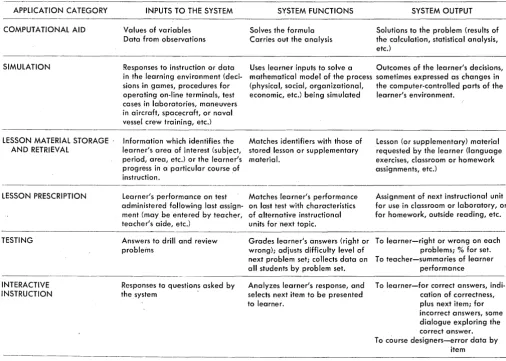
The purpose of this overview is to provide a framework, a few, specific examples to' complement those found elsewhere in this issue, and references to more de-tailed information. I do not intend to sell a potential user on instructional applications of computers; the cost can be high and the benefits are still in question. I do hope to influence other readers to invest research dollars and per-sonnel resources in work needed to make the systems and teaching stra tegies more usable. Therefore, I will discuss current problems as much as the potentials for interactive instruction systems which have already been overly praised in most popular journals.a brief history
At least three projects can claim to have begun planning in 1958. A demonstration of computer teaching of binary arithmetic was made at IBM's Thomas
J.
Watson Research Center, Yorktown Heights, N.Y., and was reported by Gus-tave Rath· and others in a book on "Automated Teaching" edited by Eugene Galanter (Wiley, 1959). A research ef-fort begun at System Development Corp. about the same time used the computer as a control unit for a random-ac-cess, projection device to provide a flexible teaching ma-chine for research on branching modes of programmed in-struction. J .C.R. Licklider and John Swets at Bolt Beranek and Newman were looking at a variety of uses, including the construction of graphs in response to requests made by students in analytic geometry.A second project at Watson Research Center grew out of William Uttal's work on teaching machines which required more logical capability than was conveniently achieved with special circuits. A project initiated by Donald Bitzer and Daniel Alpert at the University of Illinois at about the same time gave particular attention to the design of conve-nient learning stations for the student and the curriculum author. A conference sponsored by System Development. Corp. and the Office of Naval Research in October of 1961 included a good sampling of work on computer-aided in-struction and related fields. The proceedings of that