COMPUTERS
a n d
A U T O M A T I O N
DATA P R O C E S S I N G .
C Y B E R N E T I C S .
ROBOTS
International Conference
on Information Processing,
-
the Opening
A General Problem-Solving
Program for a
Computer
The Application of
a Computer
to Bank
Accounting
JULY
1959
•
Do computers
really pay?
47 users in the civil engineering field
alone, are proving that the Bendix G-15
more than pays its way.
The repeated computations encountered by civil engineers in the design of highways, bridges, dams and other public works, are tedious at best. With electronic computation the engineers are relieved of such uncreative work because the computer performs repetitive arithmetic automatically at high speed.
In time savings alone, the Bendix G-15 is a profitable tool. But add to that the value of the extra productive hours available to each engineer and the fact that the computer eliminates compromise solutions by finding the best answer through many "trial and error" solutions at tremendous speed - you can begin to see the important hidden profits of elec-tronic computing.
Many problems are being solved today on the Bendix G-15 that have never been solved before, because of the many man-years of math that manual methods would require. Profits here are so great that it is difficult to even measure them. Then there is the increased accuracy of electronic computing, with the resulting reduction of checking time.
The benefits are so many and varied that it is difficult to express them in dollars and cents. But consider the proof that 47 Bendix G-15s are being used in the civil engineering field alone. And in other fields - electronics, optics, tools, mis-siles, navigation, illumination, and even animal husbandry, the G-15 is making itself known as the computer that pays big profits in many ways. Full details are available on request.
DIVISION OF BENDIX AVIATION CORPORATION
PARTIAL LIST OF
CIVIL ENGINEERING USERS
Alfred Benesch and Associates Barber-Colman Company Bonneville Power Administration Bucyrus-Erie Company
Butler Manufacturing Company Clark, Daily and Dietz
Consoer, Townsend and Associates Cook County Highway Department Crawford, Murphy & Tilly De Leuw Cather and Company
Edwards and Kelcey, Engineers & Consultants Ellerbe and Company
Emmet J. McDonald Associates Harley, Ellington & Day, Inc.
Highway Research Board, AASHO, Road Test H. W. Lochner, Incorporated
Homer L. Chastain & Associates Hurst-Rosche, Incorporated Illinois Division of Highways
]. E. Greiner Company
J. Stephen Watkins, Consulting Engineers Jenkins, Merchant & Nankivil
John F. Meissner Engineers, Incorporated Lockwood, Kessler & Bartlett, Inc. Michigan State Highway Department
Palmer and Baker Engineers, Inc.
Parsons, Brinckerhoff, Hall and Macdonald Portland Cement Association
Reynolds, Smith & Hills
Richardson, Gordon and Associates Rochester and Goodell Engineers, Inc. Stanley Engineering Company Tudor Engineering Company
U. S. Army Corps of Engineers Vogt, Ivers, Seaman Associates Warren & Van Praag, Incorporated
Wilson and Company, Engineers & Architects Wyoming Department of Highways
DEPT. D-9A, Los ANGELES 45, CALIFORNIA
COMPUTERS
and
AUTOMATION
DATA PROCESSING
•
CYBERNETICS
•
ROBOTS
Volume 8
Number 7
JULY, 1959
Established September 1951
EDMUND C. BERKELEY Editor
H. JEFFERSON MILLS, JR. Assistant Editor
NEIL D. MACDONALD Assistant Editor
SERVICE AND SALES DIRECTOR
MILTON L. KAYE
535 Fifth Ave.
MUrray Hill 2-4194 New York 17, N.Y.
CONTRIBUTING EDITORS
ANDREW D. BOOTH
NED CHAPIN JOHN W. CARR, III
ALSTON S. HOUSEHOLDER
. ADVISORY COMMITTEE
MORTON ,M. ASTRA HAN
HOWARD T. ENGSTROM
GEORGE E. FORSYTHE
RICHARD W. HAMMING ALSTON S. HOUSEHOLDER
HERBERT F. MITCHELL, JR. SAMUEL B. WILLIAMS
ADVERTISING REPRESENTATIVES
Middle Atlantic States MILToN L. KAYE
535 Fifth Ave. New York 17, N.Y.
MUrray Hill 2-4194
TV ashington 6, D.C.
1519 Connecticut Ave.
San Francisco 5
605 Market St.
Los Angeles 5
439 S. Western Ave.
Elsewhere
ROBERT CADEL
COlumbia 5-9727
A. S. BABCOCK
YUkon 2-3954 W. F. GREEN
DUnkirk 7-8135
THE PUBLISHER
Berkeley Enterprises, Inc. 815 Washington St., Newtonville 60, Mass.
DEcatur 2-5453 or 2-3928
COMPUTERS and AUTOMATION is published monthly at 815 Washington St., Newtonville 60, Mass., by Berkeley Enterprises, Inc. Printed in U.S.A. '
SUBSCRIPTION RATES: (United States) $5.50 for 1 year, $10.50 for 2 years; (Canada) $6.00 for 1 year, $11.50 for 2 years; (Foreign) $6.50 for 1 year, $12.50 for 2 years. Address all Editorial and Subscription Mail to Berkeley Enterprises, Inc., 815 Washington St., Newtonville 60, Mass.
ENTERED AS SECOND CLASS MATIER at the Post Office at Boston, Mass.
~OSTMASTER: Please send all Forms 3579 to Berkeley Enterprises, Inc., 815 Washington St., Newtonville 60, Mass.
Copyri.ght © 1959, by Berkeley Enterprises, Inc. CHANGE OF ADDRESS: If your address changes, please send us both your new address and your old address (as it appears on the magazine address imprint), and allow three weeks for the change to be made.
4
FRONT COVER
Nuvistor Tube (RCA) Undergoing Shock Test. .1, 6
ARTICLES
International Conference on Information Processing -the Opening, HOWARD H. AIKEN, R. MAHEU, A.
DAN]ON, and H. VINEL 8
A General Problem-Solving Program for a Computer, A. NEWELL, J. C. SHAW, and H. A. SIMON 10
The Application of a Computer to Bank Accounting,
B. VV. TAUNTON
18
FOR BETTER EDUCATION
Report of "Progress
People
Red Tape Story Letters
READERS' AND EDITOR'S FORUM
On Debugging A Computer, VV. T. GANT . Computer or Man in Space?, S. DANISHEVSKY .
· 26 · 26
· 27 · 28
6 6
The Limits of Computer Power, EDMUND C. BERKELEY
6
Computer Art
9
Faithful Servant . 28
REFERENCE INFORMATION
Survey of Recent Articles, MOSES M. BERLIN . 30
New Patents, RAYMOND R. SKOLNICK. •
32
INDEX OF NOTICES
Advertising Index.
35
Back Copies see June, page 85
Bulk Subscriptions . see June, page 85
The Computer Directory & Buyer's Guide, 1959
see June, page 91
Manuscripts . see June, page 87
Who's VVho Entry Form . see June, page
95
r;
;'"~--~~~!~"'::i,:
~~~. ~";;~;~"";-'~';",~'";=:''' .":,~'t.
:",'~~~~-:-:~=~:=!~~'~~.',,:~~.'.
"~~~~!,: ,~,~ l~;'~!I.~ ~.~
:.1
Computer Programmers
I~J
, ,
l:
i
' ~ f
., !~l)
e,
.'
t ' ;
,e
'.
IBM offers attractive career opportunities to versatile, imaginative . ' programmers who want to break new ground in the fast-growing
!.,!
electronic computer field. You'll have unusual professional freedomI.
!
... work with specialists of diverse backgrounds ... have access to . i
~. ;
a wealth of systems know-how. Whether you like to work inde- ! ;
pendently or as a member of a small team, your contributions i~; and achievements will be quickly recognized. t. :
ASSIGNMENTS NOW OPEN INCLUDE •••
Mathematician-Programmer: to specify and program elements of a sophisticated automatic programming system.
Operational Programmer: to develop computer program techniques for real-time military applications using game theory and systems simulation.
Senior Programmer: to analyze engineering problems and develop machine programs for their solutions; to develop digital programs for simulating bombing and navigational problems.
Programmer: to write differential equations of circuit diagrams; to develop mathematical models of nuclear reactors; to investigate real-time control systems using high-speed digital and/or analog computers.
Diagnostic Programmer: to prepare diagnostic programs for real-time computers which will check for computer malfunction, diagnosing source of error for correction.
Systems Programmer: to generate efficient and unique logical programs for real-time control computers; to develop automatic FORTRAN-like coding systems for systems programs.
Mathematician: to handle mathematical analysis and 704 programming to solve systems problems, differential equations, probability-type problems, photo-grammetry problems.
704 Programmer: to analyze, program and code problems such as system simula-tion; to solve ordinary differential equations and numerical approximation of integrals.
Qualiflcations: B.S., M.S., Ph.D. in Mathematics or the Physical Sciences.
For details, write, outlining your background and interests, to:
Mr. R. E. Rodgers, Dept. 539-G IBM Corporation
590 Madison Avenue New York 22, New York
r /
! ,1
~,. i
i 1
,e
j
i~
,
i~i
, ,
t ~
, >
~
,-
~~ ~ ~~
r '
~ ~:
: . ,
Readers' and
Editor's Forum
FRONT COVER: NUVISTOR TUBE (RCA) UNDERGOING SHOCK TEST
The front cover shows an electronic tube of a new type called Nuvistor being tested in a special drop test of guillotine-type. The tube operates normally while under-going repeated blows with an impact equal to hundreds of
times its own weight, up to 850 times the force of gravity.
This type of tube is being developed by RCA Electron Tube Division, and is expected to be mass-produced in 1960. In size, it fits inside a thimble. It contains no mica or glass, but is made chiefly of steel, molybdenum, tungsten, and ceramic. It operates between plus 660 de-grees Fahrenheit and minus 320 degrees in liquid ni-trogen. The joints in the complete tube are processed at white heat, 2000 degrees F., in a brazing furnace and then in a vacuum exhaust furnace. It is constructed using cylindrical shapes and cantilever supports, to
re-sist vibration and shock. It requires much less power than previous tubes.
It will be used in high speed data processors and tele-vision sets, and for many other commercial, entertain-ment, and military purposes. The name comes from "nueva" meaning "new" and "vista" meaning "look."
ON DEBUGGING A COMPUTER
W. T. Gant Shell Oil Co. Midland, Texas
I have a comment concerning the article by C. R. Blair "On Economical Debugging" in the May 1959 is-sue of Computers and Automation. Mr. Blair suggests an efficient console that will waste less computer time than many waste today. This is certainly a step in the right direction but why stop short here? Why not de-velop debugging aids that will also include anything practical that one can do at a console? Some installations aren't far from such sophistication today. With this approach one not only increases the efficiency but also saves the expense of the extra hardware of the console. I for one will be glad when the computer manufac-turer leaves the console off completely except for main-tenance. In fact, I wonder if, in time, a console will really be justified there.
COMPUTER OR MAN IN SPACE?
I. From S. Danishevsky Harvard Univ. Cambridge 38, Mass.
When one thinks of a computer, he envisions a mas-sive, room-filling structure, with numerous cabinets, storages, and printers.
It is interesting if disconcerting to note then, th3;(! in a recent article in "Time," Dr. James Van Allen is qQoted as having said "Man is a fabulous nuisance in space, right now." Dr,. Van Allen 1?0es on to point out that
:,6
instruments are lighter, less demanding, and are also sensitive to many things a person's senses ignore.
Either man is considerably larger than he thinks he is, or the computer smaller.
II. From the Editor
There exist very powerful automatic digital compu-ters which occupy only a small space, particularly those constructed for airborne applications. In the future computers will be smaller still.
It really will be easier to send instruments with com-puter "brains" to explore space and report, than to send men. For example, it would be relatively easy to send a computer through the recently discovered belt of strong radiation around the earth. A man would need heavy shielding. Also, it would make little difference if the computer could not return. The man might not like to be certain of no return.
THE LIMITS OF COMPUTER POWER Edmund C. Berkeley
O
N MAY 28 in the mail we received the printed text of the 55 papers which were given at the Inter-national Conference on Information Processing m Paus June 13 to 20. In the next few days we spent about eight hours examining and reading them. Many of these papers are fascinating for they deal with the pres-ent frontiers of the powers of computers - even if some of the papers are comprehensible only to persons with advanced mathematical knowledge.Of these papers, we have at this time chosen three for publication in whole or in part in Computers and Automation, one U.S.S.R., one British, and one U.S.A., -because among many closely competing papers, these in particular seem to contain both interesting ideas and evidence of accomplishment, and seem to throw a bright light into the future development of computers and the directions in which they will be applied. These three papers are:
"Machine Translation Methods and their Application to Anglo-Russian Scheme" by I. K. Belskaya, Acad-emy of Sciences of the U.S.S.R.
"Time Sharing in Large Fast Computers," by C. Stra-chey, National Research Development Corp., Lon-don
"Report on a General Problem-Solving Program" by A. Newell and J. C. Shaw, the Rand Corp., and H. A. Simon, Carnegie Inst. of Technology
Other Frontiers
Of course there are other frontier fields besides those alluded to in the titles of the foregoing papers. One more field is for a computer to deal not only with digits and symbols, not only with words and their relations, but with meanings. We quote from the paper "A Re-duction Method for Non-Arithmetic Data and Its
Ap-[Please turn to page 29}
Here's how General Electric solves
typical
DC
power-supply problems
for computers and special applications
PROBLEM
SOLUTION
"We need to devote our engineering time
to designing our electronic circuitry.
not the power components.
JJThis is a frequent problem facing computer manu-facturers. General Electric's Rectifier Department has complete engineering and manufacturing capability not only to design and apply all types of power sup-plies, but also to incorporate power supplies into completely integrated systems.
'Qil.);U#&'
tilt's always a problem making sure transistorized equipment is safe from its power supply."
,j·'Hiid·n'
To alleviate this problem, General Electric has developed several meth-ods of making transistorized equip-ment safer in this respect. With G-E protective circuits, shorting a plus high-voltage bus to a plus or minus low-voltage bus would not cause the low-voltage bus to exceed a small percentage of nominal rated value. General Electric power supplies protect completely transistorized pieces of equipment from large losses due to over-voltage failures.
These systems could include load distribution, sup-ply sequencing, protection for power supsup-ply and load, and complete power distribution. Let General Electric tackle your DC power problems such as those asso-ciated with load IR drop, "cross talk," and other nuisance-type problems plaguing your engineers.
i
Q
;1.);"
#:'11
ti My power supply requirements fluctuate so much . .. big jobs, little jobs, all in between."
&i·j"in.U'
G.E. has built individual power sup-plies and complete systems ranging from less than one watt up to 35,000 kilowatts. These power supplies span the complete range of DC power-regulated and unpower-regulated-applying all types of components. G-E expe-rience includes completely transistor-ized supplies, and supplies with the new controlled rectifier, magnetic amplifiers, voltage stabilizing trans-formers, and motor-alternator "brute force" systems.
'Q;I.';U#~I
"We have a real low-voltage power distribution problem with our computer."
&i·",ut·n'
C Low-voltage
dis-100"'-"~ _ _ _ --J~ tribution
prob-u
o 100"
L::O-::"C""':'"AM'"'"'P=S--I---lems can be han-s died eahan-sily through
load compensa-tion. Curve "A" is net desired no-load to full-no-load regulation at no-load point. "B" is regulation at load with-out remote sensing or load compensa-tion. "C" represents IR compensation in power supply itself. "D" is amount of IR or load compensation.
NO MATTER WHAT your computer and other
special power-supply problems are, General Electric can help you economize-economize by helping you free your engineers of these problems. For more information on
power-supply products and services, contact your nearest General Electric Apparatus Sales Office or write to Section D535-2, General Electric Company, Schenectady, New York.
~gress
Is Our
Mosf
/mpoliqnt
P,()t/ue;f
GENERAL _
ELECTRIC
International Conference On
Information Processing
-The Opening
Paris, France, June
15 -
20,
,1959 --
June
15
Opening
The first session of the International Conference on Information Processing took place in the historic central lecture room of the Sorbo nne, of the University of Paris, at 11 :00 a.m. on June 15. All the other sessions of the conference took place in the beautiful and up-to-the-minute building of the United Nations Educational Scientific and Cultural Organization, at the Place de Fontenoy, in Paris. (See the picture.) Registration at the conference on the first day totaled over 1300.
The principal address at the opening was by Pro-fessor Howard H. Aiken, Harvard University, President of the Conference. There were four other speakers:
- Mr. Rene Maheu, acting Director General, UNES-CO;
- Mr. Andre Danjon, director of the Paris Observa-tory and President of the French Computing Associa-tion;
- Mr. Hugues Vinel, representative of the French Minister of State in Charge of Scientific Research; and - Prof. Pierre Auger, Secretary-General of the Con-ference.
Following are brief summaries of four of these addres-ses.
I.
Howard H. Aiken - "With Opportunity and Power Comes Responsibility for the Wise Use of Computer
Ideas"
First, I want to congratulate UNESCO and the small group which has made the preparations for this con-ference. We all are greatly indebted to them.
A short review of past developm'ents in the computer field will show the position we are now in, and the reason why we are here, and will help us extrapolate to the next decades.
The first two problems which the computer field faced at the beginning were these: constructing a com-puting device which would work; and showing that we could solve scientific problems set by other people. How far behind are these problems now!
Now we see very great improvements. Among the improvements are solid-state components, computers be-coming smaller and faster, and an improved theory of switching. This theory leads to the foundations of a theory of systems.
The application of machine ideas is having great
8
effects in many different ways: on commercial enter-prises; on the control of machinery; and in a great variety of other fields - automatic translation of langu-ages, the composition of music, the making of
con-cordances, . . .
The information-processing aspect of every segment of human activity is becoming our interest.
No group attending any conference ever faced so many challenging problems with so much chance of suc-cess and so great a potential influence on the lives of people and society in general, as do the members of this conference.
With opportunity and power comes responsibility -responsibility for the wise application of computer ideas for the public interest, for 'Thumanite entier."
n.
R. Maheu - ttThe Free Exchange of Ideas and Knowledge"
This is the second large-scale international scientific conference organized by Unesco in Paris - the first, held in 1957, covered the use of radio-isotopes in scien-tific research. In bringing scientists together at such conferences Unesco is fulfilling its mandate "to encour-age the unrestricted pursuit of objective truth and the free exchange of ideas and knowledge," to quote the words of its constitution.
It is impossible to-day to imagine a large factory, a large government office, or a large research laboratory, without a computation service in which a few of these machines replace a large number of specialized comput-ing staff.
One cannot even say that these machines take the place of men, because in fact they enable the perform-ance of operations which would be practically impossi-ble because of the number of man hours they would re-quire.
Thus man's intellectual power has been increased in an extraordinary manner by placing at his disposal inex-haustible memories and automatic calculation organs capable of ultra-rapid consultation, which can perform in a few seconds what once required weeks to accomplish.
III.
A. Danjon - ttprograms That Used to Be Madness" The invention of electronic mathematical computers,
Figure 1 - The UNESCO Building in Place de Fontenoy, Paris.
going back only fifteen years, deserves to be considered a landmark in the history of science in the same way as the invention of lenses or the microscope.
The ambitious program of the International Geophysi-cal Year would have been pure madness if we had not been certain of being able to analyze very rapidly all the data gathered from the entire surface of the earth.
The use of electronics has given a big impulse to as-tronomy, geodesy, geophysics (all traditionally big con-sumers of numbers), atomic physics, crystallography, genetics, biometry, and the social sciences, by opening hitherto-closed fields to their research workers.
An electronic computer would have made it easier for the French astronomer Le Verrier to have discovered Neptune in 1845. It would have also helped him in his studies of the irregularities in the long-term movement of the perihelion of Mercury's orbit; but it would not have made it unnecessary for Einstein to conceive the theory of relativity, no more than a machine perfectly aware of all theories in classical physics would have made it unnecessary for Becquerel to discover radioactivity.
Computer Art
COMPUTERS al1d AUTOMATION for July. 1959
IV.
H. Vine! - "A Choice of Various Solutions" Paris has become for a few days the meeting ground of the world's most eminent mathematicians, in additiqn to being the site of Unesco's permanent headquarters.
This conference should not only determine the logical structures of machines but, perhaps, it should also achieve a realization of their limits.
These machines have already served mankind, occa-sionally in military research, but also and above all in seeking the scientific knowledge which will be able to create our welfare of tomorrow.
The present-day complexity of science and technology requires a choice of various solutions. Only with elec-tronic processing can this be done within acceptable time-limits. To take some recent examples from our own country, this was how calculations were produced for the remarkable aircraft, the Caravelle; and this was how the plan for developing natural gas resources at Lacq was worked out.
This design symbolizes the enormous storage capacity of magnetic tape to store information. Its motif expresses: from the computer field - magnetic tape and magnetic tape reels, which may contain over 2400 feet of tape and over 100 million binary digits of information; from analytic geometry - asymptotic curves pointing to in-finity; from calculus - the mathematical expression meaning "the limit of the sum approaches"; and from mathematical logic - the Hebrew character aleph with a zero subscript (aleph naught), which was the sign used by Georg Cantor to designate the first transfinite cardinal number, the infinity of the class of natural numbers 1, 2, 3, 4, .... , which is also the infinity of all even numbers, of all rational fractions, and of a variety of other classes.
[image:9.594.46.551.36.268.2]A GENERAL PROBLEM-SOLVING
PROGRAM FOR A COMPUTER
A. Newell and
.T.
C. Shaw. Th~ RAND Corporation. and H. A. Simon, Carnegie Institute of Technology(Paper given at the International Conference on Information Processing, Paris, France, June 13-20, 1959)
This paper deals with the theory of problem solving.
It describes a program for a digital computer, called General Problem Solver I (GPS), which is part of an investigation into the extremely complex processes that are involved in intelligent, adaptive, and creative be-havior. Our principal means of investigation is syn-thesis: programming large digital computers to exhibit intelligent behavior, studying the structure of these computer programs, and examining the problem-solving and other adaptive behaviors that the programs produce. A problem exists whenever a problem solver desires some outcome or state of affairs that he does not im-mediately know how to attain. Imperfect knowledge about how to proceed is at the core of the genuinely problematic. Of course, some initial information is al-ways available. A genuine problem-solving process in-volves the repeated use of available information to ini-tiate exploration, which discloses, in turn, more infor-mation until a way to attain the solution is finally dis-covered.
Many kinds of information can aid in solving prob-lems: information may suggest the order in which pos-sible solutions should be examined; it may rule out a whole class of solutions previously thought possible; it may provide a cheap test to distinguish likely from un-likely possibilities; and so on. All these kinds of infor-mation are heuristics - things that aid discovery. Heuristics seldom provide infallible guidance; they give practical knowledge, possessing only empirical validity. Often they "work," but the results are variable and success is seldom guaranteed.
The theory of problem solving is concerned with dis-covering and understanding systems of heuristics. What
kind~ are there? How do very general injunctions ("Draw
a figure" or "Simplify") exert their effects? What heuristics do humans actually use? How are new heuris-tics discovered? And so on. GPS, the program described in this paper, contributes to the theory of problem solv-ing by embodysolv-ing two very general systems of heuris-tics - means-ends analysis and planning - within an organization that allows them to be applied to varying subject matters.
GPS grew out of an earlier computer program, the Logic Theorist (5, 8), which discovered proofs to theor-ems in the sentential calculus of Whitehead and Russell.
10
It exhibited considerable problem-solving ability. Its heuristics were largely based on the introspections of its designers, and were closely tied to the subject matter of symbolic logic.
The effectiveness of the Logic Theorist led to revised programs aimed at simulating in detail the problem-solving behavior of human subjects in the psychological laboratory. The human data were obtained by asking college sophomores to solve problems in symbolic logic, "thinking aloud" as much as possible while they worked. GPS is the program we constructed to describe as
close-ly as possible the behavior of the laboratory subjects as revealed in their oral comments and in the steps they wrote down in working the problems. How far it is successful in simulating the subjects' behavior - its usefulness as a phychological theory of human thinking - will be reported elsewhere (7).
We shall first describe the overall structure of GPS, and the kinds of problems it can tackle. Then we shall describe two important systems of heuristics it employs. The first is the heuristic of means-ends analysis, which we shall illustrate with the tasks of proving theorems in symbolic logic and proving simple trigonometric identities. The second is the heuristic of constructing general plans of solutions, which we shall illustrate, again, with symbolic logic.
The Executive Program and the Task Environment
GPS operates on problems that can be formulated in terms of objects and operators. An operator is some-thing than can be applied to certain objects to produce different objects (as a saw applied to logs produces boards). The objects can be characterized by the fea-tures they possess, and by the differences that can be ob-served between pairs of objects. Operators may be re-stricted to apply to only certain kinds of objects; and ther'e may be operators that are applied to several ob-jects as inputs, producing one or more obob-jects as out-put (as the operation of adding two numbers produces a third number, their sum).
Various problems can be formulated in a task en-vironment containing objects and operators: to find a way to transform a given object into another; to find an object possessing a given feature; to modify an object so that a given operator may be applied to it; and so on. In
chess, for example, if we take chess positions as the ob-jects and legal moves as the operators, then moves pro-duce new positions (objects) from old. Not every move can be made in every position. The problem in chess is to get from a given object - the current position - to an object having a specified feature ( a position in which the opponent's King is checkmated).
The problem of proving therems in a formal mathe-matical system is readily put in the same form. Here the objects are theorems, while the operators are the admis-sible rules of inference. To prove a theorem is to trans-form some initial objects - the axioms - into a speci-fied object - the desired theorem. Similarly, in integrat-ing functions in closed form, the objects are the mathe-matical expressions; the operators are the operations of algebra, together with formulas that define special func-tions like sine and cosine. Integration in closed form is an operation that does not apply directly to every ob-ject - if it did, there would be no problem. Integration involves transforming a given object into an equivalent object that is integrable, where equivalence is defined by the set of operations that can be applied.
Consructing a computer program can also be described as a problem in these same terms. Here, the objects are possible contents of the computer memory; the oper-ators are computer instructions that alter the memory content. A program is a sequence of operators that transforms one state of memory into another; the pro-gramming problem is to find such a sequence when cer-tain features of the initial and terminal states are speci-fied.
To operate generally within a task environment characterized by objects and operators, GPS needs sev-eral main components:
1. A vocabulary, for talking about the task environ-ment, containing terms like: object, operator, dif-ference, feature, Object #34, Operator #7. 2. A vocabulary, dealing with the organization of
the problem-solving processes, containing terms like: goal type, method, evaluation, Goal Type #2, Method #1, Goal #14.
3. A set of programs defining the terms of the prob-lem-solving vocabulary by terms in the vocabulary for describing the task environment. (We shall provide a number of examples presently.) 4. A set of programs (correlative definitions)
apply-ing the terms of the task-environment vocabulary to a particular environment: symbolic logic, trig-onometry, algebra, integral calculus. (These will also be illustrated in some detail.)
Items 2 and 3 of the above list, together with the common nouns, but not the proper nouns, of item 1 constitute GPS, properly speaking. Item 4 and the proper nouns of item 1 are required to give GPS the capacity to solve problems relating to a specified sub-ject matter. Speaking broadly, the core of GPS con-sists of some general, but fairly powerful, problem-solv-ing heuristics. To apply these heuristics to a particular problem domain, GPS must be augmented by the defini-tions and rules of mathematics or logic that describe that domain, and then must be given a problem or series of . problems to solve. The justification for calling GPS "general" lies in this factorization of p~oblem-solving heuristics from subject matter, and its ability to use the same heuristics to deal with different subjects.
COMPUTERS and AUTOMATION for July, 1959
Goal not achieved
Fig. 1 - Executive organization of GPS Command to
achieve goal
,
Evaluate goal
--
RejectAccept
Select method for this type goal
Execute method
Goal achieved
Do not try to achieve
Let us look more closely at the problem-solving vo-cabulary and heuristics. To specify problems and sub-problems, GPS has a discrete set of goal types. We shall introduce two of these initially:
Goal Type #1: Find a way to transform object a into object b. (The objects, a and b, may be any ob-jects defined in specifying the task environment. The phrase "way to transform" implies "by ap-plying a sequence of operators from the task en-vironment." )
Goal Type #2: Apply operator q to object a (or to an object obtained from a by admissible transforma-tions).
Finding a proof of a theorem (object b) from axioms (object a) is an example of a Type #1 goal; integrating (operator q) an expression (object a) is an example of a Type #2 goal.
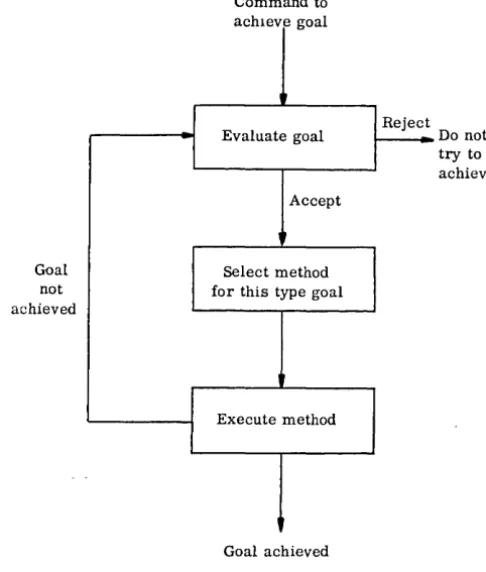
The executive organization of GPS, shown in Figure 1, is very simple. With each goal type is associated a set of methods related to achieving goals of that type. When an attempt is made to achieve a goal, it is first evaluated to see whether it is worthwhile achieving and whether achieve-ment seems likely. If so, one of the methods is selected and executed. This either leads to success or to a repeti-tion of the loop.
The principal heuristics of GPS are imbedded in the methods. All the heuristics apply the following general principle:
The principle of sub goal reduction: Make progress by substituting for the achievem.ent of a goal the achievement of a set of easier goals.
. Thi.s is, i~deed? only a heuristic principle, and it is not 'as: self-evident as it may appear. For example, none of -the programs so far written for chess or checkers makes
es-~ential use of the principle (1, 3, 6).
The' constant use of this principle makes GPS a highly
[image:11.599.310.553.33.319.2]recursive program, for the attempt to achieve one goal leads to other goals, and these, in turn, to still other goals. Thus, identical goal types and methods are used many times simultaneously at various levels in the goal struc-ture in solving a single problem. Application of the prin-ciple also combines the goals and methods into organized systems of heuristics, rather than establishing each method as an independent heuristic. We shall provide examples of two such systems in this paper.
Functional or Means-ends Analysis
Means-ends analysis, one of the most frequently used problem-solving heuristics, is typified by the following kind of common sense argument:
I want to take my son to nursery school. What's the difference between what I have and what I want? One of distance. What changes distance? My automobile. My automobile won't work. What's needed to make it work? A new battery. What has new batteries? An auto repair shop. I want the repair shop to put in a new battery; but the shop doesn't know I need one. What is the difficulty? One of communication. What allows communications? A telephone ... And so on.
This kind of analysis - classifying things in terms of the functions they serve, and oscillating among ends, func-tions required, and means that perform them - forms the basic system of heuristic of GPS. More precisely, this means-ends system of heuristic assumes the following:
1. If an object is given that is not the desired one, dif-ferences will be detectable between the available ob-ject and the desired obob-ject.
2. Operators affect some features of their operands and leave others unchanged. Hence operators can be characterized by the changes they produce and can be used to try to eliminate differences between the objects to which they are applied and desired objects. 3. Some differences will prove more difficult to affect than others. It is profitable, therefore, to try to eliminate "difficult" differences, even at the cost of introducing new differences of lesser difficulty. This process can be repeated as long as progress is being made toward eliminating the more difficult differ-ences.
To incorporate this heuristic in GPS, we expand the vo-cabulary of goal types to include:
Goal Type #3: Reduce the difference, d, between ob-ject a and object b by modifying a.
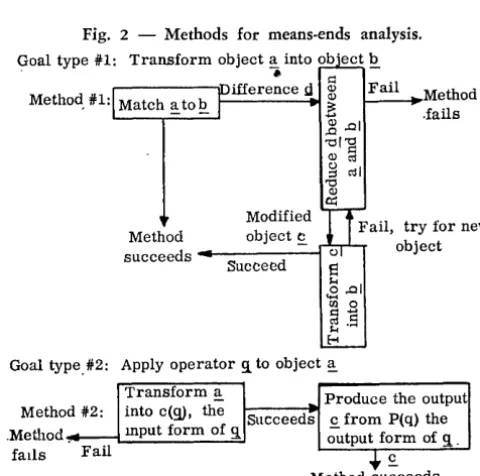
The core of the system of functional analysis is given by three methods, one associated with each of the three goal types, as shown in Figure 2. Method
#
1, associated with Goal Type #1, consists in: (a) matching the objects aand b to find a difference, d, between them; (b) setting up the Type
#
3 subgoal of reducing d, which if successful produces a new transformed object c,' (c) setting up the Type#
1 subgoal of transforming c into b. If this last . goal is achieved, the original Type#
1 goal is achieved. The'match in step (a) tests for the more important differ-ences first. It also automatically makes substitutions tor free variables.- " Method #2, for achieving a Type #2 goal, consists in: (a) determining if the operator can be applied by set-ting up a Type
#
1 goal for transforming a into C (q), the ,input form of q; (b) if successful, the output object is 1·12produced from P ( q), the output form of q. This method is appropriate where the operator is given by two forms, one describing the input, or conditions, and the other the out-put, or product. The examples given in this paper have operators of this kind. Variants of this method exist for an operator given by a program, defined iteratively, or de-fined recursively.
Method # 3, for achieving a Type # 3 goal, consists-in: ( a) searching for an operator that is relevant to re-ducing the difference, d; (b) if one is found, setting up the Type #2 goal of applying the operator, which if
successful produces the modified object.
Application to Symbolic Logic. This system of heuris-tics already gives GPS some problem-solving ability. We can apply GPS to a simple problem in symbolic logic. To do so we must provide correlative definitions for objects, operators, and differences. These are summarized in Figure
3. We must also associate with each difference the opera-tors that are relevant to modifying it. For logic this is accomplished explicitly by the table of connections in Figure 3. These connections are given to GPS, but it is not difficult to write a program that will permit GPS it-self to infer the connections from the lists of operators and differences. (E.g., comparing the right side of RI with its left side, we find they have the difference .6P, for the symbols A and B appear in opposite orders on the two sides; hence, there is a connection between .6P, and R1.) Finally, we provide criteria of progress, in terms of a list of the differences in order of difficulty.
An illustrative logic problem and its solution are shown in Figure 4. The object, LI, is given, and GPS is re-quired to derive the object, LO. The problem is stated to GPS in the form of a Type #1 goal; (Goal 1) Find a
Fig. 2 - Methods for means-ends analysis. Goal type #1: Transform object a into ob'ect b
,
.
~-ifference d ~ Fail Method
Modified
Method object ~
~ .fails
~ ..a 1
"01]
Q) ~
g
~I"0 Q)
0:;
succeeds .... -S-u-c-ce-e-d--I ~
Fail, try for new object
.8
..a 1 CIl 0~ ...
~ .S
E-4
Goal type.#2: Apply operator 9. to object ~
d #2: Metho .Method
falls
~
Fail
Transform ~
into c(g), the mput form of ~
__ Produce the output Succeeds £. from P(q) the
output form of 9.. _
.!-£
Method succeeds
Goal type #3: Reduce the difference, £, between object ~
an~ object Q.
Method #3:
Method fails
Method succeeds
[image:12.599.304.544.403.641.2]Figure 3
Figure 3a. Symbolic ;Logic Task Environment, Part I.
Objects. Expressions are built up recursively from variables,
P, Q, R, . . . . , three binary connectives, ., ~, v, and the unary prefix, - , called tilde. Examples of objects: P, -Q, PvQ, (-R.P) ~
-Q.
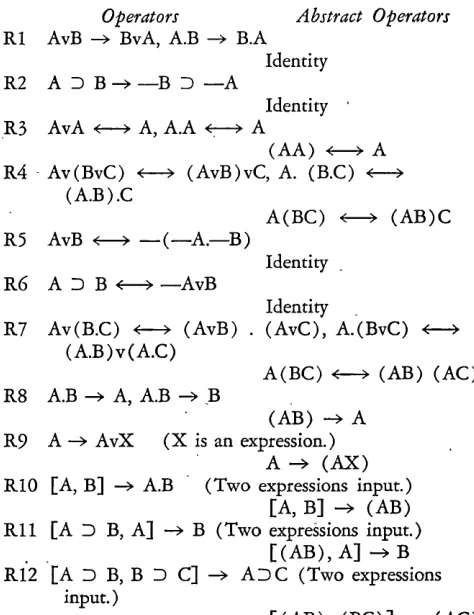
Double Tildes cancel as in ordinary algebra: - -Q =Q.Operators. There are twelve operators, given in the form C(q) ~ P(q), where C(q) is the input form, and P(q) is the output form. Thus anything of the form at the tail of an arrow can be transformed into the corresponding expression at the head of the arrow. A double arrow means the transformation works both ways. The abstracted opera-tors, used in the planning method, are given in the right-hand column opposite the operator.
Operators Abstract Operators
Rl AvB ~ BvA, A.B ~ B.A Identity R2 A ~ B ~ -B ~ -A
Identity
R3 AvA ~ A,A.A ~ A
(AA) ~ A
R4 - Av(BvC) ~ (AvB)vC, A. (B.C) ~
(A.B).C
R5 AvB ~ -(-A.-B)
R6 A ~ B ~-AvB
R7 Av(B.C) ~ (AvB)
(A.B)v(A.C)
R8 A.B ~ A, A.B ~ _B
A(BC) ~ (AB)C
Identity
Identity
(AvC), A.(BvC) ~
A(BC) ~ (AB) (AC)
(AB) ~ A R9 A ~ Av X (X is an expression.)
, A ~ (AX)
RIO [A, B] ~ A.B ' (Two expressions input.) [A, B] ~ (AB) Rl1 [A ~ B, A] ~ B (Two expressions input.)
[(AB), A] ~ B R12 [A ~ B, B ~ C] ~ A~ C (Two expressions
input.)
[(AB), (BC)] ~ (Ae)
Differences. The ,differences apply to subexpressions as well as total expressions, and several differences may exist simultaneously for the same expressions.
6. V A variable appears in one expression that does not in the other. E.g., Pv P differs by + V from PvQ, since it needs a Q; P ~ R differs by -V from R, since it needs to lose the P.
6N _ A vaJiabl~ OCqIrs different numbers of times in the two expressions. E.g., P.Q differs from (P.Q) ~ Q by +N, since it needs anoth-er Q; PvP differs from P by -N, since it needs to reduce .the nu,m-ber of P's.
6. T There is a difference in the "sign" of the two ex-pressions; e.g., Q versus
-Q,
or -(PvR) versusPvR. ' ~
6C There is a difference in binary connective;- e.g., P ~ Q versus PvQ.
"6.G There is a difference in grouping;' e.g., Pv'(QvR)
versus (PvQ) v R. '
',CO~~U~ERS an.d AUTOMATION for July, 1959
6P There is a posltlOn difference in the components of the two expressions; e.g., P ~ (QvR) versus
[image:13.595.53.290.197.505.2](QvR) ~ P. '
Figure 3b. Symbolic Logic Task Environment, 'Part II.
C a 1Z1zectiol1S between Differences and Operators. A
+,-,
or x in a cell means that the operator in the column of the cell affects the difference in the row of the cell. + in the first row means + V) - means -V, etc. The stars show the differences and operators that remain after ab-stracting, and thus mark the reduced table of connections used in the abstract task environment for planning.
*
*
*
::~ ::~*
*
RI R2 R3 R4 R5 R6 R7,RS R9 RIO_RI! Rl2 *6. V
*~N
6.T 6.C *6G
x
6.P x x x
x x x
x x
x x x
+ +
+ +
x x
Criteria of progress. All differences i~ sub expressions are less important than differences in expressions. For a pair of expressions the differences are ranked: + V, -V, +N, :-N, 6. T, 6C, 6.G; 6.P, from most important to least. E.g., '6. T is more important in -(PvQ) versus P ~ Q, but 6. C is more important in -PvQ versUs 'P -~ Q.
way to transform Ll into LO. -By Figure 2; this goal type calls for- Method # 1. Comparison of LL and· LO- shows that they have the difference, .6P; for the "R"_ is on the left end of Ll, but on the right end of.~LO~--GPS now erects the Type #3 goai; (Goaf2) Reduce 6.P,'between Ll and LO. -Goal Type #3 calls for application of Method #3.· Since, the table of connections '(Figure 3) shows that Rl is relevant to reducing 6.P, GPS erects the· Type #2 goal: (Goal 3) Apply operator Rl to L1. 'The· reader can follow the remaining -steps that lead to the s()lution from Figure 4. The resulting derivation .may be
sum-marized: . ,
Object Operator
Ll = R. (-P~Q)
12 = (-P~Q).R Apply Rl to Ll, 1 '
L3 = (P v Q).R Apply R6 to left side of L2 L4 . (Q v P).R Apply Rl to left side of L3 L4 is identical with LO Q. E. D.
GPS can 'solve problems a good deal more difficult 'than the simple one illustrared. To make full use of the twelve operators, an additional method is added to the Type #3
goal that searches the available objects for the additional input required in rules RIO, R:ll, and R12.
; Application to ,Trigonometry. GPS is a general prob-lem solver to the extent that its heuristics can be applied to varying subject-matrers; given.'the- appropriate correlative '. ':definitio-!IS: ~ Elementary algebra_ and .calcuhis~ provides a . csupject'
marter'
aistinCt' from :logic, -and F igure ~S-'shows' the ffraginegt ~,ot :this task ;eirvironment.-!lecess~;:Y" for DPS- ·to ! try':ro prove 'some: simple trigonomerric~ identities. : 'The rob-': (jeets are .flOW . algebraiC' ~tia trigonO'metric expressions; and l..the 'operarors perfbrtnti.actodzat'ion,: l!lgebraic' simplificadon, and trigonometric transformation. The differen~es ~
are,
the same ~ inM,IQgk; ~~(ept~Jor two {>missions,o which are re-lated to -the -associative and coriUn{itative laws. In logic Nlhese )"'rnusr : be' petformet{, explr&itly rLl\Vh~telts in .or.dinaryI algebra' a nC?,tatipn is ,usedJ-tltat asn:kes7,"ml;sel,;1iw~ ~implkit
Figure 4. Example of means-ends analysis in logic.
Given: Ll
=
R.(-P:JQ) Obtain: LO=
(QvP).R Goal 1: Transform Ll into LO.Match produces position difference (6P). Goal 2: Reduce 6P between Ll and LO.
First operator found is Rl. Goal 3: Apply Rl to L1.
Goal 4: Transform Ll into C(Rl).
Match succeeds with A = R and B = -P :J Q. Produce new object: ,
L2 = (-P:JQ).R
Goal 5: Transform L2 into LO.
Match produces connective difference (6 C) in left subexpression.
Goal 6: Reduce 6C between left of L2 and left of LO." First operator found is R5.
Goal 7: Apply R5 to left of L2.
GoalS: Transform left of L2 into C(R5).
Match produces connective difference (6 C) in left subexpression.
Goal 9: Reduce 6 C between left of L2 and C (R5 ) . Goal rejected: difference is no easier than difference
in Goal 6.
Second operator found is R6. Goal 10: Apply R6 to left of 12.
Goal 11: Transform left of L2 into C(R6). Match succeeds with A
=
- P and B=
Q. Produce new object:L3 = (PvQ).R
Goal 12: Transform L3 into LO.
Match produces position difference (6P) in left subexpression.
Goal 13: Reduce 6 P between left of L3 and left of LO.
First operator found is Rl. Goal 14: Apply R1 to left of L3.
Goal 15: Transform left of L3 into C(Rl). Match succeeds with A
=
P and B=
Q. Produce new object:L4 = (QvP).R
Goal 16: Transform 14 into LO.
Match shows L4 is identical with LO, QED.
and their operation automatic. The connections between differences and operators is not made via a simple table, as in logic, but requires a comparison of the object with the output form of the operator. The criteria of progress re-main the same as for logic.
GPS can now attempt to prove a trigonometric identity like:
(tan + cot) sin cos
=
1This is given as the problem of transforming the left side, which becomes Ll, into the right side, LO. The pro-cess of solving the problem, which involves 33 goals and subgoals, is shown in Figure 6, which is to.. be interpreted . in exactly the same way as Figure 4, with the llelp of Figures 2 and 5, except that the methods are not melltioned , explicitly.
Planning as a Problem-Solving Tec~nique
The second system of heuristic used by GPS is a form 01
planning that allows GPS to COnstruct a proposed solution
::14
in general terms before working out the details. It acts as
an antidote to the limitation of means-ends analysis in seeing only one step ahead. It also provides an example of the use of an auxiliary problem in a different task environ-ment to aid in the solution of a problem.
*
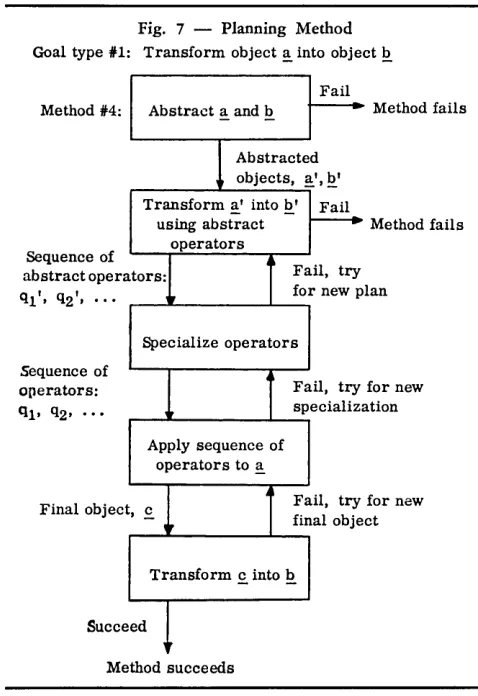
Planning is in-corporated in GPS by adding a new method, Method #4, to the repertoire of the Type#
1 goal.This Planning Method (see Figure 7) consists in (a) abstracting by omitting certain details of the original ob-jects and operators, (b) forming the corresponding prob-lem in the abstract task environment, ( c) when the ab-stract problem has been solved, using its solution to
pro-Figure 5. Trigonometry task environment
Objects. Ordinary algebraic expressions, including the trigonometric functions. The associative and
commuta-tive laws are implicit in the notation: the program can select freely which terms to use in an expression like
(x
+
y+
z). Operators.AO Combine: recursively defined to apply the fol-lowing elementary identities from the inner-most subexpressions to the main expression: (1) A + (B
+
C) ~ A+ B+
C, A(BC) ~ABC
(2) A
+
0 ~ A, A+
A ~ 2A, A - A ~O(3) AO ~ 0, Al ~ A, AA ~ A2, AB AC ~ AB+C
(4) AO ~ 1, OA ~ 0, At ~ A, (AB)C ~ ABC
Al (A - B) (A
+
B) ~ A2 - B2A2 (A
+
B)2 ~ A2 + 2AB+
B2A3 A(B + C) ~ AB
+
ACTl tan x ~ l/cot x
T2 (tan x) (cot x) ~ 1
T3 tan x ~ sin x / cos x T4 cot x ~ cos x / sin x
T5 sin2x
+
cos2x ~ 1Differences. Defined as in logic: 6 V, 6N, 6 C, 6 T, and 6 G and 6 P do not occur in algebra, since associativity and commutativity are built into the programs for hand-ling expressions. The trigonometric functions are de-tected by 6 V and 6N.
Connections between Differences and Operators. A
+,
- , or x in a cell means that the operator in the column of the cell affects the difference in the row of the cell. A t means that the test defined at the bottom is applied.AO Al A2 A3 Tl T2 T3 T4 T5
6V
t t t t t6C x x x x
6N x x x t t t t t
6T x
Test t: accept if other functions in output form already occur in expression.
Criteria of progress. Defined as in logic, but with 6C more important than 6N or 6P .
*
See the work of H. Gelernter and N. Rochester on theorem proving programs for plane geometry (2), where the geometric diagram provides an example of a very powerful auxiliary prob-lemlem space. [image:14.599.40.288.29.512.2] [image:14.599.297.547.178.682.2]Figure 6. Example of means-ends analysis in trigonometry
Given: 11 = (tan x
+
cot x) sin x cos x Obtain: 10 = 1Goal 1: Transform 11 into 10.
Goal 2: reduce -V between 11 and 10 (tan). Goal 3: Apply AO (combine) to 10 [no change
produced].
Goal 4: Apply Tl to 11.
Goal 5: Transform 11 into C(Tl) [succeeds] 12 = [(l/cot x)
+
cot x] sin x cos x Goal 6: Transform 12 into LO.Goal 7: Reduce -V between 12 and 10 (cot). Goal 8: Apply AO to 12 [no change produced]. Goal 9: Apply T4 to 12.
Goal 10: Transform 12 into C(T4) [succeeds]. 13 = [( 1/ ( cos x/sin x»
+ (
cos x/sin x)] sin xcos x
Goal 11: Transform 13 into 10.
Goal 12: Reduce -V between 13 and 10 (cos). Goal 13: Apply AO to 13:
14 = [( sin x/cos x)
+ (
cos x/sin x)] sin x cos x Goal 14: Transform 14 into 10.Goal 15: Reduce -V between 14 and 10 (sin). Goal 16: Apply AO to 14 [no change produced]. Goal 17: Apply T5 to 14.
Goal 18: Transform 14 into C(T5).
Goal 19: Reduce 6.C between 14 and C(T5) (. to
+).
Goal 20: Apply AO to 14 [no change produced]. Goal 21: Apply Al to 14.
Goal 22: Transform 14 into C(Al).
Goal 23: Reduce 6.C between 14 and C(Al) [re-ject] .
Goal 24: Apply A3 to 14.
Goal 25: Transform 14 into C(A3) [succeeds]. 15 = [sin x/cos x]sin x cos x
+
[cos x/sin x]sinx cos x
Goal 26: Transform 15 into C(T5).
Goal 27: Reduce 6. C between left of 15 and left of C(T5).
Goal 28: Apply AO to left of 15: 16 = sin2x
+
[cos x/sin x] sin x cos xGoal 29: Transform 16 into C(T5).
Goal 30: Reduce 6. C between right of 16 and right of C(T
Goal 31: Apply AO to right of 16: 17 = sin2x
+
cos2xGoal 32: Transform 17 into C(T5) [succeeds]. 18=1
Goal 33: Transform 18 into 10 [identical], QED.
vide a plan for solving the original problem, (d) translat-ing the plan back into the original task environment and executing it. The power of the method rests on two facts. First, the entire machinery of GPS can be used to solve the abstract problem in its appropriate task environment; and, because of the suppression of detail, this is usually a simpler problem (having fewer steps) than the original one. Second, the subproblems that make up the plan are col-lectively simpler (each having few steps) than the original problem. Since the exploration required to solve a problem generally increases exponentially with the number of steps in the solution, replacement of a single large problem with
COMPUtERS and AUTOMATION for July, 1959
several smaller problems, the sum of whose lengths is about equal to the length of the original problem, may reduce the problem difficulty by whole orders of magnitude.
Figure 8 shows the Planning Method applied to a prob-lem of symbolic logic. The particular abstraction scheme that is illustrated ignores differences among connectives and the order of symbols (6. C and 6.P), replacing, for example, "(R:J-P) . (-R:JQ)" with "(PR) (QR)". The operators are similarly abstracted, so that "AvB~BvA"
Fig. 7 - Planning Method Goal type 11: Transform object!!. into object ~
Fail
Method #4: Abstract a and b Method fails
Abstracted objects, !!.',~'
Transform !!.' into ~' Fail
using abstract Method fails
Sequence of abstract operators:
operators
Fail, try for new plan
Sequence of operators:
Ql' q2' •••
Specialize operators
Fail, try for new specialization
r-~---~~
Apply sequence of operators to !!.
Final object, £. Fail, try for new
final object
Transform £. into ~
Succeed
Method succeeds
becomes "( AB ) ~ (AB ) "i.e., the identity operator
-and "A.B~A" becomes "(AB)~A", as shown in Figure
3. The abstracted problem, Transform Al into AO, has several solutions in the abstracted task environment. One of these may be summarized:
Object Al (PR) (QR)
A2 (PR)
A3 (QR)
(PQ)
But (PQ) is identical
Operation
Apply R8 to get left side of At Apply R8 to get right side of Al Apply R12 to A2 and A3
with AO Q. E. D.
Transforming Al into AO is the abstract equivalent of the problem of transforming 11 into LO. The former is solved by applying the abstracted operators corresponding to R8, R8, and R12 in sequence. Hence (Figure 9, Goal 4) a plan for solving the original problem is to try to apply R8 to 11 (obtaining a new object whose abstract equiv-alent is (PR), applying R8 to the other side of 11 (obtain-ing an object correspond(obtain-ing to (QR) ), apply(obtain-ing R12 to the objects thus obtained, and finally, transforming this new object (which should be an abstract equivalent of LO) into 10. Each of the first three parts of this plan constitutes a Type #2 goal in the original task
[image:15.594.58.291.33.627.2] [image:15.594.310.549.120.468.2]'Figure 8. Example
Given: L~ = (R::J-P). (-R::JQ) Obtam: LO = - (-Q.P)
Goal 1: 'Transform Ll into LO [Method #1 fails; now Method
#=
4 is tried].Abstract Ll and ]..0:
Al = (PR) (QR) AO = (PQ)
Goal 2: Transform Al into Ao [using abstracted operators] .
Several plans are generated [details are omitted]: PI = RS, Rl1, R12.
P2 = RS, RS, R12. P3= ...
Goal 3: Apply PI to Ll [fails, details are omitted]. Goal 4: Apply P2 to L1.
Goal 5: Apply R8 to L1.
Goal 6: Transform Ll into C(R8) [succeeds]. L2 = R::J-P
Goal 7: Apply RS to L1.
Goal S: Transform Ll into C(RS) [succeeds]. L3 = -R::JQ
Goal 9: Apply R12 to L2 and L3.
ment - that is, it requires the application of a specified operator to a specified expression. These three Type #2 goals are Goals 5, 7, and 9, respectively, in Figure S. The first two are achieved almost trivially, and the third re-quires only five subgoals. The result is the expression, L5, which is to be transformed to LO, as indicated, by a Type # 1 goal (Goal 15). Note that achieving the plan only
in-E~
"R.OADV'E"W" R.",SEAR.CH COR.POR.AT'ON••• is seeking computer programmers and applications analysts for both scientific computations 'and c'ommer-cial data processing. The prog~amming fo~. scientific computation requires experience with the IBM 700 series or the RR I 100 series. Current projects involve satemte orbits, photogr~mmetry, 'and numerical solution of differentia'i equations. The data processing projects involve 0 programlTling large, new computers being
devel-oped by IBM, Sylvania, Philco, and Burroughs for a vari-ety of logistical, administrative and systems simulation objectives. The principal requirement for the analysts is a ~igh, degree C?f skill in the precise formulation of re-quirements ,for computer programs in the commercial data 'proces~ing area.
Openings 'exist at Burlingame, California;· Alamogordo, New Mexico; and Fort Huachuca, Arizona.
BrQadview offers the many advantages of a growing research, 'and development organization owned and managed by technical personnel. Main offices and
lab~r.atories are located on the San Francisco peninsula near both the University of California' and Stanford Uni'versity. Individual responsibility and professional devel-opment' are encouraged.
Please send r~sumes to: Mr. Joseph Rosenbaum
Broadview Research Corporation
, , 181 I Trousdale Drive
BurHngame, California,
16:
of planning in logic:
Goal 10: Transform L2 and L3 into C(RI2) [L2 fits B::J C].
Goal 11: Reduce 6,P between L3 and C(RI2) (A::J B with B = R).
Goal 12: Apply R2 to L3.
Goal 13: Transform L3 into C(R2) [succeeds]. L4 = -Q::JR
Goal 14: Transform L2 and L4 into C(RI2) [suc-ceeds].
L5 = -Q::J-P
Goal 15: Transform L5 into LO.
Goal 16: Reduce 6, T between L5 and LO. Goal 17: Apply R2 to L5 [fails, details omitted]. Goal 18: Apply R5 to L5.
o Goal 19: Transform L5 into C (R5 ).
Goal 20: Reduce, 6, C between L5 and C (R5). Goal 21: Apply R5 to L5 [reject].
Goal 22: Apply R6 to L5.
,Goal 23: Transform L5 into C(R6) [succeeds]. L6 = Qv-P
Goal 24: Transform L6 into C(R5) [succeeds]. L7 = -(-Q.P)
Go<i125: Transform L7 into LO [identical], QED.
volves operators that become the identity operator upon abstraction.
Like the other heuristics, the planning heuristic offers no guarantees that it will always work. It may generate no plan,' a single plan, or several. More serious, a plan may turn out to be illusory - it may prove impossible to carry it out. The first plan generated in the illustrative prob-lem, for example - RS, Rll, R12 - does not provide a basis for a valid derivation when it is translated back to the concrete task environment. The time wasted in fruitless efforts to execute invalid plans must be counted in evalu-ating the planning heuristic, but even when allowance is made for this cost, the heuristic remains a very powerful one.
Conclusion
We have now described the principal heuristics that are used by GPS, and have shown how these heuristics en-able it to solve problems. Although limitations of space
prev:en~ full discussion, we would like to conclude by
mentioning several aspects of GPS that have received in-adequate treatment in this paper.
1. GPS requires additional goals and methods, and we have investigated a number of these to varying degrees. For example, in many problems features of objects come to play a larger role than differences between objects -e.g:, control of center in chess. A goal and methods similar to Type # 3 are needed to handle features. Solving single equations in one variable also requires a new goal and new methods, embodying such heuristics as operating on both sides of an equation to isolate the variable. This goal is al-ready needed in trigonometry to recognize that (sin4
x-cos4x) is of the form (y2_
Z2), so that it can be factored.
Already GPS can handle algebraic simplification with its present repertoire, and integration of relatively simple ex-pressions with the aid of a table of integrals. There is some hope, as the example introducing means-ends analysis indi-cates, that GPS may be capable of the common sense thinking that gets moSt humans through the details of each day's living. .