R E S E A R C H A R T I C L E
Open Access
Development and validation of a telephone
classification interview for common chronic
headache disorders
Rachel Potter
1*, Siew Wan Hee
2, Frances Griffiths
2, Katherine Dodd
3, Eleanor Hoverd
2, Martin Underwood
1and
Manjit Matharu
4Abstract
Background:For a trial of supportive self-management for people with chronic headache we needed to develop and validate a telephone classification interview that can be used by a non-headache specialist to classify common chronic headache types in primary care. We aimed to specifically: exclude secondary headaches other than medication overuse, exclude primary headache disorders other than migraine and tension type headache (TTH), distinguish between chronic migraine and chronic TTH, and identify medication overuse headache.
Methods:We held a headache classification consensus conference to draw on evidence and expertise to inform the content of a logic model underpinning the classification interview. Nurses trained to use the logic model did telephone classification interviews with participants recruited from primary care. Doctors specialising in headache did a second validation interview.
Results:Twenty-six delegates attended the headache classification conference including headache specialist doctors, nurses and lay representatives (with chronic headache). We trained six nurses to do the classification interviews and completed 107 paired interviews, median days between interviews was 32 days (interquartile range 21–48 days). We measured level of agreement between the nurse and doctor interviews using proportion of concordance, simple kappa and prevalence-adjusted bias-adjusted kappa (PABAK). Proportion of concordance of agreement between nurse and doctor interviews was 0.76, simple kappa coefficientκ0.31 (95% CI, 0.09 to 0.52), and PABAK 0.51 (95% CI, 0.35 to 0.68), a moderate agreement. In a sensitivity test following review of headache characteristics recorded, concordance was 0.91,κ= 0.53 (95% CI, 0.28 to 0.79), and PABAK = 0.81 (95% CI, 0.70 to 0.92), a very good agreement.
Conclusion:We developed and validated a new evidence-based telephone classification interview that can be used by a non-headache specialist to classify common chronic headache types in primary care.
Keywords:Chronic headache, Classification, Telephone interviews, Development, Validation, Primary care
Background
Despite established diagnostic criteria for different head-ache types [1, 2] the diagnosis of chronic headache can be a challenge for the non-expert clinician [3]. Many people with chronic headache disorders do not have an accurate diagnosis and receive inappropriate treatment
of their headaches; in particular, there is under recogni-tion of medicarecogni-tion overuse headache [4].
The Chronic Headache Education and Self-management Study (CHESS) is a National Institute for Health Research (NIHR) funded programme grant (RP-PG-1212-20,018) with the overall aim of developing and evaluating an education and self-management programme for people living with chronic headache. As part of the study we needed to develop a telephone interview that can be used by a non-headache specialist nurse to confirm study eligi-bility and classify common chronic headache types in * Correspondence:[email protected]
1Warwick Clinical Trials Unit, Warwick Medical School, University of Warwick,
Coventry CV4 7AL, UK
Full list of author information is available at the end of the article
participants identified from primary care. Telephone in-terviews have been found to be as effective as face-to-face interviews in the diagnosis of migraine [5]. Add-itionally, for those allocated to the active intervention we needed an approach to inform the content of a one-to-one nurse interview that follows on from the group education and self-management intervention. Specifically we needed to be able to:
Confirm that participants have headache on≥15
days per month for≥3 months
Exclude serious pathology (secondary headaches
other than medication overuse headache)
Exclude primary headache disorders other than
migraine and tension type headache
Distinguish between chronic migraine, probable
chronic migraine, and chronic tension type headache (TTH)
Identify medication overuse headache (MOH)
There is a distinction between diagnostic criteria primarily used in clinical care and classification criteria primarily used to define cohorts for research purposes [6]. Here we describe the development and validation of a telephone headache classification interview which allows us to both describe our study population and to use as part of our study intervention to provide participants with evidence-based advice based on their headache classifica-tion. The classification interview is not intended as a sub-stitute for a clinical diagnosis [7].
We first did a systematic literature review to identify any existing tools used to classify or diagnose different headache types [8].We identified 30 tools, nine for multiple headache types and 21 for one headache type only, but none validated in primary care that can be used by a non-headache specialist to classify common headache disorders and screen for primary headaches other than migraine and TTH. As the review did not identify any tools that could be used for the CHESS study we needed to develop our own.
The aim of this study was therefore to develop and validate a telephone classification interview that can be used by a non-headache specialist to classify common chronic headache disorders in primary care.
Methods
Development of the classification interview
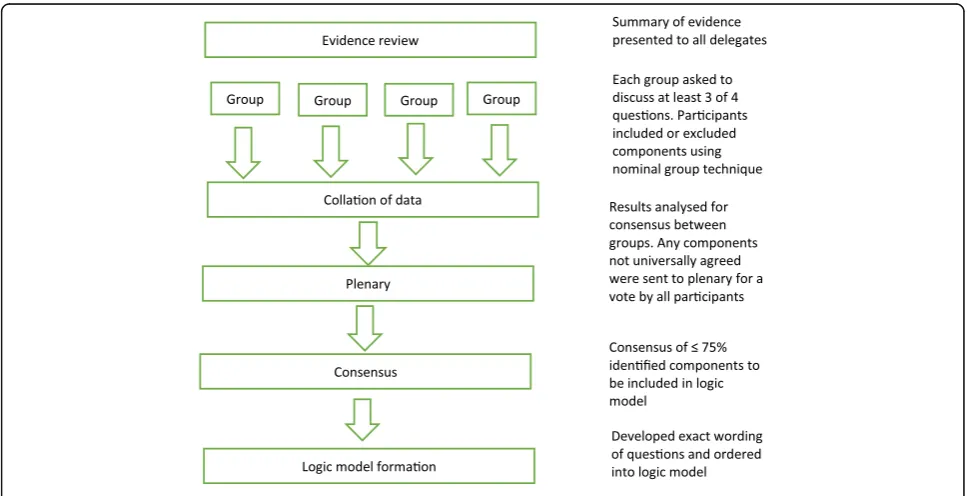
Our starting point were the findings from our systematic review [8]. This provided us with a summary of what was known about headache classification tools which we presented to participants at a headache classification consensus conference at the University of Warwick in October 2015. The aim of the meeting was to draw on evidence and expertise to reach consensus on questions to inform the content of a telephone headache classifica-tion interview that can be used by a non-headache spe-cialist. Figure 1 provides an overview of the consensus process.
We invited headache specialist neurologists, headache specialist nurses, lay representatives (people with chronic
[image:2.595.56.540.471.719.2]headaches) and General Practitioners (GPs) with a spe-cialist interest in headache identified through profes-sional contacts, profesprofes-sional specialist interest groups and headache charity groups across the UK. We used a nominal group technique [9] to allow generation of ideas across disciplines and ensure consensus on key issues important to both health professionals and people living with chronic headache.
We briefed delegates on existing classification tools, key definitions, the aims and purpose of the classification interview, and randomly allocated within professional groups to one of four groups. Each group had a facilitator and a scribe who had been trained for the consensus process and an expert (researchers from the study team). Experts, from the study team, were not active in group discussions unless prompted to clarify specific points. Groups were asked to discuss four key questions, with each group starting on a different question and progres-sing through the questions in a pre-allocated sequence, and encouraged to complete at least three of the four questions:
What do we need to know from a person to
exclude secondary headaches?
What do we need to know from a person to
exclude primary headaches other than chronic migraine and tension type headache?
What do we need to know from a person to
distinguish between chronic tension-type head-ache and chronic migraine?
What do we need to know from a person to
identify medication overuse headache?
With guidance from facilitators, delegates were en-couraged to identify and agree on the key items needed to address each question. Where there was uncertainty within the group about an item, the item was taken for-ward to a plenary session along with items that were not consistent across all four groups. At the plenary, dele-gates agreed on 75% as an acceptable level of consensus, and voted to include or exclude items before ranking them in order of importance. Following discussion and voting, consensus was achieved on the essential compo-nents of the telephone classification interview.
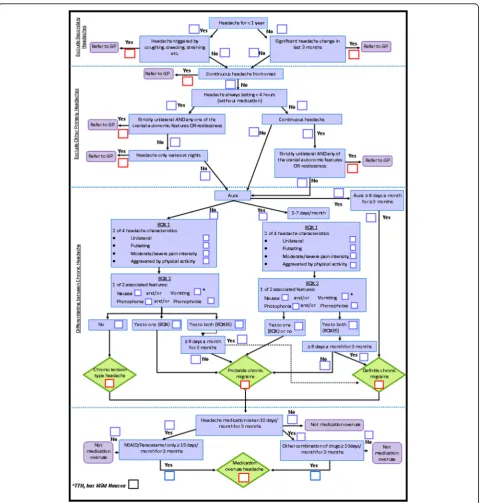
The following day, a small team of researchers met to interpret the results of the consensus conference and create mind maps to represent the finding for each of the key questions. These were used to inform the con-tent and flow of a logic model which starts with ques-tions to be asked of all interviewees then depending on the answers takes the interviewer down different ques-tion pathways. This logic model underpins the headache classification interview. Although the classification inter-view is based around the logic model, it is not intended
to be a rigid interview schedule. Instead, the non-headache specialist doing the interview is encouraged to use the logic model to inform their clinical reasoning and decision-making. The structure and sequence of the telephone interview will be determined by individual consultation style, questioning, and by the participant’s responses.
Validation of the classification interview
To validate the classification interview we did paired telephone interviews with participants recruited from primary care as part of a feasibility study for CHESS. The feasibility study received Ethics approval from West Midlands – Black Country Research Ethics Committee (15/WM/0165).
We identified participants from searches of general practice records from 14 practices in the West Midlands region of the UK that cover urban, small town and semi-rural areas with varying levels of deprivation and ethnic diversity. We searched for people who had con-sulted within the previous year with headache, or had been prescribed migraine specific medication. Due to the typically imprecise coding of chronic headache in primary care and the fluctuating nature of headache fre-quency the search included people with both episodic and chronic headaches. GPs screened lists of participants identified from the searches and excluded those with known serious underlying pathology or secondary causes of headache (other than medication overuse headache) or terminal illness because we did not want to cause un-necessary upset or distress inviting them to take part in a study of a self-management intervention for chronic headache. People interested in the study were contacted by a member of the study team to confirm that they had experienced headaches for at least half the days of the month and for at least three months. People who met these criteria and provided written consent were invited to take part in two telephone interviews, the first a tele-phone classification interview conducted by specially trained nurses and the second a validation interview conducted by doctors working for the National Migraine Centre. The nurse interviews were audio recorded for quality assurance purposes.
Sample size and statistical analysis
alternative of 0.8 (a substantial agreement [10] then at a two-sided alpha of 0.025 (correcting for multiplicity), power of 80% and the probability that a rating is a success is 0.5 then the required sample size is 153 [11]. To ac-count for both prevalence and bias, a prevalence-adjusted bias-adjusted kappa (PABAK) was estimated in addition to the kappa statistic. We computed the confidence intervals for the estimated kappa and PABAK using Donner’s good-ness of fit method [11]. We summarised demographics as mean and standard deviation or frequency and percentage as appropriate.
Training to use the classification interview
We invited six nurses to attend a one day training workshop; all were research nurses and non-headache specialists with at least 10 years of nursing experience (range 10–35 years). The training was led by a consult-ant neurologist specialised in headache (MM), and in-cluded: headache assessment, history taking, secondary headache disorders, red flags in headache, primary headache disorders and classification of chronic head-ache types using the logic model. The nurses also re-ceived advice on telephone consultation techniques, and had the opportunity to observe and discuss ex-ample case scenarios.
Following the training workshop each nurse met one-to-one with a member of the study team for be-tween one and two hours to ensure they felt confident to use the logic model, and practised classification in-terviews using mock scenarios. The nurse training was supplemented by a training manual providing a step by step guide on how to use the logic model to inform de-cision making. We also provided a telephone classifica-tion interview guide intended to be used during the classification interview with questions and prompts to guide the flow of the interview and allow the nurse to record participants’responses.
After all the classification interviews had been com-pleted we asked the nurses to complete a short anonym-ous online survey asking about their experience of the training and conducting the interviews. The doctors from the National Migraine Centre were asked to use their usual approach to a telephone assessment of head-ache type to complete the validation interviews and were not provided with a copy of the logic model.
Results
Development of the classification interview
Twenty six delegates attended the headache classifica-tion conference: five headache specialist nurses, 13 neu-rologists (10 with a specialist interest in headache), seven lay representatives (with chronic headache) and one GP with a specialist interest in headache.
Results from the plenary session for each of the four key questions are presented in Additional file1.
What do we need to know from a person to exclude secondary headaches?
The four groups had very different approaches to how they addressed this question reporting between one and nine items to consider. All groups considered the length of time a person has a headache to be an essential item, with the assumption that a long duration rules out any serious pathology. Ruling out neurological signs and cerebrospinal fluid (CSF) pressure-related symptoms was also found to be important to the delegates and these items were voted to be kept in at the plenary session.
What do we need to know from a person to exclude primary headaches other than chronic migraine and tension type headache?
This question promoted a lot of discussion and all groups returned substantial responses. One group main-tained an open question style, whereas the other groups decided that closed, symptom specific questions, were more appropriate to rule out primary headaches. At the plenary session, consensus was reached to keep in head-ache duration, location, autonomic features, presence or absence of restlessness and the timing of a headache attack.
What do we need to know from a person to distinguish between chronic tension-type headache and chronic migraine?
The group discussion centred on defining the key features of chronic migraine and chronic tension type headache. At plenary, headache characteristics, associated symp-toms, and loss of function were considered to be the most pertinent points for a telephone classification system. The inclusion of a question relating to aura received 74% con-sensus at the plenary vote, and a decision was made by the study team to include this item.
What do we need to know from a person to identify medication overuse headache?
This question was not discussed by one group due to time restraints. For the remaining groups, most items related to the recognised definition of medication over-use headache,‘headache occurring on 15 or more days per month taking acute or symptomatic headache medi-cation (on 10/15 or more days per month, depending on the medication) for more than 3 months’.
for this question was the most decisive of the four questions.
Development of the classification interview logic model The study team used the output from the consensus con-ference to develop a logic model that incorporated the findings from the day (Fig.2). This included explicitly ad-dressing questions to exclude other primary headaches and secondary headaches. Where there was lack of detail
from the output from the consensus meeting the study team drew on their experience and standard definition of headache types to ensure there was clarity for the nurse doing the interviews. The team developed a five step model that clarifies that chronic headaches is present, ex-cludes people with symptoms suggestive of secondary causes of chronic headache and primary headache disor-ders other than migraine or chronic tension type head-ache. Those with symptoms suggestive of these headache
[image:5.595.59.540.210.714.2]types are then out of the model and no further steps taken to clarify the classification within the interview. Any fur-ther diagnostic assessment would be carried out by their usual medical advisor. These three steps define the popu-lation of interest for the CHESS trial. The next step classi-fies population as chronic tension type, probable chronic migraine, or definite migraine in line with ICHD-IIIβ cri-teria [2]. Finally, the presence or absence of medication overuse is assessed.
Validation of the classification interview
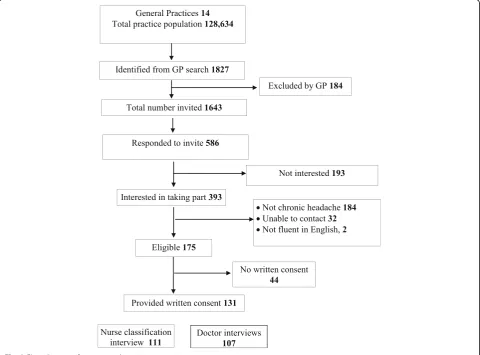
We wrote to 1634 people identified from electronic database searches in the 14 general practices, 586 (36%) replied and of those that replied 393 (67%) expressed interest in the study; of these, an eligibility telephone call confirmed that 174 had headache ≥15 days/month for
≥3 months. We obtained written consent to take part in the validation study from 131 participants; six later with-drew from the study (Fig.3). The mean age was 49 years (standard deviation, SD, 13), 108 (84%) females, 121 (93%) of White ethnicity and 86 (68%) were employed.
Nurses completed headache classification interviews with 111 participants and classified 46 (42%) with def-inite chronic migraine, 45 (41%) with probable chronic migraine and 4 (4%) with chronic TTH. Five (5%) par-ticipants were classified with other chronic headache types and 11 (10%) with non-chronic headache. Of the 95 participants classified with either chronic migraine (definite or probable) or chronic TTH, 63 (66%) had MOH; 97% chronic migraine and MOH and 3% chronic TTH and MOH.
Doctors from the National Migraine Centre completed diagnostic interviews with 108 participants and classified 52 (48%) with definite chronic migraine, 28 (26%) with probable chronic migraine and 4 (4%) with chronic TTH. One (1%) participant was classified with other chronic headache type and 23 (21%) were classified with non-chronic headache. Of the 84 participants classified with either chronic migraine or chronic TTH, 59 (70%) also had MOH (all with chronic migraine and MOH).
We did 107 paired classification interviews (Table 1). The median time between nurse and doctor interviews was 32 days (interquartile range, IQR, 21–48 days).
[image:6.595.58.539.365.720.2]In the first agreement test, data from definite and probable chronic migraine were grouped as chronic mi-graine whereas chronic TTH, other chronic headaches and non-chronic headaches were grouped as ‘others’. We grouped definite and probable chronic migraine as chronic migraine for this analysis because this is the most useful classification for the purposes of informing treatment choices.
The proportion of concordance shown in Table 2 was 0.76, a good agreement between nurse and doctor inter-views. However, the simple kappa coefficient,κ, was 0.31 (95% confidence interval, CI, 0.09 to 0.52), a fair agree-ment. The maximum attainable kappa,κmax, was 0.79, a
good agreement, which reflects the strength of agreement while preserving the distribution of the marginal totals. Adjusting for prevalence and the distribution of the mar-ginal totals, the prevalence-adjusted bias-adjusted kappa (PABAK) was 0.51 (95% CI, 0.35 to 0.68), a moderate agreement.
In a sensitivity agreement test between chronic migraine and chronic TTH the agreement between nurses and doc-tors were better with κ = 0.38 (95% CI, 0.22 to 0.54), κmax = 0.56, and PABAK = 0.76 (95% CI, 0.61 to 0.91), a
good agreement. Of the paired 74 classifications of either chronic migraine or chronic TTH both nurse interviews and doctor interviews agreed that 12 (16%) did not have MOH and that 44 (59%) had MOH (see Table 3). The agreement between nurses and doctors generally moder-ately good; κ = 0.43 (95% CI, 0.26 to 0.61), κmax= 0.79,
and PABAK = 0.41 (95% CI, 0.20 to 0.61).
We reviewed cases where both parties disagreed on the classification and when both classified the headaches
as ‘others’(non-chronic migraine or non-chronic TTH). There was disagreement on 29 headache classifications and seven classified as ‘others’. In most cases the dis-agreement was because the doctor had classified the headache type as episodic migraine and the nurse chronic migraine. Following the review of the headache characteristics recorded in the case report forms, 22 par-ticipants would have been classified as either having chronic migraine or chronic TTH, and three would have been excluded by both nurses and doctors. Of the three who would have been excluded, two had cluster head-ache and one had hemicrania continua. However, one participant would have been erroneously identified as having chronic TTH when in fact they had primary stab-bing (ice pick) headache. Table4shows the frequency of agreement and disagreement from reclassifying these cases based on doctors’and nurses’notes. In a sensitivity agreement test of chronic migraine against others (chronic TTH and other headaches), the proportion of concordance was 0.91, κ = 0.53 (95% CI, 0.28 to 0.79), κmax = 0.81 and PABAK = 0.81 (95% CI, 0.70 to 0.92),
very good agreement.
Nurse feedback
[image:7.595.57.539.100.220.2]Five nurses completed the short online survey answering questions about their experience of the training and preparation to conduct the classification interviews and their confidence using the logic model. All five nurses felt that the training workshop, one-to-one with a mem-ber of the study team and training manual had prepared them adequately to carry out the classification interviews and reported increased confidence the more interviews Table 1Frequency of agreement and disagreement between nurse and doctor classification interviews
Nurses’classification
Definite chronic migraine
Probable chronic migraine
Chronic tension type headache
Other chronic headache
Non-chronic headache
Total
Doctors’classification Definite chronic migraine 28 18 1 3 1 51
Probable chronic migraine 11 13 0 2 2 28
Chronic tension type headache 0 2 1 0 1 4
Other chronic headache 0 0 1 0 0 1
Non-chronic headache 7 8 1 0 7 23
Total 46 41 4 5 11 107
Table 2Summary of proportion of concordance, simple kappa coefficient,κ, (95% confidence interval, CI), maximum attainable
kappa,κmax, and prevalence-adjusted bias-adjusted kappa, PABAK (95% CI)
Comparison Proportion of concordance κ 95% CI κmax PABAK 95% CI
Chronic migraine vs. othersa 0.76 0.31 (0.09 to 0.52) 0.79 0.51 (0.35 to 0.68)
Chronic migraine vs. chronic TTHb 0.96 0.38 (−0.18 to 0.94) 0.79 0.92 (0.83 to 1.00)
With MOH vs. without MOHc 0.76 0.40 (0.17 to 0.63) 0.93 0.51 (0.32 to 0.71)
a
Chronic migraine = definite chronic migraine or probable chronic migraine; Others = chronic tension type, other chronic headaches or non-chronic headaches b
Chronic migraine = definite chronic migraine or probable chronic migraine; chronic TTH = chronic tension type headache c
[image:7.595.53.541.651.706.2]they completed. They considered the classification guide essential to use when they did the interviews and thought it would be difficult to do the telephone inter-views without using the guide. The main challenges de-scribed by the nurses were: having to rely on participant recall to ascertain how many days a participant experi-enced migrainous features to allow distinguish between probable and definite chronic migraine and the number of days abortive medication had been taken to be able to decide if the participant had MOH.
Discussion
We have developed and validated a telephone classifica-tion interview that can be used by a non-headache spe-cialist to classify common chronic headache disorders. Crucially, in the population studied here, there were no disagreements between nurses and doctors on the iden-tification of important headache features needing further medical consideration. Specifically the two people with features of cluster headache were identified by both the nurses and the doctors. That two people with chronic headache identified from searches of GP records had features of undiagnosed cluster headache is perhaps a noteworthy finding. Whilst we cannot draw any statis-tical inference from this study it is indicative that there is need for general practitioners to consider unrecog-nised cluster headache in people consulting for head-aches. It also provides some empirical justification for the consensus decision to screen for other primary head-ache types.
Implementation of the nurse classification interviews went well and they were able to use the logic model to in-form their decision making, but found the classification guide essential when conducting the telephone interviews.
The interviews were, however, challenging because of problems with participant recall of headache frequency and frequency of migrainous symptoms. Inclusion of a headache diary for three months prior to the interview might allow better documentation and might improve precision of the final classification. The use of a diary is recommended in guidelines [12]. This is, however, in the context of a diagnosis in a clinical situation rather than a classification interview for study entry or for epidemio-logical research. For our current purpose of running a ran-domised controlled trial in people recruited from general practice registers, in which use of a prospective diary is part of the active intervention, then adding a diary to the pre-entry classification interview is inappropriate. It would be likely to attenuate any therapeutic effect observed in the trial and needlessly prolong the already complicated recruitment process.
The greatest disagreement was between the classifica-tions of probable or definite chronic migraine. The issue here not being the presence or absence of migrainous features but rather the exact frequency. These distinc-tions are likely to be labile because any delay between interviews (median 32 days) may change final classifica-tion, there may be problems with recall bias, and the doctor interviews might have been affected by panel conditioning [13]. Whilst important for describing the population of interest for the CHESS trial in practical clinical terms the distinction between probable or defin-ite chronic migraine may be relatively less important for clinical management. Decision on the choice of migraine prophylaxis and acute treatments are likely to be driven more by the overall clinical picture and patient choice. Thus we are confident that the agreement between nurses and doctors is good enough to inform the selec-tion of people who might benefit from an educaselec-tion and self-management support intervention for chronic head-aches which itself includes identifying headache type.
[image:8.595.56.293.122.189.2]Whilst no substitute for a detailed clinical diagnosis, in-formed by at least three months of detailed headache diary data we consider our approach is a substantial advance in improving the quality of classification in people living with chronic headaches. Despite comprehensive diagnostic cri-teria for headache such as The International Classification of Headache Disorders, 3rd edition (beta version) [2], it Table 3Frequency of agreement and disagreement between
nurse and doctor classification interviews for medication overuse headache
Nurses’classification
No Yes Total
Doctors’classification No 12 10 22
Yes 8 44 52
Total 20 54 74
Table 4Frequency of agreement and disagreement between nurse and doctor classification interviews re-classified according to case notes
Nurses’classification
Chronic migraine Chronic tension type headache Others Total
Doctors’classification Chronic migraine 90 1 6 97
Chronic tension type headache 3 3 0 6
Others 0 1 3 4
[image:8.595.56.539.649.732.2]can be challenging for non-headache experts to diagnose chronic headaches. [4] We present an approach that can easily be operationalised by non-experts and which identi-fies people whose headache diagnosis need careful consid-eration by a headache expert. For the purpose of our study we trained nurses to complete the classification interviews by telephone, but envisage that that interview could be delivered by telephone or face-to-face by non-headache expert nurses or doctors to support more accur-ate diagnosis and management of chronic headache in primary care.
The logic model was developed based on evidence from a systematic review of existing classification tools [8], and the expertise and consensus of academics, health profes-sionals and people living with chronic headache. We used consensus meeting and a nominal group technique meth-odology to allow all participants to have an equal voice reaching consensus on the essential components of the classification interview, which is a strength of the study. However we acknowledge limitations to the study, we identified participants who consulted general practice and asked GPs to screen for known serious underlying path-ology or secondary causes of headache, and therefore the specificity of the logic model is not tested. Our original sample size was 153, but we only completed 107 paired in-terviews due to time constraints for recruitment to the study. The independent programme steering committee for the study advised to stop participant recruitment as pragmatically the classification was fit for purpose.
Conclusions
We have developed a new evidence-based telephone clas-sification interview that can be used by a non-headache specialist in primary care to classify common chronic headache disorders: definite chronic migraine, probable chronic migraine and chronic TTH and identify MOH; and to identify those who might need a further diagnostic assessment. Level of agreement between interviews by non-headache specialists and headache specialists was moderate; and very good in a sensitivity test following re-view of headache characteristics.
We are now using the classification interview in a multi-centre randomised control trial because we are confident that it works well for our purposes.
Additional files
Additional file 1:Voting results from the consensus conference pleanary session. (DOCX 30 kb)
Abbreviations
CHESS:Chronic Headache Education and Self-management Study; CSF: Cerebrospinal fluid; GP: General Practitioner; MOH: Medication overuse headache; PABAK: Prevalence-adjusted bias-adjusted kappa; TTH: Tension Type Headache
Acknowledgements
We would like to acknowledge and thank all the delegates who attended the consensus conference and the participants that took part in the CHESS feasibility study.
The manuscript is written on behalf of the CHESS co-applicants and study team.
Funding
This research was funded by the NIHR Programme Grants for Applied Research programme (RP-PG-1212-20,018). The views expressed in this publication are those of the author(s) and not necessarily those of the NHS, the NIHR or the Department of Health. Trial Registration: ISRCTN,
ISRCTN79708100. Registered 16th December 2015,http://www.isrctn.com/ ISRCTN79708100
Availability of data and materials
The datasets used and/or analysed during the current study are available from the corresponding author on reasonable request.
Authors’contributions
RP: study concept and design, acquisition and interpretation of data and study write up. SWH: statistical analysis, interpretation of data and critical revision of manuscript. FG: study concept and design, interpretation of data and critical revision of manuscript. KD: study design, interpretation of data and study write up. EH: study design, acquisition and interpretation of data and critical revision of manuscript. MU: project lead, study concept and design, interpretation of data and critical revision of manuscript. MM: study concept and design, interpretation of data and critical revision of manuscript. All authors read and approved the final manuscript.
Ethics approval and consent to participate
The study received Ethics approval from West Midlands–Black Country Research Ethics Committee (15/WM/0165). Participants provided written consent to take part in the study.
Consent for publication
Not applicable
Competing interests
MU was Chair of the NICE accreditation advisory committee until March 2017 for which he received a fee. He is chief investigator or co-investigator on multiple previous and current research grants from the UK National Insti-tute for Health Research, Arthritis Research UK and is a co-investigator on grants funded by Arthritis Australia and Australian NHMRC. He has received travel expenses for speaking at conferences from the professional organisa-tions hosting the conferences He is a director and shareholder of Clinvivo Ltd. that provides electronic data collection for health services research. He is part of an academic partnership with Serco Ltd. related to return to work initiatives. He is an editor of the NIHR journal series, and Member of NIHR Journal editors group for which he receives a fee. He is an NIHR Senior Investigator.
MM has served on the advisory board for Allergan, Medtronic, Novartis and Eli Lilly and has received payment for the development of educational presentations from Medtronic, Allergan and electroCore.
Publisher’s Note
Springer Nature remains neutral with regard to jurisdictional claims in published maps and institutional affiliations.
Author details
1Warwick Clinical Trials Unit, Warwick Medical School, University of Warwick,
Coventry CV4 7AL, UK.2Division of Health Sciences, Warwick Medical School,
University of Warwick, Coventry CV4 7AL, UK.3Warwick Medical School, University of Warwick, Coventry CV4 7AL, UK.4Headache Group, UCL Institute
Received: 8 November 2018 Accepted: 20 December 2018
References
1. Carville S, Padhi S, Reason T, Underwood M (2012) Diagnosis and management of headaches in young people and adults: summary of NICE guidance. BMJ 345:e5765
2. The International Classification of Headache Disorders (2013) 3rd edition (beta version). Cephalalgia 33(9):629–808
3. Latinovic R, Gulliford M, Ridsdale L (2006) Headache and migraine in primary care: consultation, prescription, and referral rates in a large population. J Neurol Neurosurg Psychiatry 77(3):385–387
4. Kernick D, Stapley S, Hamilton WGP (2008) Classification of headache: is primary headache underdiagnosed? Br J Gen Pract 58(547):102–104 5. Russell MB, Rasmussen BK, Thorvaldsen P, Olesen J (1995) Prevalence and
sex-ratio of the subtypes of migraine. Int J Epidemiol 24(3):612–618 6. Aggarwal R, Ringold S, Khanna D, Neogi T, Johnson SR, Miller A et al (2015)
Distinctions between diagnostic and classification criteria? Arthritis Care Res 67(7):891–897
7. Aggarwal R, Ringold S, Khanna D, Neogi T, Johnson SR, Miller A et al (2016) Distinctions between diagnostic and classification criteria: comment on the article by Aggarwal et al. Arthritis Care Res 68(1):149–150
8. Potter R, Probyn K, Bernstein C, Pincus T, Underwood M, Matharu M (2018) Diagnostic and classification tools for chronic headache disorders: a systematic review. Cephalalgia:333102418806864
9. Van de Ven AH, Delbecq AL (1972) The nominal group as a research instrument for exploratory health studies. Am J Public Health 62(3):337–342 10. Landis JR, Koch GG (1977) The measurement of observer agreement for
categorical data. Biometrics 33(1):159–174
11. Donner A, Eliasziw M (1992) A goodness-of-fit approach to inference procedures for the kappa statistic: confidence interval construction, significance-testing and sample size estimation. Stat Med 11(11):1511–1519 12. Headaches in over 12s: diagnosis and management. National Institute for
Health and Clinical Excellence, (NICE). ; 2012