B
0s
lifetime measurement in the
CP
-odd decay channel
B
0s→
J
=
ψ
f
0ð
980
Þ
V. M. Abazov,31B. Abbott,67B. S. Acharya,25M. Adams,46T. Adams,44J. P. Agnew,41G. D. Alexeev,31G. Alkhazov,35 A. Alton,56,a A. Askew,44S. Atkins,54K. Augsten,7V. Aushev,38Y. Aushev,38C. Avila,5 F. Badaud,10L. Bagby,45 B. Baldin,45D. V. Bandurin,74S. Banerjee,25E. Barberis,55 P. Baringer,53J. F. Bartlett,45 U. Bassler,15 V. Bazterra,46
A. Bean,53M. Begalli,2 L. Bellantoni,45S. B. Beri,23G. Bernardi,14 R. Bernhard,19 I. Bertram,39M. Besançon,15 R. Beuselinck,40P. C. Bhat,45S. Bhatia,58V. Bhatnagar,23G. Blazey,47S. Blessing,44K. Bloom,59A. Boehnlein,45 D. Boline,64E. E. Boos,33 G. Borissov,39M. Borysova,38,lA. Brandt,71O. Brandt,20M. Brochmann,75R. Brock,57 A. Bross,45D. Brown,14X. B. Bu,45M. Buehler,45V. Buescher,21V. Bunichev,33S. Burdin,39,bC. P. Buszello,37 E. Camacho-Pérez,28B. C. K. Casey,45H. Castilla-Valdez,28S. Caughron,57S. Chakrabarti,64K. M. Chan,51A. Chandra,73 E. Chapon,15G. Chen,53S. W. Cho,27S. Choi,27B. Choudhary,24S. Cihangir,45,*D. Claes,59J. Clutter,53M. Cooke,45,k
W. E. Cooper,45 M. Corcoran,73F. Couderc,15M.-C. Cousinou,12J. Cuth,21D. Cutts,70 A. Das,72 G. Davies,40 S. J. de Jong,29,30E. De La Cruz-Burelo,28F. Déliot,15R. Demina,63D. Denisov,45S. P. Denisov,34S. Desai,45C. Deterre,41,c K. DeVaughan,59H. T. Diehl,45M. Diesburg,45P. F. Ding,41A. Dominguez,59A. Dubey,24L. V. Dudko,33A. Duperrin,12 S. Dutt,23M. Eads,47D. Edmunds,57J. Ellison,43V. D. Elvira,45Y. Enari,14H. Evans,49A. Evdokimov,46V. N. Evdokimov,34 A. Fauré,15L. Feng,47T. Ferbel,63F. Fiedler,21F. Filthaut,29,30W. Fisher,57H. E. Fisk,45M. Fortner,47H. Fox,39J. Franc,7 S. Fuess,45P. H. Garbincius,45A. Garcia-Bellido,63J. A. García-González,28V. Gavrilov,32W. Geng,12,57C. E. Gerber,46 Y. Gershtein,60G. Ginther,45O. Gogota,38G. Golovanov,31P. D. Grannis,64 S. Greder,16H. Greenlee,45G. Grenier,17
Ph. Gris,10J.-F. Grivaz,13 A. Grohsjean,15,c S. Grünendahl,45 M. W. Grünewald,26T. Guillemin,13G. Gutierrez,45 P. Gutierrez,67J. Haley,68L. Han,4 K. Harder,41A. Harel,63J. M. Hauptman,52J. Hays,40T. Head,41T. Hebbeker,18 D. Hedin,47H. Hegab,68A. P. Heinson,43U. Heintz,70C. Hensel,1I. Heredia-De La Cruz,28,dM. Hernández-Villanueva,28
K. Herner,45G. Hesketh,41,f M. D. Hildreth,51 R. Hirosky,74T. Hoang,44J. D. Hobbs,64B. Hoeneisen,9 J. Hogan,73 M. Hohlfeld,21 J. L. Holzbauer,58I. Howley,71 Z. Hubacek,7,15V. Hynek,7I. Iashvili,62Y. Ilchenko,72R. Illingworth,45
A. S. Ito,45S. Jabeen,45,m M. Jaffré,13A. Jayasinghe,67M. S. Jeong,27 R. Jesik,40P. Jiang,4,* K. Johns,42E. Johnson,57 M. Johnson,45 A. Jonckheere,45P. Jonsson,40 J. Joshi,43A. W. Jung,45,oA. Juste,36E. Kajfasz,12D. Karmanov,33 I. Katsanos,59M. Kaur,23R. Kehoe,72S. Kermiche,12N. Khalatyan,45A. Khanov,68A. Kharchilava,62Y. N. Kharzheev,31
I. Kiselevich,32J. M. Kohli,23A. V. Kozelov,34J. Kraus,58A. Kumar,62A. Kupco,8 T. Kurča,17V. A. Kuzmin,33 S. Lammers,49P. Lebrun,17H. S. Lee,27S. W. Lee,52W. M. Lee,45X. Lei,42J. Lellouch,14D. Li,14H. Li,74L. Li,43Q. Z. Li,45 J. K. Lim,27D. Lincoln,45J. Linnemann,57V. V. Lipaev,34,*R. Lipton,45H. Liu,72Y. Liu,4A. Lobodenko,35M. Lokajicek,8 R. Lopes de Sa,45R. Luna-Garcia,28,gA. L. Lyon,45A. K. A. Maciel,1 R. Madar,19R. Magaña-Villalba,28S. Malik,59
V. L. Malyshev,31J. Mansour,20J. Martínez-Ortega,28R. McCarthy,64C. L. McGivern,41M. M. Meijer,29,30 A. Melnitchouk,45D. Menezes,47P. G. Mercadante,3M. Merkin,33A. Meyer,18J. Meyer,20,iF. Miconi,16N. K. Mondal,25
M. Mulhearn,74E. Nagy,12M. Narain,70R. Nayyar,42H. A. Neal,56J. P. Negret,5 P. Neustroev,35H. T. Nguyen,74 T. Nunnemann,22J. Orduna,70N. Osman,12A. Pal,71N. Parashar,50V. Parihar,70S. K. Park,27R. Partridge,70,eN. Parua,49
A. Patwa,65,jB. Penning,40M. Perfilov,33Y. Peters,41K. Petridis,41 G. Petrillo,63P. Pétroff,13M.-A. Pleier,65 V. M. Podstavkov,45A. V. Popov,34M. Prewitt,73D. Price,41N. Prokopenko,34J. Qian,56A. Quadt,20 B. Quinn,58 P. N. Ratoff,39I. Razumov,34I. Ripp-Baudot,16F. Rizatdinova,68M. Rominsky,45 A. Ross,39C. Royon,8P. Rubinov,45 R. Ruchti,51G. Sajot,11A. Sánchez-Hernández,28M. P. Sanders,22A. S. Santos,1,hG. Savage,45M. Savitskyi,38L. Sawyer,54 T. Scanlon,40R. D. Schamberger,64Y. Scheglov,35H. Schellman,69,48M. Schott,21C. Schwanenberger,41R. Schwienhorst,57 J. Sekaric,53H. Severini,67E. Shabalina,20V. Shary,15S. Shaw,41A. A. Shchukin,34V. Simak,7P. Skubic,67P. Slattery,63 G. R. Snow,59J. Snow,66S. Snyder,65S. Söldner-Rembold,41L. Sonnenschein,18K. Soustruznik,6J. Stark,11N. Stefaniuk,38 D. A. Stoyanova,34M. Strauss,67L. Suter,41 P. Svoisky,74M. Titov,15V. V. Tokmenin,31Y.-T. Tsai,63D. Tsybychev,64 B. Tuchming,15C. Tully,61L. Uvarov,35S. Uvarov,35S. Uzunyan,47R. Van Kooten,49W. M. van Leeuwen,29N. Varelas,46
E. W. Varnes,42 I. A. Vasilyev,34A. Y. Verkheev,31L. S. Vertogradov,31M. Verzocchi,45M. Vesterinen,41D. Vilanova,15 P. Vokac,7 H. D. Wahl,44M. H. L. S. Wang,45J. Warchol,51G. Watts,75M. Wayne,51J. Weichert,21L. Welty-Rieger,48
M. R. J. Williams,49,n G. W. Wilson,53M. Wobisch,54D. R. Wood,55T. R. Wyatt,41Y. Xie,45R. Yamada,45 S. Yang,4 T. Yasuda,45Y. A. Yatsunenko,31W. Ye,64Z. Ye,45H. Yin,45K. Yip,65S. W. Youn,45J. M. Yu,56J. Zennamo,62T. G. Zhao,41
B. Zhou,56J. Zhu,56M. Zielinski,63D. Zieminska,49and L. Zivkovic14 (D0 Collaboration)
1LAFEX, Centro Brasileiro de Pesquisas Físicas, Rio de Janeiro, Rio de Janeiro 22290, Brazil 2
Universidade do Estado do Rio de Janeiro, Rio de Janeiro, Rio de Janeiro 20550, Brazil 3Universidade Federal do ABC, Santo André, São Paulo 09210, Brazil
4
6Charles University, Faculty of Mathematics and Physics, Center for Particle Physics,
116 36 Prague 1, Czech Republic
7Czech Technical University in Prague, 116 36 Prague 6, Czech Republic 8
Institute of Physics, Academy of Sciences of the Czech Republic, 182 21 Prague, Czech Republic 9Universidad San Francisco de Quito, Quito, Ecuador
10
LPC, Université Blaise Pascal, CNRS/IN2P3, Clermont, F-63178 Aubière Cedex, France 11LPSC, Université Joseph Fourier Grenoble 1, CNRS/IN2P3, Institut National Polytechnique de Grenoble,
F-38026 Grenoble Cedex, France
12CPPM, Aix-Marseille Université, CNRS/IN2P3, F-13288 Marseille Cedex 09, France 13
LAL, Université Paris-Sud, CNRS/IN2P3, Université Paris-Saclay, F-91898 Orsay Cedex, France 14LPNHE, Universités Paris VI and VII, CNRS/IN2P3, F-75005 Paris, France
15
CEA Saclay, Irfu, SPP, F-91191 Gif-Sur-Yvette Cedex, France 16IPHC, Université de Strasbourg, CNRS/IN2P3, F-67037 Strasbourg, France 17
IPNL, Université Lyon 1, CNRS/IN2P3, F-69622 Villeurbanne Cedex, France and Université de Lyon, F-69361 Lyon CEDEX 07, France
18
III. Physikalisches Institut A, RWTH Aachen University, 52056 Aachen, Germany 19Physikalisches Institut, Universität Freiburg, 79085 Freiburg, Germany 20
II. Physikalisches Institut, Georg-August-Universität Göttingen, 37073 Göttingen, Germany 21Institut für Physik, Universität Mainz, 55099 Mainz, Germany
22
Ludwig-Maximilians-Universität München, 80539 München, Germany 23Panjab University, Chandigarh 160014, India
24
Delhi University, Delhi 110 007, India
25Tata Institute of Fundamental Research, Mumbai-400 005, India 26
University College Dublin, Dublin 4, Ireland
27Korea Detector Laboratory, Korea University, Seoul, 02841, Korea 28
CINVESTAV, Mexico City 07360, Mexico
29Nikhef, Science Park, 1098 XG Amsterdam, The Netherlands 30
Radboud University Nijmegen, 6525 AJ Nijmegen, The Netherlands 31Joint Institute for Nuclear Research, Dubna 141980, Russia 32
Institute for Theoretical and Experimental Physics, Moscow 117259, Russia 33Moscow State University, Moscow 119991, Russia
34
Institute for High Energy Physics, Protvino, Moscow Region 142281, Russia 35Petersburg Nuclear Physics Institute, St. Petersburg 188300, Russia 36
Institució Catalana de Recerca i Estudis Avançats (ICREA) and Institut de Física d’Altes Energies (IFAE), 08193 Bellaterra (Barcelona), Spain
37
Uppsala University, 751 05 Uppsala, Sweden
38Taras Shevchenko National University of Kyiv, Kiev 01601, Ukaine 39
Lancaster University, Lancaster LA1 4YB, United Kingdom 40Imperial College London, London SW7 2AZ, United Kingdom 41
The University of Manchester, Manchester M13 9PL, United Kingdom 42University of Arizona, Tucson, Arizona 85721, USA
43
University of California Riverside, Riverside, California 92521, USA 44Florida State University, Tallahassee, Florida 32306, USA 45
Fermi National Accelerator Laboratory, Batavia, Illinois 60510, USA 46University of Illinois at Chicago, Chicago, Illinois 60607, USA
47
Northern Illinois University, DeKalb, Illinois 60115, USA 48Northwestern University, Evanston, Illinois 60208, USA
49
Indiana University, Bloomington, Indiana 47405, USA 50Purdue University Calumet, Hammond, Indiana 46323, USA 51
University of Notre Dame, Notre Dame, Indiana 46556, USA 52Iowa State University, Ames, Iowa 50011, USA 53
University of Kansas, Lawrence, Kansas 66045, USA 54Louisiana Tech University, Ruston, Louisiana 71272, USA 55
Northeastern University, Boston, Massachusetts 02115, USA 56University of Michigan, Ann Arbor, Michigan 48109, USA 57
Michigan State University, East Lansing, Michigan 48824, USA 58University of Mississippi, University, Mississippi 38677, USA
59
University of Nebraska, Lincoln, Nebraska 68588, USA 60Rutgers University, Piscataway, New Jersey 08855, USA 61
62State University of New York, Buffalo, New York 14260, USA 63
University of Rochester, Rochester, New York 14627, USA 64State University of New York, Stony Brook, New York 11794, USA
65
Brookhaven National Laboratory, Upton, New York 11973, USA 66Langston University, Langston, Oklahoma 73050, USA 67
University of Oklahoma, Norman, Oklahoma 73019, USA 68Oklahoma State University, Stillwater, Oklahoma 74078, USA
69
Oregon State University, Corvallis, Oregon 97331, USA 70Brown University, Providence, Rhode Island 02912, USA
71
University of Texas, Arlington, Texas 76019, USA 72Southern Methodist University, Dallas, Texas 75275, USA
73
Rice University, Houston, Texas 77005, USA 74University of Virginia, Charlottesville, Virginia 22904, USA
75
University of Washington, Seattle, Washington 98195, USA
(Received 7 March 2016; published 6 July 2016)
The lifetime of the B0s meson is measured in the decay channel B0s →J=ψπþπ− with
880≤Mπþπ−≤1080MeV=c2, which is mainly aCP-odd state and dominated by thef0ð980Þresonance. In10.4fb−1of data collected with the D0 detector in Run II of the Tevatron, the lifetime of theB0smeson is measured to be τðB0sÞ ¼1.700.14ðstatÞ 0.05ðsystÞps. Neglecting CP violation in B0s=B¯0s mixing, the measurement can be translated into the width of the heavy mass eigenstate of the B0s,
ΓH¼0.590.05ðstatÞ 0.02ðsystÞps−1.
DOI:10.1103/PhysRevD.94.012001
TheB0sandB¯0smesons are produced as flavor eigenstates at hadron colliders, but the particles propagate as mass eigenstates. There are two mass eigenstates, the so-called heavy and light states, which are linear combinations of the
flavor eigenstates. In the absence of CP violation in mixing, the mass eigenstates are alsoCPeigenstates, with the heavier state expected to be the CP-odd state. The lifetimes of the two mass eigenstates can be different from each other and different from the average B0s lifetime. A measurement of theB0s lifetime in either a pureCP-odd state or pureCP-even state would give important additional information about theB0s system.
The B0s →J=ψf0ð980Þdecay channel corresponds to a pureCP-odd eigenstate decay due to angular momentum conservation, since the parentB0sis spin 0, thef0ð980Þhas
JPC¼0þþ, and theJ=ψ hasJPC¼1−−. Throughout this article, the appearance of a specific charge state also implies its charge conjugate. This decay channel was first observed by the LHCb Collaboration [1], and later con-firmed by the Belle[2], CDF[3]and D0[4]Collaborations. A measurement of the B0s lifetime in this channel gives access to the lifetime of the heavy mass eigenstate. The lifetime measurement can be transformed into a measure-ment of the parameterΓH, the decay width of the heavyB0s mass eigenstate. CDF[3]and LHCb[5]have measured this lifetime, reporting τðB0sÞ ¼ ð1.700.120.03Þps and
τðB0sÞ ¼ ð1.700.040.026Þ ps respectively, which are in good agreement with each other and somewhat longer than the mean lifetimeτðB0sÞ ¼ ð1.520.007Þ ps[6].
In this analysis, we report the lifetime of the B0s meson measured in the decay channelB0s →J=ψð→μþμ−Þπþπ− with 880≤Mπþπ− ≤1080MeV=c2, which is dominated by thef0ð980Þresonance and which isCPodd at the 99% level[7,8]. The data used in this analysis were collected with the D0 detector during Run II of the Tevatron collider *Deceased.
aVisitor from Augustana College, Sioux Falls, SD 57197, USA.
bVisitor from The University of Liverpool, Liverpool L69 3BX, UK.
cVisitor from Deutshes Elektronen-Synchrotron (DESY), Notkestrasse 85, Germany.
dVisitor from CONACyT, M-03940 Mexico City, Mexico. eVisitor from SLAC, Menlo Park, CA 94025, USA.
fVisitor from University College London, London WC1E 6BT, UK.
gVisitor from Centro de Investigacion en Computacion—IPN,
CP07738 Mexico City, Mexico.
hVisitor from Universidade Estadual Paulista, São Paulo, SP 01140, Brazil.
iVisitor from Karlsruher Institut für Technologie (KIT)— Steinbuch Centre for Computing (SCC), D-76128 Karlsruhe, Germany.
jVisitor from Office of Science, U.S. Department of Energy, Washington, D.C. 20585, USA.
kVisitor from American Association for the Advancement of Science, Washington, D.C. 20005, USA.
lVisitor from Kiev Institute for Nuclear Research (KINR), Kyiv 03680, Ukraine.
mVisitor from University of Maryland, College Park, MD 20742, USA.
nVisitor from European Orgnaization for Nuclear Research (CERN), CH-1211 Geneva, Switzerland.
oVisitor from Purdue University, West Lafayette, IN 47907, USA.
at a center-of-mass energy of 1.96 TeV, and correspond to an integrated luminosity of10.4fb−1.
The D0 detector is described in detail elsewhere[9]. The detector components most relevant to this analysis are the central tracking and the muon systems. The former consists of a silicon microstrip tracker (SMT) and a central scintillating fiber tracker (CFT) surrounded by a 2 T superconducting solenoidal magnet. The SMT has a design optimized for tracking and vertexing for pseudorapidity of jηj<3 [10]. For charged particles, the resolution on the distance of closest approach as provided by the tracking system is approximately 50μm for tracks with
pT≈1GeV=c, wherepT is the component of the momen-tum perpendicular to the beam axis. It improves asymp-totically to 15μm for tracks with pT >10GeV=c. Preshower detectors and electromagnetic and hadronic calorimeters surround the tracker. The muon system is located outside the calorimeter, and consists of multilayer drift chambers and scintillation counters inside 1.8 T iron toroidal magnets, and two similar layers outside the toroids. Muon identification and tracking for jηj<1 relies on 10 cm wide drift tubes, while 1 cm mini-drift tubes are used for 1<jηj<2. We base our data selection on reconstructed charged tracks and identified muons. Events used in this analysis are collected with both single muon and dimuon triggers. To avoid a trigger bias in the lifetime measurement, we reject events that satisfy only impact parameter-based triggers. We simulate signal events withPYTHIA[11]andEvtGen[12], followed by full detector simulation usingGEANT3[13]. To correct for trigger effects, we weight simulated events so that thepT distributions of the muons match the distributions in data.
The B0s reconstruction begins by reconstructing J=ψ candidates followed by searching forπþπ− candidates. To reconstruct J=ψ →μþμ− candidates, events with at least two muons of opposite charge reconstructed in the tracker and the muon system are selected. For at least one of the muons, hits are required in the muon system both inside and outside of the toroids. Both muons must have hits in the SMT and have pT >2.5GeV=c. The muon tracks are constrained to originate from a common vertex with aχ2 probability greater than 1%. EachJ=ψcandidate is required to have a pT greater than 1.5GeV=c and a mass in the range2.80–3.35GeV=c2.
We require two oppositely charged tracks, assumed to have the pion mass, each with at least two SMT hits and at least two CFT hits, and at least eight total hits in the tracking system. These two tracks are constrained to a common vertex with aχ2probability greater than 1%. Each
πþπ− candidate is required to have a mass in the range
880≤Mπþπ− ≤1080MeV=c2 and a pT greater than 1.5GeV=c. The B0s candidates are reconstructed by per-forming a constrained fit to a common vertex for the two pions and the two muon tracks, with the latter constrained to theJ=ψ mass of3.097GeV=c2[6]. TheB0s candidates
are required to have a mass within the range 5.1–5.8GeV=c2, and to have apTgreater than6.0GeV=c. To determine the decay time of the B0s, the distance traveled by the candidate projected in a plane transverse to the beam direction is measured, and then a correction for the Lorentz boost is applied. The transverse decay length is defined asLxy¼Lxy·pT=pT, whereLxy is the vector that points from the primary vertex[14]to theB0sdecay vertex, and pT is the transverse momentum vector of the B0s candidate. The event-by-event value of the proper trans-verse decay length,λ, for theB0s candidate is given by
λ¼Lxy
cMB
pT
; ð1Þ
whereMBis the world average mass value of theB0smeson
[6]. In order to remove background, B0s candidates are required to haveλ>0.02cm and uncertainties onλof less than 0.01 cm.
A simultaneous unbinned maximum likelihood fit to the mass and proper decay length distributions is performed to measure the lifetime. The likelihood function L is defined by
L¼YN
j¼1
½NsigFjsigþNcombFjcombþNxfFjxfþNBþFjBþ;
ð2Þ whereNis the total number of events andNsig,Ncomb,Nxf andNBþ are the expected number of signal, combinatorial background, cross-feed contamination and B →J=ψK
events in the sample, respectively. All these parameters are determined in the fit. The different background contribu-tions are discussed below.
The functions F are the product of three probability density functions that model distributions of the massm, the proper transverse decay lengthλ, and the uncertainty on the proper decay length σλ for the signal, combinatorial background, cross-feed contamination, andB events
Fj
α ¼MαðmjÞTαðλjjσλjÞEαðσλjÞ;
α¼ fsig;comb;xf; Bþg; ð3Þ
where mj, λj, and σλj represent the mass, the transverse proper decay length, and its uncertainty, respectively, for a given eventj. The use of the probability density functions
T and E follows the method of Ref. [15]. The specific models and parameters used in the fit are described below. For the signal, the mass distribution is modeled by a Gaussian function, MsigðmjÞ ¼Gðmj;μm;σmÞ, where
Gðmj;μm;σmÞ ¼ 1 ffiffiffiffiffiffi 2π
p
σm
e−ðmj−μmÞ2=ð2σ2mÞ; ð4Þ
The combinatorial background is primarily due to random combinations of J=ψ’s with additional tracks in the event, and its mass distribution is described by an exponential function
Mcombðmj;a0Þ ¼ea0mj; ð5Þ
witha0determined from the likelihood fit.
The physics cross-feed contamination is mainly pro-duced by the combination ofJ=ψ mesons from bhadron decays with other particles produced in the collision, including from the samebhadron. Otherbhadron decays with final states such as B0→J=ψKπ, B0→J=ψππ and
B0s →J=ψKKare reconstructed at mass below the signal of the B0s, either due to the lower mass of the B0 or the incorrect mass assignment of the pion mass to a kaon track. Simulations of these decays show that the cross-feed contamination can be described by a single Gaussian component
MxfðmjÞ ¼Gðmj;μxf;σxfÞ; ð6Þ
where μxf and σxf are the mean and the width of the Gaussian, determined from the likelihood fit.
The final contribution arises fromB→J=ψKdecays in which the kaon has been assigned a pion mass, and an additional track accidentally forms a vertex with the
J=ψK. The candidate mass is reconstructed in the region of real B0s events. If the higher pT nonmuon track in B0s candidates is assigned a kaon mass, a clear B signal emerges. Events in thisB mass peak, when interpreted as
J=ψππ, are used as a template[16]to determine the shape of the mass distribution of theB→J=ψK contamina-tion in the B0s candidates.
The λ distribution for the signal is parametrized by an exponential decay convoluted with a resolution function
TsigðλjjσλjÞ ¼ 1
λB Z ∞
0 Gðx;λj;σλjÞexp
−x λB
dx; ð7Þ
withλB¼cτ of theB0s to be measured. Theλdistribution for the background components is parametrized by the sum of two exponential decay functions modeling combinatorial backgroundTcombðλjÞ, an exponential decay for the cross-feed contamination TxfðλjÞ, and an exponential decay function that describesTBþðλjÞfor B contamination.
The distribution of the λ uncertainty EsigðσλjÞ is described by a phenomenological model, using an expo-nential with decay constant 1=ζ, convoluted with a Gaussian with meanϵ and widthδ:
Esigðσλj;ζ;ϵ;δÞ ¼ 1
ζe−σλj=ζ⊗Gðσλj;ϵ;δÞ; ð8Þ
where the parametersζ,ϵand widthδare determined from the fit in the sample of events. The uncertainties inλfor the background components are treated in the same manner.
The fit yields cτðB0sÞ ¼50442μm and the numbers of signal decays to be49485. Figure1shows the mass,
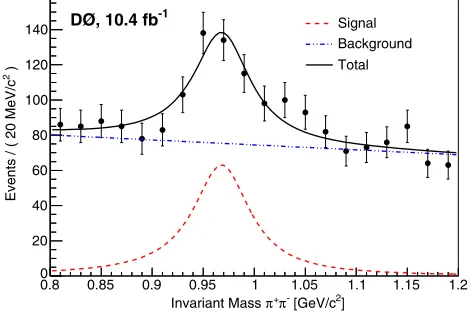
λ and λ uncertainty distributions for data with the fit results superimposed. Figure2shows the Mðπþπ−Þ mass
] 2 ) [GeV/c -π + π -+ ( 0 s
Invariant Mass B
5.1 5.2 5.3 5.4 5.5 5.6 5.7 5.8
)
2
Events / (20 MeV/c
0 50 100 150 200 250 300 350 400 Signal Cross-feed Combinatorial contamination + B Total (a) -1
Proper Transverse Decay Length [cm]
0.05 0.1 0.15 0.2 0.25 0.3
m)
μ
Events / (100
1 10 2 10 3 10 Signal Cross-feed Combinatorial contamination + B Total (b) -1
Proper Transverse Decay Length Uncertainty [cm]
0.002 0.004 0.006 0.008 0.01
m)
μ
Events / (4.5
[image:5.612.315.557.108.652.2]0 200 400 600 800 1000 1200 1400 1600 1800 Signal Cross-feed Combinatorial contamination + B Total -1 (c)
FIG. 1. Distributions of (a) invariant mass, (b) proper transverse decay length, and (c) proper transverse decay length uncertainty forB0s candidates, with the fit results superimposed. Each of the different background components is indicated in the figure. The fit yieldscτðB0sÞ ¼50442μm.
distribution for events withMðμþμ−πþπ−Þwithin oneσof theB0s mass. TheMðπþπ−Þdistribution is fit with a Flatté function[17–19]and a polynomial background.
TableIsummarizes the systematic uncertainties consid-ered for this measurement. The contribution from possible misalignment of the SMT detector has been previously determined to be5.4μm[20]. The invariant mass window used for the πþπ− distribution is varied from its nominal value of200MeV=c2to 160 and240MeV=c2and the fit is performed for each new mass window selection. This results in a systematic uncertainty of 8μm. We test the modeling and fitting method used to estimate the lifetime using data generated in pseudoexperiments with a range of lifetimes from 300 to 800μm. A bias arises due to imperfect separation of signal and background. Since the background has a shorter lifetime than the signal, the result is a slight underestimate of the signal lifetime. The bias has a value of−4.4μm for an input lifetime of500μm and 500 signal events. We have corrected the lifetime for this bias and a 100% uncertainty on the correction has been applied to the result. We estimate the systematic uncertainty due to the models for theλand mass distributions by varying the parametrizations of the different components: (i) the cross-feed contamination is modeled by two Gaussian functions instead of one, (ii) the exponential mass distribution for the combinatorial background model is replaced by a first order
polynomial, (iii) the smoothing of the nonparametric function that models theB contamination is varied, and (iv) the exponential functions modeling the backgroundλ distributions are smeared with a Gaussian resolution similar to the signal. To take into account correlations between the effects of the different models, a fit that combines all different model changes is performed. We quote the difference between the result of this fit and the nominal fit as the systematic uncertainty.
Several cross-checks of the lifetime measurement are performed. The mass windows are varied, the reconstructed
B0smass is used instead of the world average[6]value, and the data sample is split into different regions of pseudor-apidity and of azimuthal angle. All results obtained with these variations are consistent with the nominal measure-ment. Using theBbackground sample extracted from the data, we performed a fit for the lifetime of this component of the background. The result is in good agreement with the values obtained from the global fit. We have also fit the lifetime of the cross-feed contamination from the simu-lation and again good agreement with the global fit is observed.
In order to estimate the effect of a small non-CP-odd component in the analysis, we performed the fit with two exponential decay components for the signal, with the lifetime of one of them fixed to the world average of the
CP-evenB0slifetime[6], and its fraction to be 0.01 as found by the LHCb experiment [5]. The lifetime fit finds a variation of1μm with respect to the nominal fit result.
In summary, the lifetime of the B0s is measured to be
cτðB0sÞ ¼50842ðstatÞ 16ðsystÞμm; ð9Þ
from which we determine
τðB0sÞ ¼1.700.14ðstatÞ 0.05ðsystÞps; ð10Þ
in the decay channelB0s→J=ψπþπ−with880≤Mπþπ− ≤ 1080MeV=c2. In the absence of CPviolation in mixing, this measurement can be translated into the width of the heavy mass eigenstate of theB0s:
ΓH ¼0.590.05ðstatÞ 0.02ðsystÞps−1: ð11Þ
This result is in good agreement with previous measure-ments and provides an independent confirmation of the longer lifetime for the CP-odd eigenstate of the B0s=B¯0s system.
We thank the staffs at Fermilab and collaborating institutions, and acknowledge support from the Department of Energy and National Science Foundation (U.S.); Alternative Energies and Atomic Energy Commission and National Center for Scientific Research/National Institute of Nuclear and Particle Physics (France); Ministry of Education and Science of ]
2
[GeV/c
-π
+
π Invariant Mass
0.8 0.85 0.9 0.95 1 1.05 1.1 1.15 1.2
)
2
Events / ( 20 MeV/c
0 20 40 60 80 100 120 140
-1
DØ, 10.4 fb Signal
[image:6.612.57.294.48.204.2]Background Total
FIG. 2. Mðπþπ−Þ distribution for events withMðμþμ−πþπ−Þ
[image:6.612.51.299.636.716.2]within1σ of theB0s mass.
TABLE I. Summary of systematic uncertainties in the B0s lifetime measurement. The total uncertainty is determined by combining individual uncertainties in quadrature.
Source Variation (μm)
Alignment 5.4
πþπ−invariant mass window 8.0
Fit bias 4.4
Distribution models 12.5
the Russian Federation, National Research Center
“Kurchatov Institute” of the Russian Federation, and Russian Foundation for Basic Research (Russia); National Council for the Development of Science and Technology and Carlos Chagas Filho Foundation for the Support of Research in the State of Rio de Janeiro (Brazil); Department of Atomic Energy and Department of Science and Technology (India); Administrative Department of Science, Technology and Innovation (Colombia); National Council of Science and Technology (Mexico); National Research Foundation of Korea (Korea);
Foundation for Fundamental Research on Matter (The Netherlands); Science and Technology Facilities Council and The Royal Society (U.K.); Ministry of Education, Youth and Sports (Czech Republic); Bundesministerium für Bildung und Forschung (Federal Ministry of Education and Research) and Deutsche Forschungsgemeinschaft (German Research Foundation) (Germany); Science Foundation Ireland (Ireland); Swedish Research Council (Sweden); China Academy of Sciences and National Natural Science Foundation of China (China); and Ministry of Education and Science of Ukraine (Ukraine).
[1] R. Aaij et al. (LHCb Collaboration), First observation of
B0s →J=ψf0ð980Þ decays,Phys. Lett. B698, 115 (2011). [2] J. Li et al. (Belle Collaboration), Observation of B0s→
J=ψf0ð980Þ and Evidence for Bs0→J=ψf0ð1370Þ,Phys.
Rev. Lett.106, 121802 (2011).
[3] T. Aaltonen et al. (CDF Collaboration), Measurement of branching ratio and B0s lifetime in the decay B0s→
J=ψf0ð980Þ at CDF,Phys. Rev. D84, 052012 (2011).
[4] V. M. Abazovet al.(D0 Collaboration), Measurement of the relative branching ratio ofB0s→J=ψf0ð980ÞtoB0s→J=ψϕ,
Phys. Rev. D85, 011103(R) (2012).
[5] R. Aaijet al.(LHCb Collaboration), Measurement of theB¯0s Effective Lifetime in theJ=ψf0ð980ÞFinal State,Phys. Rev. Lett.109, 152002 (2012).
[6] K. A. Oliveet al.(Particle Data Group), Review of Particle Physics,Chin. Phys. C38, 090001 (2014).
[7] R. Aaij et al. (LHCb Collaboration), Analysis of the resonant components in B¯0s→J=ψπþπ−, Phys. Rev. D
86, 052006 (2012).
[8] R. Aaij et al. (LHCb Collaboration), Measurement of resonant and CP components in B¯0s →J=ψπþπ− decays,
Phys. Rev. D89, 092006 (2014).
[9] V. M. Abazov et al., The upgraded D0 detector, Nucl. Instrum. Methods Phys. Res., Sect. A565, 463 (2006).
[10] η¼−ln½tanðθ=2Þ, whereθis the polar angle with respect to the beam line.
[11] T. Sjöstrand, S. Mrenna, and P. Z. Skands, PYTHIA 6.4 Physics and Manual,J. High Energy Phys. 05 (2006) 026.
[12] D. G. Lange, The EvtGen particle decay simulation pack-age,Methods Phys. Res. Sect. A462, 152 (2001); for details seehttp://www.slac.stanford.edu/ lange/EvtGen.
[13] R. Brunet al., Reports No. CERN-W5013, No. CERN-W-5013, No. WCERN-W-5013, No. W-CERN-W-5013, 1993.
[14] The primary vertex of thepp¯ interaction is determined for each event using the average transverse position of the beam-collision point as a constraint.
[15] G. Punzi, eConf C030908, WELT002 (2003).
[16] K. Cranmer, Kernel estimation in high-energy physics,
Comput. Phys. Commun.136, 198 (2001).
[17] J. B. Gay et al., Production and decay properties of the
δð970Þ meson,Phys. Lett.63B, 220 (1976).
[18] S. M. Flatté, Coupled-channel analysis of theπη and KK¯
systems nearKK¯ threshold,Phys. Lett. 63B, 224 (1976). [19] S. M. Flatté, On the nature of0þmesons,Phys. Lett.63B,
228 (1976).
[20] V. M. Abazovet al., Measurement of theΛ0bLifetime in the DecayΛ0b→J=ψΛ0with the D0 Detector,Phys. Rev. Lett. 94, 102001 (2005).