An Incremental Parser for Abstract Meaning Representation
Marco Damonte School of Informatics University of Edinburgh
Shay B. Cohen School of Informatics University of Edinburgh
Giorgio Satta
Dept. of Information Engineering University of Padua
Abstract
Abstract Meaning Representation (AMR) is a semantic representation for natural language that embeds annotations related to traditional tasks such as named entity recognition, semantic role labeling, word sense disambiguation and co-reference resolution. We describe a transition-based parser for AMR that parses sentences left-to-right, in linear time. We further pro-pose a test-suite that assesses specific sub-tasks that are helpful in comparing AMR parsers, and show that our parser is com-petitive with the state of the art on the LDC2015E86 dataset and that it outper-forms state-of-the-art parsers for recover-ing named entities and handlrecover-ing polarity.
1 Introduction
Semantic parsing aims to solve the problem of canonicalizing language and representing its meaning: given an input sentence, it aims to ex-tract a semantic representation of that sentence. Abstract meaning representation (Banarescu et al., 2013), or AMR for short, allows us to do that with the inclusion of most of the shallow-semantic natural language processing (NLP) tasks that are usually addressed separately, such as named en-tity recognition, semantic role labeling and co-reference resolution. AMR is partially motivated by the need to provide the NLP community with a single dataset that includes basic disambiguation information, instead of having to rely on differ-ent datasets for each disambiguation problem. The annotation process is straightforward, enabling the development of large datasets. Alternative seman-tic representations have been developed and
stud-ied, such as CCG (Steedman, 1996; Steedman, 2000) and UCCA (Abend and Rappoport, 2013).
Several parsers for AMR have been recently de-veloped (Flanigan et al., 2014; Wang et al., 2015a; Peng et al., 2015; Pust et al., 2015; Goodman et al., 2016; Rao et al., 2015; Vanderwende et al., 2015; Artzi et al., 2015; Zhou et al., 2016). This line of research is new and current results suggest a large room for improvement. Greedy transition-based methods (Nivre, 2008) are one of the most popular choices for dependency parsing, because of their good balance between efficiency and ac-curacy. These methods seem promising also for AMR, due to the similarity between dependency trees and AMR structures, i.e., both representa-tions use graphs with nodes that have lexical con-tent and edges that represent linguistic relations.
A transition system is an abstract machine char-acterized by a set of configurations and transitions between them. The basic components of a con-figuration are a stack of partially processed words and a buffer of unseen input words. Starting from an initial configuration, the system applies tran-sitions until a terminal configuration is reached. The sentence is scanned left to right, with linear time complexity for dependency parsing. This is made possible by the use of a greedy classifier that chooses the transition to be applied at each step.
In this paper we introduce a parser for AMR that is inspired by the ARCEAGER dependency tran-sition system of Nivre (2004). The main differ-ence between our system and ARCEAGERis that we need to account for the mapping from word tokens to AMR nodes, non-projectivity of AMR structures and reentrant nodes (multiple incom-ing edges). Our AMR parser brincom-ings closer depen-dency parsing and AMR parsing by showing that dependency parsing algorithms, with some
ifications, can be used for AMR. Key properties such as working left-to-right, incrementality1 and linear complexity further strengthen its relevance.
The AMR parser of Wang et al. (2015a), called CAMR, also defines a transition system. It differs from ours because we process the sentence left-to-right while they first acquire the entire dependency tree and then process it bottom-up. More recently Zhou et al. (2016) presented a non-greedy tran-sition system for AMR parsing, based on ARC -STANDARD (Nivre, 2004). Our transition sys-tem is also related to an adaptation of ARCEAGER for directed acyclic graphs (DAGs), introduced by Sagae and Tsujii (2008). This is also the basis for Ribeyre et al. (2015), a transition system used to parse dependency graphs. Similarly, Du et al. (2014) also address dependency graph parsing by means of transition systems. Analogously to de-pendency trees, dede-pendency graphs have the prop-erty that their nodes consist of the word tokens, which is not true for AMR. As such, these transi-tion systems are more closely related to traditransi-tional transition systems for dependency parsing.
Our contributions in this paper are as follows:
• In§3 we develop a left-to-right, linear-time transition system for AMR parsing, inspired by the ARCEAGERtransition system for de-pendency tree parsing;
• In §5 we claim that the Smatch score (Cai and Knight, 2013) is not sufficient to evalu-ate AMR parsers and propose a set of metrics to alleviate this problem and better compare alternative parsers;
• In§6 we show that our algorithm is compet-itive with publicly available state-of-the-art parsers on several metrics.
2 Background and Notation
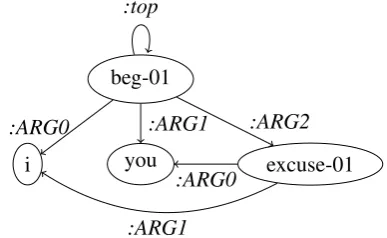
AMR Structures AMRs are rooted and directed graphs with node and edge labels. An annotation example for the sentenceI beg you to excuse meis shown in Figure 1, with the AMR graph reported in Figure 2.
Concepts are represented as labeled nodes in the graph and can be either English words (e.g. I andyou) or Propbank framesets (e.g. beg-01and
1Strictly speaking, transition-based parsing cannot
achieve full incrementality, which requires to have a single connected component at all times (Nivre, 2004).
(b / beg-01 :ARG0 (i / i :ARG1 (y / you) :ARG2 (e / excuse-01
[image:2.595.304.530.57.146.2]:ARG0 y :ARG1 i) )
Figure 1: Annotation for the sentence “I beg you to excuse me.” Variables are in boldface and concepts and edge labels are in italics.
beg-01
i you excuse-01
:ARG0 :ARG1 :ARG2
:ARG0
:ARG1 :top
Figure 2: AMR graph representation for Figure 1.
excuse-01). Each node in the graph is assigned to a variable in the AMR annotation so that a variable re-used in the annotation corresponds to reentran-cies (multiple incoming edges) in the graph. Rela-tions are represented as labeled and directed edges in the graph.
Notation For most sentences in our dataset, the AMR graph is a directed acyclic graph (DAG), with a few specific cases where cycles are permit-ted. These cases are rare, and for the purpose of this paper, we consider AMR as DAGs.
We denote by[n]the set{1, . . . , n}. We define an AMR structure as a tuple(G, x, π), wherex=
x1· · ·xn is a sentence, with each xi, i ∈ [n], a
word token, andGis a directed graphG= (V, E)
withV andEthe set of nodes and edges, respec-tively.2 We assumeG comes along with a node labeling function and an edge labeling function. Finally,π:V → [n]is a total alignment function that maps every node of the graph to an index i for the sentencex, with the meaning that nodev represents (part of) the concept expressed by the wordxπ(v).3
We note that the function π is not invertible,
2We collapse all multi-word named entities in a single
to-ken (e.g.,United KingdombecomesUnited Kingdom) both in training and parsing.
[image:2.595.320.514.218.337.2]◦ I beg you excuse
Figure 3: AMR’s edges for the sentence “I beg you to excuse me.” mapped back to the sentence, according to the alignment. ◦ is a special token representing the root.
since it is neither injective nor surjective. For each i∈[n], we let
π−1(i) ={v |v∈V, π(v) =i}
be the pre-image of i under π (this set can be empty for somei), which means that we map a to-ken in the sentence to a set of nodes in the AMR. In this way we can align each indexiforxto the induced subgraph ofG. More formally, we define
←−π(i) = (π−1(i), E∩(π−1(i)×π−1(i))), (1)
with the node and edge labeling functions of←−π(i)
inherited fromG. Hence,←π−(i)returns the AMR subgraph aligned with a particular token in the sentence.
2.1 Transition-Based AMR Parsing
Similarly to dependency parsing, AMR parsing is partially based on the identification of predicate-argument structures. Much of the dependency parsing literature focuses ontransition-based de-pendency parsing—an approach to parsing that scans the sentence from left to right in linear time and updates an intermediate structure that eventu-ally ends up being a dependency tree.
Because of the similarity of AMR structures to dependency structures, transition systems are also helpful for AMR parsing. Starting from the ARCEAGERsystem, we develop here a novel tran-sition system, called AMREAGERthat parses sen-tences into AMR structures. There are three key differences between AMRs and dependency trees that require further adjustments for dependency parsers to be used with AMRs.
Non-Projectivity A key difference between En-glish dependency trees and AMR structures is pro-jectivity. Dependency trees in English are usu-ally projective, roughly meaning that there are no which would otherwise cause a node to map to multiple in-dices. This is in line with current work on AMR parsing.
Non-projective edges 6%
Non-projective AMRs 51%
Reentrant edges 41%
[image:3.595.82.284.72.120.2]AMRs with at least one reentrancy 93%
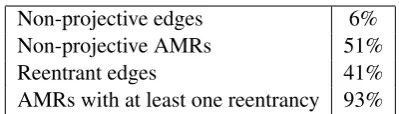
Table 1: Statistics for non-projectivity and reen-trancies in 200 AMR manually aligned with the associated sentences.5
crossing arcs if the edges are drawn in the semi-plane above the words. While this restriction is empirically motivated in syntactic theories for En-glish, it is no longer motivated for AMR struc-tures.
The notion of projectivity can be generalized to AMR graphs as follows. The intuition is that we can use the alignmentπ to map AMR edges back to the sentencex, and test whether there exist pairs of crossing edges. Figure 3 shows this mapping for the AMR of Figure 2, where the edge connect-ing excuse to I crosses another edge. More for-mally, consider an AMR edgee = (u, `, v). Let π(u) =iandπ(v) =j, so thatuis aligned with xi andvis aligned withxj. The spanning set for
e, writtenS(e), is the set of all nodeswsuch that π(w) = kandi < k < j ifi < j orj < k < i ifj < i. We say thateisprojective if, for every nodew ∈ S(e), all of its parent and child nodes are in S(e)∪ {u, v}; otherwise, we say thateis non-projective. An AMR is projective if all of its edges are projective, and is non-projective other-wise. This corresponds to the intuitive definition of projectivity for DAGs introduced in Sagae and Tsujii (2008) and is closely related to the defini-tion of non-crossing graphs of Kuhlmann and Jon-sson (2015).
Table 1 demonstrates that a relatively small per-centage of all AMR edges are non-projective. Yet, a large fraction of the sentences contain at least one non-projective edge. Our parser is able to con-struct non-projective edges, as described in§3.
Reentrancy AMRs are graphs rather than trees because they can have nodes with multiple par-ents, called reentrant nodes, as in the nodeyoufor the AMR of Figure 2. There are two phenomena that cause reentrancies in AMR: control, where a reentrant edge appears between siblings of a con-trol verb, and co-reference, where multiple
men-5https://github.com/jflanigan/jamr/
tions correspond to the same concept.6
In contrast, dependency trees do not have nodes with multiple parents. Therefore, when creating a new arc, transition systems for dependency pars-ing check that the dependent does not already have a head node, preventing the node from having ad-ditional parents. To handle reentrancy, which is not uncommon in AMR structures as shown in Ta-ble 1, we drop this constraint.
Alignment Another main difference with de-pendency parsing is that in AMR there is no straightforward mapping between a word in the sentence and a node in the graph: words may gen-erate no nodes, one node or multiple nodes. In addition, the labels at the nodes are often not eas-ily determined by the word in the sentence. For instance expectation translates to expect-01 and teacher translates to the two nodes teach-01 and person, connected through an :ARG0 edge, ex-pressing that a teacher is a person who teaches. A mechanism of concept identification is therefore required to map each tokenxi to a subgraph with
the correct labels at its nodes and edges: ifπis the gold alignment, this should be the subgraph←−π(i)
defined in Equation (1). To obtain alignments be-tween the tokens in the sentence and the nodes in the AMR graph of our training data, we run the JAMR aligner.7
3 Transition system for AMR Parsing A stack σ = σn| · · · |σ1|σ0 is a list of nodes of the partially constructed AMR graph, with the top element σ0 at the right. We use the sym-bol ‘|’ as the concatenation operator. A buffer β =β0|β1| · · · |βnis a list of indices fromx, with
the first element β0 at the left, representing the word tokens from the input still to be processed. Aconfigurationof our parser is a triple(σ, β, A), whereA is the set of AMR edges that have been constructed up to this point.
In order to introduce the transition actions of our parser we need some additional notation. We use a functionathat maps indices fromxto AMR graph fragments. For eachi∈[n],a(i)is a graph Ga = (Va, Ea), with single rootroot(Ga),
repre-senting the semantic contribution of wordxito the
6A valid criticism of AMR is that these two reentrancies
are of a completely different type, and should not be col-lapsed together. Co-reference is a discourse feature, work-ing by extra-semantic mechanisms and able to cross sentence boundaries, which are not crossed in AMR annotation.
7https://github.com/jflanigan/jamr
AMR forx. As already mentioned, Ga can have
a single node representing the concept associated withxi, or it can have several nodes in casexi
de-notes a complex concept, or it can be empty. The transition Shift is used to decide if and what to push on the stack after consuming a to-ken from the buffer. Intuitively, the graph frag-ment a(β0) obtained from the token β0, if not empty, is “merged” with the graph we have con-structed so far. We then push onto the stack the noderoot(a(β0))for further processing. LArc(`) creates an edge with label`between the top-most node and the second top-most node in the stack, and pops the latter. RArc(`)is the symmetric op-eration, but does not pop any node from the stack. Finally, Reduce pops the top-most node from the stack, and it also recovers reentrant edges be-tween its sibling nodes, capturing for instance sev-eral control verb patterns. To accomplish this, Re-ducedecides whether to create an additional edge between the node being removed and the previ-ously created sibling in the partial graph. With this operation the transition system is able to cap-ture non-projective patterns,8according to the def-inition given in §2.1, when formed by arcs be-tween nodes that share the same parent. This way of handling control verbs is similar to the REEN-TRANCEtransition of Wang et al. (2015a).
The choice of popping the dependent in the
LArctransition is inspired by ARCEAGER, where left-arcs are constructed bottom-up to increase the incrementality of the transition system (Nivre, 2004). This affects our ability to recover some reentrant edges: consider a nodeuwith two par-entsvandv0, where the arcv→uis a left-arc and
v0 →uis any arc. If the first arc to be processed is
v→ u, we useLArcthat popsu, hence making it impossible to create the second arcv0 → u.
Nev-ertheless, we discovered that this approach works better than a completely unrestricted allowance of reentrancy. The reason is that if we do not remove dependents at all when first attached to a node, the stack becomes larger, and nodes which should be connected end up being distant from each other, and as such, are never connected.
The initial configuration of the system has a ◦
node (representing the root) in the stack and the entire sentence in the buffer. The terminal con-figuration consists of an empty buffer and a stack
8In an earlier version of this paper this mechanism was
with only the ◦node. The transitions required to parse the sentenceThe boy and the girlare shown in Table 2, where the first line shows the initial configuration and the last line shows the terminal configuration.
Similarly to the transitions of the ARCEAGER, the above transitions construct edges as soon as the head and the dependent are available in the stack, with the aim of maximizing the parser incremen-tality. We now show that our greedy transition-based AMR parser is linear-time inn, the length of the input sentencex. We first claim that the output graph has sizeO(n). Each token inxis mapped to a constant number of nodes in the graph byShift. Thus the number of nodes isO(n). Furthermore, each node can have at most three parent nodes, created by transitions RArc, LArc and Reduce, respectively. Thus the number of edges is also
O(n). It is possible to bound the maximum num-ber of transitions required to parsex: the number ofShiftis bounded byn, and the number of Re-duce, LArcandRArc is bounded by the size of the graph, which is O(n). Since each transition can be carried out in constant time, we conclude that our parser runs in linear time.
4 Training the System
Several components have to be learned: (1) a tran-sition classifier that predicts the next trantran-sition given the current configuration, (2) a binary clas-sifier that decides whether or not to create a reen-trancy after aReduce, (3) a concept identification step for each Shiftto computea(β0), and 3) an-other classifier to label edges after each LArc or
RArc.
4.1 Oracle
Training our system from data requires an oracle—an algorithm that given a gold-standard AMR graph and a sentence returns transition se-quences that maximize the overlap between the gold-standard graph and the graph dictated by the sequence of transitions.
We adopt a shortest stack, static oracle similar to Chen and Manning (2014). Informally, static means that if the actual configuration of the parser has no mistakes, the oracle provides a transition that does not introduce any mistake. Shortest stack means that the oracle prefers transitions where the number of items in the stack is minimized. Given the current configuration (σ, β, A) and the
gold-standard graphG= (Vg, Ag), the oracle is defined
as follows, where we test the conditions in the given order and apply the action associated with the first match:
1. if∃`[(σ0, `, σ1)∈Ag]thenLArc(`);
2. if∃`[(σ1, `, σ0)∈Ag]thenRArc(`);
3. if¬∃i, `[(σ0, `, βi) ∈Ag ∨(βi, `, σ0) ∈Ag]
thenReduce;
4. Shiftotherwise.
The oracle first checks whether some gold-standard edge can be constructed from the two el-ements at the top of the stack (conditions 1 and 2). IfLArcorRArcare not possible, the oracle checks whether all possible edges in the gold graph in-volvingσ0 have already been processed, in which case it chooses Reduce (conditions 3). To this end, it suffices to check the buffer, sinceLArcand
RArchave already been excluded and elements in the stack deeper than position two can no longer be accessed by the parser. IfReduceis not possi-ble,Shiftis chosen.
Besides deciding on the next transition, the ora-cle also needs the alignments, which we generate with JAMR, in order to know how to map the next token in the sentence to its AMR subgraph ←−π(i)
defined in (1).
4.2 Transition Classifier
Like all other transition systems of this kind, our transition system has a “controller” that predicts a transition given the current configuration (among
Shift, LArc, RArc andReduce). The examples from which we learn this controller are based on features extracted from the oracle transition se-quences, where the oracle is applied on the train-ing data.
char-action stack buffer edges - [◦] [the,boy,and,the,girl] {}
Shift [◦] [boy,and,the,girl] {}
Shift [◦,boy] [and,the,girl] {}
Shift [◦,boy,and] [the,girl] {}
LArc [◦,and] [the,girl] {hand,:op1,boyi}=A1
RArc [◦,and] [the,girl] A1∪ {h◦,:top,andi}=A2
Shift [◦,and] [girl] A2
Shift [◦,and,girl] [] A2
RArc [◦,and,girl] [] A2∪ {hand,:op2,girli}=A3
Reduce [◦,and] [] A3
[image:6.595.120.482.61.228.2]Reduce [◦] [] A3
Table 2: Parsing steps for the sentence “The boy and the girl.”
acters from Wikipedia.9 For lexical information, we also extract the leftmost (in the order of the aligned words) child (c), leftmost parent (p) and leftmost grandchild (cc). Leftmost and rightmost items are common features for transition-based parsers (Zhang and Nivre, 2011; Chen and Man-ning, 2014) but we found only leftmost to be helpful in our case. All POS tags, dependencies and named entities are generated using Stanford CoreNLP (Manning et al., 2014). The accuracy of this classifier on the development set is 84%.
Similarly, we train a binary classifier for decid-ing whether or not to create a reentrant edge after aReduce: in this case we use word and POS em-beddings for the two nodes being connected and their parent as well as dependency label embed-dings for the arcs between them.
4.3 Concept Identification
This routine is called every time the transition classifier decides to do aShift; it is denoted bya(·)
in§3. This component could be learned in a super-vised manner, but we were not able to improve on a simple heuristic, which works as follows: during training, for eachShiftdecided by the oracle, we store the pair(β0,←−π(i))in a phrase-table. Dur-ing parsDur-ing, the most frequent graph H for the given token is then chosen. In other words, a(i)
approximates ←−π(i) by means of the graph most frequently seen among all occurrences of tokenxi
in the training set.
An obvious problem with the phrase-table ap-proach is that it does not generalize to unseen words. In addition, our heuristic relies on the fact that the mappings observed in the data are correct,
9http://mattmahoney.net/dc/enwik9.zip
country
name New York
New York
:name :wiki
:op1 :op2 :top
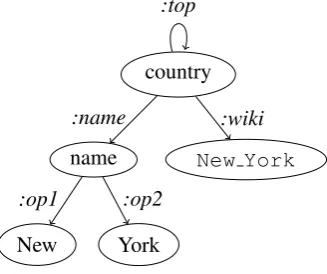
Figure 4: Subgraph for “New York.”
which is not the case when the JAMR-generated alignments contain a mistake. In order to alleviate this problem we observe that there are classes of words such as named entities and numeric quan-tities that can be disambiguated in a deterministic manner. We therefore implement a set of “hooks” that are triggered by the named entity tag of the next token in the sentence. These hooks override the normalShiftmechanism and apply a fixed rule instead. For instance, when we see the tokenNew York(the two tokens are collapsed in a single one at preprocessing) we generate the subgraph of Fig-ure 4 and push its root onto the stack. Similar sub-graphs are generated for all states, cities, countries and people. We also use hooks for ordinal num-bers, percentages, money and dates.
4.4 Edge Labeling
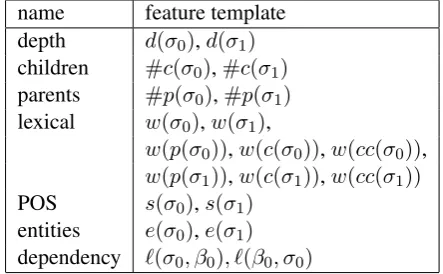
[image:6.595.335.499.276.413.2]depth d(σ0), d(σ1) children #c(σ0),#c(σ1) parents #p(σ0),#p(σ1)
lexical w(σ0), w(σ1), w(β0), w(β1), w(p(σ0)), w(c(σ0)), w(cc(σ0)), w(p(σ1)), w(c(σ1)), w(cc(σ1)) POS s(σ0), s(σ1), s(β0), s(β1) entities e(σ0), e(σ1), e(β0), e(β1) dependency `(σ0, σ1), `(σ1, σ0),
∀i∈ {0,1}:`(σi, β0), `(β0, σi)
∀i∈ {1,2,3}:`(β0, βi), `(βi, β0)
[image:7.595.305.527.63.200.2]∀i∈ {1,2,3}:`(σ0, βi), `(βi, σ0) Table 3: Features used in transition classifier. The function dmaps a stack element to the depth of the associated graph fragment. The functions#c and #p count the number of children and par-ents, respectively, of a stack element. The function w maps a stack/buffer element to the word em-bedding for the associated word in the sentence. The functionpgives the leftmost (according to the alignment) parent of a stack element, the function cthe leftmost child and the functionccthe leftmost grandchild. The functionsmaps a stack/buffer el-ement to the part-of-speech embedding for the as-sociated word. The functionemaps a stack/buffer element to its entity. Finally, the function`maps a pair of symbols to the dependency label embed-ding, according to the edge (or lack of) in the de-pendency tree for the two words these symbols are mapped to.
:ARG0-of, :ARG1, :location, :timeand:polarity. We use a feed-forward neural network similar to the one we trained for the transition classier, with features shown in Table 4. The accuracy of this classifier on the development set is 77%.
We constrain the labels predicted by the neural network in order to satisfy requirements of AMR. For instance, the label :top can only be applied when the node from which the edge starts is the special◦node. Other constraints are used for the :polaritylabel and for edges attaching to numeric quantities.
5 Fine-grained Evaluation
Until now, AMR parsers were evaluated using the Smatch score.10 Given the candidate graphs and
10Since Smatch is an approximate randomized algorithm,
decimal points in the results vary between different runs and are not reported. This approach was also taken by Wang et al.
name feature template depth d(σ0),d(σ1) children #c(σ0),#c(σ1) parents #p(σ0),#p(σ1) lexical w(σ0),w(σ1),
w(p(σ0)),w(c(σ0)),w(cc(σ0)), w(p(σ1)),w(c(σ1)),w(cc(σ1)) POS s(σ0),s(σ1)
[image:7.595.75.299.63.227.2]entities e(σ0),e(σ1) dependency `(σ0, β0), `(β0, σ0)
Table 4: Features used in edge labeling. See Ta-ble 3 for a legend of symbols.
the gold graphs in the form of AMR annotations, Smatch first tries to find the best alignments be-tween the variable names for each pair of graphs and it then computes precision, recall and F1 of the concepts and relations. We note that the Smatch score has two flaws: (1) while AMR parsing in-volves a large number of subtasks, the Smatch score consists of a single number that does not as-sess the quality of each subtasks separately; (2) the Smatch score weighs different types of errors in a way which is not necessarily useful for solving a specific NLP problem. For example, for a spe-cific problem concept detection might be deemed more important than edge detection, or guessing the wrong sense for a concept might be consid-ered less severe than guessing the wrong verb al-together.
Consider the two parses for the sentenceSilvio Berlusconi gave Lucio Stanca his current role of modernizing Italy’s bureaucracy in Figure 5. At the top, we show the output of a parser (Parse 1) that is not able to deal with named entities. At the bottom, we show the output of a parser (Parse 2) which, except for:name,:opand:wiki, always uses the edge label:ARG0. The Smatch scores for the two parses are 56 and 78 respectively. Both parses make obvious mistakes but the three named entity errors inParse 1are considered more impor-tant than the six wrong labels inParse 2. However, without further analysis, it is not advisable to con-clude thatParse 2is better thanParse 1. In order to better understand the limitations of the differ-ent parsers, find their strengths and gain insight in which downstream tasks they may be helpful, we compute a set of metrics on the test set.
Unlabeled is the Smatch score computed on
(g / give-01
:ARG0 (p3 / silvio :mod (n4 / berlusconi) )
:ARG1 (r / role :time (c2 / current)
:mod (m / modernize-01 :ARG0p4
:ARG1 (b / bureaucracy :part-of (c3 / italy) ) )
:possp4)
:ARG2 (p4 / person lucio :mod stanca) )
(g / give-01
:ARG0 (p3 / person :wiki” S i l v i o B e r l u s c o n i ”
:name (n4 / name :op1 ” S i l v i o ”:op2 ” B e r l u s c o n i ” ) )
:ARG0 (r / role
:ARG0 (c2 / current)
:ARG0 (m / modernize-01 :ARG0p4
:ARG0 (b / bureaucracy
:ARG0 (c3 / country :wiki ” I t a l y ”
:name (n6 / name :op1 ” I t a l y ” ) ) ) )
:ARG0p4)
:ARG0 (p4 / person :wiki−
:name (n5 / name :op1 ” Lucio ” :op2 ” S t a n c a ” ) ) )
Figure 5: Two parses for the sentence “Silvio Berlusconi gave Lucio Stanca his current role of modernizing Italy’s bureaucracy.”
the predicted graphs after removing all edge la-bels. In this way, we only assess the node labels and the graph topology, which may be enough to benefit several NLP tasks because it identifies ba-sic predicate-argument structure. For instance, we may be interested in knowing whether two events or entities are related to each other, while not being concerned with the precise type of relation holding between them.
No WSD gives a score that does not take into account word sense disambiguation errors. By ig-noring the sense specified by the Propbank frame used (e.g., duck-01 vsduck-02) we have a score that does not take into account this additional com-plexity in the parsing procedure. To compute this score, we simply strip off the suffixes from all Propbank frames and calculate the Smatch score.
Following Sawai et al. (2015), we also evalu-ate the parsers using the Smatch score on noun phrases only (NP-only), by extracting from the AMR dataset all noun phrases that do not include further NPs.
As we previously discussed, reentrancy is a very important characteristic of AMR graphs and it is not trivial to handle. We therefore implement a test for it (Reentrancy), where we compute the Smatch score only on reentrant edges.
Concept identification is another critical com-ponent of the parsing process and we therefore compute the F-score on the list of predicted cepts (Concepts) too. Identifying the correct con-cepts is fundamental: if a concept is not identi-fied, it will not be possible to retrieve any edge
Metric First parse Second parse
Smatch 56 78
Unlabeled 65 100
No WSD 56 78
NP-only 39 86
Reentrancy 69 46
Concepts 56 100
Named Ent. 0 100
Wikification 0 100
Negations 0 0
[image:8.595.320.514.60.213.2]SRL 69 54
Table 5: Evaluation of the two parses in Figure 5 with the proposed evaluation suite.
involving that concept, with likely significant con-sequences on accuracy. This metric is therefore quite important to score highly on.
Similarly to our score for concepts, we fur-ther compute an F-score on the named entities (Named Ent.) and wiki roles for named entities (Wikification) that consider edges labeled with :nameand :wikirespectively. These two metrics are strictly related to the concept score. How-ever, since named entity recognition is the fo-cus of dedicated research, we believe it is impor-tant to define a metric that specifically assesses this problem. Negation detection is another task which has received some attention. An F-score for this (Negations) is also defined, where we find all negated concepts by looking for the :polarity role. The reason we can compute a simple F-score instead of using Smatch for these metrics is that there are no variable names involved.
Finally we compute the Smatch score on:ARG edges only, in order to have a score for semantic role labeling (SRL), which is another extremely important subtask of AMR, as it is based on the identification of predicate-argument structures.
[image:8.595.69.295.63.241.2]Metric J’14 C’15 J’16 Ours
Smatch 58 63 67 64
Unlabeled 61 69 69 69
No WSD 58 64 68 65
NP-only 47 54 58 55
Reentrancy 38 41 42 41
Concepts 79 80 83 83
Named Ent. 75 75 79 83
Wikification 0 0 75 64
Negations 16 18 45 48
[image:9.595.81.283.61.219.2]SRL 55 60 60 56
Table 6: Results on test split of LDC2015E86 for JAMR, CAMR and our AMREAGER. J stands for JAMR and C for CAMR (followed by the year of publication). Best systems are in bold.
6 Experiments
We compare our parser11 against two available parsers: JAMR (Flanigan et al., 2014) and CAMR (Wang et al., 2015b; Wang et al., 2015a), using the LDC2015E86 dataset for evaluation. Both parsers are available online12 and were recently updated for SemEval-2016 Task 8 (Flanigan et al., 2016; Wang et al., 2016). However, CAMR’s SemEval system, which reports a Smatch score of 67, is not publicly available. CAMR has a quadratic worst-case complexity (although linear in prac-tice). In JAMR, the concept identification step is quadratic and the relation identification step is O(|V|2log|V|), with|V|being the set of nodes in the AMR graph.
Table 6 shows the results obtained by the parsers on all metrics previously introduced. On Smatch, our system does not give state-of-the-art results. However, we do obtain the best results for Unlabeled and Concept and outperform the other parses forNamed Ent. andNegations. Our score of Reentrancy is also close the best scor-ing system, which is particularly relevant given the importance of reentrancies in AMR. The use of theReducetransition, which targets reentran-cies caused by control verbs, is critical in order to achieve this result.
The relatively high results we obtain for the
un-11Our parser is available at https://github.com/
mdtux89/amr-eager, the evaluation suite at https: //github.com/mdtux89/amr-evaluation and a demo at http://cohort.inf.ed.ac.uk/ amreager.html
12JAMR: https://github.com/jflanigan/
jamr, CAMR:https://github.com/c-amr/camr.
labeled case suggests that our parser has difficulty in labeling the arcs. Our score for concept identi-fication, which is on par with the best result from the other parsers, demonstrates that there is a rel-atively low level of token ambiguity. State-of-the-art results for this problem can be obtained by choosing the most frequent subgraph for a given token based on a phrase-table constructed from JAMR alignments on the training data. The scores for named entities and wikification are heavily de-pendent on the hooks mentioned in §4.3, which in turn relies on the named entity recognizer to make the correct predictions. In order to alleviate the problem of wrong automatic alignments with respect to polarity and better detect negation, we performed a post-processing step on the aligner output where we align the AMR constant - (mi-nus) with words bearing negative polarity such as not,illegitimateandasymmetry.
Our experiments demonstrate that there is no parser for AMR yet that conclusively does better than all other parsers on all metrics. Advantages of our parser are the worst-case linear complexity and the fact that is possible to perform incremen-tal AMR parsing, which is both helpful for real-time applications and to investigate how meaning of English sentences can be built incrementally left-to-right.
7 Conclusion
We presented a transition system that builds AMR graphs in linear time by processing the sentences left-to-right. The system is trained with feed-forward neural networks. The parser demonstrates that it is possible to perform AMR parsing us-ing techniques inspired by techniques from depen-dency parsing.
Acknowledgments
The authors would like to thank Sameer Bansal, Jeff Flanigan, Sorcha Gilroy, Adam Lopez, Nikos Papasarantopoulos, Nathan Schneider, Mark Steedman, Sam Thomson, Clara Vania and Chuan Wang for their help and comments. This research was supported by a grant from Bloomberg and by the H2020 project SUMMA, under grant agree-ment 688139.
References
Omri Abend and Ari Rappoport. 2013. Universal con-ceptual cognitive annotation (UCCA). In Proceed-ings of ACL.
Yoav Artzi, Kenton Lee, and Luke Zettlemoyer. 2015. Broad-coverage CCG semantic parsing with AMR. Proceedings of EMNLP.
Laura Banarescu, Claire Bonial, Shu Cai, Madalina Georgescu, Kira Griffitt, Ulf Hermjakob, Kevin Knight, Philipp Koehn, Martha Palmer, and Nathan Schneider. 2013. Abstract meaning representation for sembanking. Proceedings of Linguistic Annota-tion Workshop.
Shu Cai and Kevin Knight. 2013. Smatch: an evalua-tion metric for semantic feature structures. Proceed-ings of ACL.
Danqi Chen and Christopher D Manning. 2014. A fast and accurate dependency parser using neural net-works. InProceesings of EMNLP.
Yantao Du, Fan Zhang, Weiwei Sun, and Xiaojun Wan. 2014. Peking: Profiling syntactic tree parsing tech-niques for semantic graph parsing. InProceedings of the 8th International Workshop on Semantic Eval-uation (SemEval-2014), pages 459–464.
Jeffrey Flanigan, Sam Thomson, Jaime G Carbonell, Chris Dyer, and Noah A Smith. 2014. A discrim-inative graph-based parser for the abstract meaning representation. Proceedings of ACL.
Jeffrey Flanigan, Chris Dyer, Noah A Smith, and Jaime Carbonell. 2016. CMU at SemEval-2016 task 8: Graph-based AMR parsing with infinite ramp loss. Proceedings of SemEval, pages 1202–1206.
James Goodman, Andreas Vlachos, and Jason Narad-owsky. 2016. Noise reduction and targeted explo-ration in imitation learning for abstract meaning rep-resentation parsing. Proceedings of ACL.
Marco Kuhlmann and Peter Jonsson. 2015. Pars-ing to noncrossPars-ing dependency graphs. Transac-tions of the Association for Computational Linguis-tics, pages 559–570.
Christopher D. Manning, Mihai Surdeanu, John Bauer, Jenny Finkel, Steven J. Bethard, and David Mc-Closky. 2014. The Stanford CoreNLP natural lan-guage processing toolkit. InACL System Demon-strations.
Joakim Nivre. 2004. Incrementality in deterministic dependency parsing. Proceedings of the Workshop on Incremental Parsing: Bringing Engineering and Cognition Together. ACL.
Joakim Nivre. 2008. Algorithms for deterministic in-cremental dependency parsing. Computational Lin-guistics, Volume 34, Number 4, December 2008. Xiaochang Peng, Linfeng Song, and Daniel Gildea.
2015. A synchronous hyperedge replacement gram-mar based approach for AMR parsing. Proceedings of CoNLL.
Michael Pust, Ulf Hermjakob, Kevin Knight, Daniel Marcu, and Jonathan May. 2015. Using syntax-based machine translation to parse english into abstract meaning representation. arXiv preprint arXiv:1504.06665.
Sudh Rao, Yogarshi Vyas, Hal Daume III, and Philip Resnik. 2015. Parser for abstract meaning represen-tation using learning to search. arXiv:1510.07586.
Corentin Ribeyre, ´Eric Villemonte de La Clergerie, and Djam´e Seddah. 2015. Because syntax does matter: Improving predicate-argument structures parsing us-ing syntactic features. InConference of the North American Chapter of the Association for Computa-tional Linguistics: Human Language Technologies.
Kenji Sagae and Jun’ichi Tsujii. 2008. Shift-reduce dependency DAG parsing. Proceedings of COL-ING.
Yuichiro Sawai, Hiroyuki Shindo, and Yuji Matsumoto. 2015. Semantic structure analysis of noun phrases using abstract meaning representation. Proceedings of ACL.
Mark Steedman. 1996. Surface Structure and Inter-pretation. The MIT Press.
Mark Steedman. 2000. The Syntactic Process. The MIT Press.
Lucy Vanderwende, Arul Menezes, and Chris Quirk. 2015. An AMR parser for english, french, german, spanish and japanese and a new AMR-annotated corpus.Proceedings of NAACL-HLT.
Chuan Wang, Nianwen Xue, and Sameer Pradhan. 2015a. Boosting transition-based AMR parsing with refined actions and auxiliary analyzers. Pro-ceedings of ACL.
Chuan Wang, Sameer Pradhan, Nianwen Xue, Xiao-man Pan, and Heng Ji. 2016. CAMR at SemEval-2016 task 8: An extended transition-based AMR parser. Proceedings of SemEval.
Yue Zhang and Joakim Nivre. 2011. Transition-based dependency parsing with rich non-local fea-tures. Proceedings of ACL.