Proceedings of the 2019 Conference on Empirical Methods in Natural Language Processing 1007
Hierarchical Pointer Net Parsing
Linlin Liu12∗†, Xiang Lin1†, Shafiq Joty13, Simeng Han1, Lidong Bing2 1Nanyang Technological University, Singapore
2R&D Center Singapore, Machine Intelligence Technology, Alibaba DAMO Academy 3Salesforce Research Asia, Singapore
{linx0057, srjoty, hans0035}@ntu.edu.sg
{linlin.liu, l.bing}@alibaba-inc.com
Abstract
Transition-based top-down parsing with pointer networks has achieved state-of-the-art results in multiple parsing tasks, while having a linear time complexity. However, the decoder of these parsers has a sequential structure, which does not yield the most appropriate inductive bias for deriving tree structures. In this paper, we propose hierarchi-cal pointer network parsers, and apply them to dependency and sentence-level discourse parsing tasks. Our results on standard bench-mark datasets demonstrate the effectiveness of our approach, outperforming existing methods and setting a new state-of-the-art.
1 Introduction
Parsing of sentences is a core natural language un-derstanding task, where the goal is to construct a tree structure that best describes the relation-ships between the tree constituents (e.g., words, phrases). For example, Figure1shows examples of a dependency tree and a sentence-level dis-course tree that respectively represent how the words and clauses are related in a sentence. Such parse trees are directly useful in numerous NLP applications, and also serve as intermediate rep-resentations for further language processing tasks such as semantic and discourse processing.
Existing approaches to parsing can be distin-guished based on whether they employ a greedy
transition-basedalgorithm (Marcu,1999;Zhang and Nivre, 2011; Wang et al., 2017) or a glob-ally optimized algorithm such as graph-based
methods for dependency parsing (Eisner,1996) or
chart parsingfor discourse (Soricut and Marcu, 2003;Joty et al.,2015). Transition-based parsers build the tree incrementally by making a series
∗
Linlin Liu is under the Joint PhD Program between Alibaba and Nanyang Technological University.
†
Equal contribution.
Figure 1: (a) A dependency tree for a sentence; (b) a discourse tree for the sentence “[Now that’s name-dropping,]e1 [if you know]e2 [what I mean.]e3”, where
‘S’ denotes Satellite and ‘N’ denotes Nucleus.
of shift-reduce decisions. The advantage of this method is that the parsing time is linear with re-spect to the sequence length. The limitation, how-ever, is that the decisions made at each step are based on local information, disallowing the model to capture long distance dependencies and also causing error propagation to subsequent steps. Re-cent methods attempt to address this issue us-ing neural networks capable of rememberus-ing long range relationships such as Stacked LSTMs (Dyer et al.,2015;Ballesteros et al.,2015) or using glob-ally normalized models (Andor et al.,2016).
The globally optimized methods, on the other hand, learn scoring functions for subtrees and per-form search over all possible trees to find the most probable tree for a text. Recent graph-based meth-ods use neural models as scoring functions ( Kiper-wasser and Goldberg,2016;Dozat and Manning, 2017). Despite being more accurate than greedy parsers, these methods are generally slow having a polynomial time complexity (O(n3)or higher).
[image:1.595.312.527.221.287.2]while limiting the number of parsing steps to lin-ear. However, the decoder of these parsers has a sequential structure, which may not yield the most appropriateinductive biasfor deriving a hi-erarchical structure. For example, when decod-ing “pens”in Figure 1 in a top-down depth-first manner, the decoder state is directly conditioned on“and”as opposed to the states representing its parent“sell”. This on one hand may induce irrel-evant information in the current state, on the other, as the text length gets longer, the decoder state at later steps tends to forget more relevant informa-tion due to long distance. Having an explicit hier-archical inductive bias should allow the model to receive more relevant information and help with the long-term dependency problem by providing shortcuts for gradient back-propagation.
In this paper, we propose a Hierarchical Pointer Network (H-PtrNet) parser to address the above mentioned limitations. In addition to the sequential dependencies, our parser also directly models the parent-child and sibling relationships in the decoding process. We apply our proposed method to both dependency and discourse parsing tasks. To verify the effectiveness of our approach, we conduct extensive experiments and analysis on both tasks. Our results demonstrate that in depen-dency parsing, our model outperforms in most of the languages. In discourse parsing, we push for-ward the state-of-the-art in all evaluation metrics. Furthermore, our results on the hardest task of relation labeling have touched human agreement scores on this task. We have released our code at https://ntunlpsg.github.io/project/parser/ptrnet-depparser/for research purposes.
2 Background
2.1 Dependency Parsing
Dependency parsing is the task of predicting the existence and type of linguistic dependency re-lations between words in a sentence (Figure1a). Given an input sentence, the output is a tree that shows relationships (e.g., NOMINAL SUB
-JECT (NSUBJ), DETERMINER (DET)) between head words and words that modify those heads, calleddependentsormodifiers.
Approaches to dependency parsing can be di-vided into two main categories: greedy transition-based parsing and graph-transition-based parsing. In both paradigms, neural models have proven to be more effective than feature-based models where
select-ing the composition of features is a major chal-lenge. Kiperwasser and Goldberg (2016) pro-posed graph-based and transition-based depen-dency parsers with a Bi-LSTM feature represen-tation. Since then much work has been done to improve these two parsers. Dozat and Manning (2017) proposed abi-affineclassifier for the pre-diction of arcs and labels based on graph-based model, and achieved state-of-the-art performance. Nguyen and Verspoor(2018) adopted a joint mod-eling approach by adding a Bi-LSTM POS tag-ger to generate POS tags for the graph-based de-pendency parser. Though transition-based meth-ods are superior in terms of time complexity, they fail in capturing the global dependency informa-tion when making decisions. To address this is-sue, Andor et al.(2016) proposed a globally op-timized transition-based model. Recently, by in-corporating a stack within a pointer network, Ma et al. (2018) proposed a transition-based model and achieved state-of-the-art performance across many languages .
2.2 Discourse Parsing
Rhetorical Structure Theory or RST (Mann and Thompson, 1988) is one of the most influential theories of discourse, which posits a tree structure (called discourse tree) to represent a text (Fig.1b). The leaves of a discourse tree represent contigu-ous text spans called Elementary Discourse Units (EDUs). The adjacent EDUs and larger units are recursively connected by coherence relations (e.g., CONDITION, ATTRIBUTION). Furthermore, the discourse units connected by a relation are dis-tinguished based on their relative importance — NUCLEUSrefers to the core part(s) while SATEL
-LITErefers to the peripheral one. Coherence anal-ysis in RST consists of two subtasks: (a) identi-fying the EDUs in a text, referred to asDiscourse Segmentation, and (b) building a discourse tree by linking the EDUs hierarchically, referred to as
Discourse Parsing. This work focuses on the more challenging task of discourse parsing assum-ing that EDUs have already been identified. In fact, state-of-the-art segmenter (Lin et al., 2019) has already achieved 95.6 F1 on RST discourse treebank, where the human agreement is 98.3F1.
shown competitive results with neural models that are able to automatically learn the feature repre-sentations in an end-to-end fashion (Ji and Eisen-stein, 2014; Li et al., 2014). Very recently, Lin et al.(2019) propose a parser based on pointer net-works and achieve state-of-the-art performance.
Remark. Although related, the dependency and RST tree structures (hence the parsing tasks) are different. RST structure is similar to constituency structure. Therefore, the differences between constituency and dependency structures also hold here.1 First, while dependency relations can only be between words, discourse relations can be be-tween elementary units, bebe-tween larger units or both. Second, in dependency parsing, any two words can be linked, whereas RST allows connec-tions only between two adjacent units. Third, in dependency parsing, a head word can have mul-tiple modifier words, whereas in discourse pars-ing, a discourse unit can be associated with only one connection. The parsing algorithm needs to be adapted to account for these differences.
2.3 Pointer Networks.
Pointer networks (Vinyals et al.,2015) are a class of encoder-decoder models that can tackle prob-lems where the output vocabulary depends on the input sequence. They use attentions as pointers to the input elements. An encoder network first con-verts the input sequence X = (x1, . . . ,xn) into
a sequence of hidden states H = (h1, . . . ,hn).
At each time step t, the decoder takes the input from previous step, generates a decoder state dt,
and uses it to attend over the input elements. The attention gives asoftmaxdistribution over the in-put elements.
st,i =σ(dt,hi); at= softmax(st) (1)
where σ(., .) is a scoring function for atten-tion, which can be a neural network or an ex-plicit formula like dot product. The model uses
at to infer the output: ˆyt = arg max(at) = arg maxp(yt|y<t,X, θ) whereθis the set of pa-rameters. To condition on yt−1, the corresponding inputxyt−1 is copied as the input to the decoder.
1There are also studies that use dependency structure to
directly represent the relations between the EDUs; see (Muller et al.,2012;Li et al.,2014;Morey et al.,2018).
3 Hierarchical Pointer Networks
Before presenting our proposed hierarchical pointer networks, we first revisit how pointer net-works have been used for parsing tasks.
3.1 Pointer Networks for Parsing.
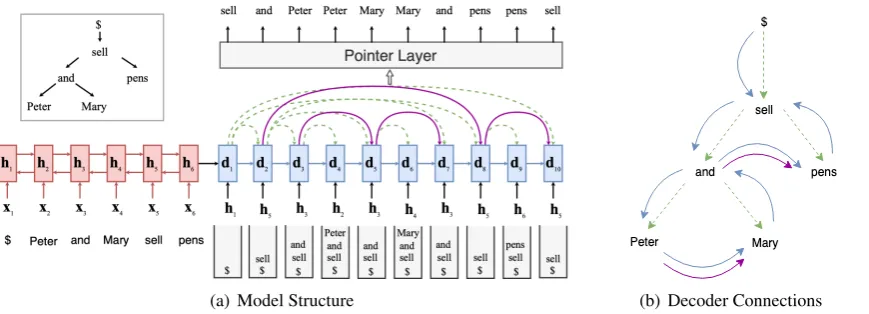
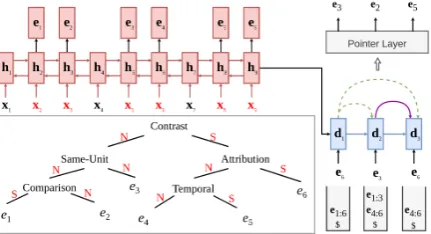
Ma et al. (2018) and Lin et al. (2019) both use a pointer network as the backbone of their pars-ing models and achieve state-of-the-art perfor-mance in dependency and discourse parsing tasks, respectively. As shown in Figures 2(a) and 3, in both cases, the parsing algorithm is imple-mented in a top-down depth-first order. They share the same encoder-decoder structure. A bi-directional Recurrent Neural Network (RNN) encodes a sequence of word embeddings X = (x1, . . . ,xn)into a sequence of hidden states H = (h1, . . . ,hn). The decoder implements a
uni-directional RNN to greedily generate the corre-sponding tree. It maintains a stack to keep track of the units that yet need to be parsed, i.e.,head words for dependency parsing and larger units for discourse parsing. At each step t, the decoder takes out an element from the stack and gener-ates a decoder state dt, which is in turn used in
the pointer layer to compute the attention over the relevant input elements. In the case of depen-dency parsing, the representation of the head word is used to find its dependent. For discourse pars-ing, it uses the representation of the span to iden-tify the break position that splits the text span into two subspans.
In addition to the tree structure, the parser also deals with the corresponding labelling tasks. Whenever the pointer network yields a newly created pair (i.e., head-dependent in dependency parsing, two sub-spans in discourse parsing), a separate classifier is applied to predict the corre-sponding relation between them.
3.2 Limitations of Existing Methods
One crucial limitation of the existing models is that the decoder has a linear structure, although the task is to construct a hierarchical structure. This can be noticed in the Figures2 and3, where the current decoder statedtis conditioned on the
relevant to the current element. For example, in Figure2, the decoder state for pointing to “pens” is conditioned on the state used for pointing to “and”, but not the one used for pointing to “sell”, which is more relevant according to the dependency struc-ture. Also, the decoder state for “sell” is far apart from the one for “pens”. Therefore, more relevant information could be diminished in a sequential decoder, especially for long range dependencies.
3.3 Hierarchical Decoder
To address the above issues, we propose hierarccal pointer network (H-PtrNet), which poses a hi-erarchical decoder that reflects the underlying tree structure. H-PtrNet has the same encoder-decoder architecture as the original pointer network except that each decoding statedtis conditioned directly
on its parent’s decoder statedp(t)and its immedi-ate sibling’s decoder stimmedi-ateds(t) in addition to the previous decoder statedt−1 and parent’s encoder state hp(t) (from input). Formally, the pointing mechanism in H-PtrNet can be defined as:
dt=f(dp(t),ds(t),dt−1,hp(t)) (2)
st,i=σ(dt,hi) (3)
p(yt|y<t,X, θ)= softmax(st)=
exp(st,i) P
iexp(st,i)
(4)
wheref(.)is a fusion function to combine the four components into a decoder state, and other terms are similarly defined as before for Eq. 1. Figure 2(b)shows an example of H-PtrNet decoder con-nections for dependency parsing.
The fusion function f(.) can be implemented in multiple ways and may depend on the specific parsing task. More variants of the fusion function will be discussed in Section4.
Decoder Time Complexity. Given a sentence of lengthn, the number of decoding steps to build a parse tree is linear. The attention mechanism at each decoding step computes an attention vector of length n. The overall decoding complexity is
O(n2), which is same as the StackPointer Parser (Ma et al.,2018).
Remark. If we look at the decoding steps of the StackPointer Parser (Ma et al.,2018) more closely, we notice that it also takes the decoder state of the immediate sibling (when it points to itself). This
decoder state represents the state after all its chil-dren are generated. Thus it contains information about its children. In contrast, in our model we consider the decoder state when the sibling was first generated from its parent. Therefore this state contains the sibling’s parent information, which helps with capturing long term dependencies.
3.4 Model Specifics for Dependency Parsing
Figure 2(a) shows the encoding and decoding steps of H-PtrNet for dependency parsing. We use the same encoder as Ma et al. (2018) (red color).2 Given a sentence, a convolutional neural network (CNN) is used to encode character-level representation of each word, which is then con-catenated with word embedding and POS embed-ding vectors to generate the input sequenceX = (x1, . . . ,xn). Then a three-layer bi-directional
LSTM encodesXinto a sequence of hidden states
H = (h1, . . . ,hn). The decoder (blue color) is a
single layer uni-directional LSTM, and also main-tains a stack to track of the decoding status. At each decoding stept, the decoder receives the en-coder state of the parent from the stack. In ad-dition, it gets decoder statesfrom three different sources: previous decoding stepdt−1, parentdp(t) and immediate siblingds(t).
Instead of simply feeding these three compo-nents to the decoder, we incorporate a gating mechanism to generalize the ability of our model to extract the most useful information. Eventually, the fusion functionf(dp(t),ds(t),dt−1,hp(t)) in Eq. 2 is defined with a gating mechanism. We experimented with two different gating functions:
gt=sigmoid(Wgddt−1+Wgpdp(t)
+Wgsds(t)+bg) (5)
gt=sigmoid(Wgp(dt−1dp(t))
+Wgs(dt−1ds(t)) +bg) (6)
where Wgp, Wgs, Wgd and bg are the gating
weights. The fusion function is then defined as
h0t= tanh(Wddt−1+Wpdp(t)+Wsds(t))(7)
h00t =gth0t (8)
dt=LSTM(h00t,hp(t)) (9)
(a) Model Structure (b) Decoder Connections
Figure 2: (a) H-PtrNet for dependency parsing. To reduce visual clutter, we do not show the attention scores over all the input elements at each pointing step, rather show only the pointed element. Figure (b) shows the decoder connections in our H-PtrNet model. The StackPointer network ofMa et al.(2018) has a sequential decoder (shown as blue straight lines). The Green dash lines indicate parent connections and purple solid lines denote the immediate sibling connections in our model.
whereWd,Wp,Wsare the weights to get the
in-termediate hidden stateh0t, andgtis a gate to
con-trol the information flow from the three decoder states LSTM is the LSTM layer that accepts h00t
as the the hidden state andhp(t)as its input. The LSTM decoder state dt is then used to compute
the attention distribution over the encoder states in pointer layer.
Pointer and Classifier. Same as Ma et al. (2018), the pointer and the label classifier are im-plemented asbi-affinelayers. Formally, the scor-ing functionσ(dt,hi)in Eq.3is defined as:
st,i=g1(dt)TWg2(hi) +Ug1(dt)+
Vg2(hi) +b (10)
where W, U and V are the weights, and g1(.) andg2(.)are two single layer MLPs with ELU ac-tivations. The dependency label classifier has the same structure as the pointer. More specifically,
p(yl|X) = softmax(g01(dt)TWcg02(hk)+
Ucg10(dt) +Vcg02(hk) +bc) (11)
where hk is the encoder state of the dependent
word,dtis the decoder state of the head word,Wc,
UcandVcare the weights, andg10(.)andg20(.)are two single layer MLPs with ELU activations.
Partial Tree Information. Similar to Ma et al. (2018), we provide the decoder at each step with higher order information about the parent and the sibling of the current node.
3.5 Model Specifics for Discourse Parsing.
For discourse parsing, our model uses the same structure as Lin et al. (2019).3 The encoder is a 5-layer bidirectional RNN based on Gated Re-current Units (BiGRU) (Cho et al., 2014). As shown in Figure3, after obtaining a sequence of encoder hidden states representing the words, the last hidden states of the EDUs (e.g., h2, h3, h5,
h6, h8 andh10) are taken as the EDU represen-tations, generating a sequence of EDU representa-tionsE = (e1, . . . ,em)for the input sentence.
Our hierarchical decoder is based on a 5-layer unidirectional GRU. The decoder maintains a
stack to keep track of the spans that need to be parsed further. At time step t, the decoder takes the text span (e.g., ei:j) representation from the
top of the stack and receives the corresponding parent decoder state dp(t), sibling decoder state
ds(t)and previous decoder statedt−1 as the input to generate a current decoder state dt. For
dis-course parsing, we apply Eq. 7and9(with GRU) to implement the fusion function f(.) and to get the decoder state dt.4 The decoder state is then
used in the pointer layer to compute the attention score over the current text span (e.g., ei:j) in
or-der to find the position kto generate a new split
(ei:k,ek+1:j). The parser then applies a relation
classifierΦ(ei:k,ek+1:j)to predict the relation and
the nuclearity labels for the the new split.
3
https://ntunlpsg.github.io/project/ parser/pointer-net-parser
4Adding gating mechanism did not give any gain, rather
[image:5.595.89.524.65.222.2]Figure 3: H-PtrNet for discourse parsing. The input symbols in red (x2,x3,x5,x6,x8,x9) represent last
words of the respective EDUs. To avoid visual clut-ter, we do not show the attention distributions over the EDUs, rather only show the decisions. Green dash lines indicate parent connections and purple solid lines de-note the immediate sibling connections.
For pointing, the parser uses a simpledot prod-uctattention. For labeling, it uses abi-affine clas-sifier similar to the one in Eq. 11. It takes the representations of two spans (i.e.,ek forei:k, ej
for ek+1:j) as input and predicts the
correspond-ing relation between them. Whenever the length of any of the newly created span (ei:kandek+1:j)
is larger than two, the parser pushes it onto the stack for further processing. Similar to depen-dency parsing, the decoder is also provided with
partial tree information– the representations of theparentand the immediatesibling.
3.6 Objective Function
Same asMa et al.(2018) andLin et al.(2019), our parsers are trained to minimize the total log loss (cross entropy) for building the right tree struc-turefor a given sentenceX. The structure lossL is the pointing loss for the pointer network:
L(θ) =−
T X
t=1
logPθ(yt|y<t,X) (12)
where θ denotes the model parameters, y<t rep-resents the subtrees that have been generated by our parser at previous steps, andT is the number needed for parsing the whole sentence (i.e., num-ber of words in dependency parsing and spans con-taining more than two EDUs in discourse parsing). The label classifiers are trained simultaneously, so the final loss function is the sum of structure loss (Eq.12) and the loss for label classifier.
4 Experiments
In this section, we describe the experimental de-tails about dependency parsing and discourse pars-ing, as well as the analysis on both tasks.
Apart from the two gating-based fusion func-tions described in Section3(Eq. 5-6), we experi-mented with three different versions of our model depending on which connections are considered in the decoder. We append suffixes Pfor parent, S
forsiblingandTfortemporalto the model name (H-PtrNet) to denote different versions.
• H-PtrNet-P: The H-PtrNet model with fusion function dt = f(dp(t),hp(t)), where the de-coder receives hidden (dede-coder) state only from the parent (dp(t)) in each decoding step. Note thathp(t)is the encoder state of the parent.
• H-PtrNet-PS: The H-PtrNet model with fusion functiondt = f(dp(t),ds(t),hp(t)), where the decoder receives the hidden states from both the parent and sibling in each decoding step.
• H-PtrNet-PST: This is the full model with fu-sion function dt = f(dp(t),ds(t),dt−1,hp(t)) (Eq.2). In this model, the decoder receives the hidden states from its parent, sibling and previ-ous step in each decoding step.
4.1 Dependency Parsing
Dataset. We evaluate our model on the English Penn Treebank (PTB v3.0) (Marcus et al.,1994), which is converted to Stanford Dependencies for-mat with Stanford Dependency Converter 3.3.0 (Schuster and Manning, 2016). To make a thor-ough empirical comparison with previous stud-ies, we also evaluate our system on seven (7) languages from the Universal Dependency (UD) Treebanks5(version 2.3).
Metrics. We evaluate the performance of our models with unlabeled attachment score (UAS) and labeled attachment score (LAS). We ignore punctuations in the evaluation for English.
Experimental Settings. We use the same setup asMa et al.(2018) in the experiments for English Penn Treebank and UD Treebanks. For a fair com-parison, we rerun their model with the hyperpa-rameters provided by the authors on the same ma-chine as our experiments. For all the languages,
StackPtr (code) H-PtrNet-PST (Gate) H-PtrNet-PST (SGate)
UAS LAS UAS LAS UAS LAS
bg 94.17±0.11 90.63±0.06 94.20±0.16 90.70±0.14 94.50±0.16 91.01±0.20
ca 93.82±0.06 91.99±0.07 93.78±0.03 91.92±0.03 93.67±0.06 91.82±0.07
en 90.97±0.07 89.06±0.08 91.03±0.19 89.07±0.16 90.94±0.12 89.01±0.12
de 87.97±0.20 83.75±0.21 88.14±0.22 83.89±0.26 88.06±0.17 83.83±0.13
fr 91.57±0.23 88.76±0.21 91.63±0.15 88.70±0.14 91.69±0.07 88.80±0.11
it 93.76±0.13 92.00±0.08 93.73±0.08 91.90±0.10 93.88±0.05 92.09±0.02
[image:7.595.132.462.61.228.2]ro 91.15±0.12 85.54±0.13 91.34±0.18 85.73±0.22 91.09±0.09 85.36±0.10
Table 1: Dependency parsing results on 7 UD Treebanks. StackPtr (code)denotes the experiments we rerun on our machine.H-PtrNet-PST (Gate)andH-PtrNet-PST (SGate)are H-PtrNet models with gating mechanism.
we follow the standard split for training, valida-tion and testing. It should be noted thatMa et al. (2018) used UD Treebanks 2.1, which is not the most up-to-date version. Therefore, during exper-iments, we rerun their codes with UD Treebanks 2.3 to match our experiments. To be specific, we use structured-skipgram (Ling et al.,2015) for En-glish and German, while Polyglot embedding ( Al-Rfou et al.,2013) for the other languages. Adam optimizer (Kingma and Ba, 2015) is used as the optimization algorithm. We apply 0.33 dropout rate between layers of encoder and to word em-beddings as well as Eq. 8. We use beam size of 10 for English Penn Treebank, and beam size of 1 for UD Treebanks. The gold-standard POS tags is used for English Penn Treebank. We also use the universal POS tags (Petrov et al.,2011) provided in the dataset for UD Treebanks. See Appendix for a complete list of hyperparameters.
Results on UD Treebanks. We evaluate on 7 different languages from the UD Treebanks: 4 ma-jor ones: English (en), German (de), French (fr), and Italian (it), and 3 relatively minor ones: Bul-garian (bg), Catalan (ca), and Romanian (ro). Ta-ble1shows the results. We refer to the results of our run of the code released byMa et al. (2018) as StackPtr (code).6 StackPtr (code) and our mod-els are trained in identical settings making them comparable. H-PtrNet-PST (Gate) (Eq. 5) and H-PtrNet-PST (SGate) (Eq. 6) are H-PtrNet models with gating mechanism. Element wise product in Eq. 6 has the effect of similarity comparison, so we denote it as SGATE. With gating mechanism,
6We do not directly report the results from their paper
be-cause we use a different version of the UD Treebanks.
Approach UAS LAS
Baselines
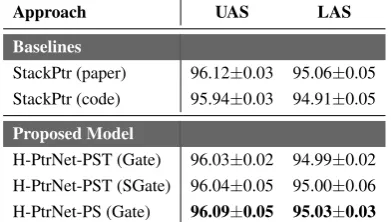
StackPtr (paper) 96.12±0.03 95.06±0.05 StackPtr (code) 95.94±0.03 94.91±0.05
Proposed Model
H-PtrNet-PST (Gate) 96.03±0.02 94.99±0.02 H-PtrNet-PST (SGate) 96.04±0.05 95.00±0.06 H-PtrNet-PS (Gate) 96.09±0.05 95.03±0.03
Table 2: Dependency parsing results on English Penn Treebank v3.0.
our model shows consistent improvements against the baseline on bg, en, de, fr, it and ro. We also tested H-PtrNet-PS on these 7 languages, but the performances are worse than StackPtr.
Results on English Penn Treebank. Table 2 presents the results on English Penn Treebank. StackPtr (paper) refer to the results reported by Ma et al.(2018), and StackPtr (code) is our run of their code in identical settings as ours. Our model H-PtrNet-PST (Gate) outperforms the baseline by 0.09 and 0.08 in terms of UAS and LAS, respec-tively. Performance of H-PtrNet-PST (SGate) is close to that of H-PtrNet-PST (Gate), though we see slight improvement. We also test H-PtrNet-PS (Gate), the model with parent and sibling con-nections only, which further improves the perfor-mance to 96.09 and 95.03 in UAS and LAS.
[image:7.595.319.515.281.392.2](a) H-PtrNet-PST (no gating) (b) H-PtrNet-PST (SGate)
Figure 4: UD German parsing performance in terms of sentence length.
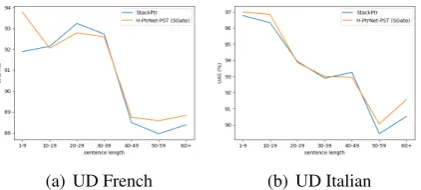
[image:8.595.308.526.64.254.2](a) UD French (b) UD Italian
Figure 5: Performance analysis on French and Italian based on H-PtrNet-PST (SGate).
which is shown in Figure4. The blue line shows the performance of StackPtr, and the orange line shows the performance of our model. From Fig-ure 4(a) we can see that our model without gate performs better on relatively short sentences (10 to 29 words), however, the accuracy drops on longer sentences. The reason could be that adding parent and sibling hidden states to decoder may amplify error accumulation from early parsing mistakes.
Figure 4(b) shows the performance of our model with SGATE (Eq. 6), where we can see
that the performance on long sentences has been improved significantly. In the meanwhile, it still maintains higher accuracy than StackPtr on the short sentences (10 to 29 words). Figure5shows two more examples, again, from which we can see that our model with SGATE tends to outperform
StackPtr on longer sentences.
4.2 Discourse Parsing
Dataset. We use the standard RST Discourse Treebank (RST-DT) (Carlson et al.,2002), which contains discourse annotations for 385 news ar-ticles from Penn Treebank (Marcus et al.,1994). We evaluate our model in sentence-level parsing, for which we extract all the well-formed sentence-level discourse trees from document-sentence-level trees.
Approach Span Nuclearity Relation
Human Agreement 95.7 90.4 83.0
Baselines
Joty et al.(2012) 94.6 86.9 77.1
Ji and Eisenstein(2014) 93.5 81.3 70.5
Wang et al.(2017) 95.6 87.8 77.6 Pointer Net†(Lin et al.,2019) 97.39
±0.1 91.01±0.4 81.08±0.4
Pointer Net§(Lin et al.,2019) 97.14
±0.1 91.00±0.3 81.29±0.2
Proposed Model
H-PtrNet-P† 97.68±0.03 91.86±0.2 81.82±0.2
H-PtrNet-P§ 97.51±0.08 91.98±0.1 82.11±0.2
H-PtrNet-PS† 97.56±0.1 91.52±0.3 82.05±0.5
H-PtrNet-PS§ 97.35±0.1 91.78±0.1 82.35±0.2
H-PtrNet-PST† 97.56±0.06 91.97±0.3 82.37±0.4
[image:8.595.70.281.74.178.2]H-PtrNet-PST§ 97.48±0.2 92.01±0.2 82.77±0.2
Table 3: Discourse parsing results with gold segmen-tation. † denotes the models selected based on Span.
§ denotes the models selected based on Relation. We
run all the experiments for three times and report the averages and the standard deviations.
In all, the training data contains 7321 sentences, and the testing data contains 951 sentences. These numbers match the statistics reported byLin et al. (2019). We follow the same settings as in their ex-periments and randomly choose 10% of the train-ing data for hyperparameter tuntrain-ing.
Metric and Relation Labels. Following the standard in RST parsing, we use the unlabeled (Span) and labeled (Nuclearity, Relation) metrics proposed byMarcu(2000). We only presentF1 -score for space limitations. Following the previ-ous work, we attach the nuclearity labels (NS, SN, NN) to 18 discourse relations, together giving 39 distinctive relation labels.
[image:8.595.71.282.234.329.2]Results. We present the results in Table 3. In discourse parsing, the number of EDUs in a sen-tence is relatively small compared to the sensen-tence lengths (in words) in dependency parsing. Based on the observation in dependency parsing that the performance of H-PtrNet may drop for longer sen-tences due to parent error accumulation, we expect that in discourse parsing, this should not be the case since the the number of parsing steps is much smaller compared to that of dependency parsing.
We first consider the models that were selected based on Span performance (models with † su-perscript). H-PtrNet-P, with only parent connec-tion, outperforms the baseline in all three tasks. It achieves an absolute improvement of 0.29 F1 in span identification compared to the baseline. Con-sidering the performance has already exceeded the human agreement of 95.7F1, this gain is remark-able. Thanks to the higher accuracy on finding the right spans, we also achieve 0.85 and 0.74 absolute improvements in Nuclearity and Relation tasks, respectively. By adding the sibing and temporal connections, we test the performance of our full model, H-PtrNet-PST. The performance on Span is 0.17F1higher than the baseline. However, it is not on par with our H-PtrNet-P. But, it is not sur-prising since we adopt binary tree structures in dis-course parsing, which means the sibling informa-tion could be redundant in most cases. This also accords with our previous assumption that parent connections may bring enough information to de-code RST trees.
Now we consider the models that were selected based on Relation labeling performance (models with § superscript). We achieve significant im-provement in Relation compared to the baseline. Eventually the parser yields anF1of 82.77, which is very close to the human agreement (83.0 F1). We observe that the performance in H-PtrNet-PS and H-PtrNet-PST is better than the H-PtrNet-P. As the relation classifier and the pointer network share the same encoder information (Sec. 3), we believe that richer decoder information leads the model to learn better representations of the text spans (encoder states) and further leads to a bet-ter performance in relation labeling.
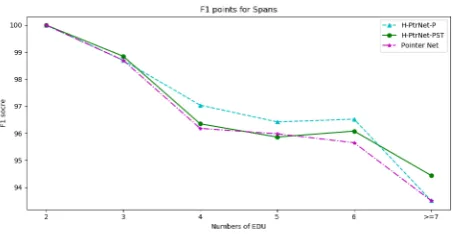
We further analyze the performance of our pro-posed model in terms of number of EDUs. We present the F1 score in Span of H-PtrNet-P and H-PtrNet-PST as well as the baseline in Figure6. It can be observed that both PtrNet-P and
H-Figure 6:F1score in Span for different EDU numbers.
PtrNet-PST outperform the baseline with respect to almost every number of EDUs. Moreover, we can see that the H-PtrNet-P performs better in most of the cases, which once again conforms to our assumption that parent information is enough to decode RST trees. However, as discussed in our dependency parsing experiments, when the number of words (EDUs for discourse parsing) in-creases, the model may suffer from error accumu-lation from early parsing. Hence, H-PtrNet-PST tends to perform better when EDU number be-comes large.
5 Conclusions
In this paper, we propose hierarchical pointer net-work parsers and apply them to dependency and discourse parsing tasks. Our parsers address the limitation of previous methods, where the decoder has a sequential structure while it is decoding a hierarchical tree structure, by allowing more flex-ible information flow to help the decoder receive the most relevant information. For both tasks, our parsers outperform existing methods and set new state-of-the-arts of the two tasks. The broken-down analysis clearly illustrates that our parsers perform better for long sequences, complying with the motivation of our model.
Acknowledgements
This research is partly supported by the Alibaba-NTU Singapore Joint Research Institute, Nanyang Technological University (NTU), Singapore. Shafiq Joty would like to thank the funding support from his Start-up Grant (M4082038.020).
References
[image:9.595.311.538.61.178.2]represen-tations for multilingual nlp. arXiv preprint arXiv:1307.1662.
Daniel Andor, Chris Alberti, David Weiss, Aliaksei Severyn, Alessandro Presta, Kuzman Ganchev, Slav Petrov, and Michael Collins. 2016. Globally nor-malized transition-based neural networks. In Pro-ceedings of the 54th Annual Meeting of the Associa-tion for ComputaAssocia-tional Linguistics (Volume 1: Long Papers), pages 2442–2452, Berlin, Germany. Asso-ciation for Computational Linguistics.
Miguel Ballesteros, Chris Dyer, and Noah A. Smith. 2015. Improved transition-based parsing by mod-eling characters instead of words with LSTMs. In
Proceedings of the 2015 Conference on Empirical Methods in Natural Language Processing, pages 349–359, Lisbon, Portugal. Association for Compu-tational Linguistics.
Lynn Carlson, Daniel Marcu, and Mary Ellen Okurowski. 2002. RST Discourse Treebank (RST– DT) LDC2002T07. Linguistic Data Consortium, Philadelphia.
Kyunghyun Cho, Bart van Merrienboer, C¸ aglar G¨ulc¸ehre, Dzmitry Bahdanau, Fethi Bougares, Hol-ger Schwenk, and Yoshua Bengio. 2014. Learning phrase representations using RNN encoder-decoder for statistical machine translation. InProceedings of the 2014 Conference on Empirical Methods in Nat-ural Language Processing, EMNLP 2014, October 25-29, 2014, Doha, Qatar, A meeting of SIGDAT, a Special Interest Group of the ACL, pages 1724– 1734.
Timothy Dozat and Christopher D. Manning. 2017. Deep biaffine attention for neural dependency pars-ing. InICLR.
Chris Dyer, Miguel Ballesteros, Wang Ling, Austin Matthews, and Noah A. Smith. 2015. Transition-based dependency parsing with stack long short-term memory. InProceedings of the 53rd Annual Meeting of the Association for Computational Lin-guistics and the 7th International Joint Conference on Natural Language Processing (Volume 1: Long Papers), pages 334–343, Beijing, China. Associa-tion for ComputaAssocia-tional Linguistics.
Jason Eisner. 1996. Three new probabilistic models for dependency parsing: An exploration. In Proceed-ings of the 16th Conference on Computational Lin-guistics - Volume 1, COLING ’96, pages 340–345, Copenhagen, Denmark. ACL.
Vanessa Wei Feng and Graeme Hirst. 2014. A linear-time bottom-up discourse parser with constraints and post-editing. InProceedings of the 52nd Annual Meeting of the Association for Computational Lin-guistics (Volume 1: Long Papers), pages 511–521. Association for Computational Linguistics.
Yangfeng Ji and Jacob Eisenstein. 2014. Represen-tation learning for text-level discourse parsing. In
Proceedings of the 52nd Annual Meeting of the As-sociation for Computational Linguistics (Volume 1: Long Papers), pages 13–24, Baltimore, Maryland. ACL.
Shafiq Joty, Giuseppe Carenini, and Raymond Ng. 2012. A novel discriminative framework for sentence-level discourse analysis. In Proceedings of the 2012 Joint Conference on Empirical Methods in Natural Language Processing and Computational Natural Language Learning, pages 904–915. Asso-ciation for Computational Linguistics.
Shafiq Joty, Giuseppe Carenini, and Raymond T Ng. 2015. Codra: A novel discriminative framework for rhetorical analysis. Computational Linguistics, 41:3:385–435.
Diederik P. Kingma and Jimmy Ba. 2015. Adam: A method for stochastic optimization. CoRR, abs/1412.6980.
Eliyahu Kiperwasser and Yoav Goldberg. 2016. Sim-ple and accurate dependency parsing using bidirec-tional LSTM feature representations. Transactions of the Association for Computational Linguistics, 4:313–327.
Sujian Li, Liang Wang, Ziqiang Cao, and Wenjie Li. 2014. Text-level discourse dependency parsing. In
Proceedings of the 52nd Annual Meeting of the As-sociation for Computational Linguistics (Volume 1: Long Papers), pages 25–35. ACL.
Xiang Lin, Shafiq Joty, Prathyusha Jwalapuram, and M Saiful Bari. 2019. A Unified Linear-Time Frame-work for Sentence-Level Discourse Parsing. In Pro-ceedings of the 57th Annual Meeting of the Associa-tion for ComputaAssocia-tional Linguistics, ACL ’19, pages xx–xx, Florence, Italy. ACL.
Wang Ling, Chris Dyer, Alan W Black, and Isabel Trancoso. 2015. Two/too simple adaptations of word2vec for syntax problems. In Proceedings of the 2015 Conference of the North American Chap-ter of the Association for Computational Linguistics: Human Language Technologies, pages 1299–1304.
Xuezhe Ma, Zecong Hu, Jingzhou Liu, Nanyun Peng, Graham Neubig, and Eduard Hovy. 2018. Stack-pointer networks for dependency parsing. In Pro-ceedings of the 56th Annual Meeting of the Associa-tion for ComputaAssocia-tional Linguistics (Volume 1: Long Papers), pages 1403–1414. Association for Compu-tational Linguistics.
William Mann and Sandra Thompson. 1988. Rhetor-ical Structure Theory: Toward a Functional Theory of Text Organization. Text, 8(3):243–281.
Daniel Marcu. 1999. The automatic construction of large-scale corpora for summarization research. In
Proceedings of SIGIR, pages 137–144.
Mitchell Marcus, Mary Marcinkiewicz, and Beatrice Santorini. 1994. Building a Large Annotated Cor-pus of English: The Penn Treebank. Computational Linguistics, 19(2):313–330.
Mathieu Morey, Philippe Muller, and Nicholas Asher. 2018. A dependency perspective on RST discourse parsing and evaluation. American Journal of Com-putational Linguistics, 44(2):197–235.
Philippe Muller, Stergos Afantenos, Pascal Denis, and Nicholas Asher. 2012. Constrained decoding for text-level discourse parsing. In Proceedings of COLING 2012, pages 1883–1900, Mumbai, India. The COLING 2012 Organizing Committee.
Dat Quoc Nguyen and Karin Verspoor. 2018. An im-proved neural network model for joint POS tagging and dependency parsing.CoRR, abs/1807.03955.
Matthew E. Peters, Mark Neumann, Mohit Iyyer, Matt Gardner, Christopher Clark, Kenton Lee, and Luke Zettlemoyer. 2018. Deep contextualized word rep-resentations. InProc. of NAACL.
Slav Petrov, Dipanjan Das, and Ryan T. McDonald. 2011. A universal part-of-speech tagset. CoRR, abs/1104.2086.
Sebastian Schuster and Christopher D. Manning. 2016. Enhanced english universal dependencies: An im-proved representation for natural language under-standing tasks. InLREC.
Radu Soricut and Daniel Marcu. 2003. Sentence Level Discourse Parsing Using Syntactic and Lexical In-formation. In Proceedings of the 2003 Conference of the North American Chapter of the Association for Computational Linguistics on Human Language Technology - Volume 1, NAACL’03, pages 149–156, Edmonton, Canada. ACL.
Oriol Vinyals, Meire Fortunato, and Navdeep Jaitly. 2015. Pointer networks. In C. Cortes, N. D. Lawrence, D. D. Lee, M. Sugiyama, and R. Garnett, editors,Advances in Neural Information Processing Systems 28, pages 2692–2700. Curran Associates, Inc.
Yizhong Wang, Sujian Li, and Houfeng Wang. 2017. A two-stage parsing method for text-level discourse analysis. InProceedings of the 55th Annual Meet-ing of the Association for Computational LMeet-inguistics (Volume 2: Short Papers), pages 184–188. Associa-tion for ComputaAssocia-tional Linguistics.
Yue Zhang and Joakim Nivre. 2011. Transition-based dependency parsing with rich non-local features. In
![Figure 1: (a) A dependency tree for a sentence; (b)a discourse tree for the sentence “[Now that’s name-dropping,]e1 [if you know]e2 [what I mean.]e3”, where‘S’ denotes Satellite and ‘N’ denotes Nucleus.](https://thumb-us.123doks.com/thumbv2/123dok_us/1337566.665135/1.595.312.527.221.287/figure-dependency-sentence-discourse-sentence-dropping-satellite-nucleus.webp)