Data-Driven Dependency Parsing of New Languages
Using Incomplete and Noisy Training Data
Kathrin Spreyer and Jonas Kuhn Department of Linguistics University of Potsdam, Germany
{spreyer,kuhn}@ling.uni-potsdam.de
Abstract
We present a simple but very effective ap-proach to identifying high-quality data in noisy data sets for structured problems like parsing, by greedily exploiting partial struc-tures. We analyze our approach in an anno-tation projection framework for dependency trees, and show how dependency parsers from two different paradigms (graph-based and transition-based) can be trained on the result-ing tree fragments. We train parsers for Dutch to evaluate our method and to investigate to which degree graph-based and transition-based parsers can benefit from incomplete training data. We find that partial correspon-dence projection gives rise to parsers that out-perform parsers trained on aggressively fil-tered data sets, and achieve unlabeled attach-ment scores that are only 5% behind the aver-age UAS for Dutch in the CoNLL-X Shared Task on supervised parsing (Buchholz and Marsi, 2006).
1 Introduction
Many weakly supervised approaches to NLP rely on heuristics or filtering techniques to deal with noise in unlabeled or automatically labeled training data, e.g., in the exploitation of parallel corpora for cross-lingual projection of morphological, syntactic or se-mantic information. While heuristic approaches can implement (linguistic) knowledge that helps to de-tect noisy data (e.g., Hwa et al. (2005)), they are typ-ically task- and language-specific and thus introduce a component of indirect supervision. Non-heuristic filtering techniques, on the other hand, employ re-liability measures (often unrelated to the task) to predict high-precision data points (e.g., Yarowsky et al. (2001)). In order to reach a sufficient level
of precision, filtering typically has to be aggressive, especially for highly structured tasks like parsing. Such aggressive filtering techniques incur massive data loss and enforce trade-offs between the quality and the amount of usable data.
Ideally, a general filtering strategy for weakly su-pervised training of structured analysis tools should eliminate noisy subparts in the automatic annota-tion without discarding its high-precision aspects; thereby data loss would be kept to a minimum. In this paper, we propose an extremely simple ap-proach to noise reduction which greedily exploits partial correspondences in a parallel corpus, i.e., correspondences potentially covering only substruc-tures of translated sentences. We implemented this method in an annotation projection framework to create training data for two dependency parsers rep-resenting different parsing paradigms: The MST-Parser (McDonald et al., 2005) as an instance of
graph-based dependency parsing, and the
Malt-Parser (Nivre et al., 2006) to represent
transition-based dependency parsing. In an empirical
evalu-ation, we investigate how they react differently to incomplete and noisy training data.
Despite its simplicity, the partial correspondence approach proves very effective and leads to parsers that achieve unlabeled attachment scores that are only 5% behind the average UAS for Dutch in the CoNLL-X Shared Task (Buchholz and Marsi, 2006). After a summary of related work in Sec. 2, we discuss dependency tree projection (Sec. 3) and par-tial correspondence (Sec. 4). In Sec. 5, we give an overview of graph- and transition-based dependency parsing and describe how each can be adapted for training on partial training data in Sec. 6. Experi-mental results are presented in Sec. 7, followed by an analysis in Sec. 8. Sec. 9 concludes.
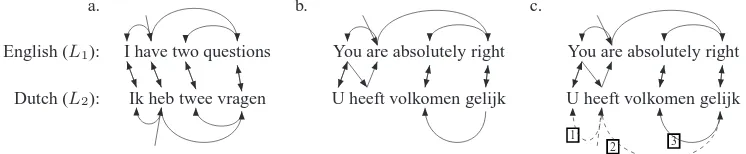
a. b. c.
English (L1): I have two questions You are absolutely right You are absolutely right
Dutch (L2): Ik heb twee vragen U heeft volkomen gelijk U heeft volkomen gelijk
1
[image:2.612.119.492.57.134.2]2 3
Figure 1: Dependency tree projection from English to Dutch. (a) Ideal scenario with bidirectional alignments. (b) Projection fails due to weak alignments. (c) Constrained fallback projection.
2 Related Work
Annotation projection has been applied to many dif-ferent NLP tasks. On the word or phrase level, these include morphological analysis, part-of-speech tag-ging and NP-bracketing (Yarowsky et al., 2001), temporal analysis (Spreyer and Frank, 2008), or se-mantic role labeling (Pad´o and Lapata, 2006). In these tasks, word labels can technically be intro-duced in isolation, without reference to the rest of the annotation. This means that an aggressive filter can be used to discard unreliable data points (words in a sentence) without necessarily affecting high-precision data points in the same sentence. By us-ing only the bidirectional word alignment links, one can implement a very robust such filter, as the bidi-rectional links are generally reliable, even though they have low recall for overall translational cor-respondences (Koehn et al., 2003). The bidirec-tional alignment filter is common practice (Pad´o and Lapata, 2006); a similar strategy is to discard en-tire sentences with low aggregated alignment scores (Yarowsky et al., 2001).
On the sentence level, Hwa et al. (2005) were the first to project dependency trees from English to Spanish and Chinese. They identify unreliable target parses (as a whole) on the basis of the num-ber of unaligned or over-aligned words. In addition, they manipulate the trees to accommodate for non-isomorphic sentences. Systematic non-parallelisms between source and target language are then ad-dressed by hand-crafted rules in a post-projection step. These rules account for an enormous increase in the unlabeled f-score of the direct projections, from 33.9 to 65.7 for Spanish and from 26.3 to 52.4 for Chinese. But they need to be designed anew for every target language, which is time-consuming and requires knowledge of that language.
Research in the field of unsupervised and weakly supervised parsing ranges from various forms of EM training (Pereira and Schabes, 1992; Klein and Man-ning, 2004; Smith and Eisner, 2004; Smith and Eis-ner, 2005) over bootstrapping approaches like self-training (McClosky et al., 2006) to feature-based enhancements of discriminative reranking models (Koo et al., 2008) and the application of semi-supervised SVMs (Wang et al., 2008). The partial correspondence method we present in this paper is compatible with such approaches and can be com-bined with other weakly supervised machine learn-ing schemes. Our approach is similar to that of Clark and Curran (2006) who use partial training data (CCGlexical categories) for domain adaptation; however, they assume an existing CCG resource for the language in question to provide this data.
3 Projection of Dependency Trees
Most state-of-the-art parsers for natural languages are data-driven and depend on the availability of suf-ficient amounts of labeled training data. However, manual creation of treebanks is time-consuming and labour-intensive. One way to avoid the expensive annotation process is to automatically label the train-ing data ustrain-ing annotation projection (Yarowsky et al., 2001): Given a suitable resource (such as a parser) in language L1, and a word-aligned paral-lel corpus with languages L1 and L2, label theL1 -portion of the parallel text (with the parser) and copy the annotations to the corresponding (i.e., aligned) elements in languageL2. This is illustrated in Fig. 1a. The arrows between English and Dutch words indicate the word alignment. Assuming we have a parser to produce the dependency tree for the En-glish sentence, we build the tree for the Dutch sen-tence by establishing arcs between wordswD (e.g.,
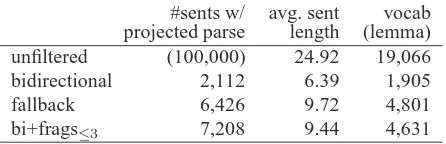
#sents w/ avg. sent vocab projected parse length (lemma)
unfiltered (100,000) 24.92 19,066
bidirectional 2,112 6.39 1,905
fallback 6,426 9.72 4,801
[image:3.612.75.298.54.126.2]bi+frags≤3 7,208 9.44 4,631
Table 1: Data reduction effect of noise filters.
(Ik and I) and(hD, hE)(heb and have) such thathE is the head ofwEin the English tree.
Annotation projection assumes direct
correspon-dence (Hwa et al., 2005) between languages (or
annotations), which—although it is valid in many cases—does not hold in general: non-parallelism between corresponding expressions in L1 and L2 causes errors in the target annotations. The word alignment constitutes a further source for errors if it is established automatically—which is typically the case in large parallel corpora.
We have implemented a language-independent framework for dependency projection and use the Europarl corpus (Koehn, 2005) as the parallel text. Europarl consists of the proceedings of the Euro-pean Parliament, professionally translated in 11 lan-guages (approx. 30mln words per language). The data was aligned on the word level with GIZA++ (Och and Ney, 2003).1 In the experiments reported here, we use the language pair English-Dutch, with English as the source for projection (L1) and Dutch as L2. The English portion of the Europarl cor-pus was lemmatized and POS tagged with the Tree-Tagger (Schmid, 1994) and then parsed with Malt-Parser (which is described in Sec. 6), trained on a dependency-converted version of the WSJ part from the Penn Treebank (Marcus et al., 1994), but with the automatic POS tags. The Dutch sentences were only POS tagged (with TreeTagger).2
3.1 Data Loss Through Filtering
We quantitatively assess the impact of various fil-tering techniques on a random sample of 100,000 English-Dutch sentence pairs from Europarl (avg.
1
Following standard practice, we computed word align-ments in both directions (L1 →L2andL2 →L1); this gives rise to two unidirectional alignments. The bidirectional align-ment is the intersection of the two unidirectional ones.
2
The Dutch POS tags are used to train the monolingual parsers from the projected dependency trees (Sec. 7).
24.9 words/sentence). The English dependency trees are projected to their Dutch counterparts as ex-plained above for Fig. 1a.
The first filter we examine is the one that consid-ers exclusively bidirectional alignments. It admits dependency arcs to be projected only if the headhE and the dependentwE are each aligned
bidirection-ally with some word in the Dutch sentence. This is
indicated in Fig. 1b, where the English verb are is aligned with the Dutch translation heeft only in one direction. This means that none of the dependencies involving are are projected, and the projected struc-ture is not connected. We will discuss in subsequent sections how less restricted projection methods can still incorporate such data.
Table 1 shows the quantitative effect of the bidi-rectional filter in the row labeled ‘bidibidi-rectional’. The proportion of usable sentences is reduced to 2.11%. Consequently, the vocabulary size diminishes by a factor of 10, and the average sentence length drops considerably from almost 25 to less than 7 words, suggesting that most non-trivial examples are lost.
3.2 Constrained Fallback Projection
As an instance of a more relaxed projection of com-plete structures, we also implemented a fallback to unidirectional links which projects further depen-dencies after a partial structure has been built based on the more reliable bidirectional links. That is, the dependencies established via unidirectional align-ments are constrained by the existing subtrees, and are subject to the wellformedness conditions for de-pendency trees.3 Fig. 1c shows how the fallback
mechanism, initialized with the unconnected struc-ture built with the bidirectional filter, recovers a parse tree for the weakly aligned sentence pair in Fig. 1b. Starting with the leftmost word in the Dutch sentence and its English translation (U and You), there is a unidirectional alignment for the head of
You: are is aligned to heeft, so U is established as
a dependent of heeft via fallback. Likewise, heeft can now be identified as the root node. Note that the (incorrect) alignment between heeft and You will not be pursued because it would lead to heeft being a de-pendent of itself and thus violating the
wellformed-3I.e., single headedness and acyclicity; we do not require the
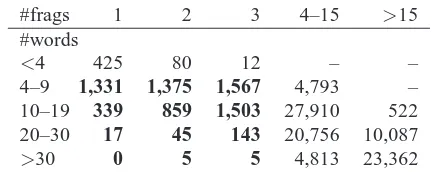
#frags 1 2 3 4–15 >15 #words
<4 425 80 12 – –
4–9 1,331 1,375 1,567 4,793 –
10–19 339 859 1,503 27,910 522
20–30 17 45 143 20,756 10,087
[image:4.612.76.293.53.139.2]>30 0 5 5 4,813 23,362
Table 2: Fragmented parses projected with the alignment filter. The sentences included in the data set ‘bi+frags≤3’
are in boldface.
ness conditions. Finally, the subtree rooted in gelijk is incorporated as the second dependent of heeft.
As expected, the proportion of examples that pass this filter rises, to 6.42% (Table 1, ‘fallback’). How-ever, we will see in Sec. 7 that parsers trained on this data do not improve over parsers trained on the bidirectionally aligned sentences alone. This is pre-sumably due to the noise that inevitably enters the training data through fallback.
4 Partial Correspondence Projection
So far, we have only considered complete trees, i.e., projected structures with exactly one root node. This is a rather strict requirement, given that even state-of-the-art parsers sometimes fail to produce plausible complete analyses for long sentences, and that non-sentential phrases such as complex noun phrases still contain valuable, non-trivial informa-tion. We therefore propose partial correspondence
projection which, in addition to the complete
anno-tations produced by tree-oriented projection, yields partial structures: It admits fragmented analyses in case the tree-oriented projection cannot construct a complete tree. Of course, the nature of those frag-ments needs to be restricted so as to exclude data with no (interesting) dependencies. E.g., a sentence of five words with a parse consisting of five frag-ments provides virtually no information about de-pendency structure. Hence, we impose a limit (fixed at 3 after quick preliminary tests on automatically labeled development data) on the number of frag-ments that can make up an analysis. Alternatively, one could require a minimum fragment size.
As an example, consider again Fig. 1b. This ex-ample would be discarded in strict tree projection, but under partial correspondence it is included as a partial analysis consisting of three fragments:
U heeft volkomen gelijk
Although the amount of information provided in this analysis is limited, the arc between gelijk and
volkomen, which is strongly supported by the
align-ment, can be established without including poten-tially noisy data points that are only weakly aligned. We use partial correspondence in combination with bidirectional projection.4 As can be seen in Table 1 (‘bi+frags≤3’), this combination boosts the amount of usable data to a range similar to that of the fallback technique for trees; but unlike the latter, partial correspondence continues to impose a high-precision filter (bidirectionality) while improving re-call through relaxed structural requirements (partial correspondence). Table 2 shows how fragment size varies with sentence length.
5 Data-driven Dependency Parsing
Models for data-driven dependency parsing can be roughly divided into two paradigms: Graph-based and transition-based models (McDonald and Nivre, 2007).
5.1 Graph-based Models
In the graph-based approach, global optimization considers all possible arcs to find the treeTˆs.t.
ˆ
T = arg max
T∈Ds(T) = arg maxT∈D X
(i,j,l)∈AT
s(i, j, l)
where D is the set of all well-formed dependency trees for the sentence,AT is the set of arcs inT, and
s(i, j, l)is the score of an arc between wordswiand
wjwith labell. The specific graph-based parser we use in this paper is the MSTParser of McDonald et al. (2005). The MSTParser learns the scoring func-tionsusing an online learning algorithm (Crammer and Singer, 2003) which maximizes the margin be-tweenTˆandD\ {Tˆ}, based on a loss function that counts the number of words with incorrect parents relative to the correct tree.
5.2 Transition-based Models
In contrast to the global optimization employed in graph-based models, transition-based models con-struct a parse tree in a stepwise way: At each point,
4
the locally optimal parser action (transition)t∗is de-termined greedily on the basis of the current config-urationc(previous actions plus local features):
t∗= arg max
t∈T s(c, t)
whereT is the set of possible transitions. As a rep-resentative of the transition-based paradigm, we use the MaltParser (Nivre et al., 2006). It implements in-cremental, deterministic parsing algorithms and em-ploys SVMs to learn the transition scoress.
6 Parsing with Fragmented Trees
To make effective use of the fragmented trees pro-duced by partial correspondence projection, both parsing approaches need to be adapted for training on sentences with unconnected substructures. Here we briefly discuss how we represent these structures, and then describe how we modified the parsers.
We use the CoNLL-X data format for dependency trees (Buchholz and Marsi, 2006) to encode partial structures. Specifically, every fragment root spec-ifies as its head an artificial root token w0 (distin-guished from a true root dependency by a special relation FRAG). Thus, sentences with a fragmented parse are still represented as a single sentence, in-cluding all words; the difference from a fully parsed sentence is that unconnected substructures are at-tached directly under w0. For instance, the partial parse in Fig. 1b would be represented as follows (de-tails omitted):
(1) 1 U pron 0 FRAG 2 heeft verb 0 ROOT 3 volkomen adj 4 mod 4 gelijk noun 0 FRAG
6.1 Graph-based Model: fMST
In the training phase, the MSTParser tries to max-imize the scoring margin between the correct parse and all other valid dependency trees for the sentence. However, in the case of fragmented trees, the train-ing example is not strictly speaktrain-ing correct, in the sense that it does not coincide with the desired parse tree. In fact, this desired tree is among the other possible trees that MST assumes to be incorrect, or at least suboptimal. In order to relax this assump-tion, we have to ensure that the loss of the desired tree is zero. While it is impossible to single out this
one tree (since we do not know which one it is), we can steer the margin in the right direction with a loss function that assigns zero loss to all trees that are
consistent with the training example, i.e., trees that
differ from the training example at most on those words that are fragment roots (e.g., gelijk in Fig. 1). To reflect this notion of loss during optimization, we also adjust the definition of the score of a tree:
s(T) = X
(i,j,l)∈AT:l6=FRAG
s(i, j, l)
We refer to this modified model as f(iltering)MST.
6.2 Transition-based Model: fMalt
In the transition-based paradigm, it is particularly important to preserve the original context (includ-ing unattached words) of a partial analysis, because the parser partly bases its decisions on neighboring words in the sentence.
Emphasis of the role of isolated FRAGdependents as context rather than proper nodes in the tree can be achieved, as with the MSTParser, by eliminat-ing their effect on the margin learned by the SVMs. Since MaltParser scores local decisions, this simply amounts to suppressing the creation of SVM train-ing instances for such nodes (U and gelijk in (1)). That is, where the feature model refers to context information, unattached words provide this infor-mation (e.g., the feature vector for volkomen in (1) contains the form and POS of gelijk), but there are no instances indicating how they should be attached themselves. This technique of excluding fragment roots during training will be referred to as fMalt.
7 Experiments
7.1 Setup
We train instances of the graph- and the transition-based parser on projected dependencies, and occa-sionally refer to these as “projected parsers”.5
All results were obtained on the held-out CoNLL-X test set of 386 sentences (avg. 12.9
5The MaltParsers use the projective Nivre arc-standard
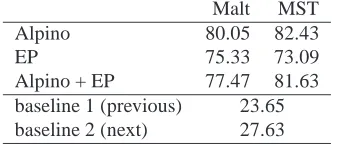
Malt MST
Alpino 80.05 82.43
EP 75.33 73.09
Alpino + EP 77.47 81.63
[image:6.612.319.542.53.234.2]baseline 1 (previous) 23.65 baseline 2 (next) 27.63
Table 3: Upper and lower bounds (UAS).
words/sentence) from the Alpino treebank (van der Beek et al., 2002). The Alpino treebank consists mostly of newspaper text, which means that we are evaluating the projected parsers, which are trained on Europarl, in an out-of-domain setting, in the ab-sence of manually annotated Europarl test data.
Parsing performance is measured in terms of
un-labeled attachment score (UAS), i.e., the proportion
of tokens that are assigned the correct head, irrespec-tive of the label.6
To establish upper and lower bounds for our task of weakly supervised dependency parsing, we pro-ceed as follows. We train MaltParsers and MST-Parsers on (i) the CoNLL-X training portion of the Alpino treebank (195,000 words), (ii) 100,000 Eu-roparl sentences parsed with the parser obtained from (i), and (iii) the concatenation of the data sets (i) and (ii). The first is a supervised upper bound (80.05/82.43% UAS)7 trained on manually labeled in-domain data, while the second constitutes a weaker bound (75.33/73.09%) subject to the same out-of-domain evaluation as the projected parsers, and the third (77.47%) is a self-trained version of (i). We note in passing that the supervised model does not benefit from self-training. Two simple baselines provide approximations to a lower bound: Baseline 1 attaches every word to the preceding word, achiev-ing 23.65%. Analogously, baseline 2 attaches every word to the following word (27.63%). These sys-tems are summarized in Table 3.
6
The labeled accuracy of our parsers lags behind the UAS, because the Dutch dependency relations in the projected anno-tations arise from a coarse heuristic mapping from the original English labels. We therefore report only UAS.
7The upper bound models are trained with the same
param-eter settings as the projected parsers (see fn. 5), which were ad-justed for noisy training data. Thus improvements are likely with other settings: Nivre et al. (2006) report 81.35% for a Dutch MaltParser with optimized parameter settings. McDon-ald et al. (2006) report 83.57% with MST.
words Malt MST
a. trees (bidirectional) 13,500 65.94 67.76
trees (fallback) 62,500 59.28 65.08
bi+frags≤3 68,000 55.09 57.14
bi+frags≤3(fMalt/fMST) 68,000 69.15 70.02
b. trees (bidirectional) 100,000 61.86 69.91 trees (fallback) 100,000 60.05 64.84
bi+frags≤3 100,000 54.50 55.87
bi+frags≤3(fMalt/fMST) 100,000 68.65 69.86
c. trees (bidirectional) 102,300 63.32 69.85 trees (fallback) 465,500 53.45 64.88
bi+frags≤3 523,000 51.48 57.20
bi+frags≤3(fMalt/fMST) 523,000 69.52 70.33
Table 4: UAS of parsers trained on projected dependency structures for (a) a sample of 100,000 sentences, subject to filtering, (b) 10 random samples, each with 100,000 words after filtering (average scores given), and (c) the entire Europarl corpus, subject to filtering.
7.2 Results
Table 4a summarizes the results of training parsers on the 100,000-sentence sample analyzed above. Both the graph-based (MST) and the transition-based (Malt) parsers react similarly to the more or less aggressive filtering methods, but to different de-grees. The first two rows of the table show the parsers trained on complete trees (‘trees (bidirec-tional)’ and ‘trees (fallback)’). In spite of the ad-ditional training data gained by the fallback method, the resulting parsers do not achieve higher accuracy; on the contrary, there is a drop in UAS, especially in the transition-based model (−6.66%). The in-creased level of noise in the fallback data has less (but significant)8 impact on the graph-based coun-terpart (−2.68%).
Turning to the parsers trained on partial cor-respondence data (‘bi+frags≤3’), we observe even greater deterioration in both parsing paradigms if the data is used as is. However, in combination with the fMalt/fMST systems (‘bi+frags≤3 (fMalt/fMST)’), both parsers significantly outperform the
tree-8Significance testing (p<.01) was performed by means of
[image:6.612.102.271.56.129.2]Recall Precision
dep. length 1 2 3–6 ≥7 root 1 2 3–6 ≥7 root
a. trees (bi.) 83.41 66.44 52.94 40.64 52.45 82.46 66.06 61.38 34.95 50.97
trees (fb.) 82.20 64.21 54.59 37.95 55.72 82.64 61.41 54.39 31.96 68.55
bi+frags≤3 70.18 59.50 46.61 32.14 61.87 83.75 67.22 58.25 32.81 27.01
bi+frags≤3(fMalt) 89.23 75.34 59.18 41.65 59.06 83.46 69.05 65.85 48.21 75.79
Alpino-Malt 92.81 84.94 75.11 65.44 66.15 89.71 81.08 77.56 62.57 84.58
b. trees (bi.) 87.53 73.79 59.57 46.79 71.01 86.43 74.08 64.78 45.17 66.79
trees (fb.) 82.53 69.37 55.77 37.46 70.24 85.31 69.29 59.85 40.14 53.99
bi+frags≤3 68.11 57.48 34.30 13.00 90.68 90.28 78.54 66.36 43.70 23.41
bi+frags≤3(fMST) 87.73 72.84 62.55 50.15 67.78 86.94 71.60 66.05 48.48 68.20
[image:7.612.84.534.55.212.2]Alpino-MST 94.13 86.60 76.91 65.14 71.60 91.76 82.49 76.23 71.96 85.38
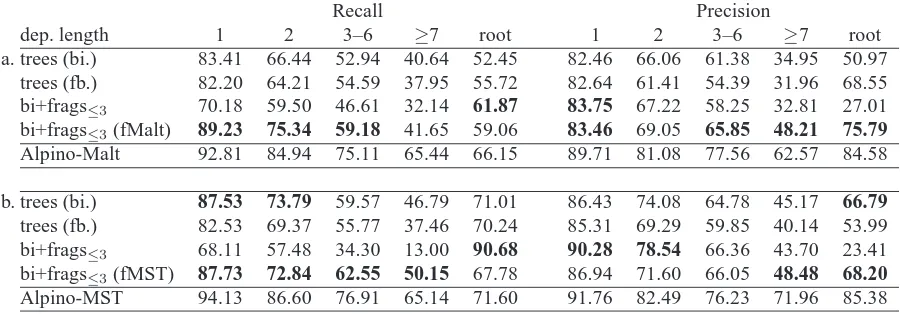
Table 5: Performance relative to dependency length. (a) Projected MaltParsers and (b) projected MSTParsers.
oriented models (‘trees (bidirectional)’) by 3.21% (Malt) and 2.26% (MST).
It would be natural to presume that the superior-ity of the partial correspondence filter is merely due to the amount of training data, which is larger by a factor of 5.04. We address this issue by isolat-ing the effect on the quality of the data, and hence the success at noise reduction: In Table 4b, we con-trol for the amount of data that is effectively used in training, so that each filtered training set consists of 100,000 words. Considering the Malt models, we find that the trends suggested in Table 4a are con-firmed: The pattern of relative performance emerges even though any quantitative (dis-)advantages have been eliminated.9 10 Interestingly, the MSTParser does not appear to gain from the increased variety (cf. Table 1) in the partial data: it does not differ significantly from the ‘trees (bi.)’ model.
Finally, Table 4c provides the results of training on the entire Europarl, or what remains of the corpus after the respective filters have applied. The results corroborate those obtained for the smaller samples.
In summary, the results support our initial hy-pothesis that partial correspondence for sentences containing a highly reliable part is preferable to
9
The degree of skewedness in the filtered data is not con-trolled, as it is an important characteristic of the filters.
10
Some of the parsers trained on the larger data sets (Table 4b+c) achieve worse results than their smaller counterparts in Table 4a. We conjecture that it is due to the thresholded POS-based data split, performed prior to SVM training: Larger train-ing sets induce decision models with more specialized SVMs, which are more susceptible to tagging errors. This could be avoided by increasing the threshold for splitting.
relaxing the reliability citerion, and—in the case of the transition-based MaltParser—also to aggres-sively filtering out all but the reliable complete trees. With UASs around 70%, both systems are only 5% behind the average 75.07% UAS achieved for Dutch in the CoNLL-X Shared Task.
8 Analysis
We have seen that the graph- and the transition-based parser react similarly to the various filtering methods. However, there are interesting differences in the magnitude of the performance changes. If we compare the two tree-oriented filters ‘trees (bi.)’ and ‘trees (fb.)’, we observe that, although both Malt and MST suffer from the additional noise that is in-troduced via the unidirectional alignments, the drop in accuracy is much less pronounced in the latter, graph-based model. Recall that in this paradigm, optimization is performed over the entire tree by scoring edges independenly; this might explain why noisy arcs in the training data have only a negligi-ble impact. Conversely, the transition-based Malt-Parser, which constructs parse trees in steps of lo-cally optimal decisions, has an advantage when con-fronted with partial structures: The individual frag-ments provide exactly the local context, plus lexical information about the (unconnected) wider context.
(Alpino-sent. length <4 4–9 10–19 20–30 >30 a. trees (bi.) 73.87 62.13 65.67 60.81 55.18 trees (fb.) 69.91 57.84 62.29 60.04 55.47 bi+frags≤3 74.14 54.40 56.62 54.07 48.95
bi+fr≤3(fMalt) 73.51 65.69 71.70 68.49 63.71
Alpino-Malt 81.98 69.81 81.11 82.82 76.02
b. trees (bi.) 76.67 70.16 73.09 69.56 63.57 trees (fb.) 73.24 64.93 67.79 64.98 57.70 bi+frags≤3 77.48 59.65 55.96 55.27 52.74
bi+fr≤3(fMST) 73.24 67.84 73.46 70.04 62.92
[image:8.612.318.535.50.240.2]Alpino-MST 81.98 72.24 85.10 83.86 78.51
Table 6: UAS relative to sentence length. (a) Projected MaltParsers and (b) projected MSTParsers.
Malt/MST) and the projected parsers degrades as de-pendencies get longer, and the difference between the two grows. Performance across sentence length remains relatively stable. But note that both tables again reflect the pattern we saw in Table 4. Impor-tantly, the relative ranking (in terms of f-score, not shown, resp. UAS) is still in place even in long dis-tance dependencies and long sentences. This indi-cates that the effects we have described are not arti-facts of a bias towards short dependencies.
In addition, Table 5 sheds some light on the im-pact of fMalt/fMST in terms of the trade-off between precision and recall. Without the specific adjust-ments to handle fragadjust-ments, partial structures in the training data lead to an immense drop in recall. By contrast, when the adapted parsers fMalt/fMST are applied, they boosts recall back to a level compara-ble to or even above that of the tree-oriented pro-jection parsers, while maintaining precision. Again, this effect can be observed across all arc lengths, ex-cept arcs to root, which naturally the ‘bi+frags’ mod-els are overly eager to predict.
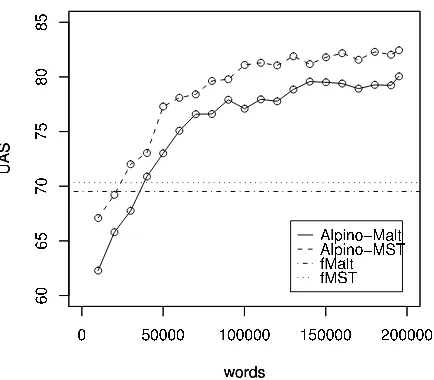
[image:8.612.80.300.53.201.2]Finally, the learning curves in Fig. 2 illus-trate how much labeled data would be required to achieve comparable performance in a supervised setting. The graph-based upper bound (Alpino-MST) reaches the performance of fMST (trained on the entire Europarl) with approx. 25,000 words of manually labeled treebank data; Alpino-Malt achieves the performance of fMalt with approx. 35,000 words. The manual annotation of even these moderate amounts of data involves considerable ef-forts, including the creation of annotation guidelines
Figure 2: Learning curves for the supervised upper bounds. They reach the performance of the projected parsers with∼25,000 (MST) resp. 35,000 (Malt) words.
and tools, the training of annotators etc.
9 Conclusion
In the context of dependency parsing, we have pro-posed partial correspondence projection as a greedy method for noise reduction, and illustrated how it can be integrated with data-driven parsing. Our ex-perimental results show that partial tree structures are well suited to train transition-based dependency parsers. Graph-based models do not benefit as much from additional partial structures, but instead are more robust to noisy training data, even when the training set is very small.
In future work, we will explore how well the tech-niques presented here for English and Dutch work for languages that are typologically further apart, e.g., English-Greek or English-Finnish. Moreover, we are going to investigate how our approach, which essentially ignores unknown parts of the annotation, compares to approaches that marginalize over hid-den variables. We will also explore ways of combin-ing graph-based and transition-based parsers along the lines of Nivre and McDonald (2008).
Acknowledgments
References
Sabine Buchholz and Erwin Marsi. 2006. Conll-x shared task on multilingual dependency parsing. In Proceed-ings of CoNLL-X, pages 149–164, New York City, June.
Stephen Clark and James R. Curran. 2006. Partial train-ing for a lexicalized-grammar parser. In Proceed-ings of HLT-NAACL 2006, pages 144–151, New York, June.
Koby Crammer and Yoram Singer. 2003. Ultraconserva-tive online algorithms for multiclass problems. Jour-nal of Machine Learning Reseach, 3:951–991, Jan-uary.
Rebecca Hwa, Philip Resnik, Amy Weinberg, Clara Cabezas, and Okan Kolak. 2005. Bootstrapping parsers via syntactic projection across parallel texts. Natural Language Engineering, 11(3):311–325. Dan Klein and Christopher D. Manning. 2004.
Corpus-based induction of syntactic structure: Models of de-pendency and constituency. In Proceedings of ACL 2004, pages 478–485, Barcelona, Spain.
Philipp Koehn, Franz Josef Och, and Daniel Marcu. 2003. Statistical phrase-based translation. In Proceed-ings of HLT-NAACL 2003, pages 127–133.
Philipp Koehn. 2005. Europarl: A Parallel Corpus for Statistical Machine Translation. In Proceedings of the MT Summit 2005.
Terry Koo, Xavier Carreras, and Michael Collins. 2008. Simple semi-supervised dependency parsing. In Pro-ceedings of ACL-HLT 2008), pages 595–603, Colum-bus, Ohio, June.
Mitchell Marcus, Grace Kim, Mary Marcinkiewicz, Robert MacIntyre, Ann Bies, Mark Ferguson, Karen Katz, and Britta Schasberger. 1994. The Penn tree-bank: Annotating predicate argument structure. In ARPA Human Language Technology Workshop. David McClosky, Eugene Charniak, and Mark Johnson.
2006. Effective self-training for parsing. In Proceed-ings of HLT-NAACL 2006, pages 152–159, New York, June.
Ryan McDonald and Joakim Nivre. 2007. Characteriz-ing the errors of data-driven dependency parsCharacteriz-ing mod-els. In Proceedings of EMNLP-CoNLL 2007, pages 122–131.
Ryan McDonald, Fernando Pereira, Kiril Ribarov, and Jan Hajiˇc. 2005. Non-projective dependency pars-ing uspars-ing spannpars-ing tree algorithms. In Proceedpars-ings of HLT-EMNLP 2005).
Ryan McDonald, Kevin Lerman, and Fernando Pereira. 2006. Multilingual dependency analysis with a two-stage discriminative parser. In Proceedings of CoNLL-X.
Joakim Nivre and Ryan McDonald. 2008. Integrating graph-based and transition-based dependency parsers. In Proceedings of ACL-HLT 2008, pages 950–958, Columbus, Ohio, June.
Joakim Nivre and Jens Nilsson. 2005. Pseudo-projective dependency parsing. In Proceedings of ACL 2005, pages 99–106.
Joakim Nivre, Johan Hall, Jens Nilsson, G¨uls¸en Eryiˇgit, and Svetoslav Marinov. 2006. Labeled pseudo-projective dependency parsing with support vector ma-chines. In Proceedings of CoNLL-X, pages 221–225. Franz Josef Och and Hermann Ney. 2003. A
system-atic comparison of various statistical alignment mod-els. Computational Linguistics, 29(1):19–51.
Sebastian Pad ´o and Mirella Lapata. 2006. Optimal con-stituent alignment with edge covers for semantic pro-jection. In Proceedings of COLING/ACL 2006, Syd-ney, Australia.
Fernando Pereira and Yves Schabes. 1992. Inside-outside reestimation from partially bracketed corpora. In Proceedings of ACL 1992, pages 128–135.
Helmut Schmid. 1994. Probabilistic part-of-speech tag-ging using decision trees. In International Conference on New Methods in Language Processing, pages 44– 49, Manchester, England.
Noah A. Smith and Jason Eisner. 2004. Annealing techniques for unsupervised statistical language learn-ing. In Proceedings of ACL 2004, pages 487–494, Barcelona, July.
Noah A. Smith and Jason Eisner. 2005. Contrastive esti-mation: Training log-linear models on unlabeled data. In Proceedings of ACL 2005, pages 354–362, Ann Ar-bor, MI, June.
Kathrin Spreyer and Anette Frank. 2008. Projection-based acquisition of a temporal labeller. In Proceed-ings of IJCNLP 2008, Hyderabad, India, January. Leonoor van der Beek, Gosse Bouma, Robert Malouf,
and Gertjan van Noord. 2002. The Alpino depen-dency treebank. In Computational Linguistics in the Netherlands (CLIN).
Qin Iris Wang, Dale Schuurmans, and Dekang Lin. 2008. Semi-supervised convex training for dependency pars-ing. In Proceedings of ACL-HLT 2008, pages 532– 540, Columbus, Ohio, June.