Multi-class Animacy Classification with Semantic Features
Johannes Bjerva
Center for Language and Cognition Groningen University of Groningen
The Netherlands [email protected]
Abstract
Animacy is the semantic property of nouns denoting whether an entity can act, or is perceived as acting, of its own will. This property is marked grammatically in var-ious languages, albeit rarely in English. It has recently been highlighted as a rele-vant property for NLP applications such as parsing and anaphora resolution. In order for animacy to be used in conjunction with other semantic features for such applica-tions, appropriate data is necessary. How-ever, the few corpora which do contain animacy annotation, rarely contain much other semantic information. The addition of such an annotation layer to a corpus al-ready containing deep semantic annotation should therefore be of particular interest. The work presented in this paper contains three main contributions. Firstly, we im-prove upon the state of the art in multi-class animacy multi-classification. Secondly, we use this classifier to contribute to the anno-tation of an openly available corpus con-taining deep semantic annotation. Finally, we provide source code, as well as trained models and scripts needed to reproduce the results presented in this paper, or aid in annotation of other texts.1
1 Introduction
Animacy is the semantic property of nouns de-noting whether, or to what extent, the referent of that noun is alive, human-like or even cogni-tively sophisticated. Several ways of characteris-ing the animacy of such referents have been pro-posed in the literature, the most basic distinction being between animate and inanimate entities. In
1https://github.com/bjerva/animacy
such a binary scheme, examples of animate nouns might include author and dog, while examples of inanimate nouns might includetableandrock. More elaborate schemes tend to represent a hier-archy or continuum typically ranging from HU -MAN →NON-HUMAN→INANIMATE(cf.
Com-rie (1989)), with other categoCom-ries in between. In various languages, animacy affects linguis-tic phenomena such as case marking and argument realization. Furthermore, hierarchical restrictions are often imposed by animacy, e.g. with subjects tending to be higher in an animacy hierarchy than objects (Dahl and Fraurud, 1996). Even though animacy is rarely overtly marked in English, it still influences the choice of certain grammatical struc-tures, such as the choice of relative pronouns (e.g.
whovs.which).
The aims of this work are as follows: (i)to im-prove upon the state of the art in multi-class an-imacy classification by comparing and evaluating different classifiers and features for this task,(ii)to investigate whether a corpus of spoken language containing animacy annotation can be used as a basis to annotate animacy in a corpus of written language,(iii)to use the resulting classifier as part of the toolchain used to annotate a corpus contain-ing deep semantic annotation.
The remainder of this paper is organized as fol-lows: In Section 2 we go through the relevance of animacy for Natural Language Processing (NLP) and describe some corpora which contain animacy annotation. Previous attempts and approaches to animacy classification are portrayed in Section 3. Section 4 contains an overview of the data used in this study, as well as details regarding the man-ual annotation of animacy carried out as part of this work. The methods employed and the results obtained are presented in Sections 5 and 6. The discussion is given in Section 7. Finally, Section 8 contains conclusions and some suggestions for fu-ture work in multi-class animacy classification.
2 Background
2.1 Relevance of animacy for NLP
Although seemingly overlooked in the past, ani-macy has recently been shown to be an impor-tant feature for NLP. Øvrelid & Nivre (2007) found that the accuracy of a dependency parser for Swedish could be improved by incorporating a bi-nary animacy distinction. Other work has high-lighted animacy as relevant for anaphora and co-reference resolution (Or˘asan and Evans, 2007; Lee et al., 2013) and verb argument disambiguation (Dell’Orletta et al., 2005).
Furthermore, in English, the choices for dative alternation (Bresnan et al., 2007), between geni-tive constructions (Stefanowitsch, 2003), and be-tween active and passive voice (Rosenbach, 2008) are also affected by the animacy of their con-stituent nouns. With this in mind, Zaenen et al. (2004) suggest that animacy, for languages such as English, is not a matter of grammatical and un-grammatical sentences, but rather of sentences be-ing more and less felicitous. This highlights anno-tation of animacy as potentially particularly useful for applications such as Natural Language Gener-ation.
In spite of this, animacy appears to be rarely an-notated in corpora, and thus also rather rarely used in tools and algorithms for NLP (although some recent efforts do exist, cf. Moore et al. (2013)). Furthermore, the few corpora that do include ani-macy in their annotation do not contain much other semantic annotation, making them less interesting for computational semanticists.
2.2 Annotation of animacy
Resources annotated with animacy are few and far between. One such resource is the MC160 dataset which has recently been labelled for bi-nary animacy (Moore et al., 2013). The distinc-tion between animate and inanimate was based on whether or not an entity could “move under its own will”. Although interesting, the size of this data set (approximately 8,000 annotated nouns) limits its usefulness, particularly with the methods used in this paper.
Talbanken05 is a corpus of Swedish spoken lan-guage which includes a type of animacy annota-tion (Nivre et al., 2006). However, this annotaannota-tion is better described as a distinction between human and non-human, than between animate and inani-mate (Øvrelid, 2009). Although the work in this
paper focusses on English, a potential application of this corpus is discussed at the end of this paper (see Section 8).
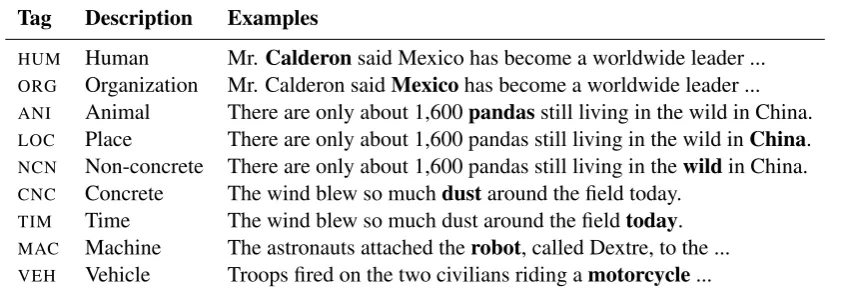
The NXT Switchboard corpus represents a larger and more interesting resource for our pur-poses (Calhoun et al., 2010). This spoken lan-guage corpus contains high quality manual anno-tation of animacy for nearly 200,000 noun phrases (Zaenen et al., 2004). Furthermore, the annota-tion is fairly fine-grained, as a total of ten animacy categories are used (see Table 1), with a few addi-tional tags for mixed animacy and cases in which annotators were uncertain. This scheme can be arranged hierarchically, so that the classes Con-crete, Non-conCon-crete, Place and Time are grouped as inanimate, while the remaining classes are grouped as animate. The availability of this data allows us to easily exploit the annotation for a su-pervised learning approach (see Section 5).
3 Related work
In this section we will give an overview of previ-ous work in animacy classification, some of which has inspired the approach presented in this paper.
3.1 Exploiting corpus frequencies
A binary animacy classifier which uses syntactic and morphological features has been previously developed for Norwegian and Swedish (Øvrelid, 2005; Øvrelid, 2006; Øvrelid, 2009). The fea-tures used are based on frequency counts from the dependency-parsed Talbanken05 corpus. These frequencies are counted per noun lemma, mean-ing that this classifier is not context sensitive. In other words, cases of e.g. polysemy whereheadis inanimate in the sense ofhuman head, but animate in the sense ofhead of an organization, are likely to be problematic. Intuitively, by taking context or semantically motivated features into account, such cases ought to be resolved quite trivially.
This classifier performs well, as it reaches an accuracy for 96.8% for nouns, as compared to a baseline of 90.5% when always picking the most common class (Øvrelid, 2009). Furthermore, it is shown that including the binary distinction from this classifier as a feature in dependency parsing can significantly improve its labelled attachment score (Øvrelid and Nivre, 2007).
vari-Table 1: Overview of the animacy tag set from Zaenen et al. (2004) with examples from the GMB. Tag Description Examples
HUM Human Mr. Calderonsaid Mexico has become a worldwide leader ... ORG Organization Mr. Calderon saidMexicohas become a worldwide leader ... ANI Animal There are only about 1,600pandasstill living in the wild in China. LOC Place There are only about 1,600 pandas still living in the wild inChina. NCN Non-concrete There are only about 1,600 pandas still living in thewildin China. CNC Concrete The wind blew so muchdustaround the field today.
TIM Time The wind blew so much dust around the fieldtoday. MAC Machine The astronauts attached therobot, called Dextre, to the ... VEH Vehicle Troops fired on the two civilians riding amotorcycle...
ous language-specific heuristics are used to im-prove coverage of, e.g., loanwords from English. The features used are mainly frequency counts of nouns as subjects or objects of certain verbs. This is then fed to a Bayesian classifier, which yields quite good results on both Japanese and English.
Taking these works into account, it is clear that the use of morphosyntactic features can provide relevant information for the task of animacy clas-sification. However, both of these approaches use binary classification schemes. It is therefore not clear whether acceptably good results could be ob-tained for more elaborate schemes.
3.2 Exploiting lexico-semantic resources Or˘asan & Evans (2007) present an animacy classi-fier which is based on knowledge obtained from WordNet (Miller, 1995). In one approach, they base this on the so-calledunique beginnersat the top of the WordNet hierarchy. The fact that some of these are closely related to animacy is then used to infer the animacy of their hyponyms. The inclu-sion of the classifications obtained by this system for the task of anaphora resolution is shown to im-prove its results.
An animacy classifier based on exploiting syn-onymy relations in addition to hypsyn-onymy and hy-peronymy has been described for Basque (de Il-laraza et al., 2002). In this work, a small set con-sisting of 100 nouns was manually annotated. Us-ing an electronic dictionary from which semantic relations could be inferred, they then further auto-matically annotated all common nouns in a 1 mil-lion word corpus.
An approach to animacy classification for Dutch is presented in Bloem & Bouma (to ap-pear). This approach exploits a lexical semantic
resource, from which word-senses were obtained and merged per lemma. This is done, as they pos-tulate that ambiguity in animacy per lemma ought to be relatively rare. Each lemma was then as-signed a simplified animacy class depending on its animacy category – either human, non-human
orinanimate. Similarly to Baker & Brew (2010), they also use dependency features obtained from an automatically parsed corpus for Dutch. This type-based approach obtains accuracies in the low 90% range, compared to a most frequent class baseline of about 81%.
Based on the three aforementioned works, it is clear that the use of semantic relations obtained from lexico-semantic resources such as WordNet are particularly informative for the classification of animacy.
3.3 Multi-class animacy classification
An animacy classifier which distinguishes be-tween ten different classes of animacy has been developed by Bowman & Chopra (2012). They use a simple logistic regression classifier and quite straight-forward bag-of-words and PoS fea-tures, as well as subject, object and PP dependen-cies. These are obtained from the aforementioned Switchboard corpus, for which they obtain quite good results.
[image:3.595.91.515.89.236.2]inanimate. The voters comprise a variety of sys-tems, based on the n-gram list method of Ji and Lin (2009), a WordNet-based approach similar to Or˘asan & Evans (2007), and several others. Their results yield animacy detection rates in the mid-90% range, and can therefore be seen as an im-provement upon the state of the art. However, comparison between animacy classification sys-tems is not all that straight-forward, considering the disparity between the data sets and classifica-tion schemes used.
These two works show that multi-class animacy classification can be successfully done both with syntactic and semantic features.
4 Data
Two annotated corpora are used in this work. A further data source is concreteness ratings ob-tained through manual annotation (Brysbaert et al., 2013), and is used as a feature in the classifier. These ratings were obtained for approximately 40,000 English words and two-word expressions, through the use of internet crowd-sourcing. The rating was given on a five-point scale, ranging from abstract, or language based, to concrete, or
experience based(Brysbaert et al., 2013).
4.1 The NXT Switchboard Corpus
Firstly, the classifier is trained and evaluated on the Switchboard corpus, as this allows for direct com-parison of results to at least one previous approach (i.e. Bowman & Chopra (2012)).
4.1.1 Pre-processing of spoken data
The fact that the Switchboard corpus consists of transcribed spoken data presents challenges for some of the tools used in the feature extraction process. The primary concern identified, apart from the differing form of spoken language as compared to written language, is the presence of disfluency markers in the transcribed texts. As a preprocessing step, all disfluencies were removed using a simple automated script. Essentially, this consisted of removing all words tagged as interjec-tions (labelled with the tagUH), as this is the tag assigned to disfluencies in the Switchboard cor-pus. Although interjections generally can be in-formative, the occurrences of interjections within NPs was restricted to usage as disfluencies.
4.2 The Groningen Meaning Bank
There are several corpora of reasonable size which include semantic annotation on some level, such as PropBank (Palmer et al., 2005), FrameNet (Baker et al., 1998), and the Penn Discourse TreeBank (Prasad et al., 2005). The combination of sev-eral levels of semantic annotation into one formal-ism are not common, however. Although some ef-forts exist, they tend to lack a level of formally grounded “deep” semantic representation which combines these layers.
The Groningen Meaning Bank (GMB) contains a substantial collection of English texts with such deep semantic annotation (Basile et al., 2012a). One of its goals is to combine semantic phenom-ena into a single formalism, as opposed to deal-ing with sdeal-ingle phenomena in isolation. This pro-vides a better handle on explaining dependencies between various ambiguous linguistic phenomena. Manually annotating a comprehensive corpus with gold-standard semantic representations is ob-viously a hard and time-consuming task. There-fore, a sophisticated bootstrapping approach is used. Existing NLP tools are used to get a rea-sonable approximation of the target annotations to start with. Pieces of information coming from both experts (linguists) and crowd sourcing meth-ods are then added in to improve the annotation. The addition of animacy annotation is done in the same manner. First, the animacy classifier will be incorporated into this toolchain. We then cor-rect the tags for a subset of the corpus, which is also used to evaluate the classifier. Note that the classifier used in the toolchain uses a different model from the conditions where we evaluate on the Switchboard corpus. For the GMB, we include training data obtained through the crowd-sourcing game Wordrobe, which uses a subset of the data from the GMB (Venhuizen et al., 2013).
4.2.1 Annotation
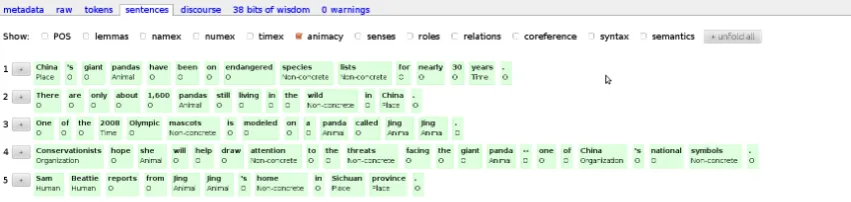
Figure 1: A tagged document in the GMB.
in a resource which already contains other seman-tic annotation should prove parseman-ticularly useful, as this allows animacy to be used in conjunction with other semantically based features in NLP tools and algorithms. This annotation was done using the GMB’s interface for expert annotation (Basile et al., 2012b). A total of 102 documents, contain-ing approximately 15,000 tokens, were annotated by an expert annotator, who corrected the tags as-signed by the classifier. We assign animacy tags to all nouns and pronouns. Similarly to our tag-ging convention for named entities, we assign the same tag to the whole NP, so that wagon driver
is tagged with HUM, althoughwagon in isolation
would be tagged with CNC. This has the added
advantage that this is the manner in which NPs are annotated in the Switchboard corpus, making eval-uation and comparison with Bowman & Chopra (2012) somewhat more straight-forward. An ex-ample of a tagged document can be seen in Fig-ure 1. Table 2 shows the amount of annotated nouns per class. In order to verify the integrity of this annotation, two other experts annotated a ran-dom selection of ten documents. Inter-annotator agreement was calculated using Fleiss’ kappa on this selection, yielding a score ofκ=.596.
Table 2: Annotation statistics forp00of the GMB
HUM NCN CNC TIM ORG LOC ANI VEH MAC
1436 2077 79 500 887 512 67 28 0
5 Method 5.1 Classifiers
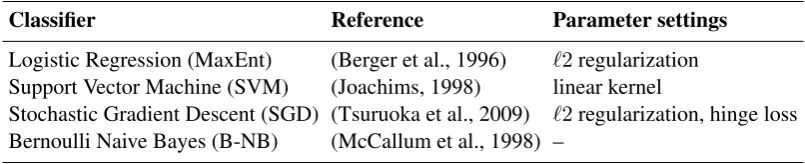
We experiment using four different classifiers (see Table 3). All classifiers used are obtained from the implementations provided by SciKit-learn (Pe-dregosa et al., 2011). For each type of classifier,
we train one classifier for each class in a one-versus-all fashion. For source code, trained mod-els and scripts to run the experiments in this paper, please seehttps://github.com/bjerva/ animacy.
The classifiers are trained on a combination of the Switchboard corpus and data gathered from Wordrobe, depending on the experimental condi-tion. In addition to the features explained below, the classifier exploits named entity tags, in that these override the proposed animacy tag where ap-plicable. That is to say, if a named entity has al-ready been identified and tagged as, e.g., a person, this is reflected in the animacy layer with theHUM
tag.
Considering that the balance between samples per class is quite skewed, an attempt was made at placing lower weights on the samples from the ma-jority classes. Although this did lead to a marginal increase in accuracy for the minority classes, over-all accuracy dropped to such an extent that this weighting was not used for the results presented in this work.
5.2 Features
In this section, an overview of the features used by the classifiers is given.
5.2.1 Bag-of-words feature
The simplest feature used consists of looking at each lemma in the NP to be classified, and their corresponding PoS tags. We also experimented with using whole sentences as context for classi-fication, but as this worsened results on our devel-opment data, it was not used for the evaluations later in the paper.
5.2.2 Concreteness ratings
Table 3: Overview of the classifiers used in the experiments. Classifier Reference Parameter settings Logistic Regression (MaxEnt) (Berger et al., 1996) `2regularization Support Vector Machine (SVM) (Joachims, 1998) linear kernel
Stochastic Gradient Descent (SGD) (Tsuruoka et al., 2009) `2regularization, hinge loss Bernoulli Naive Bayes (B-NB) (McCallum et al., 1998) –
as a feature in the classifier (Brysbaert et al., 2013). In its original form, these ratings are quite fine-grained as they are provided with the average concreteness score given by annotators on a scale. We experimented with using different granulari-ties of these scores as a feature. A simple binary distinction where anything with a score ofc >2.5 being represented as concrete, and c ≤ 2.5 be-ing represented as non-concrete yielded the best results, and is used in the evaluations in this paper. 5.2.3 WordNet distances
We also include a feature based on WordNet dis-tances. In this work, we use the path distance sim-ilarity measure provided in NLTK (Bird, 2006). In essence, this measure provides a score based on the shortest path that connects the senses in a hypernym/hyponym taxonomy. First, we calcu-late the distance to each hypernym of every given word. These distances are then summed together for each animacy class. Taking the most fre-quent hypernym for each animacy class gives us the following hypernyms: person.n.01, abstrac-tion.n.06,city.n.01,time period.n.01,car.n.01, or-ganization.n.01, artifact.n.01, animal.n.01, ma-chine.n.01, buddy.n.01. The classifier then uses whichever of these words is closest as its Word-Net feature.
5.2.4 Thematic roles
The use of thematic roles for animacy annotation constitutes a novel contribution from this work. Intuitively this makes sense, as e.g. agents tend to be animate. Although the GMB contains an anno-tation layer with thematic roles, the Switchboard corpus does not. In order to use this feature, we therefore preprocessed the latter using Boxer (Bos, 2008). We use the protoroles obtained from Boxer, namelyagent,themeandpatient. Although auto-matic annotation does not provide 100% accuracy, especially on such a particular data set, this feature proved somewhat useful (see Section 6.1.2).
6 Results
6.1 Evaluation on the Switchboard corpus We employ 10-fold cross validation for the evalua-tions on the Switchboard corpus. All NPs were au-tomatically extracted from the pre-processed cor-pus, put into random order and divided into ten equally-sized folds. In each of the ten cross valida-tion iteravalida-tions, one of these folds was left out and used for evaluation. For the sake of conciseness, averaged results over all classes are given in the comparisons of Section 6.1.1 and Section 6.1.2, whereas detailed results are only given for the best performing classifier. Note that the training data from Wordrobe is not used for the evaluations on the Switchboard corpus, as this would prohibit fair evaluation with previous work.
6.1.1 Classifier evaluation
We first ran experiments to evaluate which of the classifiers performed the best on this task. Figure 2 shows the average accuracy for each classifier, us-ing 10-fold cross validation on the Switchboard corpus. Table 4 contains the per-class results from the cross validation performed with the best per-forming classifier, namely the Logistic Regression classifier. The remaining evaluations in this pa-per are all carried out with this classifier. Aver-age accuracy over the 10 folds was 85.8%. This is well above the baseline of always picking the most common class (HUM), which results in an
ac-curacy of 45.3%. More interestingly, this is some-what higher than the best results for this dataset reported in the literature (84.9% without cross val-idation (Bowman and Chopra, 2012)).
6.1.2 Feature evaluation
MaxEnt SGD SVM B-NB 40
50 60 70 80
90 85.8
82 84.2
[image:7.595.75.288.59.245.2]80.8
Figure 2: Accuracy of the classifiers, using 10-fold cross validation on the Switchboard corpus. The dashed line represents the most frequent class baseline.
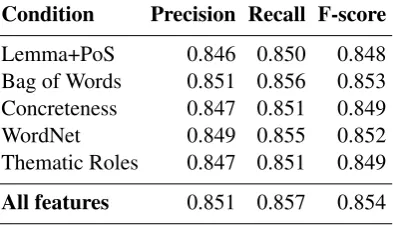
feature in addition to the lemma and PoS of the head of the NP to be classified. Although none of the features in isolation add much to the perfor-mance of the classifier, some marginal gains can be observed.
Table 5: Comparison of the effect of including sin-gle features, from cross validation on the Switch-board corpus. All conditions consist of the fea-ture named in the condition column in addition to Lemma+PoS.
Condition Precision Recall F-score Lemma+PoS 0.846 0.850 0.848 Bag of Words 0.851 0.856 0.853 Concreteness 0.847 0.851 0.849 WordNet 0.849 0.855 0.852 Thematic Roles 0.847 0.851 0.849 All features 0.851 0.857 0.854
6.1.3 Performance on unknown words For a task such as animacy classification, where many words can be reliably classified based solely on their lemma and PoS tag, it is particularly in-teresting to investigate performance on unknown words. As in all other conditions, this was evalu-ated using 10-fold cross validation on the Switch-board corpus. It should come as no surprise that the results are substantially below those for known words, for every single class. The average
accu-racy for this condition was 59.2%, which can be compared to the most frequent class (NCN)
base-line at 43.0%.
6.2 Evaluation on the GMB
Since one of the purposes of the development of this classifier was to include it in the tools used in the tagging of the GMB, we also present the first results in the literature for the animacy annotation of this corpus. Due to the limited size of the por-tion of this corpus for which animacy tags have been manually corrected, no cross-validation was performed. However, due to the high differences in the training data from the Switchboard corpus, and the evaluation data in the GMB, the results could be seen as a lower bound for this classifier on this data set. Table 4 contains the results from this evaluation. The accuracy on this dataset was 79.4%, which can be compared to a most frequent class baseline of 37.2%.
6.3 Excluding pronouns
The discrepancy between the results obtained from the Switchboard corpus and the GMB does call for some investigation. Considering that the Switchboard corpus consists of spoken language, it contains a relatively large amount of personal pronouns compared to, e.g., news text. Taking into account that these pronouns are rarely ambiguous as far as animacy is concerned, it seems feasible that this may be why the results for the Switch-board corpus are better than those of the GMB. To evaluate this, a separate experiment was run in which all pronouns were excluded. As a large amount of pronouns are tagged as HUM, the
F-scores for this class dropped by 8% and 5% for the Switchboard corpus and GMB respectively. For the GMB, results for other classes remained fairly stable, most likely due to there not being many pronouns present which affect the remain-ing classes. For the Switchboard corpus, however, an increase in F-score was observed for several classes. This might be explained by that the ex-clusion of pronouns lowered the classifier’s pre-existing bias for the HUM class, as the number
of annotated examples was lowered from approxi-mately 85,000 to 15,000.
Animacy classification of pronouns can be con-sidered trivial, as there is little or no ambiguity of that the referent of e.g.he isHUM. Even so,
[image:7.595.84.281.487.600.2]Table 4: Results from 10-fold cross validation on the Switchboard corpus and evaluation on the GMB.
Switchboard GMB
Class Count Precision Recall F-score Count Precision Recall F-score
HUM 82596 0.91 0.97 0.94 1436 0.82 0.79 0.80 NCN 62740 0.82 0.94 0.88 2077 0.76 0.88 0.82 CNC 12425 0.75 0.43 0.55 79 0.48 0.13 0.20
TIM 7179 0.88 0.85 0.87 500 0.77 0.95 0.85
ORG 6847 0.71 0.26 0.38 887 0.85 0.68 0.75
LOC 5592 0.71 0.66 0.69 512 0.89 0.71 0.79
ANI 2362 0.89 0.36 0.51 67 0.63 0.22 0.33
VEH 1840 0.89 0.45 0.59 28 1.00 0.39 0.56
MAC 694 0.80 0.34 0.47 - - -
-MIX 34 0.00 0.00 0.00 - - -
-here, as this is the standard manner of reporting results in prior work.
6.4 Summary of results
[image:8.595.84.279.475.603.2]Table 6 contains a brief overview of the most es-sential results from this work. For the Switchboard corpus, this constitutes the current best results in the literature. As for the GMB, this constitutes the first results in the literature for animacy classifica-tion.
Table 6: Main results from all conditions. B&C (2012) refers to Bowman & Chopra (2012).
Corpus Condition Accuracy
Switchboard
B&C (2012) 0.849 Unknown words 0.592 Known words 0.860 All words 0.858
GMB Unknown wordsKnown words 0.7640.831 All words 0.794
7 Discussion
The work presented in this paper constitutes a mi-nor improvement to the previously best results for multi-class animacy classification on the Switch-board corpus (Bowman and Chopra, 2012). Ad-ditionally, we also present the first results in the literature for animacy classification on the GMB, allowing for future research to use this work as a point of comparison. It is, however, important to
note that the results obtained for the GMB in this paper are prone to bias, as the annotation proce-dure was done in a semi-automatic fashion. If an-notators were affected by the output of the clas-sifier, this is likely to have improved the results presented here.
A striking factor when observing the results, is the high discrepancy in performance between the GMB and the Switchboard corpus. This is, how-ever, not all that surprising. Considering that the Switchboard corpus consists of spoken language, and the GMB contains written language, one can easily draw the conclusion that the domain dif-ferences pose a substantial obstacle. This can, for instance, be seen in the differing vocabulary. In the cross-validation conditions for the Switch-board corpus, approximately 1% of the words to be classified in each fold are unknown to the clas-sifier. As for the GMB, approximately 10% of the words are unknown. As mentioned in Sec-tion 6.1.2, the lemma of the head noun in an NP is a very strong feature, which naturally can not be used in the case of unknown words. As seen in Ta-ble 6, performance on known words in the GMB is not far away from that of known words in the Switchboard corpus.
at the very least replicate the results achieved here. Quite likely, results should even improve, seeing that the added computational power of ANNs al-lows us to capture more interesting/deeper statisti-cal patterns, if they exist in the data.
The features used in this paper mainly revolved around semantically oriented ones, such as seman-tic relations from WordNet, themaseman-tic roles and, ar-guably, concreteness ratings. Better results could most likely be achieved if one also incorporated more syntactically oriented features, such as fre-quency counts from a dependency parsed corpus, as done by e.g. Bowman & Chopra (2012) and Øvrelid (2009). Other options include the use of more linguistically motivated features, such as ex-ploiting relative pronouns (i.e.whovs.which).
8 Conclusions and future work
At the beginning of this paper, we set out three aims. Firstly, we wanted to improve upon the state of the art in multi-class animacy classifica-tion. A conclusive statement to that effect is hard to make, considering that comparison was only made directly to one previous work. However, as our performance compared to this work was some-what higher, this work certainly marks some sort of improvement. Secondly, we aimed at investi-gating whether a corpus of spoken language con-taining animacy annotation could be used to anno-tate a corpus of written language. As our results for the GMB are well above the baseline, we con-clude that this is indeed feasible, in spite of the disparities between language form and vocabulary. Lastly, we aimed at using the resulting classifier as a part of the toolchain used to annotate the GMB. This goal has also been met.
As for future work, the fact that animacy is marked explicitly in many languages presents a golden opportunity to alleviate the annotation of this semantic property for languages in which it is not explicitly marked. By identifying these markers, the annotation of animacy in such a lan-guage should be relatively trivial through the use of parallel texts. Alternatively, one could look at using existing annotated corpora, such as Tal-banken05 (Nivre et al., 2006), as a source of an-notation. One could then look at transferring this annotation to a second language. Although intu-itively promising, this approach has some poten-tial issues, as animacy is not represented univer-sally across languages. For instance, fluid
References
Kirk Baker and Chris Brew. 2010. Multilingual an-imacy classification by sparse logistic regression.
OSUWPL, 59:52–75.
Collin F. Baker, Charles J. Fillmore, and John B. Lowe.
1998. The Berkeley FrameNet project. In36th
An-nual Meeting of the Association for Computational Linguistics and 17th International Conference on Computational Linguistics. Proceedings of the Con-ference, pages 86–90, Universit´e de Montr´eal, Mon-treal, Quebec, Canada.
Valerio Basile, Johan Bos, Kilian Evang, and Noortje Venhuizen. 2012a. Developing a large semantically
annotated corpus. InProceedings of the Eighth
In-ternational Conference on Language Resources and Evaluation (LREC 2012), pages 3196–3200, Istan-bul, Turkey.
Valerio Basile, Johan Bos, Kilian Evang, and Noortje Venhuizen. 2012b. A platform for collaborative
se-mantic annotation. In Proceedings of the
Demon-strations at the 13th Conference of the European Chapter of the Association for Computational Lin-guistics (EACL), pages 92–96, Avignon, France. Adam L Berger, Vincent J Della Pietra, and Stephen
A Della Pietra. 1996. A maximum entropy
ap-proach to natural language processing.
Computa-tional linguistics, 22(1):39–71.
Steven Bird. 2006. NLTK: the natural language
toolkit. InProceedings of the COLING/ACL on
In-teractive presentation sessions, pages 69–72. Asso-ciation for Computational Linguistics.
Jelke Bloem and Gosse Bouma. to appear. Automatic
animacy classification for dutch. Computational
Linguistics in the Netherlands Journal, 3, 12/2013. Johan Bos. 2008. Wide-Coverage Semantic
Analy-sis with Boxer. In J. Bos and R. Delmonte, editors,
Semantics in Text Processing. STEP 2008 Confer-ence Proceedings, volume 1 ofResearch in Compu-tational Semantics, pages 277–286. College Publi-cations.
Samuel R Bowman and Harshit Chopra. 2012.
Au-tomatic animacy classification. In Proceedings of
the 2012 Conference of the North American Chap-ter of the Association for Computational Linguistics: Human Language Technologies: Student Research Workshop, pages 7–10. Association for Computa-tional Linguistics.
Joan Bresnan, Anna Cueni, Tatiana Nikitina, R Harald Baayen, et al. 2007. Predicting the dative alterna-tion. Cognitive foundations of interpretation, pages 69–94.
Marc Brysbaert, Amy Beth Warriner, and Victor Ku-perman. 2013. Concreteness ratings for 40
thou-sand generally known english word lemmas.
Behav-ior Research Methods, pages 1–8.
Sasha Calhoun, Jean Carletta, Jason M Brenier, Neil Mayo, Dan Jurafsky, Mark Steedman, and David Beaver. 2010. The nxt-format switchboard corpus: a rich resource for investigating the syntax,
seman-tics, pragmatics and prosody of dialogue. Language
Resources and Evaluation, 44(4):387–419.
Bernard Comrie. 1989. Language universals and
lin-guistic typology: Syntax and morphology. Univer-sity of Chicago press.
¨Osten Dahl and Kari Fraurud. 1996. Animacy in
gram-mar and discourse. PRAGMATICS AND BEYOND
NEW SERIES, pages 47–64.
Arantza D´ıaz de Illaraza, Aingeru Mayor, and Kepa Sarasola. 2002. Semiautomatic labelling of seman-tic features. InProceedings of the 19th International Conference on Computational Linguistics.
Felice Dell’Orletta, Alessandro Lenci, Simonetta Mon-temagni, and Vito Pirrelli. 2005. Climbing the path to grammar: A maximum entropy model of
sub-ject/object learning. In Proceedings of the
Work-shop on Psychocomputational Models of Human Language Acquisition, pages 72–81. Association for Computational Linguistics.
Heng Ji and Dekang Lin. 2009. Gender and animacy knowledge discovery from web-scale n-grams for
unsupervised person mention detection. InPACLIC,
pages 220–229.
Thorsten Joachims. 1998. Text categorization with
support vector machines: Learning with many rel-evant features. Springer.
Heeyoung Lee, Angel Chang, Yves Peirsman, Nathanael Chambers, Mihai Surdeanu, and Dan Ju-rafsky. 2013. Deterministic coreference resolution based on entity-centric, precision-ranked rules.
Andrew McCallum, Kamal Nigam, et al. 1998. A comparison of event models for naive bayes text classification. InAAAI-98 workshop on learning for text categorization, volume 752, pages 41–48. Cite-seer.
George A Miller. 1995. Wordnet: a lexical
database for english. Communications of the ACM,
38(11):39–41.
Joshua L. Moore, Christopher J.C. Burges, Erin Ren-shaw, and Yih Wen-tau. 2013. Animacy
detec-tion with voting models. In Proceedings of the
2013 Conference on Empirical Methods in Natural Language Processing, pages 55–60. Association for Computational Linguistics.
Joakim Nivre, Jens Nilsson, and Johan Hall. 2006. Talbanken05: A swedish treebank with phrase
struc-ture and dependency annotation. InProceedings of
Constantin Or˘asan and Richard Evans. 2007. Np ani-macy identification for anaphora resolution. J. Artif. Intell. Res.(JAIR), 29:79–103.
Lilja Øvrelid and Joakim Nivre. 2007. When word or-der and part-of-speech tags are not enough–Swedish dependency parsing with rich linguistic features. In Proceedings of the International Conference on Recent Advances in Natural Language Processing (RANLP), pages 447–451.
Lilja Øvrelid. 2005. Animacy classification based on morphosyntactic corpus frequencies: some
experi-ments with norwegian nouns. InProc. of the
Work-shop on Exploring Syntactically Annotated Corpora. Lilja Øvrelid. 2006. Towards robust animacy clas-sification using morphosyntactic distributional fea-tures. InProceedings of the Eleventh Conference of the European Chapter of the Association for Com-putational Linguistics: Student Research Workshop, pages 47–54. Association for Computational Lin-guistics.
Lilja Øvrelid. 2009. Empirical evaluations of animacy
annotation. InProceedings of the 12th Conference
of the European Chapter of the Association for Com-putational Linguistics, pages 630–638. Association for Computational Linguistics.
Martha Palmer, Paul Kingsbury, and Daniel Gildea. 2005. The proposition bank: An annotated
cor-pus of semantic roles. Computational Linguistics,
31(1):71–106.
F. Pedregosa, G. Varoquaux, A. Gramfort, V. Michel, B. Thirion, O. Grisel, M. Blondel, P. Pretten-hofer, R. Weiss, V. Dubourg, J. Vanderplas, A. Pas-sos, D. Cournapeau, M. Brucher, M. Perrot, and E. Duchesnay. 2011. Scikit-learn: Machine
learn-ing in Python. Journal of Machine Learning
Re-search, 12:2825–2830.
Rashmi Prasad, Aravind Joshi, Nikhil Dinesh, Alan Lee, Eleni Miltsakaki, and Bonnie Webber. 2005. The Penn Discourse TreeBank as a resource for
nat-ural language generation. In Proc. of the Corpus
Linguistics Workshop on Using Corpora for Natural Language Generation, pages 25–32.
Conor Quinn. 2001. A preliminary survey of animacy categories in penobscot. InPapers of the 32nd. Al-gonquian Conference, pages 395–426.
Anette Rosenbach. 2008. Animacy and grammatical variation–findings from English genitive variation.
Lingua, 118(2):151–171.
Anatol Stefanowitsch. 2003. Constructional semantics as a limit to grammatical alternation: The two
gen-itives of English. TOPICS IN ENGLISH
LINGUIS-TICS, 43:413–444.
Yoshimasa Tsuruoka, Jun’ichi Tsujii, and Sophia Ana-niadou. 2009. Stochastic gradient descent training for l1-regularized log-linear models with cumulative
penalty. InProceedings of the Joint Conference of
the 47th Annual Meeting of the ACL and the 4th In-ternational Joint Conference on Natural Language Processing of the AFNLP, volume 1, pages 477–485. Association for Computational Linguistics.
Noortje J. Venhuizen, Valerio Basile, Kilian Evang, and Johan Bos. 2013. Gamification for word sense
labeling. Proc. 10th International Conference on
Computational Semantics (IWCS-2013), pages 397– 403.