Distributed Document and Phrase Co-embeddings
for Descriptive Clustering
Motoki Sato1, Austin J. Brockmeier2, Georgios Kontonatsios1, Tingting Mu1, John Y. Goulermas2, Jun’ichi Tsujii3,1and Sophia Ananiadou1
1University of Manchester, National Centre for Text Mining (NaCTeM), Manchester, UK 2Department of Computer Science, University of Liverpool, Liverpool, UK
3Artificial Intelligence Research Center, AIST, Tokyo, Japan
[email protected], [email protected] [email protected]
Abstract
Descriptive document clustering aims to automatically discover groups of seman-tically related documents and to assign a meaningful label to characterise the content of each cluster. In this paper, we present a descriptive clustering ap-proach that employs a distributed repre-sentation model, namely the paragraph vector model, to capture semantic similar-ities between documents and phrases. The proposed method uses a joint representa-tion of phrases and documents (i.e., a co-embedding) to automatically select a de-scriptive phrase that best represents each document cluster. We evaluate our method by comparing its performance to an ex-isting state-of-the-art descriptive cluster-ing method that also uses co-embeddcluster-ing but relies on a bag-of-words represen-tation. Results obtained on benchmark datasets demonstrate that the paragraph vector-based method obtains superior per-formance over the existing approach in both identifying clusters and assigning ap-propriate descriptive labels to them.
1 Introduction
Document clustering is a well-established tech-nique whose goal is to automatically organise a collection of documents into a number of seman-tically coherent groups. Descriptive document clustering goes a step further, in that each iden-tified document cluster is automatically assigned a human-readable label (either a word or phrase) that characterises the semantic content of the doc-uments within the cluster. Descriptive clustering
methods have been shown to be useful in a va-riety of scenarios, including information retrieval (Bharambe and Kale, 2011), analysis of social net-works (Zhao and Zhang, 2011), and large-scale exploration (Nassif and Hruschka, 2013) and visu-alisation of text collections (Kandel et al., 2012).
A number of previously proposed descriptive clustering techniques work by extending a stan-dard document clustering approach. Documents are typically clustered based on a bag-of-words (BoW) representation (i.e., the occurrence counts of the words that appear in each document). Then, each cluster is labelled using the most com-monly occurring word or phrase within the clus-ter (Weiss, 2006). In contrast to this approach, the recently proposed descriptive clustering ap-proach (CEDL) (Mu et al., 2016) maps documents and candidate cluster labels into a common se-mantic vector space (i.e., co-embedding). The co-embedding space facilitates the straightforward assignment of descriptive labels to document clus-ters. The CEDL method has been shown to gener-ate accurgener-ate cluster labels and achieved improved clustering performance when compared to stan-dard descriptive clustering methods. Nonetheless, the co-embedding is based solely on a BoW rep-resentation of the documents and is thus limited in its ability to accurately represent the semantic similarity between documents.
In this paper, we investigate a specific case of descriptive clustering that selects a single multi-word phrase to characterise each cluster of doc-uments (Li et al., 2008). Firstly, we assume de-scriptive phrases are to be selected from a can-didate phrase set extracted from the corpus dur-ing preprocessdur-ing. The proposed method then follows the co-embedding descriptive clustering paradigm of the CEDL algorithm. However,
stead of using a BoW representation, we employ the paragraph vector (PV) (Le and Mikolov, 2014) model to learn a distributed vector representa-tions of phrases and documents. These distributed representations move beyond unstructured BoW representations by considering the local contexts in which words and phrases appear within docu-ments, which provides a more precise estimate of semantic similarity.
In particular, we present two extensions to the initial PV-based method that enable mod-els that learn a common co-embedding space of documents and phrases. The first extension jointly learns co-embeddings of documents and phrases. The second extension constructs ‘pseudo-documents’ consisting of the lexical context sur-rounding each occurrence of a particular phrase. Each of these contexts are treated as separate doc-ument instance that are associated with a single embedded vector. In both cases, after clustering the document embedding vectors, each embedded phrase is a candidate cluster label. To select the most appropriate descriptive label amongst these candidates, we first rank the documents according to their proximity to each candidate label’s embed-ding vector and then select the phrase whose rank-ing maximises the average precision for a given cluster.
We compare the results obtained by our PV-based descriptive clustering method against two methods: spectral clustering (Shi and Malik, 2000), which only identifies clusters (but does not assign labels to them), and the previously intro-duced CEDL method (Mu et al., 2016), which car-ries out both clustering and labelling. Experimen-tal results based on publicly available benchmark text collections demonstrate the effectiveness and superiority of our methods in both clustering per-formance and labelling quality.
2 Related Work
2.1 Descriptive Clustering
Descriptive clustering methods typically use an unsupervised approach to firstly group documents into flat or hierarchical clusters (Steinbach et al., 2000). Document clusters are then charac-terised using a set of informative and discrimina-tive words (Zhu et al., 2006), phrases (Mu et al., 2016; Li et al., 2008) or sentences (Kim et al., 2015).
Early approaches to descriptive clustering
followed the description-comes-first (DCF) paradigm (Osi´nski et al., 2004; Weiss, 2006; Zhang, 2009). DCF-based methods work by firstly identifying a set of cluster labels, and subsequently forming document clusters by measuring the relevance of each document to a potential cluster label. DCF-based approaches have several shortcomings, which include poor clustering performance and low readability of cluster descriptors (Lee et al., 2008; Carpineto et al., 2009).
More recent developments in descriptive clus-tering have proposed alternative techniques, which approach the problems of improving clustering performance and descriptive label quality from various different angles. For instance, Scaiella et al. (2012) identifies Wikipedia concepts in doc-uments and then computes relatedness between documents according to the linked structure of Wikipedia. Navigli and Crisafulli (2010) pro-pose a method that takes into account synonymy and polysemy. Their method utilises the Google Web1T corpus to identify word senses based on word co-occurrences and computes the similarity between documents using the extracted sense in-formation.
More recently, Mu et al. (2016) presented their co-embedding based descriptive clustering ap-proach that learns a common co-embedding vec-tor space of documents and candidate descriptive phrases. The co-embedded space simplifies the clustering and cluster labelling task into a more straightforward process of computing similarity between pairs of documents and between docu-ments and candidate cluster labels.
2.2 Distributed Representation
shown to be capable of learning a semantically richer representation of documents compared to unstructured BoW models. To our knowledge, our work constitutes the first attempt to use distributed representation models to co-embed documents and phrases for unsupervised descriptive clustering.
3 Proposed Descriptive Clustering Method
As outlined above, the descriptive clustering task (i.e., grouping documents according to semantic relatedness and characterising the cluster content using a representative descriptive phrase) relies heavily on learning a representation of documents and phrases that can accurately capture relevant semantic information. A particularly effective strategy for descriptive clustering is to jointly map documents and descriptive phrases together into a common embedding space (Mu et al., 2016). The clustering of documents and selection of descrip-tive phrases for each cluster is then carried out by calculating the cosine similarities between docu-ments (to form clusters), and between docudocu-ments and descriptive phrases (to determine descriptive labels) in the learned space. Instead of relying on the commonly used BoW model, we propose a novel descriptive clustering approach. Our method uses similarities computed from distributed joint embeddings of documents and phrases, which are learned by considering both the global context provided by the document and the local context of the descriptive phrases. We propose two different strategies to learn these embeddings, as described below.
3.1 Joint Learning of Document and Phrase Embeddings
The first strategy jointly learns the distributed resentations for documents and phrases by rep-resenting phrases, words, and documents as vec-tors that are used both to predict the occurrence of words in given documents (reflecting global doc-ument content information), and to predict the co-occurrences of words and phrases within a sliding window, to reflect the local context information.
We extend the PV model described in Dai et al. (2015) to simultaneously generate word, phrase and document embeddings. The objective func-tion is to maximise the log probability of words and phrases conditioned on either their global or
local context: X
t∈TP
logp(pt|dt) +|C1 t|
X
c∈Ct
logp(pt|c) (1)
+ X
s∈TW
logp(ws|ds) +|C1 s|
X
c∈Cs
logp(ws|c)
where TP is the set of training phrase instances; pt ∈ P is the t-th phrase instance; dt denotes the document corresponding to the t-th training instance; c denotes a member of the local con-textCt = [qt−L, . . . , qt−1, qt+1, . . . , qt+L], which
occurs within a window size ofL of the training instance (|Ct| = 2L) and consists of both words and phrasesqt∈ P ∪ W; likewise, TW is the set
of training word instances;ws∈ Wis thes-th tar-get word instance; ds denotes the document cor-responding to thes-th training instance; andCsis its local context with|Cs| = 2L. To summarise, the probability terms p(pt|dt)and p(ws|dt)model the document content information from a global level, while p(pt|c) and p(ws|c) model the local context. There are2L+ 1 conditional probabili-ties estimated for each training instance.
The probability of a given lexical unit
qt∈ P ∪ W (either a word or a phrase) is mod-elled using the vector embeddings of the|P|+|W| words and phrases and the softmax function as fol-lows:
p(qt|dt) = exp(u
>
qtzdt)
P
q∈P∪Wexp(u>qzdt)
(2)
p(qt|c) = exp(u
>
qtzc)
P
q∈P∪Wexp(u>qzc) (3) where uqt is a weight vector specific to the
tar-get word or phrase, zdt is the embedding vector
of the document corresponding to instancet, and
zcis the embedding vector of a word or phrase in the context ofqt. Since the document, phrase and word vectors all use the same weight vectoruqt
to predict the target phrase, they are necessarily in the same vector space.
3.2 Phrase Embeddings via Local Context Pseudo-Documents
as ‘pseudo-documents’ by using the sets of words appearing in the local context of each phrase oc-curence. Specifically, training instances for a phrase’s embedding vector are constructed by ex-tracting the local context around each occurrence of a phrase in the document collection. Using the augmented training set, consisting of both the original documents and the additional pseudo-documents, we can then employ any existing PV model (Le and Mikolov, 2014; Dai et al., 2015) to learn the document-phrase co-embeddings.
However, due to the significant differences in the sizes and numbers of documents and pseudo-documents, there is a danger that the addition of the pseudo-documents can have a detrimental ef-fect on the performance of the model. Thus, we adopt a two-stage training procedure. Firstly, an embedding model is trained using only the docu-ments. Then, we fix the weights of the model and optimise the phrase embeddings by providing the pseudo-documents as the input to the model.
We have integrated the above-mentioned pro-cess with two PV approaches, namely the dis-tributed memory model (PV-DM) Le and Mikolov (2014), and the extension of the distributed BoW model (PV-DBOW) in Dai et al. (2015).
In the PV-DM model, the probability that a tar-get word will appear in a given lexical context is conditioned on the surrounding co-occurring words and also the document:
X
t∈TW
logp(wt|Ct, dt), (4)
where wt is the target word for instance t, TW is the set of training word instances,
Ct = [wt−L, . . . , wt−1, wt+1, . . . , wt+L]are
con-text words that occur within a window size ofL
words around wt, and dt denotes the document corresponding to the t-th training instance. The probability is modelled using a softmax function.
For phrase p, the objective is to maximise the sum of the log probabilitiesPt∈Tplogp(wt|Ct, p) wherewt ∈ Tpare the word instances that appear in local context around the phrase, i.e.,Tpis the set of word instances across all pseudo-documents, andCtis the set of words that occur around thet-th word instance which also occur within the pseudo-documents for the phrase. Explicitly, the optimal embedding vector for the phrase is determined by
solving the following optimisation problem:
max
zp
X
t∈Tp
logPexp(u>wtxt+vw>tzp)
wexp(u>wxt+vw>zp) (5)
xt= [x>wt−L, . . . ,x>wt−1,x>wt+1, . . . ,x>wt+L]>
wherextis the concatenation of all word vectors in the context of wordw and{uw}w and{vw}w for w. To find an approximate solution, the pa-rameters of the embedding vector are randomly initialised and optimised using stochastic gradient descent; the gradient is calculated via backpropa-gation (Rumelhart et al., 1986).
The PV-DBOW model simplifies the PV-DM model by ignoring the local context of words in the log probability function. The probability that a target word will appear in a given lexical context is conditioned solely by the document. Dai et al. (2015) introduced a modified version of the PV-DBOW model that treats words and documents as interchangeable inputs to the neural network. This enables the model to jointly learn word and document embeddings in the same space; we de-note the model as PV-DBOW-W. Essentially, the objective of the PV-DBOW-W model is a combi-nation of both the skip-gram model (Mikolov et al., 2013b) that generates word embeddings and the PV-DBOW method which is used for learning document embeddings:
X
t∈TW
logp(wt|dt) +|C1 t|
X
c∈Ct
logp(wt|c). (6)
To optimise the embedding of a specific phrase, denotedp, the existing word embeddings remain fixed, and the objective function is simplified as P
t∈Tplogp(wt|p) where wt ∈ Tp are word
in-stances that appear in the local contexts around the phrase. The optimal embedding vector for this phrase is determined by solving the following op-timisation problem:
max
zp
X
t∈Tp
logPexp(u>wtzp)
wexp(u>wzp) (7)
3.3 Descriptive Phrase Selection
Given co-embeddings of documents and phrases, any clustering algorithm can be applied. We use k-means, with the cosine similarity-based dis-tance metric, to cluster the documents. Given the set of documents within each identified clus-ter G1, . . . ,GK, the document embedding vec-tors {zd}Nd=1 and the descriptive phrase
embed-ding vectors{zp}Pp=1, we then select a descriptive
phrase that best represents the documents assigned to a cluster.
A baseline approach for descriptive phrase se-lection is to select the phrase whose embedding vector is nearest to the cluster centroid; however, proximity to the cluster centroid is not always a good indicator of cluster membership, as it ignores the location of documents belonging to other clus-ters. An ideal phrase vector should lie closer to documents within the cluster than documents out-side of the cluster. Accordingly, we rank doc-uments based on their proximity to a candidate phrase and calculate the average precision of this ranking (where documents belonging to the given cluster are the true positives).
For clusterG, we define the cluster membership indicator for each document as:
yd=
1 d∈ G
0 otherwise (8)
For a given phrase p, let πp(1) be the index of the nearest document to the phrase, and πp(i) be the index of thei-th nearest neighbour. The preci-sion after thek-nearest documents are retrieved is
Pπp(k) = 1k
Pk
i=1yπp(i). The phrase which
max-imises the average precisionPp is selected as the cluster descriptor
p∗ = arg max
p Pp =
1 |G|
X
k∈|G| Pπp(k)
, (9)
where|G|is the number of documents in the clus-ter.
4 Results
We evaluate the proposed PV-based descriptive clustering methods in terms of cluster quality and descriptive phrase selection. Additionally, we show a visualisation of the co-embedding space in the supplementary material.
4.1 Datasets
We use two well-known, publicly available datasets: “Reuters-21578 Text Categorization Test Collection” from the Reuters newswire (Lewis, 1997), and the “20 Newsgroups” email dataset1.
We pprocess the 20 Newsgroups corpus to re-move email header information while for both datasets we extract candidate phrases using Ter-mine (Frantzi et al., 2000), an automatic term ex-traction tool.
For the Reuters corpus, we use the complete document collection for training the PV models. For evaluation, we use both the training and test-ing sets of the modApte split, and select the 10 categories with the largest number of documents. Moreover, we remove documents that belong to multiple categories, this process results in an eval-uation set of8,009documents. For the 20 News-groups dataset, we use the complete set of18,846 documents for training the PV models. We remove words and phrases that only appear in a single document and then remove any empty documents. This process results in an evaluation set of18,813 documents with 20 categories, organised into 4 higher level parent categories. Table 1 summarises various characteristics of the employed datasets, including: a) number of documents, b) number of candidate phrases and c) category labels.
Table 1: Categories included in the evaluation subsets. ‘R10’ corresponds to the 10 largest cat-egories after removing documents with multiple categories; the number of documents is in paren-theses. All 20-Newsgroups categories have be-tween 628 and 997 documents.
Reuters - 8,009 docs - 9,984 words - 11,732 phrases R10 earn(3923), acq(2292), crude(374), trade(327),
money-fx(293), interest(271), money-supply(151), ship(144), sugar(122), coffee(112)
20 News - 18,813 docs - 43,285 words - 36,041 phrases sci crypt, electronics, med, space
comp os.ms-windows.misc, sys.ibm.pc.hardware, graphics, windows.x, sys.mac.hardware rec autos, motorcycles, sport.baseball, sport.hockey mix comp.os.ms-windows.misc, rec.autos,
rec.sport.baseball, sci.med, sci.space all *
4.2 Paragraph Vector Models
PV-DBOW-W, and PV-DM), introduce a fourth model (PV-CAT) and explain the different settings that we use throughout the experiments. The PV-DBOW-WP model is used to jointly train phrase, word and document co-embeddings. For the PV-DBOW-W and PV-DM models, we use the two-stage training approach, in which the document embeddings and softmax weights are trained first, and then the phrase co-embeddings are trained using pseudo-documents. A window size of 10 words around the target phrase is used as the lo-cal context to create the pseudo-documents.
Each PV model has a number of parameters, in-cluding the dimension of the embedded spaces and the size of the context window. We set all em-bedding dimensions to 100. For the PV-DBOW-W and PV-DBOPV-DBOW-W-PV-DBOW-WP model, we use a context window of10words/phrases while for the PV-DM model a window size of 2 words (we tuned the size of the context window by applying the two PV models to a small development set of the Reuters corpus). This disparity in window size is not sur-prising since the PV-DM model considers the or-der of words within the local context and uses dif-ferent parameters for the vectors at each location in the context window, Equation (5), whereas an increased window size does not add additional pa-rameters to the PD-DBOW model.
We create an additional model, namely PV-CAT, by concatenating the vector representations induced by the PV-DBOW-W and the PV-DM models. This is performed after training the docu-ment and the phrase vectors. Intuitively, the con-catenation of the PV-DBOW-W and PV-DM fea-ture vectors can provide complimentary informa-tion given that the two models are trained using a different size of context window (i.e., 10and2 words, respectively).
Given that the size of the vocabulary is very large, computing the softmax function during stochastic gradient descent is computationally ex-pensive. For faster training, different optimisa-tion algorithms can be used to approximate the log probability function. We use a combina-tion of negative sampling and hierachical soft-max via backpropagation (Mnih and Hinton, 2009; Mikolov et al., 2013b). Specifically, we use neg-ative sampling and then further optimise the em-beddings using hierarchical softmax. Although, these are different optimisation approaches, both methods can be applied in this ad-hoc manner.
Moreover, we follow the process described in Le and Mikolov (2014) to tune the learning rate. For this, we set the initial learning rate to 0.025 and decrease it linearly during10training epochs such that the learning rate is0.001during the last train-ing epoch.
4.3 Baseline Methods
As our first baseline, we perform spectral clus-tering based on the affinity matrix produced ac-cording to the cosine similarity between the stan-dard term-frequency inverse document (tf-idf) rep-resentation of the documents. We used the nor-malised cut (NC) spectral clustering algorithm proposed by Shi and Malik (2000).
We also compare our proposed method to the CEDL algorithm (Mu et al., 2016), which uses a measure of second-order similarity be-tween phrases and documents, based on their co-occurrences at the document level, to obtain a spectral co-embedding. We use the same pa-rameters suggested in the original publication, but carried out minor changes to the algorithm to allow the method to be scaled up to larger datasets. To compare clustering performance, we also run the CEDL algorithm without the phrase co-embeddings.
4.4 Evaluation of Cluster Quality
In this experiment, we evaluate the clustering per-formance of the methods by comparing automati-cally generated document clusters against the gold standard categories. For all methods, we use k-means clustering with cosine similarity as the dis-tance metric. Following previous approaches (Xie and Xing, 2013), we set the number of clusters equal to the number of gold standard categories. As evaluation metrics, we use the macro-averaged F1 score2, and normalised mutual information3.
Table 2 compares the clustering performance achieved by four PV models (DBOW-WP, PV-DBOW-W, PV-DM, and PV-CAT) against the per-formance of the baselines (i.e., the two versions of the CEDL algorithm and spectral clustering via normalised cut).
2For each category, the maximum F1 score across the clusters is used.
3Normalised mutual information MI(G,C)
max{H(G),H(C)} is
de-fined as the mutual information between the automatically generated clusters and gold standard categoriesMI(G, C)
divided by the maximum of the entropy of the clustersH(G)
Table 2: Clustering performance assessed by correspondence measures to gold standard cate-gories. NC: spectral clustering via normalised cut, CE1: CEDL, CE2: CEDL without phrase co-embeddings, PV1: PV-DBOW-WP, PV2: PV-DBOW-W,PV3: PV-DM,PV4: PV-CAT.
NC CE1 CE2 PV1 PV2 PV3 PV4 F1 (macro-averaged; higher is better)
R10 0.60 0.54 0.56 0.54 0.66 0.48 0.66
sci 0.89 0.89 0.88 0.91 0.91 0.90 0.92
comp 0.48 0.46 0.55 0.67 0.66 0.63 0.65 rec 0.87 0.86 0.90 0.92 0.92 0.88 0.92
mix 0.93 0.92 0.93 0.95 0.94 0.93 0.95
all 0.56 — — 0.69 0.69 0.66 0.69
all† 0.52 0.48 0.55 0.67 0.67 0.64 0.67
Normalised mutual information (higher is better) R10 0.42 0.41 0.42 0.47 0.50 0.40 0.51
sci 0.68 0.68 0.66 0.72 0.71 0.70 0.74
comp 0.25 0.22 0.30 0.40 0.39 0.36 0.39 rec 0.69 0.67 0.74 0.78 0.78 0.70 0.78
mix 0.80 0.77 0.79 0.84 0.82 0.80 0.83
all 0.51 — — 0.62 0.62 0.60 0.63
all† 0.50 0.44 0.52 0.63 0.62 0.60 0.64 †Average of 10 random subsets using 10% of each category’s
documents.
The PV-DBOW-W and PV-CAT methods yield the best clustering performance on the Reuters dataset. Performance gains over the three baseline methods range between6%−12%(F1 score) and 8%−9% (normalised mutual information). On the 20 Newsgroups dataset, the PV-DBOW-WP and PV-CAT models outperformed the baseline methods4by approximately2%−21%(F1 score)
and3%−18%(normalised mutual information). Moreover, we note that the performance achieved by the PV-CAT model exceeds the best results re-ported in Xie and Xing (2013) (normalised mutual information of 0.6159 using a multi-grain cluster-ing topic model).
Finally, we note that co-embedding is not designed as a mechanism for improving clus-ter quality. For CEDL, the co-embedding of phrases reduced the clustering performances in most datasets. This reduction in performance is equally observed for the paragraph vector models when applied to the Reuters dataset: the jointly trained co-embedding model (i.e., PV-DBOW-WP) achieved a lower performance than the two-stage approach PV-DBOW-W (F1 score of 0.56 and 0.66, respectively).
4Our implementation of the CEDL algorithm did not scale up to the entire dataset (‘all’), but average results on random subsets were consistent, as shown in the table.
4.5 Evaluation of Cluster Labelling
In this section, we evaluate the cluster labels (i.e., multi-word phrases) selected by the proposed PV-based descriptive clustering methods. As a base-line approach, we use the CEDL algorithm that produces a co-embedded space of documents and phrases5.
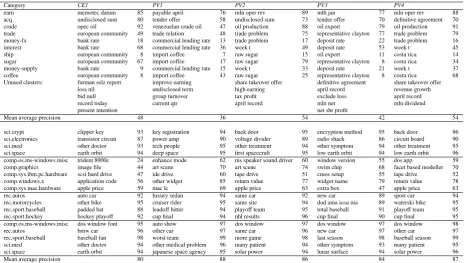
For each document cluster, we apply the phrase selection criterion, Equation (9), to identify the phrase that best describes the underlying cluster. Then for each gold standard category, the cluster having the highest proportion of documents be-longing to the category is determined. This pro-cess means some clusters are assigned to multi-ple categories while other clusters are left unas-signed. For each assigned cluster, we rank all documents according to their similarity to the au-tomatically selected phrase (in the co-embedding space), where documents within the cluster have precedence over documents outside the cluster. We evaluate the quality of the cluster label by computing the average precision of this ranking in recalling the gold standard category. The average precision is maximised when documents closest to the selected phrase belong to the gold standard cat-egory. Table 3 shows the selected cluster descrip-tors aligned to the gold standard categories, the av-erage precision and mean avav-erage precision scores achieved by the CEDL method and PV-based de-scriptive clustering models when applied to the Reuters and the 20 Newsgroups dataset.
The Reuters dataset presents a challenging case for descriptive clustering methods given that the distribution of gold standard categories is highly skewed, i.e., the majority categories (e.g., ‘earn’ and ‘acq’) correspond to more than one clus-ters while the remaining clusclus-ters cover multiple smaller categories. Nonetheless, we observe that the automatically selected cluster descriptors are related to the corresponding gold standard cate-gories (e.g., ‘import coffee’ and ‘oil export’ for gold standard category ‘ship’). In practice, the skewed distribution of gold standard categories can be addressed by using a larger number of clus-ters in k-means, or by using a cluster algorithm more amenable to heterogeneously sized clusters.
Table 3: Cluster descriptions and average precision (as percentages) achieved by descriptive clustering methods. CE1: CEDL,PV1: PV-DBOW-WP,PV2: PV-DBOW-W, PV3: PV-DM,PV4: PV-CAT. The average precision metric depends on not only the phrase but also the location of documents relative to the selected phrase; consequently, the average precision of a phrase may vary among the embeddings.
Category CE1 PV1 PV2 PV3 PV4
earn memotec datum 85 payable april 76 mln oper rev 89 mth jan 77 mln oper rev 88 acq undisclosed sum 80 tender offer 58 undisclosed sum 73 tender offer 70 definitive agreement 70 crude opec oil 92 venezuelan crude oil 47 oil production 88 oil export 79 oil production 91 trade european community 49 trade relation 48 trade problem 75 representative clayton 77 trade problem 79 money-fx bank rate 18 commercial lending rate 13 trade problem 17 deposit rate 22 trade problem 16 interest bank rate 68 commercial lending rate 36 week t 49 deposit rate 53 week t 45 ship european community 8 import coffee 7 raw sugar 15 oil export 11 costa rica 14 sugar european community 67 import coffee 17 raw sugar 79 representative clayton 8 costa rica 34 money-supply bank rate 9 commercial lending rate 15 week t 33 deposit rate 21 week t 37 coffee european community 8 import coffee 43 raw sugar 25 representative clayton 8 costa rica 68 Unused clusters: furman selz report improve earning share takeover offer definitive agreement share takeover offer
loss nil undisclosed term high earning april record revenue growth bid null group turnover tax profit exclude loss april record record today current qtr april record mln net mln dividend present intention net shr profit
Mean average precision 48 36 54 42 54
sci.crypt clipper key 93 key registration 94 back door 95 encryption method 95 back door 96 sci.electronics transistor circuit 87 power amp 90 voltage divider 89 radio shack 86 circuit board 90 sci.med other doctor 93 tech people 95 other treatment 94 other symptom 94 other treatment 95 sci.space earth orbit 94 deep space 95 first spacecraft 95 low earth orbit 94 low earth orbit 96 comp.os.ms-windows.misc trident 8900c 24 enhance mode 62 ms speaker sound driver 60 window version 55 dos app 59 comp.graphics image file 44 art scene 70 art scene 74 swim chip 68 facet based modeller 70 comp.sys.ibm.pc.hardware scsi hard drive 47 ide drive 60 tape drive 51 cmos setup 55 tape drive 52 comp.windows.x application code 56 other widget 85 return value 77 widget name 79 return value 78 comp.sys.mac.hardware apple price 59 mac lc 69 apple price 63 extra box 47 apple price 63 rec.autos auto car 92 luxury sedan 94 same car 92 new car 89 sport car 94 rec.motorcycles other bike 95 cruiser rider 95 same site 94 dod ama icoa nia 89 waterski bike 95 rec.sport.baseball padded bat 88 leadoff hitter 94 playoff team 95 total baseball 91 playoff team 95 rec.sport.hockey hockey playoff 92 cup final 94 nhl results 96 cup final 90 cup final 95 comp.os.ms-windows.misc dos window font 95 auto show 97 dos window 97 dos window 97 dos window 98 rec.autos bmw car 96 other car 97 same car 96 new car 97 other car 97 rec.sport.baseball baseball fan 98 worst team 99 more game 98 last season 98 baseball season 99 sci.med other doctor 94 other medical problem 96 many patient 94 other symptom 93 many patient 95 sci.space earth orbit 94 japanese space agency 95 solar power 94 lunar surface 94 solar power 96
Mean average precision 80 88 86 84 87
corpus, and we note that all descriptive cluster-ing methods were able to identify meancluster-ingful clus-ter descriptors that have a clear correspondence to the gold standard categories (e.g., ‘window ver-sion’ and ‘dos app’ for the category ‘comp.os.ms-windows.misc’).
With regard to the mean average precision, we observe that the PV-DBOW-W and PV-CAT mod-els obtained the best performance. Moreover, the PV-CAT model achieved statistically significant improvements over the CEDL baseline in terms of the average precision across the 28 categories while no significant6 improvement was observed
for the remaining three PV-based models.
The results that we obtained demonstrate that the PV-based co-embedding space can effectively capture semantic similarities between documents and phrases. An illustrative example of this is shown in Table 4. In this example, we selected two documents that neighbour the phrase “user inter-face” in the PV-CAT co-embedded feature space
6For significance testing, we used a paired sign-test, with a significance threshold of 0.05 and Bonferroni multiple test correction for the 4 tests; the uncorrected p-value for the PV-CAT model is 0.0009.
for the “20 Newsgroups” dataset. It can be noted that although neither of the two documents explic-itly contain the input phrase, the first discusses a semantically similar topic, and the second uses the acronym GUI, i.e., graphical user interface.
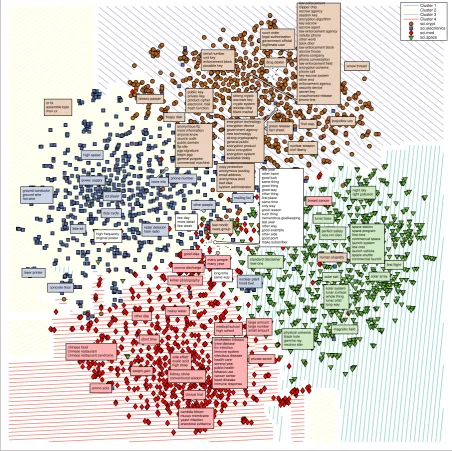
As another example, we generate a two-dimensional visualisation of the document-phrase co-embeddings using t-SNE (van der Maaten and Hinton, 2008) that demonstrates how co-embedded phrases can be used as ‘landmarks’ for exploring a corpus. For this example, we use the ‘sci’ categories from the 20 Newsgroup corpus and select the 200 most frequent phrases in this subset. As input to t-SNE, we use the chordal distance de-fined by the cosine similarity in the co-embedding space and set the perplexity level to 40. Figure 1 in the supplementary material shows the visuali-sation with the cluster boundaries, location of the documents and co-embedded phrases.
5 Conclusion
Table 4: Two documents whose vector embed-dings were the 5th and 6th nearest neighbours (ac-cording to the cosine of the angle of the corre-sponding vectors) to the phrase “user interface” in the PV-CAT based co-embedded space.
train/comp.windows.x 67337
Does anyone know the difference between MOOLIT and OLIT? Does Sun support MOOLIT? Is MOOLIT avail-able on Sparcstations? MoOLIT (Motif/Open Look Intrin-sic Toolkit allows developers to build applications that can switch between Motif and Open Look at run-time, while OLIT only gives you Open Look.
Internet: [email protected] test/comp.windows.x 68238
Hi there,
I’m looking for tools that can make X programming easy. I would like to have a tool that will enable to create X mo-tifGUIInteractivly. Currently I’m Working on a SGI with forms. A package that enables to createGUIwith no cod-ing at all (but the callbacks).
Any help will be appreciated. Thanks Gabi.
group. In this paper, we have presented a descrip-tive clustering method that uses paragraph vec-tor models to support accurate clustering of doc-uments and selection of meaningful and precise cluster descriptors. Our PV-based approach maps phrases and documents to a common feature space to enable the straightforward assignment of de-scriptive phrases to clusters. We have compared our approach to another state-of-the-art algorithm employing a co-embedding based on bag-of-word representations. The PV-based descriptive clus-tering method achieved superior clusclus-tering perfor-mance on both the Reuters and the 20 Newsgroups datasets. An evaluation of the selected cluster de-scriptors showed that our method selects informa-tive phrases that accurately characterise the con-tent of each cluster.
Acknowledgments
This research was partially funded by the Medi-cal Research Council grant MR/L01078X/1 “Sup-porting Evidence-based Public Health Interven-tions using Text Mining”.
References
Ujwala Bharambe and Archana Kale. 2011. Land-scape of web search results clustering algorithms. In
Advances in Computing, Communication and Con-trol, pages 95–107. Springer.
Claudio Carpineto, Stanislaw Osi´nski, Giovanni Ro-mano, and Dawid Weiss. 2009. A survey of
web clustering engines. ACM Computing Surveys (CSUR), 41(3):17.
Andrew M. Dai, Christopher Olah, and Quoc V. Le. 2015. Document embedding with paragraph vec-tors. CoRR, abs/1507.07998.
Katerina Frantzi, Sophia Ananiadou, and Hideki Mima. 2000. Automatic recognition of multi-word terms: The c-value/nc-value method. International Journal on Digital Libraries, 3(2):115–130.
Sean Kandel, Ravi Parikh, Andreas Paepcke, Joseph M. Hellerstein, and Jeffrey Heer. 2012. Pro-filer: Integrated statistical analysis and visualization for data quality assessment. InProceedings of the International Working Conference on Advanced Visual Interfaces, pages 547–554.
Sun Kim, Lana Yeganova, and John W. Wilbur. 2015. Summarizing topical contents from PubMed docu-ments using a thematic analysis. InProceedings of the 2015 Conference on Empirical Methods in Nat-ural Language Processing, pages 805–810. Associ-ation for ComputAssoci-ational Linguistics.
Quoc Le and Tomas Mikolov. 2014. Distributed repre-sentations of sentences and documents. In Proceed-ings of the 31st International Conference on Ma-chine Learning (ICML-14), pages 1188–1196.
Yeha Lee, Seung-Hoon Na, and Jong-Hyeok Lee. 2008. Search result clustering using label language model. In Proceedings of the Third International Joint Conference on Natural Language Processing: Volume-II.
David D. Lewis. 1997. Reuters-21578 text catego-rization test collection, distribution 1.0. Available athttps://archive.ics.uci.edu/ml.
Yanjun Li, Soon M. Chung, and John D. Holt. 2008. Text document clustering based on frequent word meaning sequences. Data & Knowledge Engineer-ing, 64(1):381–404.
Chenglong Ma, Weiqun Xu, Peijia Li, and Yonghong Yan, 2015. Proceedings of the 1st Workshop on Vec-tor Space Modeling for Natural Language Process-ing, chapter Distributional Representations of Words for Short Text Classification, pages 33–38. Associ-ation for ComputAssoci-ational Linguistics.
Tomas Mikolov, Kai Chen, Greg Corrado, and Jeffrey Dean. 2013a. Efficient estimation of word represen-tations in vector space. Workshop at International Conference on Learning Representations (ICLR).
Andriy Mnih and Geoffrey E. Hinton. 2009. A scal-able hierarchical distributed language model. In Ad-vances in Neural Information Processing Systems, pages 1081–1088.
Tingting Mu, John Y. Goulermas, Ioannis Korkontze-los, and Sophia Ananiadou. 2016. Descriptive doc-ument clustering via discriminant learning in a co-embedded space of multilevel similarities. Journal of the Association for Information Science and Tech-nology, 67(1):106–133.
C. Filipe Nassif and Eduardo Raul Hruschka. 2013. Document clustering for forensic analysis: An ap-proach for improving computer inspection. Infor-mation Forensics and Security, IEEE Transactions on, 8(1):46–54.
Roberto Navigli and Giuseppe Crisafulli. 2010. Induc-ing word senses to improve web search result clus-tering. InProceedings of the 2010 Conference on Empirical Methods in Natural Language Process-ing, pages 116–126. Association for Computational Linguistics.
Stanisław Osi´nski, Jerzy Stefanowski, and Dawid Weiss. 2004. Lingo: Search results clustering al-gorithm based on singular value decomposition. In
Intelligent Information Processing and Web Mining, pages 359–368. Springer.
Jeffrey Pennington, Richard Socher, and Christopher Manning. 2014. Glove: Global vectors for word representation. In Proceedings of the 2014 Con-ference on Empirical Methods in Natural Language Processing (EMNLP), pages 1532–1543. Associa-tion for ComputaAssocia-tional Linguistics.
David E. Rumelhart, Geoffrey E. Hinton, and Ronald J. Williams. 1986. Learning representations by back-propagating errors.Nature, 323:533–536.
Ugo Scaiella, Paolo Ferragina, Andrea Marino, and Massimiliano Ciaramita. 2012. Topical clustering of search results. InProceedings of the Fifth ACM International Conference on Web Search and Data Mining, pages 223–232.
Jianbo Shi and Jitendra Malik. 2000. Normalized cuts and image segmentation. Pattern Analysis and Machine Intelligence, IEEE Transactions on, 22(8):888–905.
Michael Steinbach, George Karypis, and Vipin Kumar. 2000. A comparison of document clustering tech-niques. In KDD Workshop on Text Mining, pages 525–526.
Joseph Turian, Lev-Arie Ratinov, and Yoshua Bengio. 2010. Word representations: A simple and general method for semi-supervised learning. In Proceed-ings of the 48th Annual Meeting of the Association for Computational Linguistics, pages 384–394. As-sociation for Computational Linguistics.
Laurens van der Maaten and Geoffrey Hinton. 2008. Visualizing data using t-SNE. Journal of Machine Learning Research, 9:2579–2605.
Dawid Weiss. 2006. Descriptive Clustering as a Method for Exploring Text Collections. Ph.D. thesis, Poznan University of Technology, Pozna´n, Poland. Pengtao Xie and Eric P. Xing. 2013. Integrating
docu-ment clustering and topic modeling. InProceedings of the Twenty-Ninth Conference on Uncertainty in Artificial Intelligence.
Chengzhi Zhang. 2009. Document clustering descrip-tion based on combinadescrip-tion strategy. InFourth Inter-national Conference on Innovative Computing, In-formation and Control (ICICIC), pages 1084–1088. IEEE.
Peixin Zhao and Cun-Quan Zhang. 2011. A new clus-tering method and its application in social networks.
Pattern Recognition Letters, 32(15):2109–2118. Ye-Hang Zhu, Guan-Zhong Dai, Benjamin C.M. Fung,
and De-Jun Mu. 2006. Document cluster-ing method based on frequent co-occurrcluster-ing words. In Proceedings of the 20th Pacific Asia Confer-ence on Language, Informatics, and Computation (PACLIC), pages 442–445.
law enforcement clipper chip escrow agency session key encryption algorithm key escrow escrow agent law enforcement agency cellular phone other word back door law enforcement block escrow house phone company phone conversation law enforcement field encryption scheme phone call key escrow system other end enforcement agency security device secret key unauthorized release phone line few year other hand good luck same thing good thing good way other thing first place same time only way good reason such thing tremendous goalkeeping last year other way good example other side good point make subscriber smokeless tobacco lyme disease hiv infection immune system infectious disease health care several year public health tobacco use cancer center heart disease immune response encryption technology encryption device government agency new technology strong cryptography general public encryption product voice encryption encryption system available today anonymous ftp more information anyone know source code public domain ftp site pgp signature begin pgp general purpose commercial machine space station space program first time commercial space launch system low cost launch vehicle space shuttle commercial launch copy protection anonymous posting email address anonymous post bad idea system administrator solar system lunar surface whole thing lunar orbit long way public key private key product cipher electronic mail hash function strong crypto escrowe key crypto system wiretap chip black market serial number unit key enforcement block possible key court order legal authorization government official legitimate user candida bloom mucus membrane yeast infection anecdotal evidence physical universe black hole gamma ray neutron star ground conductor ground wire hot wire chinese food chinese restaurant chinese restaurant syndrome
few day more detail few week large amount large number small amount or bl assemble byte mov cx side effect oxalic acid high dose kidney stone conventional wisdom many people many year night sky light pollution radar detector ham radio long time same way high frequency original poster few month news group press release fact sheet perfect safety nice nm oleo
[image:11.595.72.525.122.573.2]standard disclaimer new one nuclear plant fossil fuel nuclear weapon civil liberty medical school high school other people good idea drug dealer magnetic field clinical trial private sector breast cancer weight gain mailing list solar sail laser printer power supply amino acid concrete floor little bit phone number solar array laissez passer kirlian photography first flight cd player screw thread human stupidity prejudice ucc first step other day lunar base duty cycle corona discharge short time heavy water high speed more info floppy disk Cluster 1 Cluster 2 Cluster 3 Cluster 4 sci.crypt sci.electronics sci.med sci.space