Proceedings of the 2019 Conference on Empirical Methods in Natural Language Processing 1403
Self-Attention with Structural Position Representations
Xing Wang Tencent AI Lab
Zhaopeng Tu Tencent AI Lab
Longyue Wang Tencent AI Lab
Shuming Shi Tencent AI Lab
Abstract
Although self-attention networks (SANs) have advanced the state-of-the-art on various NLP tasks, one criticism of SANs is their ability of encoding positions of input words (Shaw et al., 2018). In this work, we propose to augment SANs with structural position rep-resentationsto model the latent structure of the input sentence, which is complementary to the standard sequential positional represen-tations. Specifically, we use dependency tree to represent the grammatical structure of a sentence, and propose two strategies to en-code the positional relationships among words in the dependency tree. Experimental re-sults on NIST Chinese⇒English and WMT14 English⇒German translation tasks show that the proposed approach consistently boosts per-formance over both the absolute and relative sequential position representations.
1 Introduction
In recent years, self-attention networks (SANs, Parikh et al.,2016;Lin et al.,2017) have achieved the state-of-the-art results on a variety of NLP tasks (Vaswani et al.,2017;Strubell et al.,2018; Devlin et al., 2019). SANs perform the
atten-tion operaatten-tion under the posiatten-tion-unaware “bag-of-words” assumption, in which positions of the input words are ignored. Therefore, absolute position (Vaswani et al., 2017) or relative posi-tion (Shaw et al.,2018) are generally used to cap-ture the sequential order of words in the sentence. However, several researches reveal that the se-quential structure may not be sufficient for NLP tasks (Tai et al.,2015;Kim et al.,2017;Shen et al., 2019), since sentences inherently have hierarchi-cal structures (Chomsky,1965;Bever,1970).
In response to this problem, we propose to aug-ment SANs with structural position representa-tionsto capture the hierarchical structure of the in-put sentence. The starting point for our approach
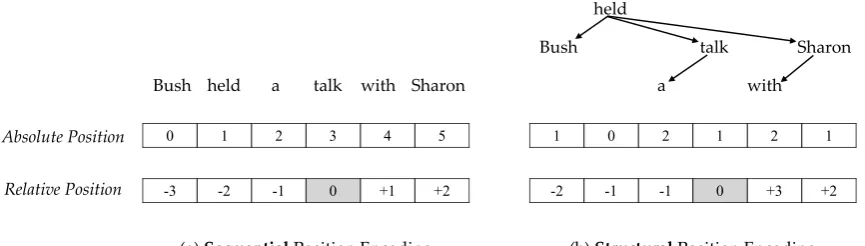
is a recent finding: the latent structure of a sen-tence can be captured by structural depths and dis-tances (Hewitt and Manning,2019). Accordingly, we proposeabsolute structural positionto encode the depth of each word in a parsing tree, and rel-ative structural positionto encode the distance of each word pair in the tree.
We implement our structural encoding strate-gies on top of TRANSFORMER (Vaswani et al., 2017) and conduct experiments on both NIST Chinese⇒English and WMT14 English⇒German translation tasks. Experi-mental results show that exploiting structural position encoding strategies consistently boosts performance over both the absolute and rela-tive sequential position representations across language pairs. Linguistic analyses (Conneau et al., 2018) reveal that the proposed structural position representation improves the translation performance with richer syntactic information. Our main contributions are:
• Our study demonstrates the necessity and effectiveness of exploiting structural posi-tion encoding for SANs, which benefits from modeling syntactic depth and distance under the latent structure of the sentence.
• We propose structural position representa-tions for SANs to encode the latent structure of the input sentence, which are complemen-tary to their sequential counterparts.
2 Background
Self-Attention SANs produce representations by applying attention to each pair of elements from the input sequence, regardless of their distance. Given an input sequence X =
Bush held a talk with Sharon
Bush held
a talk
with
Sharon
0 1 2 3 4 5 1 0 2 1 2 1
-3 -2 -1 0 +1 +2 -2 -1 -1 0 +3 +2
Absolute Position
Relative Position
[image:2.595.73.506.63.186.2](a) Sequential Position Encoding (b) Structural Position Encoding
Figure 1: Illustration of (a) the standardsequential position encoding(Vaswani et al.,2017;Shaw et al.,2018), and (b) the proposedstructural position encoding. The relative position in the example is for the word “talk”.
it into queriesQ ∈ RI×d, keysK ∈
RI×d, and
valuesV ∈RI×d:
Q,K,V=XWQ,XWK,XWV ∈RI×d, (1)
where {WQ,WK,WV} ∈ Rd×d are trainable
parameters and d indicates the hidden size. The output sequence is calculated as
O = ATT(Q,K)V ∈RI×d,(2)
where ATT(·)is a dot-product attention model.
Sequential Position Encoding To make use of the order of the sequence, information about the absolute or relative position of the elements in the sequence is injected into SAN:
• Absolute Sequential PE (Vaswani et al., 2017) is defined as
ABSPE(abs) =f(abs/100002i/d), (3)
whereabsis the absolute position in the se-quence andiis the dimension of position rep-resentations. f(·) is sin(·) for the even di-mension, andcos(·)for the odd dimension.
Vaswani et al. (2017) propose to conduct element-wise addition to combine the fixed sequential position representation with word embedding and feed the combination repre-sentation to the SANS.
• RelativeSequential PE (Shaw et al.,2018) is calculated as
RELPE(rel) =R[rel], (4)
where rel is the relative position to the queried word, which is used to index a learn-able matrix R that represents relative posi-tion embeddings.
Shaw et al. (2018) propose relation-aware SANs and take the relative sequential encod-ing as the additional key and value (Eq.2) in the attention computation.
Figure 1(a) shows an example of absolute (i.e., abs) and relative (i.e.,rel) sequential positions.
3 Approach
3.1 Structural Position Representations
In this study, we choose dependency tree to repre-sent repre-sentence structure for its simplicity on mod-eling syntactic relationships among input words. Figure 1 shows an example to illustrate the idea of the proposed approach. From the perspec-tive of relationship path between words, sequen-tial PE measures the sequensequen-tial distance between the words. As shown in Figure 1 (a), for each word, absolute sequential position represents the sequential distance to the beginning of the sen-tence, while relative sequential position measures the relative distance to the queried word (“talk” in the example).
The latent structure can be interpreted in var-ious ways, from syntactic tree structures, e.g., constituency tree (Collins, 2003) or dependency tree (K¨ubler et al., 2009), to semantic graph structures, e.g., abstract meaning representation graph (Banarescu et al.,2013). In this work, de-pendency path, which is induced from the depen-dency tree, is adopted to provide a new perspective on modelling pairwise relationships.
Absolute Structural Position We exploit the tree depth of the word in the dependency tree as its absolute structural position. Specifically, we treat the main verb (Tapanainen and Jarvinen,1997) of the sentence as the origin and use the distance of the dependency path from the target word to the origin as the absolute structural position
absstru(xi) =distancetree(xi, origin), (5)
wherexi is the target word,treeis the given
de-pendency structure and the origin is the main verb of thetree.
In the field of NMT, BPE sub-words and end-of-sentence symbolshould be carefully handled as they do not appear in the conventional dependency tree. In this work, we assign theBPE sub-words share the absolute structural position of the orig-inal word and set the the first larger integer than the max absolute structural position in dependency tree as the absolute structural position of end-of-sentence symbol.
Relative Structural Position For the relative structural position relstru(xi, xj), we calculate
relstru(xi, xj) in the dependency tree following
two hierarchical rules:
1. if xi andxj are at same dependency edge,
relstru(xi, xj) =absstru(xi)−absstru(xj).
2. if xi and xj are at different
depen-dency edges, relstru(xi, xj) = fstru(i − j) ∗
(absstru(xi) +absstru(xj)), where
fstru(x) =
1 x >0 0 x= 0
−1 x <0
(6)
FollowingShaw et al. (2018), we use clipping distancerto limit the maximum relative position.
3.2 Integrating Structural PE into SANs
We inherit position encoding functions from se-quential approaches (Eq.3 and Eq.4) to imple-ment the structural position encoding strategies. Since structural position representations capture complementary position information to their se-quential counterparts, we also exploit to integrate the structural position encoding into SANs with the sequential counterparts approaches (Vaswani et al.,2017;Shaw et al.,2018).
For theabsolute position, we use the nonlinear function to fuse the sequential and structure
posi-tion representaposi-tions1:
asb(xi) =fabs(ABSPE(absseq),
ABSPE(absstru))
(7)
where fabs is the nonlinear function.
ABSPE(absseq) and ABSPE(absstru) are
abso-lute sequential and structural position embedding in Eq.3and Eq.5respectively.
For therelativeposition, we followShaw et al. (2018) to extend the self-attention computation to consider the pairwise relationships and project the relative structural position as described at Eq.(3) and Eq.(4) inShaw et al.(2018)2.
4 Related Work
There has been growing interest in improving the representation power of SANs (Dou et al., 2018, 2019; Yang et al., 2018; Wang et al., 2018; Wu et al.,2018;Yang et al.,2019a,b;Sukhbaatar et al., 2019). Among these approaches, a straightfor-ward strategy is that augmenting the SANs with position representations (Shaw et al., 2018; Ma et al.,2019;Bello et al.,2019;Yang et al.,2019c), as the position representations involves element-wise attention computation. In this work, we pro-pose to augment SANs with structural position representations to model the latent structure of the input sentence.
Our work is also related to the structure mod-eling for SANs, as the proposed model utilizes the dependency tree to generate structural repre-sentations. Recently, Hao et al. (2019c,b) inte-grate the recurrence into the SANs and empiri-cally demonstrate that the hybrid models achieve better performances by modeling structure of sen-tences. Hao et al.(2019a) further make use of the multi-head attention to form the multi-granularity self-attention, to capture the different granularity phrases in source sentences. The difference is that we treat the position representation as a medium to transfer the structure information from the de-pendency tree into the SANs.
1We also use parameter-free element-wise addition method to combine two absolute position embedding and get 0.28 BLEU point improvement on development set of NIST Chinese⇒English over the baseline model that only uses ab-solute sequential encoding.
# Sequential Structural Spd. BLEU Abs. Rel. Abs. Rel.
1
× ×
× × 2.81 28.33
2 X × 2.53 35.43
3 × X 2.65 34.23
4
X ×
× × 3.23 44.31
5 X × 2.65 44.84
6 X X 2.52 45.10
7
X X
× × 3.18 45.02
8 X × 2.64 45.43
[image:4.595.74.289.62.220.2]9 X X 2.48 45.67
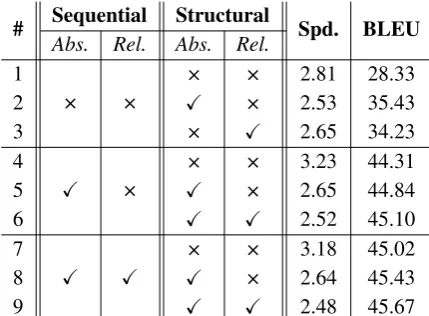
Table 1: Impact of the position encoding components on Chinese⇒English NIST02 development dataset us-ing Transformer-Base model. “Abs.” and “Rel.” denote absoluteand relativeposition encoding, respectively. “Spd.” denotes the decoding speed (sentences/second) on a Tesla M40, the speed of structural position encod-ing strategies include the step of dependency parsencod-ing.
5 Experiment
We conduct experiments on the widely used NIST Chinese⇒English and WMT14 English⇒German data, and report the 4-gram BLEU score (Papineni et al.,2002).
Chinese⇒English We use the training dataset consists of about 1.25 million sentence pairs. NIST 2002 (MT02) dataset is used as development set. NIST 2003, 2004, 2005, 2006 datasets are used as test sets. We use byte-pair encoding (BPE) toolkit to alleviate the out-of-vocabulary problem with 32K merge operations.
English⇒German We use the dataset consist-ing of about4.5million sentence pairs as the train-ing set. The newstest2013 and newstest2014 are used as the development set and the test set. We also apply BPE with 32K merge operations to ob-tain subword unit.
We evaluate the proposed position encod-ing strategies on TRANSFORMER (Vaswani et al., 2017) and implement them on top of THUMT (Zhang et al., 2017). We use the Stan-ford parser (Klein and Manning, 2003) to parse the sentences and obtain the structural structural absolute and relative position as described in Section 3. When using relative structural position encoding, we use clipping distance r = 16. To make a fair comparison, we valid different position encoding strategies on the encoder and keep the TRANSFORMER decoder unchanged.
We study the variations of the BASE model on Chinese⇒English task, and evaluate the over-all performance with the BIG model on both translation tasks.
5.1 Model Variations
We evaluate the importance of the proposed absolute and relative structural position encod-ing strategies and study the variations with Transformer-Base model on Chinese⇒English data. The experimental results on the development set are shown in Table1.
Effect of Position Encoding We first remove the sequential encoding from theTransformer en-coder (Model #1) and observe the translation per-formance degrades dramatically (28.33−44.31 =
−15.98), which demonstrates the necessity of the position encoding strategies.
Effect of Structural Position Encoding Then we valid our proposed structural position encod-ing strategies over the position-unaware model (Models #2-3). We find that absolute and relative structural position encoding strategies improve the translation performance by 7.10 BLEU points and 5.90 BLEU points respectively, which shows that the introducing of the proposed absolute and rel-ative structural positions improves the translation performance in terms of BLEU score.
Combination of Sequential and Structural Po-sition Encoding Strategies We integrate the ab-solute and relative structural position encoding strategies into theBasemodel equipped with abso-lute sequential position encoding (Models #4-6). We observe that the proposed two approaches are able to achieve improvements over theBasemodel with decoding speed marginally decreases.
Finally, we valid the proposed structural posi-tion encoding over theBasemodel equipped with absolute and relative sequential position encod-ing (Models #7-9). We find that sequential rela-tive encoding obtains 0.71 BLEU points improve-ment (Model #7 vs. Model #4) and structural po-sition encoding achieves a further improvement in performance by 0.65 BLEU points (Model #9 vs. Model #7), demonstrating the effectiveness of the proposed structural position encoding strategies.
5.2 Main Results
Model Architecture Zh⇒En En⇒De
MT03 MT04 MT05 MT06 Avg WMT14
Hao et al.(2019c) - - - 28.98
[image:5.595.106.494.61.157.2]Transformer-Big 45.30 46.49 45.21 44.87 45.47 28.58 +StructuralPE 45.62 47.12↑ 45.84 45.64⇑ 46.06 28.88 +RelativeSequential PE 45.45 47.01 45.65 45.87⇑ 46.00 28.90 +StructuralPE 45.85↑ 47.37⇑ 46.20⇑ 46.18⇑ 46.40 29.19⇑
Table 2: Evaluation of translation performance on NIST Zh⇒En and WMT14 En⇒De test sets.Hao et al.(2019c) is aTransformer-Bigmodel which adopted an additional recurrence encoder with the attentive recurrent network to model syntactic structure. “↑/ ⇑”: significant over theTransformer-Big(p < 0.05/0.01), tested by bootstrap resampling (Koehn,2004).
Model Surface Syntactic Semantic
SeLen WC Avg TrDep ToCo BShif Avg Tense SubN ObjN SoMo CoIn Avg
BASE 92.20 63.00 77.60 44.74 79.02 71.24 65.00 89.24 84.69 84.53 52.13 62.47 74.61 +Rel. Seq.PE 89.82 63.17 76.50 45.09 78.45 71.40 64.98 88.74 87.00 85.53 51.68 62.21 75.03 +Stru.PE 89.54 62.90 76.22 46.12 79.12 72.36 65.87 89.30 85.47 84.94 52.90 62.99 75.12
Table 3: Performance on linguistic probing tasks. The probing tasks were conducted by evaluating linguistics embedded in theTransformer-Baseencoder outputs. “Base”, “+Rel. Seq.PE”, “+Stru.PE” denote Transformer-Base,Transformer-Basewith relative sequential PE,Transformer-Basewith relative sequential PE and structural PE models respectively.
Chinese⇒English and English⇒German data, and list the results in Table2.
For Chinese⇒English, Structural position encoding (+ Structural PE) outperforms the Transformer-Bigby 0.59 BLEU points on average over four NIST test sets. Sequential relative encoding approach (+Relative Sequential PE) outperforms the Transformer-Big by 0.53 BLEU points, and structural position encoding (+ Structural PE) achieves further improvement up to +0.40 BLEU points and outperforms the Transformer-Big by 0.93 BLEU points. For English⇒German, similar phenomenon is ob-served, which reveals that the proposed structural position encoding strategy can consistently boost translation performance over both the absolute and relative sequential position representations.
5.3 Linguistic Probing Evaluation
We conduct probing tasks3(Conneau et al.,2018) to evaluate structure knowledge embedded in the encoder output in the variations of theBasemodel that are trained on En⇒De translation task.
We followWang et al.(2019) to set model con-figurations. The experimental results on probing tasks are shown in Table3, and the BLEU scores of “Base”, “+ Rel. Seq. PE”, “+ Stru. PE” are
3https://github.com/facebookresearch/
SentEval/tree/master/data/probing
27.31, 27.99 and 28.30. From the table, we can see 1) adding the relative sequential positional embed-ding achieves improvement over the baseline on semantic tasks (75.03 vs. 74.61). This may indi-cate the model benefits more from semantic mod-eling; 2) with the structural positional embedding, the model obtains improvement on syntactic tasks (65.87 v.s. 64.98), which indicates that the repre-sentations preserve more syntactic knowledge.
6 Conclusion
In this paper, we have presented a novel structural position encoding strategy to augment SANs by
considering the latent structure of the input sen-tence. We extract structural absolute and rela-tive positions from the dependency tree and in-tegrate them into SANs. Experimental results on Chinese⇒English and English⇒German transla-tion tasks have demonstrated that the proposed approach consistently improve translation perfor-mance over both the absolute and relative sequen-tial position representations.
[image:5.595.73.528.233.288.2]References
Laura Banarescu, Claire Bonial, Shu Cai, Madalina Georgescu, Kira Griffitt, Ulf Hermjakob, Kevin Knight, Philipp Koehn, Martha Palmer, and Nathan Schneider. 2013. Abstract meaning representation for sembanking. In the 7th Linguistic Annotation Workshop and Interoperability with Discourse.
Irwan Bello, Barret Zoph, Ashish Vaswani, Jonathon Shlens, and Quoc V Le. 2019. Attention augmented convolutional networks. arXiv.
Thomas G Bever. 1970. The cognitive basis for lin-guistic structures. Cognition and the development of language, 279(362).
Noam Chomsky. 1965. Aspects of the Theory of Syn-tax, volume 11. MIT press.
Michael Collins. 2003. Head-driven statistical mod-els for natural language parsing.Computational lin-guistics, 29(4).
Alexis Conneau, Germ´an Kruszewski, Guillaume Lample, Lo¨ıc Barrault, and Marco Baroni. 2018. What you can cram into a single vector: Probing sentence embeddings for linguistic properties. In ACL.
Jacob Devlin, Ming-Wei Chang, Kenton Lee, and Kristina Toutanova. 2019. Bert: Pre-training of deep bidirectional transformers for language understand-ing. InNAACL.
Zi-Yi Dou, Zhaopeng Tu, Xing Wang, Shuming Shi, and Tong Zhang. 2018. Exploiting deep representa-tions for neural machine translation. InEMNLP.
Ziyi Dou, Zhaopeng Tu, Xing Wang, Longyue Wang, Shuming Shi, and Tong Zhang. 2019. Dynamic layer aggregation for neural machine translation. In AAAI.
Chris Dyer, Adhiguna Kuncoro, Miguel Ballesteros, and Noah A Smith. 2016. Recurrent neural network grammars. InNAACL.
Akiko Eriguchi, Yoshimasa Tsuruoka, and Kyunghyun Cho. 2017. Learning to parse and translate improves neural machine translation. InACL.
Jie Hao, Xing Wang, Shuming Shi, Jinfeng Zhang, and Zhaopeng Tu. 2019a. Multi-granularity self-attention for neural machine translation. InEMNLP.
Jie Hao, Xing Wang, Shuming Shi, Jinfeng Zhang, and Zhaopeng Tu. 2019b. Towards better modeling hi-erarchical structure for self-attention with ordered neurons. InEMNLP.
Jie Hao, Xing Wang, Baosong Yang, Longyue Wang, Jinfeng Zhang, and Zhaopeng Tu. 2019c. Modeling recurrence for transformer. InNAACL.
John Hewitt and Christopher D. Manning. 2019. A structural probe for finding syntax in word represen-tations. InNAACL.
Yoon Kim, Carl Denton, Luong Hoang, and Alexan-der M Rush. 2017. Structured attention networks. InICLR.
Dan Klein and Christopher D Manning. 2003. Accu-rate unlexicalized parsing. InACL.
Philipp Koehn. 2004. Statistical significance tests for machine translation evaluation. InEMNLP.
Sandra K¨ubler, Ryan McDonald, and Joakim Nivre. 2009. Dependency parsing. Synthesis Lectures on Human Language Technologies, 1(1).
Zhouhan Lin, Minwei Feng, Cicero Nogueira dos San-tos, Mo Yu, Bing Xiang, Bowen Zhou, and Yoshua Bengio. 2017. A Structured Self-attentive Sentence Embedding. InICLR.
Chunpeng Ma, Akihiro Tamura, Masao Utiyama, Ei-ichiro Sumita, and Tiejun Zhao. 2019. Improving neural machine translation with neural syntactic dis-tance. InNAACL).
Joakim Nivre. 2005. Dependency grammar and depen-dency parsing. MSI report, 5133(1959).
Kishore Papineni, Salim Roukos, Todd Ward, and Wei-Jing Zhu. 2002. Bleu: a method for automatic eval-uation of machine translation. InACL.
Ankur Parikh, Oscar T¨ackstr¨om, Dipanjan Das, and Jakob Uszkoreit. 2016. A Decomposable Attention Model for Natural Language Inference. InEMNLP.
Peter Shaw, Jakob Uszkoreit, and Ashish Vaswani. 2018. Self-Attention with Relative Position Repre-sentations. InNAACL.
Yikang Shen, Shawn Tan, Alessandro Sordoni, and Aaron Courville. 2019. Ordered neurons: Integrat-ing tree structures into recurrent neural networks. In ICLR.
Linfeng Song, Daniel Gildea, Yue Zhang, Zhiguo Wang, and Jinsong Su. 2019. Semantic neural ma-chine translation using AMR.TACL.
Emma Strubell, Patrick Verga, Daniel Andor, David Weiss, and Andrew McCallum. 2018. Linguistically-Informed Self-Attention for Seman-tic Role Labeling. InEMNLP.
Sainbayar Sukhbaatar, Edouard Grave, Piotr Bo-janowski, and Armand Joulin. 2019. Adaptive at-tention span in transformers. InACL.
Kai Sheng Tai, Richard Socher, and Christopher D Manning. 2015. Improved semantic representations from tree-structured long short-term memory net-works. InACL.
Ashish Vaswani, Noam Shazeer, Niki Parmar, Jakob Uszkoreit, Llion Jones, Aidan N Gomez, Łukasz Kaiser, and Illia Polosukhin. 2017. Attention is All You Need. InNIPS.
Qiang Wang, Fuxue Li, Tong Xiao, Yanyang Li, Yin-qiao Li, and Jingbo Zhu. 2018. Multi-layer repre-sentation fusion for neural machine translation. In COLING.
Xing Wang, Zhengdong Lu, Zhaopeng Tu, Hang Li, Deyi Xiong, and Min Zhang. 2017. Neural machine translation advised by statistical machine transla-tion. InAAAI.
Xing Wang, Zhaopeng Tu, Longyue Wang, and Shum-ing Shi. 2019. ExploitShum-ing sentential context for neu-ral machine translation. InACL.
Wei Wu, Houfeng Wang, Tianyu Liu, and Shuming Ma. 2018. Phrase-level self-attention networks for uni-versal sentence encoding. InACL.
Baosong Yang, Jian Li, Derek F. Wong, Lidia S. Chao, Xing Wang, and Zhaopeng Tu. 2019a. Context-aware self-attention networks. InAAAI.
Baosong Yang, Zhaopeng Tu, Derek F. Wong, Fan-dong Meng, Lidia S. Chao, and Tong Zhang. 2018. Modeling localness for self-attention networks. In EMNLP.
Baosong Yang, Longyue Wang, Derek F. Wong, Lidia S. Chao, and Zhaopeng Tu. 2019b. Convo-lutional self-attention networks. InNAACL.
Shan Yang, Heng Lu, Shiying Kang, Lei Xie, and Dong Yu. 2019c. Enhancing hybrid self-attention struc-ture with relative-position-aware bias for speech synthesis. InICASSP.