3885
A Large-Scale Comparison of Historical Text Normalization Systems
Marcel Bollmann
Department of Computer Science University of Copenhagen, Denmark
Abstract
There is no consensus on the state-of-the-art approach to historical text normalization. Many techniques have been proposed, in-cluding rule-based methods, distance metrics, character-based statistical machine translation, and neural encoder–decoder models, but stud-ies have used different datasets, different eval-uation methods, and have come to different conclusions. This paper presents the largest study of historical text normalization done so far. We critically survey the existing literature and report experiments on eight languages, comparing systems spanning all categories of proposed normalization techniques, analysing the effect of training data quantity, and using different evaluation methods. The datasets and scripts are made publicly available.
1 Introduction1
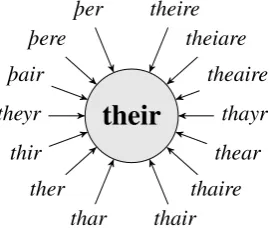
Spelling variation is one of the key challenges for NLP on historical texts, affecting the performance of tools such as part-of-speech taggers or parsers and complicating users’ search queries on a cor-pus. Normalization is often proposed as a solu-tion; it is commonly defined as the mapping of his-torical variant spellings to a single, contemporary “normal form” as exemplified in Figure1.
Automatic normalization of historical texts has a long history, going back to at leastFix (1980). Earlier approaches often rely on hand-crafted al-gorithms tailored to one specific language, while more recent approaches have focused on super-vised machine learning, particularly character-based statistical machine translation (SMT) and its neural equivalent (NMT). However, no clear consensus has emerged about the state of the art for this task, with papers either reporting an ad-vantage for NMT (Hämäläinen et al.,2018), SMT
1This work largely builds upon the author’s doctoral thesis (Bollmann,2018), the research for which was carried out at Ruhr-Universität Bochum, Germany.
their
thair thaire
thear thayr theaire theiare theire þer
þere
þair
theyr
thir
[image:1.595.350.486.225.340.2]ther thar
Figure 1: Historical text normalization exemplified: mapping variant spellings from historical English texts to their normalization‘their’
(Domingo and Casacuberta, 2018), or language-specific algorithms (Schneider et al.,2017). More-over, the quantity of annotated training data varies considerably between studies, making it diffi-cult to obtain practical recommendations for new projects seeking to use normalization techniques.
Contributions This paper aims to provide the most comprehensive evaluation and analysis of historical text normalization systems so far. Mo-tivated by a systematic review of previous work on this topic (Sec.2), only publicly available nor-malization systems covering a wide range of pro-posed techniques are selected (Sec.3) and eval-uated across a diverse collection of historical datasets covering eight languages (Sec.4). This is followed by a detailed analysis of the effect of training data quantity and a critical discussion of evaluation methods for assessing normalization quality (Sec.5).
The datasets and code are made freely available whenever possible,2 along with detailed instruc-tions on how to reproduce the experiments.
2https://github.com/coastalcph/
2 A Brief Survey of Automatic Historical Text Normalization
The following overview is broadly organized by categories that each represent a conceptually or methodically different approach.
2.1 Substitution Lists
The conceptually simplest form of normalization is to look up each historical variant in a pre-compiled list that maps it to its intended normal-ization. This approach can go by many names, such as lexical substitution, dictionary lookup, wordlist mapping, ormemorization. While it does not generalize in any way to variants that are not covered by the list, it has proven highly effective as a component in several normalization systems, such as the semi-automatic VARD tool (Rayson et al.,2005;Baron and Rayson,2008) or the fully automatic Norma tool (Bollmann,2012).
2.2 Rule-based Methods
Rule-based approaches try to encode regularities in spelling variants—e.g., historicalhvioften rep-resenting modernhui—in the form of replacement rules, typically including context information to discriminate between different usages of a charac-ter. Some of the earliest approaches to normaliza-tion are rule-based, with rules being created man-ually for one particular language, such as Old Ice-landic (Fix,1980) or Old German (Koller,1983).
VARD 2 uses “letter replacement rules” to con-struct normalization candidates, but is not neces-sarily concerned with precision due to its inter-active nature (Baron and Rayson, 2008). Boll-mann et al.(2011) describe a supervised learning algorithm to automatically derive context-aware replacement rules from training data, including “identity rules” that leave a character unchanged, then apply one rule to each character of a historical word form to produce a normalization.Porta et al.
(2013) model phonological sound change rules for Old Spanish using finite-state transducers; Etxe-berria et al.(2016) describe a similarly motivated model that can be trained in a supervised manner.
Rule-based methods are also commonly found when the goal is not to produce a single best nor-malization, but to cluster a group of spelling vari-ants (Giusti et al.,2007) or to retrieve occurrences of variant spellings given a modern form in an information retrieval (IR) scenario (Ernst-Gerlach and Fuhr,2006;Koolen et al.,2006).
2.3 Distance-based Methods
Approaches using edit distance measures (such as Levenshtein distance;Levenshtein,1966) are most commonly found in an IR context, since mea-sures that compare two word forms are a natu-ral fit for matching a search term with relevant word forms in a historical document (e.g., Robert-son and Willett,1993). Weighted variants of dis-tance measures can be used to assign lower costs to more likely edit operations (Kempken et al.,
2006;Hauser and Schulz,2007).
In a normalization context, distance measures can be used to compare historical variants to en-tries in a contemporary full-form lexicon ( Keste-mont et al.,2010;Jurish,2010a). Norma includes a distance-based component whose edit weights can be learned from a training set of normaliza-tions (Bollmann,2012). Pettersson et al.(2013a) find a similar approach to be more effective than hand-crafted rules on Swedish. Sometimes, the line between distance-based and rule-based meth-ods get blurred;Adesam et al.(2012) use the Lev-enshtein algorithm to derive “substitution rules” from training data, which are then used to link up historical Swedish forms with lexicon entries;van Halteren and Rem (2013) describe a comparable approach for Dutch.
Furthermore, distance measures also lend them-selves to unsupervised approaches for cluster-ing historical variants of the same modern form, where identifying the precise modern form is not necessarily required (Amoia and Martínez,2013;
Barteld et al.,2015).
2.4 Statistical Models
In a probabilistic view of the normalization task, the goal is to optimize the probabilityp(t|s) that a contemporary word formtis the normalization of a historical word forms. This can be seen as a noisy channel model, which has been used for normalization by, e.g., Oravecz et al.(2010) and
Etxeberria et al.(2016).
More commonly, character-based statistical machine translation (CSMT) has been applied to the normalization task. Instead of translating a sentence as a sequence of tokens, these ap-proaches “translate” a historical word form as a sequence of characters. This has been found to be very effective for a variety of historical lan-guages, such as Spanish (Sánchez-Martínez et al.,
2013b), Slovene (Scherrer and Erjavec, 2013,
2016;Ljubeši´c et al.,2016), as well as Hungarian, German, and English (Pettersson, 2016), where it is usually found to outperform previous ap-proaches.
Pettersson et al.(2014) find that a CSMT system often performs best in a comparison with a filter-ing method and a distance-based approach on five different languages. Schneider et al.(2017) com-pare VARD 2 to CSMT on English and find that VARD 2 performs slightly better. Domingo and Casacuberta(2018) evaluate both word-based and character-based models and find that SMT outper-forms a neural network model.
2.5 Neural Models
Neural network architectures have become pop-ular for a variety of NLP tasks, and historical normalization is no exception. Character-based neural machine translation (CNMT) is the logi-cal neural equivalent to the CSMT approach, and has first been used for normalization of histori-cal German (Bollmann et al., 2017; Korchagina,
2017) using encoder–decoder models with long short-term memory (LSTM) units. Robertson and Goldwater (2018) present a more detailed eval-uation of this architecture on five different lan-guages. Hämäläinen et al.(2018) evaluate SMT, NMT, an edit-distance approach, and a rule-based finite-state transducer, and advocate for a combi-nation of these approaches to make use of their individual strengths; however, they restrict their evaluation to English.
Other neural architectures have rarely been used for normalization so far. Al Azawi et al.
(2013) and Bollmann and Søgaard (2016) frame the normalization task as a sequence labelling problem, labelling each character in the historical word form with its normalized equivalent. Keste-mont et al. (2016) use convolutional networks for lemmatization of historical Dutch. Overall, though, the encoder–decoder model with recurrent layers is the dominant approach.
2.6 Beyond Token-Level Normalization
The presented literature almost exclusively fo-cuses on models where the input is a single to-ken. In theory, it would be desirable to include context from the surrounding tokens, as some his-torical spellings can have more than one mod-ern equivalent depending on the context in which they are used (e.g., historicalthercould represent
their orthere). Remarkably few studies have at-tempted this so far: Jurish (2010b) uses hidden Markov models to select between normalization candidates;Mitankin et al.(2014) use a language model in a similar vein;Ljubeši´c et al.(2016) ex-periment with “segment-level” input, i.e., a string of several historical tokens as input to a normal-izer. Since this area is currently very underex-plored, it warrants a deeper investigation that goes beyond the scope of this paper.
3 Experimental Setup
Systems The selection of normalization systems follows two goals: (i) to include at least one sys-tem for each major category as identified in Sec.2; and (ii) to use only freely available tools in order to facilitate reproduction and application of the de-scribed methods. To that effect, this study com-pares the following approaches:
• Norma3(Bollmann,2012), which combines substitution lists, a rule-based normalizer, and a distance-based algorithm, with the op-tion of running them separately or combined. Importantly, it implements supervised learn-ing algorithms for all of these components and is not restricted to a particular language.
• cSMTiser4 (Ljubeši´c et al., 2016; Scherrer and Ljubeši´c, 2016), which implements a normalization pipeline using character-based statistical machine translation (CSMT) using the Moses toolkit (Koehn et al.,2007).
• Neural machine translation (NMT), in the form of two publicly available implementa-tions: (i) the model byBollmann(2018), also used inBollmann et al.(2018);5 and (ii) the model byTang et al.(2018).6
Two systems were chosen for the NMT ap-proach as they use very different hyperparameters, despite both using comparable neural encoder– decoder models: Bollmann (2018) uses a single LSTM layer with dimensionality 300 in the en-coder and deen-coder, while Tang et al. (2018) use six vanilla RNN cells with dimensionality 1024.
3https://github.com/comphist/norma 4
https://github.com/clarinsi/csmtiser 5I reimplemented the model here using the XNMT toolkit (Neubig et al.,2018).
6https://github.com/tanggongbo/
Dataset/Language Time Period Genre Tokens
TRAIN DEV TEST
DEA German (Anselm) 14th–16thc. Religious 233,947 45,996 45,999
DER German (RIDGES) 1482–1652 Science 41,857 9,712 9,587
EN English 1386–1698 Letters 147,826 16,334 17,644
ES Spanish 15th–19thc. Letters 97,320 11,650 12,479
HU Hungarian 1440–1541 Religious 134,028 16,707 16,779
IS Icelandic 15thc. Religious 49,633 6,109 6,037
PT Portuguese 15th–19thc. Letters 222,525 26,749 27,078
SLB Slovene (Bohoriˇc) 1750–1840s Diverse 50,023 5,841 5,969
SLG Slovene (Gaj) 1840s–1899 Diverse 161,211 20,878 21,493
SV Swedish 1527–1812 Diverse 24,458 2,245 29,184
Table 1: Historical datasets used in the experiments
Datasets Table 1 gives an overview of the his-torical datasets. They are taken from Bollmann
(2018) and represent the largest and most var-ied collection of datasets used for historical text normalization so far, covering eight languages from different language families—English, Ger-man, Hungarian, Icelandic, Spanish, Portuguese, Slovene, and Swedish—as well as different text genres and time periods. Furthermore, most of these have also been used in previous work, such as the English, Hungarian, Icelandic, and Swedish datasets (e.g., Pettersson et al., 2014;Pettersson,
2016;Robertson and Goldwater,2018;Tang et al.,
2018) and the Slovene datasets (e.g., Ljubeši´c et al.,2016;Scherrer and Erjavec,2016; Etxeber-ria et al.,2016;Domingo and Casacuberta,2018). Additionally, contemporary datasets are re-quired for the rule-based and distance-based com-ponents of Norma, as they expect a list of valid target word forms to function properly. For this, we want to choose resources that are readily avail-able for many languages and are reliavail-able, i.e., con-sist of carefully edited text. Here, I choose a combination of three sources:7 (i) the normaliza-tions in the training sets, (ii) the Europarl corpus (Koehn,2005), and (iii) the parallel Bible corpus by Christodouloupoulos and Steedman (2015). The only exception is Icelandic, which is not cov-ered by Europarl; here, we can follow Petters-son (2016) instead by using data from two spe-cialized resources, the BÍN database ( Bjarnadót-tir,2012) and the MÍM corpus (Helgadóttir et al.,
2012). This way, we obtain full-form lexica of
7Detailed descriptions of the data extraction procedure can be found in the Supplementary Material.
12k–64k word types from the Bible corpus, 55k– 268k types from Europarl, and 2.8M types from the Icelandic resources.
Preprocessing The most important preprocess-ing decisions8 are (i) to lowercase all characters and (ii) to remove all punctuation-only tokens. Both capitalization and punctuation often cannot be handled correctly without considering token context, which all current normalization models do not do. Furthermore, their usage can be very erratic in historical texts, potentially distorting the evaluation; e.g., when a text uses punctuation marks according to modern conventions, their nor-malization is usually trivial, resulting in artificial gains in normalization accuracy that other texts do not get. At the same time, most previous work has not followed these same preprocessing guidelines, making a direct comparison more difficult. This work tries to make up for this by evaluating many different systems, effectively reproducing some of these previous results instead.
4 Evaluation
All models are trained and evaluated separately for each dataset by calculating word accuracy over all tokens. In particular, there is no step to dis-criminate between tokens that require normaliza-tion and those that do not; all word forms in the datasets are treated equally.
For Norma, all components are evaluated both separately and combined, as the former gives us insight into the performance of each individual
Method Dataset
DEA DER EN ES HU IS PT SLB SLG SV
Identity 30.63 44.36 75.29 73.40 17.53 47.62 65.19 40.74 85.38 58.59
Maximum 94.64 96.46 98.57 97.40 98.70 93.46 97.65 98.71 98.96 98.97
Norma, Lookup 83.86 82.15 92.45 92.51 74.58 82.84 91.67 81.76 93.90 83.80
Norma, Rule-based 76.48 82.52 90.85 88.59 78.73 83.72 86.33 86.09 91.63 85.23
Norma, Distance-based 58.92 73.30 83.92 84.41 62.38 69.95 77.28 71.02 88.20 76.03
Norma (Combined) 88.02 86.55 94.60 94.41 86.83 *86.85 94.19 89.45 91.44 87.12
cSMTiser 88.82 *88.06 *95.21 *95.01 *91.63 *87.10 *95.09 *93.18 *95.99 91.13
cSMTiser+LM 86.69 *88.19 95.24 95.02 91.70 *86.83 95.18 93.30 96.01 *91.11
NMT(Bollmann,2018) 89.16 *88.07 94.80 *94.83 91.17 86.45 94.64 91.61 95.19 90.27
NMT(Tang et al.,2018) 89.64 88.22 94.95 *94.84 *91.65 87.31 94.51 92.60 *95.85 90.39
†SMT(Pettersson et al.,2014) – – 94.3– – 80.1– 71.8– – – – 92.9–
[image:5.595.74.522.73.283.2]†NMT(Tang et al.,2018) – – 94.69 – 91.69 87.59 – – – 91.56
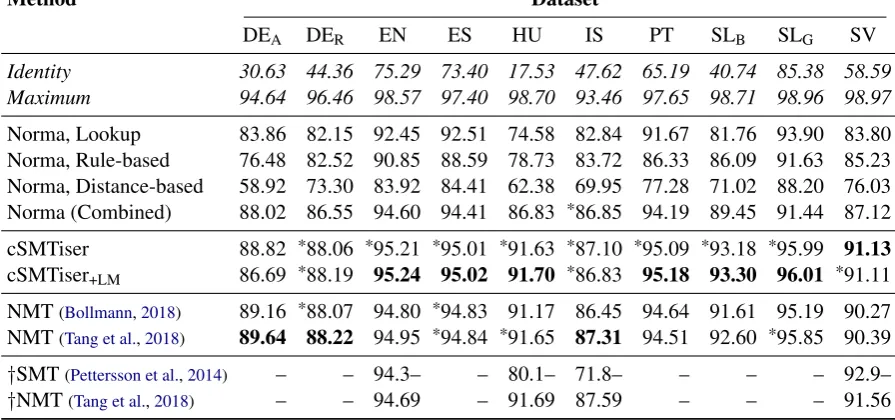
Table 2: Word accuracy of different normalization methods on the test sets of the historical datasets, in percent; best result for each dataset in bold; results marked with an asterisk (*) are not significantly different from the best result using McNemar’s test atp < 0.05. †indicates scores that were not (re)produced here, but reported in previous work; they might not be strictly comparable due to differences in data preprocessing (cf. Sec.3). Additionally, Identityshows the accuracy when leaving all word forms unchanged, while Maximumgives the theoretical maximum accuracy with purely token-level methods.
component, while the latter is reported to produce the best results (Bollmann,2012). For cSMTiser, the authors suggest using additional monolingual data to improve the language model; the contem-porary datasets are used for this purpose and the model is trained both without and with this ad-ditional data; the latter is denoted cSMTiser+LM.
For NMT, the model byBollmann(2018) is evalu-ated using an ensemble of five models; the model byTang et al.(2018) is trained on character-level input using the default settings provided by their implementation.9
To illustrate how challenging the normalization task is on different datasets, we can additionally look at the identity baseline—i.e., the percentage of tokens that do not need to be normalized—as well as themaximum accuracy obtainable if each word type was mapped to its most frequently oc-curring normalization. The latter gives an indica-tion of the extent of ambiguity in the datasets and the disadvantage of not considering token context (cf. Sec.2.6).
Results Table 2 shows the results of this eval-uation. The extent of spelling variation varies
9This is the “Att-RNN” setting reported in their paper; due to the high computational demands of the model, it was not feasible to run experiments with multiple configurations.
greatly between datasets, with less than 15% of tokens requiring normalization (SLG) to more than
80% (HU). The maximum accuracy is above 97% for most datasets, suggesting that we can ob-tain high normalization accuracy in principle even without considering token context.
For the normalization systems, we observe sig-nificantly better word accuracy with SMT than NMT on four of the datasets, and non-significant differences on five others. There is only one dataset (DEA) where the NMT system by Tang et al. (2018) gets significantly better word accu-racy than other systems. This somewhat con-tradicts the results from Tang et al. (2018), who find NMT to usually outperform the SMT baseline byPettersson et al.(2014). However, note that the results for the cSMTiser system are often signifi-cantly better than reported in previous work: e.g., on Hungarian, cSMTiser obtains 91.7% accuracy, but only 80.1% with the SMT system from Pet-tersson et al.(2014).
Overall, the deep NMT model by Tang et al.
sev-Method Dataset
DEA DER EN ES HU IS PT SLB SLG SV
Norma, Lookup 0.41 0.31 0.38 0.35 0.43 0.38 0.39 0.44 0.44 0.29
Norma, Rule-based 0.40 0.33 0.43 0.39 0.38 0.40 0.45 0.47 0.46 0.32
Norma, Distance-based 0.42 0.34 0.46 0.44 0.41 0.44 0.50 0.52 0.39 0.38
Norma (Combined) 0.41 0.33 0.45 0.42 0.34 0.42 0.51 0.51 0.42 0.31
cSMTiser 0.37 0.26 0.39 0.41 0.26 0.40 0.50 0.53 0.56 0.24
cSMTiser+LM 0.39 0.27 0.39 0.42 0.27 0.41 0.50 0.53 0.56 0.24
NMT(Bollmann,2018) 0.38 0.26 0.39 0.43 0.27 0.40 0.48 0.47 0.51 0.23 NMT(Tang et al.,2018) 0.38 0.27 0.38 0.42 0.26 0.41 0.46 0.50 0.56 0.24
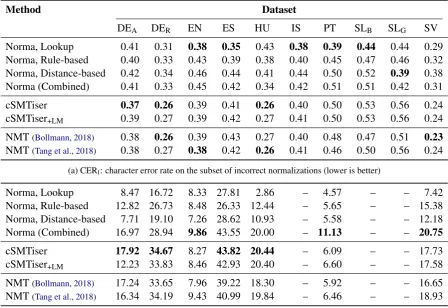
(a) CERI: character error rate on the subset of incorrect normalizations (lower is better)
Norma, Lookup 8.47 16.72 8.33 27.81 2.86 – 4.57 – – 7.42
Norma, Rule-based 12.82 26.73 8.48 26.33 12.44 – 5.65 – – 15.38
Norma, Distance-based 7.71 19.10 7.26 28.62 10.93 – 5.58 – – 12.18
Norma (Combined) 16.97 28.94 9.86 43.55 20.00 – 11.13 – – 20.75
cSMTiser 17.92 34.67 8.27 43.82 20.44 – 6.09 – – 17.73
cSMTiser+LM 12.23 33.83 8.46 42.93 20.40 – 6.60 – – 17.58
NMT(Bollmann,2018) 17.24 33.65 7.96 39.22 18.30 – 5.92 – – 16.65 NMT(Tang et al.,2018) 16.34 34.19 9.43 40.99 19.84 – 6.46 – – 18.93
[image:6.595.74.523.63.371.2](b) Stemming accuracy: percentage of incorrect normalizations with correct word stems (higher is better)
Table 3: Evaluations on the subset of incorrect normalizations only; best results for each dataset in bold. Note that this subset is different for each system, so for comparisons between systems, these numbers should be considered in conjunction with word accuracy scores from Table2.
eral datasets (particularly in the “combined” set-ting), it is generally significantly behind the SMT and NMT methods.
5 Analysis
5.1 Measuring Normalization Quality
While word accuracy is easily interpretable, it is also a very crude measure, as it classifies predic-tions as correct/incorrect without considering the type of error(s) made by the model. Character er-ror rate (CER) has sometimes been suggested as a complement to address this issue, but I believe this is not very insightful: For any normalization system that achieves a reasonably high word accu-racy, CER will highly correlate with accuracy sim-ply because CER equals zero for any word that is accurately normalized.10 At the same time, there is a need for a more fine-grained way to assess the normalization quality. Consider the
follow-10When comparing word accuracy scores in Table2with the same configurations evaluated using CER, they correlate with Pearson’sr≈ −0.96.
ing example from the Hungarian dataset with its predicted normalization from the NMT system by
Bollmann(2018):
(1) ORIG yduewzewlendewk GOLD üdvözülend˝oek PRED üdvözülend˝ok
Here, the prediction matches the correct target form almost perfectly, but would be counted as incorrect since it misses an insertion of the let-ter hei towards the end. In this vein, it will be treated the same by the word accuracy measure as a prediction that, e.g., had left the original form unchanged.
CERI One alternative is to consider character error rate on the subset of incorrect normaliza-tions only. This way, CER becomes a true com-plement to word accuracy by assessing the mag-nitude of errorthat a normalization model makes when it is not perfectly accurate. The results of this measure, denoted CERI, are shown in
by Norma’s lookup module, which leaves histor-ical word forms unchanged if they are not in its lookup wordlist learned during training. This sug-gests that the incorrect predictions made by other systems are oftenworsethan just leaving the his-torical spelling unchanged.
Stemming Another problem of CER is that all types of errors are treated the same: a one-letter difference in inflection, such as king – kings or came– come, would be treated identically to an error that changes the meaning of the word (bids– beds) or results in a non-word (creature – crya-ture). I propose an approach that, to the best of my knowledge, has not been used in normaliza-tion evaluanormaliza-tion before: measure accuracy onword stems, i.e., process both the reference normaliza-tion and the predicnormaliza-tion with an automatic stem-ming algorithm and check if both stems match. For this evaluation, I choose the Snowball stem-mer (Porter, 2001) as it contains stemming al-gorithms for many languages (including the ones represented here except for Icelandic and Slovene) and is publicly available.11
Table 3b shows the accuracy on word stems, again only evaluated on the subset of incorrect normalizations, as this better highlights the differ-ences between settings. This evaluation reveals some notable differences between datasets: For example, while the English and Spanish datasets have very comparable accuracy scores overall (cf. Tab.2), they show very different characteristics in the stemming evaluation; for English, only up to 9.86% of incorrect predictions show the correct word stem, while for Spanish the number is up to 43.82%. Examining predictions on the dev set, many of the incorrectly predicted cases in Span-ish result from mistakes in placement of diacrit-ics, such asésta–estáorenvíe–envié; the stem-ming algorithm removes diacritics and can there-fore match these instances. Overall, this gives an indication that the errors made on the Spanish dataset are less severe than those on English, de-spite comparable word accuracy scores and a usu-ally higher CERIfor Spanish.
This case study shows that stemming can be a useful tool for error analysis in normalization models and reveal characteristics that neither word accuracy nor CER alone can show.
11http://snowballstem.org/
5.2 Effect of Training Data Quantity
Supervised methods for historical text normal-ization have been evaluated with highly vary-ing amounts of trainvary-ing data: e.g.,Domingo and Casacuberta(2018) train a normalizer for 17th cen-tury Spanish on 436k tokens; Etxeberria et al.
(2016) use only 8k tokens to train a normalizer for Basque. Even in the evaluation in Sec.4, train-ing set sizes varied between 24k and 234k tokens, depending on the dataset. Furthermore, many re-search projects seeking to use automatic normal-ization techniques cannot afford to produce train-ing data in high quantity. All of this raises the question how different normalization systems per-form with varying amounts of training data, and whether reasonable normalization results can be achieved in a low-resource scenario.
Methodology All models are retrained on vary-ing subsets of the trainvary-ing data, with sizes rang-ing from 100 tokens to 50,000 tokens. However, the lower the training set size is, the higher the potential variance when training on it, since ran-dom factors such as the covered spelling variants or vocabulary are more likely to impact the re-sults. Therefore, I choose the following approach: For each dataset and training size, up to ten differ-ent training splits are extracted,12 and a separate
model is trained on each one. Each model is then evaluated on the respective development dataset, and only the average accuracy across all splits is considered.
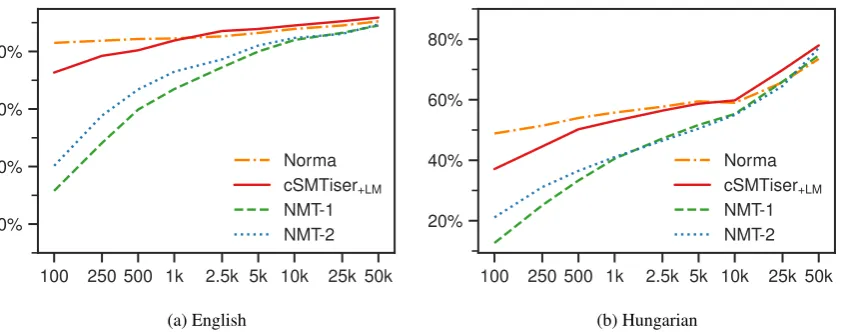
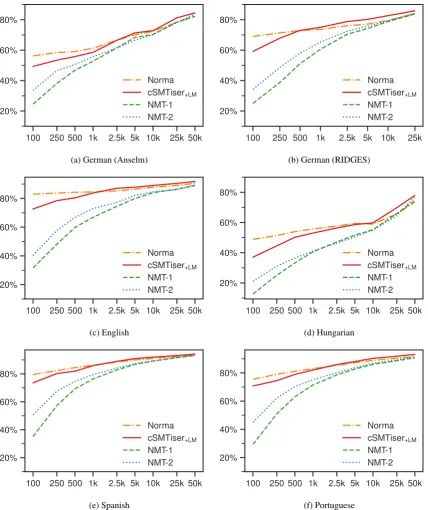
Results Figure2shows two learning curves that are representative for most of the datasets.13 They reveal that Norma (in the “combined” setting) performs best in extremely low-resource scenar-ios, but is overtaken by the SMT approach as more training data becomes available; usually al-ready around 500–1000 tokens. The NMT mod-els have a steeper learning curve, needing more training data to become competitive. Extrapolat-ing this trend, it is conceivable that the NMT mod-els would simply need more training data than our current datasets provide in order to consistently outperform the SMT approach. On the other hand, there appears to be no correlation between the size of the training set (cf. Tab.1) and the relative
per-12The ten training splits consist of chunks of n tokens that are spaced equidistantly across the full training set; for largern, the number of chunks is reduced so that no splits overlap to more than 50%.
100 250 500 1k 2.5k 5k 10k 25k 50k 20%
40% 60% 80%
Norma cSMTiser+LM NMT-1 NMT-2
(a) English
100 250 500 1k 2.5k 5k 10k 25k 50k 20%
40% 60% 80%
Norma cSMTiser+LM NMT-1 NMT-2
[image:8.595.85.506.69.235.2](b) Hungarian
Figure 2: Word accuracy on the development sets for different amounts of training data (note that thex-axis is log-scaled); NMT-1 is the model byBollmann(2018), NMT-2 is the model byTang et al.(2018).
formance of NMT vs. SMT (cf. Tab.2) in the ex-periments. Since I am not aware of larger datasets for the historical normalization task, this remains an open question for now.
A remarkable result is that very small amounts of training data can already be helpful for the nor-malization task. The English dataset has compar-atively little spelling variation to begin with: leav-ing all words unnormalized already results in an accuracy of 75.5%. Still, with as little as 100 to-kens for training, applying the Norma tool raises the accuracy above 83%. For Hungarian, the same amount of training data raises the accuracy from 17.8% (unnormalized) to around 50%. It would be interesting to further compare these results with fully unsupervised methods.
5.3 Out-of-Vocabulary Words
Robertson and Goldwater(2018) highlight the im-portance of evaluating separately on seen vs. un-seen tokens, i.e., tokens that have also been in the training set (in-vocabulary) and those that have not (out-of-vocabulary), as well as comparing to a naive memorization baseline. These numbers are presented in Table4. For unseen tokens (Tab.4b), the accuracy scores follow generally the same trend as in the full evaluation of Tab.2; i.e., SMT performs best in most cases. For seen tokens (Tab.4a), however, Norma’s lookup component— which implements naive memorization—obtains the highest score on nine datasets.
These observations suggest a new normaliza-tion strategy: apply the naive lookup on the subset of in-vocabulary tokens and the SMT/NMT mod-els on the subset of out-of-vocabulary tokens only.
Table 5 shows the results of this strategy.14 On nine datasets, it performs better than always us-ing the learned models (as in Tab.2), and this dif-ference is statistically significant on five of them. These results support the claim from Robertson and Goldwater(2018) that “learned models should typically only be applied tounseentokens.”
6 Conclusion
This paper presented a large study of historical text normalization. Starting with a systematic sur-vey of the existing literature, four different sys-tems (based on supervised learning) were eval-uated and compared on datasets from eight dif-ferent languages. On the basis of these results, we can extract some practical recommendations for projects seeking to employ normalization tech-niques:
1. to use the Norma tool when only little train-ing data (<500 tokens) is available;
2. to use cSMTiser otherwise, ideally with addi-tional data for language modelling; and
3. to make use of the naive memoriza-tion/lookup technique for in-vocabulary to-kens when possible.
Furthermore, the qualitative analysis (in Sec.5.1) should encourage authors evaluating normaliza-tion systems to use task-motivated approaches, such as evaluation on word stems, to provide
Method Dataset
DEA DER EN ES HU IS PT SLB SLG SV
Norma, Lookup/Combined 92.36 93.66 97.46 96.59 96.81 89.51 97.04 97.15 98.17 97.61
Norma, Rule-based 80.34 89.26 93.17 89.98 88.42 86.21 88.77 93.61 96.10 92.10
Norma, Distance-based 60.79 78.85 86.77 85.89 67.04 70.99 78.93 77.49 94.54 84.17
cSMTiser 92.18 93.25 97.10 96.33 96.33 89.27 96.80 96.73 98.09 97.66
cSMTiser+LM 90.52 93.45 97.15 96.42 96.33 88.99 96.82 96.90 98.07 97.66
NMT(Bollmann,2018) 91.91 93.29 97.19 96.37 96.18 88.67 96.72 95.92 97.56 97.01 NMT(Tang et al.,2018) 92.25 93.41 97.19 96.27 96.43 89.34 96.60 96.84 97.89 96.90
(a) In-vocabulary/seen tokens
Norma, Lookup 3.91 19.92 30.42 46.72 3.28 29.40 28.25 18.07 68.07 39.85
Norma, Rule-based 40.27 46.06 62.06 72.97 47.66 63.73 57.50 54.99 64.59 63.37 Norma, Distance-based 41.33 43.25 48.63 67.78 47.43 61.64 57.79 44.23 49.82 50.15 Norma (Combined) 47.25 48.13 59.18 69.93 54.83 65.52 60.62 57.57 50.71 53.73
cSMTiser 57.25 59.96 71.78 80.22 76.59 69.70 74.69 78.49 83.30 70.35
cSMTiser+LM 50.69 59.76 71.70 79.24 76.86 69.55 75.91 78.40 83.56 70.26
NMT(Bollmann,2018) 63.24 59.83 65.17 77.57 75.13 68.66 70.00 73.75 80.87 68.78 NMT(Tang et al.,2018) 65.09 60.16 67.15 78.75 76.33 71.04 69.90 75.04 83.46 69.66
[image:9.595.75.522.73.350.2](b) Out-of-vocabulary/unseen tokens
Table 4: Word accuracy for seen/unseen tokens separately (cf. Sec.5.3); best results for each dataset in bold.
Method Dataset
DEA DER EN ES HU IS PT SLB SLG SV
Best without lookup *89.64 *88.22 95.24 95.02 91.70 *87.31 95.18 93.30 *96.01 91.13
cSMTiser 88.98 *88.41 95.54 95.25 *92.00 *87.31 *95.31 93.52 *96.06 *91.09 cSMTiser+LM 88.35 *88.37 *95.53 *95.17 92.07 *87.30 95.39 *93.50 96.10 *91.07
NMT(Bollmann,2018) 89.56 *88.38 95.05 95.03 91.66 *87.20 94.93 92.60 95.71 90.72 NMT(Tang et al.,2018) 89.74 88.45 95.19 *95.13 *91.94 87.46 94.92 92.85 *96.08 *90.93
Table 5: Word accuracy for the “lookup on seentokens, learned models onunseen tokens” strategy, following Robertson and Goldwater(2018) (cf. Sec.5.3), compared to the best result without this strategy (according to Table2). Best result for each dataset in bold; results marked with an asterisk (*) are not significantly different from the best result using McNemar’s test atp <0.05.
deeper insight into the properties of their models and datasets.
Detailed information on how to train and ap-ply all of the evaluated techniques is made available online at https://github.com/ coastalcph/histnorm.
Acknowledgments
I would like to thank my PhD supervisor, Stefanie Dipper, for her continuous support over many years that culminated in the doctoral thesis on
which this paper is based; the acknowledgments in that thesis largely extend to this paper as well. Many thanks to Anders Søgaard for many helpful discussions and for supporting the follow-up ex-periments conducted for this paper. Further thanks go to the anonymous reviewers whose helpful sug-gestions have largely been incorporated here.
[image:9.595.75.522.407.528.2]References
Yvonne Adesam, Malin Ahlberg, and Gerlof Bouma. 2012. bokstaffua, bokstaffwa, bokstafwa, bokstaua, bokstawa. . . Towards lexical link-up for a corpus of Old Swedish. InProceedings of the 11th Con-ference on Natural Language Processing (KON-VENS 2012), LThist 2012 workshop, pages 365– 369, Vienna, Austria.
Mayce Al Azawi, Muhammad Zeshan Afzal, and Thomas M. Breuel. 2013. Normalizing histori-cal orthography for OCR historihistori-cal documents us-ing LSTM. In Proceedings of the 2nd Interna-tional Workshop on Historical Document Imaging and Processing (HIP ’13), pages 80–85, Washing-ton, DC.
Marilisa Amoia and José Manuel Martínez. 2013. Us-ing comparable collections of historical texts for building a diachronic dictionary for spelling normal-ization. InProceedings of the 7th Workshop on Lan-guage Technology for Cultural Heritage, Social Sci-ences, and Humanities (LaTeCH), pages 84–89. As-sociation for Computational Linguistics.
Alistair Baron and Paul Rayson. 2008. VARD 2: A tool for dealing with spelling variation in historical corpora. In Proceedings of the Postgraduate Con-ference in Corpus Linguistics.
Fabian Barteld, Ingrid Schröder, and Heike Zinsmeis-ter. 2015. Unsupervised regularization of historical texts for POS tagging. InProceedings of the Work-shop on Corpus-Based Research in the Humanities (CRH), pages 3–12, Warsaw, Poland.
Kristín Bjarnadóttir. 2012. The database of mod-ern Icelandic inflection (Beygingarlýsing íslensks nútímamáls). In Proceedings of the Workshop on Language Technology for Normalisation of Less-Resourced Languages, pages 13–18.
Marcel Bollmann. 2012. (Semi-)automatic normaliza-tion of historical texts using distance measures and the Norma tool. InProceedings of the Second Work-shop on Annotation of Corpora for Research in the Humanities (ACRH-2), pages 3–12, Lisbon, Portu-gal.
Marcel Bollmann. 2018. Normalization of historical texts with neural network models. Bochumer Lin-guistische Arbeitsberichte, 22.
Marcel Bollmann, Joachim Bingel, and Anders Sø-gaard. 2017. Learning attention for historical text normalization by learning to pronounce. In Pro-ceedings of the 55th Annual Meeting of the Associa-tion for ComputaAssocia-tional Linguistics (Volume 1: Long Papers), pages 332–344. Association for Computa-tional Linguistics.
Marcel Bollmann, Florian Petran, and Stefanie Dipper. 2011. Rule-based normalization of historical texts. In Proceedings of the International Workshop on Language Technologies for Digital Humanities and Cultural Heritage, pages 34–42, Hissar, Bulgaria.
Marcel Bollmann and Anders Søgaard. 2016. Im-proving historical spelling normalization with bi-directional LSTMs and multi-task learning. In Pro-ceedings of COLING 2016, the 26th International Conference on Computational Linguistics: Techni-cal Papers, pages 131–139. The COLING 2016 Or-ganizing Committee.
Marcel Bollmann, Anders Søgaard, and Joachim Bin-gel. 2018. Multi-task learning for historical text normalization: Size matters. InProceedings of the Workshop on Deep Learning Approaches for Low-Resource NLP, pages 19–24. Association for Com-putational Linguistics.
Christos Christodouloupoulos and Mark Steedman. 2015. A massively parallel corpus: the Bible in 100 languages. Language Resources and Evalua-tion, 49(2):375–395.
Miguel Domingo and Francisco Casacuberta. 2018. Spelling normalization of historical documents by using a machine translation approach. In Proceed-ings of the 21st Annual Conference of the European Association for Machine Translation, pages 129– 137.
Andrea Ernst-Gerlach and Norbert Fuhr. 2006. Gen-erating search term variants for text collections with historic spellings. InProceedings of the 28th Euro-pean Conference on Information Retrieval Research (ECIR 2006), Lecture Notes in Computer Science, pages 49–60, Berlin. Springer.
Izaskun Etxeberria, Iñaki Alegria, Larraitz Uria, and Mans Hulden. 2016. Evaluating the noisy chan-nel model for the normalization of historical texts: Basque, Spanish and Slovene. In Proceedings of the Tenth International Conference on Language Re-sources and Evaluation (LREC 2016), pages 1064– 1069, Paris, France. European Language Resources Association (ELRA).
Hans Fix. 1980. Automatische Normalisierung – Vo-rarbeit zur Lemmatisierung eines diplomatischen al-tisländischen Textes. In Paul Sappler and Erich Straßner, editors, Maschinelle Verarbeitung alt-deutscher Texte. Beiträge zum dritten Symposion, Tübingen 17.–19. Februar 1977, pages 92–100. Niemeyer, Tübingen.
Rafael Giusti, Arnaldo Candido Jr, Marcelo Muniz, Lívia Cucatto, and Sandra Aluísio. 2007. Auto-matic detection of spelling variation in historical corpus: An application to build a Brazilian Por-tuguese spelling variants dictionary. InProceedings of the Corpus Linguistics Conference (CL2007), Birmingham, UK.
Mika Hämäläinen, Tanja Säily, Jack Rueter, Jörg Tiedemann, and Eetu Mäkelä. 2018. Normalizing Early English letters to present-day English spelling. InProceedings of the Second Joint SIGHUM Work-shop on Computational Linguistics for Cultural Heritage, Social Sciences, Humanities and Litera-ture, pages 87–96. Association for Computational Linguistics.
Andreas W. Hauser and Klaus U. Schulz. 2007. Unsu-pervised learning of edit distance weights for retriev-ing historical spellretriev-ing variations. In Proceedings of the First Workshop on Finite-State Techniques and Approximate Search (FSTAS 2007), pages 1–6, Borovets, Bulgaria.
Sigrún Helgadóttir, Ásta Svavarsdóttir, Eiríkur Rögn-valdsson, Kristín Bjarnadóttir, and Hrafn Loftsson. 2012. The tagged Icelandic corpus (MíM). In
Proceedings of the Workshop on Language Tech-nology for Normalisation of Less-Resourced Lan-guages, pages 67–72.
Marcin Junczys-Dowmunt, Roman Grundkiewicz, Tomasz Dwojak, Hieu Hoang, Kenneth Heafield, Tom Neckermann, Frank Seide, Ulrich Germann, Alham Fikri Aji, Nikolay Bogoychev, André F. T. Martins, and Alexandra Birch. 2018. Marian: Fast neural machine translation in C++. InProceedings of ACL 2018, System Demonstrations, pages 116– 121, Melbourne, Australia. Association for Compu-tational Linguistics.
Bryan Jurish. 2010a. Comparing canonicalizations of historical German text. In Proceedings of the 11th Meeting of the ACL Special Interest Group on Computational Morphology and Phonology, pages 72–77, Uppsala, Sweden. Association for Computa-tional Linguistics.
Bryan Jurish. 2010b. More than words: using to-ken context to improve canonicalization of histori-cal German. Journal for Language Technology and Computational Linguistics, 25(1):23–39.
Sebastian Kempken, Wolfram Luther, and Thomas Pilz. 2006. Comparison of distance measures for historical spelling variants. In Max Bramer, editor,
Artificial Intelligence in Theory and Practice, pages 295–304. Springer, Boston, MA.
Mike Kestemont, Walter Daelemans, and Guy De Pauw. 2010. Weigh your words—memory-based lemmatization for Middle Dutch. Literary and Lin-guistic Computing, 25(3):287–301.
Mike Kestemont, Guy de Pauw, Renske van Nie, and Walter Daelemans. 2016. Lemmatization for variation-rich languages using deep learning. Dig-ital Scholarship in the Humanities.
Philipp Koehn. 2005. Europarl: A parallel corpus for statistical machine translation. In Proceedings of MT Summit.
Philipp Koehn, Hieu Hoang, Alexandra Birch, Chris Callison-Burch, Mercello Federico, Nicola Bertoldi, Brooke Cowan, Wade Shen, Christine Moran, Richard Zens, Chris Dyer, Ondˇrej Bojar, Alexandra Constantin, and Evan Herbst. 2007. Moses: Open source toolkit for statistical machine translation. In
Proceedings of the ACL 2007 Demo and Poster Ses-sions, pages 177–180, Prague, Czech Republic.
Gerhard Koller. 1983. Ein maschinelles Verfahren zur Normalisierung altdeutscher Texte. In Dietmar Peschel, editor,Germanistik in Erlangen, volume 31 of Erlanger Forschungen, pages 611–620. Univer-sitätsbund Erlangen-Nürnberg, Erlangen.
Marijn Koolen, Frans Adriaans, Jaap Kamps, and Maarten de Rijke. 2006.A cross-language approach to historic document retrieval. InProceedings of the 28th European Conference on Information Retrieval Research (ECIR 2006), Lecture Notes in Computer Science, pages 407–419, Berlin. Springer.
Natalia Korchagina. 2017. Normalizing medieval Ger-man texts: from rules to deep learning. In Proceed-ings of the NoDaLiDa 2017 Workshop on Processing Historical Language, pages 12–17. Linköping Uni-versity Electronic Press.
Vladimir I. Levenshtein. 1966. Binary codes capable of correcting deletions, insertions, and reversals. So-viet Physics Doklady, 10(8):707–710.
Nikola Ljubeši´c, Katja Zupan, Darja Fišer, and Tomaž Erjavec. 2016. Normalising Slovene data: his-torical texts vs. user-generated content. In Pro-ceedings of the 13th Conference on Natural Lan-guage Processing (KONVENS 2016), volume 16 of Bochumer Linguistische Arbeitsberichte, pages 146–155, Bochum, Germany.
Petar Mitankin, Stefan Gerdjikov, and Stoyan Mihov. 2014. An approach to unsupervised historical text normalisation. In Proceedings of the First Interna-tional Conference on Digital Access to Textual Cul-tural Heritage (DATeCH ’14), Madrid, Spain.
Graham Neubig, Matthias Sperber, Xinyi Wang, Matthieu Felix, Austin Matthews, Sarguna Pad-manabhan, Ye Qi, Devendra Singh Sachan, Philip Arthur, Pierre Godard, John Hewitt, Rachid Riad, and Liming Wang. 2018. XNMT: The extensible neural machine translation toolkit. In Conference of the Association for Machine Translation in the Americas (AMTA) Open Source Software Showcase, Boston.
Csaba Oravecz, Bálint Sass, and Eszter Simon. 2010. Semi-automatic normalization of Old Hungarian codices. In Proceedings of the ECAI 2010 Work-shop on Language Technology for Cultural Her-itage, pages 55–59.
Extraction. Doctoral dissertation, Uppsala Univer-sity, Department of Linguistics and Philology, Upp-sala.
Eva Pettersson, Beáta Megyesi, and Joakim Nivre. 2013a. Normalisation of historical text using context-sensitive weighted Levenshtein distance and compound splitting. In Proceedings of the 19th Nordic Conference of Computational Linguistics (NODALIDA 2013), pages 163–179. Linköping Uni-versity Electronic Press.
Eva Pettersson, Beáta Megyesi, and Joakim Nivre. 2014. A multilingual evaluation of three spelling normalisation methods for historical text. In Pro-ceedings of the 8th Workshop on Language Tech-nology for Cultural Heritage, Social Sciences, and Humanities (LaTeCH), pages 32–41. Association for Computational Linguistics.
Eva Pettersson, Beáta Megyesi, and Jörg Tiedemann. 2013b. An SMT approach to automatic annotation of historical text. In Proceedings of the Workshop on Computational Historical Linguistics at NODAL-IDA 2013, NEALT Proceedings Series 18/Linköping Electronic Conference Proceedings 87, pages 54– 69. Linköping University Electronic Press.
Jordi Porta, José-Luis Sancho, and Javier Gómez. 2013. Edit transducers for spelling variation in Old Spanish. In Proceedings of the Workshop on Computational Historical Linguistics at NODAL-IDA 2013, NEALT Proceedings Series 18/Linköping Electronic Conference Proceedings 87, pages 70– 79. Linköping University Electronic Press.
Martin Porter. 2001. Snowball: A language for stem-ming algorithms.
Paul Rayson, Dawn Archer, and Nicholas Smith. 2005. VARD versus Word: A comparison of the UCREL variant detector and modern spell checkers on En-glish historical corpora. InProceedings of the Cor-pus Linguistics Conference CL2005, Birmingham, UK. University of Birmingham.
Alexander Robertson and Sharon Goldwater. 2018. Evaluating historical text normalization systems: How well do they generalize? In Proceedings of the 2018 Conference of the North American Chap-ter of the Association for Computational Linguistics: Human Language Technologies, Volume 2 (Short Papers), pages 720–725. Association for Computa-tional Linguistics.
Alexander M. Robertson and Peter Willett. 1993. A comparison of spelling-correction methods for the identification of word forms in historical text databases. Literary and Linguistic Computing, 8(3):143–152.
Felipe Sánchez-Martínez, Isabel Martínez-Sempere, Xavier Ivars-Ribes, and Rafael C. Carrasco. 2013. An open diachronic corpus of historical Spanish: annotation criteria and automatic modernisation of spelling.CoRR, abs/1306.3692.
Yves Scherrer and Tomaž Erjavec. 2013. Moderniz-ing historical slovene words with character-based SMT. In Proceedings of the 4th Biennial Interna-tional Workshop on Balto-Slavic Natural Language Processing, pages 58–62. Association for Computa-tional Linguistics.
Yves Scherrer and Tomaž Erjavec. 2016. Modernising historical Slovene words. Natural Language Engi-neering, 22(6):881–905.
Yves Scherrer and Nikola Ljubeši´c. 2016. Automatic normalisation of the Swiss German ArchiMob cor-pus using character-level machine translation. In
Proceedings of the 13th Conference on Natural Lan-guage Processing (KONVENS 2016), volume 16 of Bochumer Linguistische Arbeitsberichte, pages 248–255, Bochum, Germany.
Gerold Schneider, Eva Pettersson, and Michael Percil-lier. 2017. Comparing rule-based and SMT-based spelling normalisation for English historical texts. In Proceedings of the NoDaLiDa 2017 Workshop on Processing Historical Language, pages 40–46. Linköping University Electronic Press.
Rico Sennrich, Alexandra Birch, Anna Currey, Ulrich Germann, Barry Haddow, Kenneth Heafield, An-tonio Valerio Miceli Barone, and Philip Williams. 2017.The University of Edinburgh’s neural MT sys-tems for WMT17. In Proceedings of the Second Conference on Machine Translation, pages 389– 399. Association for Computational Linguistics.
Gongbo Tang, Fabienne Cap, Eva Pettersson, and Joakim Nivre. 2018. An evaluation of neural ma-chine translation models on historical spelling nor-malization. InProceedings of the 27th International Conference on Computational Linguistics, pages 1320–1331. Association for Computational Linguis-tics.
A Appendix
Figures3and4show plots of the learning curves for all of the datasets.
A.1 Preprocessing
The full preprocessing steps of all datasets (both historical and contemporary) comprise of:
1. lowercasing all tokens;
2. filtering out pairs where either the histori-cal token or the reference normalization is empty;
100 250 500 1k 2.5k 5k 10k 25k 50k 20%
40% 60% 80%
Norma cSMTiser+LM NMT-1 NMT-2
(a) German (Anselm)
100 250 500 1k 2.5k 5k 10k 25k 20%
40% 60% 80%
Norma cSMTiser+LM NMT-1 NMT-2
(b) German (RIDGES)
100 250 500 1k 2.5k 5k 10k 25k 50k 20%
40% 60% 80%
Norma cSMTiser+LM NMT-1 NMT-2
(c) English
100 250 500 1k 2.5k 5k 10k 25k 50k 20%
40% 60% 80%
Norma cSMTiser+LM NMT-1 NMT-2
(d) Hungarian
100 250 500 1k 2.5k 5k 10k 25k 50k 20%
40% 60% 80%
Norma cSMTiser+LM NMT-1 NMT-2
(e) Spanish
100 250 500 1k 2.5k 5k 10k 25k 50k 20%
40% 60% 80%
Norma cSMTiser+LM NMT-1 NMT-2
[image:13.595.79.508.143.654.2](f) Portuguese
100 250 500 1k 2.5k 5k 10k 25k 20%
40% 60% 80%
Norma cSMTiser+LM NMT-1 NMT-2
(a) Icelandic
100 250 500 1k 2.5k 5k 10k 20%
40% 60% 80%
Norma cSMTiser+LM NMT-1 NMT-2
(b) Swedish
100 250 500 1k 2.5k 5k 10k 25k 20%
40% 60% 80%
Norma cSMTiser+LM NMT-1 NMT-2
(c) Slovene (Bohoriˇc)
100 250 500 1k 2.5k 5k 10k 25k 50k 20%
40% 60% 80%
Norma cSMTiser+LM NMT-1 NMT-2
[image:14.595.80.506.66.411.2](d) Slovene (Gaj)
Figure 4: Word accuracy on the development sets (continued); NMT-1 is the model byBollmann(2018), NMT-2 is the model byTang et al.(2018).
4. replacing all digits with zeroesiff the digits in the historical token and the reference nor-malization match;
5. replacing actual space characters in either the historical token or the reference normaliza-tion with a special symbol that does not oth-erwise occur in the dataset; and
6. performing Unicode normalization according to the NFC standard.