724
Pooled Contextualized Embeddings for Named Entity Recognition
Alan Akbik
Zalando Research M¨uhlenstraße 25
10243 Berlin
Tanja Bergmann
Zalando Research M¨uhlenstraße 25
10243 Berlin
{firstname.lastname}@zalando.de
Roland Vollgraf
Zalando Research M¨uhlenstraße 25
10243 Berlin
Abstract
Contextual string embeddingsare a recent type of contextualized word embedding that were shown to yield state-of-the-art results when utilized in a range of sequence labeling tasks. They are based on character-level language models which treat text as distributions over characters and are capable of generating em-beddings for any string of characters within any textual context. However, such purely character-based approaches struggle to pro-duce meaningful embeddings if a rare string is used in a underspecified context. To ad-dress this drawback, we propose a method in which we dynamically aggregate contextual-ized embeddings of each unique string that we encounter. We then use a pooling oper-ation to distill a global word representoper-ation from all contextualized instances. We eval-uate thesepooled contextualized embeddings on common named entity recognition (NER) tasks such as CoNLL-03 and WNUT and show that our approach significantly improves the state-of-the-art for NER. We make all code and pre-trained models available to the research community for use and reproduction.
1 Introduction
Word embeddings are a crucial component in many NLP approaches (Mikolov et al.,2013; Pen-nington et al., 2014) since they capture latent se-mantics of words and thus allow models to bet-ter train and generalize. Recent work has moved away from the original “one word, one embed-ding” paradigm to investigatecontextualized em-bedding models (Peters et al.,2017,2018;Akbik et al., 2018). Such approaches produce different embeddings for the same word depending on its context and are thus capable of capturing latent contextualized semantics of ambiguous words.
Recently, Akbik et al. (2018) proposed a character-level contextualized embeddings
ap-Fung B-PER
Permadi E-PER
( Taiwan S-LOC
) v Indra
S-ORG
Figure 1: Example sentence that provides underspecified context. This leads to an underspecified contextual word em-bedding for the string “Indra” that ultimately causes a mis-classification of “Indra” as an organization (ORG) instead of person (PER) in a downstream NER task.
proach they refer to as contextual string embed-dings. They leverage pre-trained character-level language models from which they extract hidden states at the beginning and end character positions of each word to produce embeddings for any string of characters in a sentential context. They showed these embeddings to yield state-of-the-art results when utilized in sequence labeling tasks such as named entity recognition (NER) or part-of-speech (PoS) tagging.
Underspecified contexts. However, such contex-tualized character-level models suffer from an in-herent weakness when encountering rare words in an underspecified context. Consider the example text segment shown in Figure1: “Fung Permadi (Taiwan) v Indra”, from the English CONLL-03 test data split (Tjong Kim Sang and De Meulder, 2003). If we consider the word “Indra” to be rare (meaning no prior occurrence in the corpus used to generate word embeddings), the underspecified context allows this word to be interpreted as either a person or an organization. This leads to an un-derspecified embedding that ultimately causes an incorrect classification of “Indra” as an organiza-tion in a downstream NER task.
knowl-2 100 101 102 103 104 105 106 107 108 109 110 111 112 113 114 115 116 117 118 119 120 121 122 123 124 125 126 127 128 129 130 131 132 133 134 135 136 137 138 139 140 141 142 143 144 145 146 147 148 149 150 151 152 153 154 155 156 157 158 159 160 161 162 163 164 165 166 167 168 169 170 171 172 173 174 175 176 177 178 179 180 181 182 183 184 185 186 187 188 189 190 191 192 193 194 195 196 197 198 199
NAACL-HLT 2019 Submission ***. Confidential Review Copy. DO NOT DISTRIBUTE.
[image:2.595.85.522.62.243.2]figure2-crop.pdf
Figure 2:PLACEHOLDER Illustration of character-level RNN language model.
edge a reader is expected to have. Indeed, the string “Indra” in the CONLL-03 data also occurs in the earlier sentence “Indra Wijaya (Indonesia) beat Ong Ewe Hock”. Based on this, we propose an approach in which we dynamically aggregate contextualized embeddings of each unique string that we encounter as we process a dataset. We then use a pooling operation to distill a global word rep-resentation from all contextualized instances that we use in combination with the current contextu-alized representation as new word embedding.
We evaluate our proposed embedding approach on the task of named entity recognition on the CONLL-03 (English, German and Dutch) and
WNUT datasets. In all cases, we find that our approach outperforms previous approaches and yields new state-of-the-art scores. We contribute our approach and all pre-trained models to the open source FLAIR1framework, to ensure repro-ducibility of these results.
2 Method
Our proposed approach dynamically builds up a “memory” of contextualized embeddings and ap-plies a pooling operation to distill a global con-textualized embedding for each word. It requires anembed() function that produces a contextual-ized embedding for a givenwordin asentence
context (seeAkbik et al.(2018)). It also requires amemorythat records for each unique word all
previous contextual embeddings, and apool() op-eration to pool embedding vectors.
This is illustrated in Algorithm 1: to embed a word (in a sentential context), we first call the
embed() function (line 2) and add the resulting
1https://github.com/zalandoresearch/flair
embedding to the memory for this word (line 3). We then call the pooling operation over all contex-tualized embeddings for this word in the memory (line 4) to compute the pooled contextualized em-bedding. Finally, we concatenate the original con-textual embedding together with the pooled repre-sentation, to ensure that both local and global in-terpretations are represented (line 5). This means that the resulting pooled contextualized embed-dinghas twice the dimensionality of the original embedding.
Algorithm 1Compute pooled embedding
Input:sentence,memory 1: for wordinsentence do 2: embcontext ←
embed(word) withinsentence 3: addembcontexttomemory[word]
4: embpooled←pool(memory[word])
5: word.embedding←
concat(embpooled,embcontext)
6: end for
Crucially, our approach expands the memory each time we embed a word. Therefore, the same word in the same context may have different em-beddings over time as the memory is built up.
Pooling operations. Per default, we usemean
pooling to average a word’s contextualized em-bedding vectors. We also experiment withmin
andmaxpooling to compute a vector consisting of all element-wise minimum or maximum values.
Training downstream models. When training downstream task models (such as for NER), we typically make many passes over the training data. As Algorithm 2 shows, we reset the memory at the beginning of each pass over the training data (line
embcontext Indra2
I n d r a W i j a y a b e a t O n g E w e
embcontext Indra3
A n d I n d r a s a i d t h a t . . . memory
Indra
embproposed
F u n g P e r m a d i v I n d r a Character Language Model
embcontext Indra1
pooling concatenation
current sentence
Figure 2: Example of how we generate our proposed embedding (embproposed) for the word “Indra” in the example text
segment “Fung Permadi v Indra”. We extract a contextual string embedding (embcontext) for this word and retrieve from
thememory all embeddings that were produced for this string on previous sentences. We pool and concatenate all local contextualized embeddings to produce the final embedding.
edge a reader is expected to have. Indeed, the string “Indra” in the CONLL-03 data also occurs in the earlier sentence “Indra Wijaya (Indonesia) beat Ong Ewe Hock”.
Based on this, we propose an approach in which we dynamically aggregate contextualized embed-dings of each unique string that we encounter as we process a dataset. We then use a pooling opera-tion to distill a global word representaopera-tion from all contextualized instances that we use in combina-tion with the current contextualized representacombina-tion as new word embedding. Our approach thus pro-duces evolving word representations that change over time as more instances of the same word are observed in the data.
We evaluate our proposed embedding approach on the task of named entity recognition on the CONLL-03 (English, German and Dutch) and WNUT datasets. In all cases, we find that our approach outperforms previous approaches and yields new state-of-the-art scores. We contribute our approach and all pre-trained models to the open source FLAIR1 framework (Akbik et al., 2019), to ensure reproducibility of these results.
2 Method
Our proposed approach (see Figure 2) dynami-cally builds up a “memory” of contextualized em-beddings and applies a pooling operation to distill a global contextualized embedding for each word. It requires an embed() function that produces a contextualized embedding for a given word in a
1https://github.com/zalandoresearch/flair
sentencecontext (seeAkbik et al.(2018)). It also
requires amemory that records for each unique
word all previous contextual embeddings, and a
pool()operation to pool embedding vectors. This is illustrated in Algorithm 1: to embed a word (in a sentential context), we first call the
embed() function (line 2) and add the resulting embedding to the memory for this word (line 3). We then call the pooling operation over all contex-tualized embeddings for this word in the memory (line 4) to compute the pooled contextualized em-bedding. Finally, we concatenate the original con-textual embedding together with the pooled repre-sentation, to ensure that both local and global in-terpretations are represented (line 5). This means that the resulting pooled contextualized embed-ding has twice the dimensionality of the original embedding.
Algorithm 1Compute pooled embedding Input:sentence,memory
1: for wordinsentence do
2: embcontext ←
embed(word) withinsentence
3: addembcontexttomemory[word]
4: embpooled←pool(memory[word])
5: word.embedding←
concat(embpooled,embcontext)
6: end for
Pooling operations. We experiment with differ-ent pooling operations: meanpooling to average
a word’s contextualized embedding vectors, and
Approach CONLL-03 EN CONLL-03 DE CONLL-03 NL WNUT-17
Pooled Contextualized Embeddingsmin 93.18±0.09 88.27±0.30 90.12±0.14 49.07±0.31
Pooled Contextualized Embeddingsmax 93.13±0.09 88.05±0.25 90.26±0.10 49.05±0.26
Pooled Contextualized Embeddingsmean 93.10±0.11 87.69±0.27 90.44±0.20 49.59±0.41
Contextual String Emb. (Akbik et al.,2018) 92.86±0.08 87.41±0.13 90.16±0.26 49.49±0.75
best published
BERT (Devlin et al.,2018)† 92.8
CVT+Multitask (Clark et al.,2018)† 92.6
ELMo (Peters et al.,2018)† 92.22
Stacked Multitask (Aguilar et al.,2018)† 45.55
[image:3.595.76.518.60.190.2]Character-LSTM (Lample et al.,2016)† 90.94 78.76 81.74
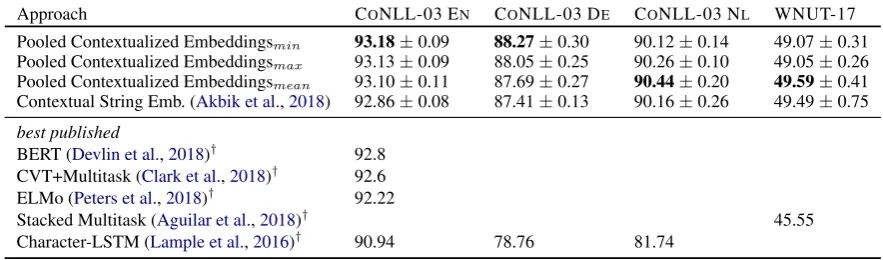
Table 1: Comparative evaluation of proposed approach with different pooling operations (min,max,mean) against current state-of-the-art approaches on four named entity recognition tasks (†indicates reported numbers). The numbers indicate that
our approach outperforms all other approaches on the CoNLL datasets, and matches baseline results on WNUT.
element-wise minimum or maximum values. Training downstream models. When training downstream task models (such as for NER), we typically make many passes over the training data. As Algorithm 2 shows, we reset the memory at the beginning of each pass over the training data (line 2), so that it is build up from scratch at each epoch.
Algorithm 2Training 1: forepochinepochsdo
2: memory←map ofwordto list
3: train and evaluate as usual 4: end for
This approach ensures that the downstream task model learns to leverage pooled embeddings that are built up (e.g.evolve) over time. It also ensures that pooled embeddings during training are only computed over training data. After training, (i.e. during NER prediction), we do not reset embed-dings and instead allow our approach to keep ex-panding the memory and evolve the embeddings.
3 Experiments
We verify our proposed approach in four named entity recognition (NER) tasks: We use the En-glish, German and Dutch evaluation setups of the CONLL-03 shared task (Tjong Kim Sang and De Meulder, 2003) to evaluate our approach on classic newswire data, and the WNUT-17 task on emerging entity detection (Derczynski et al.,2017) to evaluate our approach in a noisy user-generated data setting with few repeated entity mentions.
3.1 Experimental Setup
We use the open source FLAIR framework in all our experiments. It implements the stan-dard BiLSTM-CRF sequence labeling architec-ture (Huang et al.,2015) and includes pre-trained
contextual string embeddings for many languages. To FLAIR, we add an implementation of our pro-posedpooled contextualized embeddings.
Hyperparameters. For our experiments, we fol-low the training and evaluation procedure outlined inAkbik et al. (2018) and follow most hyperpa-rameter suggestions as given by the in-depth study presented inReimers and Gurevych(2017). That is, we use an LSTM with 256 hidden states and one layer (Hochreiter and Schmidhuber,1997), a locked dropout value of 0.5, a word dropout of 0.05, and train using SGD with an annealing rate of 0.5 and a patience of 3. We perform model se-lection over the learning rate∈ {0.01,0.05,0.1} and mini-batch size ∈ {8,16,32}, choosing the model with the best F-measure on the validation set. Following Peters et al. (2017), we then re-peat the experiment 5 times with different random seeds, and train using both train and development set, reporting both average performance and stan-dard deviation over these runs on the test set as final performance.
Standard word embeddings. The default setup of Akbik et al. (2018) recommends contextual string embeddings to be used in combination with standard word embeddings. We use GLOVE em-beddings (Pennington et al.,2014) for the English tasks and FASTTEXT embeddings (Bojanowski et al.,2017) for all newswire tasks.
Baselines. Our baseline are contextual string em-beddings without pooling, i.e. the original setup proposed in Akbik et al. (2018)2. By compar-ing against this baseline, we isolate the impact of our proposed pooled contextualized embeddings.
2Our reproduced numbers are slightly lower than we re-ported in Akbik et al. (2018) where we used the official CONLL-03 evaluation script over BILOES tagged entities.
Approach CONLL-03 EN CONLL-03 DE CONLL-03 NL WNUT-17
Pooled Contextualized Embeddings (only) 92.42±0.07 86.21±0.07 88.25±0.11 44.29±0.59 Contextual String Embeddings (only) 91.81±0.12 85.25±0.21 86.71±0.12 43.43±0.93
Table 2: Ablation experiment using contextual string embeddings without word embeddings. We find a more significant impact on evaluation numbers across all datasets, illustrating the need for capturing global next to contextualized semantics.
In addition, we list the best reported numbers for the four tasks. This includes the recent BERT ap-proach using bidirectional transformers byDevlin et al.(2018), the semi-supervised multitask learn-ing approach by Clark et al. (2018), the ELMo word-level language modeling approach byPeters et al.(2018), and the best published numbers for WNUT-17 (Aguilar et al.,2018) and German and Dutch CONLL-03 (Lample et al.,2016).
3.2 Results
Our experimental results are summarized in Ta-ble1for each of the four tasks.
New state-of-the-art scores. We find that our ap-proach outperforms all previously published re-sults, raising the state-of-the-art for CONLL-03 on English to 93.18 F1-score (↑0.32 pp vs. previ-ous best), German to 88.27 (↑0.86 pp) and Dutch to 90.44 (↑0.28 pp). The consistent improvements against the contextual string embeddings baseline indicate that our approach is generally a viable op-tion for embedding entities in sequence labeling. Less pronounced impact on WNUT-17. How-ever, we also find no significant improvements on the WNUT-17 task on emerging entities. Depend-ing on the poolDepend-ing operation, we find compara-ble results to the baseline. This result is expected since most entities appear only few times in this dataset, giving our approach little evidence to ag-gregate and pool. Nevertheless, since recent work has not yet experimented with contextual embed-dings on WNUT, as side result we report a new state-of-the-art of 49.59 F1 vs. the previous best reported number of 45.55 (Aguilar et al.,2018). Pooling operations. Comparing the pooling op-erations discussed in Section2, we generally find similar results. As Table 1 shows, min pooling
performs best for English and German CoNLL, whilemeanpooling is best for Dutch and WNUT.
3.3 Ablation: Character Embeddings Only To better isolate the impact of our proposed ap-proach, we run experiments in which we do not use any classic word embeddings, but rather rely solely on contextual string embeddings. As Ta-ble 2 shows, we observe more pronounced
im-provements of pooling vis-a-vis the baseline ap-proach in this setup. This indicates that pooled contextualized embeddings capture global seman-tics words similar in nature to classical word em-beddings.
4 Discussion and Conclusion
We presented a simple but effective approach that addresses the problem of embedding rare strings in underspecified contexts. Our experimental evalu-ation shows that this approach improves the state-of-the-art across named entity recognition tasks, enabling us to report new state-of-the-art scores for CONLL-03 NER and WNUT emerging entity detection. These results indicate that our embed-ding approach is well suited for NER.
Evolving embeddings. Our dynamic aggrega-tion approach means that embeddings for the same words will change over time, even when used in exactly the same contexts. Assuming that entity names are more often used in well-specified con-texts, their pooled embeddings will improve as more data is processed. The embedding model thus continues to “learn” from data even after the training of the downstream NER model is com-plete and it is used in prediction mode. We con-sider this idea of constantly evolving representa-tions a very promising research direction.
Future work. Our pooling operation makes the conceptual simplification that all previous in-stances of a word are equally important. However, we may find more recent mentions of a word - such as words within the same document or news cycle - to be more important for creating embeddings than mentions that belong to other documents or news cycles. Future work will therefore examine methods to learn weighted poolings of previous mentions. We will also investigate applicability of our proposed embeddings to tasks beside NER. Public release. We contribute our code to the FLAIRframework3. This allows full reproduction of all experiments presented in this paper, and
lows the research community to use our embed-dings for training downstream task models.
Acknowledgements
We would like to thank the anonymous reviewers for their helpful comments. This project has received funding from the European Union’s Horizon 2020 research and innovation pro-gramme under grant agreement no 732328 (“FashionBrain”).
References
Gustavo Aguilar, Adrian Pastor Lopez Monroy, Fabio Gonz´alez, and Thamar Solorio. 2018. Modeling noisiness to recognize named entities using multi-task neural networks on social media. In Proceed-ings of the 2018 Conference of the North American Chapter of the Association for Computational Lin-guistics: Human Language Technologies, Volume 1 (Long Papers), volume 1, pages 1401–1412.
Alan Akbik, Tanja Bergmann, Duncan Blythe, Kashif Rasul, Stefan Schweter, and Roland Vollgraf. 2019. Flair: An easy-to-use framework for state-of-the-art nlp. In NAACL, 2019 Annual Conference of the North American Chapter of the Association for Computational Linguistics: System Demonstrations.
Alan Akbik, Duncan Blythe, and Roland Vollgraf. 2018. Contextual string embeddings for sequence labeling. InCOLING 2018, 27th International Con-ference on Computational Linguistics, pages 1638– 1649.
Piotr Bojanowski, Edouard Grave, Armand Joulin, and Tomas Mikolov. 2017. Enriching word vectors with subword information. Transactions of the Associa-tion for ComputaAssocia-tional Linguistics, 5:135–146.
Kevin Clark, Minh-Thang Luong, Christopher D. Man-ning, and Quoc V. Le. 2018. Semi-supervised sequence modeling with cross-view training. In EMNLP.
Leon Derczynski, Eric Nichols, Marieke van Erp, and Nut Limsopatham. 2017. Results of the wnut2017 shared task on novel and emerging entity recogni-tion. InProceedings of the 3rd Workshop on Noisy User-generated Text, pages 140–147.
Jacob Devlin, Ming-Wei Chang, Kenton Lee, and Kristina Toutanova. 2018. Bert: Pre-training of deep bidirectional transformers for language understand-ing. arXiv preprint arXiv:1810.04805.
Sepp Hochreiter and J¨urgen Schmidhuber. 1997. Long short-term memory. Neural computation, 9(8):1735–1780.
Zhiheng Huang, Wei Xu, and Kai Yu. 2015. Bidirec-tional lstm-crf models for sequence tagging. arXiv preprint arXiv:1508.01991.
Guillaume Lample, Miguel Ballesteros, Sandeep Sub-ramanian, Kazuya Kawakami, and Chris Dyer. 2016.
Neural architectures for named entity recognition. InProceedings of the 2016 Conference of the North American Chapter of the Association for Computa-tional Linguistics: Human Language Technologies, pages 260–270. Association for Computational Lin-guistics.
Tomas Mikolov, Ilya Sutskever, Kai Chen, Greg S Cor-rado, and Jeff Dean. 2013. Distributed representa-tions of words and phrases and their compositional-ity. InAdvances in neural information processing systems, pages 3111–3119.
Jeffrey Pennington, Richard Socher, and Christopher Manning. 2014. Glove: Global vectors for word representation. InProceedings of the 2014 confer-ence on empirical methods in natural language pro-cessing (EMNLP), pages 1532–1543.
Matthew Peters, Waleed Ammar, Chandra Bhagavat-ula, and Russell Power. 2017. Semi-supervised se-quence tagging with bidirectional language mod-els. InProceedings of the 55th Annual Meeting of the Association for Computational Linguistics (Vol-ume 1: Long Papers), pages 1756–1765, Vancouver, Canada. Association for Computational Linguistics.
Matthew E. Peters, Mark Neumann, Mohit Iyyer, Matt Gardner, Christopher Clark, Kenton Lee, and Luke Zettlemoyer. 2018. Deep contextualized word rep-resentations. InProc. of NAACL.
Nils Reimers and Iryna Gurevych. 2017. Reporting Score Distributions Makes a Difference: Perfor-mance Study of LSTM-networks for Sequence Tag-ging. In Proceedings of the 2017 Conference on Empirical Methods in Natural Language Processing (EMNLP), pages 338–348, Copenhagen, Denmark.