Abstract—Quality of software game development is considered to be a key vital part for game software industry which is highly competitive. Unlike other software development, the full requirements of game software cannot always be completely defined upfront. Therefore, defining quality measurement method is a must, especially in the early stage of the game software development which will result in easier bug and software improvement and better cost effectiveness than implementing quality assurance after the game has been fully developed. This study presents the defining usability quality metric for game prototype using software attributes by referring to ISO Standards 9126-3: Software Engineering - Product Quality, with the adaptation for the quality assurance and measurement during game prototyping period. In order to be fully utilized and optimized the effectiveness of the proposed quality metric, it is best to define the development process environment and its application simultaneously.
Index Term—Game Design Process, Quality Measurements, Game Prototype, Usability Quality Metric, Quality Evaluation
I. INTRODUCTION
AME development has high investment cost in each stage of development as well as aggressive competitiveness in the game industry. In order for game developer to gain the interest of users in an aspect of usability quality and to out-perform the large scale of competitors, a higher quality of game must be developed which can be obtained through various methods such as the development of human skills, the development of process and the development of measurement process. However, each method has its strengths and downfalls. The development of human skills takes time and is at risk of employment turnover. The development of process may be difficult to become standardized due to the uniqueness of the game, namely different types of game requires different processes. Facing with some of these challenges, there is one method to improve the usability quality of a game by deploying the quality measurement processes which can be directly correlated to the quality of the game. This method is one of the best methods for quality improvement because
Adisak Srisuriyasavad is with the Software Engineering Laboratory, Center of Excellence in Software Engineering Department of Computer
Engineering, Faculty of Engineering Chulalongkorn University, Thailand ; e-mail: [email protected]
Nakornthip Prompoon is with the Software Engineering Laboratory, Center of Excellence in Software Engineering Department of Computer
Engineering, Faculty of Engineering Chulalongkorn University, Thailand ;e-mail: [email protected]
the close loop system which uses the results of the measurements to determine the quality of the game, to analyze for further improvements and to properly integrate into the production processes to fulfill each organization’s particular needs.
Most studies have revealed that the quality measurement of the game is performed after the completion of the game development [3]-[10]. Such measurements will not be effective to improve the development of the game because if the game output does not match with the requirements and modifications have to be made after the completion of development. Any changes will increase the cost and will lengthen the development time without any added values. The more effective and suitable method to improve the quality of the game would be to incorporate the quality measurements into the early stage of the game development during the prototype period.
Five steps of the development of game [11] [12] are concept, pre-production, production, testing and maintenance. The first 2 steps (concept and pre-production) are grouped into Game Design Process which can be further breakdown into 3 portions: Concept Stage, Elaboration Stage and Tuning Stage.
The main objective of the game design phase is to create a game with usability quality. This standard can be applied to typical software development. However, in order to use this standard particularly for the game development with special requirement applications, it’s necessary to modify certain metrics and criteria to be better suited for the game development. For example, in order for the game to have the quality attribute of Satisfaction which is the result of the quality of the functionality, the quality of the Satisfaction has many sub-characteristics and variables. The typical use for the quality measuring metric for this Satisfaction characteristic for other software developments is to ask the users to complete the questionnaire and this method cannot be adequately applied to the game development. In order to improve the effectiveness of the metric, it should include the concept of Playtest [12] which is to incorporate the quality metrics in the game prototyping period.
The standard that defines a measurement process applicable to system and software engineering and management disciplines in a good organization is ISO/IEC 15939, Systems and Software Engineering -- Measurement Process [14] which outlined 5 key important processes: Establish and Sustain Measurement, Plan the Measurement Process, Perform the Measurement Process, Evaluate Measurement, and Technical and Management Processes.
Defining Usability Quality Metric for Game
Prototype Using Software Attributes
Adisak Srisuriyasavad and Nakornthip Prompoon
This study will focus on the defining usability quality metric for game prototype with 2 concepts: quality simulation from the ISO 9126 from the quality of the usability perspective and the Playtest procedure.
The subsequent sections will cover the principles related to the study of the working protocols, the results of defining usability quality metric, the application of the quality metric, the conclusion of the studies and the opportunities for further improvements.
II.BACKGROUND
A. Game Prototype [12]
Game prototype is the simulation of the game that is used to better understand and to test the functionality of the game which could be in the digital and non-digital format. There are 2 types of game prototypes:
Physical Prototype [12] is a non-digital prototype which can be simply created with paper, play dough, card or other handicraft materials which can be categorized as follows:
Foundation is the very first prototype that is built for the purpose of testing the feasibility of the game objectives and key concept in the roughest and simplest stage.
Structure is the next prototype that follows the foundation prototype which includes the basic core play modes of the game concepts and features or the basic rules for different scenarios for a game.
Formal Details specify the details for the rules, logics and algorithms that are necessary for the various scenarios of the game which will cover the game functions as well as checking for conflicts in order to ensure cohesiveness of the game.
Refinement is the process where the reduction, addition, modification of the rules are made in order to improve the enjoyment of the game, to check if the game is fun to play and to test the ease and cohesiveness of interactions of the functions.
Digital Prototype [12] is the prototype in the digital format which is created in order to test the blueprint of the core game and to test the experience, the look and feel of the real game.
In this research, the scope will be focused on the usability quality metric of the game prototype of the Physical Prototype since we believe that the research result would be directly applied to the Digital Prototype.
B. Game Development
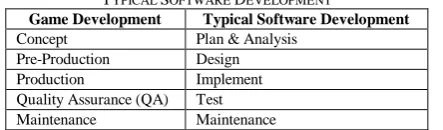
The game development has a similar process and procedure [12] as other software development as shown in Table I.
TABLE I
COMPARISON OF THE PROCESSES BETWEEN GAME DEVELOPMENT AND
TYPICAL SOFTWARE DEVELOPMENT
Game Development Typical Software Development
Concept Plan & Analysis Pre-Production Design Production Implement Quality Assurance (QA) Test Maintenance Maintenance
To further explore the Game Development, the 5 steps are described as follows:
Concept Phase is the step to think about the work plan,
conditions and game play description and features in a general sense. The outputs of this step are Concept Document, Project Plan, Budget and Contract.
Pre-Production Phase is the step to design the format of the game play and the characteristics of the game in details such as defining the characters, defining the plots, defining the functional requirements and others. The outputs of this step are Game Prototype and Game Design Document.
Production Phase is the step to create the game. The outputs of this step are the Alpha Code and other assets such as graphics and sounds.
Quality Assurance (QA) phase is the step to test the game for any bugs, errors or items that are not corresponding to the specified requirements. The output of this step is the full playable game that meets Concept Document and Design Document purpose.
Lastly, Maintenance is the step to maintain, improve and establish game related activities or promotions.
C. Game Design Process
From the game production process that was mentioned in Section B, further working details for the Concept and Pre-production Phase were described in [11].
The results of the analysis and game design consists of 2 parts: game prototype and game design document [12] which mainly describes the vision, business objectives, target groups, rules platform, roles and characters, plots and story line of game, and list of related interfaces. .
Although the quality metric is an important factor in the designing of various games, the game design document is not often used for the analysis and design of games in the game industry. In some cases, the game designers will publish such documents after the game is completed or only as requested in special occasion which could result in investment lost if the game has not been produced exactly to meet the design requirements. Hence, this study will define the quality metric from the beginning of the design phase through the end of the design phase and focusing only on the usability quality metric for game prototype.
D. Software Quality Measurement
There are numerous methods defined for the quality measurement of general software, however, the standard that has been widely utilized in the industry is ISO standards: ISO/IEC 9126 Software engineering - Product quality. This ISO standard is divided into 3 groups based on the measuring methods and the correlation between groups.
Quality in use is the metric from the user’s perspective by testing the success in using the software.
External Quality is the metric from the software
developer’s perspective by testing the functionality of the applications such as Black Box Testing.
Internal Quality is the metric from the software
developer’s perspective by testing the internal structures or workings of an application as in White Box Testing during Pre-Production Phase.
[image:2.595.60.282.686.751.2]Quality under the ISO/IEC 9126-3: Software Engineering - Product Quality-Part 3 Internal Quality which is the measurable quality characteristic during the design or the production phase.
E. Playtest
Playtest is the process to test a game [12] which is commonly used in the game industry and it has been designed to be used with the quality measurement of the Physical Prototype in 5 portions:
Functional is to test if the game prototype has rules and playability which can be measured by asking the tester if the game was enjoyable in the way that it was intended.
Internally Complete is to test the completeness of the details in the game prototype, check for the conflicting rules and find the optimum point, test if the tester spend suitable time in each portion, test to see if the tester can progress to the next level or not.
Balanced is to test the game prototype.
Fun is the test to measure if the game is enjoyable as expected or not by considering the following Dramatic Element which may consist of the following fun factors: competition, fantasy, social interaction, exploration, self, story, construction/destruction, collection, goal and stimulation. If the prototype is designed to include the factors, it will enable the game to be more enjoyable and more attractive to players.
Accessible is the test to determine the ease of use to the players in case no instruction is provided – are the players able to start the game, can the game be easily maneuvered, can the game be played smoothly?
Because different game prototypes demand different quality needs, Tracy Fullerton [12] has described the various testing for the different physical prototype in Table II.
TABLE II
PLAYTEST FOR GAME PROTOTYPE
F
u
n
F
u
n
c
ti
o
n
a
l
In
te
rn
a
l
Co
m
p
le
te
Ba
la
n
c
e
d
A
c
c
e
ss
ib
le
Foundation X
Structure X X
Formal Details X X X
Refinement X X
This study has incorporated the playtest process with the physical prototype. However, the digital prototype was not covered by Tracy Fullerton.
III. RELATED STUDIES
Software testing has many levels as mentioned in SWEBOK [1] that testing level has two topics: target of the test and objectives of testing.
The target of the test can be divided into Unit Test, Integration Test and System Test. The objectives of testing can be grouped into Acceptance/Qualification Testing, Installation Testing, Alpha and Beta Testing, Conformance Testing/Functional Testing/Correctness Testing, Reliability Achievement and Evaluation, Regression Testing, Performance Testing, Stress Testing, Back to Back Testing,
Recovery Testing, Configuration Testing, Usability Testing, Test-driven Development. However, the most important testing for the game industry is the Usability Test because this testing is able to reflect the measurement of the satisfaction of the players the most.
As for the usability test, Nielsen [19] stated that there are 3 basic steps which can be used for usability testing process: Capture – collect all of the data related to the usability such as duration of use, bugs or errors found during use, satisfaction level of user.
Analysis – analyze, review and determine the results from the testing and look for problem areas of improvement
Critique – provide recommendations for improvements
Subsequently, Melody Y. Ivory and Marti A. Hearst [2] conducted further studies and consolidated all of the work that had been performed on the Usability Testing for more than 75 methods, grouped them into 39 groups based on the method type and represented 4 perspectives:
Method Class described the derivation of collective data such as from actually usage, from usability testing or from simulation.
Method Type described the method that evaluation was obtained such as thinking-aloud protocol.
Automation Type described that the quality metric can be performed automatically in each process step such as Capture, Analysis or Critique.
Effort Level described the level of assets required for testing (labor or resources) such as model development or interface usage.
Categorizing the usability testing into 4 such perspectives is very beneficial to the ease of understanding the methodology of the usability testing of the software. Usability testing of most games is evaluated with heuristic technique [3] – [10] where the different studies have different groupings and test methodologies such as challenges in the evaluation of educational computer game. This study [3] covered the evaluation with heuristic approach and had broken down the evaluation into 5 portions: Interface, Pedagogical, Multimedia, Content and Playability.
The evaluation with heuristic method of this study had established a check list for the 5 subcategories so that the testers can review the critical points and can provide the rating. .
However, because this study [3] has conducted the evaluation after the game had been fully developed, hence, it was not suitable to be applied to the game design phase. As well as the heuristic method has some weaknesses due to the results of the testing is highly depending on the skills of the testers. Therefore, it may not be the best testing application for game design phase.
Jaafar designed the quantifiable method for the evaluation by having the expert identifies the numerical rating of the severity on each of the problems that were found during the evaluation. Then, the severity rating can be compared between the different problems found and the ranking can be performed to prioritize the problems that needed to be resolved first. However, this study [4] was also conducted at the end of game development which was much too late to avoid additional cost in case the results were not satisfied and changes had to be made.
In some studies, psychological theories were used in the quality metric such as in Game Flow: A Model for Evaluating Player Enjoyment in Games which referred to the psychological theory on the optimal experience of flow [18] called Game Flow which consisted of 8 elements
Subsequently, this study [10] generated an evaluation list under the heuristic method in each of the enjoyment elements with a questionnaire for the player to perform rating and calculated the average value to determine the quality metric of the game. This study has brought the psychological awareness of enjoyment to use in the usability testing for game which was found be to quite useful. However, this evaluation was also performed after the completion of the game development and therefore may not be suited for the game prototype evaluation.
IV. DEFINING USABILITY QUALITY METRIC
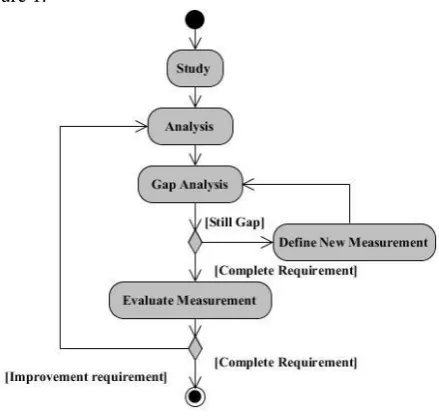
[image:4.595.60.280.418.627.2]This study has defined the quality metric as showed in Figure 1.
Fig 1. Process Flow in Defining Quality Metric in Game Prototype
Defining the quality metric as the following process flow:
A. Study
Study is to research and collect information from 3 parts: 1) Research the game design process flow, output of design and quality requirements from the game design referred from the book written by Tracy Fullerton.
2) Research the process to create measurements from ISO/IEC 15939: Systems and Software engineering -- Measurement Process and IEEE 1061: Standard for a
Software Quality Metrics Methodology, to gain knowledge on the components of the effective quality metric, evaluation of quality metrics and application of quality metrics
3) Research the Quality Model from ISO/IEC 9126-3: Software Engineering - Product quality - Part 3 Internal metrics, for the specific characteristics of usability. Also, review the various studies on usability performed by
Melody Y., Marti A. Hearst [2] in order to gain a better understanding of the nature of usability quality metric so that the right tools or methods can be selected for the game prototype.
B. Analysis
In this step, the gathered information and data from the previous step are evaluated, compared and contrasted to select the metric from ISO 9126 that matches the desired quality requirements for the game prototype, including optimizing the applicability.
Therefore, the metric from the attribute of learnability was selected which consists of the metric to measure the completeness of user documentation by expanding to the different document types according to the types of game.
C. Gap Analysis
Gap Analysis is to examine the variation between the standard metric and the required quality metric for game design by comparing the metric with the known standards from ISO 9126. It is found that some important and necessary details have not been established for the metric for quality measurement during the game design.
D. Define New Measurement
This step is to define new measurement by using the method in defining new metric from ISO 15939 and IEEE 1061 and to design the measurement method from the study by Melody Y., Marti A. Hearst [2] which referenced the similar method in ISO 9126. For example, the metric to measure the balance of the formal prototype is used to measure the quality of balance by defining the metric with the measure method on a questionnaire to evaluate the satisfaction in the balance of game. This has a similar attribute as the metric called Attractive Interaction which uses the questionnaire to measure the satisfaction on the software supplementary materials.
E. Evaluate Measurement
After the new measurement is defined, it has to be evaluated for the correctness and suitability of the quality metric for each type of the game prototype. For example, to review the enjoyment factor of the prototype foundation, a questionnaire to evaluate the enjoyment of the game from the sensation must be checked to see if it has sufficient related questions, is it too complicated to be evaluated within the allotted time or allotted resources.
V.USABILITY QUALITY METRIC FOR GAME PROTOTYPE
TABLE III
USABILITY QUALITY METRIC FOR GAME PROTOTYPE Game
Prototype
Usability Quality Requirement
Metric Name Measurement Function ISO9126-3
Usability Metrics Reference
Foundation Fun Dramatic element score
Count the number of enjoyment factor with questionnaire to score the dramatic elements and compare to the score of the target group
Attractive interaction Structure Fun Dramatic element
score
Count the number of enjoyment factor with questionnaire to score the dramatic elements and compare to the score of the target group
Attractive interaction Functional Dramatic element
completeness
Count the number of dramatic elements with specified functions and compare to the total number playable dramatic elements
N/A
Formal Details
Functional Dramatic element completeness
Count the number of dramatic elements with specified functions and compare to the total number playable dramatic elements
N/A
Internal Complete
Input validity checking
Count the number of input items, which check for valid data and compare with the number of input items, which could check for valid data
Input validity checking
User operation cancellability
Count the number of implemented functions, which can be cancelled by the user prior to completion and compare it with the number of functions requiring the pre-cancellation capability
User operation cancellability
User operation undoability
Count the number of implemented functions, which can be undone by the user after completion and compare it with the number of functions
User operation Undoability Operation status
monitoring capability
Count the number of implemented functions, which status can be monitored and compare it with the number of functions requiring the monitoring capability
Operation status monitoring capability Operational
consistency
Count the number of control that is consistent with natural behavior and compare it with the total number of control
Operational Consistency Operational error
recoverability
Count the number of functions implemented with user error tolerance and compare it to the total number of functions requiring the tolerance capability
Operational error recoverability Balanced Game Balanced
Score
Score from the questionnaire on the satisfaction level of the balanced of the game prototype
N/A
Refinement Fun Attractive Interaction
Score from the questionnaire of the attractiveness of the user Interface Attractive Interaction Accessible Customizability Count the number of implemented functions, which can be customized by the
user during operation and compare it with the number of functions requiring the customization capability
Customizability
Message clarity Count the numbers of implemented messages with clear explanations and compare it with the total number of messages implemented
Message Clarity
Interface element clarity
Count the number of interface elements which are self explanatory and compare it with the total number of interface elements
Interface Element Clarity Completeness of
user documentation and/or help facility
Count the number of functions implemented with help facility and/or documentation and compare with the total number of functions
Completeness of user documentation and/or help facility Completeness of
description
Count the number of functions which are adequately described and compare with the total number of functions
Completeness of Description Demonstration
capability
Count the number of functions that are adequately demonstrable and compare with the total number of functions requiring demonstration capability
Demonstration Capability Evident functions Count the number of functions that are evident to the user and compare with
the total number of functions
Evident functions
Function understandability
Count the number of user interface functions where purposes is understood by the user and compare with the number of user interface functions
Function understandability
A. Foundation
The usability quality metric on the enjoyment of the game in the attractiveness attributes, ISO 9126 has stated that it can be done with a questionnaire to assess the attractiveness. There are many principles that can be applied to the quality metric questionnaire such as the dramatic elements by counting the number of dramatic elements the game prototype can create and compare to the number of dramatic elements that the target group received from the game. Then the result can be compared to the expected outcome. If the result is higher than the expectation, then the game should be processed to the next step. If the outcome is lower, then the game prototype should be improved or corrected before the production phase. The following metric in Table IV can be used for this purpose.
B. Structure
The usability quality metric will focus on the game enjoyment and function in the playtest.
Fun will be measured by a questionnaire, similarly to the
foundation prototype; however, the scoring will be more details than the foundation prototype because there is pre-determined mode of the game based on the dramatic elements. For example, if we design a car racing game and the dramatic element is the competitiveness. If one car can pass another car, this can be called a competition but it’s not aggressive. However, if we add the feature for the player to see the result or the ranking while playing the game or add the feature for player to play tricks on others, it will add to the “fun”ness of the game
Functional will be measured with a checklist to test if all of the dramatic elements or sensations are experienced as we expected for every pre-determined mode and adequately provided to the players.
C. Formal Details
This usability quality metric that will focus on the function of the playtest, the completeness and the balanced of game have been outlined in ISO 9126 as follows:
features that will create enjoyment or fun in the game. Internal Complete will be measured y a checklist on the sub-characteristics of the operations as mentioned in the ISO 9126. This will enable the flexibility and suitability in operations during the game play. For example, in a car racing game, the player can select to play against the computer; however, if later, the player finds out the computer cannot be defeated and starts to get bored, the player can quit the game and start over again.
Balanced will be measured by a questionnaire to test the balance of the game. For example, in a car racing game, if the game provides an option for the player to pick from the different make and model of cars, it will lengthen the play duration. However, if the game design is not balanced with very few car make/model options to select from, the player will have limited choice. The design of the selection of car make/model is very important which may require feedback from large population of players in order to improve the quality of the game.
TABLE IV DRAMATIC ELEMENT SCORE
Item Description
Metric Name Dramatic Element Score Information
Need
Evaluate enjoyment of game prototype
Purpose Measure quality metric in enjoyment, measure the variety of enjoyment from playing the game to reflect the enjoyment of game prototype
Base Measure
Number of expected dramatic elements from target group
Scale Ratio Scale
Indicator Score of enjoyment that was targeted by organization which may come from target group, investor or type of game
Scale Ratio Scale Measurement
Method
X = A/B ; A = number of received emotion elements from the target group; B = total number of dramatic elements that are expected to received
Scale Ratio Scale
Interpretation 0 <= X<=1 ; The closer X is to 1, the more compliant
Decision Criteria
If X is less than target, game must be redesigned. If X is equal to or more than target, then proceed to next step
D. Refinement
The usability quality metric that is focusing of the fun and the accessibility of game has been outlined in ISO 9126 as follows:
Fun will be measured by a questionnaire to assess the attractiveness and suitability of the graphic in the game. For example, in the car racing game, if the target players are teenagers or adults, the graphic and sounds should be realistic and should be in a race track or on a street. However, if the target group is younger children, then, the graphics and sounds should be more imaginative with bright colored, cute, warm and comical characters. Therefore, the quality metric in this portion must be conducted with the feedback from the players with the right target group.
Accessible will be measured by a checklist from the sub-characteristics in the operation, learnability and understandability with the focus on the game that is designed to be user-friendly. The players should be able to understand and learn to play the game easily. For example,
in the car racing game, the players will be challenged to control and drive the car to its full performance potential with consideration to the surrounding environment and the direction of the streets, therefore, it is very important to provide an instruction or help function on how to control the car by starting with the basic and key tasks, then progress into other more difficult features. If the game is designed with the controls that are appropriate to other games or to the player’s daily activities, then the command will be easier to use.
VI. APPLICATIONS
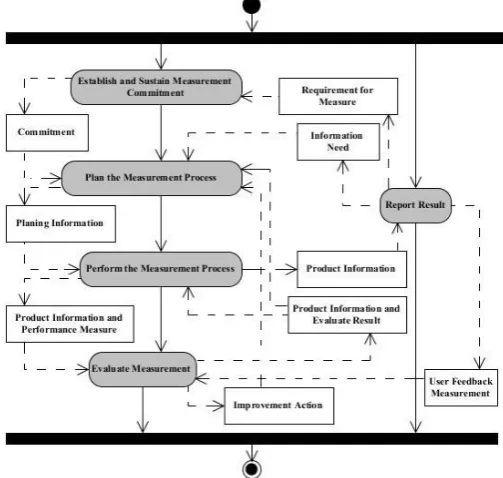
[image:6.595.49.286.304.548.2]Although this study is discussing the usability quality metric for the game prototype during the design phase in details, the quality requirements will vary upon the needs of organization and type of game. In order to effectively apply the quality metric, the usability quality metric must be embedded in the development and the implementation in the context of the game to gain the optimum results and the maximized benefits. ISO/IEC 15939-2007 covers the process to apply the quality metric to an organization which can be mapped into the activity diagram in Figure 2.
Fig 2. Activity Diagram – Measurement Process Model in an Organization
From the above figure, there are 5 major activities to implement the measurement process in an organization. These activities are as follows:
A. Establish and Sustain Measurement Commitment
[image:6.595.303.555.336.575.2]the game is well balanced. The usability quality metric can also be collected through the counting of game won, similar to using the questionnaire, therefore, the organization can select the method of quality measurement that is best suited to the organization’s requirements and strategies.
B. Plan the Measurement Process
This is the step to do the planning on the quality measurement of the game prototype which consists of several activities: define roles and responsibilities of the measuring team, define data to be collected, define data collection method and define analysis method. If the planning is done properly and correctly, then the measurement process will be done correctly, appropriately and in a timely manner.
C. Perform the Measurement Process
In this step, the important activities are consolidating the collected information from the measurement process, analyzing the data and providing feedback for improvements. For example, the quality metric to measure the enjoyment of the foundation prototype of the game can be done through the questionnaire, conduct the survey, analyze the data and compare the results to the organization objectives and review for the decision to make changes or improvement, as needed, then provide the summary to the design team and management.
D. Evaluate Measurement
This step is to evaluate the effectiveness and the reliability of the metric that was used. Key activities include examining the strengths and weaknesses of the gathered information and the measurement method, providing recommendation for improvements and summarized the information for the next quality metric measurements.
E. Report Result
In this step, the conclusion is drawn from the quality measurement process and provided to the design team for further development. Furthermore, for the game design that has unique and specific characteristic, then, additional requirements must be defined for the prototype. For example, in the car racing game, additional metric may be added for the accessibility by counting the number of players who can successfully play and control the car through a specific level in the game and compare to the total number of players.
VII.CONCLUSION ANDFUTURE WORK
The usability quality metric and description in the game prototype is presented and can be used from the beginning of the design stage through the end of the design stage for every type of game prototype and can be applicable to all five usability quality requirements, namely, Fun, Functional, Internal Complete, Balanced and Accessible. The measurements and results will improve the usability quality of the game and will minimize the unnecessary cost to revise or correct the design errors or bugs.
To further enhance the completeness of this study and to improve the application to be more specific, the
recommendations for continuous improvement are as follows:
Establish tools to collect and analyze the data and provide some logic to help to the decision making so that the usability quality metric can be used more effectively.
Furthermore, the quality measurement processes will be developed and applied to other steps in the game development process in addition to the game design phase.
Adapt the usability quality metric to measure the quality of the games that have unique characteristics such as games on mobile phone; or to specify the type of games in greater details such as strategic planning games or combating games.
REFERENCE
[1] “http://www.computer.org/portal/web/swebok/html/contentsch5#ch5”,S WEBOK Website, Access 29 Nov 2012
[2] Melody Y., Marti A. Hearst, “The State of the Art in Automating Usability of User Interfaces”, ACM Computing Surveys, Vol. 33, No. 4, December 2001, pp. 470-516
[3] Hasiah Mohamed, Azizah Jaafar, “Challenges in the evaluation of educational computer game”, International Symposium on Information Technology, ITSim-ITSim, vol.1, 2010, page 1-6.
[4] Hasiah Mohamed, Rohana Yusoff, Azizah Jaafar, “Quantitive analysis in a heuristic evaluation for Usability of Educational Computer Game (UsaECG)”, CAMP: Information Retrieval & Knowledge Management, 2012, page 187-192.
[5] Gavin Sim, “Designing the Anti-Heuristic Game: A Game Which Violates Heuristics”, IDC’12: Proceedings of the 11th International
Conference on Interaction Design and Children, June 2012, page 308-311.
[6] Aditya Ponnada, Ajaykumar Kannan, “Evaluation of mobile games using playability heuristics”, ICACCI’12: Proceedings of the International Conference on Advances in Computing, Communications and Informatics, August 2012, page 244-247.
[7] Hannu Korhonen, Elina M.I. Koivisto, “Playability Heuristics for Mobile Games”, Mobile HCI ’06: Proceeding of the 8th
conference on Human-computer interaction with mobile devices and services, September 2006, page 9-16.
[8] Hannu Korhonen, Elina M.I. Koivisto, “Playability Heuristics for Mobile Multi-player Games”, DIMEA ’07: Proceeding of the 2nd international conference on Digital interactive media in entertainment and art, September 2007, page 28-35.
[9] Heather Desurvire, Martin Caplan, Jozsef A. Toth, “Using Heuristics to Evaluate the Playability of Games”, CHI EA ’04: CHI ’04 extended abstracts on Human factor in computing systems, April 2004, page 1509-1512.
[10] Penelope Sweetser, Peta Wyeth, “Game Flow: A Model for Evaluating Player Enjoyment in Games”, Computers in Entertainment (CIE), volume 3 Issue 3, July 2005, page 1-24.
[11] Ernest Adams, Andrew Rollings, “Fundamentals of Game Design”, Pearson Prentice Hall, ISBN 0-13-168747-6, 2006
[12] Tracy Fullerton, “Game Design Workshop”, Elsevier Inc., ISBN 978-0-240-80974-8, 2008
[13] The International Organization for Standardization and the International Electro technical Commission, “ISO/IEC 9126-3: Software Engineering-Product Quality-Part 3 Internal Quality”, ISO, Switzerland, 2003
[14] Software and Systems Engineering Standards Committee, “IEEE Standard Adoption of ISO/IEC 15939:2007 Systems and Software Engineering Measurement Process” [Electronic book]. IEEE Computer Society, 2008
[15] Chris Crawford, “Chris Crawford on Game Design”, New Riders Games; 1 edition (June 28, 2003), ISBN: 978-0131460997, 2003 [16] Jesse Schell, “The Art of Game Design”, Elsevier, ISBN
978-0-12-369496-6, 2008
[17] Software and System Engineering Standards Committee, “IEEE Standard for a Software Quality Metrics Methodology” [Electronic book], IEEE Computer Society, 2009
[18] Csikszentmihalyi, Mihaly (1990), “Flow: The Psychology of Optimal Experience”, New York: Harper and Row, ISBN 0-06-092043-2 [19] Nielsen, J. (1993), “Usability Engineering”. Boston, MA: Academic