Study of Partial Replacement of Cement by Fly Ash
and Coarse Aggregate by Coconut Shell
Aditya Singh
1, Ashutosh Singh
2, Sunny Phadtare
3, Suyog Koche
4, P.V Kalokhe
21, 2, 3, 4, 5Student, Department of Civil Engineering, Pimpri Chinchwad College of Civil Engineering, Pimpri Chinchwad College of
Engineering, Pune – 411044, Maharashtra, India
5Assistant Professor, Department of Civil Engineering, Pimpri Chinchawad College of Engineering, Pune-411044, Maharashtra,
India
Abstract: A large amount of waste coconut shell is generated in India from temples and industries of coconut product and its disposal need to be addressed. Researchers have proposed to utilize it as ingredient of concrete. This experimental investigation was aimed to quantify the effects of replacing partially the conventional coarse aggregate by coconut shell and partial replacement of cement by fly ash to produce concrete. This project is aimed to observe the effect of such replacement on mechanical properties of concrete. It was found that with increasing proportion of coconut shells, there is decrement in compressive strength. Such study will help to arrive at final decision regarding quantity of coconut shell for replacing conventional aggregates in concrete production.
Keywords: Coarse aggregate, Coconut shell, Fly ash, compressive strength, tensile strength.
I. INTRODUCTION
Infrastructure development across the world created demand for construction materials. Concrete is the premier civil engineering construction material. Concrete manufacturing involve consumption of ingredients like cement, aggregates, water and admixture(s). Among all the ingredients, aggregates form the major part. Concrete is the second most consumed commodity by volume after water. One cubic meter consists of approximately 300 kilograms of cement, 150 liters of water and 2 tones of aggregates. Analysis by Fredonia shows that in 2010 the Indian market for construction aggregates was 2.2 billion tones, the second largest national market in the worldbehind China.
Use of natural aggregate in such a rate leads to a question about the preservation of natural aggregates sources. In addition, operations associated with aggregate extraction and processing are the principal causes of environmental concerns. In light of this, in the contemporary civil engineering construction, using alternative materials in place of natural aggregate in concrete production makes concrete as sustainable and environmentally friendly construction material.
With increased population and modern living habits, production of waste material is increasing at fast pace and its disposal has become a genuine problem.
To resolve the problem, solution is either, to minimize the waste at production level or to utilize the waste materials for some positive activity. Different alternative waste materials and industrial by products such as fly ash, bottom ash, recycled aggregates, foundry sand, china clay sand, crumb rubber, glass were replaced with natural aggregate and investigated properties of the concretes. Apart from above mentioned waste materials and industrial by products, few studies identified that the agricultural by product can also be used as aggregate in concrete and one of those agricultural by product is coconut shells. From such studies, it may be believed that innovation in the construction industry will mainly focus on use of industrial and agro wastes or by-products that are suitable for partial replacement of conventional ingredients of concrete. According to a report, coconut is grown in more than 86 countries worldwide, with a total production of 54 billion nuts per annum. India occupies the premier position in the world with an annual production of 13 billion nuts, followed by Indonesia and the Philippines.
A. Objectives of the Research Work
1) To determine the physical properties of crushed coconut shell and other concreting materials.
2) To determine the mechanical properties of coconut shell concrete and control concrete.
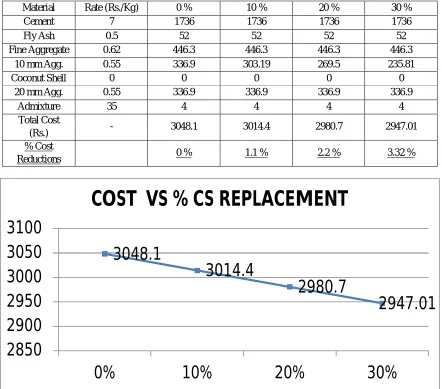
3) To check the cost of coconut shell concrete.
II. EXPERIMENTATION
A. Procurement of Materials
India is one of the leading producers of coconuts. Researchers have proposed to utilize it as ingredient of concrete. According to reports of Green ills Club, 5 Tones of tender empty coconut shells are produced in Pune.
We contacted some coconut vendors in Kirkee, market, Pune and one vendor agreed for supplying us the coconut shells. We have also contacted a local group of Nature Enthusiasts going by the name ‘Green Hills Group’, and have arranged the further demands of coconut shells from them free of cost.
Fig 2.1:- Coconut shells used in project
B. Crushing and sieving of coconut shells
Coconut shells supplied by the vendor to us were not of the size that we could use in concrete mix. So it was important to crush those coconut shells into required size.
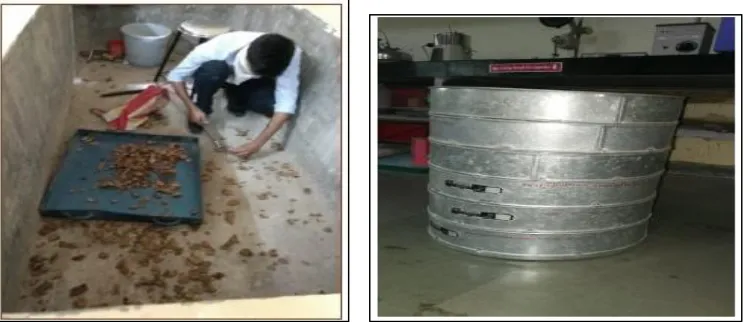
Coconut shells were crushed manually, some by Impact testing apparatus and then for some large quantity Los Angeles Abrasion machine was used.
After crushing, sieving of these crushed coconut shells was done manually by using sieves of size 8 mm, 10 mm, 12.5 mm, and the pan.
Crushed coconut shells of size 8mm and 10mm will be used as partial replacement of 10mm coarse aggregate in this project.
[image:2.595.85.461.564.725.2]
C. Specific gravity & water absorption of aggregate (IS 2386-part 3: 1963)
This test is used for determination of specific gravity & water absorption of aggregates by determining the ratio of weight of a given volume of aggregate to the weight of an equal volume of water. Coarse aggregate specific gravity measures coarse aggregate weight under three different sample conditions:
1) Oven-dry
2) Saturated surface-dry
3) Submerged in water
Fig 3.10 Weighing oven-dried coconut shells Fig 3.11Oven-drying of coconut shells
D. Sieve Analysis of Aggregates
Sieve analysis helps to determine the particle size distribution of the coarse and fine aggregates. This is done by sieving the aggregates as per IS: 2386 (Part I) – 1963. In this we use different sieves as standardized by the IS code and then pass aggregates through them and thus collect different sized particles left over different sieves.
E. Workability of Concrete
For determining workability of Concrete, We performed Slump Cone Test. Concrete slump test or slump cone test is to determine the workability or consistency of concretemix prepared at the laboratory or the construction site during the progress of the work. Concrete slump test is carried out from batch to batch to check the uniform quality of concrete during construction.
[image:3.595.104.493.199.431.2]The slump test is the most simple workability test for concrete, involves low cost and provides immediate results. Due to this fact, it has been widely used for workability tests since 1922. The slump is carried out as per procedures mentioned in ASTM C143 in the United States, IS: 1199 – 1959 in India and EN 12350-2 in Europe.
[image:3.595.111.487.607.734.2]F. Compressive Strength of Concrete
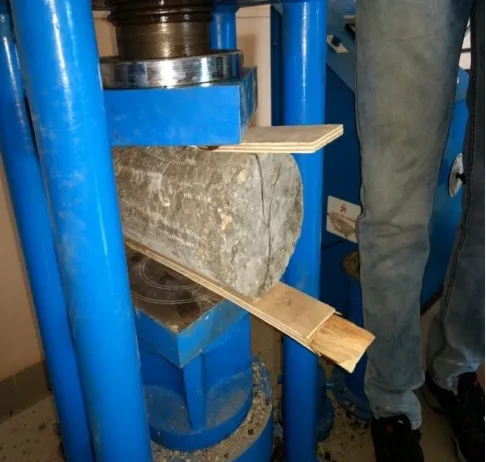
[image:4.595.206.425.186.354.2]Compressive strength of concrete cube test provides an idea about all the characteristics of concrete. By this single test one judge that whether Concreting has been done properly or not. Concrete compressive strength for general construction varies from 15 MPa (2200 psi) to 30 MPa (4400 psi) and higher in commercial and industrial structures. Compressive strength of concrete depends on many factors such as water-cement ratio, cement strength, quality of concrete material, quality control during production of concrete etc.
Fig 3.20Compression Testing of cubes
G. Tensile Strength of Concrete
The tensile strength of concrete is one of the basic and important properties which greatly affect the extent and size of cracking in structures. Moreover, the concrete is very weak in tension due to its brittle nature. Hence, it is not expected to resist the direct tension. So, concrete develops cracks when tensile forces exceed its tensile strength.
Therefore, it is necessary to determine the tensile strength of concrete to determine the load at which the concrete members may crack.
Furthermore, splitting tensile strength test on concrete cylinder is a method to determine the tensile strength of concrete. The procedure based on the ASTM C496 (Standard Test Method of Cylindrical Concrete Specimen) which similar to other codes like IS 5816 1999.
[image:4.595.177.420.495.726.2]III. RESULTS AND DISCUSSION
A. Physical properties of Materials
[image:5.595.99.495.174.270.2]The physical properties of materials are those that are used in reference to the physical structure of particles that the materials consist of.
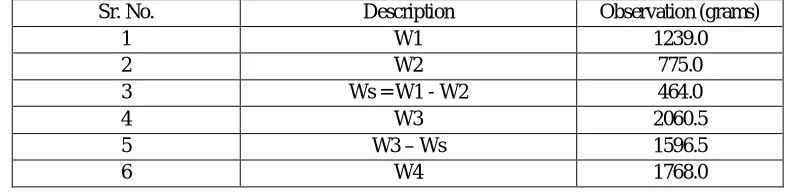
Table 4.1: Observation table (Specific gravity and water absorption)
Sr. No. Description Observation (grams)
1 W1 1239.0
2 W2 775.0
3 Ws = W1 - W2 464.0
4 W3 2060.5
5 W3 – Ws 1596.5
6 W4 1768.0
Weight of saturated aggregate suspended in water with basket = W1 g
Weight of basket suspended in water = W2 g
Weight of saturated aggregate in water = (W1-W2)g = Ws g
Weight of saturated surface dry aggregate in air = W4 g
Weight of water equal to the volume of the aggregate = (W3-Ws) g
B. Results for Coconut Shells
1) Specific Gravity = W4 / (W3-Ws) = 1768.0 / (1596.5) = 1.107
2) Apparent Specific Gravity = W4 / (W4-Ws) = 1768.0 / (1304) = 1.355
3) Water Absorption= (W3-W4) * 100 / W4
[image:5.595.90.498.481.680.2]= (2060.5 - 1768.0) * 100 / (1768) = 16.54 %
Table 4.2: Observation table (Specific gravity)
Sr. No. Type of soil Specific Gravity Apparent Specific Gravity 1. Coconut Shells 1.107 1.355 2. Coarse Aggregate 2.70 2.91 3. Crushed sand 2.89 3.02
Table 4.3: Observation table (Water Absorption) Sr.
No.
Type of soil Water Absorption % 1. Coconut Shells 16.54
2. Coarse Aggregate 2
3. Crushed sand 1
C. Workability of Concrete
Slump of the 20% Coconut Shell Concrete = 0 mm
D. Mechanical properties of Materials
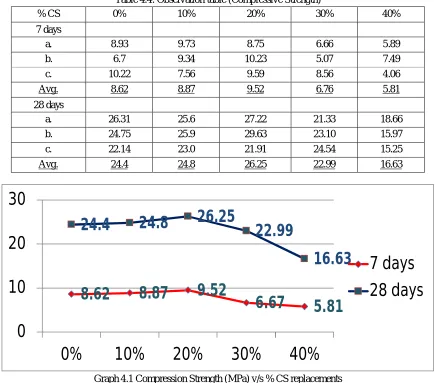
Table 4.4: Observation table (Compressive Strength)
% CS 0% 10% 20% 30% 40%
7 days
a. 8.93 9.73 8.75 6.66 5.89 b. 6.7 9.34 10.23 5.07 7.49 c. 10.22 7.56 9.59 8.56 4.06 Avg. 8.62 8.87 9.52 6.76 5.81 28 days
a. 26.31 25.6 27.22 21.33 18.66 b. 24.75 25.9 29.63 23.10 15.97 c. 22.14 23.0 21.91 24.54 15.25 Avg. 24.4 24.8 26.25 22.99 16.63
Graph 4.1 Compression Strength (MPa) v/s % CS replacements
Table 4.5: Observation table (Tensile Strength) Cylinder Load in KN
a. 272
b. 206
c. 239
Table 4.6: Weight of cubes in (kg)
Cubes 0% 10% 20% 30%
1. 9.33 8.84 8.56 8.21
2. 9.30 9.04 8.78 8.33
3. 9.28 8.86 8.60 8.39
Average. 9.3 8.91 8.65 8.31 % Weight
Reduction 0 % 4.2 % 7.0 % 10.64 %
8.62
8.87
9.52
6.67
5.81
24.4
24.8
26.25
22.99
16.63
0
10
20
30
0%
10%
20%
30%
40%
Graph 4.2 Weight of cube (Kg) v/s % CS replacement
Table 4.7: Material Rates per cubic-m of concrete
Material Rate (Rs./Kg) 0 % 10 % 20 % 30 % Cement 7 1736 1736 1736 1736
Fly Ash 0.5 52 52 52 52
Fine Aggregate 0.62 446.3 446.3 446.3 446.3 10 mm Agg. 0.55 336.9 303.19 269.5 235.81
Coconut Shell 0 0 0 0 0
20 mm Agg. 0.55 336.9 336.9 336.9 336.9
Admixture 35 4 4 4 4
Total Cost
(Rs.) - 3048.1 3014.4 2980.7 2947.01 % Cost
Reductions 0 % 1.1 % 2.2 % 3.32 %
Graph 4.3 Cost (Rs.) per cubic m of concrete v/s % CS replacement
9.3
8.91
8.65
8.31
7.5
8
8.5
9
9.5
0%
10%
20%
30%
3048.1
3014.4
2980.7
2947.01
2850
2900
2950
3000
3050
3100
0%
10%
20%
30%
E. Concrete Mix Design (IS 10262 – 2009)
Mix Design Proportion Cement: F.A: C.A 1 : 2.04: 3.5
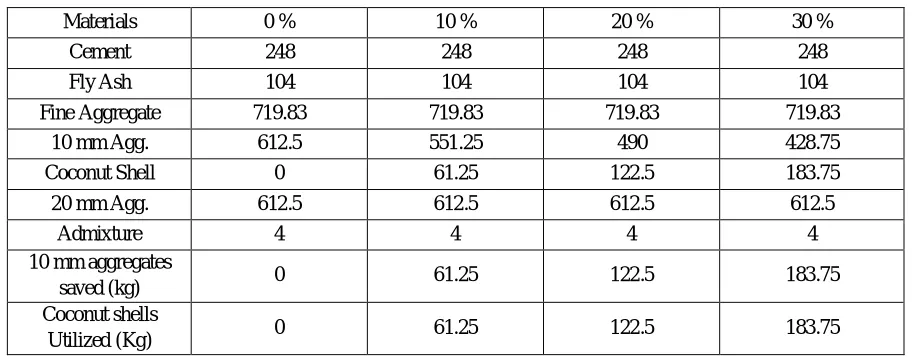
F. Content of Materials 1) Cement = 248 kg/cubic m
2) Fly Ash = 104 kg/cubic m
3) Fine Aggregate= 719.83 kg/cubic m
4) 10 mm Aggregate = 612.5 kg/cubic m
5) 20 mm Aggregate = 612.5 kg/cubic m
6) Water = 142 kg/cubic m
[image:8.595.70.527.303.484.2]7) Admixture = 4.95 kg/cubic m
Table 4.14: Weight of Materials for (1 cubic m) concrete
IV. CONCLUSION
A. In this study we tested the Coconut Shell Concrete for Compression and Tension. 22.5 % Cement was replaced by 32.5 % Fly Ash and 10 mm Coarse Aggregate was replaced by 10, 20, 30, and 40 % Coconut Shells.
B. The Results for 28 day Compressive strength was highest for 20 % CS concrete at 26.25 Mpa, while, the average Tensile Strength for 20 % CS Concrete was 239 KN.
C. The compressive strength decreases sharply beyond 30 % replacement of coarse aggregate by Coconut shell.
D. Coconut shell can be used as partial replacement for C.A up to a 30 %.
E. When Coarse aggregate is partially replaced by coconut shell at 10 %, 20 %, and 30 %, the weight of coconut shell concrete reduces by 4.2 %, 7 %, and 10.64 % respectively, and the cost of concrete reduces by 1.1 %, 2.2 %, and 3.32 % respectively.
F. 20% replacement of coarse aggregate by coconut shell gives optimum concrete. Increase in coconut shell beyond 30% gives very poor results and cannot be used for construction
G. Use of coconut shell as aggregate will reduce the material cost in construction. Therefore, Coconut shell can be used as a potential light weight aggregate in concrete for proper size and mix.
Materials 0 % 10 % 20 % 30 %
Cement 248 248 248 248
Fly Ash 104 104 104 104
Fine Aggregate 719.83 719.83 719.83 719.83 10 mm Agg. 612.5 551.25 490 428.75 Coconut Shell 0 61.25 122.5 183.75 20 mm Agg. 612.5 612.5 612.5 612.5
Admixture 4 4 4 4
10 mm aggregates
saved (kg) 0 61.25 122.5 183.75 Coconut shells
V. ACKNOWLEDGEMENT
It gives us great pleasure in presenting our project named “Study of partial replacement of cement by fly ash and coarse aggregate by coconut shell”.
We take this opportunity to thank Mrs. P. V. Kalokhe our Project guide who has been a constant source of inspiration and also took keen interest in each and every step of the project development. We would also thank our co- guide Mr. S. B. Gorade who provided us valuable assistance through his knowledge of the subject. We are also grateful to Mr. S. S. Hamde for assisting us in the Laboratory. We are grateful for their encouragement in shaping the idea and valuable suggestions in making it a reality. Again we take the opportunity to express our deep sense of gratitude to Dr. S. T. Mali for the valuable guidance and for providing lab facilities as H.O.D of Civil Department and also to all staff members who have helped us directly orindirectly.
We thank to our Principal, Dr. A. M. Fulambarkar, who is always a constant source of motivation for us.
REFERENCES
[1] R. Annadurai, K. Gunasekaran, P.S. Kumar ‘Long term study on compressive and bond strength of coconut shell aggregate concrete’, Published in Construction and Building Materials journal, Volume- 28, Issue: 1 March 2012, Pages: 208-215
[2] ApekshaKanojia, Sarvesh K. Jain ‘Performance of coconut shell as coarse aggregate in concrete’, published in International Research Journal of Engineering and Technology, Volume- 2, Issue: 4 July 2015
[3] A. Jaya Prithika, S K Sekar ‘Mechanical and fracture characteristics of eco-friendly concrete produced using coco nut shell, ground granulated blast furnace slag and manufactured sand’, Construction and Building Materials journal, Volume- 103, Issue: 30 January 2016, Pages: 1-7
[4] S. A. Kakade- Lecturer, Dr. A. W. Dhawale ‘Use of coconut shells as coarse aggregate in concrete’, published in International Journal of Technical Research and Application, Volume-3, Issue: 3 (May- June).
[5] K. Gunasekaran, P.S. Kumar, M. Lakshmipathy ‘Mechanical and bond properties of coconut shell concrete’, published in Construction and Building Materials journal, Volume- 28, Issue: 1 January 2011, Pages: 92-9
[6] PayamShafigh, U. Johnson Alengaram, Hilmi Bin Mahmud, MohdZaminJumaat, ‘Engineering properties of oil palm shell lightweight concrete containing fly ash’, published in Material and Design journal, Volume- 49, Issue: August 2013, Pages: 613-621.
[7] PayamShafigh, U. Johnson Alengaram, Hilmi Bin Mahmud, MohdZaminJumaat, ‘Oil palm shell as lightweight aggregate for production of High strength lightweight concrete’, published in Construction and Building Materials journal, Volume- 25 , Issue: 4 April 2011, Pages: 1848-1853.
[8] M. A. Mannan, C. Ganapathy, ‘Engineering properties of concrete with oil palm shell as Coarse Aggregate’, published in Construction and Building Materials journal, Volume- 16, Issue: February 2002, Pages: 29-34.
IS Codes
IS 456-2000-code for plain cement concrete. IS 516-1959-code for testing of concrete specimens.
IS 5816-1970-methods of test for split tensile strength of concrete.
IS: 2386 - 1963 for sp. gravity, density, water absorption, moisture content etc. IS 10262 – Code for concrete mix design.
i.
Books
Concrete Technology – M L Gambhir
Webography