Abstract— The authors offer a corruption evolution model. They show that corruption has two equilibrium states. One of them is characterized by its absence, but it is unstable. The second equilibrium is stable, it has equal corruption acceleration and countervailing forces. The countervailing forces are presented by two types. The first type includes public anticorruption activities, the second type – moral, ethical norms and other limiters. Under certain conditions, the action of the second forces can suppress corruption more than that of the first forces. The offered model allowed to range countries by the importance of the first and the second anticorruption forces by means of the Corruption Perception Index (CPI). It is shown that it corresponds to the “geographical” classification dividing the countries into two groups: with “Western (economic)” and “Eastern (social)” corruption.
Index Terms— Corruption, evolution model, equilibrium states of corruption, tough (law-enforcement) and soft (mental) corruption limiters, “Western” and “Eastern” variants of corruption
I. INTRODUCTION
HE present scope of corruption is impressive. According to expert estimates, one monetary unit spent to fight against corruption at the national level generally yields the returns, which are one order higher than the expenses, to fight against international corruption – two orders higher. For this reason over the last two decades about ten anticorruption declarations and conventions were adopted under the aegis of the United Nations. The difficulty of anticorruption efforts is also connected with latency and multidimensionality of the phenomenon. From the political perspective, corruption is a tool of a race for power, from the economic one –
Manuscript received February 27, 2017; revised March 04, 2017. The work was supported by Act 211 Government of the Russian Federation, contract № 02.A03.21.
V. N. Smagin is with the Higher School of Economics and Management, South Ural State University, 76 Prospekt Lenina, Chelyabinsk, 454080, Russian Federation (e-mail: [email protected]).
A. V. Karpushkina is with the Higher School of Economics and Management, South Ural State University, 76 Prospekt Lenina, Chelyabinsk, 454080, Russian Federation (e-mail: [email protected]).
I. V. Danilova is with the Higher School of Economics and Management, South Ural State University, 76 Prospekt Lenina, Chelyabinsk, 454080, Russian Federation (e-mail: [email protected]).
S. V. Aliukov is with the Higher School of Economics and Management, South Ural State University, 76 Prospekt Lenina, Chelyabinsk, 454080, Russian Federation (corresponding author, home phone: +7-351-267-97-81; sell phone: 8-922-6350-198; e-mail: [email protected]).
fighting against additional costs and reduction of the economic mechanism efficiency, from the legal one – a crime, from the psychological one – ignoring the property right for lucrative purposes, from the social one – worsening of the social activities, redistribution of revenues and increase of their differentiation, growing tension of the social tissue and strengthening terrorism. Much attention is paid to this issue. As an example, let us name the papers within the framework of the economic approach - Rose-Ackerman [1,2] and Becker [3], political - Nye [4] and Deleon [5], sociological - Coleman [6] and Left [7], psychological - Hantington [8], etc.
The main lines of anticorruption efforts include: 1) laws providing for punishment for corruption and formation of autonomous authorities to control corruption;
2) creation of an atmosphere of intolerance for corruption in the society.
The efforts in these lines will be more successful if the understanding of corruption, its development and influence of legal restrictions and people’s mentality thereon is more profound and theoretically justified. The objective of this paper is to study these matters.
II. VERBAL MODEL OF CORRUPTION SPREAD Budgets of any level provide for social goods in their expenditure side. In the conditions of corruption expenditures are not made in the best way for the society due to corruptive dealing of the official with his/her vis-à-vis.
A successful deal enriches the official and his/her counterpart, and impunity encourages repetition and increase of the scope of such deals. The share of the money stolen from the budget begins to grow from the minimum possible value to the maximum value in the absence of public counteraction. The increasing share of the stolen money cannot remain unnoticed for the supervisory authorities and the society when it reaches a rather high value. After that, law-enforcement bodies generally interrupt the activities of the corrupt official. As a result, there appears a balance of interests between the society and the corruptive bureaucratic community, and corruption reaches the equilibrium state. Higher anticorruption expenses are unacceptable for the society because the advantage is low, while lower expenses increase social losses. This equilibrium level is flexible, whereas it depends on the development of the civil self-awareness (moral-ethical, religious, business norms, etc.) and on the governmental anticorruption efforts (strictness of the law, inevitability of punishment, availability of preventive measures, etc.).
Corruption Spread in the Resisting
Economical System
V. Smagin, A. Karpushkina, I. Danilova and S. Aliukov
III. MATHEMATICAL MODEL OF CORRUPTION EVOLUTION Let us use the share of the goods stolen by corrupt officials from the society as a variable of the maximum value – “x” (х ∈ [0;1]). It is natural to assume that “x” is a motivation to increase it. In the first approximation it is logical to adopt
x
r x
(Malthus population growth equation), wherex
– rate of increase of “х”, r – factor of
proportionality between these values determining the corrupt officials’ response to the reached level of corruption: the higher the success of “х”, the more you want to develop it (
x
).
However, in due course motivation begins to be hindered by the decreasing growth potential of “х” value because there is equilibrium value “хe” determined by the
society’s ability to restrict the corrupt officials’ wants. Therefore, evolution of corruption in the second approximation is described by the following nonlinear differential equation:
(1
);
[0,1].
x
r x
x
x
(1) [image:2.595.314.552.356.476.2]The equation [1] is well known under the name of a logistical equation and was introduced by Verhulst as an alternative to Malthus equation to describe the dynamics of the population size in the conditions of a competition for limited resources. It is also used to characterize reproduction of bacteria in Petri dish when the nutrient medium is restricted or in other similar situations. The solution of the equation (1) is shown in Fig. 1.
Fig. 1. Phase portrait
x
f x
( )
and integral curvesx
y x
( )
of Verhulst equationThe left part of the figure is a phase portrait reflecting the connection between value “х” and the rate of its variation “
x
”.
The right part shows a solution of this equation (1). It is clear from the right part that at initial values of “х” in the course of time the system tends to the equilibrium state
х=1. The equation (1) has two equilibrium states: х=0 and
х=1 (wherein
x
=0). Equilibrium х=0 is unstable, whereas an accidental deviation of “х” from 0 puts the system in motion and leads to a continuous growth of “х” to its other equilibrium х=1. This equilibrium is already stable. Any deviation of “х” from the equilibrium state returns the
system to position хe=1. Corruption stops only when the
budget is fully exhausted if it does not face counteractions. Now let us consider external factors limiting corruption. For that purpose, let us transform the equation (1) into the equation of corruption evolution in a resisting environment:
0
(
);
,
(0,1);
0,
C
x
r x a
x
x a
c
(2)
where х – share of the social goods stolen by corrupt officials; а – limit of corruption development set by the law and maintained by the activities of the law-enforcement system; с – coefficient of the society’s acceptability of corruption.
The essence of the dynamical system parameters (2) will be disclosed below at the model analysis.
IV. MODEL ANALYSIS
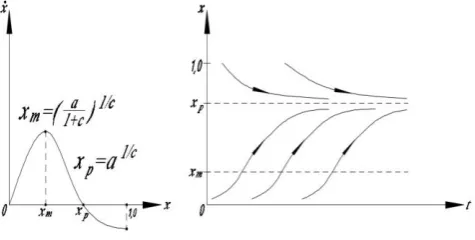
[image:2.595.51.283.478.607.2]The phase portrait and the solution of the model (2) are shown in Fig. 2.
Fig. 2. Phase portrait and integral curves of the equation (2)
The phase portrait suggests that at external forces restricting corruption it does not reach the maximum value of хe=1, but is set at the equilibrium level of х=хe. The
system has two equilibrium states (
x
=0). One is unstable –
х=0, when even appearance of a little corruption (х=0) leads to its steady growth to the value of х=хe. The second
value х=хe is stable, when its decrease х<хe activates
forces (of corrupt officials) increasing corruption, whereas at х <хe
x
> 0. Excess of corruption level “хe” activates
the external forces (environmental resistance) returning “х” to the level of “хe” (whereas
x
< 0).
The integral curves show that any initial state of corruption “х” (0 < x < 1) is further changed in the direction of an asymptotic approaching the equilibrium “хe”. If х > хe, then “х” approaches “хe” from above, if х <
хe, - from below. This upward movement (х < хe) passes
along a logistic (s-shaped) curve, first with an accelerated speed and at reaching its maximum in point
хm=(a/(с1+с))1/c (point of inflection x=f(t)) the speed is
protuberance, which suggests the beginning of the crucial moment in the development, when the dominance passes from the forces accelerating corruption to the forces resisting its spread.
The right part of the equation (2) contains two multipliers defining the evolution speed of this dynamic system. The first multiplier “
x
” shows the attained corruption level, and the higher it is, the more motivated are its acceleration forces. The second multiplier(
C)
a
x
shows the potential of further corruption growth. The lower it is, the more depleted in the growth reserve, which is terminated at C
a
x
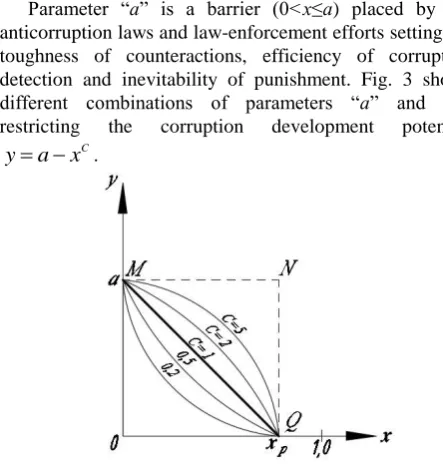
. It happens at a certain combination of parameters “а” and “с” of the model (2), namely, хe=а1/с.Parameter “а” is a barrier (0<х≤а) placed by the anticorruption laws and law-enforcement efforts setting the toughness of counteractions, efficiency of corruption detection and inevitability of punishment. Fig. 3 shows different combinations of parameters “а” and “с”
restricting the corruption development potential
[image:3.595.47.269.226.461.2]C
y
a
x
.Fig. 3. Dependency of the potential of “у” on “х”, “а”, “с”
The corruption growth potential is equal to zero at
хe=а1/с. It is maximum at х=0 and equal to “а”. Within
these ranges it can vary differently, depending on “с”. At small “с” it is quickly reduced once corruption grows. Therefore, “с” can be interpreted as a coefficient of corruption acceptability for the environment, in which it is spread. It is also logical to call is a coefficient of social propensity for corruption. At с =1 the environmental resistance is indifferent to corruption (у=а - х), it is spread like in a biological system and decelerated only by the size of the remaining resource (а - х).
At с >1 the environment is a nutrient for corruption spread, its growth potential is more than defined at the legislative level (see Fig. 3).
At с <1, the equilibrium occurs earlier (хe<a), and at с
>1, vice versa, later, and it is хe >а (see Table I). I.e., the
environment can alter legislative limiters of corruption “а”, which is set at the level of “хe”in the course of evolution
(see Table I).
We can show that in the extreme case of с→∞ the corruption growth potential is described by section MN
(Fig. 3) and is equal to “а”, irrespective of “х”. Corruption is set at the maximum legal level хe=а. The environment
maintains no resistance. Such situation is typical of a tribal
social pattern, in which traditions, customs and the chief’s decisions are used as regulators.
In another extreme case of с→0 the corruption growth potential is described by section ON (Fig.3), which means that corruption is equal to zero (whereas
x
< 0 at any х) irrespective of legal restrictions (а). It can be interpreted as a full dependence of power on the civil society.
TABLEI
VALUES OF EQUILIBRIUM CORRUPTION ХE=А1/С
a\c 0,2 0,5 1,0 2,0 5,0
0,2 0,003 0,04 0,2 0,45 0,72
0,4 0,01 0,16 0,4 0,63 0,83
0,6 0,077 0,36 0,6 0,77 0,903
0,8 0,33 0,64 0,8 0,89 0,96
1,0 1,0 1,0 1,0 1,0 1,0
It is clear from Table I that at any legal restrictions (0<а<1) equilibrium “хe” begins at higher or lower values
of “а”, irrespective of “с” (for example, at а=0,2 depending on “с” the range is equal to 0,003 ≤ хe ≤ 0,72.
At а=1 and с=1 the system behaves like a biological system, and equilibrium is reached at maximum “х” (хe =
1).
It is clear from table 1 that at any legal restrictions (0 <
а < 1) equilibrium “хe” begins at higher or lower values of
“а”, irrespective of “с” (for example, at а=0,2 depending on “с” the range is equal to 0,003 ≤ хe ≤ 0,72.
At а=1 and с=1 the system behaves like a biological system, and equilibrium is reached at maximum “х” (хe=1).
For social systems, which behavior is not only determined by the attained level of corruption and legal restrictions but also by the set of social and cultural norms, the response to corruption will be different from the biological one.
Value “c” certainly characterizes an average
unacceptability of corruption by the society. It is stratified with regard to corruption. There is a layer obtaining a corruption rent, which does not only have any objections to corruption but also welcomes this phenomenon. It compensates insufficient obtaining of social goods (good healthcare, education, housing services, etc.) with an excess in the currency (including foreign) variant.
There is a layer, for example, small and medium business, which feels that the taxes paid are not adequately returned from the budget, and there arises a need to reduce tax liabilities by shadowing a part of its business.
There is also a layer of citizens, for which social goods comprise a considerable part of the overall consumption (financial allowances, pensions, privileges, free healthcare, education, etc.). Corruption implies limitation of basic demands thereto (food, clothes, drugs, housing, etc.).
The growing gap in income creates tension in the society and can cause social unrest and commotion.
Combinations of “а” and “с” are unequal in different societies and, accordingly, the level of corruption set therein will differ. Let us use the obtained model analysis results (fig. 2, 3; table 1) for classification of corruption types. Let us take the simplest “geographical” one.
European corruption id characterized by a low level. It is perceived as an anomaly, and the response of certain members of the society is not perceived as whistle-blowing but as fulfillment of the civic duty. Corruptive transactions are rare and accidental, corruptive networks appear only seldom and are kept secret. European corruption is often called “economic”, whereas it is not supported by the society and defined only by seeking lucre. In this corruption the law is above the power, corruption spread quickly runs into resistance and reduces its growth potential (case с <1 in fig. 3 and in table 1).
For Eastern corruption, also called ‘social”, corruptive relations are customary, acceptable for the majority of population and connected with social relations: family, community, friendly, corporate, ethnical, etc.
In this model the power is above the law, and illegal actions do not provoke rejection by the majority, the growth potential is higher (see с>1, in fig. 2 and table 1). In this model “the law is above all” principle is replaced with “forgiveness to friends, law – to enemies, 50 shades of grey to all the rest”. Others begin to use the developed efficient formula – “everything can be solved if you know to whom, when and how much to give”.
It is understood that the Western and Eastern variants of corruption are just its pure lines suitable for a theoretical analysis. In individual countries, in view of their peculiarities, corruption acts as a mixture of the Western, Eastern and sometimes African and Latin American corruption models mixed in different proportions.
It should be noted that the difference between the set corruption level – “xe” and its prohibitive border – “a”
shows the contribution of the social component in decrease of corruption. At с >1 (xe >a) the more the society supports
corruption, the higher is the difference (xe - a) depending
on value “c”. At c = ∞ it becomes maximum (xe = 1 at c =
∞), in spite of the legal restriction x ≤ a. At c < 1 (x < a) the more the society does not accept corruption, the less is
c (the more is a – xe). At c = 0 its equilibrium value is xe =
0, in spite of the legislative limit x ≤ a.
The offered corruption evolution model (2) is explanatory. It is unsuitable for exercising of the predictive function inherent in theory. For that purpose we must know the values of parameters “а” and “с”, and they have no numerical definiteness not due to the lack of information but due to semantic uncertainty and conceptual blurring of these notions.
If we agree with the metaphoric image of “tough and soft forces” defining the social phenomenon, “a” is tough
forces (in the form of laws, resolutions, orders, official regulations, etc.) and “c” is soft forces (in the form of
social-cultural, moral norms, etc., which is usually called “mentality”).
Soft forces can influence corruption more that tough forces. In the model (2), at the society’s low acceptability of corruption its equilibrium level is set at a lower value than the level set by the tough forces “a”. And, vice versa,
soft forces (с >1) can lead to a higher equilibrium level of corruption than “a” (see table 1).
Soft forces can have an absolute prevalence over tough ones. For example, if the society does not accept corruption completely (с =0), the model (2) will take the following form:
x
r x a
(
1).
And whereas a <1, then(a
1) < 0 and, consequently, at any “х”, its derivative is negative (x
< 0). It has the following conceptual interpretation – any deviation of “
x
” from statex
= 0, activates the forces (in this case mental – с = 0) decreasing “x
” and returning to statex
= 0. It is equilibrium for system хe = 0.And analogously, if the mentality absolutely accepts corruption (с = ∞), then:
x
r x a
0.
It means that appeared corruptionx
> 0 begins to grow exponentially to the legally permitted level хe = a, and then stops (inaccordance with the model (2) х∈ (0,а), а∈[0,1]).
Let us try to use the model (2) to evaluate the society’s propensity for corruption (c) and corruption spread in different countries based on the actual data. These actual data are presented by the “Corruption Perception Index (CPI)” annually set by Transparency International independent organization, which characterizes corruption in the public sector. It does not separate the tough and soft forces but evaluates their cumulative effect.
The Index is a complex structure reflecting opinion polls covering different lines of corruption, statistic data (if any), opinions of experts, which aggregate them in a consolidated point index (CPI). It is subjective and similar to the points given by judges in figure skating, diving, etc. The cumulative expert opinion forms the CPI.
Due to the latency of corruption plus immeasurability of most social and psychological notions (in the physical, chemical and biological sense), parameters “а” and “с” included in the model (2) are immeasurable. However, their connection with corruption is manifested in the form of tendencies, and only extreme cases (с = 0, с = ∞, а = 1) precisely define their connection with equilibrium values of corruption хe.
Let us connect the equilibrium (preset) corruption level in different countries “хe” with the set Corruption
Perception Index. The index varies from 0 to 100, and the minimum corruption level corresponds to the value of CPI=100. I.e., the connection of “хe” and the CPI is
reverse, they vary in the opposite directions.
Besides, let us assume that corruption load on the budget can hardly exceed 50% (хe ≤ 0,5), whereas the
power immanently needs to maintain security agencies, state apparatus, power infrastructural facilities, etc. Therefore, let us assume that the connection of “хe” and the
CPI is linear and described by the following dependency CPI=(0,5
хe)·200 (хe ∈ [0;0,5]; CPI∈ [100;0]). Let usdivide the entire range of the CPI variation into five intervals with the pitch of 20 points, and, accordingly, assign five intervals of variation of “хe” to each CPI
interval.
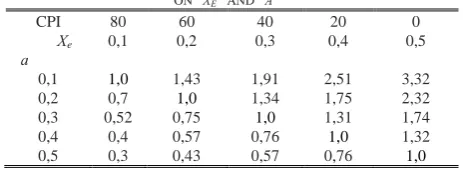
Based on the assumptions, let us calculate the soft (metal) force, i.e. parameter “с” (
ln
ln
ea
c
x
), by whichWestern corruption differs from Eastern corruption. Calculation results are presented in Table II.
group – CPI ∈ (40;20], 5-th group – CPI ∈(20;0] – counties with maximum corruption.
TABLE II
VALUE OF THE SOCIETY’S PROPENSITY FOR CORRUPTION “С” DEPENDING
ON “ХE” AND “А”
CPI 80 60 40 20 0 Хe
а
0,1 0,2 0,3 0,4 0,5 0,1 1,0 1,43 1,91 2,51 3,32 0,2 0,7 1,0 1,34 1,75 2,32 0,3 0,52 0,75 1,0 1,31 1,74 0,4 0,4 0,57 0,76 1,0 1,32 0,5 0,3 0,43 0,57 0,76 1,0 Based on the assumption, these groups correspond to the values of the groups of equilibrium corruption “хe”
included in the model (2): 1-st group – хe ∈ [0;0,1], 2-nd
group – хe ∈ (0,1;0,2], 3-rd group – хe ∈ (0,2;0,3], 4-th
group – хe∈ (0,3;0,4], 5-th group – хe∈(0,4;0,5].
It should be noted that the main diagonal divides Western and Eastern corruption. Squares with a low propensity for corruption (с<1,0) are below, squares with a high propensity for corruption (с>1) are above. The squares of the main diagonal characterize the behavior of the society as a biological formation. Corruption development thereon corresponds to the remaining reserve of the funds unspent by corruption (а - х). These are countries with European corruption model.
In 2016 the first group of the CPI included 12 out of 167 countries: Denmark (CPI=92), New Zealand (91), Finland (89), Sweden (87), Norway (86), Switzerland (86), Singapore (84), Netherlands (83), Luxemburg (82), Canada (81). Their propensity for corruption, depending on the strictness of legal restrictions (0,1<а ≤0,5), is within the range of 1,0 - 0,3 (first column of Table II).
We can assume that the threshold of а=0,1 most likely fits in with Singapore known for its strictness and efficiency of anticorruption efforts The threshold of the remaining countries lacking excessive strictness of anticorruption legislation is likely а>0,1. It is difficult to say more precisely, for that purpose we need the legislators’ expert estimate of the level of “а” for a specific country. The general consideration coming out of the first column of Table II is: the weaker the legal restrictions (the higher is “а”), the less must be the propensity for corruption – “с” to keep corruption at a low level (0<хe≤0,1).
The second group (хe∈(0,1:0,2] corresponding to CPI ∈ (80,60]) consists of 26 countries with the most diversified geography. Here are some of them in the ascending order of corruption: Australia (CPI=80), Germany (79), UK (78), USA and Hong Kong (74 each), Uruguay and Chili (73 each), France and Estonia (69 each), Taiwan and Poland (61 each). This group, according to table 2 (second column), can include countries not only with economic but also with social corruption. Depending on the composition of “хe” and “а”, variation of “с” is
within the range of [0,43;1,43]. For example, at tough legal restrictions (а = 0,1) at хe = 0,2 there is social (Eastern)
corruption (с = 1,43).
The third group of 42 countries (хe∈ (0,2:0,3), CPI ∈
(40;60)) includes the following countries in the ascending order of corruption: Israel and Spain (CPI= 60 each),
South Korea, Latvia and Slovakia (55 each), Brazil, Bulgaria and Italy (43 each), Serbia (41), etc. According to table 22 (third column), Western and Eastern corruption are represented here in almost equal ratios. In the third column (хe=0,3) two squares and located above and two
squares – below the main diagonal dividing economic (Western) and social (Eastern) corruption.
The fourth group is the most numerous. It consists of 80 countries (хe ∈ (0,3;0,4) and CPI ∈ (20,40)) and
exceeds the sum total of all the first three groups by its number (78 countries). The corruption level is high in these countries: corruption “eats” here up to 40% of funds out of the available 50%. It includes the following countries in the ascending order of corruption: Tunisia, El Salvador, Mongolia, India, China, Mexico, Ethiopia, Belorussia, Gambia, Russia, Uganda, Ukraine, Kenya, Tajikistan, Zimbabwe. In this group the share of social corruption is even higher: three squares above the main diagonal versus one square below.
The fifth group includes 17 countries (хe ∈ (0,4:0,5),
CPI ∈ (20;0)) with the highest corruption level. Some of them are: Burundi and Syria (20 each), Libya and Uzbekistan (18 each), Sudan (12), North Korea and Somalia (8 each). There is only social corruption in this group (in all of the countries с ≥ 1,0).
As for the countries closing the group, it is logical to assume the following. In Somalia with a weak national identity there is likely an African variant of corruption. We believe that in North Korea with its strong state authority the social structure is close to the tribal one. People close to the chief make corruption and other crimes using political and judicial immunity by virtue of their statusness. The fifth group is characterized by “the power is above the law” and “a man for the state but not the state for the man” principle.
V. CONCLUSION
1. The paper offers a mathematical model of corruption evolution in the resisting environment. On a formal level it is a modification of Verhulst’s logistical control offered to describe growth of the population (and any biological community) in the conditions of restricted resources and competition therefor. The model offered in the paper differs from the known one in that it contains a notion of external forces maintaining an active resistance of the environment, where corruption is spread.
2. As it is shown in the paper, the external forces can be divided into two groups: a) tough or brute forces (parameter “a” of the model) reflecting stable
anticorruption activities of the state in the form of laws classifying corruption as a crime, supervisory authorities, judicial system, etc.; b) soft or mental forces (parameter “c” of the model) defining the measure of acceptability of
corruption for the society.
3. At the set parameters (“a” and “c”) corruption
evolves as a dynamic system and has two equilibrium states.
[image:5.595.51.283.110.195.2]This equilibrium state (set corruption level хe) is already
stable. Here, the equality of the forces motivating corruption and the forces resisting to its development is reached.
4. In the absence of soft forces (с=1), interpreted as the society’s indifferent behavior with regard to corruption, as a behavior of the biological community only responding to the remaining reserve of the nutrient medium, stable equilibrium corruption in the society хe is set at the level of
хe=а, i.e. defined by the set of public anticorruption efforts.
5. In the presence of soft (mental) forces characterizing either the society’s negative (с <1) attitude to corruption, or accepting (с >1) corruption, there are also two equilibrium states of the dynamic system (ẋ=0): хe=0 –
unstable and хe ∈(0;1) – stable. In case of the society’s low
propensity for corruption (с <1) stable equilibrium is less than the prohibitive level (хe < а). In case of the society’s
high propensity for corruption (с >1) stable equilibrium is reached at хe > а.
6. It is shown that the extreme case of the society’s unacceptability of corruption (с→0) is characterized by the stable equilibrium’s tending to zero (хe→0), in spite of the
nonzero public barrier for corruption х=а. It can be interpreted as establishment of a civil society (in the absolute variant), which fully controls the power and excludes corruption.
Another extreme case (с→∞) is reflected in the fact that equilibrium corruption (хe→1) reaches its maximum
value, when it passes threshold “а” set by the state. It can imply that state restrictions have a fake nature, and the social mentality admits any government actions. This is a variant of a tribal social arrangement.
Thus, soft mental forces “с” can have a bigger influence on the corruption level (towards any part) than tough government forces “а”. In the society indifferent to corruption (с =1), which behaves like a biological system, corruption is set at the level offered by the state (хe =а).
7. The model offered in the paper gives a quantitative characteristics of the “geographical” classification of corruption – “Western” and “Eastern”. In the “Western” variant characterized by the society’s low propensity for corruption (с <1) a level of corruption below the prohibitive one is set in due course (хe<а), while in the
“Eastern” variant with a high propensity for corruption (с
>1) the equilibrium level is higher than the one defined by the state law-enforcement system (хe >а). The model is
explanatory, it is not qualified for exercising of the predictive function due to the quantitative ambiguity of parameters “а” and “с”. It is connected with conceptual ambiguity of terms – prohibitive level of corruption or tough force regulating corruption (а); mental, soft force (с) influencing corruption.
8. The authors have analyzed divisions of the countries by the geographical corruption classification based on the “Corruption Perception Index (CPI)” of 2016. For that purpose, they made certain assumptions concerning the connection between the CPI and equilibrium corruption “хe” in the countries with the CPI. This compliance (of the
CPI and “хe”) is ambiguous, whereas the model contains
two parameters “tough” force – “а” and “soft” force – “с”), and the CPI gives an overall expert estimate of corruption. In the presence of legislators’ expert estimates of “tough” forces “а” it would be possible to calculate
“precisely” the “soft” force – the society’s propensity for corruption “с”. Until then, we have made only rough estimates of “с” (see table 2).
All the countries are divided into 5 interval groups by the corruption perception index and corresponding “хe”. The first
group with the minimum corruption level predictably included countries, which, according to the experts, represent “Western (economic) corruption”. The fifth group included countries with the maximum corruption level, and they refer to countries with “Eastern (social) corruption” and, from our point of view, with a large mixture of its marginal variants – “African” and “Latin American”. The fourth group of countries is most numerous, it consists of a half of the studied countries. These are countries with prevailing “Eastern (social) corruption”, with corruption in a nasty form (20<CPI<40), which confirms the expert opinion on the epidemics of this “disease” in the global society. Almost 60% of all the studied countries have a nasty form (4th group) and the thermal stage (5th group) of the disease.
9. The overall qualitative wording of the obtained results is as follows. Corruptive phenomena pass spontaneously, under the influence of the eternal and ineradicable human sins (greediness, disrespect of the property of the major part of the society, etc.). When its scales become significant and sensitive for the society, it protects itself from corruption with the help of law-enforcement measures (tough force) and moral non-admission (soft force).
The political will is not characterized by declarations on intensions but by active establishment of efficient institutes to fight against corruption. The equilibrium state of corruption in the society any time depends on the historically formed ratios between the potentials of the blocks of socioeconomic relations in “power for people” and “people for power” forms. The more eminent is the second block, the higher is corruption.
REFERENCES
[1] S. Rose-Ackerman, "The Economics of Corruption," Journal of Public Economics, vol. 4, 1975, pp.187-203.
[2] S. Rose-Ackerman, "Economics and Development," Annual Bank
Conference of Development Economics, The World Bank,
Washington, D.C., 1997.
[3] G. Becker, "Crime and Punishment: An Economics Approach," Journal of Political Economy, no. 76, 1968.
[4] J. Nye, "Corruption and Political Development: A Cost-Benefit Analysis," American Political Science Review, no. 61, 1967, pp. 417-727.
[5] P. Deleon, "Corruption in Contemporary American Politics," Paper presented at the Seventh International Anticorruption Conference, Beijing, 6-10 October 1995.
[6] J. Coleman, "The Criminal Elite: Sociology of White Collar," NY: St. Martin`s Press, 1985, pp. 46-54.
[7] N. Left, "Economics Development through Bureaucratic," American Behavioral Science, no. 8, 1964.
[8] S. Hantington, "Political Order in Changing Societies," New Haven: Yale University Press, 1968.
[9] T. Malthus, "An Essay on the Principle of Population as it Affects the Future Improvement of Society," 1798.
[10] P. Verhulst, (1838): Notice sur la loi que la population poursuit dans son accroissement. Correspondance mathematique et physique 10:113-121.