Abstract—Career choice is an important aspect in a student’s life. The choice that a student makes would affect the life of that student as people get shaped by their careers. It is an important issue and should be undertaken with care. Students should have the tool that could help them in making the right choices of their careers. Students have usually been guided by those who are already in their careers and they get motivated by the success they see in those people. In many situations these students choose the careers that these other people are in, which may not suit the students. For this reason, there has been the need for another way that students could be guided in choosing their careers. This need is due to the fact that students should choose their careers based on their capabilities. There should be able a better way to assess the capabilities of these students. This research focuses on the development and use of web applications to give assist students in their career choices. We then present research findings on the experience of users on the usability of the web application.
Index Terms— Career choice; web applications; knowledge support; usability
I. INTRODUCTION
AREER planning and development is an important process in an individual’s life that should start early. People should not wait until it’s too late when they then find themselves venturing into a wrong career that does not suit them. Most people start thinking about their career at the last stage of their high school level or in some cases when they are already in colleges [6]. This is why most college students end up in careers that they do not understand. This is evident from the way some early level students in colleges are not competent in their careers, let alone being interested in such careers [25].
A career should be compatible with the individual’s undertaking if one has to be successful in one’s field of study. This can only be possible by being vast with what the course one is doing is all about early in time. It’s one thing to venture into a promising career with good remuneration levels in job market but yet another thing to venture into a career of interest where growth comes naturally [8]. For instance, students could get their way into a medical class in
Manuscript received July 6, 2013; revised August 16, 2013. This work is a product of S. K. Mtsweni’s Bachelor of Technology degree’s study. S. K. Mtsweni acknowledges the support of J. O. Dehinbo and S.O. Ogunleye.
S. K. Mtsweni and J. O. Dehinbo are with the Department of Web and Multimedia Computing in the Faculty of Information, Communication and Technology, at the Tshwane University of Technology, South Africa. (phone: +27-82 766-6468; e-mail: [email protected] and phone +27-82-259-4883; [email protected] or [email protected] respectively).
college because doctors are well respected and well paid in the job market. However, the effectiveness in service delivery by such an individual and their growth rate in career falls back on whether or not they are interested in that area of study [15].
It has been argued that career choices should be inculcated into students while they are still kids. This could make them develop in the subjects that would help them in their development in the future.
Career planning and development is an important process in an individual’s life that should start early [26] to avoid venturing into a wrong career that does not suit one [37]. Career planning and choosing has not been undertaken with care for many students. The human process where students base their career choices on those who are already in the field is not that effective [37]. Career motivational talks often make students choose their careers on other people’s strengths with no proper assessment of skills and expertise of the students [25].
The rampant problem that is common now is to find students leaving their careers later in their lives. Career dissatisfaction is an issue that needs to be looked into. One common problem is that students make careers which they do not like but because they want to be compared with those who have been successful in this field. This problem of wrong career moves is the motivating factor for this research.
The main purpose of the research is to examine how web applications can be implemented to assist high school students in choosing the right career. The involves establishing why most college students land in the wrong careers and providing solutions to this problem for the high school students before they make the wrong decisions regarding their career.
This study will be guided by the following objectives:
To explore the methods that are used to guide students in choosing careers
To investigate the role of web technology in career choice making
To develop and implement a web-based application for career choosing process
To investigate the usability of the developed web-based application for career choice making.
Towards enabling the actualization of the objectives, a review of related literature is presented next. It highlights various methods and tools as used in previous studies for making career choice. This is aimed at indicating the uniqueness of this study.
Development and Usability of a Web
Application for Career Choice for High School
Students
Steven K. Mtsweni and Johnson O. Dehinbo
II. LITERATURE REVIEW
Many studies have been put forward on web applications and their various applications in today’s society. The flexibility and convenience that comes along with web based applications have made them extremely popular in today’s educational systems [37]. According to Grove [17], services and information should be made available with web based applications. In essence, the application of web based systems to aid students’ career choice is introducing a classroom platform in a form that students would enjoy. Miller [22] also highlights the advantages and disadvantages of web based application and their impact on young students. Placing services for web based career choices online would provide an opportunity even for those who are bent towards the obvious courses to view other careers. In addition, students who fear public ridicule can have private sessions to research preferred courses and make independent choices.
A. Students and Wrong Career
School leavers miss out colleges due to confusion about the career path to take, mostly because of poor planning. Part of the problem that is making students land in a wrong career is that students are not finding enough information about courses before they go onto them. For example, they may end up in a course, not having an idea that mathematics is involved, yet they do not want mathematics [2]. Other students may want to go to a specific college because of social life experienced in that college. Others choose a course that is done by their friends or relatives who they think are enjoying that career. Others would choose a college because it is near their home or because it is far from home thereby offering them freedom from close relatives.
Students need to know their talents when young, in order to know what their heart wants to be in future and thus land in an exciting career of their choice [31]. Every career requires a combination of several requirements that students may not be aware of, such as personal characteristics and personal abilities which should be fully assessed before students can see themselves fit for that career. This is because everybody is unique in his/her own ways.
Some students have interest in studying prestigious courses such as Medicine, Engineering, Law, and Pharmacy without a single thought of the necessary subject combinations or the necessary personality types. Most students choose a career field based on handful of options that are familiar to them [24]. When these students are asked why they choose a certain career, the answers that most of them give sound something like: “I choose accounting because my father is an accountant, and it seems pretty neat.” Or, “Everyone is getting into Information technology these days. That’s the way to go.” [24].
B. Methods Used to Guide Students in Choosing Careers
Young people need assistance in exploring career possibilities and making important career decisions. The world of work being more complex today than ever before, due to high technology that is changing rapidly, these young people need far more guidance and information than in past generations. There are guide materials to guide parents and teachers in helping students choose a career. The guides
provide teachers or counselors with practical manuals that have exercises, activities, theoretical frameworks and the expected results, to provide a step by step process of career guidance [36]. Conferences are used too to help students discuss with their school mates and with different schools on what it takes for one to land in a specific career. Forums are vital methods where peers meet and discuss their careers but the effectiveness of the use of such forums is yet to be proven.
Very common is the use of people who are experienced in the right career paths to guide students to make the right career choices. The effectiveness in career choice and development requires people to have concrete information on the career they are about to venture into. Information is basic in helping the individuals ensure they do not make mistakes in career choice. Some companies invite young school graduates to an internship and job opportunities where they are trained by experienced trainers in order to search for available opportunities of their interest. There is so much need for high school students to be guided by people who have experience in the job market on career choice [11]. Information for instance covering the people from their school who ventured into a certain career and how far they have gone in their career could be a good source of motivation. There are so many ways through which such information can be availed to high schools.
C. Technologies Used to Guide Students in Choosing
Careers
Web applications have been popular with their use in various issues and to solve many problems. A web application is an application that is developed and can be accessed on the internet from any location [5]. Web applications have been suggested for use to help students learn. There are various learning paradigms that students can adopt from the use of web applications [11]. This gap should be delved into to provide high school students with enough information on the different areas of studies that exist in the higher institutions of learning, else they could in most times target only the most common courses like engineering, law and medicine. Those who fail to make it to these courses would likely settle for education or nursing [11]. However, in the real sense, there are so many courses at the disposal of students. Courses like strategic management, project planning and management and most importantly Information Technology are constantly ignored, yet they are so relevant to the contemporary society [19].
There are several career development systems that are being used by companies to know core competencies and developable skills for their employees. These systems also have training programs, assessment tools, appraisal systems, job development plans, and communications tools as elements in the system. Also, on the Internet, there are several electronic books that help in career development. And in libraries are hard copy career resources that are readily available for choosing career. The system should also have a database containing occupational information including skills, abilities, work activities, and interests’ information on every occupation.
allows people to browse occupations by career cluster, industry, skills, tools, technology needed and level of education required. A lot of research has been done about the use of technology in undertaking long-distance education. The same research can be extended to the use of technology in choosing careers for young kids. Given the move towards an information society and the improvement of technology underway, a website can be a good platform to make career talks and motivations available for high schools students. This is considered important because so many students can get access to the information simultaneously and from anywhere eliminating geographical barriers to access of information [11].
D. Web-based Frameworks for Career Choosing Process
Shaheen [33] developed a framework that was to establish high standards for career development and to serve as a guide for making local decisions about curriculum development, delivery and assessment. The framework has grouped career skills into three areas: core educational learning, individual/social learning, and career learning. This framework is developed to help integrate career development in teaching and not for students who want to interact with the system in determining their careers.
Australian Blueprint for Career Development is a framework that was developed to design, implement and evaluate career development programs for young people and adults [21]. It identifies skills, attitudes, and knowledge that people require to make sound choices and manage their careers. It has eleven career management competencies which are grouped into three areas such as personal management, learning and work exploration competencies, and core building competencies. The framework is designed to help teachers, parents, career development practitioners, employment service providers, and employers who support people’s careers and not designed for students specifically.
III. RESEARCH METHODOLOGY
The basic methodology of the research is participatory design. This is the research and development method which allows developers to investigate system requirements and improve system usability by the means of direct end user’s participation in the project [35, 20, 13]. The participatory design process encourages co-research, co-design and, in some cases, co-development of the product. The walkthrough methodology was used for evaluating the application for effectiveness and efficiency. This methodology is an effective “usability evaluation approach that predicts how easy it would be for people to learn to do particular tasks on a computer-based system” [4]. As the developed software is to be used by the high school students to guide them through their career perspectives, usability is the key quality of the system.
The participatory design process consists of the following three stages [35].
1. Initial exploration of work: During this stage, the information about the target users is gathered by the designers, and the representative group of the prospective users is invited to participate in the
design process. The users explore the technologies used in the development process and learn to use these properly under the guidance of the developers. The key tasks for the users to perform on the developed software are also defined by the developers during this stage according to the cognitive walkthrough methodology [4].
2. Discovery process: This stage requires the maximal intensive interactions between users and developers. The user requirements for the system, as well as the approaches to collaboration are formulated during this period. The virtual team working techniques are implemented.
3. Prototyping: During this stage the software prototype is built. This is the most crucial stage for the project. The software prototype is the working web application which is used to clarify the user’s requirements and perfect the software usability and ergonomics.
Prototyping could be conducted using two main methodologies [16], namely the throw-away methodology and evolutionary methodology. The throw-away prototyping concerns building the functionally limited software model which incorporates only poor understood functions and requirements. During the co-work of the designers and users on the prototype, these functions and requirements are thoroughly studied, and the software specification is updated. Then the software model is rejected (“thrown away”), and the fully functional software is built using the experience obtained. The evolutionary prototype, on the contrary, incorporates only well-known functions and requirements. The evolutionary prototype is very close to the end product by its functionality. During the participatory design process, the desired improvements and clarifications are implemented into the model, and the prototype is then used as an end product version.
As a goal of the project is to develop a web application for career guidance, the evolutionary prototyping methodology was used. The application’s working principle is close to the LinkedIn and other professional social networks. It facilitates the collaboration between developer and end users of the site.
IV. OVERVIEW OF THE DEVELOPED APPLICATION The demo application has been deployed on Heroku server and can be accessed with the following address
http://cryptic-mountain-3309.herokuapp.com.
The landing page briefs you about the web application and the need to register on the website. It also has a menu which has more information about careers. The menu also has links for sign-in or sign-up.
-Signup page consist of basic user information that is required for the user to sign in. As a user you will need to sing up before you can login/ sign in.
-The user can update personal details captured when registering on the application for first time. Users can also complete high school information. This is not compulsory but this kind of information is important as it helps other users to see how other people are progressing in their careers.
-Users can also complete employment information; this information will be used by other users to draw reports. For example, to see which career has many people and which tertiary institution has many students on specific career fields.
-Users can configure the comments and articles that he/she is interested in. Only the comments and articles of the selected career fields will be shown on the profile of the user. This configuration can be changed anytime.
-Users can post a comment and link the comment to a specific career field. The comments will be seen only by the users who subscribed to the career field that the comment is linked to.
[image:4.595.308.516.61.139.2]-Users can see all the comments that are posted by other users on his/her dashboard. Only the comments that are linked to the career fields that the user is subscribed to, will be shown. This prevents users from seeing information or comments of the career fields that they are not interested in.
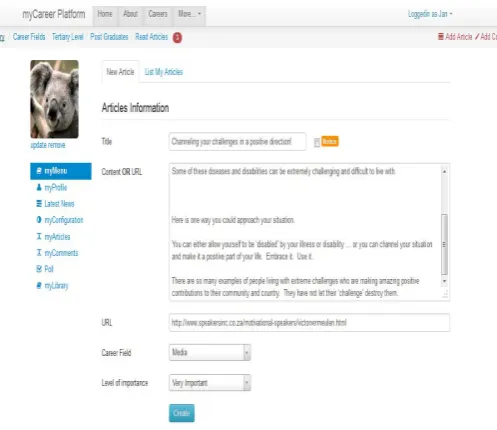
Fig. 1. User posting articles
-Users can post articles can post articles to all career fields on the system. Articles will be seen only by the users who are subscribed to that career field that the article is linked to. The users can also put a URL for the external sources of the link to the article. In figure 2, “My Articles” lists all the articles that are posted by user.
-Users can view the details of the article. User can click on the URL link in case the article is linked to any external web pages, and it will direct him/her to the external source.
[image:4.595.306.554.190.359.2]-Users can browse and search subscribed users (figure 3). Results can be filtered by career field, school, work place or province. Users can send private messages to users in case they have questions about that user’s career. Personal information like emails and cellphone numbers are not available for public.
Fig. 2. List of articles posted by users
Fig. 3. User searching articles
V. RESULTS ON PROTOTYPE EXPLORATIONS
A. General Summaries
This section presents research findings on the experience of users on the web based application for career choice for high school students. Since the application is solely intended for aiding high school students in their career choice, all the participants had a direct connection to high school students and careers. In order to obtain conclusive results, the participants were split into two broad categories based on their gender. These two categories were further split into four categories as follows: Students, teachers and tutors, parents, and potential employers as shown in figure 4 below. A total of 48 respondents were involved: 31 male and 17 female. This is aimed at specifically getting career views based on gender perspectives [10].
[image:4.595.47.296.341.556.2] [image:4.595.305.545.613.757.2]
The data analysis was done through accessing the developed application, and the response rate was around 90% in terms of participation. However, the respondents were further tested in the following areas: Prototype, participatory design, and walkthroughs.
The responses were carefully analyzed afterwards, cleaned and tabulated into relevant information. The user experience allowed the participants to suggest changes they felt could improve on the application’s design [1].
B. Findings of Participatory Design
Participatory design also referred to as cooperative design is used to get submissions from participants about their ideas on how to best aid high school students to get acquainted with their career path [18].
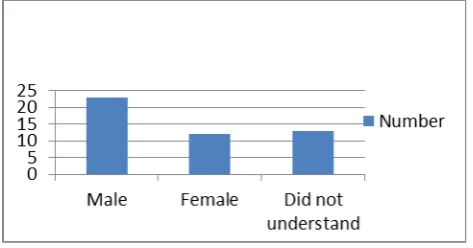
[image:5.595.46.283.318.442.2]As shown in figure 5 below, out of the total number of respondents, 35 considered it a good idea and were willing to contribute ideas that would help build the web application. The other 13 either did not understand how it worked completely, or did not buy the concept. Of the 35 respondents who considered it a good idea, 12 were female, and the remaining 23 were male.
Fig. 5. Support for the developed application
C. Findings on Interacting with the Prototype
A prototype was designed and then sent to the respondents for evaluation [7]. This design was meant to test how best the user experience can be used to improve the final system [23]. Each group had their own way of responding when using the web based application. Students were expected to rate the new proposal against the current system where the curriculum determined how their careers shaped up [34]. Students thought the current system served them well and provided a viable path to land a solid career after graduation. This was also supported by professionals who agreed with the current system. However, there were other students who saw the need to effect some changes. Some of the professionals strongly believed that the web application would solve the current deadlock in career choice among high school students.
From the results, it is safe to conclude that majority of the students strongly agreed with the system operations. In addition, the higher majority are willing to try something new to change the current situation. It is also evident that the female gender is more comfortable with change and would greatly benefit if the system is implemented.
Other than students, the prototype also targeted information from prospective employers who were more than willing to share their experience. They were expected to update information about their career choice that would help mentor and encourage high school students’ focus on
their potential [14]. A total of 12 employers participated: 8 and 4 male and female respectively. They also agreed to the application’s capacity to make notable changes in choosing career for students. Majority alluded to the fact that since technology use is rampant to the current generation, a web application would capture the attention of many high school students thus creating change. However, minority thought it will not make much of a difference as it is the education system that determines the career path that students take up.
D. Walkthrough Findings
The purpose of conducting the walkthrough was to gain and manage the users’ expectation [17]. The walkthrough process was specifically designed for parents and teachers. The respondents were not entirely required to enroll as parents since they can register as prospective employers in their respective fields. They were however, required to evaluate the various parameters and ascertain that they conform to required standards [12]. Basically, from their views after interacting with the system, it would be possible to set specific objectives for the application targeting high school students [14].
About 4 teachers participated, each carefully selected to cover the entire high school levels and to ensure the results were as accurate as possible. Unlike students, the rate of response was 100% positive. Teachers agreed that students pay more attention to technology and the application would help shape career minded students. Some of the teachers saw it more of a social network and thought it will take up students’ time. However, they agreed that it is a good concept and should be given a different approach that could fit in the curriculum and strongly agreed to the capacity of the system to impact positive change. They especially gave a nod to the platform of students interacting with people who have excelled in their careers. This was a plus as students would be able to learn outside class. This fact was strongly contradicted with the minority female teachers who thought the application would waste time.
Parents also mentioned that their children spend a lot of time online and this application will be extending their classroom to the students. This way, at a tender age they could get to know what it takes to build their career.
It is therefore correct to conclude that the system would be a success and is supported by a majority of the stakeholders. Allowing the students to learn about career at an early stage and in a professional way will have many benefits [27]. It will allow the students get a first-hand experience from those who are ahead of them, and at the same time give them an opportunity to explore their career path in practice [10].
VI. CONCLUSION
This study highlighted the need, development and usability of a web based career choice application for high school students. However, for this application to be fully functional it is crucial for all stakeholders to participate in it. For example, students who are the main users of this system need to raise their concerns and highlight their preferences well and clear enough [32]. Teachers, parents, and potential employers could give guidance in form of their inputs.
maintenance and upgrades [3]. Advancement in technology allows developers to skillfully hide the complexity of applications from users thereby presenting a user friendly application. In this case, scalability is not just reduced to an increase in the number of users who access and use the system at a given time [28]. When it comes to web applications there is an endless list of users each with new requirements. User and system interaction mechanisms also call for the ability of the system and its administrators to handle a sudden influx of connections and requests.
VII. RECOMMENDATIONS
Higher education institutions and the employment market are currently experiencing a lot of changes that should be inculcated to students at the earliest level [26]. These include increased demands in the job market, increased scrutiny of students to ensure they have what it takes to take up a given course, and increased pressure on students to achieve the very best. Such scenarios present opportunities to include innovation and positive change to students at an early level and aid in landing a career that they will most likely excel in [9]. Incorporating a web application for career choice in high school education would be a big step to ease the student’s burden in career choice.
VIII. FUTURE WORKS
Further studies can be based on understanding how the various components of this system can be harnessed further to improve the user experience, error detection, and back up recovery in case of failure. This should culminate into an adaptive high school application from the already usable and implemented system [27].
On flexibility and scalability, future research could be inclined on devising an architectural model capable of stretching to its limit without affecting the general performance. Concurrency in the system can also be further researched on in relation to horizontal scalability and availability to its users [28]. In the process of evaluating the application it was also established that most users prefer mobile access to the application. The web servers to be installed must be in full view of possible expansion and should be able to handle a quick uninterrupted upgrade.
REFERENCES
[1] A. Aggarwal.. Web-Based Learning and Teaching Technologies: Opportunities and Challenges: IGI Global, 2000.
[2] A.M.Aleman and L.K. Wartman, Online socila networking on campus: Understanding what matters in student culture, Taylor & Francis, New York, 2009.
[3] G. Alonso. Web Services: Concepts, Architectures and Applications: Springer, 2004.
[4] M.H. Blackmon, Cognitive Walkthrough. In W. S. Bainbridge (Ed.), Encyclopedia of Human-Computer Interaction, vol. 1, pp. 104–107. Great Barrington, MA: Berkshire Pub. 2004.
[5] P.G. Bocij, Business Information Systems: Technology, Development and Management, 4th edn, FT Prentice Hall, Harlow England, 2008. [6] S. D. Brown and R.W. Lent (Eds.). Career development and
counseling: Putting theory and research to work. Wiley, 2004. [7] R. Chiang, K. Siau, and B.C. Hardgrave, Systems Analysis and
Design: Techniques, Methodologies, Approaches, and Architectures: M.E. Sharpe, 2009.
[8] C. M. Chiu and E.T. Wang, “Understanding Web-based learning continuance intention: The role of subjective task value”. Information & Management, vol. 45, no.3, pp.194-201, 2008.
[9] N.L. Davis, “Factors Influencing Career Choice among Students Enrolled in a Four-year Tourism Administration Program: Southern Illinois University at Carbondale”, 2009.
[10] G.V. Davidson-Shivers and K.L. Rasmussen, “Web-based learning: design, implementation, and evaluation”, Pearson/Merrill/Prentice Hall, 2006.
[11] R.C. Discenza, “The Design and management of effective distance learning programs”, Idea Group Pub, Hershey, 2002.
[12] G.T. Eliason and J. Patrick, “Career Development in the Schools” (He: Information Age Pub Incorporated, 2008.
[13] R.D. Ellis and S.H. Kurniawan, “Increasing the usability of online information for older users: A case study in participatory design. International Journal of Human-Computer Interaction, vol. 12, no.2), pp. 263-276, 2000.
[14] S. Fowler and V. Stanwick, “Web Application Design Handbook: Best Practices for Web-Based Software”, Elsevier Science, 2004. [15] I. Gati and N. Saka. “Internet-based versus paper-and-pencil
assessment: Measuring career decision-making difficulties”. Journal of Career Assessment, vol. 9, no.4, pp. 397-416, 2001.
[16] V.S. Gordon and J.M. Bieman, “Rapid prototyping: lessons learned”, Software, IEEE, vol.12, no.1 pp. 85-95, 1995.
[17] R. Grove, “Web Based Application Development”, Jones & Bartlett Learning, 2009.
[18] P. Gupta, “System Analysis and Design”, Laxmi Publications Pvt Limited, 2009.
[19] S. Jablonski, I. Petrov, C. Meiler, and U. Mayer, “Guide to Web Application and Platform Architectures”, Springer, 2004.
[20] F. Kensing and J. Blomberg, “Participatory design: Issues and concerns”, Computer Supported Cooperative Work (CSCW), vol. 7, no.3-4, pp. 167-185, 1998.
[21] MCEECDYA, “The Australian Blueprint for career Development”, Miles Morgan, Australia, 2010.
[22] M. Miller, “Cloud Computing: Web-Based Applications That Change the Way You Work and Collaborate Online”, Pearson Educ. 2008. [23] B. Newman and P. Newman, “Development Through Life: A
Psychosocial Approach”, Wadsworth/Cengage Learning, 2008. [24] L.W. Oliver and S.C. Whiston.”Internet career assessment for the new
millennium”. Journal of Career Assessment, vol. 8, no.4, pp.361-369, 2000.
[25] L.W. Oliver and J.S. Zack, “Career assessment on the Internet: An exploratory study”. Journal of Career Assessment, vol. 7, no.4, pp., 323-356, 1999.
[26] B.W. Packard, “Web-based mentoring: Challenging traditional models to increase women's access”. Mentoring and Tutoring, vol. 11, no.1, pp. 53-65, 2003.
[27] W. Patton and M. McMahon, “Career Development And Systems Theory”, Sense Publishers, 2006.
[28] M.A. Radaideh and H. Al-Ameed, “Architecture of Reliable Web Applications Software”, Idea Group Pub, 2007.
[29] N.K. Robinson, D. Meyer, J.P. Prince, C. McLean, and R. Low, “Mining the Internet for career information: a model approach for college students”, Journal of Career Assessment, vol. 8, no.1, pp.37-54, 2000.
[30] J.P. Sampson, “Integrating Internet‐Based Distance Guidance With Services Provided in Career Centers”, The Career Development Quarterly, vol. 47, no.3, pp. 243-254, 2000.
[31] Sate University, “Software development job description, career as a network administrator, salary, employment”, Infoworld, vol 63, no. 2, p. 73, 2011.
[32] T.A. Saunders. “Career Choice: The Voices of Music Students”, African Minds, 2008.
[33] J. Shaheen, “K-12 Career Development Curriculum Framework”, New Hampshire, 2006.
[34] B. Shertzer, “Career planning: freedom to choose”, Houghton Mifflin, 1985.
[35] C. Spinuzzi, “The methodology of participatory design”, Technical Communication, vol. 52, no.2, pp. 163-174, 2005.
[36] G. Tsiapis, “Report on Effective Career Guidance,” EPINOIA S.A., South Africa, 2008.