JOURNAL OF FOREST SCIENCE, "&, 2002 (4): 141149
The stability and permanence of primeval forest eco-systems in a tree layer, expressed by a definite stand vol-ume, are the result of three natural, separate, and partially antagonistic processes: natural loss, recruitment and in-crement (DZIEWOLSKI, RUTKOWSKI 1987). Their values can be measured and expressed by the number of trees or volume units. In forests of primeval character their extent can be determined by two measurements taken at the be-ginning and end of the control period.
The investigations carried out in primeval forests of the Eastern Carpathians in the past (MAUVE 1931; KORSUÒ
1938) were based on a single measurement, thus they do not contain data describing the three processes men-tioned above. The data on the increment of primeval moun-tain forests of the Western Carpathians (Dobroè and Badín in Slovakia) can be found in KORPE¼ s (1995) mono-graphic work. It also includes data on the increment of primeval beech forests in the Slovak Eastern Carpathians (Vihorlat). Studies of this type were also carried out in Poland in the National Parks of the Western Carpathians situated in the Gorce and Pieniny Mountains (DZIEWOL
-SKI, RUTKOWSKI 1987, 1991). These papers contain data on the loss, recruitment, and increment in stands with fir and beech in their species composition, expressed by the number of trees and volume units.
Similar investigations were undertaken by the authors of this paper in the Bieszczady Mountains National Park
situated in the Polish part of the Eastern Carpathians (the Western Bieszczady Mountains). Their objective was to determine the loss, recruitment, and increment in beech stands of primeval character, and also determine the char-acteristics of trees that died during the control period (19881998).
STUDY AREA AND REMARKS ON THE METHODS
A description of three permanent sample plots where the measurements were carried out can be found in the paper of JAWORSKI et al. (1991), and in the paper prepared for publica-tion(JAWORSKI et al. 2002) (compare Table 1). But it should be mentioned that according to KORPE¼ (1982, 1995) the stands under investigations represent the growing up stage, storeyed structure phase (Tworylczyk stand), the initial phase of the growing up stage (Jawornik I stand), and the growing up stage in the aging and regeneration phase (Ja-wornik II stand) (Table 1).
Investigations carried out on three permanent sample plots in 1988 and 1998 included the measurements of d1.3
and height of all trees permanently numbered with marked places of diameter measurement (d1.3 ≥ 6 cm),
and the evaluation of vitality and growth tendency according to IUFRO classification (LEIBUNDGUT 1966). The trees that reached the size of merchantable timber
Natural loss of trees, recruitment and increment in stands
of primeval character in selected areas of the Bieszczady Mountains
National Park (South-Eastern Poland)
A. J
AWORSKI, Z
B. K
O£ODZIEJAgricultural University, Department of Silviculture, Cracow, Poland
ABSTRACT: In three investigated stands the highest increment (8.8 m3/ha per year, i.e. 1.5% of the actual stand volume,
measured at the end of the control period) was reached by Jawornik I stand in the initial period of the growing up stage, and Tworylczyk stand in the advanced growing up stage (7.4 m3/ha per year, i.e. 1.2% of the actual stand volume). Jawornik II
stand, in the optimum stage, the aging phase, had the lowest increment (3.9 m3/ha per year, i.e. 0.7% of the actual stand
volume). The process of a natural volume loss was the most intensive in Tworylczyk stand (7.6 m3/ha per year), a little less
intensive in Jawornik II stand (7.1 m3/ha per year), and the least intensive in Jawornik I stand (5.8 m3/ha per year). The
analysis of tree loss, recruitment, and increment, and the relations between these processes, can form the basis for a conclu-sion that stable stands developed in the Carpathian primeval beech forests in the years 1988–1998. Such steady processes can be used for the development of a stable, multifunctional model of the forest managed by the selection system, or the Swiss irregular shelterwood system in the Carpathian beech stands of a similar structure.
(d1.3≥ 8 cm) during the control period were included in the
category of recruitment while the trees that died during that period to the category of loss. The trees 67.9 cm in d1.3 were qualified as the advanced upgrowth and are not
taken into consideration in this paper.
The volume of trees was computed using the original computer program Zasoby based on GRUNDNER and SCHWAPPACH (1952) volume tables. In order to determine the stand volume on the basis of 1988 measurements and the volume loss during 19881998 a stand height smooth curve was drawn according to Michajlovs function (KORF et al. 1972) while the stand volume in 1998, includ-ing the volume of recruitment, was determined on the ba-sis of this curve for 1998 data (BRUCHWALD 1995).
First, the computations included the control of the num-ber of trees:
N98 N88 + NL NR = 0
where: N88 number of trees at the beginning of the period
(1988),
N98 number of trees at the end of the period (1998),
NL number of trees that died (loss) during 1988 1998,
NR number of trees qualified as the recruitment dur-ing 19881998.
The current periodic increment (IV) was computed ac-cording to the formula:
IV = V98 V88 + VL VR (m3/ha per 10 years)
where: V88 volume at the beginning of the period (1988),
V98 volume at the end of the period (1998),
VL volume of trees that died (loss) during 1988 1998,
[image:2.595.73.537.75.213.2]VR volume of trees qualified as the recruitment during 19881998.
Table 1. Location of sample plots and their site and stand characteristics
Plot (Forest Range) Jawornik I (Suche Rzeki) Jawornik II (Suche Rzeki) Tworylczyk (Suche Rzeki)
Location (compartment) 99a 99a 151a
Size (ha) 1/3 1/2 1/2
Exposure NNWNNE WNW
Slope 1317° 1823° 1825°
Elevation (m) 780800 780810 720
Plant association Dentario glandulosae-Fagetum lunarietosum Dentario glandulosae-Fagetum
Developmental stage growing up stage, optimum stage, growing up stage,
and phase acc. phase of storeyed structure with phase of aging phase of storeyed
to KORPE¼ (1995) aging symptoms in upper storey and regeneration structure
Table 2. Loss, recruitment, and volume increment during 1988–1998 in three stands areas in the Bieszczady Mountains
Loss Recruitment Increment
No. of trees Volume No. of trees Volume 19881998 19881998 19881998
Species N88 V88 N98 V98 No. of trees Volume No. of trees Volume IV =
(trees/ha) (m3/ha) (trees/ha) (m3/ha) N
L VL NR VR V98 V88 + VL VR
(trees/ha) (m3/ha) (trees/ha) (m3/ha) (m3/ha)
per 10 years per 10 years per 10 years
Jawornik I
Fagus sylvatica 144 447.68 150 483.46 9 34.98 15 0.32 70.44
Abies alba 39 99.57 39 94.27 3 23.34 3 0.02 18.02
Total 183 547.25 189 577.73 12 58.32 18 0.34 88.46
Jawornik II
Fagus sylvatica 156 631.41 152 599.71 18 71.33 14 0.23 39.40
Abies alba 4 0.09 6 0.14 2 0.04 0.01
Total 160 631.50 158 599.85 18 71.33 16 0.27 39.41
Tworylczyk
Fagus sylvatica 278 583.74 280 579.89 34 75.82 36 0.62 71.35
Abies alba 10 27.71 8 30.14 2 0.17 2.60
[image:2.595.77.539.516.757.2]RESULTS
LOSS, RECRUITMENT AND INCREMENT
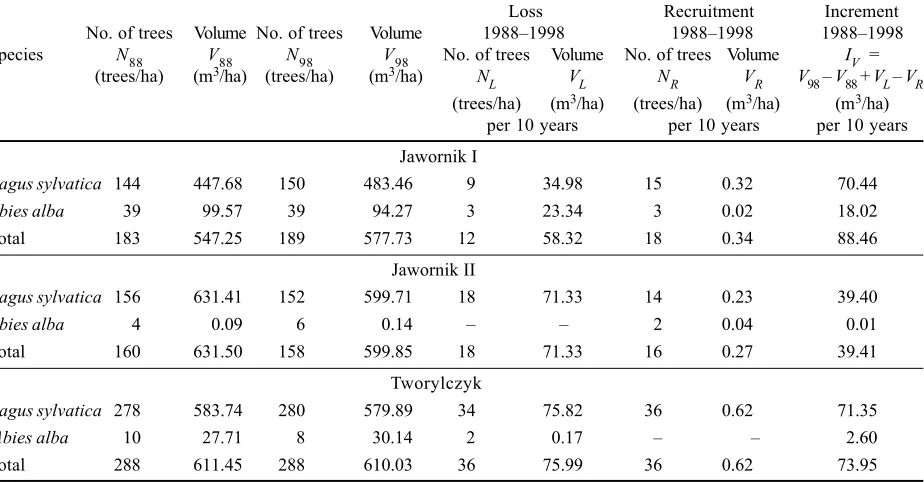
In Jawornik I stand, 12 trees (3 firs and 9 beeches) died during the control period on the area of 1 ha. Their vo-lume amounted to 58.32 m3/ha. The recruitment consisted
of 18 trees/ha (3 firs and 15 beeches) of the total volume 0.34 m3/ha (Table 2). The mean annual loss in numbers in
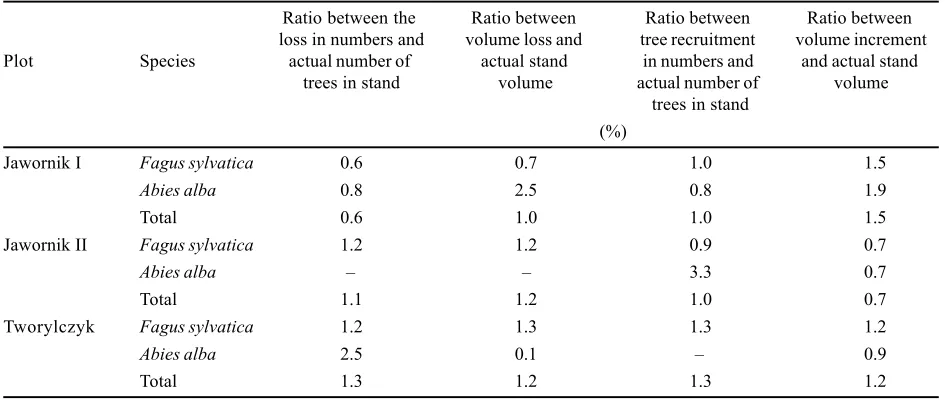
the case of fir was 0.8%, and in the case of beech 0.6% (Table 3). The value of the fir annual loss was 2.5% of the fir volume in 1998, and that of the beech loss 0.7%, and the volume of the total annual loss was 1% of the actual (1998) stand volume (Table 3). The average volume of a single dead fir (7.78 m3) was higher than that of beech
(3.89 m3). The volume increment reached 88.46m3/ha per
10 year (Table 2).
In Jawornik II stand, 18 beech trees of the total volume of 71.33 m3 (Table 2) died during the control period, i.e.
annually 1.2% of all beech trees on average. The average volume of a dead beech was 3.96 m3. The mean annual
loss amounted to 1.2% of the actual stand volume (Tab-le 3). The recruitment consisted of 14 beeches (0.23 m3)
and only 2 firs (0.04 m3) (Table 2). The volume increment
was 39.41 m3/ha per 10 year (Table 2).
In Tworylczyk stand, the loss in tree numbers was equal to the recruitment and amounted to 36 trees/ha (Table 2). The recruitment during a 10-year period consisted of beech only (36 trees and 0.62 m3) while among the dead
trees there were 34 beeches (75.82 m3) and 2 firs (0.17 m3)
(Table 2). The annual loss was 1.3% of the actual number of living firs and beeches together (Table 3). The annual mortality of beech trees amounted to 1.2% of the total number of trees of this species while in the case of fir it was 2.5% (Table 3). The average volume of a single dead beech (2.23 m3) was much higher than that of fir (0.085 m3).
The volume increment was 73.95 m3/haper 10 year
(Tab-le 2).
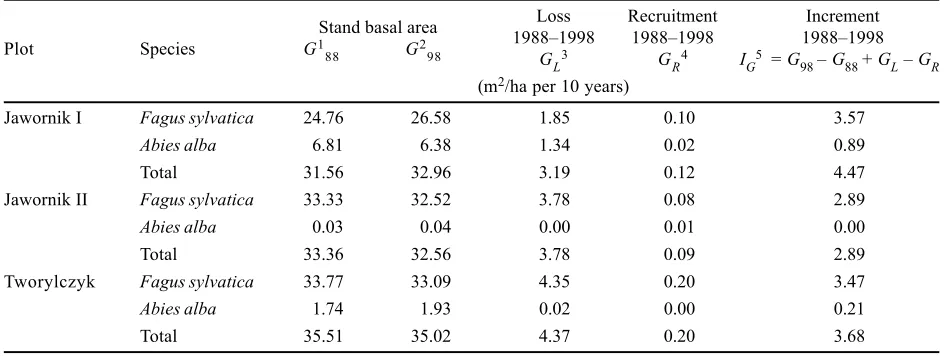
The basal area increment at breast height in three study areas Jawornik I, Jawornik II, and Tworylczyk was 4.47 m2/ha per 10 year, 2.89 m2/ha per 10 year, and
3.68 m2/ha per 10 year, respectively (Table 4).
CHARACTERISTICS OF TREES THAT DIED
Jawornik I
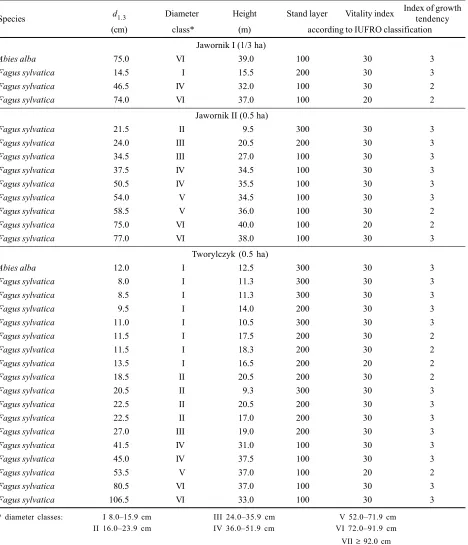
The only dead fir tree came from the upper storey and reached 75 cm in d1.3 (Table5). In 1988 it belonged to
weakened trees, vitality index 30 according to the IUFRO classification, and had a low growth tendency, index 3 (Table 5).
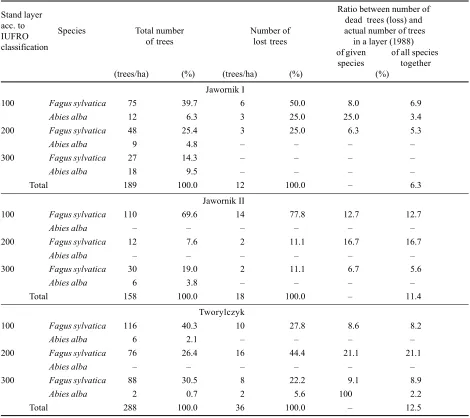
The beeches that died (3 trees on a sample plot 1/3 ha in area) were weakened (index 30) or of normal vitality (20) and of a slow (3) or normal (2) growth rate (Table 5). The largest number of beeches (6 trees/ha) died in the highest layer, making 8% of all beech trees and 6.9% of all trees in this layer. In the middle layer (200) 3 beech trees died per hectare (Table 6). The low stand density in the lower and middle layers, and favorable light conditions due to a sparsely stocked stand, developed as a result of the break-up stage that terminated 1020 years ago, did not cause mortality among beech trees in the lower storey.
Jawornik II
[image:3.595.55.529.555.755.2]Only beech trees (18 trees/ha) (Table 2) died in this stand during the control period, and most of them (77.8%) came from the upper layer (100) (Table 6). In the two re-maining layers only 2 trees/ha died in each of them, i.e. in each layer 11.1% of the total number of dead trees (Table 6). Considering the ratio between the number of dead trees and the total number of trees in a given stand layer, the highest loss in numbers (16.7%) occurred in the middle layer (200), then (12.7%) in the upper layer (100), and the lowest loss (5.6%) occurred in the lower layer (300) (Tab-le 6). The dead beech trees represented all diameter classes
Table 3. Annual loss, recruitment, and increment in relation to actual growing stock
Ratio between the Ratio between Ratio between Ratio between
loss in numbers and volume loss and tree recruitment volume increment
Plot Species actual number of actual stand in numbers and and actual stand
trees in stand volume actual number of volume
trees in stand (%)
Jawornik I Fagus sylvatica 0.6 0.7 1.0 1.5
Abies alba 0.8 2.5 0.8 1.9
Total 0.6 1.0 1.0 1.5
Jawornik II Fagus sylvatica 1.2 1.2 0.9 0.7
Abies alba 3.3 0.7
Total 1.1 1.2 1.0 0.7
Tworylczyk Fagus sylvatica 1.2 1.3 1.3 1.2
Abies alba 2.5 0.1 0.9
with the exception of class one. Weakened beeches with slow growing rate dominated among the dead trees (Tab-le 5).
Tworylczyk
Dying of trees occurred in all stand layers, but it was most severe in the middle layer (44.4% of dead trees, i.e. 21.1% of the total number of trees in this layer) (Table 6). An equal number of trees died in the upper and lower layers (10 trees/ha, i.e. 27.8% in each layer), which amount-ed to 8.2% and 11.1% of the actual number of trees in each layer respectively (Table 6). Most of the dead beech trees (41.2%) belonged to the 815.9 cm diameter class, and nearly 24% to the 1623.9 cm class (Table 5). Before death most of these beeches had weakened vitality (30) and slow growth rate (3) (Table 5).
DISCUSSION
The highest increment (8.8 m3/ha per year, i.e. 1.5% of
the actual stand volume) was reached by Jawornik I stand in the initial period of the growing up stage. The next was Tworylczyk stand (7.4 m3/ha per year, i.e. 1.2% of the actual
stand volume) being in an advanced phase of this stage. Jawornik II stand, being in the optimum stage, the aging phase, had the lowest increment (3.9 m3/ha per year, i.e.
0.7% of the actual stand volume) (Tables 2 and 3). In the primeval forests of Slovakia, composed of fir and beech, the current annual volume increment in the Do-broè reserve ranged from 7.1 to 12.1 m3/ha, and in Badín
4.7 and 8.6 m3 /ha (KORPE¼ 1995). In the Peruèica reserve
in Bosnia (the Sutjeska National Park) this increment was 6.48.8 m3/ha per year (PINTARIÈ 1978). In stands of the
Babia Góra National Park (Poland) it was 3.58.6 m3/ha per
year (JAWORSKI, PALUCH unpublished). In beech
for-ests of Vihorlat (the Kyjov reserve) growing under very favorable site conditions the current volume increment of merchantable timber reached 312 m3/ha per year
(KORPE¼ 1995). Therefore it can be concluded that beech stands investigated in the Bieszczady Mountains reached the increment similar to that of other European primeval forests composed of fir and beech. Only the stands in the Dobroè and Kyjov reservesin Slovakia were better in this respect than the investigated stands.
The data concerning the volume increment in the Biesz-czady Mountains stands investigated, especially of a com-plex structure in the growing up stage (Tworylczyk and Jawornik I) are worth comparing with the current volume increment of beech selection forests in Germany. It is 7.2 m3/ha per year in the forest of Langula (mean for the
period 19741988) (GEROLD, BIEHL 1992), and 4.6 m3/ha
per year in the forest of Keula (LANDBECK 1952). This in-crement is close to that found in the Bieszczady Moun-tains, which, however, is much lower than the increment reached in a long term thinning experiment in Fabrik-schleichen 015 where it was 1214.5 m3/ha per year in the
stand 140160 years old during 19601980 (PRETZCH
1992, 1996). This increment increase need not be connect-ed with faster growth causconnect-ed by thinning because it was also observed in experimental areas where thinning was moderate. A similar tendency of the increasing produc-tivity of sites was observed in most regions of Central Europe where beech occurs (SKOVSGAARD, HENRIKSEN
1996; UNTHEIM 1996).
The trend of increasing growth could be caused by one factor, combination of factors or by regionally changing factors that finally had similar effects on growth. The land use history, forest management, natural disturbances, cli-mate, including nitrogen deposition and increased CO2
[image:4.595.69.541.77.255.2]content in the atmosphere, or other factors are among the Table 4. Loss, recruitment, and increment of stand basal area at breast height during 1988–1998
Stand basal area Loss Recruitment Increment
Plot Species G1
88 G298 19881998G 19881998 19881998
L3 GR4 IG5 = G98 G88 + GL GR
(m2/ha per 10 years)
Jawornik I Fagus sylvatica 24.76 26.58 1.85 0.10 3.57
Abies alba 6.81 6.38 1.34 0.02 0.89
Total 31.56 32.96 3.19 0.12 4.47
Jawornik II Fagus sylvatica 33.33 32.52 3.78 0.08 2.89
Abies alba 0.03 0.04 0.00 0.01 0.00
Total 33.36 32.56 3.78 0.09 2.89
Tworylczyk Fagus sylvatica 33.77 33.09 4.35 0.20 3.47
Abies alba 1.74 1.93 0.02 0.00 0.21
Total 35.51 35.02 4.37 0.20 3.68
G881 stand basal area at the beginning of the period (1988) G982 stand basal area at the end of the period (1998) GL3 basal area of dead trees (loss)
possible causes. The significance of each factor possibly varies in space and time. Growth responses to the influ-encing factor are modified by site and stand conditions (SPIECKER et al. 1996).
To make a comparison between the increment in man-aged forests and that in forests of primeval character is not fully correct because the silvicultural activities of the forest manager generally aim at maximum utilization of the growth potential of trees and stands while in the primeval forests the increment depends on natural changes not
always fulfilling our expectations. These data are quoted to stress the changes in productivity of beech fo-rests in Central Europe that have not been observed in the primeval beech forests of South-Eastern Poland at the present time. This has been indicated by a not very high increment in stands investigated in the Biesz-czady Mountains (3.98.8 m3/ha), generally close to the
[image:5.595.59.527.77.622.2]current volume increment of the primeval stands during the last three decades, the values of which are given above.
Table 5. Characteristics of dead trees (loss) (1988 measurements and classification)
d1.3 Diameter Height Stand layer Vitality index Index of growth
Species tendency
(cm) class* (m) according to IUFRO classification
Jawornik I (1/3 ha)
Abies alba 75.0 VI 39.0 100 30 3
Fagus sylvatica 14.5 I 15.5 200 30 3
Fagus sylvatica 46.5 IV 32.0 100 30 2
Fagus sylvatica 74.0 VI 37.0 100 20 2
Jawornik II (0.5 ha)
Fagus sylvatica 21.5 II 9.5 300 30 3
Fagus sylvatica 24.0 III 20.5 200 30 3
Fagus sylvatica 34.5 III 27.0 100 30 3
Fagus sylvatica 37.5 IV 34.5 100 30 3
Fagus sylvatica 50.5 IV 35.5 100 30 3
Fagus sylvatica 54.0 V 34.5 100 30 3
Fagus sylvatica 58.5 V 36.0 100 30 2
Fagus sylvatica 75.0 VI 40.0 100 20 2
Fagus sylvatica 77.0 VI 38.0 100 30 3
Tworylczyk (0.5 ha)
Abies alba 12.0 I 12.5 300 30 3
Fagus sylvatica 8.0 I 11.3 300 30 3
Fagus sylvatica 8.5 I 11.3 300 30 3
Fagus sylvatica 9.5 I 14.0 200 30 3
Fagus sylvatica 11.0 I 10.5 300 30 3
Fagus sylvatica 11.5 I 17.5 200 30 2
Fagus sylvatica 11.5 I 18.3 200 30 2
Fagus sylvatica 13.5 I 16.5 200 20 2
Fagus sylvatica 18.5 II 20.5 200 30 2
Fagus sylvatica 20.5 II 9.3 300 30 3
Fagus sylvatica 22.5 II 20.5 200 30 3
Fagus sylvatica 22.5 II 17.0 200 30 3
Fagus sylvatica 27.0 III 19.0 200 30 3
Fagus sylvatica 41.5 IV 31.0 100 30 3
Fagus sylvatica 45.0 IV 37.5 100 30 3
Fagus sylvatica 53.5 V 37.0 100 20 2
Fagus sylvatica 80.5 VI 37.0 100 30 3
Fagus sylvatica 106.5 VI 33.0 100 30 3
The loss of trees, being a result of natural mortality, was most severe in Tworylczyk stand representing the ad-vanced growing up stage and the phase of storeyed struc-ture. In this stand 36 trees/ha died during the period of 10 years (Table 2). The loss of trees was twice as low in the stand being in the optimum stage and the initial aging phase (Jawornik II) (Table2). The smallest number of trees (12 trees/ha per 10 year, i.e. 0.6% of the actual number annually) died in Jawornik I stand representing the initial phase of the growing up stage (Tables 2 and 3).
In Jawornik I stand, where the break-up process had been finished 1020 years ago (JAWORSKI et al. 2002), the tree mortality have decreased and presently it takes place in the upper layer, and less frequently in the middle layer (Tables 5 and 6). In the case of large diameter trees (d1.3 above 70 cm) the mortality is a result of reaching the
natural (biological) life end. These specimens are most likely the remnants of the oldest tree generation. Other two trees probably died due to competition or other forms
of harmful effects of surrounding trees. There were no external disease symptoms on these trees.
In Tworylczyk stand, representing the growing up stage and having a storeyed structure, the loss in tree numbers was the highest in the middle layer while in the upper and lower layers it was much lower (Tables 5 and 6).
The process of natural mortality in stands with complex storeyed structure (Jawornik I and Tworylczyk) resem-bles the removal of trees mature for cutting in the selec-tion system. The dead trees in the upper stand layer, above 70 cm in d1.3, correspond to the crop harvesting,
but in the latter case it concerns living trees of weakened vitality and slower growth. The dead trees in the same layer but of smaller diameters, and the dead trees in the middle layer (200) correspond to a known rule of entering with selection cuttings to all stand layers.
The natural selection taking place in these stands seem-ingly plays a role of selection cutting carried out by the forest manager, but mainly in a negative direction (sanita-Table 6. Total number of trees and number of trees lost in individual stand layers
Stand layer Ratio between number of
acc. to dead trees (loss) and
IUFRO Species Total number Number of actual number of trees
classification of trees lost trees of givenin a layer (1988)of all species
species together
(trees/ha) (%) (trees/ha) (%) (%)
Jawornik I
100 Fagus sylvatica 75 39.7 6 50.0 8.0 6.9
Abies alba 12 6.3 3 25.0 25.0 3.4
200 Fagus sylvatica 48 25.4 3 25.0 6.3 5.3
Abies alba 9 4.8
300 Fagus sylvatica 27 14.3
Abies alba 18 9.5
Total 189 100.0 12 100.0 6.3
Jawornik II
100 Fagus sylvatica 110 69.6 14 77.8 12.7 12.7
Abies alba
200 Fagus sylvatica 12 7.6 2 11.1 16.7 16.7
Abies alba
300 Fagus sylvatica 30 19.0 2 11.1 6.7 5.6
Abies alba 6 3.8
Total 158 100.0 18 100.0 11.4
Tworylczyk
100 Fagus sylvatica 116 40.3 10 27.8 8.6 8.2
Abies alba 6 2.1
200 Fagus sylvatica 76 26.4 16 44.4 21.1 21.1
Abies alba
300 Fagus sylvatica 88 30.5 8 22.2 9.1 8.9
Abies alba 2 0.7 2 5.6 100 2.2
[image:6.595.70.540.73.491.2]tion cuttings), although frequently in connection with other aims of selection cutting (LEIBUNDGUT 1966; SCHÜTZ 1997). However, additional studies are required to determine how much the aims of the nature approxi-mate the aims of the man under definite conditions.
The losses in Jawornik II stand also consisted of trees of the older generation from the highest storey (Tables 5 and 6), but the dying of these trees cannot be compared to selection cuttings due to a little differentiated struc-ture. They basically resemble a one-storey structure, single tree cuttings used in the Swiss irregular shelter-wood system where the trees mature for cutting are re-moved.
The per cent of the annual loss in tree numbers and vol-ume: 0.6% and 1% in Jawornik I stand, and 1.1% and 1.2% in Jawornik II, respectively, and the per cent of volume increment in these stands: 1.5% and 0.7%, respectively (Table 3), assure the permanence of the primeval ecosys-tem of the Carpathian beech forest. The extent of the loss and increment, determined in this study, can form the basis for a multifunctional model of the forest managed by the selection or Swiss irregular shelterwood system.
It should be stressed that the permanence of forest en-terprise managed by the selection system can be assured if the difference between the intensity of the increment process and the intensity of the loss (exploitation) is the lowest possible (RÜESCH 1983; SCHÜTZ 2001). Similar as-sumptions were made for stands managed by the Swiss irregular shelterwood system (POZNAÑSKI 1999).
Tworylczyk stand, similarly like Jawornik I stand, indi-cates a possibility of forming the complex storeyed struc-ture in beech forests. It is presently characterized by stability in respect of the loss, increment and volume (Table 2). This stand with complex structure and a high volume for the many-storeyed beech forest shows, how-ever, a tendency to form a two-storeyed structure, which is indicated by a decrease in tree numbers in the middle layer (from 32.6% in 1988 to 26.4% in 1998) (JAWORSKI et al. 2002). The processes taking place do not favor the formation of many-storeyed structure. The formation of the complex storeyed structure requires a lower stand vol-ume in the case of the beech forest. Among other things, it is indicated by data from some beech selection forests, e.g. in Keula with 408 m3/ha (GEROLD, BIEHL 1992), and in
Bleicherode with 548 m3/ha (DITTMAR 1990). But GEROLD
and BIEHL (1992) are of the opinion that the selection structure disappears at the stand volume above500 m3/ha.
In order to maintain a stable selection structure it is necessary to secure the continuity of regeneration, and an adequate number of trees in low diameter classes, and the transfer of these trees into higher classes, which is connected with the optimum stand volume. According to SANIGA (1998) this volume is 280300 m3/ha in Slovak
beech selection forests (the Eastern Carpathians). Citing Schaeffers investigations, SCHÜTZ (1992) is convinced that the maintenance of selection structure in beech fo-rests is possible at the stand volume not higher than 200250 m3/ha. It should be remembered, however, that
the optimum stand volume depends on the site, and the values cited above have only a guiding meaning.
Thus it can be assumed that the cuttings in Tworyl-czyk stand expressed by a natural volume loss are too weak to assure the many-storeyed structure. A higher tree loss in the highest layer would be favorable in this respect. A lower volume of Jawornik I stand (547 m3/ha)
in 1988 (Table 2) is more favorable for the maintenance of storeyed differentiation of the stand. In the managed for-ests where we wish to maintain a selection structure stron-ger cuttings would be more favorable that would permit to reach a stable stand volume of about 400430 m3/ha.
Such volume is reached by the primeval beech forests with selection structure also in the Bieszczady Mountains (JAWORSKI et al. 2000).
CONCLUSIONS
1. In forests of primeval character in the Bieszczady Mountains the tree loss, recruitment, and increment are closely connected with the developmental stages and phases of primeval forest.
2. For practical forestry the knowledge of the loss, re-cruitment and increment in forests of primeval charac-ter, expressed by the number of trees and volume units, can be a helpful tool in computation of the amount of cut securing the stability of a tree layer ecosystem in managed forests of similar site and stand conditions and managed by the selection or Swiss irregular shel-terwood systems.
3. In spite of the fact that the primeval forests cannot be an uncritical model for forest management since not every stand (its developmental stage or phase) fulfils the postulate of a multifunctional forest, the stable fo-rest ecosystems can serve as a model of the silvicultu-ral procedure followed in the Carpathian managed beech forests of similar development and structure. However, further studies are necessary in this respect using a more ample study material.
R e f e r e n c e s
BRUCHWALD A., 1995. Dendrometria. Warszawa, SGGW: 261. DITTMAR O., 1990. Untersuchungen im Buchen
Plenter-wald Keula. Forst u. Holz, 45: 419423.
DZIEWOLSKI J., RUTKOWSKI B., 1987. Ubytek, dorost
i przyrost w rezerwacie lenym pod Trzema Koronami w Pieninach. Sylwan, 131, 7: 2533.
DZIEWOLSKI J., RUTKOWSKI B., 1991. Tree mortality, recruitment and increment during the period 19691986 in a reserve at Turbacz in the Gorce Mountains. Fol. For. Pol., Ser. A, 31: 3748.
GEROLD D., BIEHL R., 1992. Vergleich zwischen Buchen-plenterwald und Buchenbetriebsklasse. Allg. Forstz., 47, 2: 9194.
JAWORSKI A., 1997. Karpackie lasy o charakterze pierwot-nym i ich znaczenie w kszta³towaniu proekologicznego mo-delu gospodarki lenej w górach. Sylwan, 141, 4: 3349. JAWORSKI A., KO£ODZIEJ ZB., PORADA K., 2002.
Struc-ture and dynamics of stands of a primeval character in select-ed sample plots of the Bieszczady National Park.J. For. Sci.,
48 (in print).
JAWORSKI A., KO£ODZIEJ ZB., OPYD ZB., 2000. Bukowe lasy o charakterze pierwotnym jako model lasów przerêbo-wych. Acta Agr. Silv., Ser. Silv., 38: 331.
JAWORSKI A., PALUCH J. Factors affecting the basal area increment of the primeval forests in the Babia Gora National Park. (Unpublished data.)
JAWORSKI A., SKRZYSZEWSKI J., WI¥TKOWSKI W.,
KARCZMARSKI J.,1991. Budowa i struktura
dolnoreglo-wych drzewostanów o charakterze pierwotnym na wy-branych powierzchniach w Bieszczadach Zachodnich. Zesz. Nauk. AR w Krakowie, 254, Lenictwo, 20: 1743. KORF V., HUBAÈ K., MELKO ., WOLF J., 1972.
Den-drometrie. Praha, SZN: 376.
KORPEL ., 1982.Degree of equilibrium and dynamical chan-ges of the forest on example of natural forests of Slovakia. Acta Fac. For. Zvolen., 24: 931.
KORPEL ., 1995. Die Urwälder der Westkarpaten. Stuttgart, G. Fischer: 310.
KORSUÒ F., 1938. Taxaèní prùzkum reservace Stuica, Javorník a Pop Ivan. Sborník VÚZ ÈSR, 152, 7: 245372, 438448. LANDBECK H., 1952. Über die Plenterwälder im
Nordthürin-gen. Der Wald, 2: 244247, 279282.
LEIBUNDGUT H., 1966. Die Waldpflege. Bern, P. Haupt: 192.
LEIBUNDGUT H., 1982. Europäische Urwälder der Bergstufe. Bern, P. Haupt: 308.
MAUVE K.,1931. Über Bestandesaufbau, Zuwachsverhält-nisse und Verjüngung im galizischen Karpathen-Urwald. Mitt. Forstwirtsch. u. Forstwiss., 2: 257311.
PINTARI K., 1978. Urwald Peruèica als natürliches For-schungslaboratorium. Allg. Forstz., 33, 24: 702707.
POZNAÑSKI R., 1999. Nowa metoda programowania rozwo-ju zasobów lenych w przerêbowo-zrêbowym sposobie za-gospodarowania z rêbni¹ stopniow¹. Sylwan, 143, 5: 1325. PRETZSCH H., 1992. Zunehmende Unstimmigkeit zwischen erwartetem und wirklichem Wachstum unserer Waldbestände. Forstw. Cbl., 111: 366382.
PRETZSCH H., 1996. Growth trends of forests in Southern Germany. In: SPIECKER H., MIELIKÄINEN K., KÖHL M., SKOVSGAARD J. (eds.), Growth trends in European forests. European Forest Institute Research Report 5: 107 131.
RÜESCH W., 1983. Hiebsatzweiser in der Praxis. Schweiz. Z. Forstwes., 134, 2: 109129.
SANIGA M., 1998. truktúra a regeneraèné procesy bukového výberkového lesa. Lesnictví, 44: 241249.
SCHÜTZ J. PH., 1992. Die Waldbauliche Formen und die Gren-zen der Plenterung mit Laubbaumarten. Schweiz. Z. Forstwes., 143, 6: 442460.
SCHÜTZ J. PH., 1997. Sylviculture 2. Lausanne, Presses Poly-techniques et Universitaires Romandes: 178.
SCHÜTZ J. PH., 2001. Der Plenterwald. Berlin, Parey Buch-verlag: 207.
SKOVSGAARD J.P., HENRIKSEN H.A., 1996. Increasing site productivity during consecutive generations of naturally re-generated and planted beech (Fagus sylvatica L.) in Den-mark. In: SPIECKER H., MIELIKÄINEN K., KÖHL M., SKOVSGAARD J. (eds.), Growth trends in European for-ests. European Forest Institute Research Report 5: 8997. SPIECKER H., MIELIKÄINEN K., KÖHL M.,
SKOVSGAARD J., 1996. Conclusions and summary. In: SPIECKER H., MIELIKÄINEN K., KÖHL M., SKOVS-GAARD J. (eds.), Growth trends in European forests. Euro-pean Forest Institute Research Report 5: 369372. UNTHEIM J., 1996. Has site productivity changed? A case
study in the Eastern Swabian Alb, Germany. In: SPIECKER H., MIELIKÄINEN K., KÖHL M., SKOVSGAARD J. (eds.), Growth trends in European forests. European Forest Institute Research Report 5: 133147.
Received 14 February 2002
Pøirozený úbytek stromù, dorùstání a pøírùst v pùvodních porostech vybraných partií
Národního parku Bieszczady v jihovýchodním Polsku
A. JAVORSKI, ZB. KO£ODZIEJ
Zemìdìlská univerzita, Lesnická fakulta, Krakov, Polsko
ABSTRAKT: Cílem studie je zjitìní poznatkù o úbytku stromù, resp. døeva, dorùstání (doplnìní) a pøírùstu pùvodních bukových porostù. Toto etøení je zaloeno na mìøeních provedených na tøech trvalých zkusných plochách v letech 1988 a 1998. Ze tøí sledovaných porostù bylo nejvyího pøírùstu dosaeno u porostù Jawornik I v èasném stadiu dorùstání (8,8 m3/ha za rok, tj. 1,5 % stávající porostní zásoby, mìøené na konci kontrolního období) a Tworylczyk v pokroèilém
Corresponding author:
MSc. ZBIGNIEW KO£ODZIEJ, Agricultural University, Faculty of Forestry, Department of Silviculture, Al. 29 Listopada 46, 31 425 Cracow, Poland
tel.: + 48 12 411 91 44, fax: + 48 12 411 97 15, e-mail: [email protected]
optima, vykazoval nejnií pøírùst (3,9 m3/ha za rok, tj. 0,7 % stávající porostní zásoby). Pøirozené objemové ztráty byly
nejvìtí v porostu Tworylczyk (7,6 m3/ha za rok) a o nìco mení na lokalitì Jawornik II (7,1 m3/ha za rok) a nejmení
v porostu Jawornik I (5,8 m3/ha za rok). Studie umoòuje formulovat následující závìry: V lesích pùvodního charakteru
v NP Bieszczady jsou úbytek stromù, dorùstání a pøírùst blízce spojeny s dynamikou rùstových a vývojových stadií a fází pùvodního lesa. Pro lesnickou praxi jsou poznatky o úbytku, dorùstání a pøírùstu pùvodních lesù vyjádøeny poèty stromù a jednotkami objemu (porostní zásoby); mohou být uiteèným nástrojem pøi výpoètu rozsahu tìebního zabezpeèení a stability ekosystému v obhospodaøovaných lesích podobných stanovitních a porostních pomìrù zejména jde o lesy obhospodaøované jednotlivým èi skupinovitým výbìrem nebo zpùsoby. Navzdory faktu, e pùvodní les nemùe obecnì plnit roli modelu lesnického hospodaøení, protoe ne kadý porost (vývojové stadium nebo fáze) splòuje poadavek více-úèelového lesa, stabilní lesní ekosystémy vak mohou slouit jako model pìstebních opatøení v hospodáøských lesích v po-dobných podmínkách prostøedí.